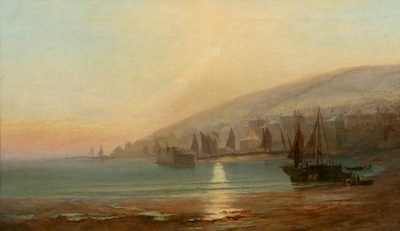
(Henry Martin, ‘A December Morning in Mount’s Bay’: Penlee House Gallery and Museum)
December. Originally, as the name hints, the tenth month of the year. Blackburn and Holford-Strevens quote Richard Saunders’ 1697 Apollo Anglicanus, The English Apollo: ‘In December Melancholy and Phlegm much increase, which are heavy, dull, and cold, and therefore it behoves all that will consider their healths, to keep their heads and bodies very well from cold, and to eat such things as be of a hot quality.’[1] Not a lot to argue with there. Today at least is cold, clear and dry, so proper winter weather.
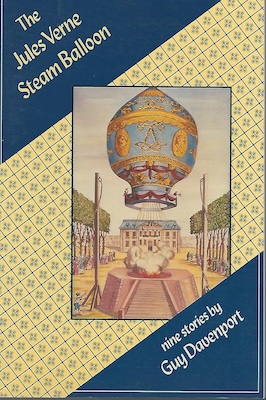
‘North Point has just accepted The Jules Verne Steam Balloon, for next fall’, Guy Davenport wrote to the poet and New Directions publisher James Laughlin on 1 December 1986. ‘Nine stories, dedicated to Humph’s memory, nine being a cat number.’[2] And the book does indeed carry a dedication to Davenport’s recently deceased cat, ‘For my friend Humphry 1971-1986’.
Curiously, on the same date as Davenport’s letter, the first ever ascent in a hydrogen balloon was recorded. This was ten days after the first manned Montgolfier balloon flight, launched from the hill of La Muette on 21 November 1783. It was 70 feet high, and powered by a six-foot open brazier, burning straw. The intrepid voyagers were Pilâtre de Rozier and the Marquis d’Arlandes, a major in the Garde Royale. The later ascent was made by Dr Alexander Charles, who had, in effect, invented ‘nearly all the features of the modern gas balloon in a single brilliant design.’ Launched from Tuileries Gardens on 1 December 1783, with Charles’ scientific assistant M. Robert, it attracted ‘what has been estimated as the biggest crown in pre-Revolutionary Paris, upwards of 400,000 people, about half the total population of the city.’[3]
Two hours later, the balloonists landed some 27 miles away and Charles asked Robert to step out of the basket. Then he reached 10,000 feet in ten minutes, observing his instruments and making notes until his hand became too cold to grasp the pen. ‘I was the first man ever to see the sun set twice in the same day. The cold was intense and dry, but supportable. I had acute pain in my right ear and jaw. But I examined all my sensations calmly. I could hear myself living, so to speak.’ Then he gently released the gas-valve and, within 35 minutes, was back on the ground, three miles from the first landing-point: an almost vertical ascent. It was the first solo flight in history. He wrote that: ‘Never has a man felt so solitary, so sublime,—and so utterly terrified.’ Charles never flew again.[4]
From that to. . . this. I was reminded of a passage in Thomas Medwin’s record of talking with Lord Byron at Pisa in 1822: ‘I suppose we shall soon travel by air-vessels; make air instead of sea voyages; and at length find our way to the moon . . . Where shall we set bounds to the power of steam? Who shall say “Thus far shalt thou go, and no farther?” We are at present in the infancy of science.’[5]
In fact, his daughter Ada was then an infant scientist, just six years old: later Countess Lovelace, she was a mathematician and pioneer computer scientist, associated particularly with Charles Babbage and his Analytical Engine. Ada would, like her father, die in her 37th year—and was buried beside him.

(Hogarth, ‘A Rake’s Progress: 1–The Rake Taking Possession of the Estate’: Sir John Soane’s Museum)
I’ve lately been reading Jenny Uglow’s wonderful Hogarth biography and in his 37th year, Hogarth began 1734 with prints of The Fair (later called Southwark Fair) ready for sale though those of The Rake’s Progress had been delayed. One detail that—inevitably—caught my eye was the reference to the story told by John Nichols, in his Biographical Anecdotes of William Hogarth.[6] He wrote there that Hogarth ‘boasted that he could draw a Serjeant with his pike, going into an alehouse, and his Dog following him, with only three strokes;—which he executed thus:

A. The perspective line of the door.
B. The end of the Serjeant’s pike, who is gone in.
C. The end of the Dog’s tail, who is following him.
There are similar whims of the Caracci.’[7]
In 1914, Ford Madox Ford published ‘On Impressionism’, an essay in two parts, in Harold Monro’s Poetry and Drama (June and December issues). ‘Let us approach this matter historically’, Ford begins the second section of his first article, ‘—as far as I know anything about the history of Impressionism, though I must warn you that I am a shockingly ill-read man. Here, then, are some examples: do you know, for instance, Hogarth’s drawing of the watchman with the pike over his shoulder and the dog at his heels going in at a door, the whole being executed in four lines? Here it is:
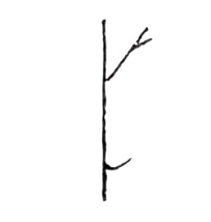
Now, that is the high-watermark of Impressionism; since, if you look at those lines for long enough, you will begin to see the watchman with his slouch hat, the handle of the pike coming well down into the cobble-stones, the knee-breeches, the leathern garters strapped round his stocking, and the surly expression of the dog, which is bull-hound with a touch of mastiff in it.’
Apart from the reversing of the image, the three strokes have become four. ‘The Impressionist must always exaggerate.’[8] Though a good many of the pikes I’ve seen pictured have one or more short curved blades at the top. . .
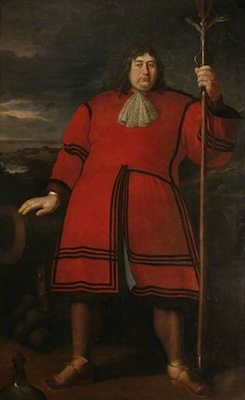
(Godfrey Kneller, Anthony Payne (c.1612-1691), the Cornish Giant: Cornish Museum and Art Gallery)
Hogarth has always had his admirers, and often been viewed chiefly as a satirist, like Swift or Pope, an acerbic commentator on the age’s hypocrisy, excesses and corruption. One of those admirers is the extraordinary painter, writer and central figure of Vorticism—‘Vorticism, in fact, was what I, personally, did, and said, at a certain period’—Wyndham Lewis and, interestingly, the single work of Hogarth’s he refers to several times is The Shrimp Girl, a superbly captured street-seller, ‘a moment caught on the wing’, Hogarth succeeding in conveying ‘all the movement in the girl’s body as he loaded his brush with pinks, vermilions and green—the bright colours of the rococo palette—and made fast curving strokes to outline the fall of her shoulders and breasts’.
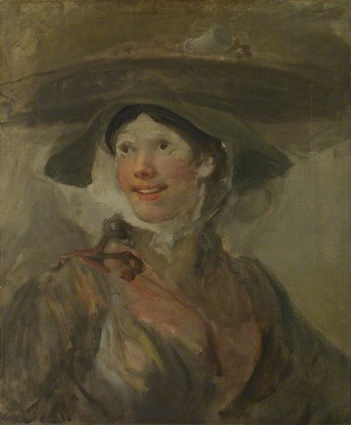
(William Hogarth, Shrimp Girl: National Gallery)
After his death, Hogarth’s widow Jane ‘would tell visitors who saw The Market Wench, as it was known, “They say he could not paint flesh. There’s flesh and blood for you; – them!”’[9] In a characteristically combative statement late in life, Lewis cited that picture again: ‘Hogarth’s Shrimp Girl shows what splendid painting can be done in England. But since that eighteenth-century explosion there have been only the Pre-Raphaelites, and so it must be admitted that painting is not our forte.’
Lewis’s blindness had ended his five years as art critic of The Listener—see his remarkable final piece there, ‘The Sea-Mists of the Winter’—and there is a poignant closing paragraph to this essay too:
‘The question is not how a thing is done, but the thing that is done. However, unless the thing is beautifully painted, it never comes to life. I have never seen the original of the Shrimp-Girl, but several colour plates of it. I am blind, but, if I could see, I would do a large design of something like a Jabberwock outraging an eagle.’[10]
Notes
[1] Bonnie Blackburn and Leofranc Holford-Strevens, The Oxford Companion to the Year (Oxford: Oxford University Press, 1999), 481.
[2] W. C. Bamberger, editor, Guy Davenport and James Laughlin: Selected Letters (New York: W. W. Norton & Co., 2007), 36.
[3] Julian Barnes, Levels of Life (London: Cape, 2013), 12; Richard Holmes. The Age of Wonder: How the Romantic Generation Discovered the Beauty and Terror of Science (London: Harper Collins, 2008), 129-131; L. T. C. Rolt, The Aeronauts (London: Longman, 1966), 50.
[4] Holmes, The Age of Wonder, 132.
[5] Thomas Medwin, Conversations with Byron, (1824), quoted by Fiona MacCarthy, Byron: Life and Legend (London: John Murray, 2002), 70.
[6] Hogarth: A Life and a World (London: Faber and Faber, 1997), 55.
[7] See Biographical Anecdotes of William Hogarth, Third edition (London: Printed by and Ford John Nichols in Red-Lion-Passage, Fleet-Street, 1785), 63.
[8] Ford Madox Ford, ‘On Impressionism I’, Poetry and Drama (June 1914), 169-170.
[9] Uglow, Hogarth, 408, 409.
[10] Wyndham Lewis, ‘The Vorticists’, Vogue (September 1956), in Wyndham Lewis On Art: Collected Writings 1913-1956, edited by Walter Michel and C. J. Fox (London: Thames & Hudson, 1969), 457, 458; the earlier quotation is from the introduction to the catalogue of the 1956 retrospective exhibition, Tate Gallery, July-August 1956 in this same volume, 451. For other references to this picture, see 327, 329, 404.
 Reconstructionary Tales