Pikes, balloons and a touch of mastiff

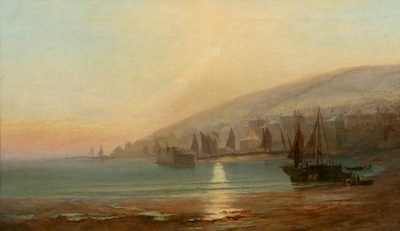
(Henry Martin, ‘A December Morning in Mount’s Bay’: Penlee House Gallery and Museum)

December. Originally, as the name hints, the tenth month of the year. Blackburn and Holford-Strevens quote Richard Saunders’ 1697 Apollo Anglicanus, The English Apollo: ‘In December Melancholy and Phlegm much increase, which are heavy, dull, and cold, and therefore it behoves all that will consider their healths, to keep their heads and bodies very well from cold, and to eat such things as be of a hot quality.’[1] Not a lot to argue with there. Today at least is cold, clear and dry, so proper winter weather.

‘North Point has just accepted The Jules Verne Steam Balloon, for next fall’, Guy Davenport wrote to the poet and New Directions publisher James Laughlin on 1 December 1986. ‘Nine stories, dedicated to Humph’s memory, nine being a cat number.’[2] And the book does indeed carry a dedication to Davenport’s recently deceased cat, ‘For my friend Humphry 1971-1986’.
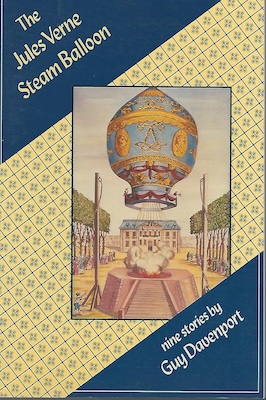
Curiously, on the same date as Davenport’s letter, the first ever ascent in a hydrogen balloon was recorded. This was ten days after the first manned Montgolfier balloon flight, launched from the hill of La Muette on 21 November 1783. It was 70 feet high, and powered by a six-foot open brazier, burning straw. The intrepid voyagers were Pilâtre de Rozier and the Marquis d’Arlandes, a major in the Garde Royale. The later ascent was made by Dr Alexander Charles, who had, in effect, invented ‘nearly all the features of the modern gas balloon in a single brilliant design.’ Launched from Tuileries Gardens on 1 December 1783, with Charles’ scientific assistant M. Robert, it attracted ‘what has been estimated as the biggest crown in pre-Revolutionary Paris, upwards of 400,000 people, about half the total population of the city.’[3]

Two hours later, the balloonists landed some 27 miles away and Charles asked Robert to step out of the basket. Then he reached 10,000 feet in ten minutes, observing his instruments and making notes until his hand became too cold to grasp the pen. ‘I was the first man ever to see the sun set twice in the same day. The cold was intense and dry, but supportable. I had acute pain in my right ear and jaw. But I examined all my sensations calmly. I could hear myself living, so to speak.’ Then he gently released the gas-valve and, within 35 minutes, was back on the ground, three miles from the first landing-point: an almost vertical ascent. It was the first solo flight in history. He wrote that: ‘Never has a man felt so solitary, so sublime,—and so utterly terrified.’ Charles never flew again.[4]

From that to. . . this. I was reminded of a passage in Thomas Medwin’s record of talking with Lord Byron at Pisa in 1822: ‘I suppose we shall soon travel by air-vessels; make air instead of sea voyages; and at length find our way to the moon . . . Where shall we set bounds to the power of steam? Who shall say “Thus far shalt thou go, and no farther?” We are at present in the infancy of science.’[5]

In fact, his daughter Ada was then an infant scientist, just six years old: later  Countess Lovelace, she was a mathematician and pioneer computer scientist, associated particularly with Charles Babbage and his Analytical Engine. Ada would, like her father, die in her 37th year—and was buried beside him.

(Hogarth, ‘A Rake’s Progress: 1–The Rake Taking Possession of the Estate’: Sir John Soane’s Museum)

I’ve lately been reading Jenny Uglow’s wonderful Hogarth biography and in his 37th year, Hogarth began 1734 with prints of The Fair (later called Southwark Fair) ready for sale though those of The Rake’s Progress had been delayed. One detail that—inevitably—caught my eye was the reference to the story told by John Nichols, in his Biographical Anecdotes of William Hogarth.[6] He wrote there that Hogarth ‘boasted that he could draw a Serjeant with his pike, going into an alehouse, and his Dog following him, with only three strokes;—which he executed thus:

A. The perspective line of the door.
B. The end of the Serjeant’s pike, who is gone in.
C. The end of the Dog’s tail, who is following him.
There are similar whims of the Caracci.’[7]

In 1914, Ford Madox Ford published ‘On Impressionism’, an essay in two parts, in Harold Monro’s Poetry and Drama, June and December issues). ‘Let us approach this matter historically’, Ford begins the second section of his first article, ‘—as far as I know anything about the history of Impressionism, though I must warn you that I am a shockingly ill-read man. Here, then, are some examples: do you know, for instance, Hogarth’s drawing of the watchman with the pike over his shoulder and the dog at his heels going in at a door, the whole being executed in four lines? Here it is:
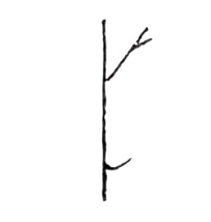
Now, that is the high-watermark of Impressionism; since, if you look at those lines for long enough, you will begin to see the watchman with his slouch hat, the handle of the pike coming well down into the cobble-stones, the knee-breeches, the leathern garters strapped round his stocking, and the surly expression of the dog, which is bull-hound with a touch of mastiff in it.’

Apart from the reversing of the image, the three strokes have become four. ‘The Impressionist must always exaggerate.’[8] Though a good many of the pikes I’ve seen pictured have one or more short curved blades at the top. . .
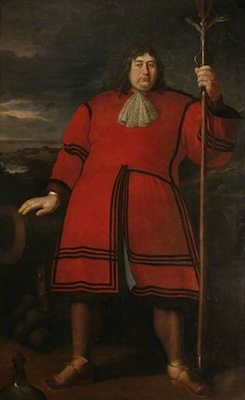
(Godfrey Kneller, Anthony Payne (c.1612-1691), the Cornish Giant: Cornish Museum and Art Gallery)

Hogarth has always had his admirers, and often been viewed chiefly as a satirist, like Swift or Pope, an acerbic commentator on the age’s hypocrisy, excesses and corruption. One of those admirers is the extraordinary painter, writer and central figure of Vorticism—‘Vorticism, in fact, was what I, personally, did, and said, at a certain period’—Wyndham Lewis and, interestingly, the single work of Hogarth’s he refers to several times is The Shrimp Girl, a superbly captured street-seller, ‘a moment caught on the wing’, Hogarth succeeding in conveying ‘all the movement in the girl’s body as he loaded his brush with pinks, vermilions and green—the bright colours of the rococo palette—and made fast curving strokes to outline the fall of her shoulders and breasts’.
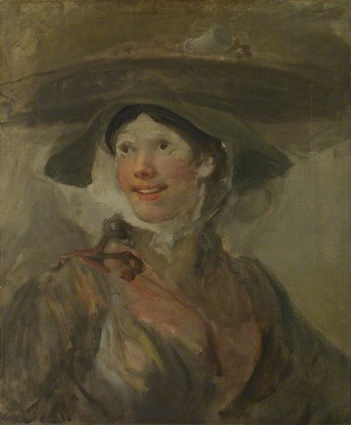
(William Hogarth, Shrimp Girl: National Gallery)

After his death, Hogarth’s widow Jane ‘would tell visitors who saw The Market Wench, as it was known, “They say he could not paint flesh. There’s flesh and blood for you; – them!”’[9] In a characteristically combative statement late in life, Lewis cited that picture again: ‘Hogarth’s Shrimp Girl shows what splendid painting can be done in England. But since that eighteenth-century explosion there have been only the Pre-Raphaelites, and so it must be admitted that painting is not our forte.’

Lewis’s blindness had ended his five years as art critic of The Listener—see his remarkable final piece there, ‘The Sea-Mists of the Winter’—and there is a poignant closing paragraph to this essay too:

‘The question is not how a thing is done, but the thing that is done. However, unless the thing is beautifully painted, it never comes to life. I have never seen the original of the Shrimp-Girl, but several colour plates of it. I am blind, but, if I could see, I would do a large design of something like a Jabberwock outraging an eagle.’[10]


Notes

[1] Bonnie Blackburn and Leofranc Holford-Strevens, The Oxford Companion to the Year (Oxford: Oxford University Press, 1999), 481.

[2] W. C. Bamberger, editor, Guy Davenport and James Laughlin: Selected Letters (New York: W. W. Norton & Co., 2007), 36.

[3] Julian Barnes, Levels of Life (London: Cape, 2013), 12; Richard Holmes. The Age of Wonder: How the Romantic Generation Discovered the Beauty and Terror of Science  (London: Harper Collins, 2008), 129-131; L. T. C. Rolt, The Aeronauts (London: Longman, 1966), 50.

[4] Holmes, The Age of Wonder, 132.

[5] Thomas Medwin, Conversations with Byron, (1824), quoted by Fiona MacCarthy, Byron: Life and Legend (London: John Murray, 2002), 70.

[6] Hogarth: A Life and a World (London: Faber and Faber, 1997), 55.

[7] See Biographical Anecdotes of William Hogarth, Third edition (London: Printed by and Ford John Nichols in Red-Lion-Passage, Fleet-Street, 1785), 63.

[8] Ford Madox Ford, ‘On Impressionism I’, Poetry and Drama (June 1914), 169-170.

[9] Uglow, Hogarth, 408, 409.

[10] Wyndham Lewis, ‘The Vorticists’, Vogue (September 1956), in Wyndham Lewis On Art: Collected Writings 1913-1956, edited by Walter Michel and C. J. Fox (London: Thames & Hudson, 1969), 457, 458; the earlier quotation is from the introduction to the catalogue of the 1956 retrospective exhibition, Tate Gallery, July-August 1956 in this same volume, 451. For other references to this picture, see 327, 329, 404.

Fetch a flitch of bacon


(John Frederick Herring II, ‘Farmyard with Saddlebacks’: Haworth Art Gallery)

The year has turned but, unfortunately, the direction of human travel has not, bringing to mind the old ballad:

It was mirk, mirk night, there was nae starlight,
They waded thro’ red blude to the knee;
For a’ the blude that’s shed on the earth
Rins through the springs of that countrie.[1]

We have long passed ‘that blessed season’, which Saki so liked, ‘between the harshness of winter and the insincerities of summer’.[2] I read hungrily, if not always strictly relevantly to the projects currently in train.

‘Every time I consider autobiography’, Guy Davenport wrote to the author and publisher W. C. Bamberger in June 2000, ‘my mind instantly runs to senseless (but satisfying) recrimination.’ He went on to detail the losses – due to carelessness or dishonesty – of valued letters, priceless association copies of books, drawings made to accompany essays or stories, which were jettisoned by editor or publisher once the material had been printed. ‘One of them was a Greek mask I’d worked on for a week, pen and ink, perhaps the finest drawing I’ve ever done.’ He added: ‘And there’s the art book with color plates that a fellow grad student at Harvard borrowed and kept his place with a slice of bacon,’ before concluding: ‘L’enfer, c’est les autres.’[3]


(Portrait of Lady Charlotte Harley as Ianthe: drawn by Richard Westall, engraved by W. Finden)

Bacon, you say. . . . Francis and Roger and Francis, and how many more? There was Lady Charlotte, wife of Colonel Anthony Bacon of the Lancers and daughter of the Earl of Oxford. Bacon was involved in the War of the Brothers, 1832-1834 (Pedro and Miguel) in Portugal, in the cause of Dom Pedro. Charlotte was the ‘Ianthe’ to whom, at the age of ten, Byron wrote his introductory stanzas at the beginning of Childe Harold.[4]

Such is thy name with this my verse entwined;
And long as kinder eyes a look shall cast
On Harold’s page, Ianthe’s here enshrined
Shall thus be first beheld, forgotten last[5]

There was Sir Nicholas Bacon, Keeper of the Great Seal to Queen Elizabeth I, who built a fine house mentioned by Ronald Blythe in his discussion of Stiffkey, a Norfolk village more famous since for the rector, Harold Davidson, who was defrocked after being charged with immorality – and died as a result of being mauled by a lion.[6] Francis – not the painter – supplies two epigraphs to Dorothy Sayers in her 1935 novel, Gaudy Night.[7] More entertainingly on the bacon front, Peter Vansittart writes that, until the Hundred Years’ War, the patron saint of England was Edward the Confessor. ‘Then Edward III, in debt to Genoese bankers, replaced him with their patron, the more aggressive St George, who was not to escape the attention of the supreme English ironist, Gibbon: he dismissed George as a dishonest bacon contractor, loathed by Christian and pagan alike.’[8]

Anyone fretfully wondering how long it will take Ford Madox Ford to rock up can now put their mind at rest. In Ancient Lights, Ford segued from a memory of Dante Gabriel Rossetti’s limericks to an anecdote about ‘another poet, a descendant of many Pre-Raphaelites, of whom it was related that whilst reading his friend’s valuable books at that friend’s breakfast table he was in the habit of marking his place with a slice of bacon.’ He added that he knew this anecdote to be untrue.[9] How might he be so sure? Slip forward twenty years and Ford is remembering his doctor, Tebb, with whom Ford stayed for a while when the good doctor was treating him in the late stages of a breakdown. He writes of Tebb inventing ‘one of the most ingenious lies’ about his guest: that Ford marked his place in Tebb’s ‘priceless first editions and incredibly sumptuous large paper copies with a slice of bacon.’[10]

Reading the recently published collection of shorter pieces by Hilary Mantel—and reminding myself of just how funny she can be—I come across an article, written for Vogue, on perfumes. Mantel remarks: ‘What women have always wanted to know is what scent drives men wild; researchers have the answer, say Turin and Sanchez [co-authors of the book Perfumes: The Guide], and it’s bacon.’[11] It’s just possible that this news may not have brought unalloyed delight to those inquiring women.

Bacon features largely in Ford’s letters around the end of the First World War, given the twin factors of meat rationing (introduced in 1918) and Ford’s own pig-breeding ambitions. ‘I got as far as the above’, he wrote to Stella Bowen in a letter that stretched over two days (28-29 April 1919), ‘when sleep overtook me—or rather sleepiness, for, when I went to bed I cd not get to sleep. I fancy an unmixed diet of bacon is telling on my liver.’[12]


William Cobbett – farmer, MP, soldier, traveller, radical journalist, printer, avid dispenser of practical advice to the common people (‘The Poor Man’s Friend’) – who took a positive view of pigs, wrote in his Cottage Economy:

A couple of flitches of bacon are worth fifty thousand Methodist sermons and religious tracts. The sight of them upon the rack tends more to keep a man from poaching and stealing than whole volumes of penal statutes, though assisted by the terrors of the hulks and the gibbet.[13]

It was also a matter of personal preference. On one of his famous rural rides, he arrived at Ashurst ‘(which is the first parish in Kent on quitting Sussex)’, where, ‘for want of bacon’, he was ‘compelled to put up with bread and cheese for myself. I waited in vain for the rain to cease or to slacken, and the want of bacon made me fear as to a bed.’[14] So he rode on through the night and the driving rain. Better drenched than baconless.

No mention of pork or bacon, unsurprisingly, in our Syrian and Palestinian cookbooks, nor, surely, in Claudia Roden’s The Book of Jewish Food? But yes, there is an entry in her index, which turns out to be connected with her visit to El Molino in Granada, a centre for research into the history of Spanish food. She was told that some Marranos, forced by the Inquisition to convert to Christianity, ‘made a point of cooking pork to protect themselves from charges by the Inquisition of continuing to practise their old religion.’[15]

The Librarian and I were recently comparing our inability to remember jokes. Some people have a repertoire of hundreds, others recall not a single one. The Librarian offers only one: it concerns the Pink Panther and she first heard it decades ago. I cudgel my brains and offer a knock knock joke dredged from some long unvisited cerebral recess:

Knock knock! (Who’s there?) Egbert! (Egbert who?) Egbert not bacon!

A brief, pitying smile. She murmurs, with visible effort, ‘That’s quite funny.’

It’s the way I tell them.


Notes

[1] ‘Thomas the Rhymer’, in The Oxford Book of Ballads, edited by Arthur Quiller-Couch (Oxford: Oxford University Press, 1910, reprinted 1932), 3.

[2] ‘The Romancers’, The Short Stories of Saki (London: The Bodley Head, 1930), 311.

[3] Guy Davenport, I Remember This Detail: 40 Letters to Bamberger Books, edited by W. C. Bamberger (Whitmore Lake, Michigan: Bamberger Books, 2022), 79-80. The French sentence is Jean Paul Sartre’s famous line from his play Huis Clos (No Exit).

[4] Rose Macaulay, They Went to Portugal (1946; London, Penguin Books, 1985), 307.

[5] Lord Byron, Selected Poems, edited by Susan J. Wolfson and Peter J. Manning (London: Penguin Books, 1996), 60.

[6] Ronald Blythe, The Age of Illusion: England in the Twenties and Thirties 1919-40 (Harmondsworth: Penguin, 1964), 156.

[7] Dorothy Sayers, Gaudy Night (1935; London: Hodder and Stoughton, 2016), Chapters 3 and 17.

[8] Peter Vansittart, In Memory of England: A Novelist’s View of History (London: John Murray, 1998), 42.

[9] Ford Madox Ford, Ancient Lights and Certain New Reflections (London: Chapman and Hall, 1911), 44, 45.

[10] Ford Madox Ford, Return to Yesterday: Reminiscences 1894-1914 (London: Victor Gollancz, 1931), 305.

[11] Hilary Mantel, ‘At First Sniff’ (2009), in A Memoir of My Former Self: A Life in Writing, edited by Nicholas Pearson (London: John Murray 2023), 332. I also learn from this that Burger King, yes, released a meat-infused scent called ‘Flame Grilled’.

[12] Correspondence of Ford Madox Ford and Stella Bowen, edited by Sondra J. Stang and Karen Cochran (Bloomington & Indianapolis: Indiana University Press, 1994), 109-110.

[13] William Cobbett, Cottage Economy (1823; Oxford University Press, 1979), 103. In past centuries, pigs ‘were kept by everyone, fed economically on scraps, waste, and wild food’: Alan Davidson, The Oxford Companion to Food, Second Edition by Tom Jaine (Oxford: Oxford University Press, 2006), 49.

[14] William Cobbett, Rural Rides, edited by George Woodcock (1830 edition; Harmondsworth: Penguin Books, 1983), 171-172.

[15] Claudia Roden, The Book of Jewish Food (London: Viking, 1997), 332.

Tapping the glass


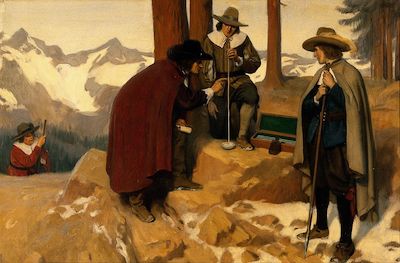
(Ernest Board, ‘The discovery of the barometer: Torricelli experimenting in the Alps’, 1643: Wellcome Collection.)

Alluding to the still-controversial matter of Edward Jenner’s experiments, Lord Byron in 1818 observed:

But vaccination certainly has been
    A kind antithesis to Congreve’s rockets,
With which the Doctor paid off an old pox,
By borrowing a new one from an ox.

The Congreve rocket, the editors note, was used at the Battle of Leipzig (1813), producing sufficient noise and glare to frighten and confuse the French.[1]

Fright and confusion have been much in evidence lately, not least in connection with vaccination rather than the Congreve rocket. But then Jenner’s use of cowpox germs led to resistance on religious grounds, people refusing to be treated with ‘substances originating from God’s lowlier creatures’ and when vaccination was made compulsory in 1853, this ‘led to protest marches and vehement opposition from those who demanded freedom of choice.’[2]

The rain, currently exercising its freedom of choice, appears to positively enjoy being rain and doing the things rain does. ‘How dark/ seems the whole country we enter’, the poet Keith Douglas wrote, ‘Now it rains,/ the trees like ominous old men are shaking.’[3] In her novel set in late 15th century Somerset, Samantha Harvey’s narrator observes that: ‘In the village at this time of year we had only one way of telling the weather: if you can see the ridge, you know it’s going to rain; if you can’t, it’s already raining.’[4]

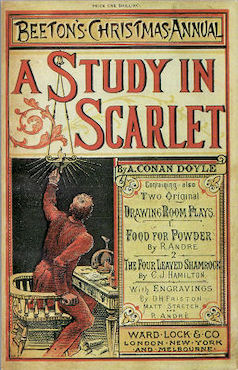
Wet or dry, the last week or two has seen me out for the most part on my own, sticking mainly to the lower paths in the park because my back was noticeably resentful of hills and acutely keen to tell me so. The Librarian has been walking later and alone, for longer and on an altogether higher plane. Aware that I was missing some lines from the handful of poems committed to memory, I’ve taken to carrying a paperback in my pocket so I can prompt myself. My memory seems more and more to resemble the version proposed by Mr Sherlock Holmes to a sceptical Dr John Watson early in A Study in Scarlet, the brain as a kind of attic with limited space, so that: ‘“Depend upon it there comes a time when for every addition of knowledge you forget something that you knew before.”’[5]


I’m reasonably discreet but a woman with a child in a pushchair may have flinched a little to hear as she passed me that ‘John Macdonald found a corpse, put it under the sofa,/ Waited till it came to life, and hit it with a poker’. Describing the same circular route as myself, though in the contrary direction, she may have been in time to catch the last run through: ‘It’s no go the Herring Board, it’s no go the Bible,/ All we want is a packet of fags when our hands are idle.’ The last lines of MacNeice’s poem seem painfully apt: ‘The glass is falling hour by hour, the glass will fall for ever,/ But if you break the bloody glass you won’t hold up the weather.’[6]

In my sunnier moments, it also prompts the thought of how many houses used to have barometers—I must have come across dozens—and how relatively few do so now. It’s hardly surprising: they were for use not ornament and the Met Office forecasts are increasingly accurate. There’s also this new-fangled thing called the internet.


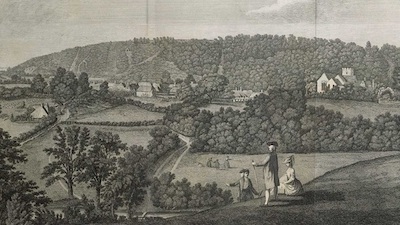
(North east view of Selbourne, from The Natural History and Antiquities of Selborne by Gilbert White © The British Library Board)

The naturalist Gilbert White, at whose house barometers and thermometers ‘were much-prized members of the household’—and who was ‘assiduous’ in his readings and recordings—wrote of house-crickets that: ‘Whatever is moist they affect; and therefore often gnaw holes in wet woollen stockings and aprons that are hung to the fire: they are the housewife’s barometer, foretelling her when it will rain; and are prognostic sometimes, she thinks, of ill or good luck; of the death of a near relation, or the approach of an absent lover. By being the constant companions of her solitary hours they naturally become the objects of her superstition.’[7]

Pressure rising, pressure falling. We don’t, I suppose, really need to tap the glass of a barometer these days. Farce or tragedy or tragicomedy, it’s being played out before our eyes—quite enlightening, no doubt, for those in the habit of thinking that we had only the one plague to contend with.

Writing little more than a year before his death, Byron had a word about barometers:

The London winter’s ended in July,
    Sometimes a little later. I don’t err
In this: whatever other blunders lie
    Upon my shoulders, here I must aver
My Muse a glass of weatherology;
    For Parliament is our barometer:
Let radicals its other acts attack,
Its sessions form our only almanac.[8]

If Parliament is our barometer now, I think it’s safe to say that the weather prospects are not encouraging.


Notes

[1] Lord Byron, ‘Canto I’, Don Juan, edited by T. G. Steffan, E. Steffan and W. W. Pratt (London: Penguin Books, 1996), 78, 580n. On the proof, Byron’s friend, John Cam Hobhouse wrote: ‘Mon cher ne touchez pas à la petite Verole [smallpox]’: ‘Appendix’, 757.

[2] See: https://www.jenner.ac.uk/about/edward-jenner (accessed 8 January 2022)

[3] Keith Douglas, last lines of ‘Soissons’ (1940): The Complete Poems of Keith Douglas, edited by Desmond Graham (Oxford: Oxford University Press, 1979), 47. Soissons is a commune in Hauts-de-France, roughly 100 kilometres north-east of Paris.

[4] Samantha Harvey, The Western Wind (London: Jonathan Cape, 2018), 91.

[5] Arthur Conan Doyle, The New Annotated Sherlock Holmes: The Novels, edited with notes by Leslie S. Klinger (New York and London: W.W. Norton and Company 2006), 34.

[6] Louis MacNeice, ‘Bagpipe Music’, Collected Poems, edited by Peter McDonald (London: Faber, 2007), 95, 96.

[7] Alexandra Harris, Weatherland: Writers and Artists Under English  Skies (London: Thames & Hudson, 2015), 209; Gilbert White, The Illustrated History of Selborne (London: Macmillan, 1984), 210.

[8] Byron, ‘Canto XIII’, Don Juan 453.

Backing the inevitable


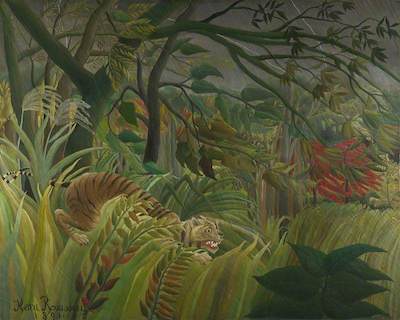
(Henri Rousseau, Surprised!, National Gallery)

As the Chinese Year of the Ox prepares to shuffle off in favour of the Year of the Tiger, more locally I have the Year of the Back – or no, that’s too downbeat, even for me. Say: the Month of the Back. Or, as I noted in my sporadically-kept diary, ‘The Back is back.’ Following in what has, unfortunately, become an irregular traditional practice—2013, 2015, 2019 and 2020—I am devoting twenty minutes each morning to putting my socks on. A schooling in patience, so to speak.

Initially, the cat looked suspicious and a little bewildered to have the Librarian preparing and serving his food—that bowl on the floor being just too far away for me—but is becoming reconciled. As is she. Probably. Perhaps.

When it comes to the serious work, though, the problem is that, like a bad toothache, a wrecked back tends to occupy the mind and resents any incursions by such brittle beasts as research or writing. But I can read more rovingly, so I do that: Mary Gaitskill, C. L. R. James, Annie Ernaux, Jane Gardam – and Byron’s Don Juan. Writing to poet-publisher James Laughlin in 1993, Guy Davenport told him: ‘I’ve been rereading (for the whatevereth time) Don Juan, which may be the funniest poem in English—certainly the greatest stylistic tour de force. It’s proof enough that God doesn’t read our books that Byron didn’t get to finish it. Juan was to have become a ranting Methodist in Yorkshire.’[1] Nearly sixty years earlier, W. H. Auden had, at the age of twenty-nine:

Just read Don Juan and I found it fine.
I read it on the boat to Reykjavik
Except when eating or asleep or sick.[2]

I remembered a brief exchange with the poet and artist David Jones that William Blissett recorded:

 ‘“Bugger old age.” 
“Is that your final word today?” 
“Yes.”’[3]

Jones lived to—almost—seventy-nine. In the half-century since his death, of course, our expectations are a little greater. (Or were, until the recent downturn, often the sign of governments with fatally wrong priorities.)

Still, physically at least, deterioration is written into everybody’s contract. A quotation was long lodged in my head from Henry Miller, which I had trouble finding, not least because, it transpires, I had the word order slightly wrong. I’m reminded now that ‘We resist only what is inevitable’ is from Miller’s 1957 Big Sur and the Oranges of Hieronymus Bosch, one of those statements that seems to shunt the reader or listener straight to the opposite or corollary statement, here, that we don’t resist what is not inevitable—and which, arguably, might be changed or averted through resistance. That would accord with the view of Miller famously presented by George Orwell in ‘Inside the Whale’, which begins and ends with Miller, to whom Orwell ascribes ‘a sort of mystical acceptance of thing-as-it-is.’ Orwell then runs through just what such acceptance includes in the mid-twentieth century—concentration camps, Hitler, Stalin, press censorship, political murders and the rest—but argues that Miller’s general attitude, nevertheless, is ‘“Let’s swallow it whole”’.[4]


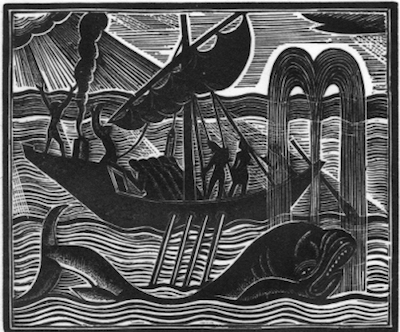
(David Jones, from The Book of Jonah
https://www.artwales.com/exhibition-mtg-en.php?locationID=184 )

Inevitability, then, most famously that of death and taxes, according to Benjamin Franklin, though my Oxford Dictionary of Quotations points to Daniel Defoe as precedent, more or less. For the rich, of course, in this country and surely many others, paying tax seems to be optional if you have that sort of moral threshold, that sort of accountant and offshore accounts already set up – but no government, however supine or conflicted, has yet managed to legislate against the Grim Reaper or to arrange loopholes for its friends.

Endings, anyway. As Annie Ernaux has it, ‘The time that lies ahead of me grows shorter. There will inevitably be a last book, as there is always a last lover, a last spring, but no sign by which to know them.’[5] And D. H. Lawrence wrote to Catherine Carswell, ‘One can tell what will happen, more or less. Some things one knows inwardly, and infallibly. But the how and the why are left to the conjunction of circumstances.’[6]

Lawrence, in fact, dwelt often on inevitability. ‘This is England. One meaning blots out another. So the mines were blotting out the halls. It was inevitable. When the great landowners started the mines, and made new fortunes, they started also their own obliteration from the English countryside. One meaning blots out another.’ And: ‘It had taken Constance a long time to accept the inevitable. The old England was doomed to be blotted out, with a terrifying absoluteness, by a new and gruesome England. It was inevitable.’[7]

This, perhaps, has a distant relative in Aldous Huxley’s pronouncement in a letter to his brother Julian a few months before the Armistice in 1918: ‘Whatever happens, we may be sure it will be for the worst. I dread the inevitable acceleration of American world domination which will be the ultimate result of it all. It was a thing that had got to come in time, but this will hasten its arrival by a century.’[8]

Patrick White’s Voss remarks that: ‘Human behaviour is a series of lunges, of which, it is sometimes sensed, the direction is inevitable.’[9] A little more positively, perhaps, ‘And yes’, Katherine Mansfield wrote to William Gerhardi in March 1922, ‘that is what I tried to convey in The Garden Party. The diversity of life and how we try to fit in everything, Death included. That is bewildering for a person of Laura’s age. She feels things ought to happen differently. First one and then another. But life isn’t like that. We haven’t the ordering of it. Laura says, “But all these things must not happen at once.” And Life answers, “Why not? How are they divided from each other?” And they do all happen, it is inevitable. And it seems to me there is beauty in that inevitability.’[10]


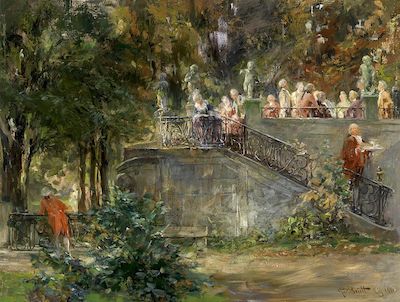
(Ferdinand Brütt, Gartenfest (1900)

There is, lastly—or firstly—the consciously literary. Ford Madox Ford wrote, in a piece on Joseph Conrad, of ‘the great faculty of this author – that he can make an end seem inevitable, in every instance, the only possible end.’[11]

More than a decade later, and returning to the subject—and the writer—at greater length, Ford wrote of ‘all that is behind the mystic word “justification.” Before everything a story must convey a sense of inevitability: that which happens in it must seem to be the only thing that could have happened. Of course a character may cry, “If I had then acted differently how different everything would now be.” The problem of the author is to make his then action the only action that character could have taken. It must be inevitable, because of his character, because of his ancestry, because of past illness or on account of the gradual coming together of the thousand small circumstances by which Destiny, who is inscrutable and august, will push us into one certain predicament.’[12]

‘One certain predicament.’ There’s a neat summary. My current predicament is, though, gradually easing. Of course, that’s a subjective assessment. Subjective? ‘This word has made considerable progress in England during the year you have been away’, Edward Fitzgerald wrote to his friend Frederick Tennyson (7 June 1840), ‘so that people begin to fancy they understand what it means.’[13]

I fancy it means that I no longer have to read Don Juan while lying on the bedroom floor.


Notes

[1] W. C. Bamberger, editor, Guy Davenport and James Laughlin: Selected Letters (New York: W. W. Norton & Co., 2007), 146.

[2] Letter to Lord Byron, in W. H. Auden and Louis MacNeice, Letters from Iceland (London: Faber and Faber, 1937), 18.

[3] William Blissett, The Long Conversation: A Memoir of David Jones (Oxford: Oxford University Press, 1981), 108.

[4] George Orwell, A Patriot After All: 1940-1941, edited by Peter Davison, revised and updated edition (London: Secker and Warburg, 2000), 86-115.

[5] Annie Ernaux, A Girl’s Story, translated by Alison L. Strayer (London: Fitzcarraldo Editions, 2020), 17.

[6] Letters of D. H. Lawrence III, October 1916–June 1921, edited by James T. Boulton and Andrew Robertson (Cambridge: Cambridge University Press, 1984), 24.

[7] D. H. Lawrence, The First and Second Lady Chatterley Novels, edited by Dieter Mehl and Christa Jansohn (Cambridge: Cambridge University Press, 1999), 366.

[8] Aldous Huxley, Letters of Aldous Huxley, edited by Grover Smith (London: Chatto and Windus, 1969), 160.

[9] Patrick White, Voss (London: Eyre & Spottiswoode, 1957), 16-17.

[10] Katherine Mansfield, Selected Letters, edited by Vincent O’Sullivan (Oxford: Oxford University Press, 1990), 250.

[11] Ford Madox Ford, ‘Joseph Conrad’, English Review (December 1911), 82.

[12] Ford Madox Ford, Joseph Conrad: A Personal Remembrance (London: Duckworth, 1924), 204.

[13] The Letters of Edward Fitzgerald, edited by Alfred McKinley Terhune and Annabelle Burdick Terhune, four volumes (Princeton: Princeton University Press, 1980), I, 250.