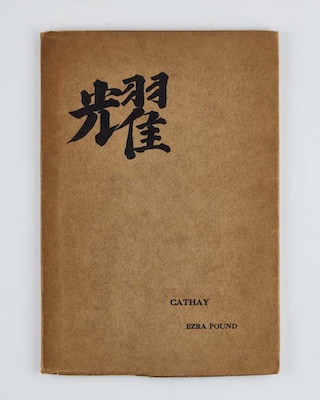
Who has brought this to pass?
Who has brought the flaming imperial anger?
Who has brought the army with drums and with kettle drums?
Barbarous kings.[1]
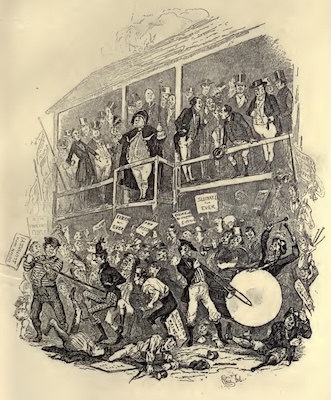
Reading again Charles Dickens’ first—and astonishingly successful—novel, I was glad, being myself a man of Kent, to be reminded of it by Mr Alfred Jingle: ‘“Splendid—capital—Kent, Sir—Everybody knows Kent—apples, cherries, hops, and women.”’
Further on, nothing worse that morning having happened chez nous than a smear of marmalade on a page, I came across the newspaper editor’s interesting take on research methods:
‘Mr. Pott looked dubiously at Bob Sawyer for some seconds, and, turning to Mr. Pickwick, said—
“You have seen the literary articles which have appeared at intervals in the Eatanswill Gazette in the course of the last three months, and which have excited such general—I may say such universal attention and admiration?”
“Why,” replied Mr. Pickwick, slightly embarrassed by the question, “the fact is, I have been so much engaged in other ways, that I really have not had an opportunity of perusing them.”
“You should do so, Sir,” said Pott, with a severe countenance.
“I will,” said Mr. Pickwick.
“They appeared in the form of a copious review of a work on Chinese metaphysics, Sir,” said Pott.
“Oh,” observed Mr. Pickwick—”from your pen I hope?”
“From the pen of my critic, Sir,” rejoined Pott with dignity.
“An abstruse subject I should conceive,” said Mr. Pickwick.
“Very, Sir,” responded Pott, looking intensely sage. “He crammed for it, to use a technical but expressive term; he read up for the subject, at my desire, in the Encyclopaedia Britannica.”
“Indeed,” said Mr. Pickwick, “I was not aware that that valuable work contained any information respecting Chinese metaphysics.”
“He read, Sir,” rejoined Pott, laying his hand on Mr. Pickwick’s knee, and looking round with a smile of intellectual superiority, “he read for metaphysics under the letter M, and for China under the letter C; and combined his information, Sir!”’[2]
Whether or not its practitioners would admit to it, I suspect that such an approach has not entirely died out in the journalistic—and, perhaps, academic—worlds. It certainly hasn’t died out in preparations, such as they are, for various contemporary military adventures.
Two weeks into March now, so two weeks of the current leaders of Israel and the United States making the world a safer place by gleefully setting large parts of it on fire. They have also encouraged the population of Iran to rise up against their oppressors but done so by the peculiar expedient of slaughtering their families and destroying their homes. An old song but not a good one. Lebanon too has been attacked yet again and civilian deaths are rapidly rising there also.
Here, a former British Prime Minister who dragged the country into an illegal and unsanctioned war—and who will be remembered, despite some positive domestic achievements, for nothing else, in history’s long view—has criticised the current Prime Minister for declining to drag the country immediately into an illegal and unsanctioned war. As things continue to deteriorate, though, he is being dragged rather further than we’d hoped.
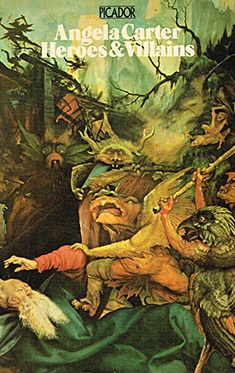
‘And what does the word “city” mean?’ the Professor asks Marianne in Angela Carter’s post-apocalyptic novel:
‘She thought for a while.
“Ruins?” she hazarded.’[3]
Well, yes. Apart from destroyed apartment blocks and a girls’ school, the bombs have not spared Tehran’s Golestan Palace, which dates back to the 14th century and is a world heritage site under the protection of UNESCO, which sent to all parties the coordinates of the palace at least ten days ago. The 17th century Chehel Sotoon Palace in Isfahan and other Iranian heritage sites have also been damaged.
‘The tragic statement of the poem’, Guy Davenport wrote of Ezra Pound’s Cantos, ‘is that whereas centuries go into the perfection of a culture, an age of carelessness or ruinous war can destroy a culture in the batting of an eye.’[4]
Carelessness, ruinous war, yes – or barbarous kings.
Notes
[1] Rihaku (Li Po), ‘Lament of the Frontier Guard’, in Cathay, translated by Ezra Pound, ‘from the Notes of the Late Ernest Fenollosa, and the Decipherings of the Professors Mori and Ariga’: Collected Shorter Poems, Second Edition (London: Faber & Faber, 1968), 143.
[2] Charles Dickens, The Posthumous Papers of the Pickwick Club (1836-37; edited by Mark Wormald, London: Penguin Books, 1999), 31, 679-680.
[3] Angela Carter, Heroes and Villains (London: Picador, 1972), 7.
[4] Guy Davenport, ‘Foreword’, Cities on Hills: A Study of I–XXX of Ezra Pound’s Cantos (Ann Arbor, Michigan: UMI Research Press, 1983), vii.
 Reconstructionary Tales