There not there


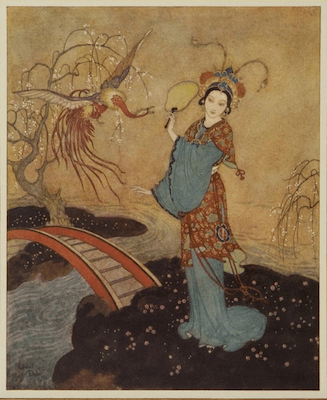
(Edmund Dulac, Frontispiece to Princess Badoura: A Tale from The Arabian Nights, by Laurence Housman)

‘The things you think of to link are not in your control. It’s just who you are, bumping into the world. But how you link them is what shows the nature of your mind. Individuality resides in the way links are made.’[1]

Bumping into the world, I noticed yesterday that I was reading A. S. Byatt on what would have been her 88th birthday. More, in the volume’s longest story, was the sentence: ‘And she waited for the sound of thunder, or worse, the silence of absence.’[2] I was struck (or bumped against) by that last phrase, having been thinking recently in similar terms. Sometimes the silence here is indeed the dictionary’s ‘absence of sound; complete quietness’ – but often something more. Silences have their own flavours, idiosyncrasies, tones, strengths and essences.

‘Throughout the house’, Patrick White wrote in  his story ‘The Night the Prowler’, ‘there were the sounds of furniture, and clocks, and silence.’[3] It has to be said that furniture was often on his mind, not least in populating Theodora Goodman’s world: ‘There is perhaps no more complete a reality than a chair and a table’ – though he adds there: ‘Still, there will always also be people, Theodora Goodman said, and she continued to wait with something of the superior acceptance of mahogany for fresh acts.’[4] When the painter Hurtle Duffield meets a man named Mothersole on the ferry, the printer asks what sort of things Duffield paints. ‘“Well! For some time now, tables and chairs.”’ Mothersole finds it a ’funny sort of subject’ and Duffield responds: ‘“Why? What could be more honest?”’[5]

There must be vastly fewer ticking clocks in the world now, timepieces having been widely and inescapably recruited to the cause of at least electronic silence. Ticking is a disturbing anomaly in this grave, enslaved new world. My maternal grandfather once owned several fish and chip shops in Portsmouth but, by the time I was of an age to notice such things, he had become a jeweller and watchmaker. The clocks that had audibly populated so much fiction through several centuries still kept the faith in his shop. He even had, at one point and appropriately enough, a grandfather clock. Ticks, tocks and chimes galore.
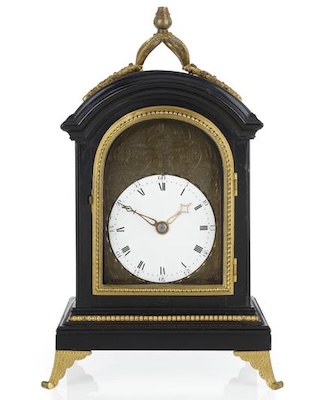

(The Clockmakers’ Museum. Musical table clock by Thwaites for Barraud. L2015-3473 Science Museum Group Collection Online.)

Thinking of silence, then, we often think of absence too, perhaps of the old saying that ‘absence makes the heart grow fonder’ (or, as I once heard someone—probably of a poetic turn of mind—say, a few drinks in: ‘Absinthe takes the art au fond-er’). Old sayings, though. People sometimes ask: are they true? To which the answer is, can only be, it depends. For some yes, for others no.

Absence can be a source of amusement, an occasion for pleasure. Rudyard Kipling’s parents (John Lockwood Kipling and Alice Macdonald) were unable to attend a party given by Dante Gabriel Rossetti because the date of their sailing on the S. S. Ripon to Bombay had been brought forward by a day, to Wednesday 12 April, 1865. ‘In their absence, however, Ford Madox Brown proposed their health, in a speech throughout which, with his usual inability to remember names, he referred to the bridegroom as “John Gilpin”—to the delight of all present.’[6]

Annie Erneaux, though, recalled literally writing out her passion in Florence, being temporarily removed from an intense and wounding affair: ‘Those eight days on my own, without speaking, except to waiters in restaurants, haunted by the image of A. (to the extent that I was astonished to be accosted by men, could they not see him silhouetted inside my own body?) seemed to me an ordeal for the betterment of love. A sort of further investment, this time to imagination and craving through absence.’ And elsewhere she stated that:  ‘It is the absence of meaning in what one lives, at the moment one lives it, which multiplies the possibilities of writing.’[7]
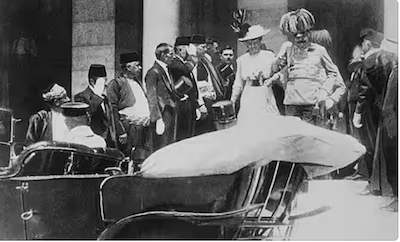

(Franz Ferdinand & Sophie. Photograph: Bettmann/Corbis via The Guardian)

When Stanley Weintraub wrote about the guns falling silent at the end of the First Word War, his book’s title, A Stillness Heard Round the World, looked back both to Ralph Waldo Emerson’s ‘Concord Hymn’, which included the phrase ‘the shot heard round the world’ and the fact that Emerson’s phrase has often been applied to the shot that began the war, fired at the Austrian Archduke Franz Ferdinand by Gavrilo Princip, who killed both the Archduke and his wife Sophie on 28 June 1914. The significance of that incident was not widely grasped and reports of it were often to be found on the inner pages of the following day’s newspapers – a squabble in the Balkans! – but since then a great deal of writing about it has certainly been found possible.

Marcel Proust observed that ‘the absence of a thing is not merely that, it is not simply a partial lack, it is a disruption of everything else, it is a new state which one cannot foresee in the old.’[8] We can, in fact, often foresee that absence, we grasp its inevitability, not least the inescapable end of every living thing but of course that single fact is not, cannot be, all there is. We distinguish between ‘surprise’ and ‘shock’ for a reason. Our awareness that something is coming, will inevitably happen, does not provide a thorough preparation for the event and its aftermath. Some effects are unscripted.

‘There is a time in life when you expect the world to be always full of new things’, Helen Macdonald wrote. ‘And then comes a day when you realise that is not how it will be at all. You see that life will become a thing made of holes. Absences. Losses. Things that were there and are no longer. And you realise, too, that you have to grow around and between the gaps, though you can put your hand out to where things were and feel that tense, shining dullness of the space where the memories are.’[9]

Yes. As Sarah Moss wrote, ‘One does not need to see ghosts, to know that people are haunted.’ And, a little further on: ‘It is not ghosts but absence that is harder to bear.’[10]


Notes

[1] Anne Carson, Paris Review interview (2004), quoted by Jennifer Krasinski in her review of Carson’s Wrong Norma in Bookforum, 30, 3 (Winter 2024), 13.

[2] A. S. Byatt, ‘The Djinn in the Nightingale’s Eye’, in Medusa’s Ankles: Selected Stories (London: Vintage, 2023), 256.

[3] Patrick White, ‘The Night the Prowler’, in The Cockatoos: Shorter Novels and Stories (London: Jonathan Cape, 1974), 149.

[4] White, The Aunt’s Story, (1948; Harmondsworth: Penguin Books, 1963), 141.

[5] White, The Vivisector (London: Jonathan Cape, 1970), 420.

[6] Roger Lancelyn Green, Kipling and the Children (London: Elek, 1965), 20, citing Georgiana Burne-Jones, Memorials of Edward Burne-Jones (1904), I, 290.

[7] Annie Erneaux, Simple Passion, translated by Tanya Leslie (London: Fitzcarraldo Editions, 2021), 33; A Girl’s Story, translated by Alison L. Strayer (London: Fitzcarraldo Editions, 2020), 143.

[8] Marcel Proust, In Search of Lost Time. 1: The Way By Swann’s, translated by Lydia Davis (London: Allen Lane, 2002), 308.

[9] Helen Macdonald, H is for Hawk (London: Jonathan Cape, 2014), 171.

[10] Sarah Moss, Signs for Lost Children (London: Granta Books, 2016), 64, 86.
Communicable experience: words begin again


Sitting down to write the handful of Christmas cards we sent this year, I found myself oddly inhibited when it came to the notes I’d meant to add—mainly rallying cries or apologies for silences, distances and disappearances. Last year, so much still felt relatively new, baffling, a strangeness that could be conveyed in simple language, with an expectation of a shared response, a reciprocity. To say the same things twelve months later seemed somehow absurd; in fact, any phrase that came to mind appeared wholly banal, quite pointless. Then, too, it required too many assumptions, some quite hazardous, about people’s recent history and present circumstances. So, either a five-page letter or nothing at all – beyond best wishes for next year – hardly, when it came to it, a difficult choice.

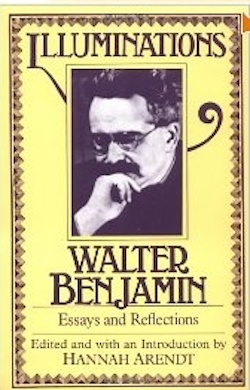
I thought of the famous observation of Walter Benjamin, ‘Was it not noticeable at the end of the [First World] war that men returned from the battlefield grown silent—not richer, but poorer in communicable experience?’ He has been discussing the loss of ‘the ability to exchange experiences’, one reason for this being that ‘experience has fallen in value.’ Our picture of both the external world and the moral world have undergone ‘changes which were never thought possible.’ He goes on:

A generation that had gone to school on a horse-drawn streetcar now stood under the open sky in a countryside in which nothing remained unchanged but the clouds, and beneath these clouds, in a field of force of destructive torrents and explosions, was the tiny, fragile human body.[1]

It’s very easy to look at this and think ah, yes, mechanized warfare, dramatic scientific and technological changes, transport and communications revolutions, all very historical, all very back then. Despite the massive volume of commentary—largely because of it, perhaps—we find it harder to grasp the speed and impact of some of the changes occurring in our own historical period, in part because as things develop and change increasingly quickly, we accommodate, allow for and absorb those changes increasingly quickly too. The internet—we fret if it takes more than a few seconds to respond to a search term. And if we should actually draw a complete blank? ‘If it’s not on the internet it doesn’t exist’—I remember an American librarian ascribing this assumption to college students who frequented the library, some ten or fifteen years ago now. We see many programmes, essays, articles devoted to the phenomenon of social media, especially the aggressive and destructive aspects of it. Were there always this many repellent people? Have they been created or merely enabled by the internet, because before it existed they would have had to write a letter, address an envelope and stick a stamp on it? Incredible advances in medicine: why do so many people reject them out of hand? Questions pretty simple, answers less so.


But Benjamin’s ‘communicable experience’? Men returned from the battlefield, even had they wished to, could rarely find the vocabulary to convey the enormity, intensity and sheer unprecedented nature of what some of them had seen, heard and suffered. That surely differs fundamentally from our situation now. These last two years, there has been a good deal of shared, or at least common, experience. Not as common as it was originally represented as being: the—sometimes literally—murderous inequalities that obtain in this country (among others) meant that, while some glided, many others crashed and burned. Still, there were elements of a society under siege which were at least recognised by most of us.

Helen Macdonald recently articulated with her usual lucidity some familiar if often inchoate thoughts, firstly about the dual speed of time, passing ‘far more slowly than it did before’ but also ‘running far too fast’, secondly with the unvarnished statement that: ‘Most of us began this pandemic thinking that life would return to normal. We all now know that this is a fiction; nothing will return to what it was before.’[2] And I nod, yes, though I’d baulk at that ‘all now know’. A lot of New Statesman readers, maybe. More broadly, I suspect the rule of division still holds sway. I see I wrote a little earlier of ‘our situation’. But once more particularised than ‘the human animal’, that ‘our’ is a little shaky.

We’re told, on an almost daily basis, that we live now in a divided country, a fractured society. The nation splits along fault lines of class or age or education or information sources. Brexit showed up the real cracks and some of the reactions to the pandemic, or measures intended to combat that pandemic, have revealed some more, frequently new pressures on earlier, still suppurating wounds—which are often, in fact, the most troubling.

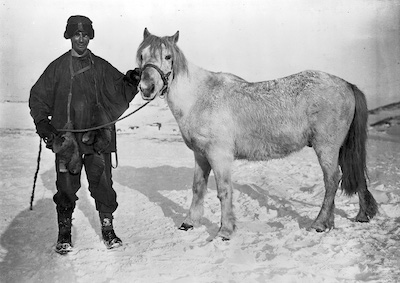
(Cherry-Garrard and pony: https://www.coolantarctica.com/Antarctica%20fact%20file/History/biography/cherry-gearrard_apsley.php

The biographer of Apsley Cherry-Garrard, a member of the Terrra Nova expedition, travelling with Scott on that doomed journey to the Antarctic in 1910, and author of The Worst Journey in the World, observes that:

Many of those who had served felt, after the war, that the world had been everlastingly divided into those who had been there, and those who had not. To Cherry that binary vision had been cast before 1914, and the war only served to polarise it further: those who had been south, and those who had not. His psyche never fully engaged with the war. It was still in the Antarctic.[3]

In a way, things were simpler in the ancient world. Herodotus lived in a world divided into Greeks and barbarians, that is to say, ‘hoi barbaroi’, the non-Greeks.[4] In more recent times, Penelope Fitzgerald’s memorable categories occur in The Bookshop: ‘She blinded herself, in short, by pretending for a while that human beings are not divided into exterminators and exterminatees, with the former, at any given moment, predominating.’[5] And predominate they do, as so much of the twentieth century and, alas, this one too, can testify. Primo Levi, who survived the death camps, later wrote: ‘Those who experienced imprisonment (and, more generally, all persons who have gone through harsh experiences) are divided into two distinct categories, with rare intermediate shadings: those who remain silent and those who speak.’[6]

Personal, temporal. A time to keep silence, and a time to speak, as Ecclesiastes has it. Anne Carson, as ever, has her own take: ‘After a story is told there are some moments of silence. Then words begin again. Because you would always like to know a little more. Not exactly more story. Not necessarily, on the other hand, an exegesis. Just something to go on with. After all, stories end but you have to proceed with the rest of the day. You have to shift your weight, raise your eyes, notice the sound of traffic again, maybe go out for cigarettes.’[7]


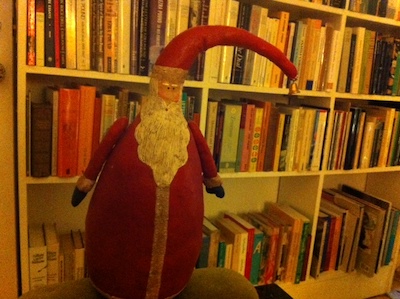
In the teeth of it all, we—we?—proceed with the rest of the day, and the words that accompany it. The rain has cleared, the sky has brightened a little. And Fat Santa has not left the building.


Notes


[1] Walter Benjamin, ‘The Storyteller: Reflections on the Works of Nikolai Leskov’ (1936), Illuminations: Essays and Reflections, edited and with an introduction by Hannah Arendt (New York: Schocken Books, 1985), 83-84.

[2] Helen Macdonald, ‘The lure of hibernation’, New Statesman (10 December 2021 – 6 January 2022), 44.

[3] Sara Wheeler, Cherry: A Life of Apsley Cherry-Garrard (London: Jonathan Cape, 2001), 189.

[4] Herodotus, The Histories, translated by Aubrey de Sélincourt, revised by John Marincola (London: Penguin Books, 1996), 3.

[5] Penelope Fitzgerald, The Bookshop (1978; London: Everyman, 2001), 29.

[6] Primo Levi, The Drowned and the Saved, translated by Raymond Rosenthal (London: Abacus, 1989), 121.

[7] Anne Carson, ‘Afterword’, in  Plainwater: Essays and Poetry (New York: Vintage, 2000), 88.