
‘Sumer is icumen in’, as the song has it, but at 7 a.m. even on the hottest days the paths have been cool, the birdsong loud and the dog walkers few and far between. There is, though, the usual dislocation of feeling, the season barely begun, while the solstice, the first day of astronomical summer and already two weeks in the past, was followed three days later by what is still widely celebrated as Midsummer’s Day.
Midsummer 1857 was the occasion of the third trip taken by Henry Thoreau—‘probably the American writer who tells us best how to live comfortably with our most constant companion, ourselves’, Edward Hoagland wrote—which provided the material of his The Maine Woods.[1] Thoreau travelled in the company of Edward Hoar and a Native American, Joe Polis, of the Penobscot tribe. The second trip had concerned moose hunting; and Thoreau noted that the moose’s sounds, by their resemblance to familiar ones (such as the strokes of an axe) ‘enhanced the impression of solitude and wildness.’ It was, though, in the account of the first expedition, which included the ascent of Mount Ktaadn (‘highest land’) that one of the most extraordinary passages occurs:
‘I stand in awe of my body, this matter to which I am bound has become so strange to me. I fear not spirits, ghosts, of which I am one, — that my body might, — but I fear bodies, I tremble to meet them. What is this Titan that has possession of me? Talk of mysteries! Think of our life in nature, — daily to be shown matter, to come in contact with it, — rocks, trees, wind on our cheeks! the solid earth! the actual world! the common sense! Contact! Contact! Who are we? where are we?’[2]
The Maine Woods was published posthumously, two years after Thoreau’s death at the age of 44, his last words reportedly ‘moose’ and ‘Indian’.

Indeed, 4th July, apart from being the birthday of Nathaniel Hawthorne (1804)—‘It is remarkable that persons who speculate the most boldly conform with the most perfect quietude to the external regulations of society. The thought suffices them, without investing itself in the flesh and blood of action’—was also the day in 1845, six weeks after Franklin set out from Greenhithe on his last voyage to find the Northwest Passage, on which Thoreau strolled off to Walden Pond.[3] (‘We commonly do not remember that it is, after all, always the first person that is speaking.’)[4]
Weeks before our own midsummer or solstice, we had four, five, gorgeous afternoons (in among the rain), as if we had skipped even late spring and vaulted straight into the first day of summer. It seemed an absurdly short time since winds were shaking the darling buds of April. We had lunch down at the harbourside on one of those April days where, sitting at an outside restaurant table, in a covered area, we’d allowed for the rain but a wind with serious ambitions caught us out sufficiently to warrant a move inside for dessert and coffee. On the wide paths, there were dogs with horizontal ears, especially spaniels eminently ready for take-off. We are more accustomed, especially on calmer days in quiet roads, to cats with vertical tails.
That other people felt the early summer sensation was confirmed by the number of them sprawled, in various positions—some of them frankly improbable—on the grass and, in one case, half on the grass and half on the path. Who would deliberately arrange themselves like that, I wondered, staring but not-staring, deciding that voicing the question ’Excuse me, are you dead?’ might not be the way to go. I became aware, not just in the park, that I spend a good deal of time when walking in looking up, a habit I date from our first visit to Amsterdam. Birds, kites (sometimes flying, more often caught in branches), clouds, rooftops and chimneys—and trees.

‘I liked cemeteries, parks, the roof terraces of buildings’, the narrator (one of them) of Valeria Luiselli’s novel says, ‘but most of all cemeteries. In a way, I was living in a perpetual state of communion with the dead. But not in a sordid sense.’[5]
Yes. In a sordid sense, though, the news impinges. Democracy—in the democracies—is not doing well, is, frankly, sick. India, Israel, the United States—and here. People everywhere, some people at any rate, continually asking how it happened, how it came to this, how things became so badly broken. But we know, really. We watched it happen.

The recently arrived near-neighbours are not always in evidence, which is the best that can be said for them. A shared house with a slew of young men of a certain type, who shout rather than talk; who bray rather than laugh; who drunkenly howl rather than sing; who can only listen to music if it’s rank bad stuff and played at full volume, who can only take phone calls on speakerphone, jammed up against our back fence. Season of pests and bellowed frightfulness, as the poet said.
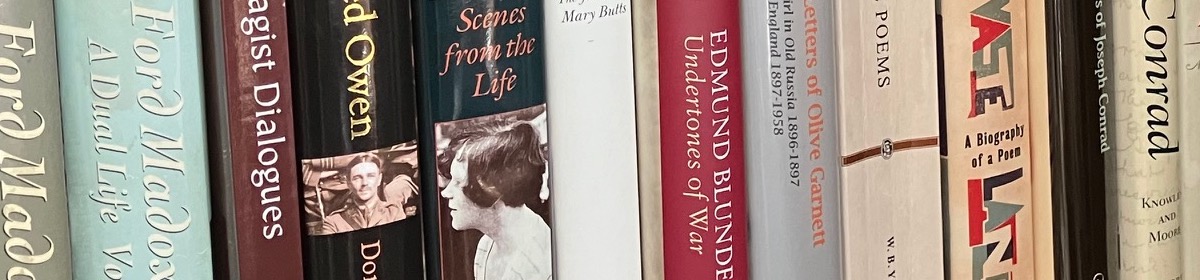
After breakfasts, showers, walks – the day offers: diseases of the potato; nursery rhymes; Welsh terriers; First World War cooking implements; advertisements for foot powder; flowering bulbs, translators of Anatole France, dog roses and Fabians. The joys of research. And the danger signs, such as the slight frisson produced by the heading of a column on an old photocopy ‘The Best of Swine’. The reason for obtaining the photocopy is there on the two central columns: a review article by Ford Madox Ford, novelist, poet, critic, autobiographer—and pig breeder. Alas, further scrutiny of that enticing right-hand column reveals the terminal ‘E’ of ‘SWINE’ to be half of a ‘B’. The review is of a selection of poetry—‘The Best of Swinburne’. Still, this review is by T. Earle Welby, probably not a household name these days but yes, a name that had already cropped up in a letter to Ford’s agent. Who was it that said everything is connected? A great many people, probably – one of them was certainly Stanley Spencer.

And here is A. E. Stallings:
Don’t ask
The Mind to rest, though someday it must cease;
In life, only the flesh has any peace.[6]
Some flesh, of course, needs greedy reading, to convince the restless mind that such things are still possible, a few hundred pages a day for a while. C. J. Sansom’s Matthew Shardlake novels and Mick Herron’s Slow Horses series fitted the bill perfectly. So I could then slow down again, with Noreen Masud’s A Flat Place, William Beckford’s journals, more D. H. Lawrence letters and a rereading of Erskine Childers’ The Riddle of the Sands. And, notwithstanding the last few days’ rain, the summer persists. As we do. As we must.
Notes
[1] In his introduction to the Penguin Nature Library edition of The Maine Woods (New York, 1988), ix.
[2] Henry David Thoreau, A Week on the Concord and Merrimack Rivers; Walden; The Maine Woods; Cape Cod, edited by Robert F. Sayre (New York: Library of America, 1985), 668, 646.
[3] Hawthorne, The Scarlet Letter (1850; edited by Brian Harding, Oxford: Oxford University Press, 1990), 164; Robert D. Richardson, Jr., Henry Thoreau: A Life of the Mind (Berkeley: University of California Press, 1986), 152.
[4] Henry David Thoreau, Walden, edited by J. Lyndon Shanley (Princeton: Princeton University Press, 1974), 3.
[5] Valeria Luiselli, Faces in the Crowd (London: Granta 2022), 10.
[6] A. E. Stallings, ‘Lost and Found’, Like (New York: Farrar Straus Giroux, 2018), 61.
 Reconstructionary Tales