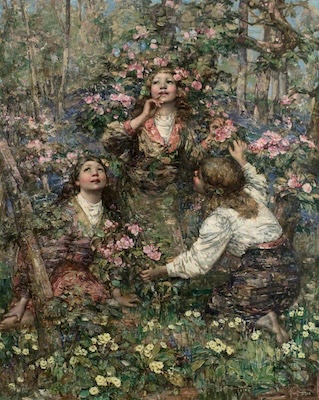
(Edward Atkinson Hornel, The Blackbird Song: Dundee Art Galleries and Museum Collection)
I thought for a moment that the blackbird in the tree that reaches over the back neighbour’s fence into our garden had sung itself hoarse. It’s certainly dwindled, unsurprisingly, since it was already in full flow when I came downstairs, cheered on by the cat, at 05:30 this morning. There is even a tentative sunlight, flickering a little, as if unsure of itself, a faltering connection – and who can wonder, at the end of an 18-month period (since October 2022) which is the wettest in Met Office recorded history? Of course, they only started collecting the data in 1836 (Guardian, 10 April 2024), so it’s not even 200 years yet.
The weekly journals arrive, still a little light on the good news. ‘Easy stories drive out hard ones. Simple paradigms prevail over complicated ones.’[1] Well, yes, though sometimes it really is that simple and, hearing some of the voices currently uplifted in the world, brings the sentiment expressed in the Goncourt Journal vividly to mind: ‘If there is a God, atheism must strike Him as less of an insult than religion.’[2]
The ice-cream van drifts into hearing, still a few streets off, playing ‘Yankee Doodle went to town’. I used to be rather baffled by the line, ‘Stuck a feather in his cap / and called it macaroni.’ Now, along with anyone that has access to the internet, and, presumably, millions of Americans, I’m no longer baffled, at least by that. As the incomparable Opie team has it: ‘Young dandies, who had been on the Tour, wore fantastical clothes, and affected Continental habits, were dubbed “Macaronis”; there was, indeed, a Macaroni Club flourishing in 1764.’[3] By 1772, a year before the Boston Tea Party and three years before the American War of Independence began, the Macaronis ‘were distinguished especially by an immense knot of artificial hair worn at the back but with the peruke flat on top’.[4] The story goes that the British forces sang it to mock those unsophisticated colonials but the Yankees took it up anyway. And, come to think of it, they won that war.

Philip Dawe, ‘The Macaroni. A Real Character at the Late Masquerade’ (1773)
Later, the rain still holding off – and now I can hear the bees. The tulips are open and not yet fallen; the cherry tree in its strong pot some seven feet high; branches above the high fence nodding; faint tones of the Italian near-neighbour and the laughter of a few guests, their windows must be ajar, the season’s premier opening; less faint tones of scaffolders a few houses along; Harry the Cat nodding on an outside blanket; all this is the first real scent of summer. I remember Sarah Bakewell noting that Plutarch’s Moralia, translated into French in the same year in which Montaigne began writing Essays, touched on the question of how to achieve peace of mind: ‘Plutarch’s advice was the same as Seneca’s: focus on what is present in front of you, and pay full attention to it.’[5] No doubt both Plutarch and Seneca had their difficulties to contend with – but one of those was not the internet, with its clamorous, competing and often lethal versions of the world. Reading of Elizabeth I’s ‘innate disposition to hedge’ in ‘the face of peril or hostility’, I noted Strachey’s later remarks about Robert Cecil: ‘But passivity, too, may be a kind of action – may, in fact, prove more full of consequence than action itself.’[6] Indeed. Or, too often, alas.
Notes
[1] Phyllis Rose, Parallel Lives: Five Victorian Marriages (London: Chatto & Windus, 1984), 9.
[2] Edmund and Jules de Goncourt, entry for 24 January 1868, Pages From the Goncourt Journal, edited and translated by Robert Baldick (New York: New York Review Books, 2006), 135.
[3] The Oxford Dictionary of Nursery Rhymes, edited by Iona and Peter Opie, second edition (Oxford: Oxford University Press, 1997), 532.
[4] James Stevens Cox, An Illustrated Dictionary of Hairdressing and Wigmaking (London: Batsford, 1984), 99.
[5] Sarah Bakewell, How To Live: A Life of Montaigne in one question and twenty attempts at an answer (London: Vintage 2011), 32.
[6] Lytton Strachey, Elizabeth and Essex: a Tragic History (1928; Oxford: Oxford University Press, 1981), 114, 140.
 Reconstructionary Tales