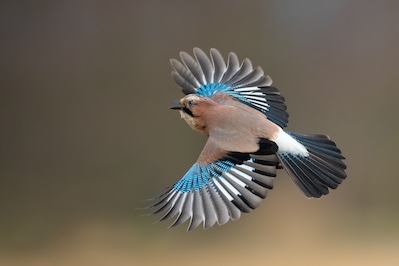
RSPB: https://www.rspb.org.uk/birds-and-wildlife/jay
The highlight of yesterday morning was the jay, garrulus glandarius, briefly perched on the high roof of the shed beyond our back fence, a bird we’ve seen high up in the trees of the Victorian cemetery but never so close to home. The lowlight, in the wake of the announcement of a forthcoming General Election, now a little over five weeks away, was probably the reported Tory proposals to cut taxes for the rich again and to bring back National Service. This last appears to be an attempt to outflank satirists with a first strike of absurdity and anachronism. We await with bated breath the reintroduction to the statute books of the death penalty for stealing a pocket handkerchief, damaging Westminster Bridge or impersonating a Chelsea Pensioner.
Reading the stories of Somerville and Ross lately, I alighted on Major Sinclair Yeates, together with Flurry Knox and the visiting Englishman Leigh Kelway, taking refuge from the rain in a public-house, having failed to get to the country races: ‘The bread tasted of mice, the butter of turf-smoke, the tea of brown paper, but we had got past the critical stage.’[1]
On occasion, we – or certainly I – don’t get to the critical stage, much less past it. Some things, moments, sights, sounds, are merely to be experienced and enjoyed (or, occasionally, suffered), without evaluation or ranking or even attempted analysis. And sometimes, writing so good or so distinctive that it delays or disarms criticism.
After a recent lunch, the librarian lingered at the table, extending her familiarity with the work of Olivia Laing, occasionally pausing to tell me how good it—The Garden Against Time—was. On my side of the table, I was extending my familiarity with the work of Anne Carson (Wrong Norma), frowning occasionally, laughing often and muttering, not at all rarely, ‘Wonderful!’ None of which, I suppose, passes muster as incisive literary analysis or exegesis. Not all the world’s a critical stage, you might say. (I’ve since read the Olivia Laing myself, muttering ‘Wonderful’ from time to time.)
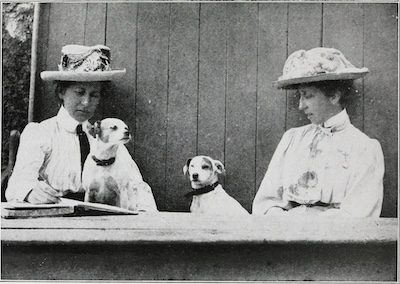
The authors: from Irish Memories (1919)
‘It has been said of Ireland that the inevitable never happens, and that the impossible invariably occurs.’[2]
The volume that contains the Somerville and Ross story was published 125 years ago and is dense with hunting and hunting lore: horses, hounds, whips, drags and the rest. I could hardly be further from the imagined target audience if an interest in, or sympathy with, hunting were assumed. But that, of course, is not the point. The point is the writing, the humour, the sharply drawn characters, the thorough, detailed knowledge of Irish people and culture with which it deals, the politics of the time not made central but subtly pointed up from time to time.
In the Laing book, in fact, there are hundreds of plant names that meant nothing to me, functioning rather as sound poetry, mantra or music. But then, as more than one critic has pointed out, you don’t need detailed knowledge of baccarat or poker to take pleasure in Ian Fleming’s Casino Royale and, more broadly, the narrator or central character of a novel with whom we don’t sympathise, empathise, agree or even like at all is pretty standard. So too the frequent apparent gap between the maker and the made, and the recurrent agonising over how one can possibly read X’s writings or look at Y’s pictures or listen to Z’s music because they were such awful people doesn’t really connect with me. . .
On hunting, Walter de la Mare had a neat little poem:
Hi! Handsome hunting man,
Fire your little gun,
Bang! Now that animal
Is dead and dumb and done.
Never more to peep again, creep again, leap again,
Eat or sleep or drink again, oh, what fun![3]
In a New York Times Book Review piece, W. H. Auden quotes it and concludes: ‘A child brought up on such verses may break his mother’s heart or die on the gallows but he will never suffer from a tin ear.’[4]
Tin ears are very widely rampant just now (if ears can in fact ramp). But then, in the cemetery this morning: two jays in the same tree, quite close together. I doubt if the Tories, in their distorting lowlight mirror, can rival that.
Notes
[1] E. Œ. Somerville & Martin Ross, ‘Lisheen Races, Second-Hand’, in The Irish R. M. (London: Abacus, 1989), 102-103.
[2] ‘Major Apollo Riggs: Part III’, The Irish R. M., 518.
[3] Walter de la Mare, Rhymes and Verses: Collected Poems for Children (New York: Holt, 1988), 86.
[4] W. H. Auden, ‘An Appreciation of the Lyric Verse of Walter de la Mare’ (NYTBR, 26 February 1956), reprinted in Prose, Volume IV: 1956-1962, edited by Edward Mendelson (Princeton: Princeton University Press, 2010), 8. He noted that Randall Jarrell’s was ‘the only good American article about de la Mare’s recent work that I have come across’. This must be the piece published in The Nation (1946) and included in Poetry and the Age (1955; London: Faber and Faber, 1973), 137-141.
 Reconstructionary Tales