‘If you are ready to leave father and mother, and brother and sister, and wife and child and friends, and never see them again’, Henry Thoreau wrote, ‘– if you have paid your debts, and made your will, and settled your affairs, and are a free man – then you are ready for a walk.’[1]
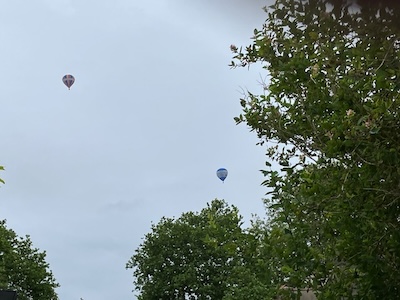
Without jettisoning all the relevant relations but also without a burdensome array of debt, I think I’m ready for a walk. A couple of mornings back, when someone all too few gardens away was learning to play ‘Johnny B. Goode’, I was a good deal readier but today, certainly at an early hour, there’s nothing louder than a blue tit close by and, further off, the occasional roar of propane burners firing as the two hot air balloons make sure that they’re well clear of the treetops in the park,
Hotter weather tends to make for weariness, certainly in those unaccustomed to it, like us in our northern temperate zone. It was hard to keep my eyes open on a recent trip down to Somerset by train, though driving probably wouldn’t have been much better (and a damned sight more hazardous). Judith Stinton once quoted Theodore Powys on motors and motoring: ‘A Journey in a motor car is the most tiring experience in the world . . . When I am tired all I feel fit to do is to stroke a cat’.[2] That I can do.
On that theme of tiredness: we have a General Election looming, its imminence evident from the increasingly desperate headlines in the right-wing press, as Jonn Elledge has noted:
https://www.newstatesman.com/politics/2024/06/the-tory-media-has-gone-into-meltdown
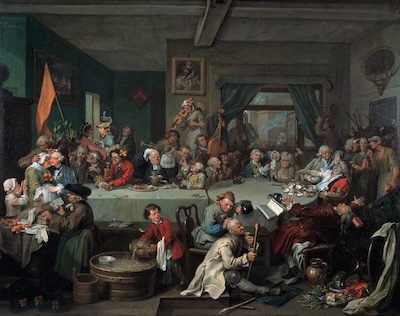
(William Hogarth, ‘An Election: 1. The Entertainment’: Sir John Soane’s Museums)
There’s a fairly general consensus that the present administration has failed utterly to honour the contract assumed to exist between government and governed, having trashed the public realm, lavished huge sums on the few at the expense of the many, and repeatedly attacked, dismantled or disparaged precisely those elements that distinguish a civilised society. Given the damage done and the importance of the contest, it seems a little strange that so much of the campaigning is so muffled – this is because neither of the two main parties can afford to be honest about the true state of the nation and what is needed even to begin to repair it. A while back, the – Tory – politician Rory Stewart, trying to define a picture of the country, came up with: ‘An economy 80 per cent based on elusive intangible services; buoyed by an improbable housing bubble, and entirely dependent for its health and care on immigrants, whom citizens seemed to wish to exclude.’[3] Not much has changed, unless for the worse. Yet with all that said, we are still in comparatively privileged conditions. It’s painfully obvious from the international news that a good many people, in several countries, some of them particularly surprising cases, have decided that fascism—which we thought a world war was largely fought to defeat—did not, after all, have a fair crack of the whip and deserves another go. Those people are doing their best, under various names and flags and guises, to give it that go now. And again, despite some disturbing recent domestic moves against democratic freedoms and the right to protest, we are still extremely unlikely in this country to be beaten, tortured or shot on account of being—or despite being—a medical professional, a journalist, a hospital patient, a poet, a photographer, a peace activist, a woman, a child, or simply someone of the wrong racial character.
(‘After such knowledge, what forgiveness?’ T. S. Eliot asked in another context.[4] To which the most probable answer is: ‘none’.)
To avoid the danger of overdosing on the pleasures of current affairs, I’m taking refuge in the extremely relaxing early eighteenth century when ‘[s]tealing anything worth more than a shilling carried the death penalty’ but, on the other hand, ‘It took only four days to go from London to York or to Exeter by stagecoach.’[5]
Those were the days. . .
Notes
[1] Henry Thoreau, ‘Walking’ (1862), in The Portable Thoreau, edited by Carl Bode (Harmondsworth: Penguin Books, 1979), 593. Emerson’s 1862 eulogy, ‘Thoreau’, included the observation that: ‘The length of his walks uniformly made the length of his writing. If shut up in the house he did not write at all.’ Ralph Waldo Emerson, Selected Essays, edited by Larzer Ziff (Harmondsworth: Penguin Books, 1982), 400.
[2] Judith Stinton, Chaldon Herring: Writers in a Dorset Landscape (Norwich: Black Dog Books, 2004), 41.
[3] Rory Stewart, Politics on the Edge: A Memoir from Within (London: Jonathan Cape, 2023), 360.
[4] T. S. Eliot, ‘Gerontion’.
[5] A ‘torrent of legislation’ after the Glorious Revolution of 1688 ‘raised the number of capital crimes from about fifty to over 200 by the turn of the nineteenth century.’ Lucy Moore, The Thieves’ Opera: The Remarkable Lives and Deaths of Jonathan Wild, Thief-Taker, and Jack Sheppard, House-Breaker (London: Penguin Books), 1998), ix, 188, 137.
 Reconstructionary Tales
You have been in great stride in your spring and summer installments–but you always are in great stride. Having now read you about your forthcoming election, I’m especially moved to write. To think of anywhere in the world where elections might be for the better! After Thursday night’s disaster here, with nothing but horror on the national horizon, I am ashamed to show my face (if only in type) outside the arena of home. O patria! quanto mi costi! And how much you cost the world!
As you say sanely about the UK, however, things are bad but not as bad as they might be, or even as they are thought to be. The same I suppose for the U.S. Nevertheless, we are overwhelmed by a culture-wide pathology. The two cures in sight–Biden’s resignation and Trump’s death–won’t be realized.
Robert
LikeLike
Thank you, Robert, good to hear from you.
Yes, I rarely stray into pronouncing on US politics, feeling very much the outsider peering in, partly because of my bafflement (shared by many in this country, I suspect), as to why Trump is allowed to stand at all – and, frankly, why he isn’t already behind bars. Things to do look very grim there, the former Republican party having turned into something quite other, and conversations among Democrats taking place now that should have taken place at least three years ago.
I hope at least for better news here soon – and something less than catastrophe in France.
All best,
Paul
LikeLike
Our 18th century Constitution-makers were too rational to imagine this wreckage. At the same time the legal “reasonings” that protect Trump prove Bottom right: “The law is a ass.” Tomorrow the Supreme Court will at last condescend to tell us just how much immunity Trump will have for his multiple crimes–and whether or not post-victory he can pardon himself.
Meanwhile, may fair stand the winds for France–may at least a few of them be fair.
Onward (so to speak!)
Robert
LikeLike
Ah, bad news from France; and bad news from a – what’s the restrained word? – ‘partisan’ Supreme Court. We don’t need a weatherman to know which way the wind blows. But it really must change soon – mustn’t it?
All best,
Paul
LikeLike
I don’t know how the winds can change now. The Supremes’ ruling today means Trump won’t be prosecuted for Jan. 6. Biden’s refusal to step down will make Trump’s victory all but sure. I suppose we can all keep whistling in the dark, but it’s not a soothing occupation. I and my fellows must try to go on working at anything good that we do. Your posts are always heartening, no matter the political weather!
LikeLike