

Strange days. Even to say so is to provoke suspicions of glimpses into the bleeding obvious. But strangeness there is, the compass broken and the maps all wrong.
Writing to Eudora Welty in July 1969, the novelist and editor William Maxwell told her of offering to let his elder daughter Kate, then fifteen, read a lot of the letters he’d received. He added: ‘And maybe I will, as a result, not be the mystery to her that my parents are to me, but more than likely it won’t change anything. It takes a great deal to change things. In a better way, I mean. To change things for the worse, all you need is somebody like Nixon, and there are plenty like him.’[1]
Watching a news programme earlier this month, I saw a clip of Nixon explaining to a bemused David Frost—unsurprisingly bemused since Nixon had no justification at all then for claiming this—that, whatever a president did, it couldn’t be illegal, by definition.
Rather more recently, of course, a stacked Supreme Court has thrust yet another blade into the guts of the republic.
I began writing a post around the time of the British general election but was overtaken, as they say, by events. When the last results were coming in early on the Friday morning, it was clear that, after so many years of other countries viewing us with sympathy or disbelief or disdain, we had a distinct possibility of edging at least in the direction of honesty or sanity or some other unfashionable trait. The irony adhered in the fact that while we had pulled ourselves out of a ditch after a decade and half, some of those same countries seemed hellbent on hurling themselves into it. Thankfully, France has since pulled back to slightly firmer ground, though remaining unsettlingly close to the edge.
Watching the election, I flagged a little around 3 a.m. but rallied at the prospect of seeing some of the more appalling figures in the Tory ranks ditched. Some clung on but there were certainly highlights, particularly the member for North East Somerset being sent home to Nanny and seeing the shortest-serving British Prime Minister do to a 26,000 majority (2019) roughly what she’d done to the country. So, however brief or prolonged the respite it promises, that interesting Fourth of July turned out to be our Independence Day. It must have appeared a great deal less so in the United States,
Since then, a European football competition that grabbed wide attention, a botched assassination attempt on a former president of the United States, the usual murders, atrocities, coups, crises and catastrophes.
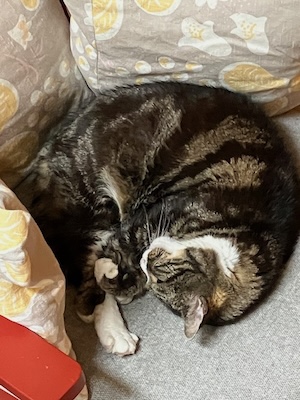
But for us, here, drowning out all that, the critical illness of an irreplaceable member of our household. Then the trips to the vet, the phone calls, the fraught conversations, the broken sleep, the agonised weighing of options. And now the weeks of ghost steps on the stairs, of puzzling shadows at the corners of your eyes, of strident silences and oddly empty spaces, because a light has gone out of our world.
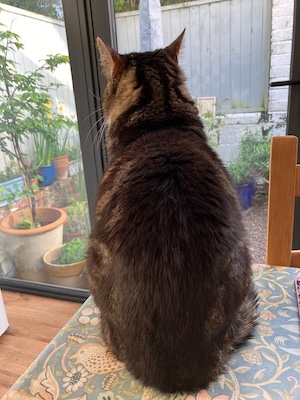
Harry the Cat has left the building.
Notes
[1] Suzanne Marrs, editor, What There Is to Say, We Have Said: The Correspondence of Eudora Welty and William Maxwell (Boston and New York: Houghton Mifflin Harcourt, 2011), 259.


Held up by personal and public crises, I am belated in sending you sympathy for your cat’s departure. I can well imagine the loss it is to you and the Librarian.
I see that you have posted another Tale, and will save “politics” for a response to that one.
Robert
LikeLike