
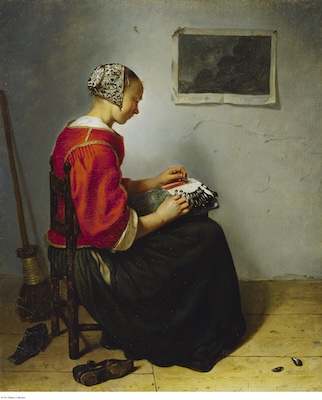
(Caspar Netscher, The Lace Maker, Wallace Collection)
‘In a mid-September twilight’, Ford Madox Ford writes, remembering himself as Second Lieutenant in September 1916, ‘the rain poured down on Pont-de-Nieppe.’ He is bothered by his wet shirt-cuffs and the man assigned to him as temporary batman has clearly decided that Ford is not a man who can be safely left and, ‘though he must have been uncommonly wet and hungry and tired, he followed me to the door of the house in whose dark windows I had seen the luminous patch—the forehead of Rosalie Prudent as she sat sewing, her head bent forward, in the twilight.
‘I don’t know how it is: but from the moment when I first saw that highlight—and it had been certainly three hours before—I had been perfectly sure that that was what it was—the forehead of a quiet woman bending her head forward to have more light from the high window whilst she sewed in the dusk.’
This is Rosalie Prudent of Pont-Nieppe, who has lost her house, her husband and her sons, and is one of the most significant figures that Lieutenant Ford Madox Hueffer—a man at the end of his tether and a writer who cannot write—will encounter during the war. She will sit by the stove in the wash-house, sewing his wristbands. She will cook him an omelette and fried potatoes, talk to his orderly and, ‘looking at Mme. Rosalie—so extremely centred in the work in hand, so oblivious to the very real danger, so brave and so tranquil, I said to myself:
“What the devil! If she can stick it, I too can!”’[1]
And he will. He is one young Australian artist and one five shilling a week cottage away from salvation: ‘The dusk was falling as I approached my isolated, sixteenth century abode that had a leaky, red-tiled roof and defective diamond-framed casements. It stood under a darkling bank. . . . And you think that the half-crown dog was an extravagance! I assure you that he was not. The floors sagged, the paper fell in scrolls from the walls. There was more than a bushel’s bulk of starling’s nest in the downstairs ingle.’[2]
Back in the day—ah, those days—I read, as did half the people I knew at the time, the books of Carlos Castaneda or, at least, the first three or four. Much of it, even the unfolding controversy, is a little cloudy now, but I do recall the assertion that: ‘The twilight is the crack between the worlds.’ Or rather, I recalled it as I made my way around the park a day or two back as the light slipped further down into its last phase before incontrovertible darkness.
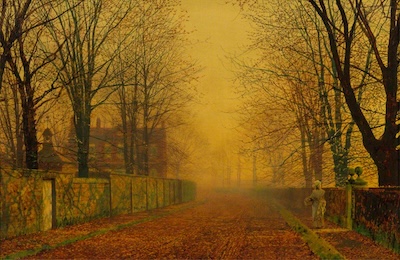
(John Atkinson Grimshaw, Evening Glow: Yale Center for British Art)
If that is in fact the case, some of the denizens of that other world are a little unsettling. As is, of course, the possibility that I myself am, in fact, an inhabitant of the ‘other’ world.
There seem to be more people than usual devoting their time to shouting into phones or at dogs, heard rather than seen, or glimpsed between branches or benches. A man wearing a cloth cap and an alarming neck tattoo scatters broken biscuits from a bag as he walks, to more than a dozen crows and one slightly shifty magpie (‘Yeah, I’m a crow. Who’s asking?’). A second man passes me, marching like a robot, legs thrown out, with a can of beer gripped in each outstretched hand; a teenaged schoolgirl, one of three, having an emotional moment, turns her tearstained face away from me as I pass and one of her friends says: ‘I didn’t meant to hurt you, Lily, but you shouldn’t have said—‘. And on an upper path, a woman running towards me; I cross over to make room for her; she smiles and turns sharply into the play area ten yards ahead, to crouch in front of a swing on which her child is sitting, watched over by a friend.
Vladimir Nabokov mentions ‘soomerki—the lovely Russian word for dusk.’[3] It is, or can be, oddly different, the air itself a different texture or the mind made more receptive to such notions by the slippage in other senses: sounds half-heard and harder to locate, things not quite seen. A Golden Labrador with one of those illuminated collars races through a thick ribbon of trees that borders a lower path, a ghost dog that has me wracking my brains to come up with Jim Jarmusch’s 1999 film, Ghost Dog: The Way of the Samurai, with Forest Whitaker as the hitman. A group of dog-owners I passed earlier did look and sound like contract killers but that may have been down to the special sound qualities of this twilight zone.
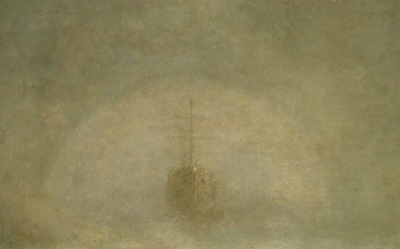
(G. F. Watts, A Sea Ghost: Watts Gallery – Artists’ Village)
‘It is the magic hour’, Lawrence Durrell wrote, ‘between two unrealized states of being—the day-world expiring in its last hot tones of amber and lemon, and the night-world gathering with its ink-blue shadows and silver moonlight.’[4] The colours may be a little different in Corfu, as emotional responses might have been a little more accentuated in Emerson’s nineteenth-century New England: ‘Crossing a bare common, in snow puddles, at twilight, under a clouded sky, without having in my thoughts any occurrence of special good fortune, I have enjoyed a perfect exhilaration. I am glad to the brink of fear.’[5]
Richard Garnett (father of Edward and Olive, father-in-law of Constance) wrote about The Twilight of the Gods (as did Richard Wagner); Nietzsche wrote about the Twilight of the Idols; D. H. Lawrence wrote of Twilight in Italy; Edith Wharton was concerned with Twilight Sleep; a volume of Conan Doyle stories was called Tales of Twilight and the Unseen. ‘I drove carefully’, the private eye Lew Archer says, ‘feeling a little depressed, stalled in the twilight period when day has run down and night hasn’t picked up speed.’[6]
We’re just a week away from the winter solstice, the shortest day, the longest night. Beyond that date, of course, the days get longer, inch by inch. Grounds for optimism, some say. And why not? Just mind the cracks—and, of course, those worlds.
Notes
[1] Ford Madox Ford, No Enemy (1929; edited by Paul Skinner, Manchester: Carcanet Press, 2002), 117, 127, 124.
[2] Ford Madox Ford, ‘Rough Cookery’, New York Herald Tribune Magazine (29 July 1928), 18.
[3] Vladimir Nabokov, Speak, Memory: An Autobiography Revisited (New York: Putnam’s, 1966), 81.
[4] Lawrence Durrell, Prospero’s Cell (London: Faber 1962), 105.
[5] Ralph Waldo Emerson, ‘Nature’, Selected Essays, edited by Larzer Ziff (Penguin American Library, 1982), 38.
[6] Ross Macdonald, The Moving Target (1949; Warner Books, 1990), 98.
 Reconstructionary Tales
When the twilight began to intensify November 5 (and when the chasm–not a mere crack–between past and present gaped open), I felt for a while incapable of communicating. I suppose I’m recovering. I certainly want to send you good wishes for the season and for 2025. Your “Reconstructions” are always heartening, always renewing.
Meanwhile, I avoid all visual news media like the plague, although I read New York Times headlines on my phone. The columns beneath the headlines are mere chatter–like just about everything else (except killing and maiming) that claims to be of “public” import. It seems downright silly to keep up with “reports” of a world that is so clearly committed to destruction and unreality.
Ford is far more real than most other apparitions in the life-fog.
Gratefully,
Robert
LikeLike