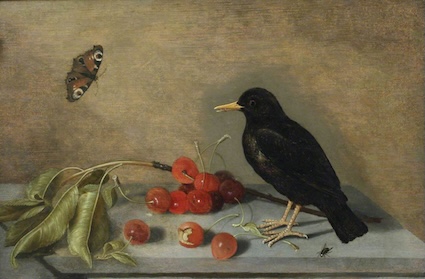
(Ambrosius Bosschaert the Younger, A Blackbird, Butterfly and Cherries: National Trust, Ham House)
04:30 and the blackbird already in full song. Not conducive to much further sleep but fine music. The same bird or a different one has several times come down to pick up grubs from pots ranged against the walls. Writing of the disappearances from the natural world over the past decades, Richard Mabey mentions smaller gnat swarms and choruses of blackbirds, and the barn owls gone.[1] And it’s true that we never hear such choruses now: it is almost always a solitary blackbird.
Guy Davenport remarks on ‘Gracchus’, meaning ‘grackle’ or ‘blackbird’; in Czech, kavka. And that Franz Kafka’s father had a blackbird on his business letterhead.[2] I recall that Davenport used ‘Grackle’ in ‘The Messengers’, his fourth story about Kafka (after ‘The Aeroplanes at Brescia’, ‘The Chair’ and ‘Belinda’s World Tour’). The writer is asked his name by the household god:
‘My name? Why, it’s Amschel. I mean, Franz. By the world, I am Franz Kafka.’
‘A kavka is a jackdaw.’
‘A grackle. Graculus, in Latin a blackbird.’
‘Yes.’[3]
I see that yesterday was Allen Ginsberg’s birthday, just one short of a centenary. Dear Ginsberg. I saw him read a couple of times, too many years ago, and the phrase ‘what thoughts I have of you’ came into my mind quite recently, remembering then: ‘What thoughts I have of you tonight, Walt Whitman, for I walked down the sidestreets under the trees with a headache self-conscious looking at the full moon.’
That poem ends: ‘Ah, dear father, graybeard, lonely old courage-teacher, what America did you have when Charon quit poling his ferry and you got out on a smoking bank and stood watching the boat disappear on the black waters of Lethe?’[4]
Whitman’s America, opening out; Ginsberg opening, broadening, welcoming. A decade or so later and he calls on Whitman again, this time with a long quotation from Democratic Vistas as epigraph to the collection called, ah, The Fall of America.
Here we are. And here we are.
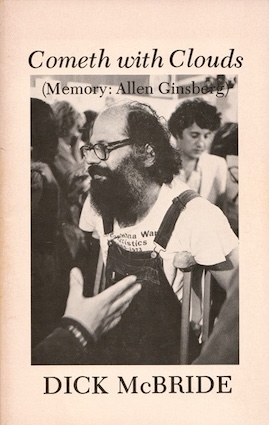
Back then too, in my early bookselling days, was Dick McBride, poet, playwright, actor, bookseller, publisher, former manager of City Lights Bookshop, having been introduced to Lawrence Ferlinghetti by poet, painter and novelist Kenneth Patchen. Dick was living in England then, distributing American small press books (and not so small: New Directions for a while)—a cottage in Great Horwood, Buckinghamshire, and an abandoned Victorian Methodist chapel for a warehouse. On my shelves is a copy of Cometh with Clouds (Memory: Allen Ginsberg), inscribed to me by Dick and dated July 14, 1983. It was published the previous year by Cherry Valley editions. I think I have a few of his other books, Lonely the Autumn Bird: Two Novels and Memoirs of a Natural-Born Expatriate were issued by Alan Swallow, and also The Astonished I, published by, ah, McBride’s Books.
Looking for online traces of Dick all these years later, I find more than I’d expected, on the Allen Ginsberg Project site and, particularly, a fine website created (and ongoing) by Rob McDowall: https://dickmcbride.co.uk/
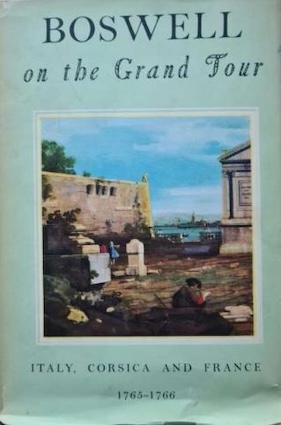
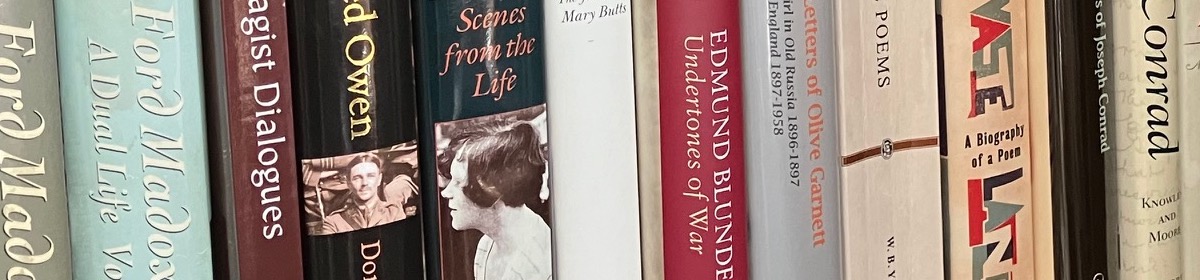
I am currently with James Boswell in Italy, Dorothy Parker in New York, and Ford Madox Ford more or less anywhere, generally in either Paris or New York, though occasionally in Corsica or Carqueiranne. Also, just now, with Stella Bowen in Italy, where she is travelling with Dorothy Pound, looking at pictures, while Ezra ransacks the archives to find material for the Malatesta Cantos. Quite unable to rely on so much of the world to refrain from barbarism and conduct its affairs with decency, intelligence or basic humanity, I’m happy enough to be elsewhere in quite other temporal locations.
Poor Boswell lectures himself on his conduct almost daily but then argues with his companions, pursues a married countess or takes himself off to the nearest working girl. A ‘fille charmante’, about seven shillings. Also, ‘“Des filles” in the next three days ran to thirteen shillings.’ He seems strikingly subject to venereal disease too. After his triumphant forays into the lives of Jean Jacques Rousseau and Voltaire, Boswell is travelling with a party that includes Lord Mountstuart, son of Lord Bute, and has secured the friendship of John Wilkes, who (perhaps not an ideal model for young Boswell) takes the view that ‘dissipation and profligacy renew the mind’, he having written his best issues of his newspaper The North Briton (founded to attack Prime Minister Lord Bute) while ‘in bed with Betsy Green’.[5]
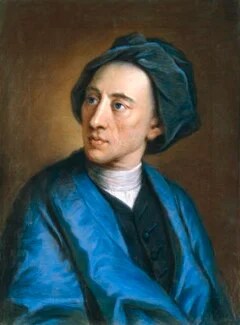
(Alexander Pope by William Hoare: National Portrait Gallery)
From time to time, I also try to get back more into the eighteenth-century frame of mind with some Pope – Alexander, to avoid any possible confusion, recalling an occasion not so long ago when I asked the Librarian what she was watching. ‘A bit of Pope’, she said. I looked into the front room and saw a blaze of red, cardinal red, you might say. Boswell, in an earlier journal, had recounted an evening including the poet’s work, which was not, however, quite enough to save the occasion: ‘The night before I drank tea and sat all the evening writing in the room with my landlord and landlady. They insisted that I should eat a bit of supper. I complied. I also drank a glass of punch. I read some of Pope. I sung a song. I let myself down too much. Also, being unaccustomed to taste supper, my small alteration put me out of order. I went up to my room much disgusted. I thought myself a low being.’[6]
Having actually taught Pope to unfortunate students many years back, I’m surprised to find I have to make a stern and conscious effort to stick with him, uneasily recalling W. H. Auden’s remark (8 January 1947) to Alan Ansen: ‘The real test of liking English poetry is Pope. His ideas aren’t much, but the language is wonderful—“Chicane in furs.” The Rape of the Lock is the most perfect poem in English.’[7] Or, indeed, Hugh Kenner, reviewing Maynard Mack’s life of the poet: ‘The great danger of absorbing writers’ biographies is that you can begin to think you understand writing you’ve not troubled to come to terms with.’[8]
I like to think of Gilbert White being presented with a copy of Pope’s six-volume translation of the Iliad by the poet himself, when graduating with distinction from Oriel College, Oxford, in 1743.
In Pope’s ‘Epistle to Burlington’, I see a neat encapsulation of pre-Romantic sensibility:
‘In all, let Nature never be forgot.
But treat the Goddess like a modest fair,
Not over-dress, nor leave her wholly bare;
Let not each beauty ev’ry where be spy’d
Where half the skill is decently to hide.
He gains all points, who pleasingly confounds
Surprizes, varies, and conceals the Bounds.’
And elsewhere a remark that never goes out of date, alas:
‘But when to Mischief Mortals bend their Will,
How soon they find fit Instruments of Ill!’ (‘Rape of the Lock’, Canto III).
Notes
[1] Richard Mabey, Nature Cure (London: Chatto & Windus 2005), 134.
[2] Guy Davenport, The Hunter Gracchus and Other Papers on Literature and Art (Washington: Counterpoint, 1996), 2.
[3] Guy Davenport, The Cardiff Team: Ten Stories (New York: New Directions, 1996), 2.
[4] ‘A Supermarket in California’, in Allen Ginsberg, Selected Poems 1947-1995 (London: Penguin Books, 2001), 89.
[5] Boswell on the Grand Tour: Italy, Corsica and France, 1765-1766, edited by Frank Brady and Frederick A. Pottle (London: William Heinemann, 1955), 54n., 58n.
[6] Sunday 19 December 1762: Boswell’s London Journal, 1762-1763, edited by Frederick A. Pottle (London: William Heinemann, 1950), 95.
[7] Alan Ansen, The Table Talk of W. H Auden, edited by Nicholas Jenkins (London: Faber and Faber, 1991), 15-16.
[8] Hugh Kenner, ‘Maynard Mack’s Pope’, Historical Fictions (Athens: University of Georgia Press, 1995), 250.
 Reconstructionary Tales