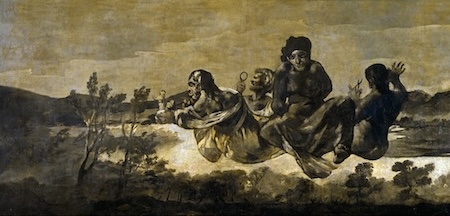
(Francisco Goya, Las Parcas: Atropos, or The Fates: Prado, Madrid)
‘Words of grief become almost meaningless in these days, they have to be used so frequently. But one does not feel any the less. Sorrows do not grow lighter because they are many.’[1]
Sitting in the kitchen, turning away from the seemingly endless and indiscriminate slaughter of civilians in Gaza and the West Bank, now extended to Lebanon, watching the rain or the gaps between the rain, I hear the Librarian coming into the kitchen, to announce another day of being baffled by the news that the American election is still ‘on a knife-edge’, the candidates ‘neck and neck’, when one of those candidates is evidently unhinged. ‘At his rallies, he just comes on and talks complete nonsense for fifty minutes.’ Similarly bewildered by this, I find it oddly reassuring that it’s not just non-Americans, looking in or on from outside, that share such feelings. Eliot Weinberger, whose devastating What I Heard About Iraq I still recall from nearly twenty years ago, summarises the matter with characteristic skill, in a piece dated 13 September:
‘It seems incredible that almost half the country still supports Trump, despite the felony convictions, the porn stars, the blatant graft, the endless lies, the allegations of assault and rape, the 6 January insurrection, the continuing refusal to accept his defeat in 2020, the classified documents in his bathroom at Mar-a-Lago, the vows to prosecute all his many enemies, including journalists, and to fire everyone in the government bureaucracy who is not loyal to him, the claims to dictatorial power. Even more incredible is that there is a slice of the voting population that is still “undecided”. Republican legislatures in various states have already set in motion procedures to keep people from voting and to deny the results if Trump loses’.[2]
There is, indeed, a report, more than one report, about highly suspect practices and preparations, changes of rules and the like, with reassuring headlines such as ‘Network of Georgia election officials strategizing to undermine 2024 result’: https://www.theguardian.com/us-news/2024/sep/18/trump-election-georgia
I know there are Americans who believe wholeheartedly that the moon landings were faked and patched together in a Hollywood back lot, while others know for a certainty that giant lizards are the true masters of the world but seeing, back in the summer, footage of men and women at political rallies with wads of fabric or nappy liners stuck to the sides of their heads was somehow in another dimension: irrefutable, painfully visible, undeniably and palpably there. A full-throttle alternative reality in operation, for sure, and believable enough that it might be swallowed by a few hundred, even a few thousand. But millions? And all in tune with what used to be a major and mainstream political party?
‘It is very extraordinary’, John Dowell reflects as he looks at the mad Nancy, ‘to see the perfect flush of health on her cheeks, to see the lustre of her coiled black hair, the poise of the head upon the neck, the grace of the white hands—and to think that it all means nothing—that it is a picture without a meaning.’[3] We are frequently confronted either by pictures that may really have no meaning—in the sense of a rational, graspable, ideally paraphrasable, meaning—or have a meaning that cannot be understood, either because we lack the necessary contextual information or because removal from the immediate experience is required, granting us distance, perspective, the means by which to find the edges, the boundaries, and thus the true extent of what we have witnessed.
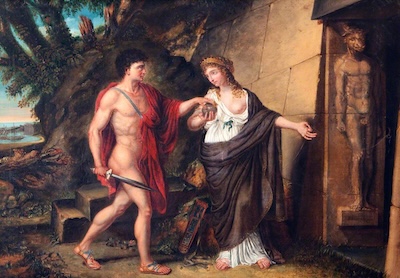
(Richard Westall, Theseus and Ariadne at the Entrance of the Labyrinth: North Lincolnshire Museums)
Edmund Blunden recalled the sight of flares on the Ypres battlefield on New Year’s Eve, 1917: ‘Their writing on the night was as the earliest scribbling of children, meaningless; they answered none of the questions with which a watcher’s eyes were painfully wide.’[4] A considerable number of people stared uncomprehendingly at the clay tablets Arthur Evans had unearthed at Knossos before the researches of Alice Kober and Michael Ventris eventually led to an understanding and decipherment of Linear B.
‘The contemporary is without meaning while it is happening’, Guy Davenport remarked, ‘it is a vortex, a whirlpool of action. It is a labyrinth.’[5] And Hugh Kenner remembered Wyndham Lewis observing that ‘The present cannot be revealed to people until it has become yesterday.’[6]
Some parts of the present, surely; and to some people. Historians will, we accept quite conventionally, see more—though in some cases, or in some senses, less. There is, after all, an increasingly clear and present danger now not only of misinformation being manufactured and widely (and rapidly) disseminated but also of witnesses being silenced (often permanently), of evidence being systematically destroyed, of commentary and analysis being censored or concealed. And yet, while it’s true that we are all in the labyrinth and that the Minotaur is real – some people, I persist in believing, still have hold of that crucial thread.
Notes
[1] Vera Brittain, Chronicle of Youth: Vera Brittain’s Diary 1913-1917 (London: Gollancz 1981), 206.
[2] Eliot Weinberger, ‘The Debate’, London Review of Books, 46, 18 (26 September 2024), 8.
[3] Ford Madox Ford, The Good Soldier: A Tale of Passion (1915; edited by Max Saunders, Oxford: Oxford University Press, 2012), 192.
[4] Edmund Blunden, Undertones of War (1928; Harmondsworth: Penguin, 1982), 234.
[5] Guy Davenport, ‘The House That Jack Built’, in The Geography of the Imagination (Boston: David R. Godine, 1997), 56.
[6] Hugh Kenner, The Pound Era (London: Faber and Faber, 1972), 436.





 Reconstructionary Tales