There not there


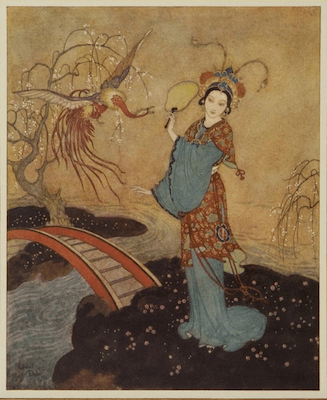
(Edmund Dulac, Frontispiece to Princess Badoura: A Tale from The Arabian Nights, by Laurence Housman)

‘The things you think of to link are not in your control. It’s just who you are, bumping into the world. But how you link them is what shows the nature of your mind. Individuality resides in the way links are made.’[1]

Bumping into the world, I noticed yesterday that I was reading A. S. Byatt on what would have been her 88th birthday. More, in the volume’s longest story, was the sentence: ‘And she waited for the sound of thunder, or worse, the silence of absence.’[2] I was struck (or bumped against) by that last phrase, having been thinking recently in similar terms. Sometimes the silence here is indeed the dictionary’s ‘absence of sound; complete quietness’ – but often something more. Silences have their own flavours, idiosyncrasies, tones, strengths and essences.

‘Throughout the house’, Patrick White wrote in  his story ‘The Night the Prowler’, ‘there were the sounds of furniture, and clocks, and silence.’[3] It has to be said that furniture was often on his mind, not least in populating Theodora Goodman’s world: ‘There is perhaps no more complete a reality than a chair and a table’ – though he adds there: ‘Still, there will always also be people, Theodora Goodman said, and she continued to wait with something of the superior acceptance of mahogany for fresh acts.’[4] When the painter Hurtle Duffield meets a man named Mothersole on the ferry, the printer asks what sort of things Duffield paints. ‘“Well! For some time now, tables and chairs.”’ Mothersole finds it a ’funny sort of subject’ and Duffield responds: ‘“Why? What could be more honest?”’[5]

There must be vastly fewer ticking clocks in the world now, timepieces having been widely and inescapably recruited to the cause of at least electronic silence. Ticking is a disturbing anomaly in this grave, enslaved new world. My maternal grandfather once owned several fish and chip shops in Portsmouth but, by the time I was of an age to notice such things, he had become a jeweller and watchmaker. The clocks that had audibly populated so much fiction through several centuries still kept the faith in his shop. He even had, at one point and appropriately enough, a grandfather clock. Ticks, tocks and chimes galore.
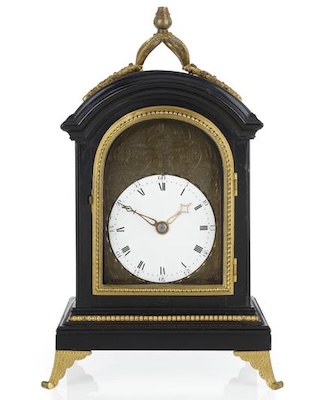

(The Clockmakers’ Museum. Musical table clock by Thwaites for Barraud. L2015-3473 Science Museum Group Collection Online.)

Thinking of silence, then, we often think of absence too, perhaps of the old saying that ‘absence makes the heart grow fonder’ (or, as I once heard someone—probably of a poetic turn of mind—say, a few drinks in: ‘Absinthe takes the art au fond-er’). Old sayings, though. People sometimes ask: are they true? To which the answer is, can only be, it depends. For some yes, for others no.

Absence can be a source of amusement, an occasion for pleasure. Rudyard Kipling’s parents (John Lockwood Kipling and Alice Macdonald) were unable to attend a party given by Dante Gabriel Rossetti because the date of their sailing on the S. S. Ripon to Bombay had been brought forward by a day, to Wednesday 12 April, 1865. ‘In their absence, however, Ford Madox Brown proposed their health, in a speech throughout which, with his usual inability to remember names, he referred to the bridegroom as “John Gilpin”—to the delight of all present.’[6]

Annie Erneaux, though, recalled literally writing out her passion in Florence, being temporarily removed from an intense and wounding affair: ‘Those eight days on my own, without speaking, except to waiters in restaurants, haunted by the image of A. (to the extent that I was astonished to be accosted by men, could they not see him silhouetted inside my own body?) seemed to me an ordeal for the betterment of love. A sort of further investment, this time to imagination and craving through absence.’ And elsewhere she stated that:  ‘It is the absence of meaning in what one lives, at the moment one lives it, which multiplies the possibilities of writing.’[7]
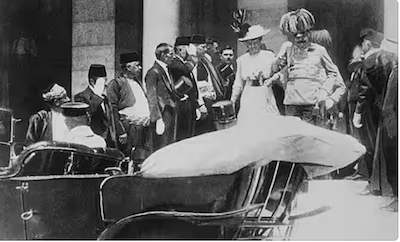

(Franz Ferdinand & Sophie. Photograph: Bettmann/Corbis via The Guardian)

When Stanley Weintraub wrote about the guns falling silent at the end of the First Word War, his book’s title, A Stillness Heard Round the World, looked back both to Ralph Waldo Emerson’s ‘Concord Hymn’, which included the phrase ‘the shot heard round the world’ and the fact that Emerson’s phrase has often been applied to the shot that began the war, fired at the Austrian Archduke Franz Ferdinand by Gavrilo Princip, who killed both the Archduke and his wife Sophie on 28 June 1914. The significance of that incident was not widely grasped and reports of it were often to be found on the inner pages of the following day’s newspapers – a squabble in the Balkans! – but since then a great deal of writing about it has certainly been found possible.

Marcel Proust observed that ‘the absence of a thing is not merely that, it is not simply a partial lack, it is a disruption of everything else, it is a new state which one cannot foresee in the old.’[8] We can, in fact, often foresee that absence, we grasp its inevitability, not least the inescapable end of every living thing but of course that single fact is not, cannot be, all there is. We distinguish between ‘surprise’ and ‘shock’ for a reason. Our awareness that something is coming, will inevitably happen, does not provide a thorough preparation for the event and its aftermath. Some effects are unscripted.

‘There is a time in life when you expect the world to be always full of new things’, Helen Macdonald wrote. ‘And then comes a day when you realise that is not how it will be at all. You see that life will become a thing made of holes. Absences. Losses. Things that were there and are no longer. And you realise, too, that you have to grow around and between the gaps, though you can put your hand out to where things were and feel that tense, shining dullness of the space where the memories are.’[9]
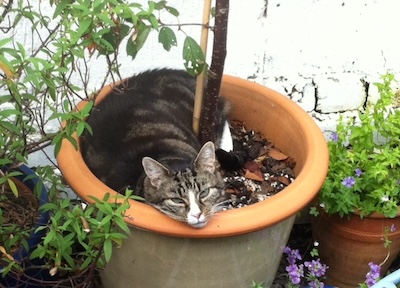

Yes. As Sarah Moss wrote, ‘One does not need to see ghosts, to know that people are haunted.’ And, a little further on: ‘It is not ghosts but absence that is harder to bear.’[10]


Notes

[1] Anne Carson, Paris Review interview (2004), quoted by Jennifer Krasinski in her review of Carson’s Wrong Norma in Bookforum, 30, 3 (Winter 2024), 13.

[2] A. S. Byatt, ‘The Djinn in the Nightingale’s Eye’, in Medusa’s Ankles: Selected Stories (London: Vintage, 2023), 256.

[3] Patrick White, ‘The Night the Prowler’, in The Cockatoos: Shorter Novels and Stories (London: Jonathan Cape, 1974), 149.

[4] White, The Aunt’s Story, (1948; Harmondsworth: Penguin Books, 1963), 141.

[5] White, The Vivisector (London: Jonathan Cape, 1970), 420.

[6] Roger Lancelyn Green, Kipling and the Children (London: Elek, 1965), 20, citing Georgiana Burne-Jones, Memorials of Edward Burne-Jones (1904), I, 290.

[7] Annie Erneaux, Simple Passion, translated by Tanya Leslie (London: Fitzcarraldo Editions, 2021), 33; A Girl’s Story, translated by Alison L. Strayer (London: Fitzcarraldo Editions, 2020), 143.

[8] Marcel Proust, In Search of Lost Time. 1: The Way By Swann’s, translated by Lydia Davis (London: Allen Lane, 2002), 308.

[9] Helen Macdonald, H is for Hawk (London: Jonathan Cape, 2014), 171.

[10] Sarah Moss, Signs for Lost Children (London: Granta Books, 2016), 64, 86.
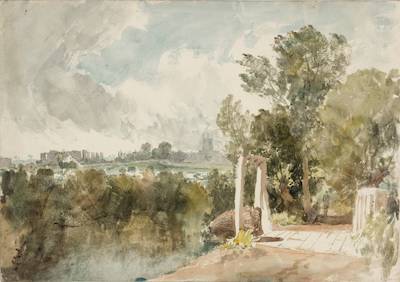
Infinite presents


(J. M. W. Turner, A Church and Village seen from a Riverside Footpath: Tate)

I was thinking about—or idly musing upon—the infinite, arrived at by the usual wandering off footpaths. Decanting a packet of ground coffee into the regular tin, I was prompted by the resulting level to look at the net weight printed on the packet. It had lessened by some ten per cent, diminished by one-tenth (‘No, we haven’t put our prices up’). But then there has been, inevitably, a strong and widespread sensation of lessening, of shrinkage over the past few years. The narrowness of nationalist discourse, the closing of borders, the hostility to refugees and migrants, together with the pandemic, lockdowns, withdrawals either voluntary or enforced, now a metaphorical or literal huddling together against cold, hunger, discomfort, all in worsening weather.

Often placed against that diminishment are, precisely, ideas of freedom, expansion, movement through time and space. Art, then, or memory, or history, or imagination. Borders, walls, boundaries, limits of any kind set aside, evaded, vaulted over. The infinite – notions of which can swing to both positive and negative poles, depending on the viewer.

I thought of Ford Madox Ford recalling his ‘most glorious memory of England’, in the 1890s, hundreds of Jewish refugees from the Russian pogroms, landing at Tilbury Docks, falling on their knees and kissing the sacred soil of Liberty. ‘It was not of course because they were Jews or were martyrs. And I daresay it was not merely because England was my country. It was pride in humanity.’ But because of ‘an Order in Council’, that route would now be narrowed or blocked: ‘This then was the last of England, the last of London . . .’ And: ‘One had been accustomed to think of London as the vastest city in the world . . . as being, precisely, London, the bloody world!’ But now? ‘Ease then was gone; freedom was no more; the great proportions were diminished . . .’[1]


(Samuel Taylor Coleridge via the BBC)

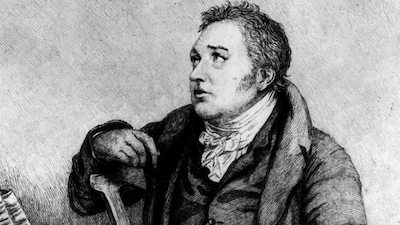
One of the most famous instances of infinitude is that of Samuel Taylor Coleridge, in Chapter XIII of the Biographia, where he summarises his distinction between imagination and fancy: ‘The primary IMAGINATION I hold to be the living Power and prime Agent of all human Perception, and as a repetition in the finite mind of the eternal act of creation in the infinite I AM.’[2] This was one of the main targets of another, later, celebrated statement, by T. E. Hulme: ‘Here is the root of all romanticism: that man, the individual, is an infinite reservoir of possibilities’ – against which, Hulme’s version of the classical: ‘Man is an extraordinarily fixed and limited animal whose nature is absolutely constant. It is only by tradition and organisation that anything decent can be got out of him.’[3]

Hulme was primarily a philosopher – a poet only in miniature. I suspect that artists generally tend more towards embracing the positive than feeling repelled or threatened by the negative. ‘We must consume whole worlds to write a single sentence and yet we never use up a part of what is available’, James Salter wrote to Robert Phelps. ‘I love the infinities, the endlessness involved . . . ’[4] Laura Cumming, writing in praise of Jan Van Eyck, observed that: ‘His art is so lifelike it was once thought divine. But he does not simply set life before us as it is – an enduring objection to realism, that it is no more than mindless copying – he adjusts it little by little to inspire awe at the infinite variety of the world and our existence within it; the astonishing fact that it contains not just all this but each of our separate selves.’[5]

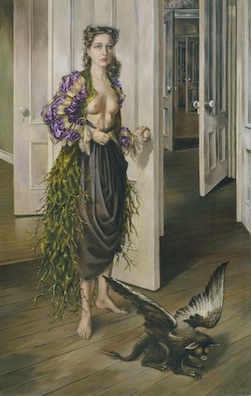
In an entry dated ‘[Saturday 24 November 1984]’, Annie Ernaux wrote: ‘One image haunts me: a big window wide open and a woman (myself) gazing out at the countryside. A springtime, sun-drenched landscape that is childhood. She is standing before a window giving onto childhood. The scene always reminds me of a painting by Dorothea Tanning – Birthday. It depicts a woman with naked breasts: behind her, a series of open doors stretch into infinity.’[6]


(Dorothea Tanner, Birthday (1942): Philadelphia Museum of Art)

Is that a wish to see the world, one’s personal world, as an unending series of opened doors? Or simply an observation, a belief, a conviction that this is how the world actually is, that much of what we assume to be fixed, unalterable, closed, finite, is nothing of the sort? Some observers, actors, participants, acknowledge the infinite nature of ideas, of the abstract but, certainly in specific circumstances—the Second World War, in the case of Ronald Duncan, pacifist and farmer—choose to turn away from them: ‘We were people used to dealing with ideas which are infinitely pliable, and for the first time were in contact with things which are rigid, brittle’, Duncan wrote. ‘Contact with things is infinitely more satisfying than contact with ideas. And if we are honest we must admit that few of us are capable of holding abstract conceptions in our heads. If we manage it, it gives us little pleasure. Somehow or other we have fallen into the rot of thinking that pigs and poetry are incompatible. They are not.’[7]

Pigs and poetry. Why, yes. In immediate postwar Sussex, Ford Madox Ford bred pigs and wrote poetry—A House (1921), Mister Bosphorus and the Muses (1923)—though, admittedly, the pigs died or had to be sold off at bacon prices when Ford and Stella Bowen moved to France. Staying in the realm of the abstract—or more abstract, at least, than pigs—I think of Sarah Churchwell, already author of a book on Fitzgerald and the world of Jay Gatsby, writing in 2018: ‘Gatsby’s famous ending, in other words, describes the narrowing of the American dream, from a vision of infinite human potential to an avaricious desire for the kind of power wielded by stupid white supremacist plutocrats who inherited their wealth and can’t imagine what to do with it beyond using it to display their dominance.’[8]

There are, though, different kinds of dominance, some more insidious than others, habits so ingrained as not to be seen any longer as habits, procedures so immediate, so automatic, so normalised as to seem – natural. Annie Ernaux has written of the worldwide web as ‘the royal road for the remembrance of things past’ and adds: ‘Memory became inexhaustible, but the depth of time, its sensation conveyed through the odour and yellowing of paper, bent-back pages, paragraphs underscored in an unknown hand, had disappeared. Here we dwelled in the infinite present.’[9]

The more I look at it, the more unsettling that final phrase is. . .

Notes


[1] Ford Madox Ford, It Was the Nightingale (London: Heinemann, 1934), 85-88.

[2] Samuel Taylor Coleridge, Biographia Literaria or Biographical Sketches of My Literary Life and Opinions, edited by James Engell and W. Jackson Bate (Princeton: Princeton University Press, 1984), I, 304.

[3] T. E. Hulme, ‘Romanticism and Classicism’, in Speculations: Essays on Humanism and the Philosophy of Art, edited by Herbert Read (Second edition, London: Routledge & Kegan Paul, 1936), 116.

[4] Memorable Days: The Selected Letters of James Salter and Robert Phelps, edited by John McIntyre (Berkeley, California: Counterpoint, 2010), 39.

[5] Laura Cumming, A Face to the World: On Self-Portraits (London: Harper Press, 2010), 13.

[6] Annie Ernaux, I Remain in Darkness, translated by Tanya Leslie (London: Fitzcarraldo Editions, 2020), 37-38.

[7] Ronald Duncan, All Men Are Islands: An Autobiography (London: Rupert Hart-Davis, 1964), 245, 226.

[8] Sarah Churchwell, Behold, America: A History of America First and the American Dream (London: Bloomsbury Publishing, 2018), 141. The earlier book was Careless People: Murder, Mayhem and the Invention of The Great Gatsby (2013).

[9] Annie Ernaux, The Years, translated by Alison L. Strayer (London: Fitzcarraldo Editions, 2019), 209-210.