‘The Weeping and the Laughter’


Almost August. Record–breaking temperatures in South Korea and Japan but a dull, grey morning here today. Even the saxophonist who practises in the small wood in the park may postpone his session for a while.

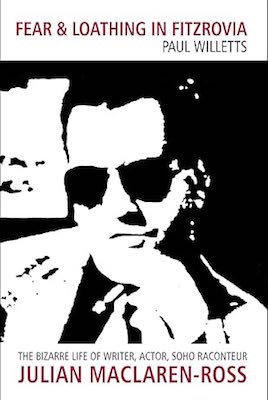
Emerging from Paul Willetts’ biography of Julian Maclaren-Ross, I was a little dizzy from the extraordinary sequences of work done, or proposed, or rewritten, of contracts honoured or let slip, of rooms and suites and flats rented and left in a series of moonlight flits or evictions, of creditors and lawsuits, landladies, hoteliers, retailers (a pram for his son Alex) and the post office (for telephone bills), of separations from, and reconciliations with, wives and girlfriends.[1] It’s difficult not to have a sense of being slightly bruised by contact with the innumerable knocks that the writer underwent. He was incurably extravagant and wasteful with money, nor did the alcoholism, heavy smoking, bad diet, amphetamine use and lack of exercise help much, and the fatal heart attack at the age of fifty-two is not wholly unexpected.

The two undeniable positives, though, are the biography itself, a prodigious feat of research and writing; and Maclaren-Ross’s own staggering fecundity. The novels, short stories, sketches, radio dramas, adaptations, autobiographies, screenplays, parodies, memoirs, reviews and essays emerge at an astonishing rate. Writing often through the night, he seems to turn out entire radio drama series in days, reviews and sketches in hours, year after year through the 1940s, 1950s and into the early 1960s, always in financial distress and increasingly aware that the impact made by some of his early work had not been maintained and had ebbed away. It’s remarkable, given the rate of production and the conditions in which most of it was written, that so much of it is so good. Some of the stories, the novel, Of Love and Hunger, the memoirs, many of the superb parodies and critical writings (on cinema as well as literature) in Bitten By the Tarantula, are assured, often very funny, and hugely impressive. 
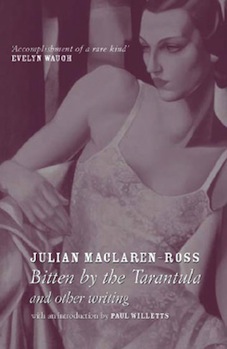

Endless monologues on a barstool in Fitzrovia. The teddy-bear coat, the sharp suit, the cigarette-holder, the silver-topped malacca cane, the snuff box, the eternal dark glasses: ‘From an early age’, Paul Willetts writes, ‘Julian put as much effort into propagating his personal myth as perfecting his prose style’ (306), going on to mention the many characters in poems and novels that are based on him, as well as the memoirs in which he features. Pubs and clubs, magazines and anthologies, are threaded through the story as much as boxers and bullfighters are in Hemingway’s, and Maclaren-Ross encountered an extraordinary range of writers, editors, publishers, painters and BBC producers. One of these, who became increasingly important in his desperate pursuit of commissions and payments, was Reginald Donald ‘Reggie’ Smith (born on this day, 31 July, 1914), whose name rang a bell because he’d cropped up in a couple of other stories. Married to the novelist Olivia Manning, he’s familiar to readers of her Balkan Trilogy as the model for her central character Guy Pringle (to viewers of the superb adaptation, it is, of course, Kenneth Branagh). Smith crops up on more than thirty pages of Willetts’ biography because he was hugely supportive of Maclaren-Ross for some years. He was a friend of the novelist and critic Walter Allen and of Louis MacNeice, and had been to King Edward Grammar School in Aston, Birmingham, with poet Henry Reed and George D. Painter, future biographer of Marcel Proust. When he married Olivia Manning in August 1939 at Marylebone Registrar’s Office, their witnesses included Stevie Smith and Walter Allen. Their best man had been written into the certificate as ‘Louise MacNeice’—both bride and groom noticed but said nothing—and Olivia seems to have taken the opportunity to shave a few years off her age, her birthdate recorded there as 1911 (in fact it was 1908).[2]


I may briefly take refuge now in something calmer, less harassed—perhaps a Simenon. Not that the world of Inspector Jules Maigret is entirely detached from that of Julian Maclaren-Ross, one of whose many publications was a translation, published by Penguin Books in association with Hamish Hamilton in 1959: Maigret and the Burglar’s Wife. . .


Notes

[1] Paul Willetts, Fear & Loathing in Fitzrovia: The Bizarre Life of Writer, Actor, Soho Raconteur Julian Maclaren-Ross, revised edition (London: Dewi Lewis, 2013). Willetts also introduces Collected Memoirs (London: Black Spring Press, 2004) and Bitten By the Tarantula and other writing (London: Black Spring Press, 2005). Penguin Books published Of Love and Hunger, with an introduction by D. J. Taylor, in 2002. ‘The Weeping and the Laughter’ is subtitled ‘A Chapter of Autobiography’ in Collected Memoirs (1-110).

[2] Neville & June Braybrooke, Olivia Manning: A Life (London: Chatto & Windus, 2004), 54, 58, 59.
Lights and shadows

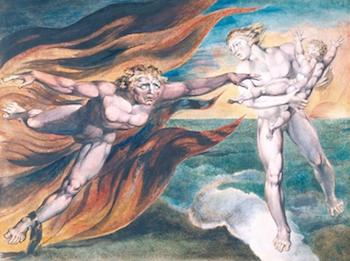
The Good and Evil Angels 1795-?c. 1805 by William Blake 1757-1827

(William Blake, The Good and Evil Angels, Tate Britain

Hell beckons. The handcart trundles a little closer. Yemen, Syria, the latest dangerous ravings from the White House. ‘End of days’, the Librarian murmurs. ‘The wheels have come off.’ Our increasingly grubby country offers only unparalleled political paralysis and irresponsibility, a housing secretary for whom the shameful rise in homelessness and rough sleeping in this country is nothing to do with government policies at all, a Labour leader inflicting what may be the final disappointment upon a large number of the party’s supporters and a Prime Minister still fixated on immigration. The death of Paddy Ashdown is a painful reminder that, not so long ago, party differences aside, there were politicians concerned about the welfare of the whole country. Following David Runciman’s provocative suggestion that six-year-olds should be given the vote, interviews with children aged six to twelve in today’s Observer, demonstrate—encouragingly or dispiritingly or both—that they frequently have a sounder grasp of the important issues than those supposedly forming and directing policies in this country – and are more humane also.

https://www.theguardian.com/global/2018/dec/23/should-we-give-children-the-vote-voting-at-age-6-politics-interviews

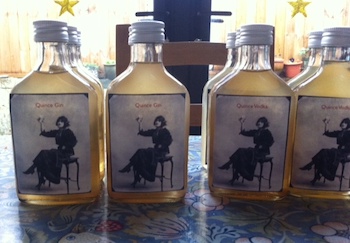
Against the encroaching darkness, the Librarian puts up strings of lights on walls and doorways, bakes, makes quince gin and quince vodka. I take refuge in the usual things. It’s been an unsettling year, yet a not unbalanced one, with its births and beginnings, deaths and disappearances.

Gin-Vodka

‘The Dyings have been too deep for me’, Emily Dickinson, observed in the Fall of 1884, ‘and before I could raise my Heart from one, another has come.’ In the nineteenth and earlier centuries, death was a more frequent caller, certainly among the young. Still, even now the frequency inevitably increases when one reaches a certain age; and one death often recalls another. Oscar Wilde famously said that, ‘Life imitates art far more than art imitates life.’ Perhaps less contentiously, art shadows life—for those who know the shadows are there—but shadows death also.

I remember sitting on an early evening train more than seven years ago, avoiding the quiet carriage in case somebody called. The train was taking me to London – to tell my mother that the hospital staff would be turning off my sister’s life support machine the following morning. I remember too making the ultimate banal observation – that life continues, everywhere, even in – perhaps especially in – the context of death. Or we simply notice it more readily. At the station, there had been two men on a bench across the tracks; one of them, a Sikh, I think, was dancing while still sitting down. His friend laughed. An elderly couple passed, intent and purposeful; young women out for the evening shimmied and twirled. And in the carriage, the usual noisy blathering into mobile phones. But life. Now. Like it or not, in that present moment, life, the undramatic pulse of it, movement, irrefutable and irreversible.

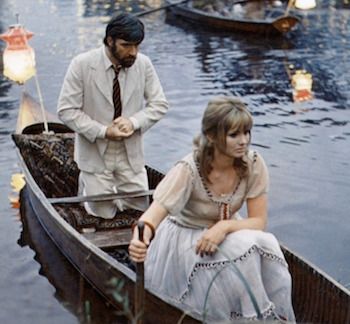
A woman had a long, very audible conversation on her phone about her father’s latest consultation with the specialist and the conditions necessary for his operation. I read; then felt guilty about reading; then stopped; then remembered that if I didn’t read I would only have other voices in my head. It was dusk, with heavy cloud, gradually darkening, but across the valley, there was a single blazing field, still in brilliant sunlight. I was rereading Women in Love and abruptly realised that I’d reached Chapter XIV, ‘Water-Party’, in which Gerald’s sister Diana dies from drowning, while he repeatedly, desperately, futilely dives in search of her.

Water-party-scene-WIL

(Alan Bates and Jennie Linden in Ken Russell’s Women in Love)

A few years further on. We scatter some of my mother’s ashes in a secluded part of the river; I say a few words, it’s all very peaceful and positive and appropriate. More recently, we scattered the rest in the sea. The tide was coming in, faster and more strongly than expected, night was approaching (also faster than expected). A dropped urn, flooded boots, more than a touch of farce, absurdity – but that seemed oddly appropriate too.

There have been other familial deaths this year, mostly expected or at least unsurprising. But only weeks after the funeral of one of my loved aunts, we attend another. One of the closest and oldest friends of the Librarian’s parents: she herself has known him since she was eight. He was prodigiously gifted, as artist and writer and photographer, possessed of a genius for friendship and for making connections of every kind, one of the bright beings on this earth, whose intellectual curiosity and vitality were like a shot into the bloodstream. I am sitting at one end of the dining-table as we finish lunch and he surges down to sit next to me. ‘What are you reading? What have you found?’ I tell him – and he already knows, has bought, has read – but wants more and, eloquently wanting more, gives back far more than that.

Anathemata DJ-Dedication

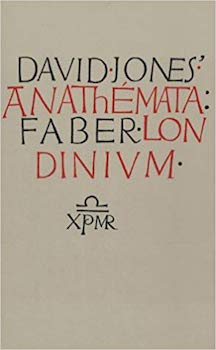
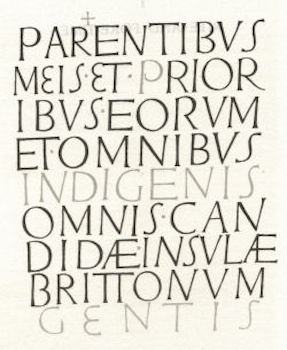
Probably not many funeral services begin with the beginning of David Jones’s The Anathemata but, that being one of his favourite works, it’s highly fitting. We sit in Sherborne Cathedral and hear:

‘We already and first of all discern him making this thing other. His groping syntax, if we attend, already shapes:
ADSCRIPTAM, RATAM, RATIONABILEM . . . and by pre-application and for them, under modes and patterns altogether theirs, the holy and venerable hands lift up an efficacious sign.’

Elsewhere, Jones wrote: ‘It is extremely difficult, if not impossible, for us to see the wood in which we find ourselves for the trees against which we break our heads and in the tangle of which we break our hearts.’

I came across the order of service for that funeral a day or two ago. ‘Where shall I put this?’ We are standing by the bookshelves and the Librarian hands me a volume of William Blake, another writer he admired. I tuck it inside the back cover.

Man was made for Joy & Woe
And when this we rightly know
Thro the World we safely go
Joy & Woe are woven fine
A Clothing for the soul divine
Under every grief & pine
Runs a joy with silken twine