New Year’s Day, and we walk in the cemetery. I think we might catch a glimpse of that fabled ‘sovereignty’ which is all the rage among Brexiteers but I see only a couple of examples of the more common unicorn. So it goes.
That we are, for the most part, in the company of the dead, is not inappropriate, given the past nine months. But there are also the living – saving the Librarian, I find there are a few too many of those for my current peace of mind but they mostly keep their distance and the paths are wide here.
On this day in 1916, D. H. Lawrence wrote to his agent, James Pinker: ‘Already, here, in Cornwall, it is better; the wind blows very hard, the sea all comes up the cliffs in smoke. Here one is outside England, the England of London — thank God.’[1]
Two years later, Wyndham Lewis found himself in the region of Neuville-Saint-Vaast, where the sculptor Henri Gaudier-Brzeska had been killed in June 1915, at the age of twenty-three. Lewis wrote to Ezra Pound on 1 January 1918: ‘I was taken out sight-seeing today, with a dismal & angry feeling I passed the place, through the fields, anyway, where Gaudier was killed. The ground was covered with snow, nobody about, and my god, it did look a cheerless place to die in.’[2]
2020 has been, by almost every measure, a dreadful year. The United States, Brazil, India, Russia, France have registered appalling figures of infection and death. Here in the United Kingdom, where terrible numbers of infections and deaths have also been recorded, the unutterable foolishness of Brexit has lurched to its appointed, what – end for some people, way station for others. In contrast to the astonishing achievements of the scientific community and the beleaguered National Health Service, our government has continued on its blundering way, handing out lucrative contracts to their unqualified, unsuitable chums as they go. Her Majesty’s Opposition, meanwhile, are missing in inaction.
But we have – what we have, whatever each of us has that is valued and cared for. We can lament the recent past and dread—or even be sanguine about—the future but, on the whole, the present seems the best bet, and as truly local as possible.
Happy New Year, as the saying goes.
Notes
[1]Letters of D. H. Lawrence II, June 1913–October 1916, edited by George J. Zytaruk and James T. Boulton (Cambridge: Cambridge University Press, 1981), 494.
[2]Pound/Lewis: The Letters of Ezra Pound and Wyndham Lewis, edited by Timothy Materer (London: Faber and Faber, 1985), 113.
St Thomas grey, St Thomas grey, The longest night and the shortest day.[1]
‘I might be lost’, Adolfo Barberá said to Iain Sinclair, ‘but I know where I am.’[2] Many of us can say, with confidence, that we’re lost. Do we know where we are? We now appear to be quarantined on an island off the coast of Europe. There are features discernible in this winter solstice landscape and the main one is probably recurrence, repetition, things going round again. I find the same quotations running through my head, for sure, such as Guy Davenport’s, ‘In our time we long not for a lost past but for a lost future’, or this from Charles Olson:
What has he to say? In hell it is not easy to know the traceries, the markings[3]
In England, the pattern is established, if not one to emulate. Receive the advice, ignore it, then eventually act on it—too late—and retreat from it too soon. Repeat. Even the—what is the latest euphemism, ‘low information voters’?—yes, it must surely be dawning on even those co-operative souls that the Leave UK gang hasn’t handled matters quite as well as they might have done. The news from Kent, on the other hand, must be hugely reassuring to those who voted for that Brexit thing.
(Via BBC)
Has this country ever been governed so badly? As we edge, run or career towards the end of 2020, it occurs to me that I’ve been reading for dear life these last months, as if the relentless turning of pages could offset to some degree the idiocy and dishonesty of this government and, frankly, the sheer insanity of the United States administration and many of its supporters.
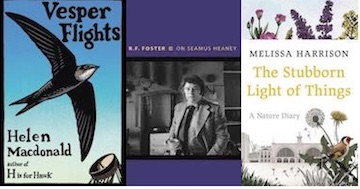
‘Prose is the devil’, Ezra Pound once remarked in a letter to Alice Corbin Henderson, poet and assistant editor to Harriet Monroe at Poetry magazine. ‘ALL prose is the devil, except perhaps a little of Flaubert and De Maupassant.’[4] Nevertheless, pace Ezra—who was, I note in passing, a clue in yesterday’s speedy crossword, ‘troubled US poet’, though why he should be described as ‘troubled’, more so than Robert Lowell or Anne Sexton or John Berryman or Sylvia Plath or a hundred others, who can say?—it’s been mainly prose that I’ve been reading, although, in conjunction with Roy Foster’s incisive book on Seamus Heaney, I found myself reading (or sometimes rereading) the first six books of Heaney’s poetry.[5]
Some tremendous books have passed before my eyes this year, though it still feels hugely pleasing to be back with Maigret—in Antibes at the moment. There have been jaunts avec M. Simenon in previous months, and a few Golden Age authors such as Margery Allingham but, beyond those, I took in several of the year’s high profile titles. Still, not for the first time, some of the best things were older – but, in either case, most seemed to be by women this time around.
Some of them cropped up on several Books of the Year lists: Maggie O’Farrell’s impressive Hamnet and Hilary Mantel’s The Mirror and the Light (I added her collection of pieces from The London Review of Books, Mantel Pieces, and—one I’d missed—her fine memoir, Giving Up the Ghost). Francesca Wade’s Square Haunting was a blast and Helen Macdonald’s collection of essays, Vesper Flights, was marvellous, one of my books of the year for sure. After Elena Ferrante’s The Lying Life of Adults, I read her earlier, very unsettling The Lost Daughter.
Not quite so new but add Annie Ernaux and Mary Gaitskill, just about anything by either of them: Ernaux seems to have reinvented or recast the genre of autobiography (Fitzcarraldo Editions have done five of hers in translation now); while Gaitskill seems to possess something like perfect pitch.
Maybe the most fun was either Craig Brown’s One Two Three Four: The Beatles in Time, six hundred plus pages which I ripped through in a couple of days; Ysenda M. Graham’s British Summer Time Begins; or Paraic O’Donnell’s two novels, The Maker of Swans and The House on Vesper Sands, which came recommended on Melissa Harrison’s podcast, ‘The Stubborn Light of Things’, also the title of the collection of her monthly nature diary columns in The Times, certainly another of my books of the year.
‘The year’, ‘the year’ – an endlessly recurring phrase, often in conjunction with such optimistic sentiments as ‘the next one can’t be worse’ and ‘soon be over’.
Ah, well.
Notes
[1] Quoted in Bonnie Blackburn and Leofranc Holford-Strevens, The Oxford Companion to the Year (Oxford: Oxford University Press, 1999), 505.
[2] Iain Sinclair, ‘Diary’, London Review of Books, 21 May 2020), 40.
[3] Guy Davenport, Apples and Pears (San Francisco: North Point Press, 1984), 63; Charles Olson, ‘In Cold Hell, in Thicket’, in The Collected Poems of Charles Olson, edited by George F. Butterick (Berkeley: University of California Press, 1997), 155.
[4]The Letters of Ezra Pound to Alice Corbin Henderson, edited by Ira B. Nadel (Austin: University of Texas Press, 1993), 43.
[5] R. F. Foster, On Seamus Heaney (Princeton: Princeton University Press, 2020).
The Christmas lights are on; and fat Santa is standing in the alcove. We have some holly; and the Christmas tree has arrived, a little larger than expected, the base of the trunk not quite fitting into the stand.
‘Just saw a bit off.’ ‘With what?’ ‘Ah – the saw.’ ‘Which is where?’ ‘I don’t know where it is but we must have one.’ ‘Must we?’
After a reasonable amount of investigation, it seems that we have no saw. Or did and lost it, or gave it to someone needy. Or it rusted or pined away from neglect. We order a saw. Length: twenty-one – are these inches or centimetres? It arrives the next day.
I’m used to watching the Librarian’s dad wield a saw, which he does confidently, fluently and effectively. I, on the other hand, differ from that specification just a little and, as a spectacle, may already be a standing joke to extra-terrestrial scouts, even an element in their amusing PowerPoint presentations of life on planet Earth, once they’ve stopped laughing at Brexit. Still, the tree is now in situ, decorated and subject to the baleful stare of the cat.
So the year dwindles down. Today is a popular birthday among the literati or, more broadly, the culturati, including one of my favourite writers, Sylvia Townsend Warner, as well as Ira Gershwin, Osbert Sitwell, Alfred Eisenstadt, Dave Brubeck and Nick Park. One of the most poignant must be that of the painter Frédéric Bazille (born 6 December 1841), who enlisted in the Franco-Prussian War and, during the winter of 1870-1871, ‘the bitterest in living memory’, was killed during a minor attack on Beaune-la-Rolande, on 20 November 1870. For ten days – ten days! – Bazille’s father ‘dug in the snow-covered battleground, looking for his son. Eventually he found his body. He hauled it back to Montpellier himself, on a peasant’s cart.’[1]
(Bazille, View of the Village)
It’s still only a few months since it ceased to be the case that, when asked if I had a personal Twitter account, I would remember, and often quote, the lines in Auden’s Letter to Lord Byron:
Indeed our ways to waste time are so many, Thanks to technology, a list of these Would make a longer book than Ulysses.[2]
The Librarian would update me daily and more or less selectively on the latest absurdities from a deranged president, a lying Cabinet minister or an idiot actor. Taking over the Twitter account for a literary society has granted me direct and immediate access to such delights, or rather, less direct than through the commentary of individuals on my timeline. It is, of course, something of an echo chamber, since those the Society follows tend to be well-informed, well-read and clear-sighted when it comes to American politics, Brexit and the English government’s record on the Covid-19 pandemic. Specialists in the apocalypse, you might say.
Still, 2020 almost gone. A vaccine in sight. Are we downhearted, you ask – but do not, I notice, wait for an answer.
Notes
[1] Sue Roe, The Private Lives of the Impressionists (London: Chatto and Windus, 2006), 82, 83.
[2] W. H. Auden and Louis MacNeice, Letters from Iceland (London: Faber and Faber, 1937), 53.
Four years back, 10 November 2016, I wrote a blog post on the company website, one of the very last such posts since we closed the company offices down just after that date:
‘A few months ago, several American friends and colleagues were kind enough to express their sympathy in the wake of the calamitous EU referendum result and what it said about the state of our country.
The least we can do is to reciprocate and send them our sympathy, condolences and best wishes, following the Presidential election and what it says about the state of their country.’
Today, let’s just make it ‘best wishes’, with the fervent hope that we never have to send condolences again.
‘A Lady asks me’, as Ezra Pound begins Canto 36, borrowing from his own translation of Guido Cavalcanti’s ‘Donna mi prega’, ‘I speak in season’. In fact, here, the season is undeniably autumn – and it’s the Librarian, asking what I’m finding the worst thing about the pandemic – ‘apart, obviously, from huge numbers of people dying’.
I know already that she misses, often very keenly, her library, the beautiful physical space itself and her colleagues—the greetings on a staircase, words exchanged in a corridor, on the phone or round the edge of a door, those brief moments that, tabulated and totalled, make up a significant proportion of any working day, both qualitatively and quantitatively.
For me, though, the shape of the days is much less changed. I read, I write, I walk, I cook, I feed the cat. The things that huge numbers of my fellow-citizens are apparently frantic for don’t really bother me. In another age, we would go to the cinema occasionally and to restaurants a little more often: but a large part of going out to eat—and of being in the cinema—is being able to relax. I certainly couldn’t relax in those settings at the moment, so why would I do it? Going on holiday: yes, but we’d be doing the same things, just in a different setting and at a substantial cost, and the logistics of any such trip make my head hurt. I’d really like to walk by the sea again – but now, as always, I don’t want to do it in the company of several thousand others.
There’s a world out there of worsening political chaos, lethal incompetence, thousands of avoidable deaths (and how many more in the United States, whose president is waging war against his own country); after the schools failures, now the universities fiasco, students imprisoned while administrators rearrange deckchairs on an ever more steeply tilting deck amidst ignorant comments from politicians and tabloid journalists.
Louis MacNeice writes in Autumn Journal:
It is this we learn after so many failures, The building of castles in sand, of queens in snow, That we cannot make any corner in life or in life’s beauty, That no river is a river which does not flow.
Even in lives superficially unchanged or little changed, this has changed. Life at present does not flow. Watching moving water, the fact of it moving becomes less and less its dominant feature; the currents that make our own lives flow are often invisible, unremarked. So perhaps one of the worst things is the simplest. We can go out, we can walk, other people can and do take buses or trains – but never now in an untroubled way, never wholly spontaneous, never unthinking, never without watchfulness, wariness, a readiness to take evasive measures. It’s the old literary metaphor of the poem as a field of action, of moving through hostile territory, always on the qui vive. A potentially productive conceit, you might argue, but probably not how you want to live your – civilian – life.
On this day in 1916, Ford Madox Ford published a piece called ‘Trois Jours de Permission’, about a three-day leave granted to him a little earlier that year, which he spent in Paris, much of it waiting for some grand fromage or other. ‘Yes, one learns to wait’, Ford wrote. ‘The most impatient temperament, somewhere in France, will be strait-waistcoated into inaction, into introspection.’
So here I am, somewhere in England, inactive and introspective, waving goodbye to September – though mentally active and prospective enough to expect little better of October. . .
I begin to think that the foxes recognise us – by sight or scent? The second, more likely. At first they would retreat much further along the road that crosses the hill we walk up; now, as we reach that point, we see them sitting or crouching only a few metres from the junction and can almost see the thought bubble that reads: It’s them, walking straight up as usual. No problem.
A morning’s tally of close encounters: three foxes, one white cat—emerging like a ghost from the bushes in the small park—one woman runner and, as we pass the larger park when almost home, a man with two small dogs. On another morning, darker and with a heavy mist, we see no foxes, two cats and five people: not so good. But always the birds: sparrows, certainly, in some of the hedges, and blackbirds, beyond which even my provisional identification skills peter out.
I’ve read, just lately, reflections on several encounters with the wild, by Helen Macdonald, John Burnside and Melissa Harrison, particularly focused on what Harrison, probably in her excellent podcast (https://melissaharrison.co.uk/podcast/) called the ‘I and Thou’ moments, after Martin Buber, the moment of relationship rather than objectification, when the bird, the animal, the forest, even the single tree, looks back at the observer, listens to the listener, in a reciprocal engagement.
Certainly, for me, these near-encounters with the wild—however wild urban foxes are reckoned to be these days—are like a shot into the veins, a thrill along the nerves, a rush of oxygen into flagging lungs. Is it the increasing rarity, the always-attendant sense of what’s being lost, the disorienting nudge out of the circles and boxes and bubbles into which we back ourselves these days, even without pandemics? Hard to say. It could just be the contrast with people, with some people.
National leaders trashing their own countries’ reputations—and often enough trashing the countries themselves—the lethal incompetence, the undisguised corruption; the sheer impunity, the denial of climate emergency, the barefaced, continuous lying and the blatant contempt for those voters who, quite bafflingly, will vote for them again—or so it seems. To those of us old enough to remember the Thatcher years, Cold Wars, nuclear stand-offs, illegal invasions and the rest, it seems extraordinary to find oneself thinking—and saying—‘It has never been this bad before.’
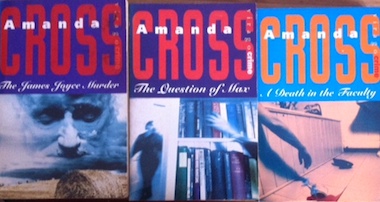
Looking for something to read the other day, since I had fewer than a hundred waiting candidates, I was browsing the Librarian’s Virago shelves. I’d looked several times at three mystery novels by Amanda Cross but never to the point of actually reading them. This seemed as if it might be the time.
‘Amanda Cross’ was, in fact, the pseudonym of Carolyn Gold Heilbrun, a professor of literature at Columbia University, where she taught from 1960 to 1992, publishing several volumes of feminist literary criticism and fourteen mystery novels featuring Kate Fansler, an amateur sleuth who is also, curiously enough, a professor of literature at a New York university.
The Amanda Cross books are upbeat, civilized, witty, highly readable – and well-populated with literary references, quotations and allusions. I’m not sure how I resisted for so long the first one I read, given that it’s called The James Joyce Murder. It has a prologue, an epilogue – and fifteen chapters, all with the titles of the stories in Joyce’s Dubliners. The order of her chapters differs from the order of the stories in Joyce’s book but all are used and, often very cleverly, the content of the chapter related to the story which gives it its title. There are also characters in the novel with names familiar to a reader of Joyce (in addition to Grace and Eveline): Kate, Molly, Lenehan, Mulligan, Eugene Stratton.
In the last one I read, A Death in the Faculty (1981), which centres on the first appointment of a woman to a tenured position in the Harvard English department—as, I gather, Heilbrun was the first woman to receive tenure in Columbia’s English department—Kate Fansler, while listening to the speeches by graduating students, recalls an event she has read about that took place at the Commencement of 1969. A law student had ‘begun his speech with a call to law and order: “The streets of our country are in turmoil. The universities are filled with students rebelling and rioting. Communists are seeking to destroy our country. Russia is threatening us with her might. And the republic is in danger. Yes, danger from within and without. We need law and order! Without law and order our nation cannot survive!”’ From the audience there is ‘wild applause’, after which the student continues: ‘“Those words were spoken in 1932 by Adolf Hitler.”’ The writer adds: ‘Kate would have given a great deal to have heard the silence that followed.’
Fifty years on from that address, it doesn’t take much effort to see the same tactics employed by Hitler still being used, most obviously and unashamedly in the United States. Still, even here, those Londoners with just a smattering of historical knowledge or, in some cases, long memories, who had thought their streets were cleared of fascists many years ago, have recently discovered that this is not in fact the case.
The Fourth of July. Birthday of Nathaniel Hawthorne and Stephen Foster (‘father of American music’), anniversary of the deaths of both Thomas Jefferson and John Adams in 1826. And yes, I make it 244 years since the Continental Congress passed the Declaration of Independence (New York abstaining).
The Oxford Companion to the Year helpfully quotes those lines which must be in the minds of a good many thinking Americans just now as they scan their present political and social landscape, lines regarding those ‘unalienable Rights’, among them, ‘Life, Liberty, and the Pursuit of Happiness’: ‘That to secure these Rights, Governments are instituted among Men, deriving their Just Powers from the Consent of the Governed, that whenever any Form of Government becomes destructive of these Ends, it is the Right of the People to alter or abolish it, and to institute new Government, laying its Foundations on such Principles, and organizing its Powers in such Form, as to them shall seem most likely to effect their Safety and Happiness.’
The Companion also quotes, in addition to George Washington, an Englishman (Marryat) and a Scotsman (Macrae), the orator, activist and author of the classic Narrative of an American Slave, Frederick Douglass, in an address he gave on 4 July 1852: ‘I am not included within the pale of this glorious anniversary! Your high independence only reveals the immeasurable distance between us. The blessings in which you this day rejoice are not enjoyed in common . . . This Fourth of July is yours, not mine. You may rejoice. I must mourn. To drag a man in fetters into the grand illuminated temple of liberty, and call upon him to join you in joyous anthem, were inhuman mockery and sacrilegious irony.’[1]
(Frederick Douglass)
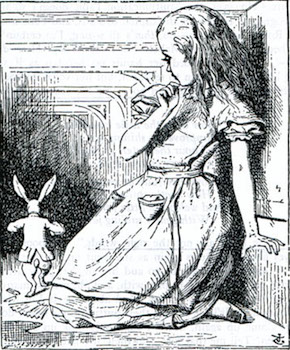
The anniversary of publication of Lewis Carroll’s Alice in Wonderland would have seemed scarily appropriate to the state or states that we’re currently in and, apparently, it was scheduled for release by Macmillan on 4 July 1865. But the illustrator, John Tenniel, was wholly unsatisfied by the quality of the pictures in the finished book and Carroll recalled the entire print run, also asking for the advance copies he’d sent out to be retrieved.
So the occasion would seem to be an all-American one – except that some members of the British government, with the eager connivance of the popular press, have named this ‘Independence Day’ (seemingly forgetful of what and whom America was declaring its independence from), the reopening of pubs, hairdressers, theme parks and restaurants, with added slogans such as ‘eat out to help out’, that ‘help’ surely intended for the hospitality industry rather than the further spreading of the virus.
‘Words of grief become almost meaningless in these days, they have to be used so frequently. But one does not feel any the less. Sorrows do not grow lighter because they are many.’[1] This is Vera Brittain, writing in June 1915, less than a year into the First World War, in which Brittain’s fiancé, younger brother and two close friends were all killed.
It’s a little over three months since the first death from Covid-19 was reported in the UK. We are 50,000–60,000 deaths further on from that now. A smallish island off the west coast of Europe which has seen the second highest total of Covid-19 deaths in the world. Second only to the United States, so little more needs to be said—except, perhaps, that this government’s domestic approval rating is the lowest in the world, nestling beside Mexico’s and below—below!—that of Donald Trump’s America.
There have been several notable shocks to the system in the last week or two – in this time of pretty constant shocks to the system. Perhaps the first was the Health Secretary claiming that the UK government did the right things at the right time – which surely took the breath away of any sentient being who had been paying attention. Secondly: the Prime Minister asserting that he was proud of the way this country and his government had dealt with the pandemic.
The third thing was an article in the New Statesman by Edward Docx—together with some of the responses to it on the letters page of the next week’s issue—about intensive care consultant Dr Jim Down and his colleagues dealing with the pandemic at its absolute peak of deaths from Covid-19 in hospitals, in harrowing and quite impossible conditions, with breathtaking and humbling courage, skill and devotion. It was a devastating article which should be – but, alas, won’t be – read by everybody.
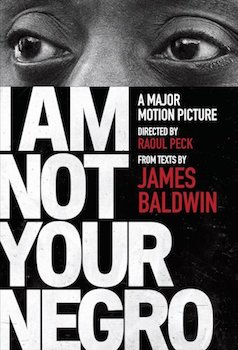
The fourth thing was watching again the superb Raoul Peck documentary centred on the remarkable James Baldwin, I Am Not Your Negro, which blew me away the first time and—well, well—blew me away the second time too. I felt just as sickened as the first time around by the footage of racist cops beating Rodney King, and by that lonely walk of Dorothy Counts through a rabid mob of white folks brave enough to scream and spit at a fifteen-year-old girl. I found it worryingly difficult to distinguish recent footage of murderous racist violence from historic footage of murderous racist violence—and very hard to differentiate American police and armed militia.
The fifth thing was footage and stills of, and commentary on, the toppling and sinking of the statue of Edward Colston in my home city of Bristol. My initial doubt about the way in which it happened centred on whether too much had been given away to reactionary elements in this country and beyond. I think now that the positive responses and effects since then have clearly outweighed that consideration, helped by some lucid and insightful pieces by historians, notably David Olusoga: https://www.theguardian.com/commentisfree/2020/jun/08/edward-colston-statue-history-slave-trader-bristol-protest
So even now, in the midst of a pandemic, with our flailing government and with appalling scenes in the United States still streaming across our screens, it’s hard not to feel a flicker of optimism that something might finally be changing for the better, that George Floyd’s killing will not simply be remembered as yet one more police killing of a black individual – because enough people have decided that they will not allow that, and are acting on their decision.
Note
[1] Entry for Thursday 10 June 1915, Vera Brittain, Chronicle of Youth: Vera Brittain’s War Diary 1913–1917, edited by Alan Bishop (London: Gollancz, 1981), 206.
Another kind of cabinet: (Domenico Remps, Cabinet of Curiosities)
I don’t actually know anybody who thought that the British – English, rather – government was handling the Covid-19 pandemic well, so have no one to ask whether recent events have changed their minds. Nor can I think of anyone who would have been surprised to learn just how much contempt Messrs Johnson and Cummings, along with those supine members of the cabinet, feel for the general public, so can’t gauge any shift in opinion there either. All I know for sure is that, given the clear evidence that protecting the nation’s health is not the prime minister’s first priority—and given the latest, wildly premature lockdown easings—I’m well advised to stick to my current strategy, which is to steer clear of anyone that I don’t already live with. Even that will get harder as the weather warms up, now that people have been shown how the rules can be bullied or bent into a more personally convenient shape.
So I’ll continue to read, cook, try to write – and find other diversions in the early morning walks, the stand-off between a magpie and a crow which seemed to go on for hours – and Harry’s early occupation of his favourite plant pot.
Journal, Tuesday 29 May 1764. ‘At three Tissot [a medical doctor] carried me to the Utrecht Bedlam. The poor creatures were almost all silly. They were mostly going about loose. They called me the King of England. I was amused with this scene. Tissot said mankind were all mad and differed only in degrees.’ (Boswell in Holland, 1763-1764, edited by Frederick A. Pottle, London: William Heinemann, 1952, 256.)
Degrees, perhaps, M. Tissot, but very large ones in some cases.









 Reconstructionary Tales