Borders and bounders

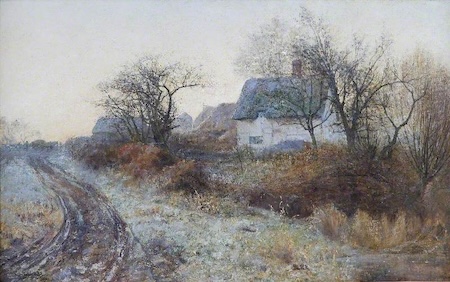
(Frederick William Newton Whitehead, A Frosty Morning: Dudley Museums Service)

‘But it must be remembered, that life consists not of a series of illustrious actions, or elegant enjoyments; the greater part of our time passes in compliance with necessities, in the performance of daily duties, in the removal of small inconveniences, in the procurement of petty pleasures; and we are well or ill at ease, as the main stream of life glides on smoothly, or is ruffled by small obstacles and frequent interruption. The true state of every nation is the state of common life.’[1]


I have a new hat, woollen, of the kind so frequently worn by sensible people in cold weather. My hat history is not an inspiring one but in this I look no more ridiculous than other wearers. Perhaps just a little more. Were it a magic hat, it might explore the current rumours of an illegal American invasion of a sovereign, oil-rich country while also analysing the strange sensation of having been here before. But of course there were differences and I’m reminded of the observation by C. L. R. James, ‘To the extent that a historical parallel is suggestive, to that very degree it is dangerous.’

James was writing of interconnections, not only with reference to cricket and colonialism but also cricket and art: ‘We may some day be able to answer Tolstoy’s exasperated and exasperating question: What is art? – but only when we learn to integrate our vision of Walcott on the back foot through the covers with the outstretched arm of the Olympic Apollo.’[2]

(Biography of Sir Clyde Walcott via New Beacon Books)

More broadly still, that two-way flow of influence and attraction that many nationalists and imperialists are unwilling or unable to comprehend. Beyond all manner of boundaries. Ian Baucom, writing of James, referred to his exploration of the false dichotomy of ‘here’ and ‘there’: the assertions of taking ‘Englishness’ abroad tending to forget or elide the ‘un-Englishness’ constantly flowing back into England. England’s history, after all, was and is, inextricably, the history of those others outside England too, the beyond also the within.[3]

I was glad to learn that ‘bounder’, a cad, an ill-bred person, though now long ‘archaic’ once also meant a limit, landmark or boundary. Even amidst the current icy weather, all along the lower half of our road, dead leaves are heaped against the kerbs, the recycling bins and front doorsteps, the park being just a stone’s throw away and a line of London plane trees just beyond its boundary wall.

This border at least is easily crossed, if not always elegantly, and is clearly visible to the naked eye. On Friday 18 November 1870, the Reverend Francis Kilvert wrote in his diary of sitting in Mrs Powell’s cottage in Killey, ‘feeling for the boundary notch in the chimney’, this being somewhere along the wavy line separating England from Wales on the map. A child had been born there that they had been careful to have born in England, ‘in the English corner of the cottage’, the midwife having Betsey deliver the child standing.[4]

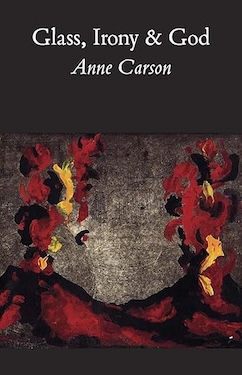
The Finnish word ‘susiraja’ – literally wolf border, the boundary between the capital region and the rest of the country, implying perhaps that everything outside is wilderness – gave Sarah Hall the title of her fine 2015 novel.[5] The poet and translator Anne Carson also touches on boundaries – and wolves: ‘The wolf is a conventional symbol of marginality in Greek poetry. The wolf is an outlaw. He lives beyond the boundary of usefully cultivated and inhabited space marked off as the polis, in that blank no man’s land called to apeiron (“the unbounded”). Women, in the ancient view, share this territory spiritually and metaphorically in virtue of a “natural” female affinity for all that is raw, formless and in need of the civilizing hand of man.’[6]

That civilizing hand seems to have been sawing off its own limbs of late but we should focus on the positives. Hardly a promising start to the new year but there’s plenty of it left. Remembering Thomas Carlyle’s 1829 essay ‘Signs of the Times’, it occurs to me that its most familiar line (for those to whom any line of it is familiar) is probably ‘Men are grown mechanical in head and in heart, as well as in hand.’ But my eye was caught by a couple of other sentences: ‘There is no end to machinery. Even the horse is stripped of his harness, and finds a fleet fire-horse invoked in his stead.’

17 February (in the lunar calendar) marks the beginning of the Chinese New Year; and 2026 is, I gather, the year of the Horse, specifically the Fire Horse. All the commentaries—astrological and others—on this configuration (yang and yang) that occurs every sixty years seem to hint at both opportunity and danger, energy, heat, a greater willingness to take risks, one of them the risk of burn-out. The word ‘expansion’ cropped up once or twice, hardly reassuring in the present global context. Still, best wishes to all for this year, and, as more than one person said in my hearing over Christmas, ‘May the gods be kind.’


Notes

[1] Samuel Johnson, A Journey to the Western Isles of Scotland, edited by Ian McGowan (1775; Edinburgh: Canongate Books, 1996), 18-19.

[2] C. L. R. James, Beyond a Boundary (1963; London: Vintage, 2019), 205, 279.

[3] Ian Baucom, Out of Place: Englishness, Empire and the Locations of Identity (Princeton: Princeton University Press, 1999), ‘Introduction : Locating English Identity’, 38-39.

[4] Francis Kilvert, Kilvert’s Diary, edited by William Plomer, Three volumes (London: Jonathan Cape, 1938, reissued 1969), Volume 1, 262.

[5] Sarah Hall, The Wolf Border (London: Faber 2015).

[6] Anne Carson, ‘The Gender of Sound’, in Glass, Irony & God, introduction by Guy Davenport (New York: New Directions, 1995), 124.
Parrot or Bevan; or, wagging the beards

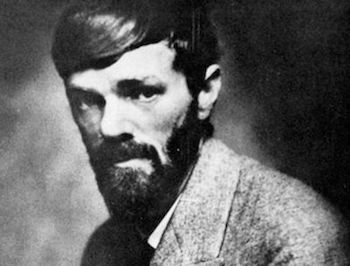
(D. H. Lawrence)

‘Please compress your last dozen unwritten—or unpublished—blog posts, into a single phrase.’

I think I’d be tempted to go with what are often referred to as D. H. Lawrence’s last words, (which they weren’t, though pretty close to the end): ’This place no good.’[1] He was referring to the Ad Astra sanatorium in Vence, of course. And he was referring to something much wider, of course. I would be referring, not to this house—last refuge of common sense and sweet reasonableness that I can truly rely on—but to the wider world that is being laid waste, particularly this country, where we live and love among the ruins that these dreadful people have reduced us to, are reducing us to. Here, at any rate, we are. Where is that? Phrases like ‘post-apocalypse’ and, yes, ‘among the ruins’ occur more often that they should, possibly because I’ve been reading Lara Feigel’s hugely impressive book on D. H. Lawrence,[2] possibly because I keep getting glimpses of the daily news.

I was reminded somehow (somehow) of Hugh Kenner’s letter to Guy Davenport (13 October 1967). They’d been discussing the name of the couple in whose house Ludwig Wittgenstein had died: was it Parrot or Bevan? Davenport was quoting the 1958 memoir by Norman Malcolm, Kenner citing the viva voce testimony of artist and writer Michael Ayrton. Kenner wrote: ‘Ayrton is in Chicago for 10 days (opening a show) but on his return I shall press him re discrepancies between Parrot and Bevan. Maybe, being English, they spell it Bevan but pronounce it Parrot. He did confirm Parrot the other day.’[3]

(For those not familiar with some of the oddities of English pronunciation of names, try Featherstonehaugh, Auchinlech, Marjoribanks, Woolfhardisworthy or Cholmondley.)[4]

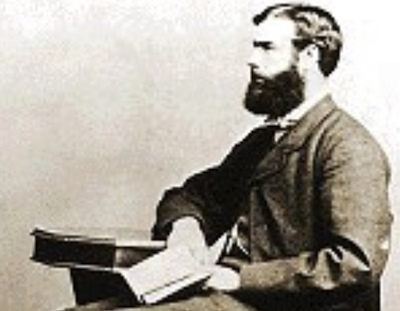
(The Reverend Francis Kilvert – including beard)

But I digress – old joke, shared among Fordians, Ford’s ‘digressions’ generally being anything but – yes, of course. Yesterday I was thinking of the Reverend Francis Kilvert, writing in October 1873: ‘This morning I went to Bath with my Father and Mother to attend the Church Congress Service at the Abbey at 11. When I got to the West door a stream of fools rushed out crying, “No room, you can’t get in!” I knew they were liars by the way they wagged their beards and as this crew of asses rushed out we rushed in and after waiting awhile worked our way up the north aisle till we reached the open transept and got an excellent place near the pulpit.’[5]

He shows here an impressive confidence in discerning the purveyors of untruths. He himself was undeniably bearded, and there was, clearly, an illegitimate manner in which beards were wagged. ‘But’, as Olive Schreiner once remarked, ‘there is another method.’ Kilvert, no doubt, had the key to it. Or perhaps God—conventionally assumed, certainly then, to resemble a man with a beard—sympathised and  helped out a little.

Schreiner had discussed the two methods by which ‘[h]uman life may be painted’, ‘the stage method’ in which characters were ‘duly marshalled at first and ticketed; we know with an immutable certainty that at the right crises each one will reappear and act his part, and, when the curtain falls, all will stand before it bowing.’ And there is, she admits, ‘a sense of satisfaction in this, and of completeness.’ Then: ‘But there is another method—the method of the life we all lead. Here nothing can be prophesied’ and ‘[w]hen the curtain falls no one is ready.’[6]

(Olive Schreiner, via the Irish Times)

It’s an argument for a greater realism, for a narrative reflecting more recognisably the ordinary human experience, echoed, if only in part, by a great many writers subsequently. Perhaps it leans far enough towards ‘mere life’ that the conscious artist might wonder where he or she actually comes in; but, in any case, the talk of stages and footlights and curtains certainly imply that she has in mind Thackeray’s Vanity Fair (1847-8), which begins ‘Before the Curtain’ and ends: ‘Come children, let us shut up the box and the puppets, for our play is played out.’[7]

The attitude to fiction exemplified by that beginning and that conclusion also exercised Ford Madox Ford – on more than one occasion and over some thirty years. He wrote in his ‘Dedicatory Letter’ to Last Post: ‘I have always jeered at authors who sentimentalised over their characters, and after finishing a book exclaim like, say, Thackeray: “Roll up the curtains; put the puppets in their boxes; quench the tallow footlights” . . . something like that.’[8] The following year, in his book on the English novel, he remarked of Thackeray that he ‘must needs write his epilogue as to the showman rolling up his marionettes in green baize and the rest of it’.[9] His final book had a final jab: ‘But what must Mr. Thackeray do but begin or end up his books with paragraphs running: “Reader, the puppet play is ended; let down the curtain; put the puppets back into their boxes. . . ”’[10]

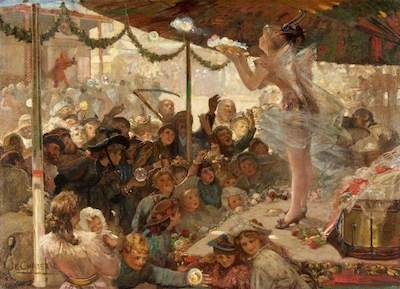
(James Elder Christie, Vanity Fair: Glasgow Museums Resource Centre)

Ford’s main criticisms of Thackeray (and other English novelists) were, firstly, that they were always interpolating moral apothegms or making sly comments about their characters; and secondly, that they committed these, and other misdemeanours while eschewing serious consideration of literary techniques because those were foreign, in short, because they were often too concerned with demonstrating that they were, in the first and most important place, English gentlemen.

I sometimes suspect a bastard version of this in the current, and recent, political situation. Anybody who offers intelligent, knowledgeable or insightful criticism of government policies on the economy, defence, immigration, education, health, social care or, indeed, just about anything else, is termed, by Conservative politicians, commentators, right-wing media hacks, opaquely-funded think tanks and the rest as ‘unpatriotic’ or ‘un-English’ or ‘doing the country down’. Irony-hunters – look no further.

Most of these characters—‘this crew of asses’—are, of course, clean-shaven – but, I suspect, would not have fooled the Reverend Kilvert for a moment.

Notes

[1] At the end of a letter to Maria Huxley [21 February 1930], in The Letters of D. H. Lawrence, Volume VII: November 1928-February 1930, edited by Keith Sagar and James Boulton (Cambridge: Cambridge University Press, 1993), 651.

[2] Lara Feigel, Look! We Have Come Through!: Living with D. H. Lawrence (London: Bloomsbury Publishing, 2022).

[3] Questioning Minds: The Letters of Guy Davenport and Hugh Kenner, edited by Edward M. Burns, two volumes (Berkeley: Counterpoint Press, 2018), II, 948. It was in fact at the home of Dr Edward Bevan and his wife Joan, as detailed in Ray Monk’s Ludwig Wittgenstein: The Duty of Genius (London: Vintage, 1991), 576ff.

[4] Examples from the often invaluable Schott’s Original Miscellany, by Ben Schott ((London: Bloomsbury, 2002), 17.

[5] Kilvert’s Diary, edited by William Plomer, Three volumes (London: Jonathan Cape, 1938, reissued 1969). Volume Two (23 August 1871–13 May 1874), 381.

[6] The Story of an African Farm (1883, under the name Ralph Iron; new edition, Chapman & Hall, 1892), vii-viii.

[7] William Makepeace Thackeray, Vanity Fair: A Novel without a Hero (1848; edited by John Carey, London: Penguin Books, 2003), 5, 809.

[8] Ford Madox Ford, Last Post (1928; edited by Paul Skinner, Manchester: Carcanet Press, 2011), 4-5.

[9] Ford Madox Ford, The English Novel (London: Constable, 1930), 7 (with its slight amendments, this followed the American edition of the previous year).

[10] Ford Madox Ford, The March of Literature: From Confucius to Modern Times (London: Allen & Unwin, 1939), 587.

Storm warnings

Rousseau, Theodore, 1812-1867; Landscape with a Stormy Sky

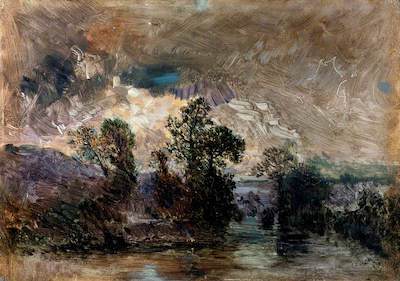
(Theodore Rousseau, Landscape with a Stormy Sky: Victoria and Albert Museum)

Walking in the park, the Librarian remarks on how beautiful the light is: lying on the trees, the mosque glimpsed between buildings on the facing hill and the lines of colourful housefronts. The light is, yes, extraordinary—but not least because of the violent mixing of colours on the sky’s palette. Above the trees behind us, there’s a great stretch of glowering darkness, which collides at one point with a patch of pure brilliance, untouched by any shadow or streak of darker colour. Above another clump of trees, a cloud of deep grey seemingly squats among the branches.

As with sky, of course, so with a great deal else. Those with the good fortune to be readers of Louis MacNeice think often of ‘Snow’, which reads in part:

The room was suddenly rich and the great bay-window was
Spawning snow and pink roses against it
Soundlessly collateral and incompatible:
World is suddener than we fancy it.

World is crazier and more of it than we think,
Incorrigibly plural. I peel and portion
A tangerine and spit the pips and feel
The drunkenness of things being various.[1]

‘Incorrigibly plural’, yes. There are simplicities, to be sure, but not always where our contemporary ‘culture warriors’ believe—or pretend to believe—they are. Elsewhere, MacNeice writes:

‘We are not changing ground to escape from facts
But rather to find them. This complex world exacts
Hard work of simplifying; to get its focus
You have to stand outside the crowd and caucus.’[2]

Now we are watching the trees bend; the door propped carefully open when the cat insists on fresh air; one brief and bitter squall of rain earlier; the wind yesterday afternoon and evening irritable, confidently predicted to be furious today. The worst storm in three decades, one forecast reads.

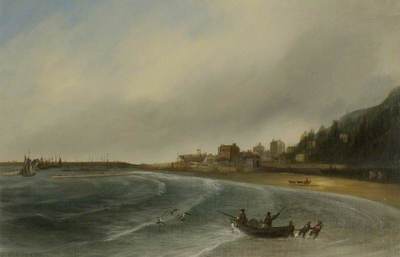
unknown artist; View of the Cobb and the Bay, Lyme Regis, Dorset

(Unknown artist: View of the Cobb and the Bay, Lyme Regis, Dorset: Lyme Regis Museum)

Novelist John Fowles wrote of the famous Cobb at Lyme Regis that it was not only a harbour but ‘a gigantic breakwater protecting the town from the great storms out of the south-west.’[3] That’s the quarter from which this storm is coming, as often before. Francis Kilvert wrote in his diary of a visit to Claremont House: ‘When the S.W. gales blew and rattled the windows Lord Clive used to get up in the night to wedge them tight and guineas being more plentiful with him than anything else he always used them. The housemaids used to transfer these guineas to their own pockets in the morning and prayed with reason for a S.W. storm.’[4]

Little wonder and plenty of reason, with an annual salary of around £20.

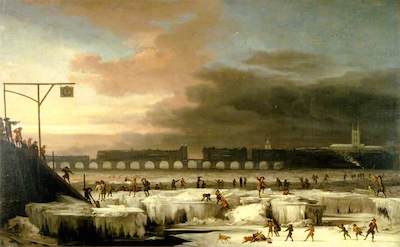
 Before the great storm of October 1987—an extreme depression in the Bay of Biscay moving north-eastwards—there were tough UK winters in 1962-63 and another drifting out of my lifetime, 1946-47. A few years before that, Rosamond Lehmann wrote in her story, ‘When the Waters Came’: ‘The wind was a steel attack; sharp knobs of ice came whirling off the elms and struck her in the face’, while the news at the post office was that: ‘The peacock at the farm had been brought in sheathed totally in ice: that was the most impressive item.’[5] This was, presumably, the wave of freezing weather in January 1940. The River Thames froze then for the first time since 1888 and there was a terrific ice storm across the country late in the month.

Hondius, Abraham, c.1625-1691; The Frozen Thames, Looking Eastwards towards Old London Bridge, London

(Abraham Hondius, The Frozen Thames, Looking Eastwards towards Old London Bridge, London: Museum of London)

In a diary entry of Sunday 8 December 1872, Kilvert wrote: ‘The morning had been lovely, but during our singing practice after evening church at about half past four began the Great Storm of 1872.’[6] In the eighteenth century, Gilbert White noted the  punishing winter of 1767-8: some days, he remarked, were more severe than any since 1739-40. But top billing was given to the ‘amazing tempest’, the great storm of November 1703.[7]

‘From the middle of the month there were gales’, Alexandra Harris writes, ‘and then on the evening of the 26th the wind grew unnerving. By midnight a hurricane was blasting across England, and there was no let-up until dawn. Fatalities were eventually calculated at about eight thousand. The greatest terror of the night was out in the Channel, where thirteen Royal Navy ships and their crews were drowned. On land barely a building survived intact. It remains the most violent storm recorded in England.’[8]

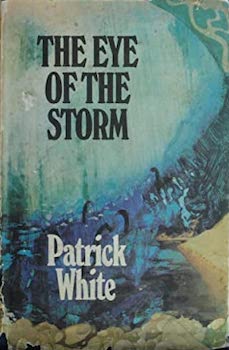
Up until ten this morning, the wind was fitful but not too severe. Predictably, some people were already dismissing the forecasts—‘Nothing’s happening!’—but footage of seafronts in south Wales and south-west England bore them out and I don’t plan to be walking under any trees today. I like this calm space, within easy reach of the kettle and the cooker. Eye of the storm. In Patrick White’s great novel of that name, Elizabeth Hunter’s daughter Dorothy, on the way to Australia, sits next to a Dutchman who tells her about a storm he experienced, being at sea when a typhoon struck. ‘For several hours we were thrown and battered – till suddenly calm fell – the calmest calm I have ever experienced at sea. God had willed us to enter the eye – you know about it? the still centre of the storm – where we lay at rest – surrounded by hundreds of seabirds, also resting on the water.’[9]

White-Eye-Storm

In a letter to Ingmar Björkstén (21 January 1973), who had asked about which of his novels felt closest to him, White confessed his difficulty. ‘I tend to feel close to The Aunt’s Story because in the beginning it was either ignored, or, in Australia, considered a freak. My feeling has been much as I imagine parents would feel towards a child who is not quite normal: they have to protect it. I also feel very close to The Solid Mandala because it conveys a certain nightmarish quality of life which I have experienced, though the incidents in the novel are hardly parallel to anything in my actual life. But at the moment I am obsessed by my latest book The Eye of the Storm, because in it I think I have come closer to giving the final answer.’[10]

David Marr, White’s biographer, remarked that: ‘The Eye of the Storm has the fundamental plot of all the books White wrote after falling in the storm at Castle Hill: the erratic, often unconscious search for God.’[11]

In his story centred on the sculptor Henri Gaudier-Brzeska, killed at Neuville-Saint-Vaast in 1915, Guy Davenport wrote: ‘But our knowledge, which must come from contemplation and careful inspection, has collided with a storm, a vortex of stupidity and idiocy.’[12]

At least we don’t have to contend with anything like that, do we? To be sure, the storm is really getting into its stride now but it’s just the weather we have to worry about, no?

Notes

[1] Louis MacNeice, Collected Poems, edited by Peter McDonald (London: Faber, 2007), 24.

[2] Louis MacNeice, ‘Letter to Graham and Anne Shepard’, Letters from Iceland, W. H. Auden and Louis MacNeice (London: Faber & Faber, 1937), 31.

[3] John Fowles, A Short History of Lyme Regis (Stanbridge: The Dovecote Press, 2004), 10.

[4] Francis Kilvert, Kilvert’s Diary, edited by William Plomer, three volumes (London: Jonathan Cape, 1938, reissued 1969), I, 297.

[5] Rosamond Lehmann, The Gypsy’s Baby and Other Stories (1946; London: Virago Press, 1982), 94.

[6] Kilvert’s Diary, II, 288-289.

[7] Gilbert White, The Illustrated History of Selborne (London: Macmillan, 1984), 46, 19-20.

[8] Alexandra Harris, Weatherland: Writers and Artists Under English  Skies (London: Thames & Hudson, 2015), 170.

[9] Patrick White, The Eye of the Storm (London: Penguin Books, 1975), 69.

[10] Patrick White, Letters, edited by David Marr (London: Jonathan Cape, 1994), 410.

[11] David Marr, Letters, 354; on the fall, see  Patrick White: A Life (London: Vintage, 1992), 281ff.

[12] Guy Davenport, ‘The Bowmen of Shu’, in Twelve Stories (Washington: Counterpoint, 1997), 140.