Darkness and Light

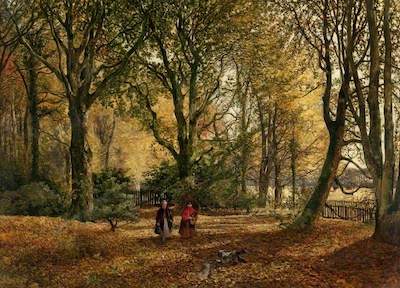
(John Milne Donald, Autumn Leaves: Glasgow Museums Resource Centre)

‘Darknesse and light divide the course of time, and oblivion shares with memory a great part even of our living beings; we slightly remember our felicities, and the smartest stroaks of affliction leave but short smart upon us.’[1]

The leaves are falling faster now, perhaps mostly fallen. Our clocks have gone back an hour and we are on Greenwich Mean Time. The polymath Edward Heron-Allen wrote in his journal on 22 May 1916, ‘The notable feature of the month is the establishment by law on the 20th of “summer time” which Willett, the originator of the idea, never lived to see introduced. At midnight on the 20th we all had to put our clocks on one hour, and in this way an hour of daylight is “added” to the day.’ And, five months later, he noted: ‘I do not think I have recorded that on 30 September we put our clocks back an hour and returned to Greenwich time.’[2]

William Willett, whose 1907 pamphlet, The Waste of Daylight, marked a crucial point in the advance towards ‘summer time’, had died from influenza on 4 March 1915, at the early age of 58, and is buried in St Nicholas churchyard in Chislehurst (as is his second wife.) The 1916 emergency law was passed to change the clocks twice a year as a measure to reduce energy and increase war production. It became a permanent feature when the Summertime Act was passed in 1925.

Leaves falling, darker days, the year in some ways closing down – but all these are in the natural order of things, as—or so we hope—the political convulsions, atrocities in Gaza, Lebanon, Ukraine, Sudan and elsewhere, are not. At least, as Jake Barnes says, at the close of Ernest Hemingway’s The Sun Also Rises, ‘Isn’t it pretty to think so?’
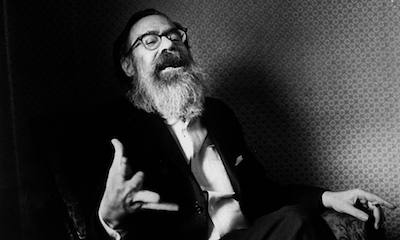
(John Berryman via The Paris Review)

‘Now there is further a difficulty with the light’, John Berryman wrote:

I am obliged to perform in complete darkness
operations of great delicacy
on my self.[3]

Currently those operations feature slow and sometimes painful analyses of my bafflement and confusion, not always helped by the Librarian’s daily bulletins from the battlefield that is the American election, often delivered in tones of appalled astonishment, while the phrase ‘batshit crazy!’ tends to recur.

What, in some senses, seems self-evident (one candidate sane, the other rather less so) is dwarfed by complexities and nuances almost invisible to us – we’re here and they’re. . . over there. I grasp, more or less, the fact that America is so divided a country now that neither side can—perhaps has no wish to—hear the other. But there is that other complication. While I can see that the appalling and spineless response of the Biden government to the conflict in the Middle East must repel a good many voters, it baffles me that those voters should think that withholding their vote from Harris (and thereby potentially contributing to her defeat) could somehow help the Palestinian people. Surely the precise opposite?
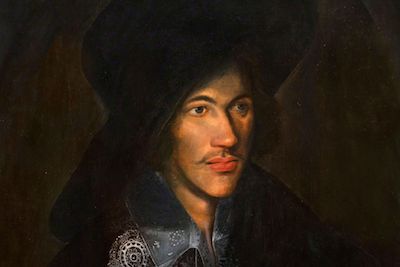
(John Donne, unknown English artist, c.1595)

Well, we’ll know soon enough. People, eh? I think of Katherine Rundell writing that, ‘amid all Donne’s reinventions, there was a constant running though his life and work: he remained steadfast in his belief that we, humans, are at once a catastrophe and a miracle.’ And: ‘He thought often of sin, and miserable failure, and suicide. He believed us unique in our capacity to ruin ourselves. “Nothing but man, of all envenomed things,/Doth work upon itself with inborn sting”. He was a man who walked so often in darkness that it became for him a daily commute.’[4]


Notes

[1] Sir Thomas Browne. Hydriotaphia, or Urn-Buriall, in Selected Writings, edited by Geoffrey Keynes (London: Faber  and Faber, 1970), 152.

[2] Edward Heron-Allen’s Journal of the Great War: From  Sussex Shore to Flanders Fields, edited by Brian W. Harvey and Carol Fitzgerald (Lewes: Sussex Record Society, 2002), 65, 71.

[3] John Berryman, ‘Dream Song # 67’, The Dream Songs, collected edition (New York: Farrar, Straus and Giroux, 1969), 74.

[4] Katherine Rundell, Super-Infinite: The Transformations of John Donne (London: Faber, 2023), 5-7.
Passing time, clocking off

harold-lloyd

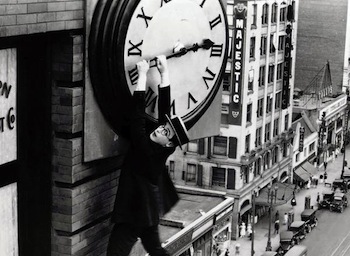
(Harold Lloyd in Safety Last!)

On 11 November 1918, US pilot Sergeant Charles Veil, still with a French squadron although he had technically become a lieutenant in the United States Army, was greeted on landing with the news that the Armistice had been signed and that the war was over. ‘No more patrols, no more fights in the air. Nothing to do, nothing to live for. . . I found my watch, brought it forth, threw it as far as ever I could. Time would never mean the same thing again. . . .’[1]

It means, of course, different things to different people at different. . . times. It might seem stable enough if you stand still—until you move east or west—a lot more stable than it used to be, for sure. Standard time came in towards the close of the nineteenth century. In the United States, it was the railroad companies rather than governments that were first to institute it: ‘Around 1870, if a traveler from Washington to San Francisco set his watch in every town he passed through, he would set it over two hundred times.’ You’d barely have had time to set the time. And, in fact, it was on this day, 18 November, in 1883, that the railroads imposed uniform time. It was called ‘the day of two noons’ because at midday clocks in the eastern part of each zone had to be set back: ‘one last necessary disruption’.[2]

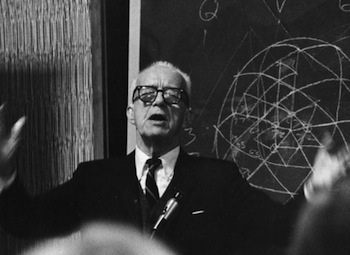
Clock time as a major issue can certainly be demanding. On Robert Scott’s Antarctic expedition of 1910-1913, the young Apsley Cherry-Gerrard (‘Cherry’) ‘kept three clocks and two wristwatches above his bunk to make absolutely sure that he did not miss his shift on deck.’[3] Hugh Kenner wrote of Buckminster Fuller that: ‘He zoomed around the globe in person, bearing his news to audiences in town after town. He wore three watches to tell him (1) the time back home, (2) the time where he was now, and (3) the time at his next stop.’[4]

Bucky

Buckminster Fuller ( https://pacificdomesnews.wordpress.com/happy-birthday-buckminster-fuller/ )

But time is not only clock time, of course: it’s time as experience, time in our heads, the moment that stretches into hours, the days collapsed into a heartbeat. Does time speed up as we age? Is it one of the inescapable problems of ageing, the days ‘flashing by like subway stations passed by the express train’, as Saul Bellow’s narrator remarks? ‘If only we could bring back the full days we knew as kids.’ But ‘[o]ur need for rapid disposal eliminates the details that bewitch, hold, or delay the children.’ Still, ‘Art is one rescue from this chaotic acceleration. Meter in poetry, tempo in music, form and color in painting. But we do feel that we are speeding earthward, crashing into our graves.’[5]

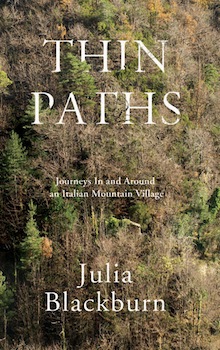
Time; space—or time as space. At a small party to celebrate the completion of her book about the area around the Italian village where she lives, Julia Blackburn writes of saying that: ‘being here in the valley has made me think that time past and time present and time future is like a vast landscape and we are walking through it on a tracery of thin paths.’[6]

thin_paths

Then space as time, in a sense. William Herschel’s 1802 paper considered the idea that deep space must also imply deep time. His telescope had ‘also, as it may be called, a power of penetrating into time past’ — the rays of light conveying the image of a remote nebula to the eye must have been ‘almost two million years on their way’. Therefore the universe was ‘almost unimaginably older than people had previously thought.’[7]

Writers, certainly most of the major modernist writers, have a complex relationship with time: James Joyce, Ford Madox Ford, David Jones, Marcel Proust, T. S. Eliot, Virginia Woolf, Ezra Pound, Dorothy Richardson, William Faulkner, Samuel Beckett, Gertrude Stein. How could they not, given the rupture of the First World War, that ‘crack across the table of History’?[8] Wyndham Lewis devoted a massive volume to opposing and analysing the ‘Time-doctrine’, the stress on the subjective and the interior which he traced to the French philosopher Henri Bergson, ‘the perfect philosophic ruffian, of the darkest and most forbidding description: and he pulls every emotional lever on which he can lay his hands.’[9] Characteristically, Lewis—‘Dogmatically, then, I am for the Great Without, for the method of external approach’[10]—had a pop at a huge range of targets, among them Joyce, Pound, Stein, Proust and a flock of philosophers.

Later writers’ view of time has tended more towards Bergson’s—and less towards Lewis’s—view of the matter. Eudora Welty remarked that ‘The time as we know it subjectively is often the chronology that stories and novels follow: it is the continuous thread of revelation.’[11] Jeanette Winterson wrote that Sigmund Freud, ‘one of the grand masters of narrative, knew that the past is not fixed in the way that linear time suggests. We can return. We can pick up what we dropped. We can mend what others broke. We can talk with the dead.’[12]

Indeed. We don’t need time machines. We are time machines. Possessing memory and imagination, we are masters—or mistresses—of both past and future. It’s just the present that’s so damned tricky.

References

[1] Stanley Weintraub, A Stillness Heard Round the World: The End of the Grest War, November 1918 (New York: Oxford University Press, 1987), 186.

[2] Stephen Kern, The Culture of Time and Space 1880-1918 (Harvard University Press, 1983), 12.

[3] Sara Wheeler, Cherry: A Life of Apsley Cherry-Gerrard (London: Jonathan Cape, 2001), 63.

[4] Hugh Kenner, The Elsewhere Community (New York: Oxford University Press, 2000), 139.

[5] Saul Bellow, Ravelstein (London: Viking, 2000), 191-192.

[6] Julia Blackburn, Thin Paths: Journeys In and Around an Italian Mountain Village (London: Jonathan Cape, 2011), 248.

[7] Richard Holmes. The Age of Wonder: How the Romantic Generation Discovered the Beauty and Terror of Science (London: Harper Collins, 2008), 203.

[8] Ford Madox Ford, A Man Could Stand Up— (1926; edited by Sara Haslam, Manchester: Carcanet, 2011), 17.

[9] Wyndham Lewis, Time and Western Man (London: Chatto & Windus, 1927), 449, 174.

[10] Wyndham Lewis, Men Without Art (London: Cassell, 1934), 128.

[11] Eudora Welty, One Writer’s Beginnings (London: Faber, 1985), 69.

[12] Jeanette Winterson, Why Be Happy When You Could Be Normal? (London: Vintage 2012), 58.