Blackberries, cats and a tilly


And every tree is a tree of branches
And every wood is a wood of trees growing
     And what has been contributes to what is.
So I am glad to have known them,
     The people or events apparently withdrawn;
The world is round and there is always dawn
     Undeniably somewhere.[1]

Some days, if you’re early enough, you can walk all the way round a huge Victorian cemetery and not see even a single dogwalker—though you might catch sight of a fox, if you’re lucky. The blackberries have got ahead of themselves to such an extent that  they’ll barely last the month: but once in the freezer drawer, they’ll see us well into winter.  Cow parsley, Anthriscus sylvestris, or Queen Anne’s lace (or, I gather, keck) still hangs on in places. A mistle thrush and a song thrush seem to answer one another and there’s a goldcrest somewhere near.

We are well past midsummer now. Glastonbury Festival is over (I shall probably get The Cure’s ‘Friday I’m in Love’ out of my head soon), the Wimbledon tennis tournament finished, the Bristol Harbour Festival has happened and the Balloon Fiesta is just a couple of weeks away. The wider canvas still largely features arterial blood and heavy boots on infant faces though even some Western politicians have now begun to wonder if deliberately starving thousands of innocent civilians and then shooting them down in cold blood day after day when they try to secure food might be just a bit over the top. Even so, to demonstrate that they know what’s terrorism and what isn’t, our government is prosecuting people who object to their country’s complicity in war crimes.

But pass on, pass on. Books, music, food, wine, love, cats.

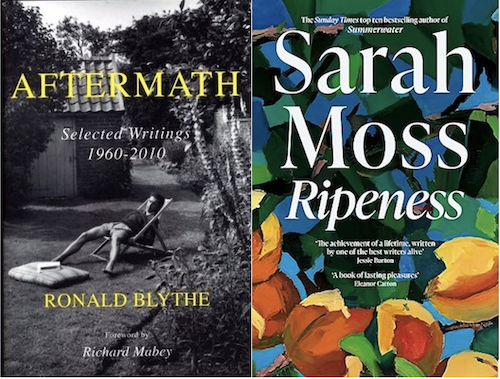
When I surface from Ford’s letters, I have waiting for me Paul Willetts’ remarkable reconstruction of the life of Julian Maclaren-Ross, Ronald Blythe, Sarah Moss, early Ernest Hemingway. Otherwise, I just revel in Anne Carson:


‘My mother forbad us to walk backwards. That is how the dead walk, she would say. Where did she get this idea? Perhaps from a bad translation. The dead, after all, do not walk backwards but they do walk behind us. They have no lungs and cannot call out but would love for us to turn around. They are victims of love, many of them.’[2]

Yes. Meanwhile, the weather, or much of it, prompts me to recognise my increasing intolerance to higher temperatures (and to much else: I know I’m widely assumed to become more conservative politically as I age but something’s clearly gone wrong). Earlier walks, more water, more cursing – I know all the tricks.

As to cats – yes, I like to remember that ‘Balthus painted himself once as a cat dining on fish, and once as the King of the Cats.’[3] Sylvia Townsend Warner mentioned, in a letter to William Maxwell (9 April 1952) , the northern Scottish traveller’s tale of seeing the cat funeral. ‘And the cat of the house, lying on the hearth, started up at these words, and exclaimed, “Then I am the King of the Cats”, and vanished up the chimney.’[4] When Swinburne died in 1909, William Butler Yeats said to his sister Lily, ‘Now I am king of the cats.’[5]

.

(John Butler Yeats, portrait of embroiderer, and co-founder (with her sister Lolly) of Cuala Industries, Susan Mary (Lily) Yeats (1901): National Gallery of Ireland)

The novelist, suffragist and partner—for several fraught years—of Ford Madox Ford had a good many of them: ‘Violet’s parrots—part of a menagerie that included an  owl (named Anne Veronica after Wells’s novel), a bulldog and nine Persian cats—shrieked “Ezra! Ezra!” whenever they saw him bouncing up the walk.’[6]

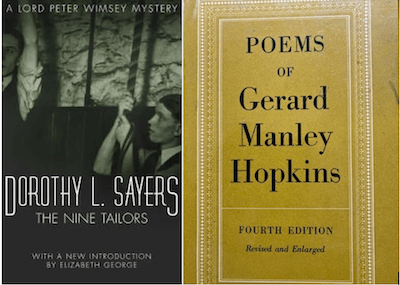
I can, alas, only half-agree with Lord Peter Wimsey when he says to Parker at the end of that bell-ringing mystery, The Nine Tailors, ‘“Bells are like cats and mirrors – they’re always queer, and it doesn’t do to think too much about them.”’[7] Queer they may be but I think about them a good deal and seem none the worse for it.

There was a collection of essays published ‘on the Occasion of the 25th Anniversary of Finnegans Wake’, which included pieces by Padraic Colum, Frank Budgen, Vivian Mercier, Fritz Senn, A. Walton Litz and other distinguished Joyceans. It was called Twelve and a Tilly.[8]

For ‘tilly’, my Shorter Oxford has: ‘In Ireland and places of Irish settlement, an additional article or amount unpaid for by the purchaser as a gift from the vendor.’ Joyce’s nocturnal masterpiece offers four occurrences and the splendid online glossary – http://finwake.com – adds to ‘the thirteenth of a baker’s dozen’ the derivation from Irish tuilleadh, added measure.

Opening my eyes to uncertain light, I can hear the table-tennis ball moving in the kitchen and the hall, knocking against skirting-boards and doorframes. I get up for a pee and a small grey tabby runs in to check on my progress and brush against my legs. Getting back into bed, I see that it’s 03:50. Moments later, the table-tennis ball is on the move again.

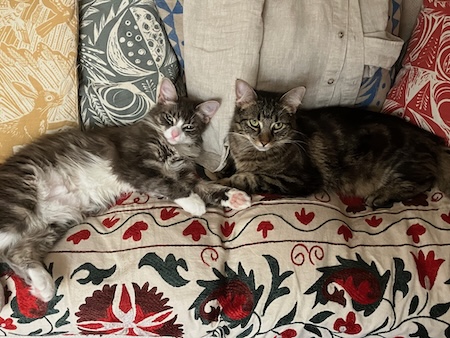
Yes, we have our own Tilly now, not an added measure but one-half of a pair. Her brother is named Max, which I like in part because it was the name of the very first pet I remember, in Gillingham, Kent, a black cocker spaniel—but also because of the occasional fleeting uncertainty which attends such phrases as ‘I said to Max’ or, more plausibly, ‘I asked Max’, which might conceivably be a reference to either a handsome tabby or our leading Ford Madox Ford scholar.

Scholars, though, at least as a general rule, do not sit in the kitchen sink, talk to toy mice or suck their tails. . .

Notes


[1] Louis MacNeice, ‘Autumn Journal: XXI’, Collected Poems, edited by Peter McDonald (London: Faber, 2007), 153.

[2] Anne Carson, ‘On Walking Backwards’, Plainwater: Essays and Poetry (New York: Vintage, 2000), 36.

[3] Guy Davenport,  A Balthus Notebook (New York: Norton, 1989), 7. Le Roi des Chats (1935). Balthus identified strongly with cats: in the year of this self-portrait, he began signing his letters to his future wife Antoinette as ‘King of Cats’. ‘Jeune fille’ occurs many times in the titles of his paintings—but so does ‘chat’ (sometimes together).

[4] Sylvia Townsend Warner, Letters, edited by William Maxwell (London: Chatto & Windus, 1982), 133.

[5] Yeats to Susan Mary (‘Lily’) Yeats, 12 Apr. 1909: R. F. Foster, W. B. Yeats: A Life. I: The Apprentice Mage: 1865–1914 (Oxford: Oxford University Press, 1997), 616n.69.

[6] Pound, of course. Barbara Belford, Violet: The Story of the Irrepressible Violet Hunt and her Circle of Lovers and Friends—Ford Madox Ford, H. G. Wells, Somerset Maugham, and Henry James (New York: Simon and Schuster, 1990), 166-7.

[7] Dorothy L. Sayers, The Nine Tailors (1934; with an introduction by Elizabeth George, London: New English Library, 2003), 305.

[8] Twelve and a Tilly: Essays on the Occasion of the 25th Anniversary of Finnegans Wake, edited by Jack P. Dalton and Clive Hart (Evanston: Northwestern University Press, 1965).

Grackles, clouds, popes

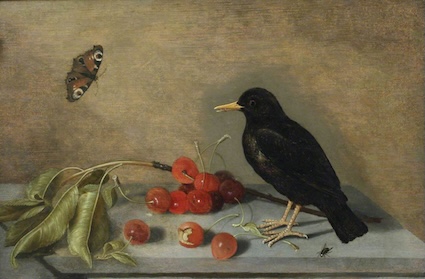
(Ambrosius Bosschaert the Younger, A Blackbird, Butterfly and Cherries: National Trust, Ham House)

04:30 and the blackbird already in full song. Not conducive to much further sleep but fine music. The same bird or a different one has several times come down to pick up grubs from pots ranged against the walls. Writing of the disappearances from the natural world over the past decades, Richard Mabey mentions smaller gnat swarms and choruses of blackbirds, and the barn owls gone.[1] And it’s true that we never hear such choruses now: it is almost always a solitary blackbird.

Guy Davenport remarks on ‘Gracchus’, meaning ‘grackle’ or ‘blackbird’; in Czech, kavka. And that Franz Kafka’s father had a blackbird on his business letterhead.[2] I recall that Davenport used ‘Grackle’ in ‘The Messengers’, his fourth story about Kafka (after ‘The Aeroplanes at Brescia’, ‘The Chair’ and ‘Belinda’s World Tour’). The writer is asked his name by the household god:
‘My name? Why, it’s Amschel. I mean, Franz. By the world, I am Franz Kafka.’
‘A kavka is a jackdaw.’
‘A grackle. Graculus, in Latin a blackbird.’
‘Yes.’[3]

I see that yesterday was Allen Ginsberg’s birthday, just one short of a centenary. Dear Ginsberg. I saw him read a couple of times, too many years ago, and the phrase ‘what thoughts I have of you’ came into my mind quite recently, remembering then: ‘What thoughts I have of you tonight, Walt Whitman, for I walked down the sidestreets under the trees with a headache self-conscious looking at the full moon.’

That poem ends: ‘Ah, dear father, graybeard, lonely old courage-teacher, what America did you have when Charon quit poling his ferry and you got out on a smoking bank and stood watching the boat disappear on the black waters of Lethe?’[4]

Whitman’s America, opening out; Ginsberg opening, broadening, welcoming. A decade or so later and he calls on Whitman again, this time with a long quotation from Democratic Vistas as epigraph to the collection called, ah, The Fall of America.

Here we are. And here we are.

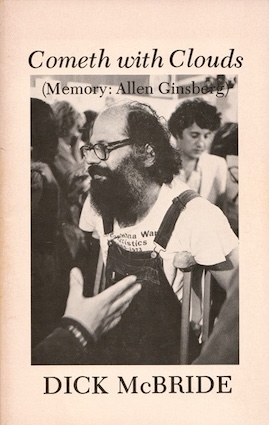
Back then too, in my early bookselling days, was Dick McBride, poet, playwright, actor, bookseller, publisher, former manager of City Lights Bookshop, having been introduced to Lawrence Ferlinghetti by poet, painter and novelist Kenneth Patchen. Dick was living in England then, distributing American small press books (and not so small: New Directions for a while)—a cottage in Great Horwood, Buckinghamshire, and an abandoned Victorian Methodist chapel for a warehouse. On my shelves is a copy of Cometh with Clouds (Memory: Allen Ginsberg), inscribed to me by Dick and dated July 14, 1983. It was published the previous year by Cherry Valley editions. I think I have a few of his other books, Lonely the Autumn Bird: Two Novels and Memoirs of a Natural-Born Expatriate were issued by Alan Swallow, and also The Astonished I, published by, ah, McBride’s Books.

Looking for online traces of Dick all these years later, I find more than I’d expected, on the Allen Ginsberg Project site and, particularly, a fine website created (and ongoing) by Rob McDowall: https://dickmcbride.co.uk/

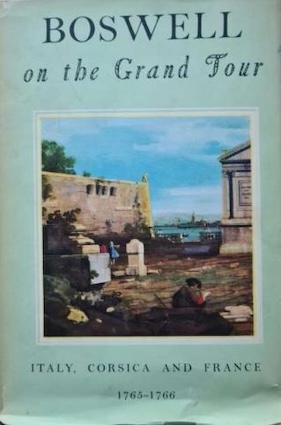
I am currently with James Boswell in Italy, Dorothy Parker in New York, and Ford Madox Ford more or less anywhere, generally in either Paris or New York, though occasionally in Corsica or Carqueiranne. Also, just now, with Stella Bowen in Italy, where she is travelling with Dorothy Pound, looking at pictures, while Ezra ransacks the archives to find material for the Malatesta Cantos. Quite unable to rely on so much of the world to refrain from barbarism and conduct its affairs with decency, intelligence or basic humanity, I’m happy enough to be elsewhere in quite other temporal locations.

Poor Boswell lectures himself on his conduct almost daily but then argues with his companions, pursues a married countess or takes himself off to the nearest working girl.  A ‘fille charmante’, about seven shillings. Also, ‘“Des filles” in the next three days ran to thirteen shillings.’ He seems strikingly subject to venereal disease too. After his triumphant forays into the lives of Jean Jacques Rousseau and Voltaire, Boswell is travelling with a party that includes Lord Mountstuart, son of Lord Bute, and has secured the friendship of John Wilkes, who (perhaps not an ideal model for young Boswell) takes the view that ‘dissipation and profligacy renew the mind’, he having written his best issues of his newspaper The North Briton (founded to attack Prime Minister Lord Bute) while ‘in bed with Betsy Green’.[5]

(Alexander Pope by William Hoare: National Portrait Gallery)

From time to time, I also try to get back more into the eighteenth-century frame of mind with some Pope – Alexander, to avoid any possible confusion, recalling an occasion not so long ago when I asked the Librarian what she was watching. ‘A bit of Pope’, she said. I looked into the front room and saw a blaze of red, cardinal red, you might say. Boswell, in an earlier journal, had recounted an evening including the poet’s work, which was not, however, quite enough to save the occasion: ‘The night before I drank tea and sat all the evening writing in the room with my landlord and landlady. They insisted that I should eat a bit of supper. I complied. I also drank a glass of punch. I read some of Pope. I sung a song. I let myself down too much. Also, being unaccustomed to taste supper, my small alteration put me out of order. I went up to my room much disgusted. I thought myself a low being.’[6]

Having actually taught Pope to unfortunate students many years back, I’m surprised to find I have to make a stern and conscious effort to stick with him, uneasily recalling W. H. Auden’s remark (8 January 1947) to Alan Ansen: ‘The real test of liking English poetry is Pope. His ideas aren’t much, but the language is wonderful—“Chicane in furs.” The Rape of the Lock is the most perfect poem in English.’[7] Or, indeed, Hugh Kenner, reviewing Maynard Mack’s life of the poet: ‘The great danger of absorbing writers’ biographies is that you can begin to think you understand writing you’ve not troubled to come to terms with.’[8]

I like to think of Gilbert White being presented with a copy of Pope’s six-volume translation of the Iliad by the poet himself, when graduating with distinction from Oriel College, Oxford, in 1743.

In Pope’s ‘Epistle to Burlington’, I see a neat encapsulation of pre-Romantic sensibility:

‘In all, let Nature never be forgot.
But treat the Goddess like a modest fair,
Not over-dress, nor leave her wholly bare;
Let not each beauty ev’ry where be spy’d
Where half the skill is decently to hide.
He gains all points, who pleasingly confounds
Surprizes, varies, and conceals the Bounds.’

And elsewhere a remark that never goes out of date, alas:

‘But when to Mischief Mortals bend their Will,
How soon they find fit Instruments of Ill!’ (‘Rape of the Lock’, Canto III).


Notes

[1] Richard Mabey, Nature Cure (London: Chatto & Windus 2005), 134.

[2] Guy Davenport, The Hunter Gracchus and Other Papers on Literature and Art (Washington: Counterpoint, 1996), 2.

[3] Guy Davenport, The Cardiff Team: Ten Stories (New York: New Directions, 1996), 2.

[4] ‘A Supermarket in California’, in Allen Ginsberg, Selected Poems 1947-1995 (London: Penguin Books, 2001), 89.

[5] Boswell on the Grand Tour: Italy, Corsica and France, 1765-1766, edited by Frank Brady and Frederick A. Pottle (London: William Heinemann, 1955), 54n., 58n.

[6] Sunday 19 December 1762: Boswell’s London Journal, 1762-1763, edited by Frederick A. Pottle (London: William Heinemann, 1950), 95.

[7] Alan Ansen, The Table Talk of W. H Auden, edited by Nicholas Jenkins (London: Faber and Faber, 1991), 15-16.

[8] Hugh Kenner, ‘Maynard Mack’s Pope’, Historical Fictions (Athens: University of Georgia Press, 1995), 250.

By heart in the park

(Philip Wilson Steer, Dover Coast: York Art Gallery)

Another last warm and sunny afternoon of autumn. How many more can there be? With the Librarian in the office for a pretty full day, so not available for the lunchtime stroll, I walk alone in the park and succumb to the temptation to recall (and recite) the handful of poems that, at one time or another, I’ve committed to memory. Committed they may have been but seem, for the most part, to have escaped or at least to be out on parole.

Matthew Arnold’s ‘Dover Beach’ is worse than shaky and, in its current state, Marvell’s ‘To His Coy Mistress’ would probably not detain her for a moment. A bit of Pound, a bit of Yeats and a fragment of Elizabeth Bishop all hold steady, while a couple of others improve with work, which necessitates keeping a wary eye open – and an ear, given the increasing tendency of people to rush up behind you on bicycles or accursed electric scooters. Robert Lowell’s ‘Skunk Hour’ (dedicated to Bishop) yields a little to pressure:

Nautilus Island’s hermit heiress still
something something
her sheep still graze above the sea

Two men, walking briskly but not quite briskly enough, so staying almost exactly the same distance behind me, fairly close and, worse, very gradually nearing. . .

Her farmer
Is first selectman in our village;
she’s in her dotage.

We’re sailing now. Ah:

Thirsting for the hierarchic privacy
of Queen Victoria’s century,
she buys up all
the eyesores facing her shore,
and lets them fall.

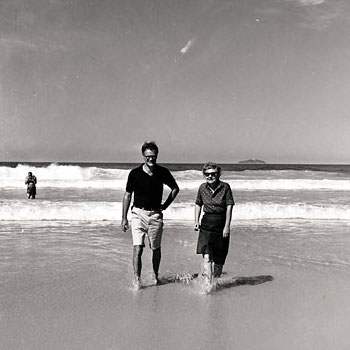
(Lowell and Bishop in Brazil, 1962. Photo: Vassar College Library via the New Criterion)

But then there’s some confusion in the order of half-remembered stanzas, though I have most of the mother skunk’s activities in the final one. Move on to surer ground, anyway, the much-learned, almost-all recollected ‘Bagpipe Music’.

Though here a slight pause for the woman standing with her dog at the top of a slope below the play area. Is it a Pointer? We’ve seen it more than once before. Similar shape, similar attitude, its attention fixed on something in the grass near the foot of a tree, that can only be a squirrel. Looking it up later, I see that it’s a Vizsla, also known as a Hungarian Pointer. I stroll past it, resisting the impulse to give it some advice: you may be quick but you won’t win, they climb, you don’t. We’ve seen some close shaves for squirrels in the past but they always seem to evade dogs’ jaws. And ‘Bagpipe Music’? Pretty good, in fact. A slight hiccup over the penultimate stanza but both MacNeice and myself ending strongly:

It’s no go my honey love, it’s no go my poppet;
Work your hands from day to day, the winds will blow the profit.
The glass is falling hour by hour, the glass will fall for ever,
But if you break the bloody glass you won’t hold up the weather.

Now distractions range from the two old ladies intent on feeding a squirrel by hand (‘Come on, dear, see what I’ve got’ – Fleas, soon enough, I suspect) to the fellow with the ponytail and curious blue-green leggings intent on kicking a very small ball across the grass, and who crosses my path again half an hour later in a different and distant part of the park; and a murder of crows, around thirty in total, spread right across and down a broad grassy slope to the cycle path that runs along beneath the outspread branches of several wild pear trees. The fruits fall partly onto the earthy slopes beyond and partly onto the cycle path itself, one missed my right ear by inches one day last week. Walking along that path now before climbing sharply to my left, I see a dozen crows rooting among the fallen pears, though some turn to stare at me as I approach. ‘Are you auditioning for that nice Mister Hitchcock?’ I ask. One crow, not to be put off by a mere human, lingers to stick its beak straight through a pear before flying up to the branch above. Knowing how clever corvids are, I watch to see how it goes about extricating beak from fruit. It thrusts the pear into a narrow fork of branches which holds it in a tight embrace, withdraws the beak and starts tucking in. I whistle my sincere appreciation. That Lowellian mother skunk, I recall,

    jabs her wedge-head in a cup
of sour cream, drops her ostrich tail,
and will not scare.

Why is it so hard these days? No answers on a postcard, please. At school, everyone learned poems by heart and some people never lost the habit. I recalled an aside of the Reverend Kilvert: ‘I thought of William Wordsworth the poet who often used to come and stay at this house with blind Mr. Monkhouse who had nearly all his poems off by heart.’[1] Eric Gill’s father and one of Gill’s teachers, named Mr Catt, were great admirers of Tennyson. Gill himself also learned much of it by heart, being particularly fond of ‘the passage about the routine of rural agriculture:

As year by year the labourer tills
His wonted glebe and lops the glades’[2]

This is from stanza CX of Tennyson’s In Memoriam A. H. H., the initials those of Tennyson’s beloved friend Arthur Henry Hallam, who died in Vienna in 1833. Born in 1811, he was eighteen months younger than Tennyson. They had met at Trinity College, Cambridge in 1828. Tennyson seems to have begun this long poem very soon after hearing of Hallam’s death, though it was not published until 1850, and then anonymously. Edward Fitzgerald—translator of The Rubaiyat of Omar Khayyam—wrote to the poet’s elder brother Frederick Tennyson (15 August 1850): ‘Alfred has also published his Elegiacs on A. Hallam: these sell greatly: and will, I fear, raise a host of Elegiac scribblers.’[3]

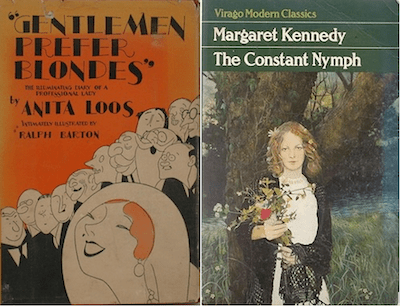
But it is not only poetry that the heroes of yesteryear committed to memory in large chunks – some mastered prose in a similar way, which always seems to me somehow an even more impressive achievement, though I accept that actors, having to learn their lines, sometimes comprising tremendously long speeches or monologues, would not necessarily find it so. Joseph Conrad and Ford Madox Ford would swap pages of Flaubert or Maupassant, while James Joyce ‘knew by heart whole pages of Flaubert, Newman, de Quincey, E. Quinet, A. J. Balfour and of many others.’[4] And, while Anita Loos’ Gentlemen Prefer Blondes was apparently one of Patrick White’s favourite novels (Joyce, Faulkner and Edith Wharton were also admirers), he knew Margaret Kennedy’s The Constant Nymph ‘practically off by heart.’[5]

‘Heart’ is another of those words with a great many friends, the compounds running over several columns of the dictionary: in one’s mouth or boots or the right place; open, shut, taken; worn on the sleeve; piercing, rending, sore and sick. It has its reasons and is, in many contexts, simply mysterious, as the author of ‘Dover Beach’ wrote:

But often, in the world’s most crowded streets,
But often, in the din of strife,
There rises an unspeakable desire
After the knowledge of our buried life;
A thirst to spend our fire and restless force
In tracking out our true, original course;
A longing to inquire
Into the mystery of this heart which beats
So wild, so deep in us – to know
Whence our lives comes and where they go.[6]

I briefly consider this last poem as a candidate but coming in at around a hundred lines, it may be a stretch too far for me. Sonnets are a handy length, though . . .


Notes

[1] Francis Kilvert, entry for 27 April 1870, Kilvert’s Diary, edited by William Plomer (London: Jonathan Cape, 1938, reissued 1969), I, 119.

[2] Fiona MacCarthy, Eric Gill (London: Faber & Faber, 1990), 26.

[3] The Letters of Edward Fitzgerald, edited by Alfred McKinley Terhune and Annabelle Burdick Terhune, four volumes (Princeton: Princeton University Press, 1980), I, 676.

[4] Frank Budgen, James Joyce and the Making of ‘Ulysses’ and other writings, enlarged edition (1934; London: Oxford University Press, 1972), 181. Edgar Quinet was a French historian; by A. J. Balfour is meant, presumably, the British Prime Minister (1902-1905) – who also published works of philosophy.

[5] David Marr, Patrick White: A Life (London: Vintage, 1992), 85.

[6] Matthew Arnold, ‘The Buried Life’, Poetry and Criticism of Matthew Arnold, edited by A. Dwight Culler (Boston: Houghton Mifflin, 1961), 114.

Words made flesh, flash, at a trumpet crash


(‘The Ash Yggdrasil’ from Aasgard and the Gods, by Wilhelm Wägner)

‘I remember going on to think that Ragnarök seemed “truer” than the Resurrection’, the narrator of A. S. Byatt’s story, ‘Sugar’, writes, having known, as a child, the 1880 book Asgard and the Gods.[1]

There’s a peculiar fascination about those moments in a work of art when other practitioners are evoked, quoted or alluded to, especially when the source is altered. Often enough, this is because the writer is quoting from memory: while George Orwell usually announces that he’s about to do so, others engage in the same practice without any such explicit statement, not infrequently getting things almost—but not quite—right. In a letter to G. K. Chesterton (6 July 1928), T. S. Eliot wrote: ‘The last time that I ventured to quote from memory in print, a correspondent [ . . . ] pointed out that I had made twelve distinct mistakes in well-known passages of Shakespeare.’[2] Joseph Conrad used lines from Spenser’s Faerie Queene (I, ix, 359-360) as the epigraph to his novel The Rover (1923), and the same lines were  later incised on his gravestone at Canterbury: ‘Sleep after toyle, port after stormie seas,/ Ease after warre, death after life does greatly please’. When they reappeared at the close of the ‘English’ text of Ford Madox Ford’s No Enemy (there is an appendix with the original French version of an earlier chapter in English), there were a few differences. ‘Sleep’ becomes ‘rest’ (a resonant word in Ford’s writings), ‘ease after warre’ is excluded, even though Ford wrote much of the book in 1919, having just been gazetted out of the British army after serving both at home and in France and Flanders, ‘death after life’ goes too, since he is celebrating survival, if among a number of ghosts. This is far from simple ‘misquoting’ or ‘misremembering’.[3]


There’s a moment in Dorothy Sayers’ 1934 novel, The Nine Tailors—‘O my, what a lovely piece of work’, Guy Davenport commented, having just read Sayers’ book—when Lord Peter Wimsey, watching a coffin go off up the road, slips into reverie, or stream of consciousness, and suddenly comes up with a chunk of what was immediately familiar to me, though it took a minute or two to identify it as a poem by Gerard Manley Hopkins called ‘That Nature is a Heraclitean Fire’:

                            ‘In a flash, at a trumpet crash,
I am all at once what Christ is, | since he was what I am, and
This Jack, joke, poor potsherd, | patch, matchwood, immortal diamond,
                            Is immortal diamond.’[4]

These are characteristically arresting lines, but the poem’s full title is ‘That Nature is a Heraclitean Fire and of the Comfort of the Resurrection’, and there is a striking gap, an elision, in the passage that occurs in Wimsey’s thoughts: the line, ‘I am all at once what Christ is, | since he was what I am, and’, is missing.[5]

Hopkins wrote to his friend, the poet Robert Bridges, on 25 September 1888, that, while the sonnet he’d recently sent Bridges on the Heraclitean fire had distilled a lot of early Greek philosophical thought, perhaps ‘the liquor of the distillation did not taste very Greek’. He added: ‘The effect of studying masterpieces is to make me admire and do otherwise’—which seems eminently reasonable.[6]


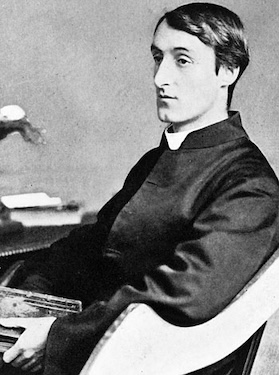
(Gerard Manley Hopkins)

Hopkins—Jesuit priest, classics professor—is, as W. H. Gardner wrote, ‘a religious, not merely a devotional, poet. Religion, for him, was the total reaction of the whole man to the whole of life’ (‘Introduction’ to Poems, xxxv). A good many of his poems are addressed directly and vividly to God, as in the first stanza of the first major poem, ‘The Wreck of the Deutschland’:

Thou mastering me
God! giver of breath and bread
World’s strand, sway of the sea;
Lord of living and dead
Thou has bound bones and veins in me, fastened me flesh,
And after it almost unmade, what with dread,
Thy doing: and dost thou touch me afresh?
Over again I feel thy finger and find thee.

‘The Windhover’ is dedicated ‘To Christ our Lord’, ‘Pied Beauty’ begins: ‘Glory be to God for dappled things’, ‘The Loss of the Eurydice’ is addressed ‘O Lord’ and a late sonnet begins: ‘Thou art indeed just, Lord, if I contend/ With thee’. The ‘terrible sonnets’, evidence of great stress, even ‘desolation’, also centrally concern his relationship with God:

I am gall, I am heartburn. God’s most deep decree
Bitter would have me taste: my taste was me;
Bones built in me, flesh filled, blood brimmed the curse.[7]


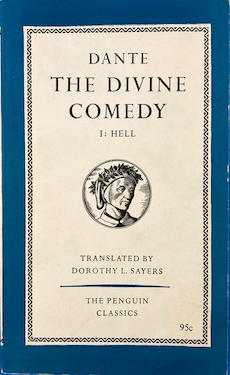
Religious themes featured early in Sayers’ writing life and became more central later, in her many plays and her translation of Dante’s Divine Comedy. This rector’s daughter may have had both father and rectory in mind when she wrote The Nine Tailors. Mr Venables is scholarly, very amiable and extremely absent-minded, and Lord Peter Wimsey comes to regard him with affection and respect. Could Sayers have felt that the line she omitted from Hopkins’ poem might have seemed blasphemous to some readers, an issue further complicated by its occurring in her hero’s thoughts? At one point, Wimsey is confronted by a visiting card on a wreath, purporting to be from him but actually supplied by his manservant Bunter (who had been Sergeant to Major Wimsey in the First World War). The card includes a biblical reference, Luke xii, 6. ‘“Very appropriate,” said his lordship, identifying the text after a little thought (for he had been carefully brought up)’ (The Nine Tailors, 133). It’s probably safe to assume that Sayers too had been ‘carefully brought up’ in that respect.


Notes

[1] A. S. Byatt, Medusa’s Ankles: Selected Stories (London: Vintage, 2023), 37. Her Ragnarok: The End of the Gods was published in 2011.

[2] Quoted in a note to the epigraph of ‘Gerontion’, in The Poems of T. S. Eliot. Volume I: Collected and Uncollected Poems, edited by Christopher Ricks and Jim McCue (London: Faber & Faber, 2015), 469.

[3] Paul Skinner, ‘Just Ford – an Appreciation of No Enemy: A Tale of Reconstruction’, Agenda, edited by Max Saunders, 27, 4/ 28, 1 (Winter 1989/ Spring 1990), 103-109 (105).

[4] Poems of Gerard Manley Hopkins, Fourth edition, revised and enlarged, edited by W. H. Gardner and N. H. Mackenzie (London: Oxford University Press, 1967), 105-106. These are the last lines of the poem.

[5] The Nine Tailors (1934; with an introduction by Elizabeth George, London: New English Library, 2003), 122. Davenport’s enthusiasm (he writes the title as The Nine Taylors) is expressed in a letter to Hugh Kenner, 10 April 1967: Questioning Minds: The Letters of Guy Davenport and Hugh Kenner, edited by Edward M. Burns, two volumes (Berkeley: Counterpoint Press, 2018), II, 888.

[6] The Letters of Gerard Manley Hopkins to Robert Bridges, edited by Claude Colleer Abbott (Oxford: Oxford University Press, 1955), 291.

[7] ‘I wake and feel the fell of dark’, Poems, 101.

Wording, birding


(Robert Wilson, Hadrian’s Villa, c.1765: Tate)

‘At night I trailed from one window recess to another’, the Emperor Hadrian recalls in Marguerite Yourcenar’s novel, ‘from balcony to balcony through the rooms of that palace where the walls were still cracked from the earthquake, here and there tracing my astrological calculations upon the stones, and questioning the trembling stars. But it is on earth that the signs of the future have to be sought.’[1]

So it is. ‘Ghosts await you in the future if they do not follow you from the past’, Sarah Moss wrote, and: ‘No one who knows what happens in the world, what humans do to humans, has any claim to contentment.’[2] Yes. I write pages and delete them, since they serve no real purpose except to relieve my feelings for a short while. The past is not always a foreign country and they do not always do things differently there. As Pankaj Mishra said in his recent ‘Winter Lecture’: ‘It hardly seems believable, but the evidence has become overwhelming: we are witnessing some kind of collapse in the free world.’[3]

Early summer creeps on, though fitfully. Watching rose petals fall from the bush in a light wind, I remembered Pound’s Canto XIII, the first in which Confucius appears, and which ends:

The blossoms of the apricot
            blow from the east to the west
And I have tried to keep them from falling.[4]


(Shen Zhou, ‘Apricot Blossom’, leaf from the album, Dreaming of Travelling While in Bed: Palace Museum, Beijing)

Ronald Bush observed that: ‘To keep the blossoms of the apricot from falling is to keep nature in a permanent vernal bounty.’[5] It also seems to me to signify cultural contact, the free exchange of ideas, without the limits of borders or nationalism. At that stage, Pound was using Guillaume Pauthier’s translation of Confucian texts in Confucius et Mencius: les quatre livres de philosophie morale et politique de la Chine and had written in ‘Exile’s Letter’:

Intelligent men came drifting in from the sea and from the west border,
And with them, and with you especially
There was nothing at cross purpose,
And they made nothing of sea-crossing or of mountain crossing,
If only they could be of that fellowship,
And we all spoke out our hearts and minds, and without regret.[6]

On the daily walks we speak our minds but, just lately, exchanges are punctuated by information from our newly downloaded Merlin app, available from Cornell University, which draws on a huge database of bird sounds, sightings and photographs to identify what you’re probably hearing in that nearby tree or passing overhead.


So we stroll along narrow paths thus:

Politics, dinner, politics. . .
‘Blue tit. Carrion crow. Wren.’
Politics, domestic details, politics, cat, literary chuntering. . .
‘Dunnock. Blackcap. Chiffchaff.’
Ash dieback, politics, university gossip, politics. . .
‘Blackbird. Herring gull. Great tit. Jay!’

Excuse me, sir, let me just ask about the birdsong: in a world both literally and metaphorically on fire, democracies hanging by a thread, war crimes, liars and knaves in public places – does it help?

Why, yes, a little – rather more than a little, in fact. . .


Notes

[1] Marguerite Yourcenar, The Memoirs of Hadrian, translated by Grace Frick, with Yourcenar (1951; Penguin Books, 2000), 82.

[2] Sarah Moss, Signs for Lost Children (London: Granta Books, 2016), 88-89, 97.

[3] Pankaj Mishra, ‘The Shoah after Gaza’ [Winter Lecture], London Review of Books 46, 5 (7 March 2024).

[4] The Cantos of Ezra Pound, fourth collected edition (London: Faber and Faber, 1987), 60.

[5] Ronald Bush, The Genesis of Ezra Pound’s Cantos (Princeton: Princeton University Press, 1989), 251.

[6] ‘Exile’s Letter’, Ezra Pound: Poems and Translations, edited by Richard Sieburth (New York: Library of America, 2003), 255.

Milady Millay: or, Edna, come over here.

Sorting-Poetry-Bks

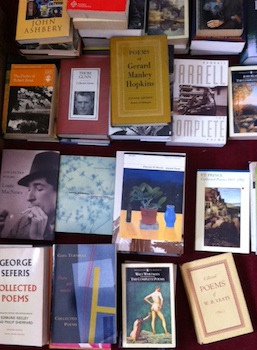
(Sorting out poetry books on the mistaken assumption that they can be fitted into the space available in such a way that the ones I want will always be at the front. . .but no Millay in any case)

‘I have just finished two volumes of letters—’, Elizabeth Bishop wrote to her friends Kit and Ilse Barker in the autumn of 1953, ‘Hart Crane’s and Edna St. Vincent Millay’s and I don’t know which is more depressing. I suppose his is, it was all over quicker—but she isn’t quite so narcissistic and has some sense of humour, at least.’[1] A couple of months later, writing to Robert Lowell, Bishop agreed with Elizabeth Hardwick about ‘poor E St. V Millay’, in Hardwick’s review of letters by Millay, Hart Crane and Sherwood Anderson in the Partisan Review, ‘Heavens she suffered. But I also suffered reading Hart Crane’.[2]

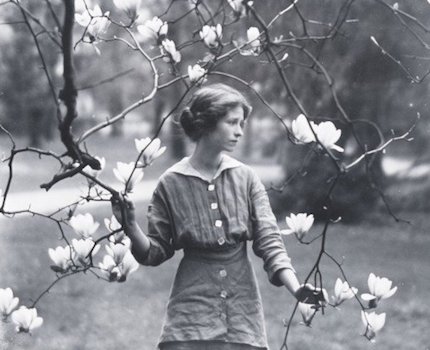
Edna St. Vincent Millay (1892-1950). I suspect that, while her name may be widely familiar to readers of poetry, she’s not actually read all that much now; maybe more so in the United States, where she used to be extremely popular. Perhaps the name conjures up a particular kind of poetry; or appeals to a particular kind of reader.

Millay

(That name: seven syllables, with a saint thrown in. I thought at one point I remembered her name being shoehorned into the lyrics of a song I’d heard but now suspect that I’m thinking of an old song lyric of my own, which managed to incorporate the name of blues and boogie-woogie pianist Champion Jack Dupree, the nickname derived from his boxing days when he fought more than a hundred bouts.)

In her long letter to Lowell of 4-5 April 1962, Bishop wrote: ‘I remember reciting that parody on E St. V Millay to you—“I want to be drowned in the deep sea water (?) I want my body to bump the pier. / Neptune is calling his wayward daughter: / ‘Edna, come over here!’” I asked Dwight Macdonald [Parodies, 1960] why he hadn’t put it in his parody book and he thought it was “dated”, I think he said.’[3]

The question mark is justified since Bishop was quoting from memory and didn’t have the first and last lines of Samuel Hoffenstein’s ‘Miss Millay Says Something Too’ exactly right:

I want to drown in good-salt water,
I want my body to bump the pier;
Neptune is calling his wayward daughter,
Crying ‘Edna, come over here!’

(See http://selfstyledsiren.blogspot.co.uk/2013/04/the-love-song-of-samuel-hoffenstein.html )

A good many histories and surveys of the period bypass Millay altogether, though Cary Nelson sets her beside Claude McKay when claiming that the ‘centrality of revolutionary change in traditional forms’ is ‘especially clear in the transformation’ that the two poets ‘worked in the sonnet.’[4]

Millay-2

The sonnet, yes. Here’s ‘Sonnet xlii’:

What lips my lips have kissed, and where, and why,
I have forgotten, and what arms have lain
Under my head till morning; but the rain
Is full of ghosts tonight, that tap and sigh
Upon the glass and listen for reply,
And in my heart there stirs a quiet pain
For unremembered lads that not again
Will turn to me at midnight with a cry.
Thus in the winter stands the lonely tree,
Nor knows what birds have vanished one by one,
Yet knows its boughs more silent than before:
I cannot say what loves have come and gone,
I only know that summer sang in me
A little while, that in me sings no more.

Millay has eight poems in F. O. Matthiessen’s The Oxford Book of American Verse (1950); in David Lehman’s 2006 The Oxford Book of American Poetry, she has six. In Geoffrey Moore’s The Penguin Book of American Verse (revised edition, 1983), she’s down to just two, the 1923 sonnet just quoted and ‘Sonnet cv’ (1931):

Hearing your words and not a word among them
Tuned to my liking, on a salty day
When inland woods were pushed by winds that flung them
Hissing to leeward like a ton of spray,
I thought how off Matinicus the tide
Came pounding in, came running through the Gut,
While from the Rock the warning whistle cried,
And children whimpered, and the doors blew shut;
There in the autumn when the men go forth,
With slapping skirts the island women stand
In gardens stripped and scattered, peering north,
With dahlia tubers dripping from the hand:
The wind of their endurance, driving south,
Flattened your words against your speaking mouth.

No marked modernist experimentation or pioneering divergences; but real skill and an ear well-tuned to that subtle boundary where the effective, well-spaced deployment of alliteration and assonance tips or slips into droning or hammering. The wind is truly driving in from the sea in this poem and not simply in the words that explicitly tell you so.

Millay—or the generally accepted valuation of Millay—seems to have made a later generation of women poets a little uneasy, especially those wanting to explore their own lives and histories in a franker, less inhibited way. Of course, there were—are?—large and lazy assumptions about what ‘women’s poetry’ was and was not. Robert Lowell, in conversation with Ian Hamilton, would name only four women who ‘stand with our best men’: Emily Dickinson, Marianne Moore, Elizabeth Bishop and Sylvia Plath.[5]

lowell-bishop-1962

Lowell is, of course, often cited—and almost as often damned—for initiating, to a large extent, the ‘confessional’ mode. When Bishop wrote to him in March 1972, expressing her deep concerns about Lowell having used and, crucially, changed letters from Elizabeth Hardwick, she added, ‘In general, I deplore the “confessional”—however, when you wrote LIFE STUDIES perhaps it was a necessary movement, and it helped make poetry more real, fresh and immediate. But now—ye gods—anything goes, and I am so sick of poems about the students’ mothers & fathers and sex-lives and so on. All that can be done—but at the same time one surely should have a feeling that one can trust the writer—not to distort, tell lies, etc.’[6]

Lowell himself was not always comfortable with the work of poets said to be influenced by him, including Anne Sexton—and Sylvia Plath, who readily acknowledged the importance of Lowell’s Life Studies in what she viewed as a ‘breakthrough into very serious, very personal emotional experience, which I feel has been partly taboo.’[7] Plath wrote to her mother in 1956, ‘Ted [Hughes] says he never read poems by a woman like mine; they are strong and full and rich—not quailing and whining like [Sara] Teasdale or simple lyrics like Millay’.[8]

In that same conversation with Ian Hamilton, asked about Anne Sexton, Lowell answered carefully that he knew Sexton well: ‘It would be a test to say what I thought of her.’ But he added, ‘She is Edna Millay after Snodgrass’. ‘After Snodgrass’ meant after—perhaps chronologically but also in the style of—that poet’s 1959 collection, Heart’s Needle: Snodgrass was an acknowledged influence on Lowell’s own move towards a freer and more personal poetry.[9] But ‘Edna Millay’ – alas, alas. Sexton specifically expressed a ‘secret fear’ of being ‘a reincarnation’ of Millay, a poet she considered ‘soggily sentimental’.[10]

‘Soggily sentimental’, though? Some of it may well be, I’ve not ventured that far; best to tread carefully and be selective. Still, you could say that of a great many others, more often than not.

Death devours all lovely things:
Lesbia with her sparrow
Shares the darkness,—presently
Every bed is narrow.

 
References

[1] Elizabeth Bishop, One Art: The Selected Letters, edited by Robert Giroux (London: Pimlico, 1996), 272.

[2] Words in Air: The Complete Correspondence between Elizabeth Bishop and Robert Lowell, edited by Thomas Travisano with Saskia Hamilton (London: Faber and Faber, 2008), 148.

[3] Words in Air , 402.

[4] Cary Nelson, ‘Modern American Poetry’, in The Cambridge Companion to American Modernism, edited by Walter Kalaidjian (Cambridge: Cambridge University Press, 2005), 78.

[5] ‘A Conversation with Ian Hamilton’ (1971), in Robert Lowell, Collected Prose (New York: Farrar, Straus and Giroux, 1990), 287.

[6] Words in Air, 708-709.

[7] Sylvia Plath to a British Council interviewer, quoted by A. Alvarez, The Savage God: A Study of Suicide (Harmondsworth: Penguin Books, 1974), 38.

[8] Sylvia Plath, Letters Home: Correspondence, 1950-1963, selected and edited with a commentary by Aurelia Schober Plath (London: Faber and Faber, 1978), 244.

[9] Steven Gould Axelrod, Robert Lowell: Life and Art (Princeton: Princeton University Press, 1979), 97-99.

[10] Quoted by Sandra M. Gilbert and Susan Gubar, No Man’s Land: The Place of the Woman Writer in the Twentieth Century, Volume 1: The War of the Words (New Haven: Yale University Press, 1988), 206.


All roses and shadow: Guy Davenport’s Sappho

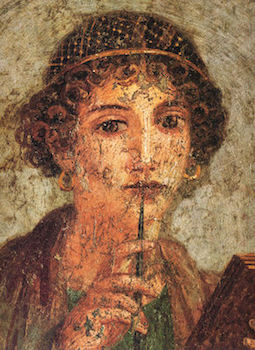
Sappho

Reading Guy Davenport’s poems and translations, I paused on one of Sappho’s addresses to the goddess Aphrodite, liking the directness of its call, a sinewy compound of appeal and command:

Come out of Crete
And find me here,
Come to your grove,
Mellow apple trees
And holy altar
Where the sweet smoke
Of libanum is in
Your praise.

Where Leaf melody
In the apples
Is a crystal crash,
And the water is cold.

All roses and shadow,
This place, and sleep
Like dusk sifts down
From trembling leaves.

I paused even longer, I think, on this:

When death has laid you down among his own
And none remember you in all the years to be,
Know, grey among ghosts in that twilight world,
That, offered the roses of Pieria, you refused,
And wander forever in the dark lord Aida’s house
Reticent still, with the blind dead, unknown.[1]

GD-JW-1964

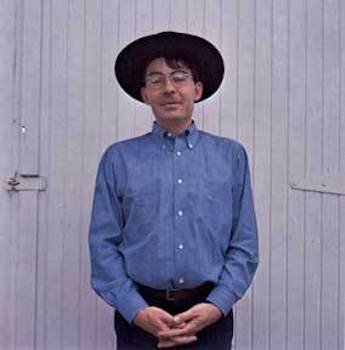
(Guy Davenport, ‘in a somewhat silent, Shakerish mood and garb’, by Jonathan Williams, 1964. Taken from Portrait Photographs , Coracle Press, London, 1979)

Yes. I was reminded of the physical responses to authentic poetry that A. E. Housman famously described in a 1933 lecture. He cites a figure named Eliphaz (in the Book of Job), to whom he ascribes the sentence, ‘A spirit passed before my face: the hair of my flesh stood up.’ He mentions bristling skin, a shiver down the spine; and mentions one of Keats’s letters, in which the poet writes of Fanny Brawne, ‘everything that reminds me of her goes through me like a spear’. Housman is making the point, at some length, that to him poetry seems ‘more physical than intellectual.’[2] Many readers would describe their reactions, rather, as ‘both’, though probably granting that each might apply at different times and in different states of mind or knowing.

Davenport’s translation wears the simple title ‘Vale’, ‘farewell’. The poem is also included in his Seven Greeks, where he gives a little more space to Sappho than to any other of his chosen writers. His note to this poem explains that ‘Aida’ here is Hades and adds: ‘Written, seemingly, to a standoffish girl. Thomas Hardy translates this in a poem called Achtung.’[3]

Achtung? Hardy’s version of Sappho quotes The Rubáiyát of Omar Khayyám and Shakespeare as epigraphs and runs:

Dead shalt thou lie; and nought
Be told of thee and thought,
For thou hast plucked not of the Muses’ tree:
And even in Hades’ halls
Amidst thy fellow-thralls
No friendly shade thy shade shall company![4]

thomas-hardy-portrait

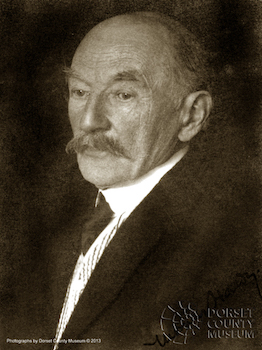
(Thomas Hardy: Dorset County Museum)

There is no poem called ‘Achtung’ in the index to Hardy’s Collected Poems. The title here is ‘Sapphic Fragment’, which seems reasonable. Two anthologies, The Oxford Book of Classical Verse, edited by Adrian Poole and Jeremy Maule, and Charles Tomlinson’s Oxford Book of Verse in English Translation, point me to more versions of the poem, but they too sternly name Hardy’s translation ‘Sapphic Fragment’. Ah, but there’s one more anthology to check: Confucius to Cummings, edited by Ezra Pound and Marcella Spann. Here’s Sappho and here’s that poem, called here, yes, ‘Achtung’.[5] The Pound connection is often useful when reading Davenport.

The Loeb edition offers: ‘But when you die you will lie there, and afterwards there will never be any recollection of you or any longing for you since you have no share in the roses of Pieria; unseen in the house of Hades also, flown from our midst, you will go to and fro among the shadowy corpses.’ The notes cite Stobaeus and Plutarch to the effect that the poem was addressed to ‘an uneducated woman’, ‘a wealthy woman’ or ‘an uncultured, ignorant woman’.[6]

Still, ‘Written, seemingly, to a standoffish girl’, feels about right to me. ‘Her Aphrodite laughs’, Davenport writes of Sappho, adding, with characteristic sharpness, ‘Sexual frenzy was as respectable a passion to Sappho as rapacious selfishness to an American. Few societies have been as afraid of the body as ours, and in the West none has, within history, been as solicitous as the Greek of its beauty.’[7] And elsewhere, ‘Seems to me that Sappho was the poet of desire.’[8]

Desire, yes.

Percussion, salt and honey,
A quivering in the thighs;
He shakes me all over again,
Eros who cannot be thrown,
Who stalks on all fours like a beast.[9]

‘Vale’—or ‘Achtung’—sets the speaker, the poet who has accepted those Pierian roses, who has drunk deep of the Pierian spring, the fountain of the Muses in Thessaly, against that other, who has not embraced, either directly or through the person of the poet, intimate knowledge of the arts and sciences, who will pass into the shadows of Hades, unmourned and unremembered.

‘Pierian roses’ recalls that man Pound again: in Hugh Selwyn Mauberley, ‘The pianola “replaces” / Sappho’s barbitos’, while in Dr Johnson’s old haunts, Fleet Street has gone to the dogs; or, at least, to stallholders with socks to sell:

Beside this thoroughfare
The sale of half-hose has
Long since superseded the cultivation
Of Pierian roses.[10]

HD

(H. D.)

Sappho’s art, Davenport, comments, ‘belongs to cultural springtimes and renaissance’—hints here of the Persephone theme which increasingly appears to occupy an entire continent in the world of modern literature—and she spoke ‘with Euclidean terseness and authority of the encounters of the loving heart, the infatuated eye’s engagement with flowing hair, suave bodies, moonlight on flowers.’ Her imagery ‘is as stark and patterned as the vase painting of her time’ – ‘Never has poetry been this clear and bright.’ And he quotes, by way of comparison, one of H. D.’s— Hilda Doolittle’s—‘conscious imitations’:

delicate the weave,
fair the thread:

clear the colours,
apple-leaf green,
ox-heart blood-red:

rare the texture,
woven from wild ram,
sea-bred horned sheep:

the stallion and his mare,
unbridled, with arrow pattern,
are worked on
the blue cloth.[11]

This is from a late H. D. poem ‘Fair the Thread’ (topped and tailed), though H. D. did produce translations, or imitations, of several of Sappho’s poems – or, rather, fragments. Sappho’s corpus consists almost entirely of fragments, which are often fleshed out by translators with guesswork and conjecture. They are also used—by poets—as taking-off points for longer, connected poems. One example is Swinburne, whose version of the fragment that Davenport called ‘Vale’ is embedded in the 300-plus lines of ‘Anactoria’, beginning there ‘Thee too the years shall cover’.[12] H. D. herself is another example, though a complicated one: the editor of her Collected Poems cites three early poems which are ‘masked as expansions of fragments of Sappho’, while one of her later critics, referring to those poems explicitly based on Sappho’s ‘fragments’, suggests that H. D.’s ‘textual play’ with Sappho ‘goes far beyond these’.[13]

Sappho’s concision and precision seem peculiarly fitted to excite the minds of the early modernist poets, particularly the Imagists; but then the fragmented state of her work, its blanks and inscrutabilities, bafflements and painstaking decipherments are also very appropriate to the story of modern literature.

Flowers-Leaves-REM

(Jacket of Davenport’s long poem, Flowers and Leaves, published by Jonathan Williams in 1966: Ralph Eugene Meatyard, ‘Untitled’, 1959. © The Estate of Ralph Eugene Meatyard.)

One more Davenport-Sappho detail. Writing about his friend, the extraordinary photographer Ralph Eugene Meatyard, Davenport remembered that, ‘Greek nor Latin had he, though he once figured out with a modern Greek dictionary that a lyric of Sappho (which he had set out to read as his first excursion into the classics) had something to do with a truck crossing a bridge.’[14]

The art of the possible. Why not?

 
References

[1] Guy Davenport, Thasos and Ohio: Poems and Translations, 1950-1980 (San Francisco: North Point Press, 1986), 32, 33.

[2] A Shropshire Lad and Other Poems: The Collected Poems of A. E. Housman, edited by Archie Burnett, with an introduction by Nick Laird (London: Penguin Books, 2010), 254-255: the whole lecture, ‘The Name and Nature of Poetry’, is reprinted here (231-256). The letter he refers to is to Charles Brown, 1 November 1820: Letters of John Keats, edited by Robert Gittings (Oxford: Oxford University Press, 1979), 397.

[3] Guy Davenport, Seven Greeks (New York: New Directions, 1995), 234 n.6. For his introduction, see 4-14 on Sappho, and for translations of her work, 69-116.

[4] Thomas Hardy, The Complete Poems, edited by James Gibson (Basingstoke: Macmillan, 1976), 181.

[5] Confucius to Cummings: An Anthology of Poetry, edited by Ezra Pound and Marcella Spann (New York: New Directions, 1964), 18.

[6] Greek Lyric I: Sappho and Alcaeus, edited and translated by David A. Campbell (Cambridge, Massachusetts: Harvard University Press, 1990), 99.

[7] Davenport, Seven Greeks, 9.

[8] W. C. Bamberger, editor, Guy Davenport and James Laughlin: Selected Letters (New York: W. W. Norton & Co., 2007), 163.

[9] Davenport, Seven Greeks, 87.

[10] Ezra Pound: Poems and Translations, edited by Richard Sieburth (New York: Library of America, 2003), 550, 556.

[11] Davenport, Seven Greeks, 5.

[12] Algernon Charles Swinburne, Poems and Ballads & Atalanta in Calydon, edited by Kenneth Haynes (London: Penguin Books, 2000), 52.

[13] H. D., Collected Poems 1912-1944, edited by Louis L. Martz (Manchester: Carcanet Press, 1984), xiv; Eileen Gregory, H. D. and Hellenism: Classic Lines (Cambridge: Cambridge University Press, 1997), 148.

[14] Guy Davenport, ‘Ralph Eugene Meatyard’, The Geography of the Imagination (Boston: David R. Godine, 1997), 370.

‘A large expensive audience’; or Charity begins at Lady Sibyl’s home

Eliot  aldous-huxley


Exactly one hundred years ago today, there was a poetry reading, in aid of charity, held at the home of Lady Sibyl Colefax, later a highly successful interior decorator. Those taking part included Aldous Huxley, the actress and later playwright Viola Tree (daughter of Herbert Beerbohm Tree), Robert Nichols, T. S. Eliot and the Sitwells.

In a letter to his mother, some ten days later, Eliot told her: ‘I assisted in a poetry reading last week at the house of some rich person for the benefit of something. A hundred and fifty people were induced to pay 10/6 each, so it was rather a rich audience. Edmund Gosse presided, and a number of “young poets” of whom I believe I was the oldest, read. It was rather amusing, as the audience and most of the poets were very solemn, and I read some light satirical stuff, and some of them didn’t know what to make of it.’[1]

The broad-backed hippopotamus
Rests on his belly in the mud;
Although he seems so firm to us
He is merely flesh and blood.

Flesh and blood is weak and frail,
Susceptible to nervous shock;
While the True Church can never fail
For it is based upon a rock.

Forty years later, reading at Columbia, Eliot remarked: ‘This is a poem which I originally read, I remember, at a poetry reading for the benefit of some Red Cross affair with Sir Edmund Gosse in the chair, and he was profoundly shocked. On the other hand, the late Arnold Bennett liked it better than anything I’d written up to the time of his death, and kept asking me to write “another Hippopotamus.”. . . it’s the only poem of mine which I’ve any reason to suppose that James Joyce ever read.’ Eliot also read ‘A Cooking Egg’ at the charity event and, as Richard Aldington mentions in his autobiography, the poem’s  mention of Sir Alfred Mond provoked ‘a rumpus in the audience’, as Lady Mond ‘sailed indignantly out of the room’.[2]  (In fact, Joyce parodied The Waste Land in a letter to Harriet Weaver; and also wrote of it  in a notebook, ‘T. S. Eliot ends idea of poetry for ladies.’)[3]

Viola-Tree
(Viola Tree)

Aldous Huxley was a little more expansive about the evening, in a letter of 13 December 1917 to his brother Julian. ‘I spent a strange day yesterday in town—being a performing poet for the sake of charity or something before a large expensive audience of the BEST PEOPLE. Gosse in the chair—the bloodiest little old man I have ever seen—dear Robbie Ross stage-managing, Bob Nichols thrusting himself to the fore as the leader of us young bards (bards was the sort of thing Gosse called us)—then myself, Viola Tree, a girl called McLeod and troops of Shufflebottoms, alias Sitwells bringing up the rear: last and best, Eliot. But oh—what a performance: Eliot and I were the only people who had any dignity: Bob Nichols raved and screamed and hooted and moaned his filthy war poems like a Lyceum villain who hasn’t learnt how to act: Viola Tree declaimed in a voice so syrupy and fruity and rich, that one felt quite cloyed and sick by two lines: the Shufflebottoms were respectable but terribly nervous: the Macleod became quite intoxicated by her own verses: Gosse was like a reciter at a penny reading. The best part of the whole affair was dinner at the Sitwells’ afterwards’.[4]

Nichols was one of the earliest war poets to achieve significant success. He was friends with both Graves and Sassoon—and Huxley, subsequently—and was close at hand when D. H. Lawrence died in March 1930 (Sybille Bedford prints his long letter to Dr Henry Head in her biography of Huxley).[5] Nichols’ poetry hasn’t lasted too well, unable as he was to evade the grip of the poetic conventions of the period even under the unprecedented pressures of the war.

They are bringing him down,
He looks at me wanly.
The bandages are brown,
Brown with mud, red only—
But how deep a red! in the breast of the shirt,
Deepening red too, as each whistling breath
Is drawn with the suck of a slow-filling squirt
While waxen cheeks waste to the pallor of death.
O my comrade![6]

Nichols

(Robert Nichols)

Aldous Huxley, on the other hand, is barely known as a poet even to those familiar with his novels and essays, though his first four published books were all volumes of poetry. While at Oxford, Robert Graves commented in a letter to Siegfried Sassoon, he had seen ‘a lot of the Garsington people [Lady Ottoline Morrell’s house] who were charming to me, and of the young Oxford poets, Aldous Huxley, Wilfred Childe and Thomas Earp – exceptionally nice people but a trifle decayed, as you might say.’[7]

In the previous year’s The Burning Wheel, Huxley—albeit a trifle decayed—had written ‘A Canal’:

No dip and dart of swallows wakes the black
Slumber of the canal: —a mirror dead
For lack of loveliness remembered
From ancient azures and green trees, for lack
of some white beauty given and flung back,
Secret, to her that gave: no sun has bled
To wake an echo here of answering red;
The surface stirs to no leaf’s wind-blown track. . .[8]

Garsington would loom larger for Sassoon a few months later when he went to consult Philip and Ottoline Morrell and ask their advice about his intended protest. Sassoon’s famous statement followed soon after his meeting in London with Bertrand Russell and Middleton Murry. Psychiatric treatment with W. H. R. Rivers at Craiglockhart—and a meeting with the young Wilfred Owen—beckoned.

References

[1] Valerie Eliot and Hugh Haughton, editors, The Letters of T. S. Eliot. Volume I: 1898–1922, revised edition (London: Faber and Faber, 2009), 240-241.

[2] The Poems of T. S. Eliot. Volume I: Collected and Uncollected Poems, edited by Christopher Ricks and Jim McCue (London: Faber & Faber, 2015), 43, 521, 510. Aldington, Life for Life’s Sake (London: Cassell, 1968), 204.

[3] Richard Ellmann, James Joyce, new and revised edition (Oxford: Oxford University Press, 1983), 572, 495.

[4] Aldous Huxley, Letters of Aldous Huxley, edited by Grover Smith (London: Chatto and Windus, 1969), 141.

[5] Sybille Bedford, Aldous Huxley: A Biography (London: Pan Macmillan, 1993), 225-228.

[6] Robert Nichols, ‘Casualty’, in Robert Giddings, The War Poets (London: Bloomsbury, 2000), 84.

[7] Letter of 26 March 1917: In Broken Images: Selected Letters of Robert Graves, 1914-1946, edited by Paul O’Prey (London: Hutchinson, 1982), 66-67.

[8] See Bedford, Aldous Huxley, 67.

Reckoning with David Jones

DJ-Books

The David Jones reckoning cannot be long postponed. I was reliably informed that, preparatory to a serious grappling with Jones’s second great long poem The Anathémata, there were tremendously useful essays, collected in The Dying Gaul, published in 1978 and long out of print. I no longer remember which essays they were: perhaps ‘Use and Sign’? Or ‘Art in Relation to War?’

I seem to recall a conversation with Dr Cornelius van Muchey (lately of Sumatra):

Have you read In Parenthesis?

I have, yes. Twice.

Okay with that?

I think. . . yes, pretty much.

Watched the films? Read the biography?

Yes. Yes.

And have you read The Anathémata?

Sort of.

What does that mean?

It means that In Parenthesis is like Ulysses while The Anathémata is more like Finnegans Wake.

Ah. Have you read Finnegans Wake?

Sort of.

Ah.

Dying-Gaul

I now have a copy of The Dying Gaul.*

‘It was a dark and stormy night, we sat by the calcined wall; it was said to the tale-teller, tell us a tale, and the tale ran thus: it was a dark and stormy night . . . ‘

* And I belatedly see that Faber, presumably taking advantage of the publication of Thomas Dilworth’s biography from Cape, have reprinted in paperback both The Dying Gaul and the wonderful Dai Greatcoat: a self-portrait of David Jones in his letters.

Houses That Jack Built

The_house_that_Jack_built

This is the farmer sowing his corn,
That kept the cock that crowed in the morn,
That waked the priest all shaven and shorn,
That married the man all tattered and torn,
That kissed the maiden all forlorn,
That milked the cow with the crumpled horn,
That tossed the dog,
That worried the cat,
That killed the rat,
That ate the malt
That lay in the house that Jack built.

The accumulative rhyme, ‘The House That Jack Built’ was first published in a 1755 collection, Nurse Truelove’s New-Year’s-Gift: or, The Book of Books for Children. It has ‘probably been more parodied than any other nursery story’, in politics and advertising: but also in literature.[1]

In Canto XVII of Autumn Sequel (1954), Louis MacNeice writes: ‘The reasons and the rhymes/ Of Mother Church and Mother Goose have grown/ Equally useless since we have grown up/ And learnt to call our minds (if minds they are) our own’. Mother Goose might have found something oddly familiar in MacNeice’s later ‘Château Jackson’, included in The Burning Perch (1963) and beginning:

Where is the Jack that built the house
That housed the folk that tilled the field
That filled the bags that brimmed the mill
That ground the floor that browned the bread
That fed the serfs that scrubbed the floors
That wore the mats that kissed the feet
That bore the bums that raised the heads
That raised the eyes that eyed the glass
That sold the pass that linked the lands. . .[2]

Bishop

https://www.poets.org/poetsorg/poet/elizabeth-bishop

Fifteen years earlier, Elizabeth Bishop had visited Ezra Pound in St Elizabeths Hospital in Washington, where Pound had been confined since being found unfit to plead on charges of treason. Bishop was introduced to Pound by Robert Lowell and later, when serving as poetry consultant to the Library of Congress, visited Pound—who called her ‘Liz Bish’, a name she much disliked—regularly.[3]

First published in 1956 but dated by Bishop as 1950, her remarkable poem ‘Visits to St Elizabeths’ begins with an instantly recognisable rhythm and form:

This is the house of Bedlam.

This is the man
that lies in the house of Bedlam.

Its final stanza—it’s a poem of 78 lines—runs:

This is the soldier home from the war.
These are the years and the walls and the door
that shut on a boy that pats the floor
to see if the world is round or flat.
This is a Jew in a newspaper hat
that dances carefully down the ward,
walking the plank of a coffin board
with the crazy sailor
that shows his watch that tells the time
of the wretched man
that lies in the house of Bedlam.[4]

Though Bishop referred to this more than once as her ‘Pound poem’,[5] she told Anne Stevenson that ‘the characters are based on the other inmates of St. E[lizabeth]’s [ . . . ] One boy used to show us his watch, another patted the floor, etc.—but naturally it’s a mixture of fact and fancy.’[6]

In the course of one of his most brilliant essays, ‘The House That Jack Built’, first given as a paper to inaugurate the Beinecke Rare Book and Manuscript Library’s Center for the Study of Ezra Pound and His Contemporaries on 30 October 1975 (it would have been Pound’s ninetieth birthday but he had died three years earlier), Guy Davenport begins by recreating John Ruskin’s writing of Letter XXIII of Fors Clavigera, almost exactly one hundred years before Pound’s death. The letter is indeed dated 24 October 1872.[7]

Beinecke-Stacks

Photo credit: David Driscoll: http://beinecke.library.yale.edu/collections

Davenport describes Fors as ‘a kind of Victorian prose Cantos’, but his interest in that particular letter is indicated by Ruskin’s title: ‘The Labyrinth’ and perhaps the footnote, which reads: ‘A rejected title for this letter was “The House that Jack Built”’. Ruskin writes about ‘the great Athenian squire’, Theseus, among much else, before reaching the cathedral door at Lucca, on which are engraved several Latin sentences, many centuries old, which Ruskin translates as: ‘This is the labyrinth which the Cretan Dedalus built, out of which nobody could get who was inside, except Theseus: nor could he have done it, unless he had been helped with a thread by Adriane, all for love’. And that statement, ‘This is the labyrinth which the Cretan Dedalus built’, can, Ruskin says, be reduced from medieval sublimity to the rather more popular ‘This is the House that Jack Built’. He analyses the symbols, considers coins, justice and other matter ‘until he can triumphantly identify the Minotaur with greed, lust, and usury’. At one point, Davenport observes that Ruskin ‘is just getting warmed up’.[8]

The same might be said of Davenport, who will, in the course of the remainder of the essay, range over Olson, Joyce, Ovid, William Carlos Williams, Pavel Tchelitchew, Zukofsky, Leonardo da Vinci, Henri Rousseau, Picasso, Apollinaire, Brancusi, Michael Ayrton (maker of labyrinths), Wilbur Wright and others: but mainly Ezra Pound. Davenport is one of the most acute readers of Pound. One of the others, Hugh Kenner, concluded his magisterial The Pound Era with the statement that ‘Thought is a labyrinth.’[9] Indeed.

GD_JW_via_Jacket

(Guy Davenport by Jonathan Williams, via Jacket magazine:
http://jacketmagazine.com/38/jwb01-davenport.shtml)

A labyrinth is certainly one in which we may be hopelessly and helplessly lost, sometimes unsure of whether we have passed this way before or even repeatedly – unless we have a thread. ‘All for love.’ Love is a good thread, undoubtedly. And there are others.

Davenport writes at one point of the frescoes in the Palazzo Schifanoia, painted for the Este family. Yeats once recalled Pound’s telling him that the frescoes had  provided a basic outline for the scheme of his epic poem. Davenport continues: ‘The Cantos do indeed follow the triumphs, the seasons, and the activities of the seasons. To know the triumphs we must know the past, which is told in many tongues in many places; to know the past we descend, like Odysseus, into the House of Hades and give the blood of our attention (as translators, historians, poets) so that the dead may speak. To know the seasons we must understand metamorphosis, for things are never still, and never wear the same mask from age to age. The contemporary is without meaning while it is happening: it is a vortex, a whirlpool of action. It is a labyrinth.’ And he concludes that ‘The clue to this labyrinth, Pound knew, was history.’[10]

‘Labyrinthine’ might mean complex or endless, perhaps needlessly convoluted. Coleridge referred to De Quincey’s mind as ‘at once systematic and labyrinthine’.[11] Yeats wrote that : ‘A man in his own secret meditation / Is lost among the labyrinth that he has made / In art or politics’.[12] But it can be a point of focus, a positive necessity. The novelist Nicholas Mosley writes: ‘The idea that to make sense of one’s life one has to tell of the bad things as well as the good at least to oneself is at the back of much of this story: without a recognition of darkness as well as light there is no pattern; without pattern there is no chance of glimpsing a path through the maze. And without this what is the point of life, what is its wonder?’[13]

Yes.

References

[1] See The Oxford Dictionary of Nursery Rhymes, edited by Iona and Peter Opie (Oxford: Oxford University Press, 1995), 229-232.

[2] Louis MacNeice, Collected Poems, edited by Peter McDonald (London: Faber and Faber, 2007), 448-449, 580.

[3] Brett C. Millier, Elizabeth Bishop: Life and the Memory of It (Berkeley: University of California Press, 1995), 199, 220.

[4] Elizabeth Bishop, Poems, Prose, and Letters, edited by Robert Giroux and Lloyd Schwartz (New York: Library of America, 2008), 127-129.

[5] Words in Air: The Complete Correspondence between Elizabeth Bishop and Robert Lowell, edited by Thomas Travisano with Saskia Hamilton (London: Faber and Faber, 2008), 201, 345.

[6] Bishop, Poems, Prose, and Letters, 853.

[7] ‘Letter 23. The Labyrinth’: Fors Clavigera, II, 394. The Ruskin Library and Research Centre at Lancaster University has digitized and made generally available the monumental 39-volume Cook and Wedderburn edition (1903-1912) of the Works of John Ruskin. A stupendous project, wonderfully achieved: http://www.lancaster.ac.uk/depts/ruskinlib/Pages/Works.html

[8] Guy Davenport, The Geography of the Imagination (London: Picador, 1984), 45-47.

[9] Hugh Kenner, The Pound Era (London: Faber, 1972), 561.

[10] Davenport, The Geography of the Imagination, 56.

[11] Collected Letters of Samuel Taylor Coleridge, III: 1807-1814, edited by E. L. Griggs (Oxford: Oxford University Press, 1959), 205, quoted by Alethea Hayter, Opium and the Romantic Imagination (London: Faber and Faber, 1971), 234.

[12] W. B. Yeats, ‘Nineteen Hundred and Nineteen’, Collected Poems, second edition (London: Macmillan, 1950), 235.

[13] Nicholas Mosley, Efforts at Truth: An Autobiography (London: Minerva, 1996), 187.