Tristan Corbière

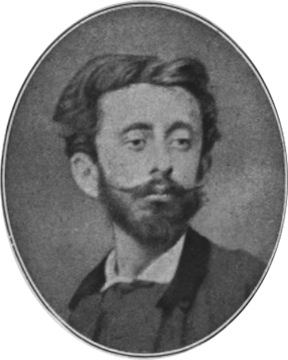
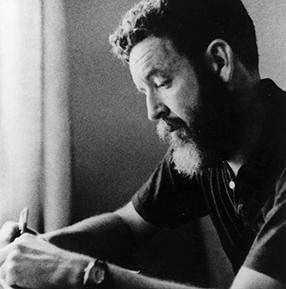
Tristan_Corbiere_portrait

Tristan Corbière was born (christened Édouard) in Finistère on 18 July 1845; he died in 1875, aged twenty-nine.

My knowledge of him is sketchy. He admired those engaged in the seafaring life, sailors and fishermen, and used a lot of sailors’ slang. Died of tuberculosis, hardly known as a writer; his poems were included in Verlaine’s collection of Les poètes maudits in 1884; he was later a strong influence on both Ezra Pound and T. S. Eliot—who wrote a poem, in French, called simply ‘Tristan Corbière’.[1]

To be honest, the major intervention of Corbière in my life was not actually the poet but a racehorse, although it was because the horse bore the name of the poet that I actually placed a bet and picked a winning horse for the only time in my life—and the Grand National, at that. 1983: Corbiere (without the accent, I believe), trained by Jenny Pitman, ridden by Ben de Haan, a chestnut gelding with a broad white blaze coming through at 13/1. Had that white blaze been a silver blaze, things would have been even more literary but a French poet was enough to part me from my money—though not for long.[2]

Centenary-Corbiere

Most of Corbiére’s poems are too long to quote entire and, I’d surmise, damned tricky to render into English since they rhyme very solidly and are extremely demotic, with a lot of slang and wordplay: ‘Corbiére’s controlled disorder permitted his mélange of mystical and bawdy, cynical and sentimental elements’.[3] Here’s the beginning of ‘Au Vieux Roscoff: Berceuse en Nord-Ouest mineur’:

Trou de flibustiers, vieux nid
A corsaires! – dans la tourmente,
Dors ton bon somme de granit
Sur tes caves que le flot hante…

Ronfle à la mer, ronfle à la brise;
Ta corne dans la brume grise,
Ton pied marin dans les brisans . . .
– Dors: tu peux fermer ton oeil borgne
Ouvert sur le large, et qui lorgne
Les Anglais, depuis trois cents ans.

The redoubtable Val Warner, who translates the poems in The Centenary Corbière and also supplies a detailed, learned and highly informative 55-page introduction, offers this, ‘To Old Roscoff: Lullaby in North-west Minor’, as:

A hole for buccaneers, old nest
Of freebooters! – in the tempest,
Sleep your heavy granite slumber
Over your cellar haunted by the combers . . .

Snore with the breeze, snore with the waters;
Through the grey fog your horn high,
Your sea legs in the breakers . . .
– Sleep: you can close your single flashing eye
Open on the open sea, where you’ve peered
For the English, for three hundred years.[4]

Warner’s introduction thoroughly explores the afterlife of Corbiére’s work and its tendency to crop up in a wide range of Anglo-American literary contexts, closing with the dedication in John Berryman’s Love & Fame (1971):

To the memory of
the suffering lover & young Breton master
who called himself ‘Tristan Corbière’

(I wish I versed with his bite)[5]


References

[1] Written about 1917: eventually published in Inventions of the March Hare: Poems 1909-1917 (London: Faber and Faber, 1996).

[2] The first story in the Memoirs of Sherlock Holmes collection (1892), notable for the ‘curious incident of the dog in the night-time’ conversation and the wonderfully direct conversational opening (‘“I am afraid, Watson, that I shall have to go,” said Holmes, as we sat down together to our breakfast one morning.””)

[3] The Centenary Corbière, translated with an introduction by Val Warner (Manchester: Carcanet Press, 2003), lviii. The first edition appeared in 1974, i.e., in time to mark the centenary of his death.

[4] The Centenary Corbière, 110-111.

[5] The Centenary Corbière, lix.

Remembering ‘Adlestrop’

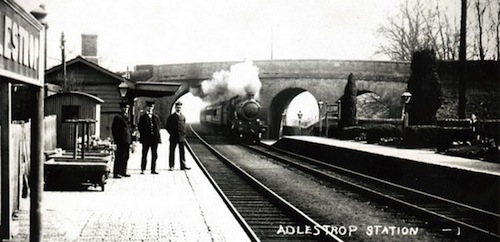
Adlestrop-station

(Via http://www.urban75.org/blog)

On 24 June 1914, a train drew up at a country station on the main Great Western Railway line which ran from London to Oxford, Worcester and Malvern (the station finally closed in 1966, a victim of the Beeching report, more suitably termed ‘the Beeching axe’, which brought about the closure of a great many railways and the loss of local services on a huge scale). Among the passengers were Edward Thomas and his wife Helen, on their way to visit Robert Frost and his wife Elinor in Ledbury.

Thomas wrote in his field notebook for that day: ‘Then we stopped at Adlestrop, through the willows could be heard a chain of blackbirds songs at 12.45 and one thrush and no man seen, only a hiss of engine letting off steam.’

When the poem was written around six months later, he commented in a later notebook: ‘Train stopping outside station at Adlestrop June 1914.’[1] A memory refreshed.

Yes. I remember Adlestrop –
The name, because one afternoon
Of heat the express-train drew up there
Unwontedly. It was late June.[2]

Four stanzas; four lines in each, rhyming abcb. This must be one of the most familiar poems in English, certainly among British readers. Voted number twenty in one survey I saw, it emerged as joint third in the most-requested poems on Radio 4’s Poetry Please programme over some thirty-five years, beside Dylan Thomas’s ‘Fern Hill’ and behind Robert Frost’s ‘Stopping by Woods on a Snowy Evening’ and Elizabeth Barrett Browning’s sonnet, ‘How Do I Love Thee? Let Me Count the Ways’.

The first stanza of ‘Adlestrop’ strikes me as a delicious example of lines that you’ve looked at a dozen times and never really seen. It begins with ‘Yes.’ A question has been asked but it’s one we don’t hear. Does the poet interrogate himself or is it an unseen and unidentified interlocutor or is the reader the implied questioner? And then: the speaker remembers Adlestrop but not, apparently, the place; only the name. He remembers, in fact, the sign, ‘Adlestrop’ because the express train drew up there ‘unwontedly’. That last word was, in an earlier draft, ‘unexpectedly’; at another stage, ‘Against the custom’ or ‘against its custom’.[3] William Cooke links the close of the poem with a passage in a prose work by Thomas, Beautiful Wales, published ten years earlier.[4] Jean Moorcroft Wilson sees the ‘germ’ of the poem in the first chapter of The Heart of England (1906).[5] Thomas ‘conflated details from different stops’.[6] Does it matter? Frankly, no. The abiding mystery is: how does it work? This short, apparently simple poem, composed of unremarkable language, no striking rhymes, that clings to the memory like a burr. How is it done? It’s a question asked, of course, of all effective art. One item of interest is precisely that ‘unwontedly’: ‘exactly the word he wanted’, Matthew Hollis remarks.[7] Yes. I had thought, vaguely, that it meant ‘unwillingly’, against one’s instincts or inclinations but ‘unwonted’ means only unaccustomed or unusual. The train drawing up there ‘unwontedly’ was something distinctive, marking the occasion out. He ‘emphasizes the unusual nature of the stop, which in turn creates a slight sense of unease.’[8]

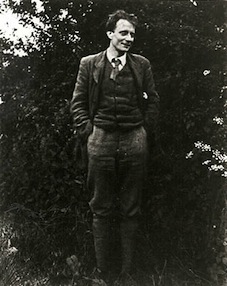
edward thomas 1913_14_small

(Thomas in 1913-1914, via Edward Thomas Fellowship:
http://www.edward-thomas-fellowship.org.uk/home.html)

I noted earlier that the poem begins with ‘Yes’. But, in fact, like Pound’s ‘In a Station of the Metro’ or several poems by Marianne Moore, it begins quite definitely with the title. ‘Adlestrop’. The name occurs three times: title, opening line and eighth line (‘Adlestrop – only the name’). Thomas ‘wrings from the name “Adlestrop”, by suspending it at the line-end, a series of unspoken associations with ideal rural communities.’ But ‘when he returns halfway through the poem to repeat that “What I saw / Was Adlestrop – only the name”, it is a signal for those associations to accelerate away from his reach.’[9] Ideal rural communities? Another critic suggests that, in the poem, ‘a scene glimpsed in a brief moment from a stationary train seems to open upon an ever-widening prospect of England’s central counties. These are common sights of the English countryside, but the moment is visionary’. It is, he adds, ‘an ideal England mirrored in the stillness and solitude of the poet’s mind’.[10] Elsewhere, it’s described as ‘the definitive English idyll.’[11]

Only a poem of permanent interest and value could, I suppose, generate such a wealth of interpretation and exegesis. The apparent simplicity is, of course, central to the challenge that so many readers find there. But one thing that strikes me and that seems often to be  absent from discussions of the poem is that, while, in June 1914, this country was not at war with Germany, in January 1915 it was. Thomas enlisted in July 1915, after an intense struggle, influenced to some extent by Robert Frost’s poem, ‘The Road Not Taken’, itself prompted in part by Frost’s experience of Thomas’s indecisiveness.[12] And if ‘Adlestrop’ was ‘an idyll’ or concerned to present ‘an ideal England’, it was in direct and active response to the forces that threatened it. Asked what it was that he was fighting for, Thomas famously ‘picked up a pinch of earth and answered: “Literally, for this”’.[13]

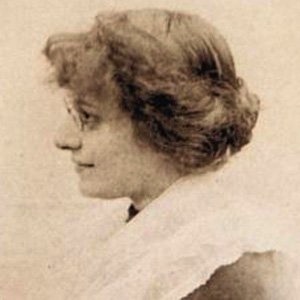
Farjeon

(Eleanor Farjeon)

So Ford Madox Ford’s persona, the poet Gringoire, voices similar concerns in No Enemy: ‘“I wonder,” Gringoire asked again that evening, “if other people had, like myself, that feeling that what one feared for was the land – not the people but the menaced earth with its familiar aspect.”’[14] In her notes to another Thomas poem, ‘The Manor Farm’, Edna Longley quotes Thomas’s essay ‘England’: ‘I believe . . . that all ideas of England are developed, spun out, from such a centre into something large or infinite, solid or aëry . . . that England is a system of vast circumferences circling round the minute neighbouring points of home’.[15] This is a conviction—a crucial one—that crops up in many literary contexts: that the national or universal, the abstract, the grandiose, must begin from the local, the concrete, the known.

That fifth line, ‘The steam hissed. Someone cleared his throat’, may conjure memories of the climactic scene of the film of The Railway Children, whereby Jenny Agutter reduced grown men to tears, but given our wealth of retrospective images, I think also of battlefields wreathed in smoke or mist, poor visibility, an image real enough but itself a metaphor for the blindness or at least uncertain vision of those directing, prosecuting and suffering the Great War.

And for that minute a blackbird sang
Close by, and round hum, mistier,
Farther and farther, all the birds
Of Oxfordshire and Gloucestershire.

(Yes. I remember ‘Adlestrop’.)


References

[1] Edward Thomas, The Annotated Collected Poems, edited by Edna Longley (Tarset, Northumberland: Bloodaxe Books, 2008), 176.

[2] Thomas, The Annotated Collected Poems, 51. This was one of sixteen poems that Thomas wrote between 4 January and 23 January 1915: Jean Moorcroft Wilson, Edward Thomas: From Adlestrop to Arras (London: Bloomsbury, 2015), 310.

[3] See Longley, The Annotated Collected Poems, 177, on ‘unwontedly’.

[4] William Cooke, Edward Thomas: A Critical Biography (London: Faber & Faber, 1970), 121-122.

[5] Wilson, Edward Thomas: From Adlestrop to Arras, 151.

[6] The Annotated Collected Poems, 176.

[7] Matthew Hollis, Now All Roads Lead to France: The Last Years of Edward Thomas (London: Faber, 2012), 204.

[8] Wilson, Edward Thomas: From Adlestrop to Arras, 314.

[9] Andrew Motion, The Poetry of Edward Thomas (London: The Hogarth Press, 1991), 4.

[10] Michael Kirkham, The Imagination of Edward Thomas (Cambridge: Cambridge University Press, 1986), 116.

[11] Stan Smith, Edward Thomas (London: Faber & Faber, 1986), 11.

[12] Hollis, Now All Roads Lead to France, 232-236.

[13] Eleanor Farjeon, Edward Thomas: The Last Four Years (Stroud: Sutton Publishing, 1997), 154.

[14] Ford, No Enemy: A Tale of Reconstruction (1929; edited by Paul Skinner, Manchester: Carcanet Press, 2002), 26.

[15] The Annotated Collected Poems, 165: the essay is in The Last Sheaf (London: Jonathan Cape, 1928).

‘Camerado! this is no book’

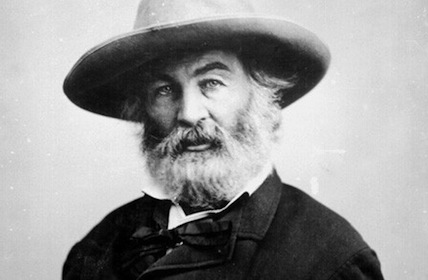
walt-whitman

Walt Whitman—‘an American, one of the roughs, a kosmos’[1]
https://www.poetryfoundation.org/poems-and-poets/poets/detail/walt-whitman

‘Camerado, this is no book,
Who touches this touches a man’—Walt Whitman, ‘So Long!’[2]

In the summer of 1945, a prisoner in the Disciplinary Training Center in Pisa, Ezra Pound, at the end of his tether (‘au bout de mes forces’), came across a copy of The Pocket Book of Verse, edited by Morris Speare and first published in 1940:

That from the gates of death
that from the gates of death: Whitman or Lovelace
found on the jo-house seat at that
in a cheap edition! [and thanks to Professor Speare]
hast’ou swum in a sea of air strip
through an aeon of nothingness,
when the raft broke and the waters went over me[3]

In April 1913, Pound had published ‘A Pact’.

I make a pact with you, Walt Whitman—
I have detested you long enough.
I come to you as a grown child
Who has had a pig-headed father;
I am old enough now to make friends.
It was you that broke the new wood,
Now is a time for carving
We have one sap and one root—
Let there be commerce between us.[4]

Not exactly a ringing endorsement for a poet who will throw you a lifeline thirty years later. One can see why Pound was included in the list of those ‘arbiters of current taste’ that, in John Berryman’s words, ‘have generally now declared themselves in favour of Whitman; but always reluctantly and with a certain resentment or even contempt. I am not,’ Berryman goes on, ‘able to feel these reservations myself’, and then: ‘I like or love Whitman unreservedly’.[5]

Randall Jarrell (never better than when he is enthusing about someone or something) wrote that: ‘To show Whitman for what he is one does not need to praise or explain or argue, one needs simply to quote.’ Jarrell does, at length and with great effect. And again, ‘Not many poets have written better, in queerer and more convincing and more individual language, about the world’s gliding wonders’. And again, ‘In modern times, what controlling, organising, selecting poet has created a world with as much in it as Whitman’s, a world that so plainly is the world?’ Perhaps just one more: ‘The thereness and suchness of the world are incarnate in Whitman as they are in few other writers.’[6]
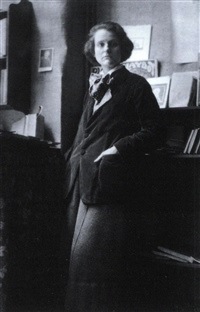
claude-cahun-sylvia-beach

(Sylvia Beach 1919 by Claude Cahun, via http://www.artnet.fr/)

Sylvia Beach (proprietor of Shakespeare & Co., first publisher of Joyce’s Ulysses), wrote of her Aunt Agnes visiting Whitman in Camden, where manuscripts were strewn all over the floor. Her aunt was with a friend, Alys Smith, who later married Bertrand Russell. Earlier visitors had included Henry Thoreau who, on 10 November 1849, went to Brooklyn with Bronson Alcott to meet Whitman, while, according to one of Whitman’s biographers, Bram Stoker also paid a visit and later ‘used Whitman as the model for the murderous count in Dracula’.[7]

It’s just short of 200 years since Walt Whitman was born, 31 May, at West Hills, Long Island; 162 since his copyright was registered (15 May 1855) and 795 copies of Leaves of Grass printed, 200 of them with embossed green cover and gilded lettering, while the remainder were bound more cheaply.[8]

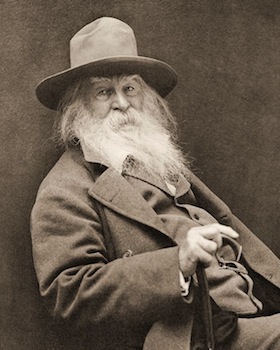
Walt-Whitman-2

(Walt Whitman: via The Guardian)

He was prolific, sometimes heroic, sometimes verbose, sometimes ridiculous, often magnificent. I tend towards Berryman’s sentiment here: unreservedly, why not? Jarrell is not uncritical—‘only a man with the most extraordinary feel for language, or none whatsoever, could have cooked up Whitman’s worst messes’—but he grasps what is perhaps the salient point about Whitman: while we are too often steered towards ‘gems’, the glittering phrases, the quotable lines, some poets need to be approached and seen and held more largely. Quoting section 36 of Song of Myself, Jarrell comments: ‘There are faults in this passage, and they do not matter’.[9] Yes. (It occurs to me at this juncture that, setting these three—Whitman, Berryman, Jarrell—together, I achieve not only an assembly of fine poets but a trio, a triumvirate, a trinity of profusely bearded Americans.)

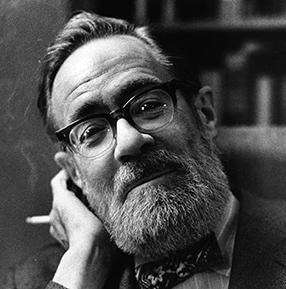
JohnBerryman_TomBerthiaume  RandallJarrell_poets.org

(John Berryman; Randall Jarrell; both via Academy of American Poets (https://www.poets.org/): John Berryman photo credit: Tom Berthiaume)

Apart from the pulling and hauling stands what I am,
Stands amused, complacent, compassionating, idle, unitary,
Looks down, is erect, or bends an arm on an impalpable certain rest,
Looking with side-curved head curious what will come next,
Both in and out of the game and watching and wondering at it.[10]

‘If you want me again look for me under your boot-soles’, Whitman wrote towards the end of ‘Song of Myself’. And again: ‘Failing to fetch me at first keep encouraged, / Missing me one place search another, / I stop somewhere waiting for you.’[11]

Do I contradict myself?
Very well then I contradict myself,
(I am large, I contain multitudes.)[12]

And he does. As we do, which is really the point.

There is a wonderful resource, the Walt Whitman Archive, at: http://www.whitmanarchive.org/
Co-directed by Ed Folsom and Kenneth M. Price and published by the Center for Digital Research in the Humanities, at the University of Nebraska-Lincoln, it offers published works, letters, manuscripts, biography, criticism, pictures, Civil War notebooks and journalism, and much else. They have also digitized—good grief—the whole nine volumes of Horace Traubel’s With Walt Whitman in Camden.


References

[1] Song of Myself (1855 edition), printed as Appendix 4 of Walt Whitman: The Complete Poems, edited by Francis Murphy (Harmondsworth: Penguin Books, 1986), 698.

[2] Walt Whitman: The Complete Poems, 513.

[3] The Cantos of Ezra Pound, fourth collected edition (London: Faber and Faber, 1987), 512-513. The last lines refer to the sequence in The Odyssey (Book V) where Odysseus, having left Calypso’s island on a raft, is shipwrecked through the malice of the god Poseidon and saved through the intervention of the goddess Leucothea.

[4] Ezra Pound: Poems and Translations (New York: Library of America, 2003), 269.

[5] Berryman, ‘“Song of Myself”: Intention and Substance’, in The Freedom of the Poet (New York: Farrar. Straus & Giroux, 1976), 227.

[6] Jarrell, Poetry and the Age ([1955] London: Faber & Faber, 1973), 107, 110, 119, 122.

[7] Sylvia Beach, Shakespeare and Company, new edition (Lincoln: University of Nebraska Press, 1991), 20; Jerome Loving, Walt Whitman: The Song of Himself (Berkeley: University of California Press, 1999), 422-426, 445.

[8] Paul Zweig, Walt Whitman: The Making of the Poet (Harmondsworth: Penguin 1986), 231.

[9] Jarrell, Poetry and the Age, 110, 116.

[10] Whitman, Song of Myself, Section 4. This is the 1891-1892 ‘deathbed’ edition, in Walt Whitman: The Complete Poems, 66-67.

[11] Song of Myself, Section 52; and the last lines: The Complete Poems, 124.

[12] Song of Myself, Section 51: The Complete Poems, 123.


Dawn chorus and aubades

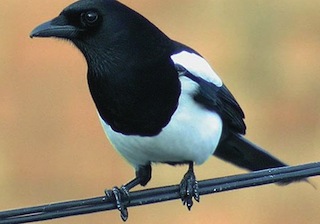
Woken by the bird chorus at 04:15, I note that it’s a new record for this month, having previously been woken at 05:15 and 04:45. They’ll be waking me the previous evening before too long. Since we are still, so to speak, between cats, we have—with curious logic—set up a bird table in our small back garden. The regular visitors are blackbirds, blue tits, and beautiful—if omnivorous and scavenging—magpies, plus the occasional sparrow. Perhaps this dawn choir is an expression of avian gratitude.

Magpie_rspb.org

(Magpie via https://www.rspb.org.uk/ )

There was a distinct dawn-related genre in Provençal troubadour literature: the aube or aubade, poems or songs announcing, or in praise of, the dawn—though the Troubadour poets sometimes lamented the dawn’s arrival since it meant the parting of the lovers.

The appeal of first light (or, sometimes, darkness) has endured. Philip Larkin’s ‘Aubade’ begins: ‘I work all day, and get half-drunk at night./ Waking at four to soundless dark, I stare.’[1]

The first stanza of William Empson’s fine ‘Aubade’ runs:

Hours before dawn we were woken by the quake.
My house was on a cliff. The thing could take
Bookloads off shelves, break bottles in a row.
Then the long pause and then the bigger shake.
It seemed the best thing to be up and go.[2]

(Nine more stanzas with just a bare handful of run-on lines; also a quite intricate pattern of repetition.)

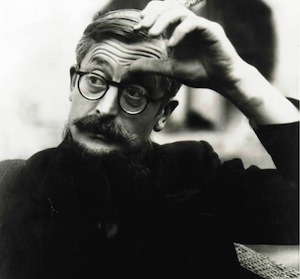
Empson_via_New_Directions

(William Empson via New Directions Publishing)

Ezra Pound’s second book, A Quinzaine for this Yule, was dedicated to ‘The Aube of the West Dawn’; he wrote and translated several aubades.

In No More Parades (the second of the volumes of Ford Madox Ford’s Parade’s End), Sylvia Tietjens has turned up at the Rouen base camp where her husband Christopher is charged with moving troops up the line.

He added: “I shall have to be up in camp before four-thirty to-morrow morning. . . . ”
Sylvia could not resist saying:
“Isn’t there a poem . . . Ah me, the dawn, the dawn, it comes too soon! . . . said of course by lovers in bed? . . . Who was the poet?”
[ . . . ]
[Tietjens] then said in his leisurely way:
“There were a great many poems with that refrain in the Middle Ages…. You are probably thinking of an albade by Arnaut Daniel, which someone translated lately. . . . An albade was a song to be sung at dawn when, presumably, no one but lovers would be likely to sing. . . . ”
“Will there,” Sylvia asked, “be anyone but you singing up in your camp to-morrow at four?”[3]

The lines that Sylvia quotes are most likely from Pound’s ‘Alba Innominata’, a translation based on the anonymous Provençal poem, ‘En un vergier sotz fue’. Its five verses and ‘Envoi’ all end (apart from one slight variation) with the line ‘Ah God! Ah God! That dawn should come so soon!’[4]

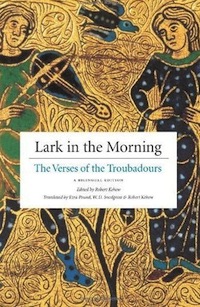
Lark_in_Morning_

Ford and Pound had met in April 1909, through the novelist May Sinclair, and Pound’s third volume, Personae, appeared in that same month. His first important periodical publication in this country was in the pages of the English Review, edited by Ford: ‘Sestina: Altaforte’, in the issue of June 1909. ‘Alba Innominata’ was included in Pound’s next volume, Exultations, published in October 1909.

At the end of 1920, Pound and his wife Dorothy moved to Paris and, in late 1922, Ford and Stella Bowen also moved to France, first to St-Jean-Cap-Ferrat, then Paris. In early 1925, they took a cottage in the village of Guermantes, about an hour’s train travel from Paris. No More Parades was begin in October 1924 and, in that same month, Pound and his wife Dorothy moved permanently to Rapallo, in Italy

Six years after his novel was published, Ford would recall Pound’s early years in London when the poet, ‘looking down his nose would chuckle like Mephistopheles and read you a translation from Arnaut Daniel. The only part of that albade that you would understand would be the refrain: “Ah me, the darn, the darn it comes toe sune!”’[5]


References

[1] Larkin, Collected Poems, edited by Anthony Thwaite (East St Kilda: The Marvell Press and London: Faber, 2003), 190.

[2] Empson’s poem is taken from Contemporary Verse, edited by Kenneth Allott (Harmondsworth: Penguin Books, 1950), 157.

[3] Ford, No More Parades (1925; edited by Joseph Wiesenfarth, Manchester: Carcanet Press, 2011), 134-135.

[4] Ezra Pound: Poems and Translations (New York: Library of America, 2003), 120; and see Richard Sieburth’s note, 1262.

[5] Ford, Return to Yesterday: Reminiscences 1894-1914 (London: Victor Gollancz, 1931), 388.

Still cormorants, flickering authors

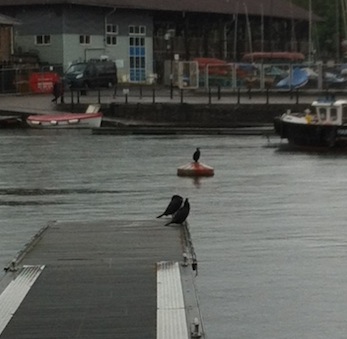
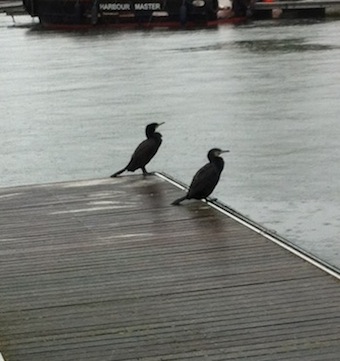
From close to the Arnolfini centre for contemporary arts, in the heart of Bristol’s harbourside, I’d seen a cormorant from time to time, as I had in other locations around the city, such as Wapping Wharf. Once I’d seen two, here, by the ferry stop at Nova Scotia Place. Now there were three. Apart from liking the distinctive look of them, and the dramatic gesture they sometimes make, of spreading their wings wide to dry them and holding that position for minutes on end, I had at the back of my mind two poems, or fragments of poems. One was a bit of doggerel from Christopher Isherwood, which runs:

The Common Cormorant or shag
Lays eggs inside a paper bag.
The reason you will see, no doubt,
It is to keep the lightning out.

But what these unobservant birds
Have never noticed is that herds
Of wandering bears may come with buns
And steal the bags to hold the crumbs.
Cormorants_three.JPG

The second was a poem that I recalled as being one of the first to make an impression on me in my schooldays, probably around the age of nine or ten. It was called ‘Flannan Isle’.

There’s a small history trailing after that first brief exhibit. Isherwood had written the verses in 1928 to accompany a cartoon in the book that eleven-year-old Sylvain Mangeot was making, entitled People One Ought to Know.[1] In 1935, it appeared in The Poet’s Tongue, credited to ‘Anon’ before being included in Isherwood’s collection, Exhumations, thirty years later.[2] Since the anthology was co-edited by W. H. Auden, with whom Isherwood was intimate for many years—and they collaborated on at least four works during the 1930s—it seems unlikely that Auden was unaware of the poem’s true authorship.[3]
Cormorants_two

As for the second poem, ‘Flannan Isle’, there were no complications, no curious details, no story there: I knew it was by James Elroy Flecker. My interest in him was slightly obscure, or at least removed from the man himself: the most enthusiastic praise of Flecker that I’d seen was by Douglas Goldring, the novelist, playwright, travel writer, polemicist—and author of several books dealing in part or entirely with Ford Madox Ford, including the earliest biography of him.[4] So, to work: ‘Flannan Isle’, by James Elroy Flecker.

Except that it isn’t.

The inimitable Guy Davenport once wrote, in a short and extremely funny essay about Joseph Cornell and the film-maker Stan Brakhage: ‘We are never so certain of our knowledge as when we’re dead wrong.’[5] ‘Flannan Isle’ is in fact by Wilfred Gibson, who featured strongly in several volumes of Georgian Poetry and was one of the ‘Dymock Poets’, so called because several of them lived around that Gloucestershire village in the years immediately preceding the First World War. Robert Frost and Edward Thomas are usually mentioned in this context, along with Gibson, Rupert Brooke, Lascelles Abercrombie and John Drinkwater.

Not only is the poem not by Flecker but it doesn’t specifically mention cormorants. Gibson’s 1912 poem is about the mysterious disappearance of three lighthousemen from the island. The narrator is on a boat sent to investigate, in response to puzzling reports:

And, as into the tiny creek
We stole beneath the hanging crag,
We saw three queer, black, ugly birds—
Too big, by far, in my belief,
For guillemot or shag—
Like seamen sitting bold upright
Upon a half-tide reef:
But, as we near’d, they plunged from sight,
Without a sound, or spurt of white.[6]

Close: the shag is similar to a cormorant, though smaller. And Isherwood, a.k.a. ‘Anon’, made them sound closer than that (‘The common cormorant or shag’).[7]
Barker, Thomas Jones, 1815-1882; The Charge of the Light Brigade

(Thomas Jones Barker, The Charge of the Light Brigade, 1877
© Defence Academy of the United Kingdom, Shrivenham)

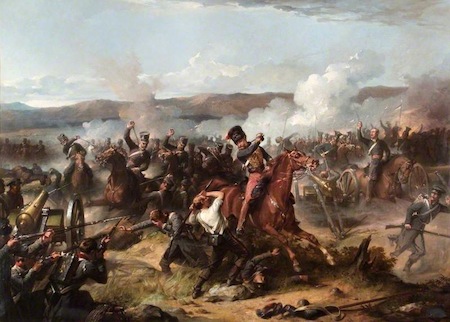
Still, I can manage to see it as very positive, that, as a child, I was struck by the poem rather than the poet. At that age, I think, for a poem to stick in my head, it  needed either strong repetition, as in Tennyson’s ‘The Charge of the Light Brigade’:

Cannon to right of them
Cannon to left of them,
Cannon behind them
Volleyed and thundered

or an unsettling image or situation, as in ‘Flannan Isle’; or a combination of both, as in Alfred Noyes’ ‘The Highwayman’, long a favourite anthology piece:

Her eyes grew wide for a moment; she drew one last deep breath,
Then her finger moved in the moonlight,
Her musket shattered the moonlight,
Shattered her breast in the moonlight and warned him—with her death.[8]

Poems aside, I find that I can watch cormorants for quite a long time. That stillness, that sleek darkness. They stand, I stand. A restful arrangement. I wasn’t really aware of the ferocious, often murderous, anti-cormorant sentiment among anglers[9] and not familiar with  the negative associations of the word common among the Elizabethan writers. As a noun, then, it seems to mean ‘glutton’; as an adjective, ‘rapacious, ravenous’. Thomas Nashe uses the noun to mean a rapacious person—and employs it fairly often. In Pierce Penniless his Supplication to the Devil, Nashe’s persona is a ‘half-starved malcontent young poet who petitions the Devil to spirit away those capitalist ‘“cormorants”’[10] who ‘bung up all the wealth of the land in their snap-hance [with snap-locks] bags, and poor scholars and soldiers wander in back lanes and the out-shifts of the city, with never a rag to their backs.’ (What Nashe would think—and write— of our contemporary social and economic inequalities is rich food for thought.) Elsewhere, he divides companies of men into ‘corn’ and ‘chaff’: ‘the corn are cormorants, the chaff are good fellows which are quickly blown to nothing with bearing a light heart in a light purse.’[11]

The word’s origin hardly helps, apparently from the medieval Latin corvus marinus, ‘sea raven’, with clear links between ‘raven’ and the old verb meaning to hunt voraciously for prey. Shakespeare writes of ‘cormorant devouring time’, and the footnote in my copy of Love’s Labour’s Lost has: ‘Cormorant: ravenous. Elsewhere Shakespeare has “cormorant war” and “cormorant belly”.’ The character of Moth in the play is generally seen now as based on Nashe.[12]

All pretty hard on the cormorants, anyway, and in the teeth—ravenous, rapacious, gluttonous—of literary and angling disapproval, I shall continue to take pleasure in the sight of them.


References

[1] David Garrett Izzo, Christopher Isherwood Encyclopedia (Jefferson, North Carolina: McFarland & Co, 2005), 37. People One Ought to Know was published in 1982.

[2] The Poet’s Tongue: An Anthology of Verse, edited by W. H. Auden and John Garrett (London: G. Bell, 1935), 123; as late as 1997, the author is given as ‘Anon’ in Old Chestnuts Warmed Up, edited by John R. Murray (London: John Murray, 1997), 17, there entitled ‘Birds, Bags, Bears and Buns’; Isherwood, Exhumations: Stories, Articles, Verses (London: Methuen, 1966), 7.

[3] The collaborative works are The Dog Beneath the Skin (1935), The Ascent of F6 (1936), On the Frontier (1938), Journey to a War (1939).

[4] The Last Pre-Raphaelite: A Record of the Life and Writings of Ford Madox Ford (London: Macdonald, 1948; published in the United States as Trained for Genius). Goldring’s essay, ‘James Elroy Flecker: An Appreciation and Some Personal Memories’, was included in his Reputations: Essays in Criticism (London: Chapman & Hall, 1920), 1-35.

[5] Davenport, ‘Pergolesi’s Dog’, in Every Force Evolves a Form (Berkeley: North Point Press, 1987), 145.

[6] A. Methuen, An Anthology of Modern Verse (London: Methuen & Co., 1921), 84.

[7] The version of ‘the well-known nonsense poem’ quoted by Mark Cocker and Richard Mabey, in Birds Britannica (London: Chatto & Windus, 2005), 34, begins: ‘The common cormorant (or shag)’, making the identification (or misidentification) more explicit.

[8] Taken from The Oxford Book of Narrative Verse, chosen and edited by Iona and Peter Opie (Oxford: Oxford University Press, 1989), 344.

[9] Birds Britannica, 34-37.

[10] See Charles Nicholl, A Cup of News: The Life of Thomas Nashe (London: Routledge & Kegan Paul, 1984), 2.

[11] The second quotation is from The Unfortunate Traveller: see The Unfortunate Traveller and Other Works, edited by J. B. Steane (Harmondsworth: Penguin Books, 1972), 104, 255: the spelling is modernised in this edition.

[12] Love’s Labour’s Lost, edited by R. W. David (London: Methuen & Co., 1987), 3, xxxvi.