
Passing by – or bypassing

(Unknown Artist, Two Figures Roll Out a Scroll of Paper with a Landscape Design on It, Watched by a Third: Wellcome Collection)

‘Any good news?’
‘There’s a goldfinch singing in the tree in the garden.’
‘Any bad news?’
(Unrolling forty-foot long scroll): ‘Where should I begin?’

A weird couple of weeks, my daughter’s text read. You might well say so. A new monarch and a new Prime Minister. Mutterings, stray black ties, then confirmation that London Bridge had, indeed, fallen. Some things since then, I gather, have gone extremely well, as smoothly as many years of rehearsals and preparations and a large wad of public money could make them; others seem be going extraordinarily badly. It was sobering, for instance, to hear of people threatened with arrest for being in charge of blank sheets of paper, not so long after British expressions of outrage and disbelief at the same phenomenon on the streets of Putin’s Moscow. By degrees, quite reasonable displays of decorum and respect began lapsing into absurdity: the often excruciating media coverage was predictable, perhaps less so some of the cancellations and closures: football matches, kids’ fun runs, bicycle racks, condom vending machines, guinea pig awareness week. . .

Since then, we’ve had the unedifying spectacle of a government clearly in hock to the fossil fuel industry, now augmented by the reckless vandalism proposed, first, by the latest Secretary of State for Business, Energy and Industrial Strategy, perhaps the most preposterous appointment in an era notorious for such appointments; second, a frankly disgusting mini-budget, focused solely on shovelling yet more money into the hands of those already stinking of the stuff. Never fear, the proles will pay. And their progeny, of course, unto the second or third generation.

The weather has changed, most evidently the early mornings: Harry the cat exchanging the briefest of greetings with the outside air before drifting back upstairs to the bedroom while I pull the back door discreetly shut; and the butter harder to spread. I note with just a touch of disquiet that the next Nicolas Freeling book I shall read—and here a footnote to ‘good news’, three Van der Valk novels in the nice green Penguin jackets—is titled Gun before Butter.


And there was The Queue. I read that a quarter of a million people chose to queue for many hours to pass the Queen’s coffin. Millions more watched the television for hours, although at least as many millions, probably more, got on with their lives in various other ways. As for The Queue: I’ve read explanations of the several credible reasons for people being there but, though Elizabeth II had been on the throne for almost the whole of my life and my mother died at much the same age as the Queen, the one never reminded me of the other (nor was there any grandmotherly resemblance) and I feel no need for a version of ‘something larger than myself’ that involves a huge crowd – the sight of one, even on a screen, still brings me out in a rash. And I am, anyway, I suppose, of the sizeable constituency that admired and respected the late Queen for the way she fulfilled her role while believing that the role itself was past its sell-by date and that this should really be the juncture at which the whole issue is debated, from the ground up (especially from the ground up). But I suspect that substantial elements of the country are neither willing nor able to engage with such matters.

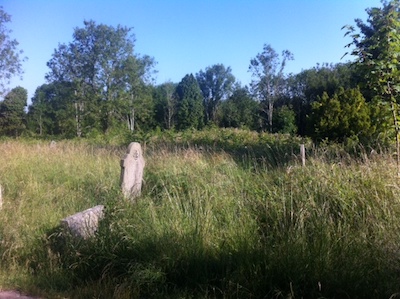
In the Victorian cemetery where we walk, we skirted a wedding in full swing when we were there a while ago, a mass of people on the steps of the building, anyway: cameras, hats, smart clothes, excited chatter. A little earlier on that same afternoon, a funeral had, I think, just finished. We were passing what seemed to be the aftermath of a wake, two or three staff in the late stages of tidying the outdoor venue, sweeping up, rearranging tables and benches. And that near-miss was probably funeral enough for me for a while.

I was, I recall, rather more exercised by the possibility that I’d confused, at some stage, Norman MacColl, editor of the Athenaeum, with Dugald Sutherland MacColl, painter, critic and Keeper of prestigious galleries (the Tate and the Wallace Collection), but also wanting to check on that other connection between moonrise and ‘Henri Beyle who wrote as Stendhal’. Was I in fact thinking of Stonehenge in another context? Fairly specialised concerns, to be sure, but then a lot of people have interests that would fall under that heading for a majority of passers-by.

That’s the crucial point about passers-by, of course. They pass by. As do I, in a great many circumstances, as do I.


Toiling optimists

(Thomas Fenwick, Late Autumn Landscape: University of Edinburgh)

A new month, the first of the meteorological autumn. On 2 September 1774, the naturalist Gilbert White observed that: ‘Many birds which become silent about Midsummer reassume their notes again in September; as the thrush, blackbird, wood-lark, willow-wren, &c.; hence August is by much the most mute month, the spring, summer, and autumn through. Are birds induced to sing again because the temperament of autumn resembles that of spring?’[1] Birds here, particularly the bluetits, are certainly singing, though a little warily. Still, who would not be wary just now?

The trees in the parks had already been misled into thinking that autumn had arrived. The weather generally has dried again, with a warm, slightly unhealthy feel to the breeze. The constants remain. . . constant – that is, the workmen, still, after months, making those thunderous noises of drilling and hammering that you associate with the beginnings of a job like that, not the late stages. Surely by now it should be no louder than the seductive murmur of a paintbrush on skirting-board or garden fence, the feathering of a soft broom, the occasional faint squeal of a cloth on clean glass. As well as the workmen, of course, the howl of ambulance sirens and the relentless overhead roar of damned aeroplanes, each one shaving just a little more off the lifespan of homo sapiens on this earth.

As for the news—from time to time, the Librarian, referencing the late Leonard Cohen just a little too appositely, will inquire, in passing: ‘You Want It Darker’? My response is most often ‘God, no!’ while, inside my mildly floundering but at-straw-grasping mind, another refrain runs: ‘It’s not dark yet but it’s getting’ there.’[2] Really, monsieur D.? Not there yet? O, optimist! But that was, of course, twenty-five years ago, which can make all the difference in the life histories of failed states.


What do you find to boast of in our age,
To boast of now, my friendly sonneteer,
And not to blush for, later? By what line
Do you entrain from Mainz to Regions saner?
Count our achievements and uplift my heart;
Blazen our fineness. Optimist, I toil
Whilst you crow cocklike.

So Ford Madox Ford began a poem, ‘Canzone à la Sonata’, dedicated to ‘E. P.’, that is, Ezra Pound, then in Giessen, the German town in which Ford stayed while pursuing a madcap scheme to secure a divorce from his wife under German law by qualifying for citizenship of that country. It was the setting for the famous ‘Giessen roll’, Ford diving headlong to the floor and writhing about in agony in response to the archaisms in Pound’s new collection of poems. The poem’s title indicates its target: ‘canzone’, a poetic form, not a style. It guys, as Ford often did, the conventional picture of the inspired and youthful lyric poet, and queries the price of exclusion paid by the optimistic singer. His inquiring ‘By what line/ Do you entrain from Mainz to Regions saner’ alludes to the poetic line but also employs an image that Ford would recur to often: the use of the railway journey as intersection of illusory stability, permanence, stasis and radical circumstantial alteration, whether in personal relationships or the larger configurations of history. Indeed, a poem called ‘In the Train’ occurs four pages earlier than ‘Canzone’ in the published volume, High Germany. By early 1912, in fact, Ford was perfectly aware of the threat from Germany, though his own history of involvement with that country was already immensely complicated and soon to become more so.


Optimist –  so many shades of meaning, interpretation, claim or confession there. People with their glasses half-full, half-empty – surely, just order another drink, to be on the safe side. The word defines not only individuals but eras: ‘It is difficult to think of an important Edwardian optimist’, Samuel Hynes wrote. ‘So that if “Edwardian” is to be used as an adjective identifying a literary tone, that tone must be one of social awareness and anxious concern.’[3]

More positively, it can evoke recovery, rebuilding, resurgence. Doris Lessing, remembering her arrival in Britain in the early 1950s, wrote: ‘There was still that post-war effervescence, the feeling that suppressed energies were exploding, the arrival of working-class or at least not middle-class talent into the arts, and, above all, the political optimism, which has so completely evaporated.’[4] More upbeat too was Margery Allingham’s view of her detective, Albert Campion, seeing in that extraordinary individual the virtues of the ordinary man (which, of course, enabled him to perform the feats of detection and deduction that qualified him to serve as her central character): ‘The optimism of a healthy mind is indefatigable, however, and as time went on even Campion began to see the events here recorded from that detached distance so often miscalled true perspective.’[5]

I am, of course, keeping my own optimism firmly within bounds: a true perspective in a healthy mind, as they say. Possibly.


Notes

[1] Gilbert White, The Illustrated History of Selborne (London: Macmillan, 1984), 94.

[2] Bob Dylan, ‘Not Dark Yet’, Track 7 on Time Out of Mind (1997).

[3] Samuel Hynes, ‘Introduction: A Note on “Edwardian”’, in Edwardian Occasions: Essays on English Writing in the Early Twentieth Century (London: Routledge & Kegan Paul, 1972), 8.

[4] Doris Lessing, Walking in the Shade (1997; London: Fourth Estate, 2013), 280.

[5] Margery Allingham, Death of a Ghost (London: Penguin Books, 1942), 176.

Striding, gliding, sliding into autumn

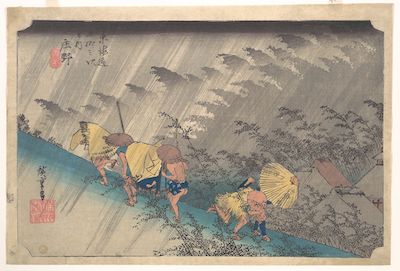
(Utagawa Hiroshige, Sudden Shower at Shōno: Metropolitan Museum of Art)

‘She can’t be completely stupid’, the Librarian says, in a rare moment of optimism, ‘she went to Oxford.’ And for a moment I almost wish I could find in that a good knockdown argument. Alas.

The heat, which changed many individual patterns of behaviour, was succeeded by several days of rain, which didn’t, and then by something balanced, pleasant, relaxing – or it would have been had the workmen in the neighbouring house, who have been there for months now, not chosen one morning to drill directly into my head. They showed too a remarkable willingness to persist, to graft, I suppose, thus refuting the latest reports of the witless witterings of—good grief!—the odds-on favourite for the leadership of the Conservative Party and thus, under our generally nineteenth-century political arrangements, Prime Minister of the United Kingdom of Great Britain and Northern Ireland.

Upstairs—and sometimes downstairs too—I bother archivists, occasionally in this country but far more often in the United States. The happy result of this is that, even as I pour a drink in the evening, goods news sometimes arrives from the Midwest or the west coast. An archivist has unearthed a previously unlisted letter from Ford Madox Ford to a publisher, a literary agent, a New York hostess, a budding author. I scrawl a message of heartfelt gratitude. Librarians and archivists may yet save the world.

Downstairs, I linger over Robert Lowell, Lafcadio Hearn and Mary Midgley. Dear Cal is of course his usual unfailingly cheerful self and emphatically not a daddy’s boy. ‘He was a man who treated even himself with the caution and uncertainty of one who has forgotten a name, in this case, his own.’[1] Hearn shuns the usual ragbag of common sense and scepticism by numbers: ‘I hold that the Impossible bears a much closer relation to fact than does most of what we call the real and the commonplace.’[2]

And Mary Midgley—I remember, a few years back, seeing an interview with, or brief statement from, the Green Party Brighton MP Caroline Lucas and Sophie Walker, then leader of the Women’s Equality Party. I found myself thinking, quite explicitly, My God! If we had people like that in charge of this country, there might be some hope. It wouldn’t be the complete bloody basket-case it is. Mary Midgley was a person like that: hugely intelligent, well-informed, intellectually curious. I read her memoir because my curiosity was piqued by the highly enjoyable volume by Benjamin Lipscomb, The Women Are Up To Something: How Elizabeth Anscombe, Philippa Foot, Mary Midgley, and Iris Murdoch Revolutionized Ethics (New York: Oxford University Press, 2022),[3] one of those valuable books which, like those of the wonderful Sarah Bakewell, are able to convince me—at least while I’m reading them—that I understand philosophy.


Midgley discusses, at one point, the idea that thought, like life, occurs in complex patterns, linked together, which have to be sorted out and dealt with on their merits. ‘This does not mean that our work is impossibly complicated. It does not mean that we cannot know anything until we know everything. Human cultures contain all sorts of convenient ways of breaking up the world into manageable handfuls and dealing with one part at a time. And we can keep continuously developing these ways so that they can correct one another. In this way, quite a lot of the time we do get things right. Attending to the background pattern of questions and answers does not tip us into a helpless relativism. But it is perfectly true that this approach does stop us hoping for a universal scientific formula underlying all thought. We cannot, as Descartes hoped, find a single path to infallible certainty. But then luckily we do not need to.’

Indeed. I confess, though, that one of my favourite moments in the book is an account of a discussion group which included Carmen Blacker, later a distinguished Japanese scholar. ‘It was Carmen who supplied me with the best example I have ever met of the diversity of moral views. When I raised the topic of conflicting customs, “Oh, I see”, she said. “Like, there’s a verb in classical Japanese which means to try out one’s new sword on a chance wayfarer?”’ Midgley later used this in an article with that name.[4]

Light rain, the faintest murmuring, and a soft soughing in the branches and leaves above the fence. Harry the cat is crouched at the open back door, snuffing up late August early evening English air. He has noticed, I think, that my method of serving his teatime bowl approximates more and more to that of Henry James’s butler, as recalled by Ford Madox Ford:

‘His methods of delivery were startling. He seemed to produce silver entrée dishes from his coat-tails, wave them circularly in the air and arrest them within an inch of your top waistcoat button. At each such presentation James would exclaim with cold distaste: “I have told you not to do that!” and the butler would retire to stand before the considerable array of plate that decorated the sideboard.’[5]

We are sliding into autumn. There is an acknowledged cost-of-living crisis. But then, come to that, there is a crisis in every area of public life, from education to social care, from farming to transport, from library provision to news media to the raw sewage fouling our coastal waters. Given our current electoral system, there’s little we can do at present: turn down the heating a degree or two, hope for a mild winter—and do our level best to resist trying out new swords on chance wayfarers.


Notes

[1] Robert Lowell, Memoirs, edited with a preface by Steven Gould Axelrod and Grzegorz Kosc (Faber & Faber 2022), 18.

[2] Lafcadio Hearn, ‘The Eternal Haunter’, in Japanese Ghost Stories, edited by Paul Murray (London: Penguin Books, 2019), 33.

[3] Benjamin J. B. Lipscomb, The Women Are Up To Something: How Elizabeth Anscombe, Philippa Foot, Mary Midgley, and Iris Murdoch Revolutionized Ethics (New York: Oxford University Press, 2022).

[4] Mary Midgley, The Owl of Minerva: A Memoir (London: Routledge, 2007), 72, 160.

[5] Ford Madox Ford, Return to Yesterday (London: Gollancz, 1931), 14.

Date, notable; roadworks, less so

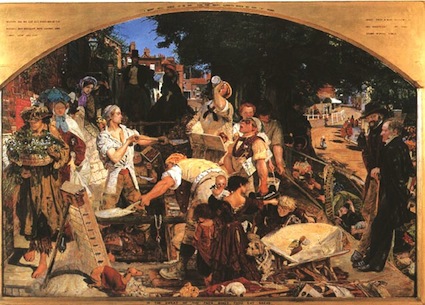
(Ford Madox Brown, Work: Manchester Art Gallery)

Our road is finally being resurfaced: the most immediately local excitement in a long time and a teasing reminder of what it could be like were there not—as there usually are—bloody cars parked bumper to bumper on both sides of the road. I say it’s being resurfaced: that’s the advertised plan, anyway. It was advertised once before but the designated two days coincided with the heat wave, more, two of the hottest days on record, so they very sensibly postponed the work.

Yesterday, then, there was a good deal of noise, and a nifty vehicle kept whizzing up and down the road, with no discernible purpose that we could see, until we finally realised that the whizzing was probably the point. An open road, a nippy vehicle and endless fun to be had. So today was, is, presumably The Day. There’s been a bit of coming and going but no sign of any actual resurfacing yet.

The pavements – and every pedestrian path hereabouts – are in a parlous condition, offering plenty of opportunities to  break your neck or at least an ankle; but, as is well established, pedestrians are very low down the food chain. Roads, on the other hand – and yet, getting on towards lunchtime, a car just passed along what I supposed was the still-closed road – and I’m beginning to wonder.

Meanwhile, today is the 4th August, a date written in very large letters in the minds and margins of most students and scholars of modern history. Fordian scholars too, aware that he slipped that date into the text of The Good Soldier some sixteen times. Right up until 1914, of course, it’s just a date. Even on the day itself, it hasn’t happened, at least in Britain, until 11:00 p.m.

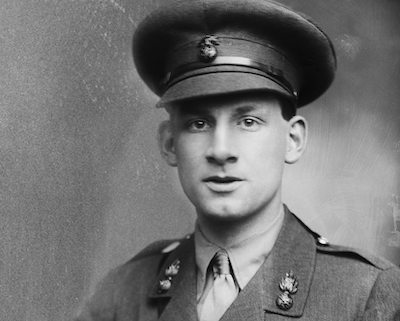
Fifty years earlier, the younger sister of Violet Hunt (novelist, suffragist, partner of Ford Madox Ford for ten fraught years) was born. Venetia Margaret Hunt, usually known as ‘Venice’, was named after Ruskin’s famous work, The Stones of Venice (1851-53) and Ruskin became her godfather. On the same day in 1899, poet and short story writer Walter de la Mare married Elfrida Ingpen, at a a private ceremony in a Battersea church.[1] The year before the Great War, D. H. Lawrence’s sister Ada was married to William Clarke, 4 August 1913. On the portentous day itself, the novelist Julian Barnes’ grandparents were married, Stanley Spencer’s sister Florence had her birthday and Siegfried Sassoon’s, his ‘impetuosity’ probably having made him the first War poet to have enlisted, his Army Medical done and dusted on 1 August , so ‘at the official outbreak of War on 4 August he was in ill-fitting khaki.’[2]

(Siegfried Sassoon via the BBC)

It has always been, in fact, a popular day for birthdays in the arts: Percy Shelley and Walter Pater, W. H. Hudson and Knut Hamsun, Louis Armstrong and Witold Gombrowicz.

Some years after that war, the poet and maker David Jones stayed with his friend Helen Sutherland at Rock Hall, Northumberland. He made his third trip there on 4 August 1931. At the start and end of each visit, Jones would be driven past the Duke of Northumberland’s castle. Helen told him this was on the site of Lancelot’s castle, Joyous Guard – and the supposed place of his burial. ‘With this association in mind’, his biographer Thomas Dilworth wrote, ‘Jones referred to the church at Rock as “the Chapel Perilous”, the place of terrifying enchantment that Lancelot enters –­ an episode in Malory that reminded him of his experience at night in Mametz Wood.’[3]

Looking back now, I’m struck by a sentence in the ‘Preface’ to Jones’s poem, written nearly ninety years ago: ‘Just as now there are glimpses in our ways of another England—yet we know the truth. Even while we watch the boatman mending his sail, the petroleum is hurting the sea.’[4]

As for that resurfacing – cars are passing and parking often now. The closed road has been thoroughly unclosed. The sun is beating down on the same surface. The workmen have packed up and gone, nifty vehicles and large vans alike, having left undone those things that they ought to have done. There will be, of course, no explanation. Still, the renewed quietness enables me to hear more distinctly Harry the Cat prematurely yowling for his tea. Every cloud, silver lining, sunny side of the street, all that.


Notes

[1] Barbara Belford, Violet: The Story of the Irrepressible Violet Hunt and her Circle of Lovers and Friends—Ford Madox Ford, H. G. Wells, Somerset Maugham, and Henry James (New York: Simon and Schuster, 1990), 29; Theresa Whistler, The Life of Walter de la Mare: Imagination of the Heart (London: Duckworth, 2003), 89.

[2] Letters of D. H. Lawrence II, June 1913-October 1916, edited by George J. Zytaruk and James T. Boulton (Cambridge: Cambridge University Press, 1981), 38 n; Julian Barnes, Nothing to be Frightened of (London: Jonathan Cape 2008), 28; Kenneth Pople, Stanley Spencer: A Biography (London: Harper Collins, 1991), 55; Jean Moorcroft Wilson, Siegfried Sassoon: The Making of a War Poet. A Biography (1886-1918) (London: Duckworth, 1998), 180.

[3] Thomas Dilworth, David Jones: Engraver, Soldier, Painter, Poet (London: Jonathan Cape, 2017), 140-142.

[4] David Jones, In Parenthesis (1937; Faber 1963), ix.

On a postcard, please


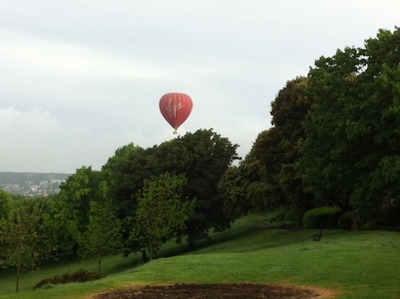
Blackberrying again: working our way down bushes on the slopes of the park, filling plastic containers, taking them home, rinsing the fruit in a colander, transferring them to compostable bags and sticking them in the freezer. It seems, oddly, like a blow on behalf of the ordinary universe. As are the hot air balloons, going over so early some mornings, as they have done for years. And, as I have done for years, I step outside and stare up at the sky and feel a strange sense of reassurance, of confirmation, of a fitness in the world.

We have stepped, or been forced, outside of all that. Our recent pleasures have included quite ridiculous weather and quite ridiculous politics. Or, more soberly, terrifying weather and terrifying politics, two areas intimately linked, of course. There have been hot summers before, 1976, 1911, and droughts, such as 1921, 1911 again – and 1976, again. But in recent years, it is no longer in a metaphorical sense, or even a hyperbolic one, that we say: the world is on fire. Set against this, of course, is the continuing failure of governments to meet the urgency of need with priority of response. If major heart surgery is needed, sticking a plaster on the patient’s thumb strikes some of us as less than adequate. But there is also the massive disconnect, the stolid denial that individual actions can make any difference – while the careful sorting of paper, cardboard and plastics for the weekly collection somehow co-exists in the same single life with a steely determination, and a conviction of entitlement, to fly to three holiday destinations every year.


Walking on one of the quieter paths in the Victorian cemetery, we pass a wedding reception at the Underwood Centre, several dozen guests in a woodland setting. In the midst of death we are in life. It is odd, to say the least, to know, or at least to suspect, that after so many centuries of progress, if you can call it that, of achievement, if that’s what it is, we are living in an age of extinction, an age in which things will not simply slow down or even go backwards but will just stop and die. We don’t want to think of such things… and the vast majority of us  – manage not to

 04:28 – and the cat feels it’s time to begin discussing breakfast. The workmen won’t be here to plague us for another three and a half hours. But there’s the light – and the birdsong. ‘All winter long’, William Maxwell wrote to Eudora Welty in June 1979, ‘I worried because there were no birds, and now there is such a racket you can’t hear yourself think.’[1] (Not long before this, he’d written: ‘In some ways the most beautiful journeys are the ones you don’t take’, which are the journeys I’ve been enjoying for a while now, liking them more and more.)

‘In this weather’—Maxwell again, this time in the summer of 1953, ‘one needs astonishment in the head to keep the heat out.’[2] That afternoon, listening to the rain on the windows, I was struck by the consciousness of what I was doing and the moment in which I was doing it: listening to the rain. It was late in the hottest day ever recorded in this country, the bulletins said, the hottest anyway since the day before. Fires were reported all over the United Kingdom, in London, South Yorkshire, Leicestershire. Our temperate northern climate, forsooth.

All those weary years, those decades, in which the warnings were given, the recommendations made, the figures presented – and nothing done and nothing done and nothing done. It would have been so much cheaper then, more manageable then, the future infinitely strengthened and sweetened then. But we had no influential figures equal to the task. Nor have we had any since. And, looking at the poor creatures now, with their paucity of ideas and their disgusting gestures at policy, it’s painfully evident why we have declined so fast and so far.

‘It does no good to regret history’, Samuel Hynes remarked, ‘all we can do is to try to understand it.’[3] That seems reasonable enough, though forces here, there and everywhere want something quite other. Why understand it? Here’s the version we like – why not go with that?


As Sarah Churchwell recently remarked, ‘The past has consequences in the present regardless of whether we know what happened in it; learning the history makes those consequences intelligible.’[4]

The other day, in an attempt to prevent the Librarian’s determined misquoting of a couple of lines in Dirty Harry, I played her the clip: at the end, the wounded man, maddened by the uncertainty about whether Harry has fired five shots or six, says: ‘I gots to know! I gots to know!’

Yes, I think I suffer a little from that compulsion. Is there one left – or is it already empty?

Answers on a postcard, please – but then you may as well recycle them.


Notes

[1] Suzanne Marrs, editor, What There Is to Say, We Have Said: The Correspondence of Eudora Welty and William Maxwell (Boston and New York: Houghton Mifflin Harcourt, 2011), 348.

[2] What There Is to Say, We Have Said, 35.

[3] Samuel Hynes, ‘Introduction: A Note on “Edwardian”, in Edwardian Occasions: Essays on English Writing in the Early Twentieth Century (London: Routledge & Kegan Paul, 1972), 11.

[4] Sarah Churchwell, The Wrath to Come: Gone With the Wind and the Lies America Tells (London: Head of Zeus, 2022), 11.

Walking early, falling surely


We are walking early to avoid the heat – not ‘The game is afoot! Into your clothes and come!’ early; and not recent Southern European heat –we’re talking, rather, of very warm English days and returning at more or less the time scheduled for the cat’s morning snack (not breakfast: that’s a separate issue).

Already, in the smallish park en route to the cemetery, there are people with dogs, plus a few without dogs and occasionally those displaying neither dogs nor signs of motion. They sit or lie on the grass and don’t move at all. Perhaps they are hoping that history—especially rancid and rancorous of late—will pass them by.

News from Ukraine and the United States, and such features as the interview with the admirable Maria Alyokhina, may put this country’s constant troubles and relentless decline into perspective but those troubles are serious enough.

https://www.theguardian.com/world/2022/jul/11/pussy-riot-maria-alyokhina-putin-crimes-hitler-years-of-resistance

At present the news media—predominantly right-wing in the UK—is convulsed by another struggle for the Conservative Party leadership. Because the only required quality in senior government ministers was unquestioning agreement with Boris Johnson, there is, unsurprisingly, little evidence of talent, ability or intellectual strength among the candidates. There are, indeed, only variations in unpleasantness. Though a surprising number of Tories have suddenly discovered ‘integrity’ in the past week or two – how to pronounce it rather than how to practise it – all these Prime Ministerial hopefuls agree that trafficking refugees to Rwanda, or some other country with a dubious record on human rights, is a damned fine idea. Then, too, most of them beat the familiar drum of delusional tax cuts, confident that the unreflecting will go no further than recognising this too as a damned fine idea. To those of us who’ve noticed the collapse in public services and recognise the reasons for that collapse—and who remember the recent history of Britain’s railway system and its energy sector—it’s a little less fine.

Refugees, immigration, the right to protest, voter suppression, public services, education, climate emergency: in a country that had not lost its senses, people like these with the views they have on such issues would simply and rightly be regarded as reprehensible individuals. As it is, one of them will soon become Prime Minister of this country, backed by a vote of well under 1% of its population. 

Still, I’ve begun reading the estimable Sarah Churchwell’s The Wrath to Come: Gone With the Wind and the Lies America Tells – which will educate me but not, I suspect, cheer me up that much. One of its central questions, ‘What the hell happened to America?’, I’ve voiced myself, though not as often as I’ve applied the same question to my own country.


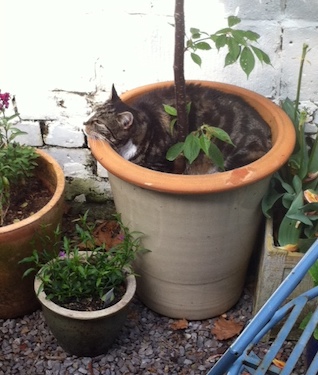
Deceptively, the sky is a pure, untroubled blue (or rather, troubled only by the repeated aircraft trails). The parasol is up; butterflies and bees are busy about their daily dealings. The  hammering of workmen pauses every so often to allow for the solo wails of ambulance sirens. But a little later, quiet is restored, the makings of a simple dinner – and the birthday champagne – are in the fridge, the cat is settled in a large earthenware pot in the garden. All is right, you might say, with the world – always excepting a significant number of the people in it and the damage they do.

Á votre santé!

Pouring a drink for Cassandra


‘Did you say something?’ the Librarian asked as the forty-fifth runner in the space of a couple of hundred metres passed us, panting infectiously. I said I might have briefly referred to the runner but wasn’t aware of having said it aloud. ‘Yes’, she said, ‘I thought it was one of the sounds you make.’

One of the sounds. We were out for lunch—‘Here we go, out into the world’, said the Librarian, who is prone to doing that sort of thing, the front door gaping as we stepped onto the pavement. Along the park’s lower path, under the railway bridge, over the river, up between the flats, through the grounds of St Mary Redcliffe, where Samuel Taylor Coleridge married and Thomas Chatterton turned up some likely manuscripts, across the hill and up to the high road from which steps cut down to the harbourside, another footbridge, then along by the river for a mile, dodging runners, watching the paddleboarders, the dogs, the photographers, then on to the Underfall Yard, the patent slipway presently unoccupied.

Lunch. I recalled Patrick White relating, in a letter to Ninette Dutton, his attendance at a lunch given by James Fairfax for ‘the visiting American millionaires’. ‘Madame Du Val cooked the lunch. Most unwisely they chose to give us omelettes. I went into the kitchen afterwards to see her and she said, “I’m fucked!” She looked it too, after eighty omelettes. I said I was fucked after one; I find cooking an omelette a highly emotional experience. Some of the elderly maids standing around seemed rather shocked.’[1]

You don’t need to be an elderly maid to feel shocked, if not surprised, just lately. And going out to lunch was quite a while back now, with half a dozen or more blog posts begun and abandoned or left for dead since then. ‘The world is too much with us’, William Wordsworth observed, not in 1802 burdened with appalling news (let alone social media) but more concerned with that ‘getting and spending’ which lays waste our powers and blinds us to the natural world and our connection to it: ‘We have given our hearts away, a sordid boon!’[2]

Writing to a couple of archivists, always in search of Fordian letters, I can’t quite bring myself to wish them a happy Independence Day, in case they suspect me of blackest humour.  Independence from the tea-swilling Britishers two and a half centuries back, but not now from their own religious and political extremists. It might be no more welcome than an American congratulating me on the fantasy glories of Brexit and the election of a government clearly intent on removing my democratic rights and safeguards.

The sense of threat from America’s gigantic lurch back into the dark feels very real: oddly, it might seem, given that I’m white, male, of an older generation, not gay – and not in the United States. But recent developments are an attack on humane and civilized values: the threat is not, or will not for long be, confined to the obvious targets. That discredited supreme court may be ‘over there’, but those who make reassuring noises about how it can’t happen in our Disunited Kingdom are dangerously naïve – or just dangerous. We too have our fair share of religious zealots, miscellaneous lunatics and neofascists and, while many Americans no doubt thought It Can’t Happen Here, it has happened there or is happening there.

Advice of the day: think of the worst that could reasonably be expected to happen then double it. More. Invite Cassandra round, pour her a drink and listen to what she has to say. If she says: ‘O dark, dark, dark. They all go into the dark’ or if she mentions ‘end of days’– listen closely.

‘I was wrong to forget’, Marguerite Yourcenar has her emperor Hadrian say, ‘that in any combat between fanaticism and common sense the latter has rarely the upper hand.’[3]


Notes

[1] Patrick White, letter of 13 April 1975, Letters, edited by David Marr (London: Jonathan Cape, 1994), 455.

[2] Wordsworth, ‘The world is too much with us’, 1802 sonnet in William Wordsworth, edited by Stephen Gill (Oxford: Oxford University Press, 2012), 237.

[3] Marguerite Yourcenar, The Memoirs of Hadrian, translated by Grace Frick, with Yourcenar (1951; Penguin Books, 2000), 198.

Oddnesses and cloudy crossroads


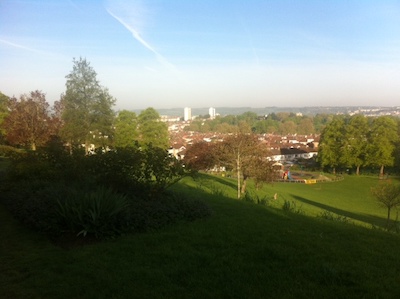
With the Librarian away and the cat, though frankly puzzled, not yet overtly resentful, I walk uphill after breakfast, through the other, smaller park and along quiet streets, one or two walkers glimpsed at comfortable distances, barely any cars on the roads I’ve chosen, and the only mild disturbance a runner with a backpack, who pants his way past while I shift well away, thinking that there’s surely no real need for that sort of thing.

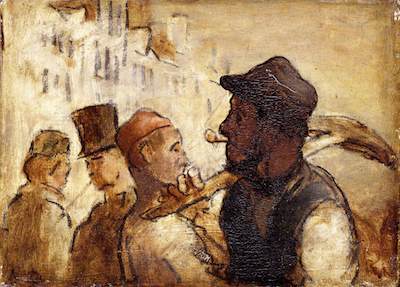
Mild disturbance, though, is almost welcome, after the past few days of relentless activity in the neighbouring house, which is evidently being gutted before its sale or re-letting. Yesterday, the workmen seemed to be drilling directly through the wall – I expected their imminent arrival in the room where I sat at my keyboard. On several days last week they took over from the other crew beyond the back fence, the ones with the shocking musical taste. Occasionally they would harmonise, after a fashion, sledgehammer against drill, concrete mixer against hacksaw. Though raising sympathetic eyebrows to the Librarian and Harry the cat when our paths crossed, I regarded the unholy row with relative equanimity—mostly—still feeling the after taste of euphoria that attended the final surrender of a tooth that had wavered and jiggled for more than a week, making mealtimes purgatory and tending to vandalise my dreams.

(Honoré Daumier, Workmen on the Street: National Museum of Wales)

We tend to think of incessant noise as a recent development—wars apart—given motorised road traffic, aircraft and other modern machinery. It’s largely true. Still, it’s salutary to be reminded of the London streets in Victorian times, when the Inns of Court served as ‘oases of quiet’, into which people walked, especially in Dickens’ work, in order to hear one another speak.[1]

Out early this morning, not in Dickens’ London, I was buffeted and boomed at only by birdsong, the bushes and hedges and thick-leaved branches in constant movement. I always find such occasions oddly heartening, as when I saw recently, in the tree that overlooks—and reaches over—our garden fence, at least two bluetits and a pair of goldfinches, plausibly the same ones seen on several occasions this past fortnight. Why ‘oddly’, though? An odd choice of word. I should know by now that I can rely more confidently on birds, trees, cats, walls, cemetery paths and grassy slopes for reassurance that we are not approaching the end of days than on the behaviour of my fellow humans (sometimes yes, often no).


‘Nature has no destiny for us: our boat is upon her ocean and in her winds, but she has expended as much ingenuity designing the flea as she has expended on us, and is perfectly indifferent to Hooke’s conversation at Garraway’s Coffee House. We, however, perish the instant we take our eyes off nature.’[2]

There we have it: the perish option. Or not. Don’t take your eyes off it—her—it. And cherish the oddities, as Enid Bagnold wrote: ‘Who wants to become a writer? And why? Because it’s the answer to everything. To “Why am I here?” To uselessness. It’s the streaming reason for living. To note, to pin down, to build up, to create, to be astonished at nothing, to cherish the oddities, to let nothing go down the drain, to make something, to make a great flower out of life, even if it’s a cactus.’[3]

The past two and a half years­—very nearly that now—have changed some behaviours, habits, attitudes and perceptions in ways which are still largely invisible to us. In Elizabeth Bowen’s novel, Friends and Relations, Lady Elfrida reflects that: ‘Surely people were odder, or was it just that one met them? Had these years, with their still recent sense of catastrophe, brought out curious people, like toads after rain?’[4] I often find other people’s behaviour odd, to be sure, but suspect that the newer, larger oddness is in myself. ‘That is to say’, Ford’s narrator Gringoire in No Enemy remarks of the recent war from which he has emerged, ‘it did teach us what a hell – what a hell! – of a lot we can do without.’[5]

A good many people in the current crisis—there is always a crisis for some of them—are finding that they have little or no choice in the matter of what to do without, of course. Others, who are in a more comfortable position, have evidently decided on at least one of the things that they won’t do without. That scrubbed-smooth sky this morning was streaked with cloud strips like tracer but also with the swift lines of numerous aircraft, stuffed with people making their modest but not insignificant contributions to the climate crisis. At one point, with a symbolism so apt as to verge on unconvincing, the clouds had formed a solid and clearly delineated crossroads which one of those crammed airliners was approaching.

It ploughed straight on, of course.


Notes

[1] Judith Flanders, The Victorian City: Everyday Life in Dickens’ London, (London: Atlantic Books, 2012), 30-33.

[2] Guy Davenport, ‘The Death of Picasso’, Eclogues: Eight Stories (London: Picador, 1984), 23. That would be scientist and philosopher Robert Hooke (1635-1703), while Garraway’s, dating from the 1650s, was the first coffee house in London. I see that Simon Schama has it as ‘Garway’ – but am not downhearted.

[3] Enid Bagnold, Autobiography (London: Century Publishing, 1985), 59.

[4] Elizabeth Bowen, Friends and Relations: A Novel (1931; Chicago: University Chicago Press, 2012), 82.

[5] Ford Madox Ford, No Enemy (1929; edited by Paul Skinner Manchester: Carcanet Press, 2002), 52. A decade earlier, his poem ‘The Starling’ began: ‘It’s an odd thing how one changes’.

Cake, justice and other helpings

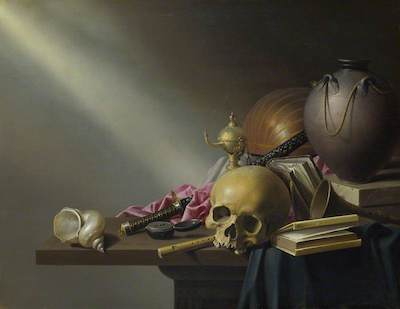
(Harmen van Steenwyck, Still Life: An Allegory of the Vanities of Human Life: National Gallery, London)

The name on the local builder’s van parked just outside our window recalls a nineteenth-century book title. ‘“Socially and politically mean one thing in the end,” said Beauchamp. “If you have a nation politically corrupt you won’t have a good state of morals in it, and the laws that keep society together bear upon the politics of the country.”’ I’ve not actually read George Meredith’s novel, Beauchamp’s Career, but was happy to lean on Roy Foster, clearly familiar not only with Meredith but also Trollope, Disraeli, George Eliot, Dickens, Mrs Humphrey Ward and others, together with a raft or, rather, flotilla of critics, biographers, diarists and historians that had any bearing on his subject.[1]

1871 was the date of the Meredith novel. A long way back—Victoria, Gladstone, the opening of the Royal Albert Hall, trade unions legalised, Stanley bumping into Livingstone, a UK census total (2 April) of 26,072,036—in some ways, at least.

In the early eighteenth century, E. P. Thompson remarked, ‘High politics was a predatory game, with recognized spoils, and [Robert] Walpole is to be distinguished chiefly by his systematizing of the means of corruption, with unusual blatancy.’[2] Through much of the nineteenth century, with England seen as primarily an industrial nation, foreign visitors went North to visit the ‘real seat of English power’, while London was regarded as a place of idleness and corruption.

As economic power failed, the perc­eived centre of the economy shifted south. The last years of the nineteenth century brought ‘a new urban world to the fore, the world of inner London.’ Imperial designs increased as manufacturing aspirations declined – and London was the heart of the Empire.’[3]

‘Unusual blatancy’ then: impunity now, with little attempt to hide the corruption, lying and hypocrisy that characterises the current English government. And Emerson’s 1836 remark that ‘The corruption of man is followed by the corruption of language’[4] is still germane.

My younger daughter comes over from Barcelona: the first sighting for eight months. While she’s here, my elder daughter comes for dinner; the four of us together, first time in a long time.

How are you?
I’m all right, I say. Apart from my eyes, ears, teeth, leg and back.
(Leave it there, man, leave it there.
I leave it there.)

All too soon, politics edge in. Then and now, sitting at a dinner table, sitting down to a keyboard, I think, though briefly: don’t just rant about bloody Tories. Surely everyone in this country with a half-decent view of the world now rants about bloody Tories. Or is that too sweeping? I’m old enough to remember when the Conservative party was a serious and respectable political organisation. I knew reasonable, intelligent people who voted for them. They were the law and order party, the party of economic moderation and stability, the party of patriotism and national pride. Not my party but – respectable. All that’s gone, of course. They’re well on the way to becoming like the Republican Party in the United States, a cult, utterly divorced from truth, honesty, justice, fairness, the national interest, democratic principles and the rest. All those Conservative MPs had their chance, they had several chances – but chose not to take them. Any claim to moral authority or ethical standards is now long gone.

I think of Elizabeth Bishop writing to her friend Pearl Kazin in 1953, mentioning a piece in Darwin’s Beagle journal about a Brazilian complaining that English Law gave the rich and respectable no advantage over the poor. ‘It reminds me of Lota’s story about a relative, a judge, who used to say, “For my friends, cake! For my enemies, Justice!”’[5]

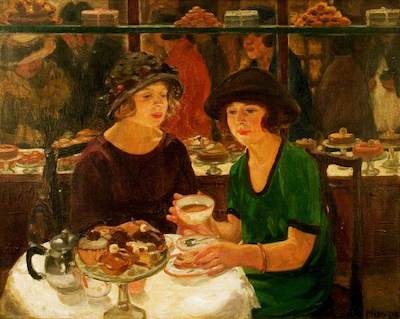
(Mabel Frances Layng, The Tea Table: West Park Museum, Macclesfield)

Cake, yes. Having it, eating it. Could we say ‘no advantage’ now? Hardly, when rich men frequently bring libel actions against investigative journalists who have looked into their dealings with offshore accounts, tax havens, foreign agents, cyber hackers, purveyors of fake news and the like, in an attempt to shut down those journalists’ researches.

The day descends. Russian forces continue their genocidal campaign in Ukraine. In India, Jignesh Mevani, a prominent campaigner for the Dalit community, is arrested for tweeting criticism of Prime Minister Modi. Police clash with Palestinian protesters in Jerusalem. In the US, car crashes have been overtaken by guns as the main cause of death among children and teenagers. In France, the far right are in serious contention for the Presidency, while Leave and Tory voters in this country apparently favour Le Pen by a margin of some 13 points. In Singapore—which currently ranks 160th out of 180 territories in the Reporters Without Borders’ World Press Freedom Index (behind Belarus and Russia – yes, really)—Terry Xu, the former editor of the Online Citizen, has been jailed for three weeks for defamation over a letter published on the site that alleged corruption among government ministers. And here – we read the headlines, watch members of parliament defend the indefensible (not least the latest vicious and absurd proposal to traffic refugees to Rwanda) and wonder how we ended up here.

No, of course we don’t really wonder, because we already know. We know. But the knowledge hurts.


Notes

[1] R. F. Foster, ‘“Fatal Drollery”: Parliamentary Novels, Outsiders and Victorian Political History’, in Paddy & Mr Punch: Connections in Irish and English History (London: Penguin Books, 1995), 139-170.

[2] E. P. Thompson, Whigs and Hunters (London: Penguin Books, 1990), 214.

[3] Alan Howkins, ‘The Discovery of Rural England’, in Robert Colls and Philip Dodd, editors, Englishness: Politics and Culture, 1880-1920 (London: Croom Helm, 1986), 65.

[4] Ralph Waldo Emerson, ‘Nature’, in Selected Essays, edited by Larzer Ziff (London: Penguin Books, 1982), 51.

[5] Elizabeth Bishop, One Art: The Selected Letters, edited by Robert Giroux (London: Pimlico, 1996), 255. ‘Lota’ is Lota de Macedo Soares, with whom Bishop lived in Brazil for fifteen years.

On the other hand


There was, is, a saying:
‘Till April is dead
Change not a thread’

Perhaps less a suggestion to heavy users of social media than a body blow to personal hygiene. All Fools’ Day, I finally troubled to find out, is of French origin, the poisson d’avril—April fish—persons to be hoaxed or have a cardboard fish attached to their backs or simply to be sent on some ridiculous errand. The April fish, because of its abundance in that month, is the mackerel – and the French maquereau also meaning ‘pimp’, occasional complications, or extensions of the idea, were always likely to arise.[1]

‘Whan that Aprille with his shoures soote’ or no, rather, as has been very often quoted of late, ‘the cruellest month’. Some days begin well enough. After breakfast, sitting at the kitchen table with Wodehouse or Lawrence or Mary Wollstonecraft (‘more tea, Mary?’), the cat at the back door or already upstairs again, sprawled on the bed with the Librarian, who is speaking French back at her iPad or looking at her timetable, clouds on the breezier days moving, steadily stately galleons, above the trees and houses, maybe the quick crossword done, even a sentence written that stays written.

But the news is always there, whether just arriving or already waiting. The worst is still from Ukraine, of course, the continued targeting and murder of civilians, and names that will not be forgotten by historians of atrocity: Borodyanka, Bucha, Mariupol, Kramatorsk.

‘Far from his illness’, W. H. Auden wrote of W. B. Yeats, ‘The wolves ran on through the evergreen forests’.[2] To those deluged in grief or fighting for their lives, it’s often shocking that things go on elsewhere – perhaps not as normal, or as before, but they go on. Apsley Cherry-Gerrard, youngest member of Scott’s second Antarctic expedition, who had gone to the war with his health still shaky, was invalided out of the army with what was eventually diagnosed as ulcerative colitis. While men died in their hundreds of thousands on the other side of the channel, Cherry found himself, in 1916, alone in the family home for the first time. ‘There, in the stillness behind the high yew hedge, he watched the oaks and beeches flower and observed the progress of a family of robins nesting in the willow. He noted the arrival of a hen sparrowhawk, and listed the species of tits hovering around the fruit trees. It was a stay against the chaos of the war, and he absorbed himself in the smallness of his garden while the world went mad.’[3]

A few months after the end of that war, Aldous Huxley—who had, in fact, volunteered but was, inevitably, rejected on health grounds because of his famously poor eyesight, following a serious infection years before—wrote to his brother Julian: ‘great events are both terrifying and boring, terrifying because one may be killed and boring because they interfere with the free exercise of the mind—and after all, that freedom is the only thing in the world worth having and the people who can use it properly are the only ones worthy of the least respect: the others are all madmen, pursuing shadows and prepared at any moment to commit acts of violence. The prospects of the universe seem to me dim and dismal to a degree.’[4]

Well, yes. On the other hand – there are goldfinches in our garden. . .


Notes

[1] Bonnie Blackburn and Leofranc Holford-Strevens, The Oxford Companion to the Year (Oxford: Oxford University Press, 1999), 140, 142-143.

[2] Auden, ‘In Memory of W. B. Yeats (d. Jan. 1939)’, W. H. Auden, The English Auden: Poems, Essays and Dramatic Writings, 1927-1939, edited by Edward Mendelson (London: Faber, 1977), 241.

[3] Sara Wheeler, Cherry: A Life of Apsley Cherry-Gerrard (London: Jonathan Cape, 2001), 185.

[4] Aldous Huxley, Letters of Aldous Huxley, edited by Grover Smith (London: Chatto and Windus, 1969), 173-174