
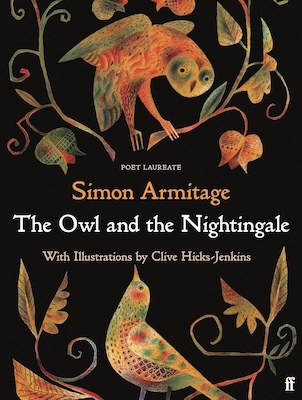
‘A clever lesson Alfred taught
that should remain within our thoughts:
“A threat seen in its infancy
will lose much of its potency.”
So heavy jolts have far less force
if spotted early in their course;
& you can dodge an arrow’s blow
by watching as it leaves the bow,
then keeping its approach in sight,
then ducking from its fatal flight.’[1]
July. A bad month for the Romanovs, among others, as I recall. Sedgemoor, the last major battle on British soil. Anaïs Nin begins her journal. Louis-Ferdinand Céline died on 1st July; Franz Kafka was born on the 3rd. I was not actually aware of those last two facts when the month began. More widely, it began with a pause in the heat, in the United Kingdom anyhow, though extreme weather still had a grip elsewhere, a death grip often enough. More locally, as in our breakfast table, it started with Céline’s Death on the Instalment Plan (Mort à crédit) and Kafka’s ‘In the Penal Colony’. Yes, as in the case of Dr Johnson’s old friend, Oliver Edwards, who had tried in his time to be a philosopher, ‘cheerfulness’ is ‘always breaking in.’[2]
Since then, wildfires raging in France, Spain, Italy, Crete, Greece. . . a fire blazing in the Cairngorms national park in Scotland for a fortnight now, and a huge area in Suffolk devastated, including the Minsmere nature reserve. The climate emergency is taking itself seriously, even if some of those affected by it still, astonishingly, do not. Our ‘temperate’ country is currently enduring, in parts of the country, its fourth heat wave of the year, half of England now officially in drought, already having recorded the hottest June ever. The excessive humidity made it much worse then, of course, oppressive and exhausting, with large areas of western Europe reportedly sitting under a ‘heat dome’, so both physically and psychologically stifling, something of a theme for the times. Closing in.
It’s an old literary theme too, unsurprisingly. In Edgar Allen Poe’s tale, ‘The Pit and the Pendulum’, after the narrator has saved himself from the pit only by tripping on the hem of his robe, and freed himself by luring rats to chew through his bonds, the walls of the cell begin closing in. They are also red-hot and force him towards the pit in the centre of the cell. ‘I shrank back – but the closing walls pressed me resistlessly onward.’[3]

Fifty years later, in Arthur Conan Doyle’s ‘The Adventure of the Engineer’s Thumb’, Hatherley lets slip to Colonel Lysander Stark that he has realised the deception practised upon him. The Colonel is not amused, slams the door and turns the key in the lock. ‘The lamp still stood upon the floor where I had placed it when examining the trough. By its light I saw that the black ceiling was coming down upon me, slowly, jerkily, but, as none knew better than myself, with a force which must within a minute grind me to a shapeless pulp.’[4]
Encroaching walls, descending ceilings, such closings-in are at the more grotesque end of the spectrum. Others are more general, more personal, more subjective.
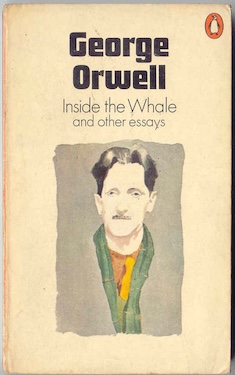
George Orwell (in 1940) writes of Henry Miller at the end of Tropic of Cancer, watching the Seine, ‘in a sort of mystical acceptance of the thing-as-it-is. Only, what is he accepting? In the first place, not America, but the ancient boneheap of Europe, where every grain of soil has passed through innumerable human bodies.’ Secondly, the modern age of concentration camps, bombs, purges, political murder and the rest. And, regarding Walt Whitman, to whose outlook Miller’s own is ‘deeply akin’, Orwell adds: ‘Unlike Whitman, we live in a shrinking world.’[5]
I live in a city, large parts of which—and in a country, large parts of which—were essentially designed for an earlier century: the twentieth and, very often, the nineteenth. Many roads are narrow, their pavements not designed to be blocked by huge plastic recycling bins and boxes, and by oversized vehicles parked half on pavements with their wing mirrors not even folded in on the pedestrian side. Shrubs and hedges, which used to be tidied and trimmed, now trail and jut over walls and fences. Innumerable plants, not all of them weeds by any means, sprout from the base of front boundary walls, shaving a few more inches off the pedestrian space: you might say ‘rewilding’ or, in some moods, ‘neglect’ or ‘arrant laziness’. Private premises encroach, if only—again—by inches, on designated public spaces. Urban walking now is too often done with arms by your sides, drawn tightly in, or turned sideways, or simply stepping into roads.
On a broader stage, there are a number of figures, in and out of parliament, the rousers and the easily roused, who clearly wish to shrink this country (among others) further, make it smaller, poorer, tighter—and whiter.
But then – ‘We find hope where we can, and where we cannot, invent it.’[6]
Still, the war, the wars, go on. The most stupid one in recent memory persists in stuttering on, and nobody knows how long it will do so, least of all those who started it or naively believed they controlled the narrative. And as Sylvia Townsend Warner wrote to her friend Paul Nordoff in 1946: ‘No one in wartime can quite escape the illusion that when the war ends things will snap back to where they were and that one will be the same age one was when it began, and able to go on from where one left off. But the temple of Janus has two doors, and the door for war and door for peace are equally marked in plain lettering, No Way Back. And the dead are not more irrevocably dead than the living are irrevocably alive.’[7]
Notes
[1] Simon Armitage, The Owl and the Nightingale (London: Faber & Faber, 2021), 58-59. ‘Alfred’ is Alfred the Great.
[2] James Boswell, Life of Johnson, edited by R. W. Chapman, revised by J. D. Fleeman, (Oxford: Oxford University Press, 1980), 957.
[3] Edgar Allan Poe, The Complete Stories (London: Everyman’s Library, 1992), 603.
[4] Arthur Conan Doyle, The New Annotated Sherlock Holmes: Volume I, edited with notes by Leslie S. Klinger (New York and London: W.W. Norton and Company 2006), 281.
[5] George Orwell, ‘Inside the Whale’, in A Patriot After All: 1940-1941, edited by Peter Davison, revised and updated edition (London: Secker and Warburg, 2000): The Complete Works of George Orwell, Volume XII, 91.
[6] Claire Messud, The Last Life (London: Pan Macmillan, 2000), 160.
[7] Sylvia Townsend Warner, Letters, edited by William Maxwell (London: Chatto & Windus, 1982), 91.
 Reconstructionary Tales