Labyrinthine meanings

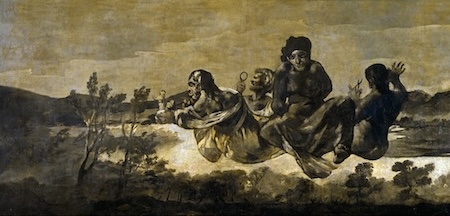
(Francisco Goya, Las Parcas: Atropos, or The Fates: Prado, Madrid)

‘Words of grief become almost meaningless in these days, they have to be used so frequently. But one does not feel any the less. Sorrows do not grow lighter because they are many.’[1]

Sitting in the kitchen, turning away from the seemingly endless and indiscriminate slaughter of civilians in Gaza and the West Bank, now extended to Lebanon, watching the rain or the gaps between the rain, I hear the Librarian coming into the kitchen, to announce another day of being baffled by the news that the American election is still ‘on a knife-edge’, the candidates ‘neck and neck’, when one of those candidates is evidently unhinged. ‘At his rallies, he just comes on and talks complete nonsense for fifty minutes.’ Similarly bewildered by this, I find it oddly reassuring that it’s not just non-Americans, looking in or on from outside, that share such feelings. Eliot Weinberger, whose devastating What I Heard About Iraq I still recall from nearly twenty years ago, summarises the matter with characteristic skill, in a piece dated 13 September:

‘It seems incredible that almost half the country still supports Trump, despite the felony convictions, the porn stars, the blatant graft, the endless lies, the allegations of assault and rape, the 6 January insurrection, the continuing refusal to accept his defeat in 2020, the classified documents in his bathroom at Mar-a-Lago, the vows to prosecute all his many enemies, including journalists, and to fire everyone in the government bureaucracy who is not loyal to him, the claims to dictatorial power. Even more incredible is that there is a slice of the voting population that is still “undecided”. Republican legislatures in various states have already set in motion procedures to keep people from voting and to deny the results if Trump loses’.[2]

There is, indeed, a report, more than one report, about highly suspect practices and preparations, changes of rules and the like, with reassuring headlines such as ‘Network of Georgia election officials strategizing to undermine 2024 result’: https://www.theguardian.com/us-news/2024/sep/18/trump-election-georgia

I know there are Americans who believe wholeheartedly that the moon landings were faked and patched together in a Hollywood back lot, while others know for a certainty that giant lizards are the true masters of the world but seeing, back in the summer, footage of men and women at political rallies with wads of fabric or nappy liners stuck to the sides of their heads was somehow in another dimension: irrefutable, painfully visible, undeniably and palpably there. A full-throttle alternative reality in operation, for sure, and believable enough that it might be swallowed by a few hundred, even a few thousand. But millions? And all in tune with what used to be a major and mainstream political party?

‘It is very extraordinary’, John Dowell reflects as he looks at the mad Nancy, ‘to see the perfect flush of health on her cheeks, to see the lustre of her coiled black hair, the poise of the head upon the neck, the grace of the white hands—and to think that it all means nothing—that it is a picture without a meaning.’[3] We are frequently confronted either by pictures that may really have no meaning—in the sense of a rational, graspable, ideally paraphrasable, meaning—or have a meaning that cannot be understood, either because we lack the necessary contextual information or because removal from the immediate experience is required, granting us distance, perspective, the means by which to find the edges, the boundaries, and thus the true extent of what we have witnessed.

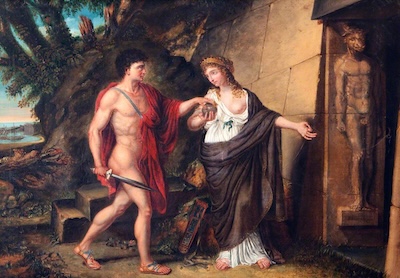
(Richard Westall, Theseus and Ariadne at the Entrance of the Labyrinth: North Lincolnshire Museums)

Edmund Blunden recalled the sight of flares on the Ypres battlefield on New Year’s Eve, 1917: ‘Their writing on the night was as the earliest scribbling of children, meaningless; they answered none of the questions with which a watcher’s eyes were painfully wide.’[4] A considerable number of people stared uncomprehendingly at the clay tablets Arthur Evans had unearthed at Knossos before the researches of Alice Kober and Michael Ventris eventually led to an understanding and decipherment of Linear B.

‘The contemporary is without meaning while it is happening’, Guy Davenport remarked, ‘it is a vortex, a whirlpool of action. It is a labyrinth.’[5] And Hugh Kenner remembered Wyndham Lewis observing that ‘The present cannot be revealed to people until it has become yesterday.’[6]

Some parts of the present, surely; and to some people. Historians will, we accept quite conventionally, see more—though in some cases, or in some senses, less. There is, after all, an increasingly clear and present danger now not only of misinformation being manufactured and widely (and rapidly) disseminated but also of witnesses being silenced (often permanently), of evidence being systematically destroyed, of commentary and analysis being censored or concealed. And yet, while it’s true that we are all in the labyrinth and that the Minotaur is real – some people, I persist in believing, still have hold of that crucial thread.


Notes

[1] Vera Brittain, Chronicle of Youth: Vera Brittain’s Diary 1913-1917 (London: Gollancz 1981), 206.

[2] Eliot Weinberger, ‘The Debate’, London Review of Books, 46, 18 (26 September 2024), 8.

[3] Ford Madox Ford, The Good Soldier: A Tale of Passion (1915; edited by Max Saunders, Oxford: Oxford University Press, 2012), 192.

[4] Edmund Blunden, Undertones of War (1928; Harmondsworth: Penguin, 1982), 234.

[5] Guy Davenport, ‘The House That Jack Built’, in The Geography of the Imagination (Boston: David R. Godine, 1997), 56.

[6] Hugh Kenner, The Pound Era (London: Faber and Faber, 1972), 436.

Changes for the worse


Strange days. Even to say so is to provoke suspicions of glimpses into the bleeding obvious. But strangeness there is, the compass broken and the maps all wrong.

Writing to Eudora Welty in July 1969, the novelist and editor William Maxwell told her of offering to let his elder daughter Kate, then fifteen, read a lot of the letters he’d received. He added: ‘And maybe I will, as a result, not be the mystery to her that my parents are to me, but more than likely it won’t change anything. It takes a great deal to change things. In a better way, I mean. To change things for the worse, all you need is somebody like Nixon, and there are plenty like him.’[1]

Watching a news programme earlier this month, I saw a clip of Nixon explaining to a bemused David Frost—unsurprisingly bemused since Nixon had no justification at all then for claiming this—that, whatever a president did, it couldn’t be illegal, by definition.

Rather more recently, of course, a stacked Supreme Court has thrust yet another blade into the guts of the republic.

 I began writing a post around the time of the British general election but was overtaken, as they say, by events. When the last results were coming in early on the Friday morning, it was clear that, after so many years of other countries viewing us with sympathy or disbelief or disdain, we had a distinct possibility of edging at least in the direction of honesty or sanity or some other unfashionable trait. The irony adhered in the fact that while we had pulled ourselves out of a ditch after a decade and half, some of those same countries seemed hellbent on hurling themselves into it. Thankfully, France has since pulled back to slightly firmer ground, though remaining unsettlingly close to the edge.

Watching the election, I flagged a little around 3 a.m. but rallied at the prospect of seeing some of the more appalling figures in the Tory ranks ditched. Some clung on but there were certainly highlights, particularly the member for North East Somerset being sent home to Nanny and seeing the shortest-serving British Prime Minister do to a 26,000 majority (2019) roughly what she’d done to the country. So, however brief or prolonged the respite it promises, that interesting Fourth of July turned out to be our Independence Day. It must have appeared a great deal less so in the United States,

Since then, a European football competition that grabbed wide attention, a botched assassination attempt on a former president of the United States, the usual murders, atrocities, coups, crises and catastrophes.


But for us, here, drowning out all that, the critical illness of an irreplaceable member of our household. Then the trips to the vet, the phone calls, the fraught conversations, the broken sleep, the agonised weighing of options. And now the weeks of ghost steps on the stairs, of puzzling shadows at the corners of your eyes, of strident silences and oddly empty spaces, because a light has gone out of our world.

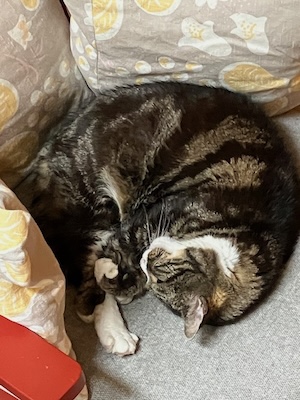
Harry the Cat has left the building.


Notes

[1] Suzanne Marrs, editor, What There Is to Say, We Have Said: The Correspondence of Eudora Welty and William Maxwell (Boston and New York: Houghton Mifflin Harcourt, 2011), 259.

Fit to stroke a cat

‘If you are ready to leave father and mother, and brother and sister, and wife and child and friends, and never see them again’, Henry Thoreau wrote, ‘– if you have paid your debts, and made your will, and settled your affairs, and are a free man – then you are ready for a walk.’[1]

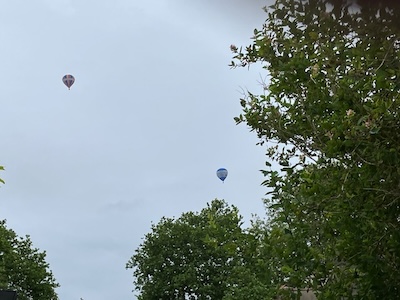
Without jettisoning all the relevant relations but also without a burdensome array of debt, I think I’m ready for a walk. A couple of mornings back, when someone all too few gardens away was learning to play ‘Johnny B. Goode’, I was a good deal readier but today, certainly at an early hour, there’s nothing louder than a blue tit close by and, further off, the occasional roar of propane burners firing as the two hot air balloons make sure that they’re well clear of the treetops in the park,

Hotter weather tends to make for weariness, certainly in those unaccustomed to it, like us in our northern temperate zone. It was hard to keep my eyes open on a recent trip down to Somerset by train, though driving probably wouldn’t have been much better (and a damned sight more hazardous). Judith Stinton once quoted Theodore Powys on motors and motoring: ‘A Journey in a motor car is the most tiring experience in the world . . . When I am tired all I feel fit to do is to stroke a cat’.[2] That I can do.

On that theme of tiredness: we have a General Election looming, its imminence evident from the increasingly desperate headlines in the right-wing press, as Jonn Elledge has noted:
https://www.newstatesman.com/politics/2024/06/the-tory-media-has-gone-into-meltdown


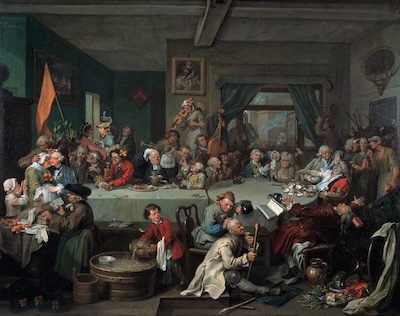
(William Hogarth, ‘An Election: 1. The Entertainment’: Sir John Soane’s Museums)

There’s a fairly general consensus that the present administration has failed utterly to honour the contract assumed to exist between government and governed, having trashed the public realm, lavished huge sums on the few at the expense of the many, and repeatedly attacked, dismantled or disparaged precisely those elements that distinguish a civilised society. Given the damage done and the importance of the contest, it seems a little strange that so much of the campaigning is so muffled – this is because neither of the two main parties can afford to be honest about the true state of the nation and what is needed even to begin to repair it. A while back, the – Tory – politician Rory Stewart, trying to define a picture of the country, came up with: ‘An economy 80 per cent based on elusive intangible services; buoyed by an improbable housing bubble, and entirely dependent for its health and care on immigrants, whom citizens seemed to wish to exclude.’[3] Not much has changed, unless for the worse. Yet with all that said, we are still in comparatively privileged conditions. It’s painfully obvious from the international news that a good many people, in several countries, some of them particularly surprising cases, have decided that fascism—which we thought a world war was largely fought to defeat—did not, after all, have a fair crack of the whip and deserves another go. Those people are doing their best, under various names and flags and guises, to give it that go now. And again, despite some disturbing recent domestic moves against democratic freedoms and the right to protest, we are still extremely unlikely in this country to be beaten, tortured or shot on account of being—or despite being—a medical professional, a journalist, a hospital patient, a poet, a photographer, a peace activist,  a woman, a child, or simply someone of the wrong racial character.

(‘After such knowledge, what forgiveness?’ T. S. Eliot asked in another context.[4] To which the most probable answer is: ‘none’.)

To avoid the danger of overdosing on the pleasures of current affairs, I’m taking refuge in the extremely relaxing early eighteenth century when ‘[s]tealing anything worth more than a shilling carried the death penalty’ but, on the other hand, ‘It took only four days to go from London to York or to Exeter by stagecoach.’[5] 

Those were the days. . .


Notes

[1] Henry Thoreau, ‘Walking’ (1862), in The Portable Thoreau, edited by Carl Bode (Harmondsworth: Penguin Books, 1979), 593. Emerson’s 1862 eulogy, ‘Thoreau’, included the observation that: ‘The length of his walks uniformly made the length of his writing. If shut up in the house he did not write at all.’ Ralph Waldo Emerson, Selected Essays, edited by Larzer Ziff (Harmondsworth: Penguin Books, 1982), 400.

[2] Judith Stinton, Chaldon Herring: Writers in a Dorset Landscape (Norwich: Black Dog Books, 2004), 41.

[3] Rory Stewart, Politics on the Edge: A Memoir from Within (London: Jonathan Cape, 2023), 360.

[4] T. S. Eliot, ‘Gerontion’.

[5] A ‘torrent of legislation’ after the Glorious Revolution of 1688 ‘raised the number of capital crimes from about fifty to over 200 by the turn of the nineteenth century.’ Lucy Moore, The Thieves’ Opera: The Remarkable Lives and Deaths of Jonathan Wild, Thief-Taker, and Jack Sheppard, House-Breaker (London: Penguin Books), 1998), ix, 188, 137.

Local elections and watching for dragons


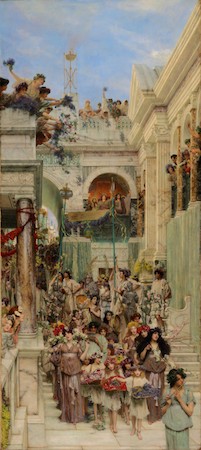
(Lawrence Alma-Tadema, Spring: J. Paul Getty Museum)

Mayday, m’aider. I think, without counting pages to an absurd degree, that 1 May, along with 1 January, is only exceeded by 25 December in the extent of its coverage in The Oxford Companion to the Year, which mentions at the outset the sacrifice of a pregnant sow by the priest of Vulcan to Maia (a goddess of growth).[1] My ageing dictionary offers for Mayday ‘given to sports and to socialist and labour demonstrations’. There was such a time, I think, and the change has not been for the better. This particular Mayday, we have continuing wars and war crimes, failing states, thuggish cops violently assaulting and arresting students and faculty on several American campuses.

But here – we have local elections! Yes, one-sixth of England’s district, borough and unitary councils will hold elections tomorrow, Thursday, 2 May: 2,636 council seats to be contested in the 107 (out of 317) scheduled council elections and 48 by-elections, plus elections for 10 metro mayors, as well as police commissioners and members of the London Assembly. Our ward is in one of the 107: two councillors to be elected and the only candidates standing who contested it that last time around are the incumbents, both Green Party councillors.

We’ve been constantly reminded, of course, that this is the Year of Elections. More than 60 countries and directly affecting almost half of the world’s population. From India and the United States to Indonesia, Mexico, Iceland and Sri Lanka. It would be pleasant to view the prospect positively or even with equanimity, but it’s just too much of a stretch. Many of the countries going to the polls are not even democracies in any meaningful sense. Not that democracy is a perfect political system—if it were, there would be fewer psychopathic thugs, undisguised crooks and congenital liars in positions of power—it’s just that all the other systems are worse.

In the UK, we expect a General Election too and, around the country, people—especially those who follow politics closely—are able to indulge in the parlour game that consists of trying to identify a single sector or section of British social, cultural and economic life that the present government, in its fourteen-year tenure, has not destroyed, diminished, degraded or damaged beyond repair or recovery. Among the candidates are the health service, universities, schools, rivers and coastal waters, housing, freedom of speech, crime, social care, railways, roads, parks, the tax system, the legal profession, pedestrian thoroughfares, prisons, immigration, foreign policy, poverty, doctors, dentists, childcare, homelessness, domestic violence, the rental sector, defence, the climate emergency, the right to protest, sexual harassment in and out of the House of Commons. Answers on a polling card, please. . . 


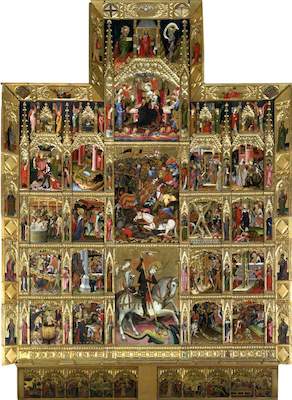
(Altarpiece of St George, Attributed to Andrés Marçal de Sas, active 1393–c.1410: Victoria and Albert Museum)

Still, as Sarah Churchwell, observed, a few years back: ‘Because most people spend little time analysing political events or studying history, democracy will always risk being shaped by voters’ feelings rather than analysis.’[2] A risk, yes, but there are points in any country’s history when the two converge, in some species of agreement: informed analysis of the last decade and a half in the United Kingdom will identify decline, dissension, worsening social and economic conditions for the majority of its citizens, while a wide-ranging survey of voters’ feelings will find an immense tiredness, if not exhaustion, in a nation where everything now is broken and nothing works – unless, as ever, you are filthy rich.


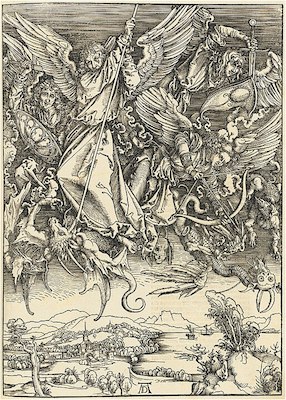
(Albrecht Dürer, St Michael Fighting the Dragon)

Churchwell wrote in another book that: ‘Mythical histories lay the groundwork for fascist politics.’[3] Also true, increasingly evident in many countries around the world, including some of the most vaunted ‘democracies’, a few of them uncomfortably close. It was briefly illuminated (through a glass, darkly) by some of the clamorous noise around 23 April, St George’s Day, the patron saint of England, though ‘very little is known of him and his very existence is often doubted’.[4] If he did exist, he may have been born in Cappadocia, may have died in Palestine and never came near England. Still, he’s the patron saint of at least fifteen countries, states and major cities around the world. And, of course, there’s the matter of that dragon, a story added centuries later. Something may have happened somewhere in Libya, it seems.

‘Before Dürer’, Philip Hoare wrote, ‘dragons existed; after him, they did not. We were left with only the dragons of our unconscious, as Carl Jung would say.’[5] Even more on topic, one might say, is Nicolas Mosley’s comment about his father, Oswald Mosley: ‘But heroes continue not to see the dragons that are in themselves.’[6]

While the local elections may not accurately predict the winners in the various constituencies in the coming General Election, they will, I think, correctly identify the losers.


Notes

[1] Bonnie Blackburn and Leofranc Holford-Strevens, The Oxford Companion to the Year (Oxford: Oxford University Press, 1999), 183.

[2] Behold, America: A History of America First and the American Dream (London: Bloomsbury Publishing, 2018), 215.

[3] The Wrath to Come: Gone With the Wind and the Lies America Tells (London: Head of Zeus, 2022), 352.

[4] The Oxford Companion to the Year, 166.

[5] Philip Hoare, Albert & the Whale (London: 4th Estate, 2021), 11.

[6] Nicholas Mosley, Rules of the Game; Beyond the Pale: Memoirs of Sir Oswald Mosley and Family (London: Pimlico, 1994), 116.

Out, brief candles

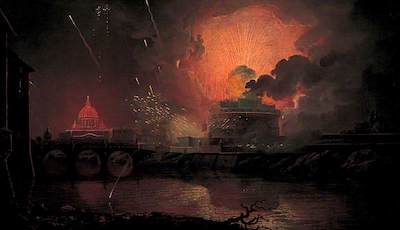
(Joseph Wright of Derby, Firework Display at Castel Sant’Angelo: Birmingham Museums Trust)

Walking to the Victorian cemetery, we pass a spent rocket on the pavement. I thought briefly of Mr Leopold Bloom on Sandymount shore, Gerty MacDowell leaning far, far back to watch the fireworks in the night sky and the, ah, stimulated Mr Bloom having to recompose ‘with careful hand’ his wet shirt. ‘My fireworks. Up like a rocket, down like a stick.’[1] The morning after Guy Fawkes’ Night: on the previous evening, we travelled the one hundred and twenty metres to a bonfire in the park. ‘People’, the Librarian reminded me, ‘you’re among people.’ True enough. Several hundred of them, in fact. But it was all in the open air and the only physical contact with a stranger was with the large dog that took a liking to my right leg. Positioned painfully near two young males of the species, the Librarian remarked that ‘boys are horrible’. I know, I said, I used to be one. After a slow start, the flames took a firm hold, climbed, threw glowing embers high into the air. Guy Fawkes. Of course, the effigies burned on the fires used to represent the Pope or various prominent Catholics, while, half a century before Mr Fawkes’ indiscretion, Mary Tudor, Bloody Mary, devoted a fair bit of energy, in her five-year rule as Queen of England, to the immolation of Protestants. One of the Oxford martyrs burnt at the stake in 1555, Hugh Latimer, is supposed to have said to another, Nicholas Ridley (the third was Thomas Cranmer, Archbishop of Canterbury): ‘Be of good comfort, and play the man, Master Ridley; we shall this day light such a candle, by God’s grace, in England, as I trust shall never be put out.’ 

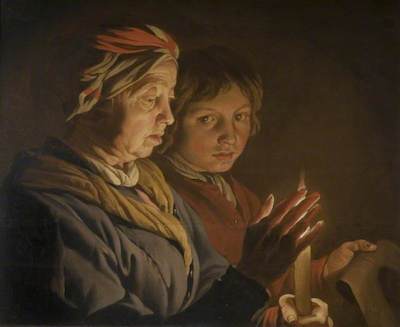
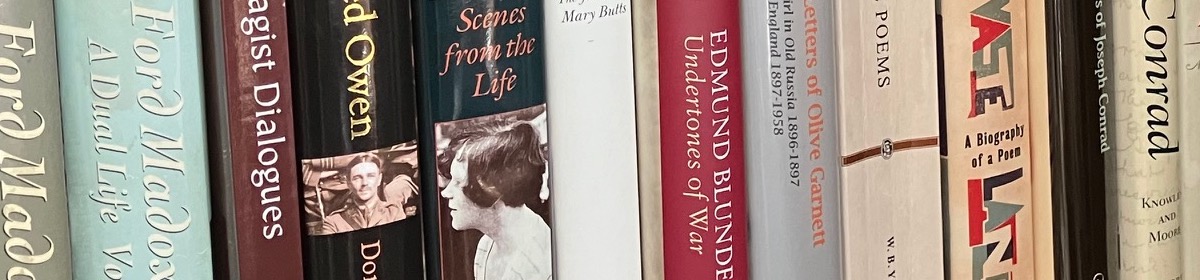
Candles, ah, literary candles: Wilfred Owen, D. H. Lawrence, Virginia Woolf, Aldous Huxley, Josephine Tey, Ford Madox Ford. . .

(Matthias Stom, An Old Woman and a Boy by Candlelight: Birmingham Museums Trust)

‘Do you happen to know Haydn’s symphony? . . . It is a piece that begins with a full orchestra, each player having beside him a candle to light his score. They play that delicate, cheerful-regretful music of an eighteenth century that was already certain of its doom. . . As they play on the contrabassist takes his candle and on tiptoe steals out of the orchestra; then the flautist takes his candle and steals away . . . .The music goes on—and the drum is gone, and the bassoon . . . and the hautbois, and the second . . . violin. . . . Then they are all gone and it is dark. . . .’[2]

Well, yes. ‘For it is not unusual in human beings who have witnessed the sack of a city or the falling to pieces of a people, to desire to set down what they have witnessed for the benefit of unknown heirs or of generations infinitely remote; or, if you please, just to get the sight out of their heads.’[3]

Ford wrote that even before the outbreak of the First World War, long before our current malaise, with—on bad days—its irrefutably apocalyptic tinge. Still, on a later occasion, there’s this: ‘But I couldn’t keep on writing. I was obsessed with the idea of a country, patrie, republic, body politic, call it what you will[ . . .] Yes: I had a vision of a country.’[4]

It is often, to be sure, hard to keep on writing. Still – a vision of a country. Some people look back in search of it, others look forward, while a good many others clearly don’t care or, contrary to that Dylan song, really do need a weatherman to know which way the wind blows. Emerging reluctantly from the fictional worlds of P. G. Wodehouse and Kate Atkinson,[5] I find the political landscape essentially unchanged. (I’m reminded that one of Atkinson’s Jackson Brodie novels is called When Will There Be Good News? No answer is required, as they say.) Perhaps, after the destructive antics of Boris Johnson and the deranged flurry of Liz Truss, some hard-pressed members of the public—even members of the so-called Conservative party—experienced a fleeting frisson of relief that there was now an unelected, right-wing multimillionaire in 10 Downing Street, poised to announce massive cuts in public spending. But in any case he fell at the first hurdle, with his appalling cabinet appointments or reappointments, squandering his one clear chance in sordid little deals; then at the second hurdle of the climate emergency, the subsequent scuffles and scrambles all profoundly unconvincing.

It’s odd that so many of the people who recur obsessively to the Second World War and the defeat of Nazism now seem not to notice or to care that countries long held up as beacons of freedom and democracy are a heartbeat away from – what’s the current phrase, ‘post-fascism’? Leaving aside the worrying recent developments in Sweden, Italy and Israel, the United States is clearly at a crisis point, on the verge of knowing for sure whether or not its two hundred and fifty year old experiment with democracy has effectively ended. Here, the Home Secretary – a scandalous appointment, then a more scandalous reappointment – channels the sort of malignant rhetoric which refugees from Hitler’s regime would find only too familiar, while the Public Order Bill, designed to limit the right to protest to such an extent that it’s effectively removed altogether, might, with trifling revisions in wording, sit quite happily in the legislative registers of China, Iran or Putin’s Russia.

Ah well. If there was settled weather for a while, it is changed and changing now, for sure. As they have it in the Scottish play:

Banquo: It will be rain tonight.
First Murderer: Let it come down.
(They fall upon Banquo)


Notes

[1] James Joyce, Ulysses (1922; London: The Bodley Head, revised edition, 1969), 482, 483.

[2] Ford Madox Ford, Provence (London: Allen & Unwin, 1938), 261.

[3] Ford Madox Ford, The Good Soldier: A Tale of Passion (1915; edited by Max Saunders, Oxford: Oxford University Press, 2012), 12.

[4] Ford Madox Ford, No Enemy (1929; edited by Paul Skinner Manchester: Carcanet Press, 2002), 132.

[5] Kate Atkinson’s long novel, Life After Life (London: Transworld, 2014), is centrally concerned with bearing witness, as several characters—and the author herself—make clear: Ursula (472), Miss Woolf (457-458), ‘Author Note’ (618).

Passing by – or bypassing

(Unknown Artist, Two Figures Roll Out a Scroll of Paper with a Landscape Design on It, Watched by a Third: Wellcome Collection)

‘Any good news?’
‘There’s a goldfinch singing in the tree in the garden.’
‘Any bad news?’
(Unrolling forty-foot long scroll): ‘Where should I begin?’

A weird couple of weeks, my daughter’s text read. You might well say so. A new monarch and a new Prime Minister. Mutterings, stray black ties, then confirmation that London Bridge had, indeed, fallen. Some things since then, I gather, have gone extremely well, as smoothly as many years of rehearsals and preparations and a large wad of public money could make them; others seem be going extraordinarily badly. It was sobering, for instance, to hear of people threatened with arrest for being in charge of blank sheets of paper, not so long after British expressions of outrage and disbelief at the same phenomenon on the streets of Putin’s Moscow. By degrees, quite reasonable displays of decorum and respect began lapsing into absurdity: the often excruciating media coverage was predictable, perhaps less so some of the cancellations and closures: football matches, kids’ fun runs, bicycle racks, condom vending machines, guinea pig awareness week. . .

Since then, we’ve had the unedifying spectacle of a government clearly in hock to the fossil fuel industry, now augmented by the reckless vandalism proposed, first, by the latest Secretary of State for Business, Energy and Industrial Strategy, perhaps the most preposterous appointment in an era notorious for such appointments; second, a frankly disgusting mini-budget, focused solely on shovelling yet more money into the hands of those already stinking of the stuff. Never fear, the proles will pay. And their progeny, of course, unto the second or third generation.

The weather has changed, most evidently the early mornings: Harry the cat exchanging the briefest of greetings with the outside air before drifting back upstairs to the bedroom while I pull the back door discreetly shut; and the butter harder to spread. I note with just a touch of disquiet that the next Nicolas Freeling book I shall read—and here a footnote to ‘good news’, three Van der Valk novels in the nice green Penguin jackets—is titled Gun before Butter.


And there was The Queue. I read that a quarter of a million people chose to queue for many hours to pass the Queen’s coffin. Millions more watched the television for hours, although at least as many millions, probably more, got on with their lives in various other ways. As for The Queue: I’ve read explanations of the several credible reasons for people being there but, though Elizabeth II had been on the throne for almost the whole of my life and my mother died at much the same age as the Queen, the one never reminded me of the other (nor was there any grandmotherly resemblance) and I feel no need for a version of ‘something larger than myself’ that involves a huge crowd – the sight of one, even on a screen, still brings me out in a rash. And I am, anyway, I suppose, of the sizeable constituency that admired and respected the late Queen for the way she fulfilled her role while believing that the role itself was past its sell-by date and that this should really be the juncture at which the whole issue is debated, from the ground up (especially from the ground up). But I suspect that substantial elements of the country are neither willing nor able to engage with such matters.

In the Victorian cemetery where we walk, we skirted a wedding in full swing when we were there a while ago, a mass of people on the steps of the building, anyway: cameras, hats, smart clothes, excited chatter. A little earlier on that same afternoon, a funeral had, I think, just finished. We were passing what seemed to be the aftermath of a wake, two or three staff in the late stages of tidying the outdoor venue, sweeping up, rearranging tables and benches. And that near-miss was probably funeral enough for me for a while.

I was, I recall, rather more exercised by the possibility that I’d confused, at some stage, Norman MacColl, editor of the Athenaeum, with Dugald Sutherland MacColl, painter, critic and Keeper of prestigious galleries (the Tate and the Wallace Collection), but also wanting to check on that other connection between moonrise and ‘Henri Beyle who wrote as Stendhal’. Was I in fact thinking of Stonehenge in another context? Fairly specialised concerns, to be sure, but then a lot of people have interests that would fall under that heading for a majority of passers-by.

That’s the crucial point about passers-by, of course. They pass by. As do I, in a great many circumstances, as do I.

Striding, gliding, sliding into autumn

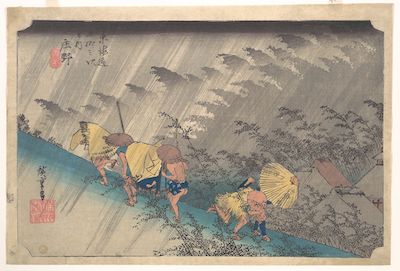
(Utagawa Hiroshige, Sudden Shower at Shōno: Metropolitan Museum of Art)

‘She can’t be completely stupid’, the Librarian says, in a rare moment of optimism, ‘she went to Oxford.’ And for a moment I almost wish I could find in that a good knockdown argument. Alas.

The heat, which changed many individual patterns of behaviour, was succeeded by several days of rain, which didn’t, and then by something balanced, pleasant, relaxing – or it would have been had the workmen in the neighbouring house, who have been there for months now, not chosen one morning to drill directly into my head. They showed too a remarkable willingness to persist, to graft, I suppose, thus refuting the latest reports of the witless witterings of—good grief!—the odds-on favourite for the leadership of the Conservative Party and thus, under our generally nineteenth-century political arrangements, Prime Minister of the United Kingdom of Great Britain and Northern Ireland.

Upstairs—and sometimes downstairs too—I bother archivists, occasionally in this country but far more often in the United States. The happy result of this is that, even as I pour a drink in the evening, goods news sometimes arrives from the Midwest or the west coast. An archivist has unearthed a previously unlisted letter from Ford Madox Ford to a publisher, a literary agent, a New York hostess, a budding author. I scrawl a message of heartfelt gratitude. Librarians and archivists may yet save the world.

Downstairs, I linger over Robert Lowell, Lafcadio Hearn and Mary Midgley. Dear Cal is of course his usual unfailingly cheerful self and emphatically not a daddy’s boy. ‘He was a man who treated even himself with the caution and uncertainty of one who has forgotten a name, in this case, his own.’[1] Hearn shuns the usual ragbag of common sense and scepticism by numbers: ‘I hold that the Impossible bears a much closer relation to fact than does most of what we call the real and the commonplace.’[2]

And Mary Midgley—I remember, a few years back, seeing an interview with, or brief statement from, the Green Party Brighton MP Caroline Lucas and Sophie Walker, then leader of the Women’s Equality Party. I found myself thinking, quite explicitly, My God! If we had people like that in charge of this country, there might be some hope. It wouldn’t be the complete bloody basket-case it is. Mary Midgley was a person like that: hugely intelligent, well-informed, intellectually curious. I read her memoir because my curiosity was piqued by the highly enjoyable volume by Benjamin Lipscomb, The Women Are Up To Something: How Elizabeth Anscombe, Philippa Foot, Mary Midgley, and Iris Murdoch Revolutionized Ethics (New York: Oxford University Press, 2022),[3] one of those valuable books which, like those of the wonderful Sarah Bakewell, are able to convince me—at least while I’m reading them—that I understand philosophy.


Midgley discusses, at one point, the idea that thought, like life, occurs in complex patterns, linked together, which have to be sorted out and dealt with on their merits. ‘This does not mean that our work is impossibly complicated. It does not mean that we cannot know anything until we know everything. Human cultures contain all sorts of convenient ways of breaking up the world into manageable handfuls and dealing with one part at a time. And we can keep continuously developing these ways so that they can correct one another. In this way, quite a lot of the time we do get things right. Attending to the background pattern of questions and answers does not tip us into a helpless relativism. But it is perfectly true that this approach does stop us hoping for a universal scientific formula underlying all thought. We cannot, as Descartes hoped, find a single path to infallible certainty. But then luckily we do not need to.’

Indeed. I confess, though, that one of my favourite moments in the book is an account of a discussion group which included Carmen Blacker, later a distinguished Japanese scholar. ‘It was Carmen who supplied me with the best example I have ever met of the diversity of moral views. When I raised the topic of conflicting customs, “Oh, I see”, she said. “Like, there’s a verb in classical Japanese which means to try out one’s new sword on a chance wayfarer?”’ Midgley later used this in an article with that name.[4]

Light rain, the faintest murmuring, and a soft soughing in the branches and leaves above the fence. Harry the cat is crouched at the open back door, snuffing up late August early evening English air. He has noticed, I think, that my method of serving his teatime bowl approximates more and more to that of Henry James’s butler, as recalled by Ford Madox Ford:

‘His methods of delivery were startling. He seemed to produce silver entrée dishes from his coat-tails, wave them circularly in the air and arrest them within an inch of your top waistcoat button. At each such presentation James would exclaim with cold distaste: “I have told you not to do that!” and the butler would retire to stand before the considerable array of plate that decorated the sideboard.’[5]

We are sliding into autumn. There is an acknowledged cost-of-living crisis. But then, come to that, there is a crisis in every area of public life, from education to social care, from farming to transport, from library provision to news media to the raw sewage fouling our coastal waters. Given our current electoral system, there’s little we can do at present: turn down the heating a degree or two, hope for a mild winter—and do our level best to resist trying out new swords on chance wayfarers.


Notes

[1] Robert Lowell, Memoirs, edited with a preface by Steven Gould Axelrod and Grzegorz Kosc (Faber & Faber 2022), 18.

[2] Lafcadio Hearn, ‘The Eternal Haunter’, in Japanese Ghost Stories, edited by Paul Murray (London: Penguin Books, 2019), 33.

[3] Benjamin J. B. Lipscomb, The Women Are Up To Something: How Elizabeth Anscombe, Philippa Foot, Mary Midgley, and Iris Murdoch Revolutionized Ethics (New York: Oxford University Press, 2022).

[4] Mary Midgley, The Owl of Minerva: A Memoir (London: Routledge, 2007), 72, 160.

[5] Ford Madox Ford, Return to Yesterday (London: Gollancz, 1931), 14.

Walking early, falling surely


We are walking early to avoid the heat – not ‘The game is afoot! Into your clothes and come!’ early; and not recent Southern European heat –we’re talking, rather, of very warm English days and returning at more or less the time scheduled for the cat’s morning snack (not breakfast: that’s a separate issue).

Already, in the smallish park en route to the cemetery, there are people with dogs, plus a few without dogs and occasionally those displaying neither dogs nor signs of motion. They sit or lie on the grass and don’t move at all. Perhaps they are hoping that history—especially rancid and rancorous of late—will pass them by.

News from Ukraine and the United States, and such features as the interview with the admirable Maria Alyokhina, may put this country’s constant troubles and relentless decline into perspective but those troubles are serious enough.

https://www.theguardian.com/world/2022/jul/11/pussy-riot-maria-alyokhina-putin-crimes-hitler-years-of-resistance

At present the news media—predominantly right-wing in the UK—is convulsed by another struggle for the Conservative Party leadership. Because the only required quality in senior government ministers was unquestioning agreement with Boris Johnson, there is, unsurprisingly, little evidence of talent, ability or intellectual strength among the candidates. There are, indeed, only variations in unpleasantness. Though a surprising number of Tories have suddenly discovered ‘integrity’ in the past week or two – how to pronounce it rather than how to practise it – all these Prime Ministerial hopefuls agree that trafficking refugees to Rwanda, or some other country with a dubious record on human rights, is a damned fine idea. Then, too, most of them beat the familiar drum of delusional tax cuts, confident that the unreflecting will go no further than recognising this too as a damned fine idea. To those of us who’ve noticed the collapse in public services and recognise the reasons for that collapse—and who remember the recent history of Britain’s railway system and its energy sector—it’s a little less fine.

Refugees, immigration, the right to protest, voter suppression, public services, education, climate emergency: in a country that had not lost its senses, people like these with the views they have on such issues would simply and rightly be regarded as reprehensible individuals. As it is, one of them will soon become Prime Minister of this country, backed by a vote of well under 1% of its population. 

Still, I’ve begun reading the estimable Sarah Churchwell’s The Wrath to Come: Gone With the Wind and the Lies America Tells – which will educate me but not, I suspect, cheer me up that much. One of its central questions, ‘What the hell happened to America?’, I’ve voiced myself, though not as often as I’ve applied the same question to my own country.


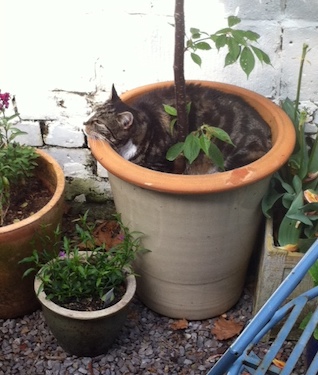
Deceptively, the sky is a pure, untroubled blue (or rather, troubled only by the repeated aircraft trails). The parasol is up; butterflies and bees are busy about their daily dealings. The  hammering of workmen pauses every so often to allow for the solo wails of ambulance sirens. But a little later, quiet is restored, the makings of a simple dinner – and the birthday champagne – are in the fridge, the cat is settled in a large earthenware pot in the garden. All is right, you might say, with the world – always excepting a significant number of the people in it and the damage they do.

Á votre santé!

Pouring a drink for Cassandra


‘Did you say something?’ the Librarian asked as the forty-fifth runner in the space of a couple of hundred metres passed us, panting infectiously. I said I might have briefly referred to the runner but wasn’t aware of having said it aloud. ‘Yes’, she said, ‘I thought it was one of the sounds you make.’

One of the sounds. We were out for lunch—‘Here we go, out into the world’, said the Librarian, who is prone to doing that sort of thing, the front door gaping as we stepped onto the pavement. Along the park’s lower path, under the railway bridge, over the river, up between the flats, through the grounds of St Mary Redcliffe, where Samuel Taylor Coleridge married and Thomas Chatterton turned up some likely manuscripts, across the hill and up to the high road from which steps cut down to the harbourside, another footbridge, then along by the river for a mile, dodging runners, watching the paddleboarders, the dogs, the photographers, then on to the Underfall Yard, the patent slipway presently unoccupied.

Lunch. I recalled Patrick White relating, in a letter to Ninette Dutton, his attendance at a lunch given by James Fairfax for ‘the visiting American millionaires’. ‘Madame Du Val cooked the lunch. Most unwisely they chose to give us omelettes. I went into the kitchen afterwards to see her and she said, “I’m fucked!” She looked it too, after eighty omelettes. I said I was fucked after one; I find cooking an omelette a highly emotional experience. Some of the elderly maids standing around seemed rather shocked.’[1]

You don’t need to be an elderly maid to feel shocked, if not surprised, just lately. And going out to lunch was quite a while back now, with half a dozen or more blog posts begun and abandoned or left for dead since then. ‘The world is too much with us’, William Wordsworth observed, not in 1802 burdened with appalling news (let alone social media) but more concerned with that ‘getting and spending’ which lays waste our powers and blinds us to the natural world and our connection to it: ‘We have given our hearts away, a sordid boon!’[2]

Writing to a couple of archivists, always in search of Fordian letters, I can’t quite bring myself to wish them a happy Independence Day, in case they suspect me of blackest humour.  Independence from the tea-swilling Britishers two and a half centuries back, but not now from their own religious and political extremists. It might be no more welcome than an American congratulating me on the fantasy glories of Brexit and the election of a government clearly intent on removing my democratic rights and safeguards.

The sense of threat from America’s gigantic lurch back into the dark feels very real: oddly, it might seem, given that I’m white, male, of an older generation, not gay – and not in the United States. But recent developments are an attack on humane and civilized values: the threat is not, or will not for long be, confined to the obvious targets. That discredited supreme court may be ‘over there’, but those who make reassuring noises about how it can’t happen in our Disunited Kingdom are dangerously naïve – or just dangerous. We too have our fair share of religious zealots, miscellaneous lunatics and neofascists and, while many Americans no doubt thought It Can’t Happen Here, it has happened there or is happening there.

Advice of the day: think of the worst that could reasonably be expected to happen then double it. More. Invite Cassandra round, pour her a drink and listen to what she has to say. If she says: ‘O dark, dark, dark. They all go into the dark’ or if she mentions ‘end of days’– listen closely.

‘I was wrong to forget’, Marguerite Yourcenar has her emperor Hadrian say, ‘that in any combat between fanaticism and common sense the latter has rarely the upper hand.’[3]


Notes

[1] Patrick White, letter of 13 April 1975, Letters, edited by David Marr (London: Jonathan Cape, 1994), 455.

[2] Wordsworth, ‘The world is too much with us’, 1802 sonnet in William Wordsworth, edited by Stephen Gill (Oxford: Oxford University Press, 2012), 237.

[3] Marguerite Yourcenar, The Memoirs of Hadrian, translated by Grace Frick, with Yourcenar (1951; Penguin Books, 2000), 198.

Bowling mangel-wurzels across the lawn

(James Eckford Lauder, The Parable of Forgiveness: Walker Art Gallery, National Museums Liverpool)

‘It was Janet’s view’, Elspeth Barker wrote of her stubbornly individual young heroine, ‘that forgetting was the only possible way of forgiving. She did not believe in forgiveness; the word had no meaning.’[1] Janet has, you might say, a lot to put up with – and the Calvinist harangues of Mr McConochie are hardly designed to stimulate the more generous Christian virtues in the bosoms of his flock. Still, other approaches are, as they say, available.

‘After such knowledge, what forgiveness?’, T. S. Eliot wrote.[2] It’s a question that’s cropped up several times in the news just lately. In Ukraine, unsurprisingly, they ask if they can ever forgive Russia, though that question often focuses more specifically on Putin. Some Russians are themselves wondering whether they can ever forgive their President for what he has done to their country, its neighbours, its standing in the world. In England, many of the relatives of those who died in hospitals and care homes in the earlier stages of the Covid-19 pandemic, unvisited, isolated from their families because of the rules made by a government that itself habitually failed to keep them, have stated that they will not forgive the man ultimately responsible for the whole lethal mess: the Prime Minister.

Forgiveness can also be given, or withheld, on a rather smaller scale. Of their gardener—until the family moved to another house—Henry Green wrote: ‘Poole, so they say, could never forgive my mother when soon after marriage she made him bowl mangel wurzels across one lawn for her to shoot at.’[3] Smaller or more frequent, up to that final point, as Ali Smith observed: ‘many things get forgiven in the course of a life: nothing is finished or unchangeable except death and even death will bend a little if what you tell of it is told right’.[4]

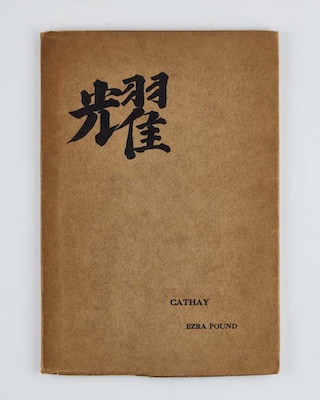
The news at the moment—none of it good—is of large events on a large canvas. But those events, whatever their size and nature, began elsewhere: in a room, in a bed, on a screen, in a garden, in a bar, in a grave. The direction of travel may vary. In Ezra Pound’s Confucius, he has this:

The men of old wanting to clarify and diffuse throughout the empire that light which comes from looking straight into the heart and then acting, first set up good government in their own states; wanting good government in their states, they first established order in their own families; wanting order in the home, they first disciplined themselves; desiring self-discipline, they rectified their own hearts; and wanting to rectify their hearts, they sought precise verbal definitions of their inarticulate thoughts [the tones given off by the heart]; wishing to attain precise verbal definitions, they set to extend their knowledge to the utmost. This completion of knowledge is rooted in sorting things into organic categories.[5]

In the bath with Elizabeth Bowen (so to speak), I read about Jefferies listening to Jameson as he declaims about the New Jerusalem to the aunt and the young mother, as they wait for the young husband who will not, perhaps, come home. ‘After all, it all came back to this – individual outlook; the emotional factors of environment; houses that were homes; living-rooms; people going out and coming in again; people not coming in; other people waiting for them in rooms that were little guarded squares of light walled in carefully against the hungry darkness, the ultimately all-devouring darkness. After all, here was the stage of every drama.’[6]

Walking briefly on the main road before turning off again into quieter places, at seven o’clock in the morning, I watch car after car go by, each containing one person, and am reminded of the final question that the New Statesman asks of its interviewee on the Q & A page each week: ‘Are we all doomed?’ The answers are sometimes considered, sometimes flippant. Here, now, the world presents itself as a peculiar version of, say, a golf course produced by a team of deranged designers or architects: they create some hazards, to make the course a little more difficult or challenging or exciting or unpredictable – bunkers, some cunning slopes, water (ideally a lake deep enough to drown in), a few awkward corners where many players will slice or hook into undergrowth or trees. Then they take away all those smooth greens and fairways, leaving only the hazards. No, wait, they put back a couple of greens and call them, what, foreign holidays or television streaming services or barbecues on somebody’s terrace. Then tee off. Fore! Playing is, of course, mandatory. As Pascal didn’t quite say: you must bet; you are in the game. But you might get lucky. So – you have to ask yourself – do you feel lucky? Well, do you?[7]

(Charles Lees, ‘A Golf Match’: National Galleries of Scotland, Scottish National Portrait Gallery)

It’s often, as they say, relative. The conduct of the present English government generally disgusts me – but I live in a wealthy country which is privileged by position, climate, history and the rest. So I hold the country and its government to high standards, with correspondingly high expectations of liberal, enlightened, equitable governance – and they fall woefully short. By almost every measure of a civilized nation, the current state of the country is a disgrace. Yet I’m still hugely – relatively – lucky by many measures. I would far rather be here, an angry and disappointed Englishman, than in a score of countries that come only too swiftly to mind, where having the wrong religion, skin colour, racial heritage or gender can all too easily leave you dead in a ditch.

‘Darknesse and light divide the course of time’, Sir Thomas Browne wrote, ‘and oblivion shares with memory a great part even of our living beings; we slightly remember our felicities, and the smartest stroaks of affliction leave but short smart upon us.’[8] I don’t know. We have machines and social media to help us remember our grievances now and those strokes of affliction leave long-lasting scars, while slightly remembered felicities probably reside on Instagram or crop up as random and unprompted ‘memories’.

‘The uncritical mind is a prey to credulity’, Guy Davenport commented, ‘and without skepticism there can be no democracy.’[9] Yes, there’s that, the gullibility which people seem oddly reluctant to admit to, retrospectively. But there comes a point, certainly in those countries that have any pretensions to a democratic system, when voters can no longer claim ignorance since they know now the nature of the ones they opted for last time. And it comes to this, that huge numbers of citizens, in many countries, say, in effect: yes, these people are corrupt, hypocritical, untruthful bastards but we’re giving them our support, so they can continue to wage war against democratic freedoms or public services or immigrants or women or universities or the poor. . .

After such knowledge, what forgiveness?


Notes

[1] Elspeth Barker, O Caledonia (London: Weidenfeld & Nicolson, 2021), 116.

[2] T. S. Eliot, ‘Gerontion’, The Poems of T. S. Eliot. Volume I: Collected and Uncollected Poems, edited by Christopher Ricks and Jim McCue (London: Faber & Faber, 2015), 32.

[3] Henry Green, Pack My Bag: A Self-Portrait (1940; London: The Hogarth Press, 1992), 3.

[4] Ali Smith, How to be both (London: Hamish Hamilton, 2014), 95.

[5] Ezra Pound, Confucius. The Unwobbling Pivot; The Great Digest; The Analects (New York: New Directions, 1969), 29-31.

[6] Elizabeth Bowen, ‘Human Habitation’, in The Collected Stories of Elizabeth Bowen, with an introduction by Angus Wilson (London: Vintage, 1999), 166.

[7] Blaise Pascal, Pensées and Other Writings, translated by Honor Levi (Oxford: Oxford University Press, 2008), 154; as rendered, or polished, by John Fowles, in The Aristos (London: Pan Books, 1968), 220.

[8] Sir Thomas Browne, Hydriotaphia, or Urn-Buriall, in Selected Writings, edited by Geoffrey Keynes (London: Faber  and Faber, 1970), 152.

[9] Guy Davenport, ‘Wheel Ruts’, in The Hunter Gracchus and Other Papers on Literature and Art (Washington: Counterpoint, 1996), 133.