Grackles, clouds, popes

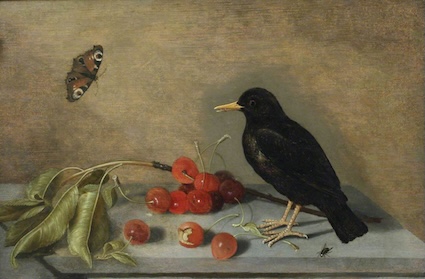
(Ambrosius Bosschaert the Younger, A Blackbird, Butterfly and Cherries: National Trust, Ham House)

04:30 and the blackbird already in full song. Not conducive to much further sleep but fine music. The same bird or a different one has several times come down to pick up grubs from pots ranged against the walls. Writing of the disappearances from the natural world over the past decades, Richard Mabey mentions smaller gnat swarms and choruses of blackbirds, and the barn owls gone.[1] And it’s true that we never hear such choruses now: it is almost always a solitary blackbird.

Guy Davenport remarks on ‘Gracchus’, meaning ‘grackle’ or ‘blackbird’; in Czech, kavka. And that Franz Kafka’s father had a blackbird on his business letterhead.[2] I recall that Davenport used ‘Grackle’ in ‘The Messengers’, his fourth story about Kafka (after ‘The Aeroplanes at Brescia’, ‘The Chair’ and ‘Belinda’s World Tour’). The writer is asked his name by the household god:
‘My name? Why, it’s Amschel. I mean, Franz. By the world, I am Franz Kafka.’
‘A kavka is a jackdaw.’
‘A grackle. Graculus, in Latin a blackbird.’
‘Yes.’[3]

I see that yesterday was Allen Ginsberg’s birthday, just one short of a centenary. Dear Ginsberg. I saw him read a couple of times, too many years ago, and the phrase ‘what thoughts I have of you’ came into my mind quite recently, remembering then: ‘What thoughts I have of you tonight, Walt Whitman, for I walked down the sidestreets under the trees with a headache self-conscious looking at the full moon.’

That poem ends: ‘Ah, dear father, graybeard, lonely old courage-teacher, what America did you have when Charon quit poling his ferry and you got out on a smoking bank and stood watching the boat disappear on the black waters of Lethe?’[4]

Whitman’s America, opening out; Ginsberg opening, broadening, welcoming. A decade or so later and he calls on Whitman again, this time with a long quotation from Democratic Vistas as epigraph to the collection called, ah, The Fall of America.

Here we are. And here we are.
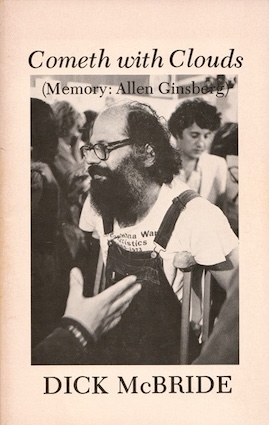
Back then too, in my early bookselling days, was Dick McBride, poet, playwright, actor, bookseller, publisher, former manager of City Lights Bookshop, having been introduced to Lawrence Ferlinghetti by poet, painter and novelist Kenneth Patchen. Dick was living in England then, distributing American small press books (and not so small: New Directions for a while)—a cottage in Great Horwood, Buckinghamshire, and an abandoned Victorian Methodist chapel for a warehouse. On my shelves is a copy of Cometh with Clouds (Memory: Allen Ginsberg), inscribed to me by Dick and dated July 14, 1983. It was published the previous year by Cherry Valley editions. I think I have a few of his other books, Lonely the Autumn Bird: Two Novels and Memoirs of a Natural-Born Expatriate were issued by Alan Swallow, and also The Astonished I, published by, ah, McBride’s Books.

Looking for online traces of Dick all these years later, I find more than I’d expected, on the Allen Ginsberg Project site and, particularly, a fine website created (and ongoing) by Rob McDowall: https://dickmcbride.co.uk/
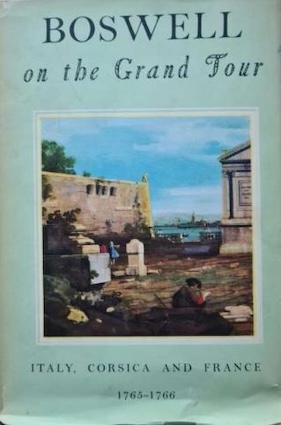
I am currently with James Boswell in Italy, Dorothy Parker in New York, and Ford Madox Ford more or less anywhere, generally in either Paris or New York, though occasionally in Corsica or Carqueiranne. Also, just now, with Stella Bowen in Italy, where she is travelling with Dorothy Pound, looking at pictures, while Ezra ransacks the archives to find material for the Malatesta Cantos. Quite unable to rely on so much of the world to refrain from barbarism and conduct its affairs with decency, intelligence or basic humanity, I’m happy enough to be elsewhere in quite other temporal locations.

Poor Boswell lectures himself on his conduct almost daily but then argues with his companions, pursues a married countess or takes himself off to the nearest working girl.  A ‘fille charmante’, about seven shillings. Also, ‘“Des filles” in the next three days ran to thirteen shillings.’ He seems strikingly subject to venereal disease too. After his triumphant forays into the lives of Jean Jacques Rousseau and Voltaire, Boswell is travelling with a party that includes Lord Mountstuart, son of Lord Bute, and has secured the friendship of John Wilkes, who (perhaps not an ideal model for young Boswell) takes the view that ‘dissipation and profligacy renew the mind’, he having written his best issues of his newspaper The North Briton (founded to attack Prime Minister Lord Bute) while ‘in bed with Betsy Green’.[5]
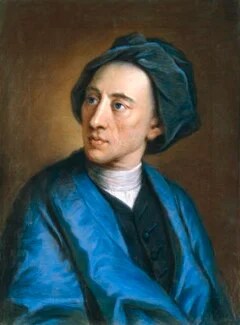
(Alexander Pope by William Hoare: National Portrait Gallery)

From time to time, I also try to get back more into the eighteenth-century frame of mind with some Pope – Alexander, to avoid any possible confusion, recalling an occasion not so long ago when I asked the Librarian what she was watching. ‘A bit of Pope’, she said. I looked into the front room and saw a blaze of red, cardinal red, you might say. Boswell, in an earlier journal, had recounted an evening including the poet’s work, which was not, however, quite enough to save the occasion: ‘The night before I drank tea and sat all the evening writing in the room with my landlord and landlady. They insisted that I should eat a bit of supper. I complied. I also drank a glass of punch. I read some of Pope. I sung a song. I let myself down too much. Also, being unaccustomed to taste supper, my small alteration put me out of order. I went up to my room much disgusted. I thought myself a low being.’[6]

Having actually taught Pope to unfortunate students many years back, I’m surprised to find I have to make a stern and conscious effort to stick with him, uneasily recalling W. H. Auden’s remark (8 January 1947) to Alan Ansen: ‘The real test of liking English poetry is Pope. His ideas aren’t much, but the language is wonderful—“Chicane in furs.” The Rape of the Lock is the most perfect poem in English.’[7] Or, indeed, Hugh Kenner, reviewing Maynard Mack’s life of the poet: ‘The great danger of absorbing writers’ biographies is that you can begin to think you understand writing you’ve not troubled to come to terms with.’[8]

I like to think of Gilbert White being presented with a copy of Pope’s six-volume translation of the Iliad by the poet himself, when graduating with distinction from Oriel College, Oxford, in 1743.

In Pope’s ‘Epistle to Burlington’, I see a neat encapsulation of pre-Romantic sensibility:

‘In all, let Nature never be forgot.
But treat the Goddess like a modest fair,
Not over-dress, nor leave her wholly bare;
Let not each beauty ev’ry where be spy’d
Where half the skill is decently to hide.
He gains all points, who pleasingly confounds
Surprizes, varies, and conceals the Bounds.’

And elsewhere a remark that never goes out of date, alas:

‘But when to Mischief Mortals bend their Will,
How soon they find fit Instruments of Ill!’ (‘Rape of the Lock’, Canto III).


Notes

[1] Richard Mabey, Nature Cure (London: Chatto & Windus 2005), 134.

[2] Guy Davenport, The Hunter Gracchus and Other Papers on Literature and Art (Washington: Counterpoint, 1996), 2.

[3] Guy Davenport, The Cardiff Team: Ten Stories (New York: New Directions, 1996), 2.

[4] ‘A Supermarket in California’, in Allen Ginsberg, Selected Poems 1947-1995 (London: Penguin Books, 2001), 89.

[5] Boswell on the Grand Tour: Italy, Corsica and France, 1765-1766, edited by Frank Brady and Frederick A. Pottle (London: William Heinemann, 1955), 54n., 58n.

[6] Sunday 19 December 1762: Boswell’s London Journal, 1762-1763, edited by Frederick A. Pottle (London: William Heinemann, 1950), 95.

[7] Alan Ansen, The Table Talk of W. H Auden, edited by Nicholas Jenkins (London: Faber and Faber, 1991), 15-16.

[8] Hugh Kenner, ‘Maynard Mack’s Pope’, Historical Fictions (Athens: University of Georgia Press, 1995), 250.
In the Scales

On 25 August 1773, in an indifferent inn at Banff, James Boswell watched Samuel Johnson pen a long letter to Mrs Thrale. ‘I wondered to see him write so much so easily. He verified his own doctrine that “a man may always write when he will set himself doggedly to it.”’[1]

Dogged, yes: ‘sullen’ I don’t quite see but ‘pertinacious’, holding obstinately to an opinion or a purpose, unyielding, we can certainly settle for. So that

Writing of April in the Scotland uplands, of mainly grey days, cold and snow, the 20-year-old John Buchan remarked: ‘Nor have we any of the common associations of spring, like the singing of birds. A mavis or a blackbird may on occasion break into a few notes, and there is, for certain, an increasing twitter among the trees. But the clear note of the lark as yet is not; the linnet does not pipe; the many named finches are still silent.’[2]

We have also been in the hills this April, though further south, with not a hint of snow. A few days in the Black Mountains, the border country, with its panoramic vistas and the River Wye looking sleek and animated and glossy, and where, on some roads, you move from England to Wales and back again with dizzying ease and frequency. That was in a foreign country. . .

As for birds. . . . In a few days and in a limited area, we saw or heard (frequently both), skylark, chaffinch, blackbird, robin, blackcap, sparrow, wood pigeon, linnet,  chiffchaff, wren, dunnock, crow, goldfinch and song thrush (Buchan’s ‘mavis’).[3] Many of these in the trees and the grass outside the living-room or kitchen windows of the farmhouse we were renting, others on walks through fields and woods.

Birds we had, then, in abundance. Space and grass and sheep and silence also. Wi-Fi, broadband, not so much. ‘I’ve rebooted it and logged on several times, it seems fine now’, the housekeeper said before leaving. The blue light lasted for at least a minute. The Librarian tried resetting it a few times, quite a few times, over the next few days with the same result. But we had food, wine, books and packs of cards. There were mobile phones too, in the event of an emergency. We survived. And what lengths would we go to, should we go to, for the latest news? After all, given the current state of things, should you not warm to neo-fascist extremism or the aggressive erasure of history or the continuing mass murder of civilians or the vicious suppression of non-violent protest, there’s little in daily bulletins to lift the spirits. Some people, though—and I have it on the best authority—can find it oddly cheering to see, as they cross a field from stile to stile, a pheasant strolling to and fro in that field, apparently without a care in the world.

So Inspector Jules Maigret sweltered in August heat or remained on edge when ‘no one had ever known such a damp, cold gloomy March.’[4] Virginia Woolf did not go to the party at Gordon Square where the d’Aranyi sisters, Adila, Hortense and Jelly (‘great-nieces of the renowned Hungarian violinist Joachim’) would be playing, because Leonard arrived home too late, ‘& it rained, & really, we didn’t want to go.’[5] And I was glad to learn about the Society of Dilettanti, concerned with practical patronage of the arts, whose members included Sir Joshua Reynolds, David Garrick and Charles James Fox, and to be told of Horace Walpole’s writing that, while the nominal qualification for membership of the Society was having been to Italy, the real one was being drunk.[6]

After the diversions of fictional Paris and historical Brighton, I am now with James Boswell, young Boswell on his Grand Tour, after Holland, currently in Germany, soon to be in Switzerland. He is still often preposterous, still wholly irresistible—and still battling with the Black Dog (‘The fiend laid hold of me’). But he finds diversions enough: ‘I must not forget to mark that I fell in love with the beauteous Princess Elizabeth. I talked of carrying her off from the Prince of Prussia, and so occasioning a second Trojan War.’[7]

We are back, then, via taxi and train among Good Friday crowds, walking again in the park amidst hurtling spaniels rather than quietly to and fro along a secluded lane with teeming hedgerows, remarkable trees and glimpses of an unfamiliar breed of sheep, which gave rise to a good deal of highly technical agricultural vocabulary: ‘God, they’re chunky!’ Too far away for a convincing photograph but, scanning various sheep breeders’ websites, we agree that they were probably Zwartbles.

As confirmed by such remarks, we are now returned to what E. M. Forster termed the world of ‘telegrams and anger’—minus the telegrams, of course, and seemingly with many times the anger. We are also back, that is to say, in the firm grip of the internet. Does that warrant one cheer or two?


Notes

[1] James Boswell, The Journal of a Tour to the Hebrides with Samuel Johnson, LL.D., edited by Ian McGowan (1785; Edinburgh: Canongate Books, 1996), 234-235.

[2] John Buchan, ‘April in the Hills’, in Scholar-Gipsies (1896; London: John Lane The Bodley Head, 1927), 28.

[3] Apparently derived from the French mauvis (though, confusingly, this seems to mean ‘redwing’, turdus iliacus rather than turdus philomelos). ‘It is still used for the bird in Orkney and survives elsewhere in Scotland’: Mark Cocker and Richard Mabey, Birds Britannica (London: Chatto & Windus, 2005),  358-359.

[4] Georges Simenon, Maigret’s Failure, translated by William Hobson (Penguin Books, 2025), 1; August heat in Maigret Sets a Trap, translated by Siân Reynolds (London: Penguin Books, 2017).

[5] The Diary of Virginia Woolf, Volume 1: 1915-19, edited by Anne Olivier Bell (with the Asheham Diary, London: Granta, 2023), 11-12.

[6] Venetia Murray, High Society in the Regency Period: 1780-1830 (London: Penguin Books, 1999), 165.

[7] Boswell on the Grand Tour: Germany and Switzerland 1764, edited by Frederick A. Pottle (London: William Heinemann, 1953), 12, 67.

Letters by degrees


On a strike day, the Librarian sets off early, bound for picket line and rally, one of millions currently defending their livelihoods, pay, pensions, conditions—not to mention the future of school and university education, the National Health Service, transport systems, emergency services and social care, just about everything that a civilised society requires, come to think of it.

Foot soldier in a different campaign, I peer at online newspaper archives—The Folkestone Herald! The North Star! The Gloucester Journal!—and mutely interrogate the pages of Suetonius, biographies of Liberal statesmen and the Catholic Encyclopedia or run a cyber-finger down columns of common First World War acronyms and abbreviations. Then: how many serving soldiers had that surname? Ah, 5,762. But perhaps—recurring hopefully to Olive Schreiner—‘there is another method’.[1]

I think sometimes of old volumes of letters I’ve read, or old biographies: ‘Cannot trace’, ‘Not yet identified’. That was then; this . . . Isn’t everything online? No. Aren’t all archives freely accessible? No. Can’t you translate anything from one language to another on one of those whizzbang websites? No (especially if he makes it up).

‘I am making quite good progress with that book’, Ford Madox Ford wrote to his friend Charles Masterman, the Liberal politician and head of the British propaganda department, in October 1914. I use the same cautious terms. Since this is not a leap year—no leaping!—it’s already the last day of February as I sit trying to work out which cousin of which daughter of which Lady This or Lady That married the right man (right for me, never mind for her). The ennobled families of England (and, often, Scotland; less often the other countries that make up, for the moment, the United Kingdom of Great Britain and Northern Ireland) breed, or bred, like rabbits, it occurs to me once more, if not for the exact same reasons as the poor. Bloodlines, money, influence, money, land, money. Clearly a genealogist would be handy since, as far back as I can recall, the interconnections of families have given me a headache. I can cope with straightforward cousins adequately but as soon as ‘second’ or ‘third’ or ‘removed’, even, on occasion, ‘by marriage’, swim before my eyes, darkness descends.

Apart from a genealogist, what else might help? Who or what would be useful? My provisional list features a few gaps or weaker links that may well be filled by fellow-editors or other colleagues and would include: someone with a better grasp of colloquial French than mine; a fluent Welsh speaker and, ideally, a Flemish one too; a classical scholar; an expert on Catholic doctrine, texts and rituals; a Biblical scholar, to be on the safe side; a couple of military historians, specialising in the First World War, plus one conversant with the minutiae of domestic British politics of the period, including a detailed knowledge of the career of David Lloyd George, ‘Dai Bach’; an expert on the topography of London; ditto Sussex; ditto Kent (again, to be on the safe side). In reserve, an expert on pigs and potatoes; scholar of dialect and slang, particularly of Sussex and Kent; and one or two historians of the London newspaper and periodical press.


(James Boswell by Joshua Reynolds, 1785: National Portrait Gallery)

On a good day, of course, I am—or attempt or aspire to be—all or most, or at least some, of these things myself – to a degree. Happy things, degrees, as James Boswell knew. ‘21 November 1762. Since I came up [to London], I have begun to acquire a composed genteel character very different from a rattling uncultivated one which for some time past I have been fond of. I have discovered that we may be in some degree whatever character we choose.’[2] And here he is a little later in the land of Rembrandt and Vermeer: ‘Tissot [a medical doctor] said mankind were all mad and differed only in degrees.’[3]

Not always happy things, of course, as C. L. R. James perceived: ‘To the extent that a historical parallel is suggestive, to that very degree it is dangerous.’[4] And talk of dangerous degrees recalls Alexandra Harris on the beginning of what historians call the Little Ice Age. ‘The start was the worst of it; there was never again such prolonged rain, frost, and drought as in the years of the Great Famine of 1315-18. But the altered climate forced long-term changes in English farming. Though the average annual temperature fell by only a degree Celsius, it was a critical degree.’[5]

How is our patient, Earth, today? Alas, doctor, situation critical.

Post! Bank statement for the Ford Madox Society. The London Review of Books. The Times Literary Supplement. And – a bellringing journal? My grasp of campanology is feeble, consisting almost entirely of The Nine Tailors, Dorothy Sayers’ 1934 novel, which takes its title from the saying that ‘nine tailors make a man’, a reference to the number of strokes at the beginning of the tolling for the dead (it was six for the death of a woman). In Akenfield, Ronald Blythe described it as three times three for a man, three times two for a woman; then the years of the dead person’s age would be tolled. He added that the practice continued up to the Second World War, ‘when all the bells of England were silenced. It was never revived.’[6]


A wrongly delivered bellringing journal, then, but the address is a very local one and can be slipped into the afternoon walk. And so it is—a detour through the park first to avoid the adjacent road, which often requires walking in the road because of all the antisocial dimwits that leave their cars on the narrow pavement. Still, even in the park, you have to avoid, in addition to cyclists, those people on those damned scooters to whom no rules apply: ‘E-twats’ is the technical term. But I exit the park close to the crossing lights, nip up the facing road and find the number. A notice is prominent in the small front garden: SOLD. The house looks dark but not empty. Should I knock – or would that risk involving me in an H. P. Lovecraft story? Discretion, valour, all that jazz. I stuff it through the letterbox, not without difficulty, and retreat.

It’s not always, though, a matter of retreat. ‘Quite an adventure for you’, the Librarian observes, as we return from Bath. ‘Going on a train. Going into shops. And a café.’

Indeed. ‘It is not grace but patience’, Guy Davenport observed, ‘that gets most of us through the world.’[7]

And our cherry tree is blossoming.


Notes

[1] Olive Schreiner. The Story of an African Farm (1883), v.

[2] Boswell’s London Journal, 1762-1763, edited by Frederick A. Pottle (London: William Heinemann, 1950), 47.

[3] Boswell in Holland, 1763-1764, edited by Frederick A. Pottle (London: William Heinemann, 1952), 256.

[4] C. L. R. James, Beyond a Boundary (1963; London: Vintage, 2019), 205.

[5] Alexandra Harris, Weatherland: Writers and Artists Under English  Skies (London: Thames & Hudson, 2015), 66.

[6] Ronald Blythe, Akenfield (Harmondsworth: Penguin Books, 1972), 84.

[7] Letter to Hugh Kenner, 8 October 1965: Questioning Minds: The Letters of Guy Davenport and Hugh Kenner, edited by Edward M. Burns, two volumes (Berkeley: Counterpoint Press, 2018), I, 732.

Archiving the opposites


I was thinking about opposites: or no—‘I would meet you upon this honestly’—for some reason, remembering the opening of Easy Rider, which I saw twice soon after its release, once straight and once. . . not, probably recklessly taking advice from a friend of that time (‘You have to see it stoned, man, otherwise you’re just wasting time and money’). The opening sequence has the soundtrack of a Steppenwolf song, its refrain being: ‘God damn the pusher’. I was reminded of it only because of its opposite, not curse but benediction, since I was thinking, after an exchange of emails yesterday and this morning: ‘God bless the archivist.’

That sentiment is common enough among researchers, I know. There is darkness; an archivist fiddles with the solar system and – there’s light. Accept the miracle, send the lavishly grateful email, know your place in an ordered universe. . .But I was thinking about opposites.

‘I reacted violently against him at first on the grounds that he was a militarist. But I soon found that if he was a militarist, he was at the same time the exact opposite.’ This is the Australian painter Stella Bowen writing, not long after his death, of her partner of ten years and father of her child, Ford Madox Ford.[1] When she met him in 1917, he was in uniform, as almost all Stella’s other friends and acquaintances at that time—poets, painters, dancers, musicians, translators—were not. The least likely candidate for an organisation such as the British Army, one might think, yet, when he was given a commission, he wrote to Lucy Masterman, ‘I can assure you, for what it is worth, that it is as if the peace of God had descended on me—that sounds absurd—but there it is! Man is a curious animal.’[2] Indeed.

(Stella Bowen, ‘Ford Playing Solitaire’)

Opposites are routinely employed or deployed in all manner of writers’ work and are integral to some. F. O. Matthiessen wrote of Ralph Waldo Emerson’s ‘inveterate habit of stating things in opposites’, while Guy Davenport noted of John Ruskin that he ‘quite early began to use the digression as a major device of style, and later saw in his infinitely branching digressions (Fors Clavigera is a long work of nothing but) “Gothic generosity” – the polar opposite of classical restraint.’[3] Of Penelope Fitzgerald, fellow-novelist Julian Barnes wrote: ‘Many writers start by inventing away from their lives, and then, when their material runs out, turn back to more familiar sources. Fitzgerald did the opposite, and by writing away from her own life she liberated herself into greatness.’[4] Reflecting on her Booker Prize winning novel, Offshore, Fitzgerald remarked: ‘It was a pity that the title was translated into various European languages with words meaning “far away” or “far from the shore,” which meant the exact opposite of what I intended. By “offshore” I meant to suggest the boats at anchor, still in touch with the land, and also the emotional restlessness of my characters, halfway between the need for security and the doubtful attraction of danger. Their indecision is a kind of reflection of the rising and falling tide, which the craft at anchor must, of course, follow.’[5]

(Thomas Rowlandson cartoon , ‘Walking up the High Street’: Messrs Johnson and Boswell in Edinburgh)

The idea of the opposite is indispensable to the firm contradiction of a prevailing trend or assumption, as essential a tool in the biographer’s or historian’s bag as a plunger in a plumber’s. Adam Sisman’s absorbing book on James Boswell observes of the famous trip to the Hebrides that this was, for most Britons, ‘still a wild and exotic region, one of the least explored in Europe. The Grand Tour was very much the fashion in the mid-eighteenth century, but the route directed the sons of the aristocracy to the sites of classical European civilization. Johnson and Boswell, by heading for the barbarian North, were going in the opposite direction.’[6] (The story-board for the animated short, ‘Sam and Jim Go Up Not Down’, is currently in draft form.) The great historian Fernand Braudel was also in a contradictory mood when he stated that, between 1350 and 1550, Europe ‘probably experienced a favourable period as far as individual living standards were concerned.’ Manpower was relatively scarce after the ravages of the Black Death. ‘Real salaries have never been as high as they were then.’ And he adds: ‘The paradox must be emphasized since it is often thought that hardship increases the farther back towards the middle ages one goes In fact the opposite is true of the standard of living of the common people – the majority.’[7] Moving on (chronologically), Alexandra Harris suggested that ‘The Georgian revival was in important ways precisely the opposite of Little Englandism: it was an investigation of England’s cultural relations with Europe and an effort to promote an audaciously international version of Englishness.’[8] If that’s the case, we clearly need another one.

The saying that ‘opposites attract’ will be true enough, no doubt, in many instances; but so too will the assertion that ‘opposites repel’, more so than ever at the current juncture when societies and nations seem to have cracked down the middle or lost their collective minds. Some ideals are being held so fiercely that they are breathlessly expiring; but then, as Robert Musil wrote: ‘Ideals have curious properties, and one of them is that they turn into their opposites when one tries to live up to them.’[9]

Sometimes. Still, God bless the archivist: that statement will brook no opposition.


Notes

[1] Stella Bowen, Drawn From Life (London: Collins, 1941), 62.

[2] Ford Madox Ford, Letters of Ford Madox Ford, edited by Richard M. Ludwig (Princeton: Princeton University Press, 1965), 61.

[3] F. O. Matthiessen, American Renaissance: Art and Expression in the Age of Emerson and Whitman (1941; New York: Oxford University Press, 1968), 3; Guy Davenport, ‘Ruskin According to Proust’, in The Hunter Gracchus and Other Papers on Literature and Art (Washington: Counterpoint, 1996), 334.

[4] Julian Barnes, ‘The Deceptiveness of Penelope Fitzgerald’, Through the Window: Seventeen Essays (And One Short Story) (London: Vintage, 2012), 4.

[5] Penelope Fitzgerald, ‘Curriculum Vitae’, in A House of Air: Selected Writings, edited by Terence Dooley with Mandy Kirkby and Chris Carduff (London: Harper Perennial, 2005), 478.

[6] Adam Sisman, Boswell’s Presumptuous Task (London: Hamish Hamilton, 2000), 89.

[7] Fernand Braudel, Civilization and Capitalism, 15th – 18th Century. Volume I: The Structures of Everyday Life: The Limits of the Possible, translated from the French; revised by Sîan Reynolds (London: Fontana Books 1985), 193, 194.

[8] Alexandra Harris, Romantic Moderns: English Writers, Artists and the Imagination from Virginia Woolf to John Piper (London, Thames & Hudson 2010), 70.

[9] Robert Musil, The Man Without Qualities, translated by Sophie Wilkins and Burton Pike (London: Picador, 1997), 247.

Differing degrees

Domenico_Remps_-_Cabinet_of_Curiosities

Another kind of cabinet: (Domenico Remps, Cabinet of Curiosities)

I don’t actually know anybody who thought that the British – English, rather – government was handling the Covid-19 pandemic well, so have no one to ask whether recent events have changed their minds. Nor can I think of anyone who would have been surprised to learn just how much contempt Messrs Johnson and Cummings, along with those supine members of the cabinet, feel for the general public, so can’t gauge any shift in opinion there either. All I know for sure is that, given the clear evidence that protecting the nation’s health is not the prime minister’s first priority—and given the latest, wildly premature lockdown easings—I’m well advised to stick to my current strategy, which is to steer clear of anyone that I don’t already live with. Even that will get  harder as the weather warms up, now that people have been shown how the rules can be bullied or bent into a more personally convenient shape.

So I’ll continue to read, cook, try to write – and find other diversions in the early morning walks, the stand-off between a magpie and a crow which seemed to go on for hours – and Harry’s early occupation of his favourite plant pot.

Wed-2705

Journal, Tuesday 29 May 1764. ‘At three Tissot [a medical doctor] carried me to the Utrecht Bedlam. The poor creatures were almost all silly. They were mostly going about loose. They called me the King of England. I was amused with this scene. Tissot said mankind were all mad and differed only in degrees.’ (Boswell in Holland, 1763-1764, edited by Frederick A. Pottle, London: William Heinemann, 1952, 256.)

Degrees, perhaps, M. Tissot, but very large ones in some cases.


Oompah and High-Wind: Dylan Thomas, Richard Hughes

Dylan-Caitlin

(Dylan and Caitlin Thomas)

On 16 May 1938, Dylan Thomas updated Henry Treece, the poet and novelist to whom he was writing regularly for a time – they later fell out over Dylan’s refusal to identify himself as an adherent of The New Apocalypse, a movement co-founded by Treece:

‘I’ve been moving house. That is, I’ve left, with trunks and disappointment, one charitable institution after another and have found and am now occupying, to the peril of my inside and out, my rheumatic joints, my fallen chest, my modern nerves, my fluttering knutted pocket, a small, damp fisherman’s furnished cottage—green rot sprouts through the florid scarlet forests of the wallpaper, sneeze and the chairs crack, the double-bed is a swing-band with coffin, oompah, slush-pump, gob-stick and almost wakes the deaf, syphilitic neighbours—by the side of an estuary in a remote village.’

I, the first named, am the ghost of this sir and Christian friend
Who writes these words I write in a still room in a spellsoaked house:
I am the ghost in this house that is filled with the tongue and eyes
Of a lack-a-head ghost I fear to the anonymous end.

Laugharne_Castle_2015

The remote village was of course Laugharne: not yet the Boat House but the cottage in Gosport Street found for Dylan and his wife Caitlin by the novelist Richard Hughes. In the same letter, Dylan wrote: ‘The village also contains bearded Richard High-Wind Hughes, but we move, in five hundred yards, in two or more different worlds: he owns the local castle, no roof and all, and lives in a grand mansion by its side and has a palace in Morocco.’

‘High-Wind’ refers to Hughes’ most famous novel, A High Wind in Jamaica, originally called The Innocent Voyage, a tale of pirates and children: you’d feel safer with the pirates. He was the author of the world’s first radio play, Danger, broadcast in 1924. After In Hazard (1938), there was a gap of over twenty years before he published The Fox in the Attic (1961), the first part of his unfinished trilogy, The Human Predicament, tracing the history of the years following the Great War and the rise of Nazism. The Wooden Shepherdess followed in 1973 but Hughes died three years later.

I read them about ten years ago, in old orange Penguins but then acquired the New York Review Books editions, with introductions by Hilary Mantel. They’re so damned attractive that you could go for a walk with one of them on your arm or, indeed, one on each arm (not literally, perhaps). Their edition of The Wooden Shepherdess includes the twelve chapters that Hughes completed of the planned third volume before his death.

Fox-in-the-Attic

The two volumes we have are a really impressive achievement, a brave tackling of the near-impossible task of weighting both individual and collective histories in a novel so that the balance is held: the context not skimped but the individuals still not pressed like flowers between the pages. The central character, Augustine, is certainly unobservant enough in some instances to be believable and Hughes has a good grasp of the sleight of hand by which great gaps can be left which are satisfactorily filled in by the pressure exerted on either side by existing material rather than needing the writer to shovel in ballast for dear life before the structure cracks. Still, the murky world of the rising Nazi party perhaps convinces even more – because it is less familiar (to the British reader, anyway), and because Hughes is so obviously thoroughly conversant with the historical sources, to an extent that renders it unnecessary for him to labour the fact.

Do we now need to labour the unsettling echoes of that time in this? Probably not: anyone likely to be able to hear them has probably already done so. Martin Kettle certainly has:

https://www.theguardian.com/commentisfree/2019/may/16/brexit-britain-weimar-germany-far-right-democracy-contempt-politicians

Also on this day in 1791, in an edition of 1750 copies (two volumes quarto, price two guineas), James Boswell’s Life of Johnson was published. Many of Johnson’s remarks, so faithfully recorded by Boswell, are specific to his time, to his social, cultural and political context. Others are applicable to other times too:

‘Where a great proportion of the people (said he,) are suffered to languish in helpless misery, that country must be ill policed, and wretchedly governed: a decent provision for the poor is the true test of civilization.—Gentlemen of education, he observed, were pretty much the same in all countries; the condition of the lower orders, the poor especially, was the true mark of national discrimination.’

‘The courage of a fly in the milk’

STW-Letters

We’re approaching 16 May, which is—among other things (not least, the birthday of Stella Bowen: see previous post)—the two hundred and fifty-fourth anniversary of the first meeting, in the bookshop run by Tom Davies, in Russell Street, off Covent Garden market, of James Boswell and Samuel Johnson. I’ve lately been reading Boswell’s London Journal, not because of the looming anniversary but because of Sylvia Townsend Warner, whose fiction is marvellous and whose letters are superb. To Leonard Bacon, the American poet and translator, she wrote: ‘The thing that struck me most about Boswell’s Dutch Diary was his desperate courage—the courage of a fly in the milk. I love him, of course, but I also esteem him. A man whose heart is a black pit of terror, black as a Geneva gown, and who yet can attend to the colour of the waistcoat he puts over it is a man after my own heart.’[1]

STW_via_NYRB

(Sylvia Townsend Warner via New York Review Books)

This was the direct, traceable cause of my picking up a secondhand copy of Boswell in Holland 1763-1764 in Lyme Regis six months ago. It was like a recommendation from a friend. On the matter of waistcoats, at the end of the volume, the editor has included a list, translated from the original French, compiled by François Mazerac, Boswell’s servant:

‘Clothes and linens that I found on entering the service of Monsieur Boswell

1 coat, waistcoat, and breeches, with silver lace

1 red coat, waistcoat, and breeches, with gold lace

1 rose-coloured coat and waistcoat, with gold buttons

1 blue coat, waistcoat, and breeches, with white buttons’

and so on for another two dozen lines, enumerating stockings, lace ruffles, silk handkerchiefs, night-caps, garter-buckles, breeches and much else.[2]

Boswell-in-Holland

The London Journal covers the two years preceding Boswell’s trip to Holland, so when I came across a copy of that in the Oxfam Bookshop recently, I grabbed it. Both of these volumes are in what’s called the ‘trade edition’, derived from the great ‘Yale Edition of the Private Papers of James Boswell’. There is also a ‘research edition’ of these and other Boswell writings, which offer complete texts and much more extensive annotation, while also preserving the spelling and capitalisation of the original manuscripts. The ‘trade’ edition is also termed the ‘reading’ edition, surely not without cause. That’s the one I have.

The London Journal is hugely diverting and gives a very vivid and complex sense of a man who is often ridiculous, sometimes silly, snobbish, prone to melancholia, afraid of ghosts, veering frequently from remorse to vigorous self-regard, yet always honest, or at least candid. I’m a newcomer to this Boswell, though I’d read his Life of Johnson years ago and found it as extraordinary an achievement as it’s generally acknowledged to be. For a long time after the biography was first published, though, Boswell himself was poorly regarded. He was seen as having been lucky in meeting Johnson when he did; and having simply recorded, in a rather naïve and straightforward manner, whatever he could of Johnson’s doings and sayings. The case was altered by the discovery of the ‘colossal hoard’ of Boswell papers, manuscripts of the Life and other writings, journals and letters. From being viewed as ‘a little man who wrote a great book’, Boswell’s reputation and standing changed quite radically. He ‘came to be seen as an important literary figure, a pioneer of modern biography — and of autobiography, for the focus of academic interest has shifted from subject to author’. He was, it became clear, ‘a much more careful and ambitious writer than anybody had supposed.’[3] The long, complex story of the discovery of Boswell’s papers and their tortuous journey into safe, scholarly hands was also new to me.[4]

Boswell-London-Journal

Boswell had left Scotland for his second sojourn in London on 15 November 1762, so he’d only just passed his twenty-second birthday (he was born on 29 October 1740). His father, the Laird of Auchinleck, wanted him to pursue the law but Boswell had conceived a desire to serve in the Guards, believing that a commission in that regiment would enable him to live permanently in London.[5]

A good deal of his time was spent in soliciting the help of powerful people in the cause of securing that commission, among them the Duke of Queensberry and the Countess of Northumberland. There are some wonderful moments of comedy when Boswell congratulates himself, such as the occasion of a ‘rout’, a large party which was ‘full of the best company’. Boswell had secured the attention of the Countess, who approached him ‘with the greatest complacency and kindness’: ‘I could observe people looking at me with envy, as a man of some distinction and a favourite of my Lady’s. Bravo! thought I. I am sure I deserve to be a favourite. It was curious to find of how little consequence each individual was in such a crowd. I could imagine how an officer in a great army may be killed without being observed. I came home quiet, laid by my clothes, and went coolly to bed. There’s conduct for you.’[6] Just a few months later, he entertains severe doubts about Lady Northumberland’s sincerity: ‘O these Great People! They are a sad set of beings. This woman who seemed to be so cordially my friend and promised me her good offices so strongly is, I fear, a fallacious hussy.’ A moment later: ‘However, let me not yet be too certain. She may perhaps be honest’ (238).

Elizabeth_Percy_Reynolds

(Sir Joshua Reynolds, portrait of Elizabeth Percy Northumberland)

On another occasion, turning over in his mind the complications inextricable from having too little money and too many ways of making life pleasant, his thoughts move from economics to artistry and, again, he finds strong cause for satisfaction. ‘How easily and cleverly do I write just now! I am really pleased with myself; words come skipping to me like lambs upon Moffat Hill; and I turn my periods smoothly and imperceptibly like a skilful wheelwright turning tops in a turning-loom. There’s fancy! There’s simile! In short, I am at present a genius: in that does my opulence consist, and not in base metal’ (187).

NPG 4452; James Boswell by Sir Joshua Reynolds

(James Boswell by Sir Joshua Reynolds; oil on canvas, 1785
762 mm x 635 mm © National Portrait Gallery)

One of his preoccupations is, of course, sex—an often risky business in eighteenth-century London. When Boswell’s father had fetched him back from London in 1760, and Boswell reluctantly returned to his law studies, he had already contracted ‘the first of many venereal infections’.[7] Ten days after leaving Scotland, though ‘determined to have nothing to do with whores’, he picks up a girl in the Strand ‘and went into a court with intention to enjoy her in armour [a prophylactic sheath]. But she had none. I toyed with her, She wondered at my size, and said if I ever took a girl’s maidenhead, I would make her squeak.’ No consummation, then, but the girl gets a shilling and Boswell gets a boost to his ego. He resolves ‘to wait cheerfully’ till he can find ‘some safe girl’ or is ‘liked by some woman of fashion.’[8] On numerous occasions, that cheerful waiting melts like summer snow. Sometimes he berates himself, sometimes just shrugs: ‘then came to the Park, and in armorial guise performed concubinage with a strong, plump, good-humoured girl called Nanny Baker’ (237). He frequently determines to be better—gravity, restraint, abstinence, seriousness—and such determination as frequently falters. Just as he humanised Johnson, recording Johnson’s flaws and faults and weaknesses as faithfully as he did the evidences of Johnson’s greatness, so the candour, the recognition of blunders and failures in his own life and character humanise the fallible and endearing Boswell.

The journal became extremely important to him: his father deprecated the habit and his old friend William Temple said that: ‘he imagined that my journal did me harm, as it made me hunt about for adventures to adorn it with, whereas I should endeavour to be calm and studious and regular in my conduct, in order to attain by habit a proper consistency of conduct. No doubt consistency of conduct is of the utmost importance. But I cannot find fault with this my journal, which is far from wishing for extravagant adventures, and is as willing to receive my silent and serious meditations as my loud and boisterous rhodomontades.’[9] Crucially, the journal habit is supported by Samuel Johnson. Even before he knows that Boswell keeps one, he suggests that he do so. ‘No former solicitations and censures could tempt me to lay thee aside,’ Boswell addresses his journal, ‘and now is there any argument which can outweigh the sanction of Mr. Samuel Johnson?’ (305)

He tells Johnson that he puts down ‘all sorts of little incidents’ in his journal and notes Johnson’s reply, which will find its way into the Life: ‘“Sir,” said he, “there is nothing too little for so little a creature as man. It is by studying little things that we attain the great knowledge of having as little misery and as much happiness as possible.”’[10]

Doctor Samuel Johnson ?1772 by Sir Joshua Reynolds 1723-1792

(Sir Joshua Reynolds, portrait of Samuel Johnson, ?1772: © Tate Gallery)

And indeed, in addition to the larger issues and events, Boswell records not only the little things but those days when there seems to be nothing much at all: ‘FRIDAY 11 FEBRUARY. Nothing worth putting into my journal occurred this day. It passed away imperceptibly, like the whole life of many a human experience’ (188); ‘THURSDAY 7 APRIL. I breakfasted with [William Johnson] Temple. This day was afterwards passed in dissipation which has left no traces on my brain’ (235); ‘Thursday 21 July 1763. ‘I remember nothing that happened worth relating this day. How many such days does mortal man pass!’ (316).

There’s a fine cast of characters: apart from those Boswellian friends and relations whose names are not generally known, the ones that are include Charles Churchill, David Hume, Oliver Goldsmith, John Wilkes, David Garrick—and, of course, Doctor Johnson.

I look forward to Holland in Jamie Boswell’s company.

References

[1] Letter of 18 October 1953: Sylvia Townsend Warner, Letters, edited by William Maxwell (London: Chatto & Windus, 1982), 131.

[2] Boswell in Holland, 1763-1764, edited by Frederick A. Pottle (London: William Heinemann, 1952), 383-384.

[3] Adam Sisman, Boswell’s Presumptuous Task (London: Hamish Hamilton, 2000), xviii-xix.

[4] Apart from Sisman’s account in his final chapter, ‘Posterity’, there’s a good account in Ian Hamilton’s chapter, ‘Boswell’s Colossal Hoard’, in his Keepers of the Flame: Literary Estates and the Rise of Biography (1992; London: Pimlico, 1993), 63-84. Frederick A. Pottle, who edited both the London and Holland journals, published a detailed account in Pride and Negligence: The History of the Boswell Papers (New York: McGraw-Hill, 1982).

[5] Pottle’s introduction to the London Journal, with its biographical outline, notes on the recurring figures in Boswell’s story and eighteenth-century background, is very helpful for those not overly familiar with the history of the period.

[6] Boswell’s London Journal, 1762-1763, edited by Frederick A. Pottle (London: William Heinemann, 1950), 71: any bracketed page numbers in the text refer to this.

[7] Boswell’s Presumptuous Task, 12.

[8] Boswell’s London Journal, 49-50.

[9] Boswell’s London Journal, 269—now usually ‘rodomontade’: boastful or inflated talk or behaviour.

[10] Boswell’s London Journal, 305; see Life of Johnson, edited by R. W. Chapman, revised by J. D. Fleeman, (Oxford: Oxford University Press, 1980), 307.