Oxford Days (a few)


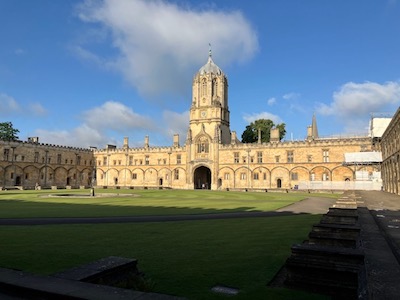
(Tom Quad, Christ Church College)

‘Even when we protested the invasion of Iraq’, I said to the Librarian, recalling that day some twenty years earlier when we shuffled along London streets in company with over a million others, ‘I think we moved more quickly than this.’

‘This’ was our glacial progress up St Aldates in Oxford on a sunny afternoon, together with residents, tourists, American and other participants in the Oxford Experience, or those embarked upon the countless other summer courses and programmes, and many hundreds of—mainly Japanese—children dressed in the Gryffindor house colours of scarlet and gold, concerned to take in the Harry Potter vibrations from New College, the Bodleian Library and Christ Church College. Tour guides in their dozens hoisted small flags or halted in gateways with uplifted arms. Lanyards in their hundreds bobbed or swung. Some individuals, either on home turf or away, looked vague, a little stunned, reminding me of the passage in Rory Stewart’s memoir, where he described Steve Hilton, David Cameron’s director of strategy, moving into the corridor and another room. ‘He seemed to be searching for something – although I couldn’t tell whether it was a cat, an idea, or his shoes.’[1]

On High Street or Broad Street, Broad Walk, Christ Church Meadow, by rivers and canals, on bridges and benches, crowds ebbed and flowed – but mainly flowed. We are soon to be visible in a thousand physical or virtual photograph albums. I said, at one point, ‘Okay, if it’s a child of ten or younger having a photograph taken, we’ll pause. Otherwise, we plough straight on.’ The Librarian agreed but soon lowered the qualifying age to eight, then six. Minutes later, it was down to zero. Thereafter, we ploughed straight on.
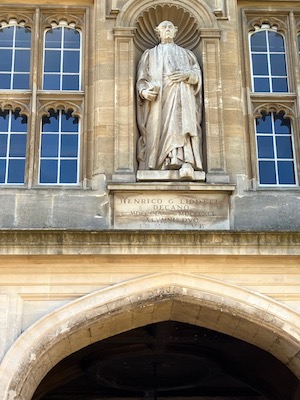

(Alice Liddell’s dad, Henry George Liddell, dean of Christ Church from 1855)

Oxford! The literary references the word throws up are astonishing, even excluding the people that only studied there. Lewis Carroll, or rather, Charles Dodgson, haunts the place, but other names rampage through a distracted memory: Philip Pullman, Dorothy Sayers’ Gaudy Night, John Wain, P. D. James, Iris Murdoch, Hardy’s Jude and Colin Dexter’s Morse, C. S. Lewis and J. R. R. Tolkien. A random footnote fact I gathered since that visit was that Edward De Vere, seventeenth Earl of Oxford, was educated not at Oxford, as one might reasonably expect, but at Queen’s College, Cambridge. Attempts were later made to claim him as the ‘real’ author of Shakespeare’s plays, an idea launched by the splendidly named John Thomas Looney. De Vere was the nephew of Arthur Golding, translator of Ovid, his Metamorphoses ‘the most beautiful book in the language’, in Ezra Pound’s words.[2] A man skilled in ‘fourteeners’ (that many syllables in a line):

Then sprang up first the golden age, which of it selfe maintainde,
The truth and right of every thing unforst and unconstrainde.
There was no feare of punishment, there was no threatning lawe
In brazen tables nayled up, to keep the folke in awe.
There was no man would crouch or creepe to Judge with cap in hand,
They lived safe without a Judge, in everie Realme and lande.

Here Daphne flees from Apollo:

And as shee ran the meeting windes hir garments backewarde blue,
So that hir naked skinne apearde behinde hir as she flue,
Hir goodly yellowe golden haire that hanged loose and slacke,
With every puffe of ayre did wave and tosse behind hir backe.[3]

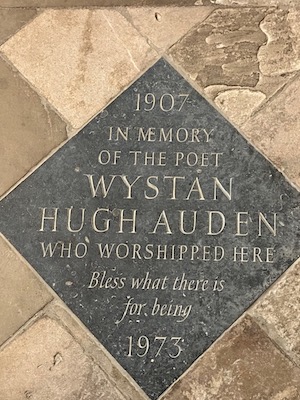
One name occurs on the ground as well as in the mind, the memorial plaque in Christ Church Cathedral (astonishing vaulted ceiling, stained glass by Burne-Jones and others, the St Frideswide Shrine). W. H. Auden came to the College to study biology, switched to English Literature in his second year and graduated (with a third class degree) in 1928. Nearly 30 years later, he became Oxford Professor of Poetry, and returned to Christ Church to live (part of the time) in 1972, the year before his death.

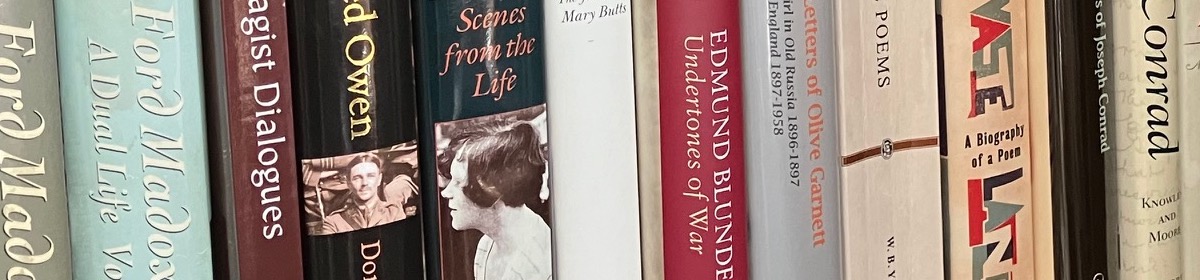
Wot, no Ford Madox Ford notes? Perhaps a sly one. In Some Do Not. . ., Christopher Tietjens, in a mood verging on ‘high good humour’, walks through a Kentish field with Valentine Wannop, a scene, a day, a walk which will recur in both their memories. Among those things that the best people must know are the local names (and the stories behind them) of the plants and flowers they pass. Tietjens—younger son, mathematician, member of the English public official class, who will also, in time, be lover, soldier and antique dealer—tells over to himself the words, the names, the language:

In the hedge: Our lady’s bedstraw: dead-nettle: bachelor’s button (but in Sussex they call it ragged robin, my dear: So interesting!) cowslip (paigle, you know, from the old French pasque, meaning Easter): burr, burdock (farmer that thy wife may thrive, let not burr and burdock wive!); violet leaves, the flowers of course over; black briony; wild clematis: later it’s old man’s beard; purple loose-strife. (That our young maids long purples call and liberal shepherds give a grosser name. So racy of the soil!) …[4]

In the wonderful Botanic Garden, the country’s oldest, one section is the Literary Garden, featuring plants that occur in literature, Alice in Wonderland, Agatha Christie (a great user of poisons) and others, including William Shakespeare:
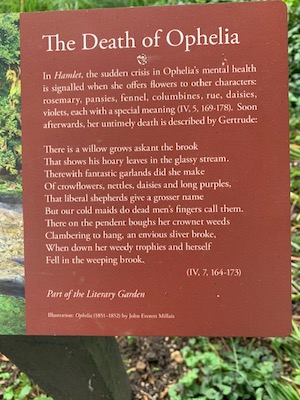
Yes, those liberal shepherds grossly naming again. Modernists though Joyce, Eliot, Woolf, Wyndham Lewis and Ford were, they were not Futurists rejecting the past—a little more selective than that: ‘BLAST years 1837 to 1900’ and, indeed, ‘BLESS SHAKESPEARE for his bitter Northern Rhetoric of humour’—and they all had frequent recourse to that Elizabethan. . .


Notes

[1] Rory Stewart, Politics on the Edge: A Memoir from Within (London: Jonathan Cape, 2023), 100.

[2] Ezra Pound, The ABC of Reading (London: Faber and Faber, 1961), 127

[3] Extracts in The Oxford Book of Classical Verse, edited by Adrian Poole and Jeremy Maule (Oxford: Oxford University Press, 2000), 394; The Oxford Book of Verse in English Translation, Chosen and Edited by Charles Tomlinson (Oxford: Oxford University Press, 1980), 38.

[4] Ford Madox Ford, Some Do Not. . . (1924; edited by Max Saunders, Manchester: Carcanet Press, 2010), 132.
Browsing Glaucus

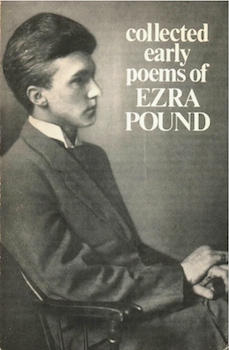
Pound-Personae-1909 Pound-CEP-ND

Leafing through Peter Jay’s edition of The Greek Anthology—borrowed from the library, so likely to be with me for a while—its translators ranging from Fleur Adcock and Guy Davenport to Tony Harrison and Peter Whigham, I came across Glaukos – not, a note explains, Glaukos of Athens but Glaukos of Nikopolis (‘perhaps the suburb of Alexandria’). This is translated by Clive Sansom:

No, not earth, nor a stone slab,
But the whole vast surface of the ocean that you see
Is Erasippus’ tomb.
He and his ship drowned together. – Where
And in what unknown depths his bones wander
Seabirds alone can tell.[1]

I like the neat manner in which the close relationship of man and ship is conveyed; and the suggestion that the bones ‘wander’, the voyager never still even in death. Who the seabirds might tell is, of course, a separate question.

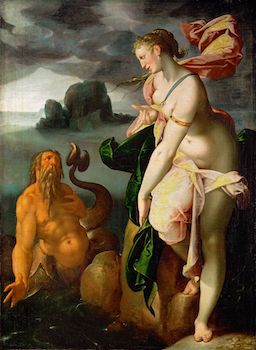
In classical literature and mythology, Glaukos or Glaucus crops up several times, including in the Iliad; he is also the son of Sisyphus who ends up being eaten by his own mares, possibly because Aphrodite was in a snit with him. But the best-known is probably the fisherman who ate a magical herb and was transformed into a sea-god. He was later renowned for his prophecies. The story of his doomed love for Scylla is told by Ovid, as is the moment of his ‘sea change’:

I picked some stalks and chewed
What I had picked. The juice, the unknown juice,
Had hardly passed my throat when suddenly
I felt my heart-strings tremble and my soul
Consumed with yearning for that other world.
I could not wait. “Farewell”, I cried, “farewell,
Land never more my home”, and plunged beneath
The waves.[2]

Spranger_Galucus-Scylla

(Bartholomeus Spranger, Glaucus and Scylla)

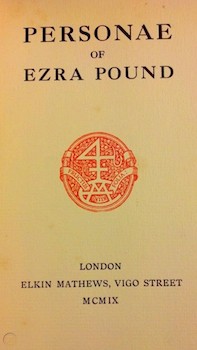
Glaucus is mentioned by Dante – and that mention, from the Paradiso, is the epigraph of Ezra Pound’s ‘An Idyl for Glaucus’, included in his third volume, Personae, published on 16 April 1909.

Pound’s poem is a dramatic monologue, which has ‘invented the lover who witnessed Glaucus’ transformation’, David Moody writes, ‘but does not know how to follow him, and who is left astray in the mortal world in which she can no longer be at home.’[3]

I sought long days amid the cliffs thinking to find
The body-house of him, and then
There at the blue cave-mouth my joy
Grew pain for suddenness, to see him ’live.
Whither he went I may not come, it seems
He is become estranged from all the rest,
And all the sea is now his wonder-house.

She suspects that ‘each time they come/ Up from the sea heart to the realm of air/ They are more far-removèd from the shore’. Once he plucks some grass and bids her eat it before abruptly leaping back into the sea. Then:

I wonder why he mocked me with the grass.
I know not any more how long it is
Since I have dwelt not in my mother’s house.
I know they think me mad, for all night long
I haunt the sea-marge, thinking I may find
Some day the herb he offered unto me.

And, at the end:

I am quite tired now. I know the grass
Must grow somewhere along this Thracian coast,
If only he would come some little while and find it me.[4]

Anglo-Saxon-K

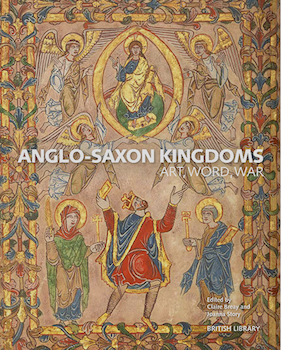
This is still early Pound: there are numberless inversions, archaisms and ‘poeticisms’ but the power and force of some of the work—including ‘An Idyl for Glaucus’—is undeniable. While ‘The Seafarer’ is two and a half years away, Hugh Witemeyer remarks of an earlier poem in the volume, ‘At the Heart O’ Me, A. D. 751’, that it was Pound’s ‘earliest experiment with Anglo-Saxon diction and meter’. Do this poem’s ‘body-house’ and ‘wonder-house’ point in the same direction?[5]

Perhaps. But then Pound read a great deal of Rudyard Kipling’s work and I remember that the opening lines of Kim are: ‘He sat, in defiance of municipal orders, astride the gun Zam-Zammah on her brick platform opposite the old Ajaib-Gher—the Wonder House, as the natives call the Lahore Museum.’ So perhaps not.

The influences tumble over one another in the first years, sometimes fighting like rats in a sack, but he’ll gradually outdistance Pre-Raphaelites, Aesthetes, Symbolists and others—not abandoning or jettisoning them but absorbing them into a stronger and more expansive poetic framework. Dante and Ovid will last the course, though: the experience of the underworld, the reaching for paradise and the lure of transformation.


Notes

[1] Peter Jay, editor, The Greek Anthology and Other Ancient Greek Epigrams: A selection in modern verse translations (London: Allen Lane, 1973), 154.

[2] Ovid, Metamorphoses, translated by A. D. Melville (Oxford: Oxford University Press, 1987), 323.

[3] A. David Moody, Ezra Pound: Poet: A Portrait of the Man and His Work: Volume I: The Young Genius 1885–1920 (Oxford: Oxford University Press, 2007), 90-91.

[4] ‘An Idyl for Glaucus’, in Collected Early Poems of Ezra Pound, edited by Michael John King (London: Faber and Faber, 1977), 83-85.

[5] Hugh Witemeyer, The Poetry of Ezra Pound: Forms and Renewal, 1908-1920 (Berkeley: University of California Press, 1981), 117.


The hunter hunted, or: hounded by Diana

Rubens-Diana-and-Actaeon

(Peter Paul Rubens, Diana and Actaeon)

Over two days at the home of the Librarian’s parents in Somerset, I find I don’t read much at all, the time slipping pleasantly away in a great deal of conversation, some eating, drinking, the odd quiz, a couple of games – not even much walking this year. Still, we return home on Boxing Day with as many books as we set out with.

Among my new acquisitions are two volumes of poetry, Like by A. E. Stallings and Michael Hofmann’s One Lark, One Horse, poets and translators linked in my mind by Ovid. Stallings is one of the many poets—I hadn’t realised until recently just how many—to have translated, recast or reimagined Ovid’s telling of the story of Actaeon, the hunter who came by chance upon the goddess Diana bathing naked. Outraged, she transformed him into a stag and he was torn to pieces by his own hounds. Stallings’ poem begins:

The hounds, you know them all by name.
You fostered them from purblind whelps
At their dam’s teats, and you have come
To know the music of their yelps[1]

There have been numerous translations of Ovid’s Metamorphoses since the sixteenth-century version by Arthur Golding, ‘the most beautiful book in the language’, Ezra Pound called it, ‘from which Shakespeare learned so much of his trade’.[2] Golding’s translation has the goddess conjuring antlers onto Actaeon’s head. Then:

She sharpes his ears, she makes his necke both slender, long and lanke.
She turns his fingers into feete, his arms to spindle shanke.
She wrappes him in a hairie hyde beset with speckled spottes,
And planteth in him fearfulnesse.[3]

Golding-Metamorphoses

Michael Hofmann was one of the editors – with James Lasdun – of the celebrated anthology, After Ovid: New Metamorphoses, which included four pieces (more than fifty pages in total) by Ted Hughes, a milestone on the road to Hughes’ later Tales from Ovid.[4] His ‘Actaeon’ begins:

Destiny, not guilt, was enough
For Actaeon. It is no crime
To lose your way in a dark wood.[5]

Absolving Actaeon of blame (and apparently absolving Dante too in passing, perhaps all of us, come to think of it) aligns Hughes with several other translators and commentators. A. D. Melville’s version, after stating that Actaeon’s hounds were ‘sated with their master’s blood’, goes on:

Though, if you ponder wisely, you will find
The fault was fortune’s and no guilt that day.
For what guilt can it be to lose one’s way?[6]

No crime, no guilt ­ – but was he not at fault at all? There’s a moment in Lisa Halliday’s novel Asymmetry when Amar tells his girlfriend Maddie a story as they skirt around the question of religious belief and she says ‘something about how, once we know the end of an unfortunate story, it’s tempting to ask why its protagonist did not do better to swerve his fate.’[7] It’s certainly easier to ask such questions if it’s not us in the story – or if we believe that we are, unaided, writing our own.

fontainebleau-diana

(Diana the Huntress: École de Fontainebleau, c. 1550-1560)

In Ford Madox Ford’s The Young Lovell, after the battle of Kenchie’s Burn, Lovell is pursuing the Scots and is lost in a great valley between moors where he sleeps on the heather. ‘There he heard many strange sounds, such as a great cry of dogs hunting overhead, which was said by those who had read in books to be the goddess Diana chasing still through the night the miserable shade of the foolish Actaeon.’[8]

Heartless fellow. Ten years after that novel was published, Ford was in Paris, feeling the mounting pressure of people’s expectations upon him to launch what became the transatlantic review: ‘not even Diana herself would preserve me from their fury if I did not provide harbourage for their compositions. I should be torn to pieces as was Actaeon by the hounds of that Goddess’.[9]

A little more sympathy from Ford than from his fictional creation – or at least no disparagement here of the unfortunate Actaeon.

Actaeon also figures in poems by writers as varied as Seamus Heaney, George Szirtes, Wendy Cope, Robin Robertson and Simon Armitage. In March 1915, Poetry published six poems by Ezra Pound, among them ‘The Coming of War: Actaeon’:

An image of Lethe,
and the fields
Full of faint light
but golden,
Gray cliffs,
and beneath them
A sea
Harsher than granite,
unstill, never ceasing;
High forms
with the movement of gods,
Perilous aspect;
And one said:
“This is Actaeon.”
Actaeon of golden greaves!
Over fair meadows,
Over the cool face of that field,
Unstill, ever moving,
Host of an ancient people,
The silent cortège.[10]

It’s not immediately obvious what Actaeon is doing here; or rather, why it’s Actaeon as opposed to any other of the illustrious dead who have crossed into Hades. (He appears in Pound’s Canto IV but in his familiar context of pool, goddess, stag and hounds.) James Longenbach comments that here Pound ‘was able to pull his experience of the war into the private world of the Image’ but points out that ‘the sacrifice was a large one’ since the poem ‘addresses the war only by mythologizing it out of its place in history and ignoring the brutality of the actual experience.’[11]

Titian, c.1488-1576; Diana and Actaeon

(Titian, Diana and Actaeon, National Galleries of Scotland)

The story that Ovid tells is, in any case, a wonderfully suggestive one, presumably accounting for its strong attraction for poets and translators. The hunt is itself a potent idea, especially the sexual politics of the hunter become the hunted, the mortal man doomed by the arbitrary act of the divine woman. Or is it arbitrary, since the intrusion may be seen as not merely a social solecism but a sacrilegious blunder, a subversion of the natural order? As for the metamorphosis, the transformation, every translation – perhaps every work of art – can be seen as a metamorphic act. But another attraction is surely the tumultuous unfurling in Actaeon’s mind, the dizzying terror, the internal screaming as the words come to his lips, the things he would utter ­ – but his power of speech is gone, his human faculties fled.

Here’s a favourite recent telling of the tale, by Lavinia Greenlaw:

He walks his mind as a forest
and sends of himself into dark places
to which he cannot tell the way.
The hunt comes on and he in his nerves
streams ahead – hounds flung after
a scent so violent no matter the path
or what’s let fall.
A burst of clearing.
Water beads and feathers her presence
as she thickens and curves.
He says words to himself not to look
but his eyes are of their own
and she at their centre a dark star
contracted to itself discarding
wave on wave on flare on fountain.
His skull erupting, branching . . .
And his blood is shaken down.
And he is all fours.
And his noise.
And his hounds.[12]


References

[1] A. E. Stallings, ‘Actaeon’, published in Poetry (May 2003).

[2] Ezra Pound, The ABC of Reading (London: Faber and Faber, 1961), 127; How to Read (London: Desmond Harmsworth, 1931), 45.

[3] Confucius to Cummings: An Anthology of Poetry, edited by Ezra Pound and Marcella Spann (New York: New Directions, 1964), 37, 40-41.

[4] After Ovid: New Metamorphoses, edited by Michael Hofmann and James Lasdun (London: Faber and Faber, 1994), 3-20, 94-109, 114-117, 245-258.

[5] Ted Hughes, Collected Poems, edited by Paul Keegan (London: Faber and Faber, 2003), 937.

[6] Ovid, Metamorphoses, III, 140-142, translated by A. D. Melville (Oxford: Oxford University Press, 1987), 55. In a note (392), Melville suggests that Ovid had his own case in mind here, having insisted that the offence for which he was exiled was an error rather than a crime.

[7] Lisa Halliday, Asymmetry (London: Granta Books, 2018), 188.

[8] Ford Madox Ford, The Young Lovell: A Romance (London: Chatto & Windus, 1913), 27. On Actaeon’s connection to Peire Vidal in The Good Soldier, see my ‘“Speak Up, Fordie!”: How Some People Want to Go to Carcassonne’, in Ford Madox Ford and the City: International Ford Madox Ford Studies 4, edited by Sara Haslam (Amsterdam: Rodopi, 2005), 204.

[9] Ford Madox Ford, It Was the Nightingale (London: Heinemann, 1934), 262.

[10] Ezra Pound, ‘Actaeon: The Coming of War’, Ezra Pound: Poems and Translations, edited by Richard Sieburth (New York: Library of America, 2003), 285.

[11] James Longenbach, Stone Cottage: Pound, Yeats and Modernism (New York: Oxford University Press, 1990), 124.

[12] Lavinia Greenlaw, ‘Actaeon’, The Casual Perfect (London: Faber & Faber, 2011), 13.