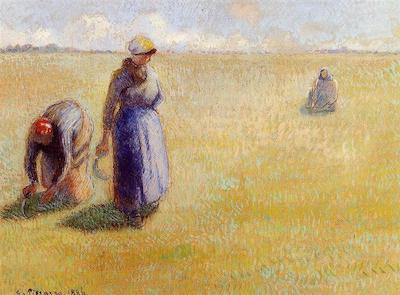
(Camille Pissarro, Three Women Cutting Grass)
It rains, it rains,
From gutters and drains
And gargoyles and gables
It drips from the tables
That tell us the tolls upon grains.
Oxen, asses, sheep, turkeys and fowls
Set into the rain-soaked wall
Of the old Town Hall.[1]
While much of the world is on fire, some of it quite literally, we have been frequently awash with summer rains, though complaining about it less than usual. The United Kingdom as a whole recorded the sixth highest July rainfall since those records began in 1836; Northern Ireland recorded its highest July rainfall ever. In the United States, heat-related deaths are confidently predicted to exceed those of previous years. Beijing reports the heaviest rainfall in 140 years, with many deaths and disappearances. In the Antarctic, sea ice levels are at record lows as we veer towards the final tipping point.
In response to all this, as if mindful of Samuel Beckett’s famous formulation in Worstward Ho—‘Try again. Fail again. Fail better’—politicians are skipping the trying bit and simply failing again, though labouring to fail even worse than before, reaching new depths of dangerous irresponsibility. Are the voters they paw at really as selfish and unthinking as they assume? Or is it just their usual contempt for the proles? Answers on a lump of coal please, tossed into a rising and soon to be overwhelming sea.
At 05:45, the vegetable boxes are already delivered and I bring them in; by 06:30 the light has deteriorated enough to warrant flipping switches in the kitchen. Surely it’s not that many days back that, in balmy weather, the mowers were out in the park and the air heavy with the distinctive and evocative scent of freshly cut grass. ‘Do you ever feel the smell of freshly cut grass is a cry for help from the grass?’ the (dead) Lily asks Finn in Lorrie Moore’s new novel.[2]
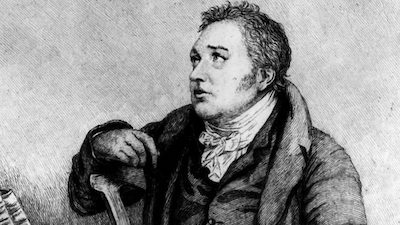
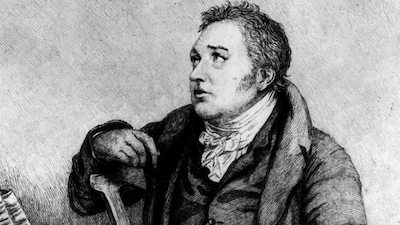
In Alethea Hayter’s fine book—but then she wrote only fine books—Voyage in Vain, she describes how Samuel Taylor Coleridge, en route to Malta, ‘identified himself’ with a sheep in a pen, destined, like the ducks and chickens, ‘to figure on the ship’s menu’. ‘He imagined it as coming from a countryside of flat peaceable meadows, and when he saw it cheerfully eating hay, he pictured its sensations, taking the brightness and sweet murmur of the sea for “dewy grass in sunshine, and the murmur of the trees”.’[3]
On another, more hazardous voyage, late in Moby Dick, Ahab’s anguished raving to the mate has: ‘“and the air smells now, as if it blew from a far-away meadow; they have been making hay somewhere under the slopes of the Andes, Starbuck, and the mowers are sleeping among the new-mown hay. Sleeping? Aye, toil we how we may, we all sleep at last on the field.”’[4]
Sensory commerce between ship and shore.
Helen, thy beauty is to me
Like those Nicéan barks of yore,
That gently, o’er a perfumed sea,
The weary, way-worn wanderer bore
To his own native shore.
Of Edgar Allan Poe’s poem ‘To Helen’, Guy Davenport remarked: ‘We can defend perfumed seas, which has been called silly, by noting that classical ships never left sight of land, and could smell orchards on shore, that perfumed oil was an extensive industry in classical times and that ships laden with it would smell better than your shipload of sheep. Poe is normally far more exact than he is given credit for.’[5]
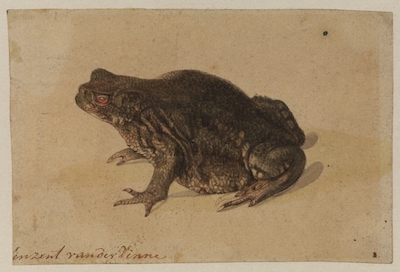
(Vincent Laurentsz van der Vinne, Toad: © The Courtauld)
Wet weather tends to steer us to the nearby park, a couple of circuits by varying paths. On drier days, we still head to Arnos Vale, pausing to pluck some rosemary from the bushes in Perrett Park, eyeing in several of our usual locations the blackberries which are nearly, nearly ready. Our walk back from Arnos Vale is along Cemetery Road. At home, I sit down with a cup of tea and a Mick Herron novel called, ah, Down Cemetery Road. And there is Zoë Boehm, thinking of Joe: ‘Larkin, she thought. He’d always been fond of Philip Larkin. Give me your arm, old toad; Help me down Cemetery Road. . .’[6]
Yes, not the famous ‘Toads’:
Why should I let the toad work
Squat on my life?
Can’t I use my wit as a pitchfork
And drive the brute off?
But ‘Toads Revisited’:
What else can I answer,
When the lights come on at four
At the end of another year?
Give me your arm, old toad;
Help me down Cemetery Road.[7]
(Naturally, having drafted this, I see a tweet from Noreen Masud, author of the excellent A Flat Place—‘We can’t live in this world without damaging or being damaged. The point is to be deliberate about which damage to give and take’[8]—with a photograph of the street sign for Cemetery Road and, for heading, that same quote from Larkin: ‘Give me your arm, old toad’. If you believe in coincidences, this is one; if not, not.)
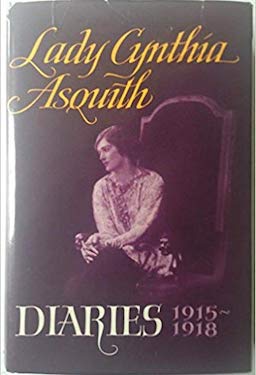
So the news of seemingly endless grotesque and malign misgovernment grinds on, and I think of D. H. Lawrence’s letter to Lady Cynthia Asquith in February 1917: ‘You mustn’t think I haven’t cared about England. I have cared deeply and bitterly. But something is broken.’[9]
I have too – and something is.
Notes
[1] Ford Madox Ford, ‘In the Little Old Market-Place’, Collected Poems (London: Max Goschen, 1913), 36.
[2] Lorrie Moore, I Am Homeless If This Is Not My Home (London: Faber & Faber, 2023), 149.
[3] Alethea Hayter, Voyage in Vain: Coleridge’s Journey to Malta in 1804 (1973; London: Robin Clark, 1993), 70.
[4] Herman Melville, Moby Dick (1851; edited by Harold Beaver, Harmondsworth: Penguin Books, 1972), 653.
[5] Guy Davenport, The Geography of the Imagination (Boston: David R. Godine, 1997), 7.
[6] Mick Herron, Down Cemetery Road (London: John Murray, 2020), 353.
[7] Philip Larkin, Collected Poems, edited by Anthony Thwaite (East St Kilda: The Marvell Press and London: Faber, 2003), 62, 90.
[8] Noreen Masud. A Flat Place: A Memoir (London: Hamish Hamilton, 2023), 210.
[9] Letters of D. H. Lawrence III, October 1916–June 1921, edited by James T. Boulton and Andrew Robertson (Cambridge: Cambridge University Press, 1984), 91.

 Reconstructionary Tales