
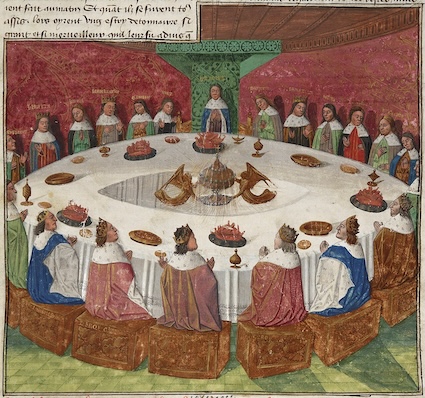
(Évrard d’Espinques, Arthur’s Knights at the Round Table)
June 1909. The seventh issue of the English Review, edited by Ford Madox Hueffer, begins with ‘Modern Poetry’, begins in fact with a notice (signed ‘E. R.’) of the death of the novelist and poet George Meredith on 18 May. Ford begins: ‘Mr Meredith follows Mr Swinburne into the shadows; and now, indeed, the whole Round Table is dissolved.’ And he comments on the suitability of that phrase given the Arthurian cycle’s domination of the age, among such writers and artists as Alfred Tennyson, Lewis Carroll, William Morris, Edward Burne-Jones, Dante Gabriel Rossetti, William Dyce, John Collier and J. W. Waterhouse. As well as the poetry, this issue offered work by Hilaire Belloc, Wyndham Lewis, Olive Garnett, H. M. Tomlinson, Joseph Conrad, Stephen Reynolds and Edward Thomas.[1]
But those ‘Modern Poets’? They were represented, in a downward sliding scale, by four poems, three, two and one. The four were by John Galsworthy, prolific novelist and playwright (but whose 1934 Collected Poems ran to just under 140 pages); there were three poems by Gerald Gould, poet, journalist and essayist, and two by Eden Phillpotts, astonishingly prolific novelist, poet and playwright (some 250 books).
And the one poem? That was by a certain Ezra Pound. Entitled ‘Sestina: Altaforte’, it began thus:
I
Damn it all! all this our South stinks peace.
You whoreson dog, Papiols, come! Let’s to music!
I have no life save when the swords clash.
But ah! when I see the standards gold, vair, purple, opposing
And the broad fields beneath them turn crimson,
Then howl I my heart nigh mad with rejoicing.[2]
Two anecdotes attaching to this, ‘the Bloody Sestina’ as Pound’s friends and acquaintances dubbed it, are, firstly, the poet declaiming it at full volume at a table in the Tour Eiffel restaurant, the occasion on which the waiter felt the need to place a screen around the offending party; and, secondly, Pound delivering it in a similar fashion to the sculptor Henri Gaudier. Deeply impressed, Gaudier reported to the writer and translator John Cournos his excitement at the fact that Pound had dared to use the word ‘piss’ in the opening line of his poem.[3] Perhaps one more note: in ‘How I Began’, relating the circumstances of its composition, Pound commented: ‘Technically it is one of my best, though a poem on such a theme could never be very important.’[4] That ‘theme’ being bloodlust, war, slaughter and other exultations (the title of the volume in which the poem was collected). A little more than a year after that comment, of course, that theme would become very prominent indeed.
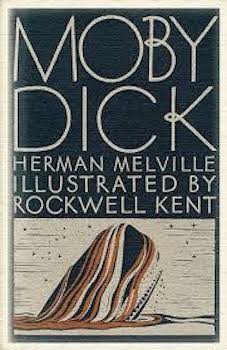
And yet . . . rather like the case of Melville’s Moby Dick, everyone knowing that it begins ‘Call me Ishmael’—except that it doesn’t, a page or so of ‘Etymology’, supplied by ‘a late consumptive usher to a grammar school’, being followed by more than a dozen pages of ‘Extracts’, supplied by ‘a sub-sub-librarian’, before those magic and memorable words appear—the case of Pound’s ‘Sestina: Altaforte’ also has some preliminary matter.
It actually begins thus:
LOQUITUR: En Bertrans de Born.
Dante Alighieri put this man in hell for that he was a stirrer-up of strife.
Eccovi!
Judge ye!
Have I dug him up again?
The scene is at his castle, Altaforte. “Papiols” is his jongleur.
“The Leopard,” [later in the poem] the device of Richard (Coeur de Lion).’
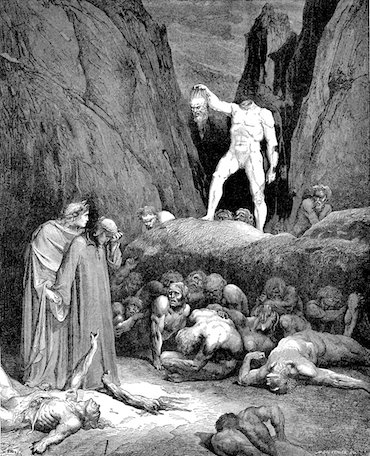
(Gustave Doré ill., Dante, The Vision of Hell, 1866)
And yes, Dante put Bertrans down in the Ninth Bolgia, among the makers of discord, carrying his own severed head by the hair.
E perchè tu di me novela porti,
sappi ch’ I’ son Bertram dal Bornio, quelli
che diedi al Re giovane I ma’ conforti.
‘And that thou mayst bear news of me, know that I am Bertran de Born, he that gave evil backing to the Young King. I made rebellion between the father and the son; Ahitophel did no worse for Absalom and David with his wicked goadings. Because I parted those so joined I carry my brain, alas, parted from its root in this trunk; thus it is observed in me the retribution.’[5]
More than 700 years further on, we may not feel so sure about a literal hell, though metaphorically, symbolically, huge numbers of people must feel themselves there on a daily and nightly basis. And we surely have a great many stirrers up of strife, for political or personal advantage, makers of discord, rabble rousers. Where might we put them now?
The novelist Sarah Moss once wrote (in what may still be my favourite of her books, or very close to it), ‘No one who knows what happens in the world, what humans do to humans, has any claim to contentment.’[6]
And a general sense of unease, of restlessness, is hardly surprising, as we see what this country (among others) is in worsening danger of becoming. The British—or the English—used to be widely admired for their qualities of tolerance and common sense—or so we believed, were led to believe. Could we believe it now? And if so, for how much longer?
Notes
[1] English Review, II, 7 (June 1909).
[2] Ezra Pound: Poems and Translations, edited by Richard Sieburth (New York: Library of America, 2003), 105.
[3] Helen Carr, The Verse Revolutionaries: Ezra Pound, H.D. and the Imagists (London: Jonathan Cape, 2009), 612.
[4] ‘How I Began’, T.P.’s Weekly (6 June 1913), 707. A note on De Born’s war songs added later to The Spirit of Romance read: ‘This kind of thing was much more impressive before 1914 than it has been since 1920.’
[5] Dante, The Divine Comedy of Dante Alighieri. I: Inferno, Italian text with translation and comment by John D. Sinclair (London: Oxford University Press, 1971), 353, Canto XXVIII.
[6] Sarah Moss, Signs for Lost Children (London: Granta Books, 2016), 97.

