Blackberries, cats and a tilly


And every tree is a tree of branches
And every wood is a wood of trees growing
     And what has been contributes to what is.
So I am glad to have known them,
     The people or events apparently withdrawn;
The world is round and there is always dawn
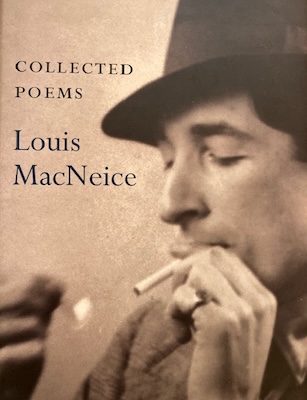
     Undeniably somewhere.[1]

Some days, if you’re early enough, you can walk all the way round a huge Victorian cemetery and not see even a single dogwalker—though you might catch sight of a fox, if you’re lucky. The blackberries have got ahead of themselves to such an extent that  they’ll barely last the month: but once in the freezer drawer, they’ll see us well into winter.  Cow parsley, Anthriscus sylvestris, or Queen Anne’s lace (or, I gather, keck) still hangs on in places. A mistle thrush and a song thrush seem to answer one another and there’s a goldcrest somewhere near.

We are well past midsummer now. Glastonbury Festival is over (I shall probably get The Cure’s ‘Friday I’m in Love’ out of my head soon), the Wimbledon tennis tournament finished, the Bristol Harbour Festival has happened and the Balloon Fiesta is just a couple of weeks away. The wider canvas still largely features arterial blood and heavy boots on infant faces though even some Western politicians have now begun to wonder if deliberately starving thousands of innocent civilians and then shooting them down in cold blood day after day when they try to secure food might be just a bit over the top. Even so, to demonstrate that they know what’s terrorism and what isn’t, our government is prosecuting people who object to their country’s complicity in war crimes.

But pass on, pass on. Books, music, food, wine, love, cats.

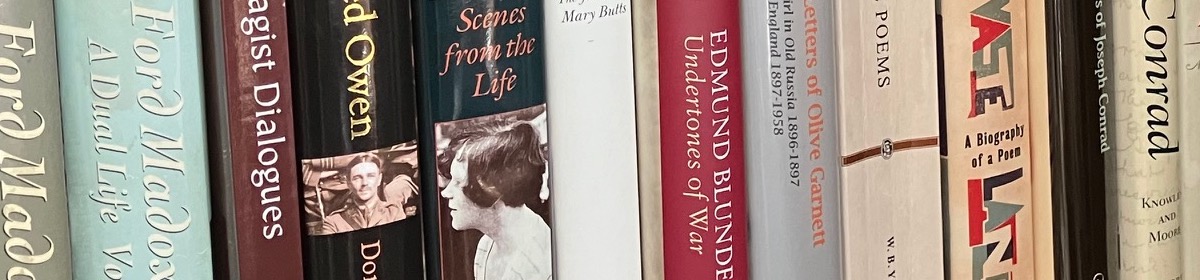
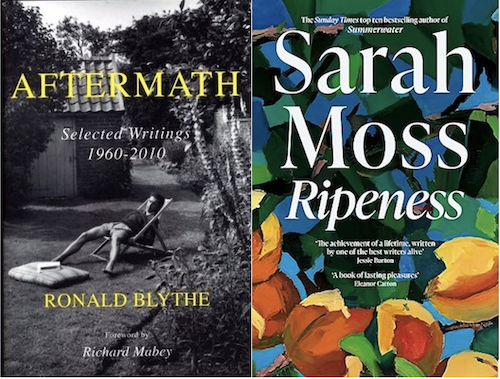
When I surface from Ford’s letters, I have waiting for me Paul Willetts’ remarkable reconstruction of the life of Julian Maclaren-Ross, Ronald Blythe, Sarah Moss, early Ernest Hemingway. Otherwise, I just revel in Anne Carson:

‘My mother forbad us to walk backwards. That is how the dead walk, she would say. Where did she get this idea? Perhaps from a bad translation. The dead, after all, do not walk backwards but they do walk behind us. They have no lungs and cannot call out but would love for us to turn around. They are victims of love, many of them.’[2]

Yes. Meanwhile, the weather, or much of it, prompts me to recognise my increasing intolerance to higher temperatures (and to much else: I know I’m widely assumed to become more conservative politically as I age but something’s clearly gone wrong). Earlier walks, more water, more cursing – I know all the tricks.

As to cats – yes, I like to remember that ‘Balthus painted himself once as a cat dining on fish, and once as the King of the Cats.’[3] Sylvia Townsend Warner mentioned, in a letter to William Maxwell (9 April 1952) , the northern Scottish traveller’s tale of seeing the cat funeral. ‘And the cat of the house, lying on the hearth, started up at these words, and exclaimed, “Then I am the King of the Cats”, and vanished up the chimney.’[4] When Swinburne died in 1909, William Butler Yeats said to his sister Lily, ‘Now I am king of the cats.’[5]

.

(John Butler Yeats, portrait of embroiderer, and co-founder (with her sister Lolly) of Cuala Industries, Susan Mary (Lily) Yeats (1901): National Gallery of Ireland)

The novelist, suffragist and partner—for several fraught years—of Ford Madox Ford had a good many of them: ‘Violet’s parrots—part of a menagerie that included an  owl (named Anne Veronica after Wells’s novel), a bulldog and nine Persian cats—shrieked “Ezra! Ezra!” whenever they saw him bouncing up the walk.’[6]

I can, alas, only half-agree with Lord Peter Wimsey when he says to Parker at the end of that bell-ringing mystery, The Nine Tailors, ‘“Bells are like cats and mirrors – they’re always queer, and it doesn’t do to think too much about them.”’[7] Queer they may be but I think about them a good deal and seem none the worse for it.

There was a collection of essays published ‘on the Occasion of the 25th Anniversary of Finnegans Wake’, which included pieces by Padraic Colum, Frank Budgen, Vivian Mercier, Fritz Senn, A. Walton Litz and other distinguished Joyceans. It was called Twelve and a Tilly.[8]

For ‘tilly’, my Shorter Oxford has: ‘In Ireland and places of Irish settlement, an additional article or amount unpaid for by the purchaser as a gift from the vendor.’ Joyce’s nocturnal masterpiece offers four occurrences and the splendid online glossary – http://finwake.com – adds to ‘the thirteenth of a baker’s dozen’ the derivation from Irish tuilleadh, added measure.

Opening my eyes to uncertain light, I can hear the table-tennis ball moving in the kitchen and the hall, knocking against skirting-boards and doorframes. I get up for a pee and a small grey tabby runs in to check on my progress and brush against my legs. Getting back into bed, I see that it’s 03:50. Moments later, the table-tennis ball is on the move again.
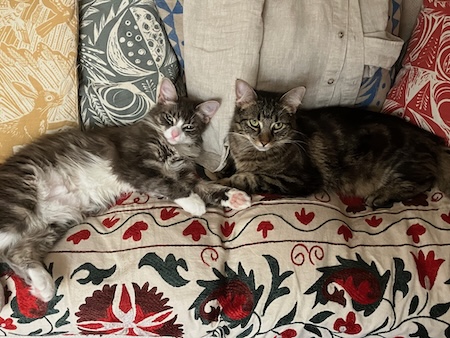
Yes, we have our own Tilly now, not an added measure but one-half of a pair. Her brother is named Max, which I like in part because it was the name of the very first pet I remember, in Gillingham, Kent, a black cocker spaniel—but also because of the occasional fleeting uncertainty which attends such phrases as ‘I said to Max’ or, more plausibly, ‘I asked Max’, which might conceivably be a reference to either a handsome tabby or our leading Ford Madox Ford scholar.

Scholars, though, at least as a general rule, do not sit in the kitchen sink, talk to toy mice or suck their tails. . .

Notes


[1] Louis MacNeice, ‘Autumn Journal: XXI’, Collected Poems, edited by Peter McDonald (London: Faber, 2007), 153.

[2] Anne Carson, ‘On Walking Backwards’, Plainwater: Essays and Poetry (New York: Vintage, 2000), 36.

[3] Guy Davenport,  A Balthus Notebook (New York: Norton, 1989), 7. Le Roi des Chats (1935). Balthus identified strongly with cats: in the year of this self-portrait, he began signing his letters to his future wife Antoinette as ‘King of Cats’. ‘Jeune fille’ occurs many times in the titles of his paintings—but so does ‘chat’ (sometimes together).

[4] Sylvia Townsend Warner, Letters, edited by William Maxwell (London: Chatto & Windus, 1982), 133.

[5] Yeats to Susan Mary (‘Lily’) Yeats, 12 Apr. 1909: R. F. Foster, W. B. Yeats: A Life. I: The Apprentice Mage: 1865–1914 (Oxford: Oxford University Press, 1997), 616n.69.

[6] Pound, of course. Barbara Belford, Violet: The Story of the Irrepressible Violet Hunt and her Circle of Lovers and Friends—Ford Madox Ford, H. G. Wells, Somerset Maugham, and Henry James (New York: Simon and Schuster, 1990), 166-7.

[7] Dorothy L. Sayers, The Nine Tailors (1934; with an introduction by Elizabeth George, London: New English Library, 2003), 305.

[8] Twelve and a Tilly: Essays on the Occasion of the 25th Anniversary of Finnegans Wake, edited by Jack P. Dalton and Clive Hart (Evanston: Northwestern University Press, 1965).
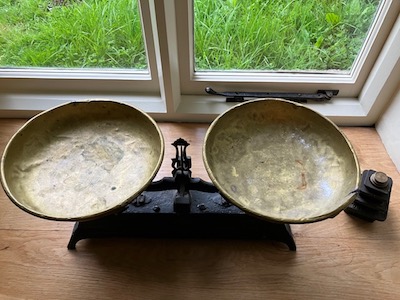
In the Scales

On 25 August 1773, in an indifferent inn at Banff, James Boswell watched Samuel Johnson pen a long letter to Mrs Thrale. ‘I wondered to see him write so much so easily. He verified his own doctrine that “a man may always write when he will set himself doggedly to it.”’[1]

Dogged, yes: ‘sullen’ I don’t quite see but ‘pertinacious’, holding obstinately to an opinion or a purpose, unyielding, we can certainly settle for. So that

Writing of April in the Scotland uplands, of mainly grey days, cold and snow, the 20-year-old John Buchan remarked: ‘Nor have we any of the common associations of spring, like the singing of birds. A mavis or a blackbird may on occasion break into a few notes, and there is, for certain, an increasing twitter among the trees. But the clear note of the lark as yet is not; the linnet does not pipe; the many named finches are still silent.’[2]

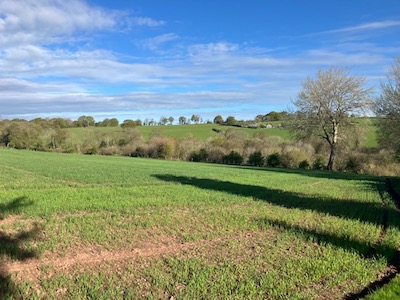
We have also been in the hills this April, though further south, with not a hint of snow. A few days in the Black Mountains, the border country, with its panoramic vistas and the River Wye looking sleek and animated and glossy, and where, on some roads, you move from England to Wales and back again with dizzying ease and frequency. That was in a foreign country. . .

As for birds. . . . In a few days and in a limited area, we saw or heard (frequently both), skylark, chaffinch, blackbird, robin, blackcap, sparrow, wood pigeon, linnet,  chiffchaff, wren, dunnock, crow, goldfinch and song thrush (Buchan’s ‘mavis’).[3] Many of these in the trees and the grass outside the living-room or kitchen windows of the farmhouse we were renting, others on walks through fields and woods.

Birds we had, then, in abundance. Space and grass and sheep and silence also. Wi-Fi, broadband, not so much. ‘I’ve rebooted it and logged on several times, it seems fine now’, the housekeeper said before leaving. The blue light lasted for at least a minute. The Librarian tried resetting it a few times, quite a few times, over the next few days with the same result. But we had food, wine, books and packs of cards. There were mobile phones too, in the event of an emergency. We survived. And what lengths would we go to, should we go to, for the latest news? After all, given the current state of things, should you not warm to neo-fascist extremism or the aggressive erasure of history or the continuing mass murder of civilians or the vicious suppression of non-violent protest, there’s little in daily bulletins to lift the spirits. Some people, though—and I have it on the best authority—can find it oddly cheering to see, as they cross a field from stile to stile, a pheasant strolling to and fro in that field, apparently without a care in the world.

So Inspector Jules Maigret sweltered in August heat or remained on edge when ‘no one had ever known such a damp, cold gloomy March.’[4] Virginia Woolf did not go to the party at Gordon Square where the d’Aranyi sisters, Adila, Hortense and Jelly (‘great-nieces of the renowned Hungarian violinist Joachim’) would be playing, because Leonard arrived home too late, ‘& it rained, & really, we didn’t want to go.’[5] And I was glad to learn about the Society of Dilettanti, concerned with practical patronage of the arts, whose members included Sir Joshua Reynolds, David Garrick and Charles James Fox, and to be told of Horace Walpole’s writing that, while the nominal qualification for membership of the Society was having been to Italy, the real one was being drunk.[6]

After the diversions of fictional Paris and historical Brighton, I am now with James Boswell, young Boswell on his Grand Tour, after Holland, currently in Germany, soon to be in Switzerland. He is still often preposterous, still wholly irresistible—and still battling with the Black Dog (‘The fiend laid hold of me’). But he finds diversions enough: ‘I must not forget to mark that I fell in love with the beauteous Princess Elizabeth. I talked of carrying her off from the Prince of Prussia, and so occasioning a second Trojan War.’[7]

We are back, then, via taxi and train among Good Friday crowds, walking again in the park amidst hurtling spaniels rather than quietly to and fro along a secluded lane with teeming hedgerows, remarkable trees and glimpses of an unfamiliar breed of sheep, which gave rise to a good deal of highly technical agricultural vocabulary: ‘God, they’re chunky!’ Too far away for a convincing photograph but, scanning various sheep breeders’ websites, we agree that they were probably Zwartbles.

As confirmed by such remarks, we are now returned to what E. M. Forster termed the world of ‘telegrams and anger’—minus the telegrams, of course, and seemingly with many times the anger. We are also back, that is to say, in the firm grip of the internet. Does that warrant one cheer or two?


Notes

[1] James Boswell, The Journal of a Tour to the Hebrides with Samuel Johnson, LL.D., edited by Ian McGowan (1785; Edinburgh: Canongate Books, 1996), 234-235.

[2] John Buchan, ‘April in the Hills’, in Scholar-Gipsies (1896; London: John Lane The Bodley Head, 1927), 28.

[3] Apparently derived from the French mauvis (though, confusingly, this seems to mean ‘redwing’, turdus iliacus rather than turdus philomelos). ‘It is still used for the bird in Orkney and survives elsewhere in Scotland’: Mark Cocker and Richard Mabey, Birds Britannica (London: Chatto & Windus, 2005),  358-359.

[4] Georges Simenon, Maigret’s Failure, translated by William Hobson (Penguin Books, 2025), 1; August heat in Maigret Sets a Trap, translated by Siân Reynolds (London: Penguin Books, 2017).

[5] The Diary of Virginia Woolf, Volume 1: 1915-19, edited by Anne Olivier Bell (with the Asheham Diary, London: Granta, 2023), 11-12.

[6] Venetia Murray, High Society in the Regency Period: 1780-1830 (London: Penguin Books, 1999), 165.

[7] Boswell on the Grand Tour: Germany and Switzerland 1764, edited by Frederick A. Pottle (London: William Heinemann, 1953), 12, 67.

Dusks and darks

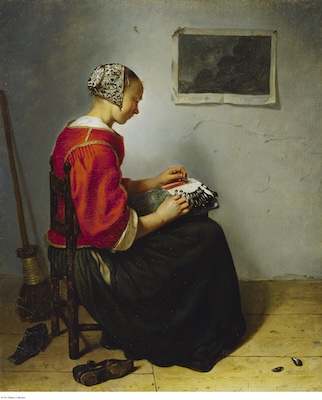
(Caspar Netscher, The Lace Maker, Wallace Collection)

‘In a mid-September twilight’, Ford Madox Ford writes, remembering himself as Second Lieutenant in September 1916, ‘the rain poured down on Pont-de-Nieppe.’ He is bothered by his wet shirt-cuffs and the man assigned to him as temporary batman has clearly decided that Ford is not a man who can be safely left and, ‘though he must have been uncommonly wet and hungry and tired, he followed me to the door of the house in whose dark windows I had seen the luminous patch—the forehead of Rosalie Prudent as she sat sewing, her head bent forward, in the twilight.

‘I don’t know how it is: but from the moment when I first saw that highlight—and it had been certainly three hours before—I had been perfectly sure that that was what it was—the forehead of a quiet woman bending her head forward to have more light from the high window whilst she sewed in the dusk.’

This is Rosalie Prudent of Pont-Nieppe, who has lost her house, her husband and her sons, and is one of the most significant figures that Lieutenant Ford Madox Hueffer—a man at the end of his tether and a writer who cannot write—will encounter during the war. She will sit by the stove in the wash-house, sewing his wristbands. She will cook him an omelette and fried potatoes, talk to his orderly and, ‘looking at Mme. Rosalie—so extremely centred in the work in hand, so oblivious to the very real danger, so brave and so tranquil, I said to myself:
“What the devil! If she can stick it, I too can!”’[1]

And he will. He is one young Australian artist and one five shilling a week cottage away from salvation: ‘The dusk was falling as I approached my isolated, sixteenth century abode that had a leaky, red-tiled roof and defective diamond-framed casements. It stood under a darkling bank. . . . And you think that the half-crown dog was an extravagance! I assure you that he was not. The floors sagged, the paper fell in scrolls from the walls. There was more than a bushel’s bulk of starling’s nest in the downstairs ingle.’[2]

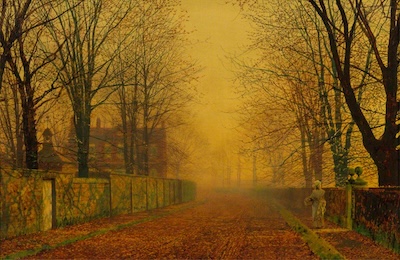
Back in the day—ah, those days—I read, as did half the people I knew at the time, the books of Carlos Castaneda or, at least, the first three or four. Much of it, even the unfolding controversy, is a little cloudy now, but I do recall the assertion that: ‘The twilight is the crack between the worlds.’ Or rather, I recalled it as I made my way around the park a day or two back as the light slipped further down into its last phase before incontrovertible darkness.

(John Atkinson Grimshaw, Evening Glow: Yale Center for British Art)

If that is in fact the case, some of the denizens of that other world are a little unsettling. As is, of course, the possibility that I myself am, in fact, an inhabitant of the ‘other’ world.

There seem to be more people than usual devoting their time to shouting into phones or at dogs, heard rather than seen, or glimpsed between branches or benches. A man wearing a cloth cap and an alarming neck tattoo scatters broken biscuits from a bag as he walks, to more than a dozen crows and one slightly shifty magpie (‘Yeah, I’m a crow. Who’s asking?’). A second man passes me, marching like a robot, legs thrown out, with a can of beer gripped in each outstretched hand; a teenaged schoolgirl, one of three, having an emotional moment, turns her tearstained face away from me as I pass and one of her friends says: ‘I didn’t meant to hurt you, Lily, but you shouldn’t have said—‘. And on an upper path, a woman running towards me; I cross over to make room for her; she smiles and turns sharply into the play area ten yards ahead, to crouch in front of a swing on which her child is sitting, watched over by a friend.

Vladimir Nabokov mentions ‘soomerki—the lovely Russian word for dusk.’[3] It is, or can be, oddly different, the air itself a different texture or the mind made more receptive to such notions by the slippage in other senses: sounds half-heard and harder to locate, things not quite seen. A Golden Labrador with one of those illuminated collars races through a thick ribbon of trees that borders a lower path, a ghost dog that has me wracking my brains to come up with Jim Jarmusch’s 1999 film, Ghost Dog: The Way of the Samurai, with Forest Whitaker as the hitman. A group of dog-owners I passed earlier did look and sound like contract killers but that may have been down to the special sound qualities of this twilight zone.

(G. F. Watts, A Sea Ghost: Watts Gallery – Artists’ Village)

‘It is the magic hour’, Lawrence Durrell wrote, ‘between two unrealized states of being—the day-world expiring in its last hot tones of amber and lemon, and the night-world gathering with its ink-blue shadows and silver moonlight.’[4] The colours may be a little different in Corfu, as emotional responses might have been a little more accentuated in Emerson’s nineteenth-century New England: ‘Crossing a bare common, in snow puddles, at twilight, under a clouded sky, without having in my thoughts any occurrence of special good fortune, I have enjoyed a perfect exhilaration. I am glad to the brink of fear.’[5]

Richard Garnett (father of Edward and Olive, father-in-law of Constance) wrote about The Twilight of the Gods (as did Richard Wagner); Nietzsche wrote about the Twilight of the Idols; D. H. Lawrence wrote of Twilight in Italy; Edith Wharton was concerned with Twilight Sleep; a volume of Conan Doyle stories was called Tales of Twilight and the Unseen.  ‘I drove carefully’, the private eye Lew Archer says, ‘feeling a little depressed, stalled in the twilight period when day has run down and night hasn’t picked up speed.’[6]

We’re just a week away from the winter solstice, the shortest day, the longest night. Beyond that date, of course, the days get longer, inch by inch. Grounds for optimism, some say. And why not? Just mind the cracks—and, of course, those worlds.


Notes

[1] Ford Madox Ford, No Enemy (1929; edited by Paul Skinner, Manchester: Carcanet Press, 2002), 117, 127, 124.

[2] Ford Madox Ford, ‘Rough Cookery’, New York Herald Tribune Magazine (29 July 1928), 18.

[3] Vladimir Nabokov, Speak, Memory: An Autobiography Revisited (New York: Putnam’s, 1966), 81.

[4] Lawrence Durrell, Prospero’s Cell (London: Faber 1962), 105.

[5] Ralph Waldo Emerson, ‘Nature’, Selected Essays, edited by Larzer Ziff (Penguin American Library, 1982), 38.

[6] Ross Macdonald, The Moving Target (1949; Warner Books, 1990), 98.

By heart in the park

(Philip Wilson Steer, Dover Coast: York Art Gallery)

Another last warm and sunny afternoon of autumn. How many more can there be? With the Librarian in the office for a pretty full day, so not available for the lunchtime stroll, I walk alone in the park and succumb to the temptation to recall (and recite) the handful of poems that, at one time or another, I’ve committed to memory. Committed they may have been but seem, for the most part, to have escaped or at least to be out on parole.

Matthew Arnold’s ‘Dover Beach’ is worse than shaky and, in its current state, Marvell’s ‘To His Coy Mistress’ would probably not detain her for a moment. A bit of Pound, a bit of Yeats and a fragment of Elizabeth Bishop all hold steady, while a couple of others improve with work, which necessitates keeping a wary eye open – and an ear, given the increasing tendency of people to rush up behind you on bicycles or accursed electric scooters. Robert Lowell’s ‘Skunk Hour’ (dedicated to Bishop) yields a little to pressure:

Nautilus Island’s hermit heiress still
something something
her sheep still graze above the sea

Two men, walking briskly but not quite briskly enough, so staying almost exactly the same distance behind me, fairly close and, worse, very gradually nearing. . .

Her farmer
Is first selectman in our village;
she’s in her dotage.

We’re sailing now. Ah:

Thirsting for the hierarchic privacy
of Queen Victoria’s century,
she buys up all
the eyesores facing her shore,
and lets them fall.

(Lowell and Bishop in Brazil, 1962. Photo: Vassar College Library via the New Criterion)

But then there’s some confusion in the order of half-remembered stanzas, though I have most of the mother skunk’s activities in the final one. Move on to surer ground, anyway, the much-learned, almost-all recollected ‘Bagpipe Music’.

Though here a slight pause for the woman standing with her dog at the top of a slope below the play area. Is it a Pointer? We’ve seen it more than once before. Similar shape, similar attitude, its attention fixed on something in the grass near the foot of a tree, that can only be a squirrel. Looking it up later, I see that it’s a Vizsla, also known as a Hungarian Pointer. I stroll past it, resisting the impulse to give it some advice: you may be quick but you won’t win, they climb, you don’t. We’ve seen some close shaves for squirrels in the past but they always seem to evade dogs’ jaws. And ‘Bagpipe Music’? Pretty good, in fact. A slight hiccup over the penultimate stanza but both MacNeice and myself ending strongly:

It’s no go my honey love, it’s no go my poppet;
Work your hands from day to day, the winds will blow the profit.
The glass is falling hour by hour, the glass will fall for ever,
But if you break the bloody glass you won’t hold up the weather.

Now distractions range from the two old ladies intent on feeding a squirrel by hand (‘Come on, dear, see what I’ve got’ – Fleas, soon enough, I suspect) to the fellow with the ponytail and curious blue-green leggings intent on kicking a very small ball across the grass, and who crosses my path again half an hour later in a different and distant part of the park; and a murder of crows, around thirty in total, spread right across and down a broad grassy slope to the cycle path that runs along beneath the outspread branches of several wild pear trees. The fruits fall partly onto the earthy slopes beyond and partly onto the cycle path itself, one missed my right ear by inches one day last week. Walking along that path now before climbing sharply to my left, I see a dozen crows rooting among the fallen pears, though some turn to stare at me as I approach. ‘Are you auditioning for that nice Mister Hitchcock?’ I ask. One crow, not to be put off by a mere human, lingers to stick its beak straight through a pear before flying up to the branch above. Knowing how clever corvids are, I watch to see how it goes about extricating beak from fruit. It thrusts the pear into a narrow fork of branches which holds it in a tight embrace, withdraws the beak and starts tucking in. I whistle my sincere appreciation. That Lowellian mother skunk, I recall,

    jabs her wedge-head in a cup
of sour cream, drops her ostrich tail,
and will not scare.

Why is it so hard these days? No answers on a postcard, please. At school, everyone learned poems by heart and some people never lost the habit. I recalled an aside of the Reverend Kilvert: ‘I thought of William Wordsworth the poet who often used to come and stay at this house with blind Mr. Monkhouse who had nearly all his poems off by heart.’[1] Eric Gill’s father and one of Gill’s teachers, named Mr Catt, were great admirers of Tennyson. Gill himself also learned much of it by heart, being particularly fond of ‘the passage about the routine of rural agriculture:

As year by year the labourer tills
His wonted glebe and lops the glades’[2]

This is from stanza CX of Tennyson’s In Memoriam A. H. H., the initials those of Tennyson’s beloved friend Arthur Henry Hallam, who died in Vienna in 1833. Born in 1811, he was eighteen months younger than Tennyson. They had met at Trinity College, Cambridge in 1828. Tennyson seems to have begun this long poem very soon after hearing of Hallam’s death, though it was not published until 1850, and then anonymously. Edward Fitzgerald—translator of The Rubaiyat of Omar Khayyam—wrote to the poet’s elder brother Frederick Tennyson (15 August 1850): ‘Alfred has also published his Elegiacs on A. Hallam: these sell greatly: and will, I fear, raise a host of Elegiac scribblers.’[3]

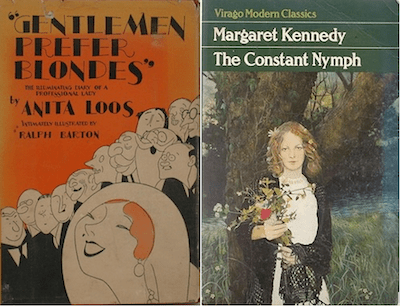
But it is not only poetry that the heroes of yesteryear committed to memory in large chunks – some mastered prose in a similar way, which always seems to me somehow an even more impressive achievement, though I accept that actors, having to learn their lines, sometimes comprising tremendously long speeches or monologues, would not necessarily find it so. Joseph Conrad and Ford Madox Ford would swap pages of Flaubert or Maupassant, while James Joyce ‘knew by heart whole pages of Flaubert, Newman, de Quincey, E. Quinet, A. J. Balfour and of many others.’[4] And, while Anita Loos’ Gentlemen Prefer Blondes was apparently one of Patrick White’s favourite novels (Joyce, Faulkner and Edith Wharton were also admirers), he knew Margaret Kennedy’s The Constant Nymph ‘practically off by heart.’[5]

‘Heart’ is another of those words with a great many friends, the compounds running over several columns of the dictionary: in one’s mouth or boots or the right place; open, shut, taken; worn on the sleeve; piercing, rending, sore and sick. It has its reasons and is, in many contexts, simply mysterious, as the author of ‘Dover Beach’ wrote:

But often, in the world’s most crowded streets,
But often, in the din of strife,
There rises an unspeakable desire
After the knowledge of our buried life;
A thirst to spend our fire and restless force
In tracking out our true, original course;
A longing to inquire
Into the mystery of this heart which beats
So wild, so deep in us – to know
Whence our lives comes and where they go.[6]

I briefly consider this last poem as a candidate but coming in at around a hundred lines, it may be a stretch too far for me. Sonnets are a handy length, though . . .


Notes

[1] Francis Kilvert, entry for 27 April 1870, Kilvert’s Diary, edited by William Plomer (London: Jonathan Cape, 1938, reissued 1969), I, 119.

[2] Fiona MacCarthy, Eric Gill (London: Faber & Faber, 1990), 26.

[3] The Letters of Edward Fitzgerald, edited by Alfred McKinley Terhune and Annabelle Burdick Terhune, four volumes (Princeton: Princeton University Press, 1980), I, 676.

[4] Frank Budgen, James Joyce and the Making of ‘Ulysses’ and other writings, enlarged edition (1934; London: Oxford University Press, 1972), 181. Edgar Quinet was a French historian; by A. J. Balfour is meant, presumably, the British Prime Minister (1902-1905) – who also published works of philosophy.

[5] David Marr, Patrick White: A Life (London: Vintage, 1992), 85.

[6] Matthew Arnold, ‘The Buried Life’, Poetry and Criticism of Matthew Arnold, edited by A. Dwight Culler (Boston: Houghton Mifflin, 1961), 114.

Rosemary, responsibility


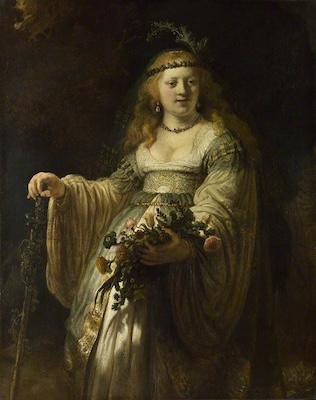
(Rembrandt van Rijn, Saskia van Uylenburgh in Arcadian Costume: National Gallery, London)

In the other park, which we traverse quite often, there are rosemary bushes to be discreetly ransacked – for potatoes, fish, meat, as well as for remembrance. ‘“There’s rosemary, that’s for remembrance”’, Ophelia says. And Laura Cumming notes that when Rembrandt’s wife Saskia van Uylenburgh died in 1642, at the age of 29 and after less than eight years of their marriage, Rembrandt ‘put a sprig of rosemary in her hand: rosemary for remembrance.’[1]

The weather forecast offers a 70% chance of rain. I add an umbrella to my tote bag and am soon walking uphill – in warm sunshine. Yes, the forecasts are more sophisticated these days, with many technical advances – on the other hand, I seem to remember that, in the days before we broke the weather, things were a bit more definite. Or did conditions appear to change every ten minutes then as well?


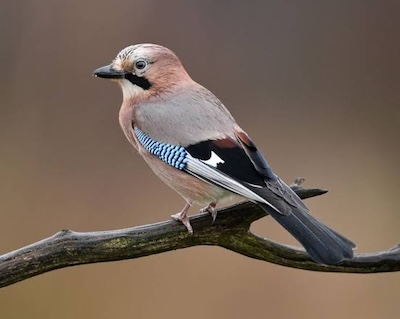
Under an abruptly darkening sky, I enter the park and the uncertain terrain of rosemary-picking. Plants in a public park: it would never occur to me to pick flowers in one and take them home since they’re for everybody to look at and enjoy. But a bush, herbs, green, largely unnoticed, simply wasted if not used. . . the case is altered, surely. Nevertheless, I aim for discretion and scan the park. Two women with dogs on the grassy slope; a woman with a child in a pushchair walking towards me on the path. Progress is arrested by the sight of a jay, landing on a nearby wooden post. It lingers for ten, fifteen seconds. I stand and stare. Eventually, it moves, I move. The woman says, in passing: ‘Pretty birds, aren’t they?’ Always the loquacious Englishman, I say ‘Yes, very’, moving on to stock up on rosemary and continue my walk into a sunshine resuming its humorous campaign.


In another campaign, the fallout from the presidential debate in Philadelphia on Tuesday night was still dominating the media, and I could still amuse the Librarian by abruptly announcing: ‘They’re eating the dogs!’ but the joke, if that’s what it is, is a dark one. Like a great many other people – at least I hope so, I’m baffled by this stuff much of the time, by those ‘undecided voters’, let alone those determined to make America hate again.

I realised later that it was the birthday of Louis MacNeice, a fine poet who also kept a wary eye on the political weather and who died at the absurdly young age of 55. Thinking of how the wrong things keep happening and the wrong people ending up on top almost invariably, and how far, how much, if at all, the rest of us can be said to bear responsibility, I noted the lines in his Autumn Journal:


And at this hour of the day it is no good saying
            “Take away this cup”;
Having helped to fill it ourselves it is only logic
            That now we should drink it up.
Nor can we hide our heads in the sand, the sands have
            Filtered away;
Nothing remains but rock at this hour, this zero
            Hour of the day.[2]

‘Responsibility’ is a handy word. Delmore Schwartz’s famous short story, ‘In Dreams Begin Responsibilities’, which gave his first volume its title, has the narrator watching, on a movie screen, the time just before the beginning of his own life, his parents moving towards their disastrous marriage, which will have a lasting and damaging effect on the poet. He’s ejected from the cinema after shouting at the screen—’“What are they doing?”’—and wakes up ‘into the bleak winter morning of my twenty-first birthday, the windowsill shining with its lip of snow, and the morning already begun.’[3]

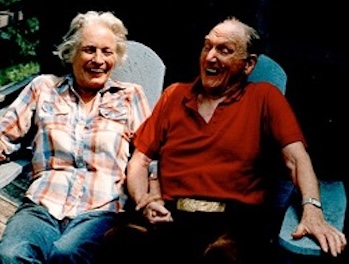
But I was thinking too of the close of Robert Penn Warren’s fine novel, All The King’s Men : ‘soon now we shall go out of the house and go into the convulsion of the world, out of history into history and the awful responsibility of Time.’[4] The connection is with MacNeice, because of that poet’s relationship with Eleanor Clark in 1939-40. When MacNeice was invited by F. R. Higgins to join the Irish Academy of Letters, it was to Eleanor that he wrote about it, saying that ‘The Irish Academy of Letters meets once a year in Dublin’s only decent restaurant and gets so drunk they have to send the waiters away.’[5] Clark grew up in Connecticut, went to  Vassar in the 1930s, and worked on their literary magazine with Elizabeth Bishop and Mary McCarthy, among others. She wrote for left-leaning magazines and journals such as The Partisan Review, thought of herself for a while as a ‘Trotskyite sympathizer’ and went to Mexico in the late 1930s. Apparently, she did some translating for Trotsky and was married for a while to his Czech secretary, Jan Frankl. She wrote novels, essays and reviews, children’s books and a memoir, but was probably best-known for her travel books, Rome and a Villa and The Oysters of Locmariaquer. She married Robert Penn Warren in 1952 and died in 1996, aged 82, seven years after Warren himself.


(Eleanor Clark and Robert Penn Warren at their summer home in West Wardsboro, Vermont, 1986: Kentucky Library and Museum)

The novelist Nicholas Mosley once wrote that ‘Humans can either learn – or refuse to believe that humans are responsible for themselves.’[6] My favourite use of ‘responsibility’, though, is probably that of the hugely influential Trinidadian radical historian, journalist and political theorist, C. L. R. James, who adopted, in his early years, William Makepeace Thackeray’s Vanity Fair as the book: ‘By the time I was fourteen I must have read the book over twenty times’. And he adds, a little later: ‘Thackeray, not Marx, bears the heaviest responsibility for me.’[7]

That radical, Thackeray!

Notes


[1] William Shakespeare, Hamlet, IV. v.; Laura Cumming, Thunderclap: A memoir of art and life & sudden death (London: Chatto & Windus, 2023), 61.

[2] Louis MacNeice, Collected Poems, edited by Peter McDonald (London: Faber, 2007), 111.

[3] Ilan Stavans, editor, The Oxford Book of Jewish Short Stories (New York: Oxford University Press, 1998), 165.

[4] Robert Penn Warren, All The King’s Men (1946; Harmondsworth: Penguin, 2007), 661.

[5] Louis MacNeice, Letters of Louis MacNeice, edited by Jonathan Allison (London: Faber, 2010), 351.

[6] Nicholas Mosley, Efforts at Truth: An Autobiography (London: Minerva , 1996), 299.

[7] C. L. R. James, Beyond a Boundary (1963; London: Vintage, 2019), 24, 52.

Wording, birding


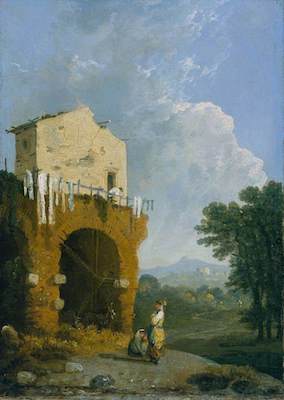
(Robert Wilson, Hadrian’s Villa, c.1765: Tate)

‘At night I trailed from one window recess to another’, the Emperor Hadrian recalls in Marguerite Yourcenar’s novel, ‘from balcony to balcony through the rooms of that palace where the walls were still cracked from the earthquake, here and there tracing my astrological calculations upon the stones, and questioning the trembling stars. But it is on earth that the signs of the future have to be sought.’[1]

So it is. ‘Ghosts await you in the future if they do not follow you from the past’, Sarah Moss wrote, and: ‘No one who knows what happens in the world, what humans do to humans, has any claim to contentment.’[2] Yes. I write pages and delete them, since they serve no real purpose except to relieve my feelings for a short while. The past is not always a foreign country and they do not always do things differently there. As Pankaj Mishra said in his recent ‘Winter Lecture’: ‘It hardly seems believable, but the evidence has become overwhelming: we are witnessing some kind of collapse in the free world.’[3]

Early summer creeps on, though fitfully. Watching rose petals fall from the bush in a light wind, I remembered Pound’s Canto XIII, the first in which Confucius appears, and which ends:

The blossoms of the apricot
            blow from the east to the west
And I have tried to keep them from falling.[4]


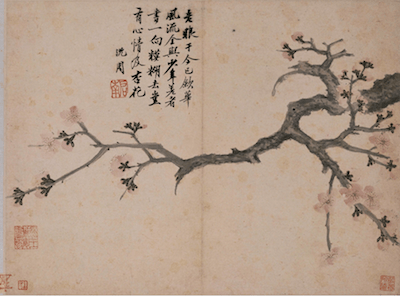
(Shen Zhou, ‘Apricot Blossom’, leaf from the album, Dreaming of Travelling While in Bed: Palace Museum, Beijing)

Ronald Bush observed that: ‘To keep the blossoms of the apricot from falling is to keep nature in a permanent vernal bounty.’[5] It also seems to me to signify cultural contact, the free exchange of ideas, without the limits of borders or nationalism. At that stage, Pound was using Guillaume Pauthier’s translation of Confucian texts in Confucius et Mencius: les quatre livres de philosophie morale et politique de la Chine and had written in ‘Exile’s Letter’:

Intelligent men came drifting in from the sea and from the west border,
And with them, and with you especially
There was nothing at cross purpose,
And they made nothing of sea-crossing or of mountain crossing,
If only they could be of that fellowship,
And we all spoke out our hearts and minds, and without regret.[6]

On the daily walks we speak our minds but, just lately, exchanges are punctuated by information from our newly downloaded Merlin app, available from Cornell University, which draws on a huge database of bird sounds, sightings and photographs to identify what you’re probably hearing in that nearby tree or passing overhead.


So we stroll along narrow paths thus:

Politics, dinner, politics. . .
‘Blue tit. Carrion crow. Wren.’
Politics, domestic details, politics, cat, literary chuntering. . .
‘Dunnock. Blackcap. Chiffchaff.’
Ash dieback, politics, university gossip, politics. . .
‘Blackbird. Herring gull. Great tit. Jay!’

Excuse me, sir, let me just ask about the birdsong: in a world both literally and metaphorically on fire, democracies hanging by a thread, war crimes, liars and knaves in public places – does it help?

Why, yes, a little – rather more than a little, in fact. . .


Notes

[1] Marguerite Yourcenar, The Memoirs of Hadrian, translated by Grace Frick, with Yourcenar (1951; Penguin Books, 2000), 82.

[2] Sarah Moss, Signs for Lost Children (London: Granta Books, 2016), 88-89, 97.

[3] Pankaj Mishra, ‘The Shoah after Gaza’ [Winter Lecture], London Review of Books 46, 5 (7 March 2024).

[4] The Cantos of Ezra Pound, fourth collected edition (London: Faber and Faber, 1987), 60.

[5] Ronald Bush, The Genesis of Ezra Pound’s Cantos (Princeton: Princeton University Press, 1989), 251.

[6] ‘Exile’s Letter’, Ezra Pound: Poems and Translations, edited by Richard Sieburth (New York: Library of America, 2003), 255.

On a postcard, please


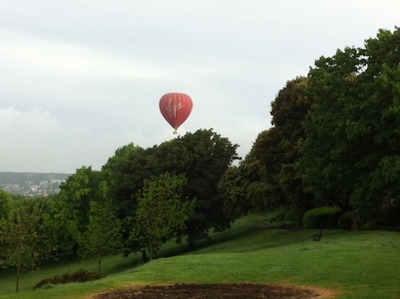
Blackberrying again: working our way down bushes on the slopes of the park, filling plastic containers, taking them home, rinsing the fruit in a colander, transferring them to compostable bags and sticking them in the freezer. It seems, oddly, like a blow on behalf of the ordinary universe. As are the hot air balloons, going over so early some mornings, as they have done for years. And, as I have done for years, I step outside and stare up at the sky and feel a strange sense of reassurance, of confirmation, of a fitness in the world.

We have stepped, or been forced, outside of all that. Our recent pleasures have included quite ridiculous weather and quite ridiculous politics. Or, more soberly, terrifying weather and terrifying politics, two areas intimately linked, of course. There have been hot summers before, 1976, 1911, and droughts, such as 1921, 1911 again – and 1976, again. But in recent years, it is no longer in a metaphorical sense, or even a hyperbolic one, that we say: the world is on fire. Set against this, of course, is the continuing failure of governments to meet the urgency of need with priority of response. If major heart surgery is needed, sticking a plaster on the patient’s thumb strikes some of us as less than adequate. But there is also the massive disconnect, the stolid denial that individual actions can make any difference – while the careful sorting of paper, cardboard and plastics for the weekly collection somehow co-exists in the same single life with a steely determination, and a conviction of entitlement, to fly to three holiday destinations every year.


Walking on one of the quieter paths in the Victorian cemetery, we pass a wedding reception at the Underwood Centre, several dozen guests in a woodland setting. In the midst of death we are in life. It is odd, to say the least, to know, or at least to suspect, that after so many centuries of progress, if you can call it that, of achievement, if that’s what it is, we are living in an age of extinction, an age in which things will not simply slow down or even go backwards but will just stop and die. We don’t want to think of such things… and the vast majority of us  – manage not to

 04:28 – and the cat feels it’s time to begin discussing breakfast. The workmen won’t be here to plague us for another three and a half hours. But there’s the light – and the birdsong. ‘All winter long’, William Maxwell wrote to Eudora Welty in June 1979, ‘I worried because there were no birds, and now there is such a racket you can’t hear yourself think.’[1] (Not long before this, he’d written: ‘In some ways the most beautiful journeys are the ones you don’t take’, which are the journeys I’ve been enjoying for a while now, liking them more and more.)

‘In this weather’—Maxwell again, this time in the summer of 1953, ‘one needs astonishment in the head to keep the heat out.’[2] That afternoon, listening to the rain on the windows, I was struck by the consciousness of what I was doing and the moment in which I was doing it: listening to the rain. It was late in the hottest day ever recorded in this country, the bulletins said, the hottest anyway since the day before. Fires were reported all over the United Kingdom, in London, South Yorkshire, Leicestershire. Our temperate northern climate, forsooth.

All those weary years, those decades, in which the warnings were given, the recommendations made, the figures presented – and nothing done and nothing done and nothing done. It would have been so much cheaper then, more manageable then, the future infinitely strengthened and sweetened then. But we had no influential figures equal to the task. Nor have we had any since. And, looking at the poor creatures now, with their paucity of ideas and their disgusting gestures at policy, it’s painfully evident why we have declined so fast and so far.

‘It does no good to regret history’, Samuel Hynes remarked, ‘all we can do is to try to understand it.’[3] That seems reasonable enough, though forces here, there and everywhere want something quite other. Why understand it? Here’s the version we like – why not go with that?


As Sarah Churchwell recently remarked, ‘The past has consequences in the present regardless of whether we know what happened in it; learning the history makes those consequences intelligible.’[4]

The other day, in an attempt to prevent the Librarian’s determined misquoting of a couple of lines in Dirty Harry, I played her the clip: at the end, the wounded man, maddened by the uncertainty about whether Harry has fired five shots or six, says: ‘I gots to know! I gots to know!’

Yes, I think I suffer a little from that compulsion. Is there one left – or is it already empty?

Answers on a postcard, please – but then you may as well recycle them.


Notes

[1] Suzanne Marrs, editor, What There Is to Say, We Have Said: The Correspondence of Eudora Welty and William Maxwell (Boston and New York: Houghton Mifflin Harcourt, 2011), 348.

[2] What There Is to Say, We Have Said, 35.

[3] Samuel Hynes, ‘Introduction: A Note on “Edwardian”, in Edwardian Occasions: Essays on English Writing in the Early Twentieth Century (London: Routledge & Kegan Paul, 1972), 11.

[4] Sarah Churchwell, The Wrath to Come: Gone With the Wind and the Lies America Tells (London: Head of Zeus, 2022), 11.

Pouring a drink for Cassandra


‘Did you say something?’ the Librarian asked as the forty-fifth runner in the space of a couple of hundred metres passed us, panting infectiously. I said I might have briefly referred to the runner but wasn’t aware of having said it aloud. ‘Yes’, she said, ‘I thought it was one of the sounds you make.’

One of the sounds. We were out for lunch—‘Here we go, out into the world’, said the Librarian, who is prone to doing that sort of thing, the front door gaping as we stepped onto the pavement. Along the park’s lower path, under the railway bridge, over the river, up between the flats, through the grounds of St Mary Redcliffe, where Samuel Taylor Coleridge married and Thomas Chatterton turned up some likely manuscripts, across the hill and up to the high road from which steps cut down to the harbourside, another footbridge, then along by the river for a mile, dodging runners, watching the paddleboarders, the dogs, the photographers, then on to the Underfall Yard, the patent slipway presently unoccupied.

Lunch. I recalled Patrick White relating, in a letter to Ninette Dutton, his attendance at a lunch given by James Fairfax for ‘the visiting American millionaires’. ‘Madame Du Val cooked the lunch. Most unwisely they chose to give us omelettes. I went into the kitchen afterwards to see her and she said, “I’m fucked!” She looked it too, after eighty omelettes. I said I was fucked after one; I find cooking an omelette a highly emotional experience. Some of the elderly maids standing around seemed rather shocked.’[1]

You don’t need to be an elderly maid to feel shocked, if not surprised, just lately. And going out to lunch was quite a while back now, with half a dozen or more blog posts begun and abandoned or left for dead since then. ‘The world is too much with us’, William Wordsworth observed, not in 1802 burdened with appalling news (let alone social media) but more concerned with that ‘getting and spending’ which lays waste our powers and blinds us to the natural world and our connection to it: ‘We have given our hearts away, a sordid boon!’[2]

Writing to a couple of archivists, always in search of Fordian letters, I can’t quite bring myself to wish them a happy Independence Day, in case they suspect me of blackest humour.  Independence from the tea-swilling Britishers two and a half centuries back, but not now from their own religious and political extremists. It might be no more welcome than an American congratulating me on the fantasy glories of Brexit and the election of a government clearly intent on removing my democratic rights and safeguards.

The sense of threat from America’s gigantic lurch back into the dark feels very real: oddly, it might seem, given that I’m white, male, of an older generation, not gay – and not in the United States. But recent developments are an attack on humane and civilized values: the threat is not, or will not for long be, confined to the obvious targets. That discredited supreme court may be ‘over there’, but those who make reassuring noises about how it can’t happen in our Disunited Kingdom are dangerously naïve – or just dangerous. We too have our fair share of religious zealots, miscellaneous lunatics and neofascists and, while many Americans no doubt thought It Can’t Happen Here, it has happened there or is happening there.

Advice of the day: think of the worst that could reasonably be expected to happen then double it. More. Invite Cassandra round, pour her a drink and listen to what she has to say. If she says: ‘O dark, dark, dark. They all go into the dark’ or if she mentions ‘end of days’– listen closely.

‘I was wrong to forget’, Marguerite Yourcenar has her emperor Hadrian say, ‘that in any combat between fanaticism and common sense the latter has rarely the upper hand.’[3]


Notes

[1] Patrick White, letter of 13 April 1975, Letters, edited by David Marr (London: Jonathan Cape, 1994), 455.

[2] Wordsworth, ‘The world is too much with us’, 1802 sonnet in William Wordsworth, edited by Stephen Gill (Oxford: Oxford University Press, 2012), 237.

[3] Marguerite Yourcenar, The Memoirs of Hadrian, translated by Grace Frick, with Yourcenar (1951; Penguin Books, 2000), 198.

Bowling mangel-wurzels across the lawn

(James Eckford Lauder, The Parable of Forgiveness: Walker Art Gallery, National Museums Liverpool)

‘It was Janet’s view’, Elspeth Barker wrote of her stubbornly individual young heroine, ‘that forgetting was the only possible way of forgiving. She did not believe in forgiveness; the word had no meaning.’[1] Janet has, you might say, a lot to put up with – and the Calvinist harangues of Mr McConochie are hardly designed to stimulate the more generous Christian virtues in the bosoms of his flock. Still, other approaches are, as they say, available.

‘After such knowledge, what forgiveness?’, T. S. Eliot wrote.[2] It’s a question that’s cropped up several times in the news just lately. In Ukraine, unsurprisingly, they ask if they can ever forgive Russia, though that question often focuses more specifically on Putin. Some Russians are themselves wondering whether they can ever forgive their President for what he has done to their country, its neighbours, its standing in the world. In England, many of the relatives of those who died in hospitals and care homes in the earlier stages of the Covid-19 pandemic, unvisited, isolated from their families because of the rules made by a government that itself habitually failed to keep them, have stated that they will not forgive the man ultimately responsible for the whole lethal mess: the Prime Minister.

Forgiveness can also be given, or withheld, on a rather smaller scale. Of their gardener—until the family moved to another house—Henry Green wrote: ‘Poole, so they say, could never forgive my mother when soon after marriage she made him bowl mangel wurzels across one lawn for her to shoot at.’[3] Smaller or more frequent, up to that final point, as Ali Smith observed: ‘many things get forgiven in the course of a life: nothing is finished or unchangeable except death and even death will bend a little if what you tell of it is told right’.[4]

The news at the moment—none of it good—is of large events on a large canvas. But those events, whatever their size and nature, began elsewhere: in a room, in a bed, on a screen, in a garden, in a bar, in a grave. The direction of travel may vary. In Ezra Pound’s Confucius, he has this:

The men of old wanting to clarify and diffuse throughout the empire that light which comes from looking straight into the heart and then acting, first set up good government in their own states; wanting good government in their states, they first established order in their own families; wanting order in the home, they first disciplined themselves; desiring self-discipline, they rectified their own hearts; and wanting to rectify their hearts, they sought precise verbal definitions of their inarticulate thoughts [the tones given off by the heart]; wishing to attain precise verbal definitions, they set to extend their knowledge to the utmost. This completion of knowledge is rooted in sorting things into organic categories.[5]

In the bath with Elizabeth Bowen (so to speak), I read about Jefferies listening to Jameson as he declaims about the New Jerusalem to the aunt and the young mother, as they wait for the young husband who will not, perhaps, come home. ‘After all, it all came back to this – individual outlook; the emotional factors of environment; houses that were homes; living-rooms; people going out and coming in again; people not coming in; other people waiting for them in rooms that were little guarded squares of light walled in carefully against the hungry darkness, the ultimately all-devouring darkness. After all, here was the stage of every drama.’[6]

Walking briefly on the main road before turning off again into quieter places, at seven o’clock in the morning, I watch car after car go by, each containing one person, and am reminded of the final question that the New Statesman asks of its interviewee on the Q & A page each week: ‘Are we all doomed?’ The answers are sometimes considered, sometimes flippant. Here, now, the world presents itself as a peculiar version of, say, a golf course produced by a team of deranged designers or architects: they create some hazards, to make the course a little more difficult or challenging or exciting or unpredictable – bunkers, some cunning slopes, water (ideally a lake deep enough to drown in), a few awkward corners where many players will slice or hook into undergrowth or trees. Then they take away all those smooth greens and fairways, leaving only the hazards. No, wait, they put back a couple of greens and call them, what, foreign holidays or television streaming services or barbecues on somebody’s terrace. Then tee off. Fore! Playing is, of course, mandatory. As Pascal didn’t quite say: you must bet; you are in the game. But you might get lucky. So – you have to ask yourself – do you feel lucky? Well, do you?[7]

(Charles Lees, ‘A Golf Match’: National Galleries of Scotland, Scottish National Portrait Gallery)

It’s often, as they say, relative. The conduct of the present English government generally disgusts me – but I live in a wealthy country which is privileged by position, climate, history and the rest. So I hold the country and its government to high standards, with correspondingly high expectations of liberal, enlightened, equitable governance – and they fall woefully short. By almost every measure of a civilized nation, the current state of the country is a disgrace. Yet I’m still hugely – relatively – lucky by many measures. I would far rather be here, an angry and disappointed Englishman, than in a score of countries that come only too swiftly to mind, where having the wrong religion, skin colour, racial heritage or gender can all too easily leave you dead in a ditch.

‘Darknesse and light divide the course of time’, Sir Thomas Browne wrote, ‘and oblivion shares with memory a great part even of our living beings; we slightly remember our felicities, and the smartest stroaks of affliction leave but short smart upon us.’[8] I don’t know. We have machines and social media to help us remember our grievances now and those strokes of affliction leave long-lasting scars, while slightly remembered felicities probably reside on Instagram or crop up as random and unprompted ‘memories’.

‘The uncritical mind is a prey to credulity’, Guy Davenport commented, ‘and without skepticism there can be no democracy.’[9] Yes, there’s that, the gullibility which people seem oddly reluctant to admit to, retrospectively. But there comes a point, certainly in those countries that have any pretensions to a democratic system, when voters can no longer claim ignorance since they know now the nature of the ones they opted for last time. And it comes to this, that huge numbers of citizens, in many countries, say, in effect: yes, these people are corrupt, hypocritical, untruthful bastards but we’re giving them our support, so they can continue to wage war against democratic freedoms or public services or immigrants or women or universities or the poor. . .

After such knowledge, what forgiveness?


Notes

[1] Elspeth Barker, O Caledonia (London: Weidenfeld & Nicolson, 2021), 116.

[2] T. S. Eliot, ‘Gerontion’, The Poems of T. S. Eliot. Volume I: Collected and Uncollected Poems, edited by Christopher Ricks and Jim McCue (London: Faber & Faber, 2015), 32.

[3] Henry Green, Pack My Bag: A Self-Portrait (1940; London: The Hogarth Press, 1992), 3.

[4] Ali Smith, How to be both (London: Hamish Hamilton, 2014), 95.

[5] Ezra Pound, Confucius. The Unwobbling Pivot; The Great Digest; The Analects (New York: New Directions, 1969), 29-31.

[6] Elizabeth Bowen, ‘Human Habitation’, in The Collected Stories of Elizabeth Bowen, with an introduction by Angus Wilson (London: Vintage, 1999), 166.

[7] Blaise Pascal, Pensées and Other Writings, translated by Honor Levi (Oxford: Oxford University Press, 2008), 154; as rendered, or polished, by John Fowles, in The Aristos (London: Pan Books, 1968), 220.

[8] Sir Thomas Browne, Hydriotaphia, or Urn-Buriall, in Selected Writings, edited by Geoffrey Keynes (London: Faber  and Faber, 1970), 152.

[9] Guy Davenport, ‘Wheel Ruts’, in The Hunter Gracchus and Other Papers on Literature and Art (Washington: Counterpoint, 1996), 133.

Oddnesses and cloudy crossroads


With the Librarian away and the cat, though frankly puzzled, not yet overtly resentful, I walk uphill after breakfast, through the other, smaller park and along quiet streets, one or two walkers glimpsed at comfortable distances, barely any cars on the roads I’ve chosen, and the only mild disturbance a runner with a backpack, who pants his way past while I shift well away, thinking that there’s surely no real need for that sort of thing.

Mild disturbance, though, is almost welcome, after the past few days of relentless activity in the neighbouring house, which is evidently being gutted before its sale or re-letting. Yesterday, the workmen seemed to be drilling directly through the wall – I expected their imminent arrival in the room where I sat at my keyboard. On several days last week they took over from the other crew beyond the back fence, the ones with the shocking musical taste. Occasionally they would harmonise, after a fashion, sledgehammer against drill, concrete mixer against hacksaw. Though raising sympathetic eyebrows to the Librarian and Harry the cat when our paths crossed, I regarded the unholy row with relative equanimity—mostly—still feeling the after taste of euphoria that attended the final surrender of a tooth that had wavered and jiggled for more than a week, making mealtimes purgatory and tending to vandalise my dreams.

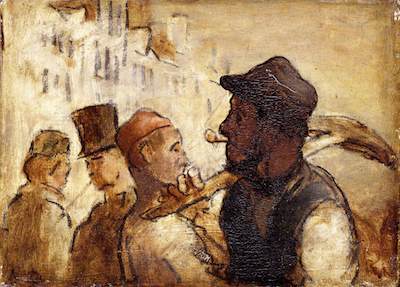
(Honoré Daumier, Workmen on the Street: National Museum of Wales)

We tend to think of incessant noise as a recent development—wars apart—given motorised road traffic, aircraft and other modern machinery. It’s largely true. Still, it’s salutary to be reminded of the London streets in Victorian times, when the Inns of Court served as ‘oases of quiet’, into which people walked, especially in Dickens’ work, in order to hear one another speak.[1]

Out early this morning, not in Dickens’ London, I was buffeted and boomed at only by birdsong, the bushes and hedges and thick-leaved branches in constant movement. I always find such occasions oddly heartening, as when I saw recently, in the tree that overlooks—and reaches over—our garden fence, at least two bluetits and a pair of goldfinches, plausibly the same ones seen on several occasions this past fortnight. Why ‘oddly’, though? An odd choice of word. I should know by now that I can rely more confidently on birds, trees, cats, walls, cemetery paths and grassy slopes for reassurance that we are not approaching the end of days than on the behaviour of my fellow humans (sometimes yes, often no).


‘Nature has no destiny for us: our boat is upon her ocean and in her winds, but she has expended as much ingenuity designing the flea as she has expended on us, and is perfectly indifferent to Hooke’s conversation at Garraway’s Coffee House. We, however, perish the instant we take our eyes off nature.’[2]

There we have it: the perish option. Or not. Don’t take your eyes off it—her—it. And cherish the oddities, as Enid Bagnold wrote: ‘Who wants to become a writer? And why? Because it’s the answer to everything. To “Why am I here?” To uselessness. It’s the streaming reason for living. To note, to pin down, to build up, to create, to be astonished at nothing, to cherish the oddities, to let nothing go down the drain, to make something, to make a great flower out of life, even if it’s a cactus.’[3]

The past two and a half years­—very nearly that now—have changed some behaviours, habits, attitudes and perceptions in ways which are still largely invisible to us. In Elizabeth Bowen’s novel, Friends and Relations, Lady Elfrida reflects that: ‘Surely people were odder, or was it just that one met them? Had these years, with their still recent sense of catastrophe, brought out curious people, like toads after rain?’[4] I often find other people’s behaviour odd, to be sure, but suspect that the newer, larger oddness is in myself. ‘That is to say’, Ford’s narrator Gringoire in No Enemy remarks of the recent war from which he has emerged, ‘it did teach us what a hell – what a hell! – of a lot we can do without.’[5]

A good many people in the current crisis—there is always a crisis for some of them—are finding that they have little or no choice in the matter of what to do without, of course. Others, who are in a more comfortable position, have evidently decided on at least one of the things that they won’t do without. That scrubbed-smooth sky this morning was streaked with cloud strips like tracer but also with the swift lines of numerous aircraft, stuffed with people making their modest but not insignificant contributions to the climate crisis. At one point, with a symbolism so apt as to verge on unconvincing, the clouds had formed a solid and clearly delineated crossroads which one of those crammed airliners was approaching.

It ploughed straight on, of course.


Notes

[1] Judith Flanders, The Victorian City: Everyday Life in Dickens’ London, (London: Atlantic Books, 2012), 30-33.

[2] Guy Davenport, ‘The Death of Picasso’, Eclogues: Eight Stories (London: Picador, 1984), 23. That would be scientist and philosopher Robert Hooke (1635-1703), while Garraway’s, dating from the 1650s, was the first coffee house in London. I see that Simon Schama has it as ‘Garway’ – but am not downhearted.

[3] Enid Bagnold, Autobiography (London: Century Publishing, 1985), 59.

[4] Elizabeth Bowen, Friends and Relations: A Novel (1931; Chicago: University Chicago Press, 2012), 82.

[5] Ford Madox Ford, No Enemy (1929; edited by Paul Skinner Manchester: Carcanet Press, 2002), 52. A decade earlier, his poem ‘The Starling’ began: ‘It’s an odd thing how one changes’.