
(any decade, look at it, put it back, don’t tell me what it was)
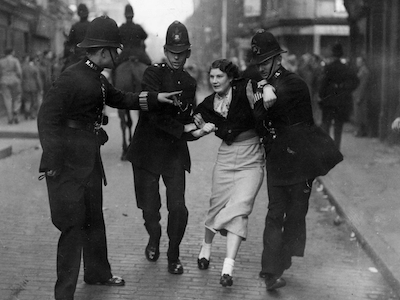
(An anti-fascist protester is arrested during the battle of Cable Street on 4 October 1936. Photograph: Topical Press Agency/Getty Images via The Guardian)
I sit in one of the dives
On Fifty-second Street
Uncertain and afraid
As the clever hopes expire
Of a low dishonest decade
(W. H. Auden, ‘September 1, 1939’)
Christopher Isherwood’s birthday having slipped past a few days ago, I wondered how long ago it was that I read him. Most of those books—the Berlin novels, Lions and Shadows, Prater Violet, Down There on a Visit, A Single Man, A Meeting by the River—I see were back in the 1970s. Christopher and His Kind, not much later; only Exhumations at all recently.[1] One of those writers, I suppose, that fits a time in the reader’s—this reader’s—life, is read once and enjoyed and put back on the shelf.
Isherwood crops up in other contexts, of course, in reading about Aldous Huxley or Edward Upward or W. H. Auden. There was Auden’s letter to him—more than one—printed as a part of Letters from Iceland, the travel book that Auden and Louis MacNeice collaborated on during their trip to the country in the summer of 1936:
‘Though I am sure you would enjoy a visit as much as I did, I think that, in the long run, the Scandinavian sanity would be too much for you, as it is for me. The truth is, we are both only really happy living among lunatics.’[2] (Note that strongly-indicated luxury of choice.)
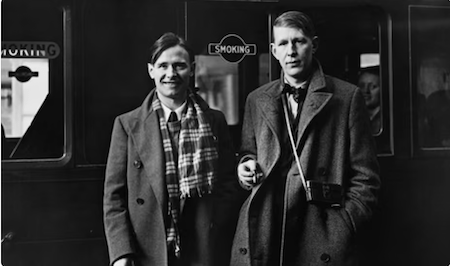
(Christopher Isherwood and Auden at the railway station prior to their departure for China, 1938. Photo © Hulton-Deutsch collection/CORBIS/via Getty Images)
Between this trip and publication of Letters from Iceland in August 1937, Auden had been to Spain in January of that year and published his poem ‘Spain’ in April. Many readers recall particularly the final lines’ assertion, that ‘History to the defeated/ May say Alas but cannot help or pardon.’ Samuel Hynes points out that Auden later ‘condemned this passage as “wicked doctrine”, on the grounds that it equates goodness with success.’ Hynes adds: ‘But in fact it does nothing of the kind; what it says is simply that History is Necessity, and that it is made by men’s choices. Once it is made, help and pardon are irrelevant. It is a harsh morality for a harsh time, but it is nevertheless a morality, and not a wicked one.’[3]
Other readers—or the same ones—will remember perhaps more readily the criticism by George Orwell, primarily of the line: ‘The conscious acceptance of guilt in the necessary murder’. Seizing on this, Orwell commented: ‘But notice the phrase “necessary murder”. It could only be written by a person to whom murder is at most a word. Personally I would not speak so lightly of murder.’ And he goes on to mention that he has seen the bodies of murdered men, as well as experiencing the related issues of grief, terror, post-mortems, ‘the howling relatives’ and the rest.[4]
Auden’s poem was revised, probably in late 1939, and collected in Another Time (1940). As Edward Mendelson comments, ‘Some readers have assumed that Auden changed this on reading George Orwell’s criticism of the poem in Inside the Whale, but Auden first published his revision a month before Orwell published his objection.’[5]
Louis MacNeice too went to Spain: once in the spring of 1936, with Anthony Blunt (art historian, fellow of Trinity College, Cambridge, Soviet spy), a few months before the outbreak of the Civil War; and again, in December 1938, during the last phase of the war, nine or ten days of walking or being driven around Barcelona. The city fell to Franco’s forces a little more than a fortnight after MacNeice’s departure.[6]
Of Madrid on that first trip, he wrote:
And all we did
In that city was drink and think and loiter.
And in the Prado half-
wit princes looked from the canvas they had paid for
(Goya had the laugh –
But can what is corrupt be cured by laughter?)
And leaving:
And next day took the boat
For home, not realising
That Spain would soon denote
Our grief, our aspirations;
Not knowing that our blunt
Ideals would find their whetstone, that our spirit
Would find its frontier on the Spanish front,
Its body in a rag-tag army.[7]
Reviewing Jon Stallworthy’s biography of MacNeice, Penelope Fitzgerald commented: ‘In Spain, he had only noticed what was inefficient, magnificent, smelly, and picturesque, he wouldn’t pretend to have predicted the civil war.’[8] But even in 1936, and not just in Spain, the atmosphere was already thick with threat, menace, blood on the stairs, armed thugs in the streets, political ravings and racist demagoguery.
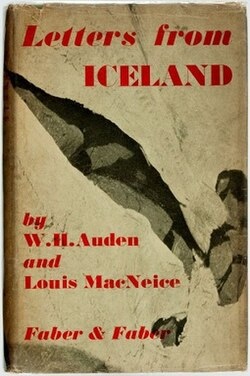
At the close of Letters from Iceland is MacNeice’s ‘Epilogue For W. H. Auden’:
For the litany of doubt
From these walls comes breathing out
Till the room becomes a pit
Humming with the fear of it
With the fear of loneliness
And uncommunicableness;
All the wires are cut, my friends
Live beyond the severed ends.
So I write these lines for you
Who have felt the death-wish too,
But your lust for life prevails
Drinking coffee, telling tales.
Our prerogatives as men
Will be cancelled who knows when;
Still I drink your health before
The gun-butt raps upon the door.[9]
From the 1930s to now, almost one hundred years. Are there currently fewer or more countries in which the rap of a gun-butt on your front door—or the local variation, petrol bombs, howling mobs, bricks— is only too likely?
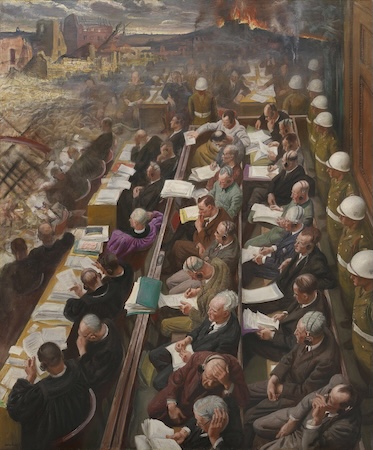
(Laura Knight, The Nuremberg Trial 1946: Imperial War Museum)
In September 1946, Rebecca West, in her ‘Eye-Witness Impressions of the Nuremberg Trial’, published in the Daily Telegraph, ‘reiterated that the point of the judgement was to warn future warmongers that the peace would catch up with them and punish them.’[10]
The ‘warning’ was of shamefully brief duration and impact since, only three years later, the first Chancellor of the Federal Republic of Germany, Konrad Adenauer, denounced the policy of ‘denazification’, pushing for amnesties and early releases, and by 1951 nearly 700,000 people had benefited. Adenauer’s State Secretary Hans Globke turned out to have played a major role in the drafting of the Nuremberg Race Laws but he kept his job.
And those ‘future warmongers’? Peace catching up and punishing them?
Ah, well.
Notes
[1] This collection includes Isherwood’s review of Ford Madox Ford’s Parade’s End, but also a story that stuck in my head for years, ‘A Visit to Anselm Oakes’, originally written as part of the novel, Down There on a Visit.
[2] W. H. Auden and Louis MacNeice, Letters from Iceland (London: Faber and Faber, 1937), 30.
[3] Samuel Hynes, The Auden Generation (1976; London: Pimlico, 1992), 254.
[4] George Orwell, ‘Inside the Whale’, in A Patriot After All: 1940-1941, edited by Peter Davison, revised and updated edition (London: Secker and Warburg, 2000): The Complete Works of George Orwell, Volume XII, 103.
[5] W. H. Auden, The English Auden: Poems, Essays and Dramatic Writings, 1927-1939, edited by Edward Mendelson (London: Faber, 1977), 424-425.
[6] Jon Stallworthy, Louis MacNeice (London: Faber and Faber, 1996), 234-237.
[7] Louis MacNeice, Autumn Journal, in Collected Poems, edited by Peter McDonald (London: Faber, 2007), 113, 114. That line-ending, ‘blunt’, presumably not by chance.
[8] Fitzgerald, ‘A Kind of Magician’, in A House of Air: Selected Writings, edited by Terence Dooley with Mandy Kirkby and Chris Carduff (London: Harper Perennial, 2005), 349.
[9] Letters from Iceland, 261; reprinted as ‘Postscript to Iceland: for W. H. Auden’ in Collected Poems, 98.
[10] Quoted by Natalie Livingstone, The Nuremberg Women (London: John Murray, 2026), 264-265.

