

(The photograph is by Francesca Woodman)
In her introduction to the New York Review Books edition of Richard Hughes’ The Fox in the Attic, Hilary Mantel refers to the very slow writer that Hughes had been even with his first novel, A High Wind in Jamaica (1929). By the time he had devised, planned and begun to write ‘The Human Predicament’, two volumes of which appeared before his death, leaving just twelve chapters of the intended third volume, he was perhaps even slower. ‘He writes in short chapters’, Mantel noted, ‘many of which are self-contained, miniaturized works of art. Some went through fifty drafts. There were times when most of his work was deletion. He would claim to have done 50,000 words, which would “progress” to 10,000.’[1]
There is slow writing and there is an inability to finish, sometimes overlapping, sometimes distinct. Ralph Ellison published Invisible Man in 1952. He wrote some 2000 pages of another which remained unfinished. Joseph Heller’s debut novel Catch-22 had to wait some thirteen years before Something Happened arrived to keep it company in the Heller oeuvre. It was decades after Henry Roth’s first novel Call It Sleep (1934) that another long fiction appeared (he had destroyed a second novel, apparently, despite Maxwell Perkins believing it to be brilliant). Ezra Pound’s Cantos remained unfinished and we can only wonder how—perhaps if—that poem could ever have been completed. James Joyce’s Finnegans Wake famously took some sixteen years, though even a cursory look at the text severely diminishes any initial feeling of surprise at that statistic.
Joyce was working on an earlier book when he met the painter Frank Budgen in Zurich. After reading A Portrait of the Artist as a Young Man, which Joyce had given him, Budgen learned about the novel then underway. Encountering Joyce one evening, he asks how Ulysses is progressing. Joyce replies: ‘I have been working hard on it all day.’
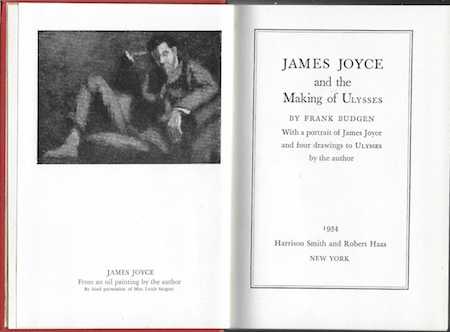
‘Does that mean you have written a great deal?’ I said.
‘Two sentences,’ said Joyce.
I looked sideways but Joyce was not smiling. I thought of Flaubert.
‘You have been seeking the mot juste?’ I said.
‘No,’ said Joyce. ‘I have the words already. What I am seeking is the perfect order of words in the sentence. There is an order in every way appropriate. I think I have it.’[2]
‘I thought of Flaubert.’ Hence le mot juste. Hence Ford Madox Ford and Joseph Conrad discussing for ‘a whole day’ the suitability in a specific context of the word ‘azure’.[3] But before them, the Brothers Goncourt (1 September 1876):
‘Flaubert told me that during the two months he had spent confined to his room, the heat had given him a kind of intoxicated urge to work, and he had worked for fifteen hours every day. He went to bed at four o’clock in the morning and was sometimes surprised to find himself back at his writing-table at nine. A grind interrupted only by a swim in the Seine in the evening.
‘And the result of those nine hundred hours of work is a story thirty pages long.’[4]
This was Un coeur simple, written between March and August 1876, one of the Trois Contes published in 1877.
Ford had referred to Trois Contes in a 1905 article, a group of ‘men of letters’ talking of exchanging books, the ones ‘which, for each of us, are particularly our own.’[5] Twenty years later, writing of ‘real France, which is one, indivisible and unchanging’, he alluded to ‘Une coeur simple’ again: ‘Mme Aubain still sits beside the white wainscoting, looking through the windows at the life of the street; Félicité is still at work from kitchen to grénier’.[6]
Midway between those citings was his second volume of rather idiosyncratic ‘propaganda’, written for his friend Charles Masterman, who was in charge of the British propaganda department at Wellington House, Between St Dennis and St George. The epilogue, ‘Félicité’ (193-222), drew on half a dozen of Ford’s articles in The Outlook between 1 May and 5 June 1915, the last of them entitled ‘Un Coeur Simple’. Terming ‘Felicité’ the story which ‘at this moment, is of most significance to the world’, Ford responds to an imagined querying of that statement: ‘I can only answer that the exact use of words seems to me to be the most important thing in the world. We are, in the end, governed so much more by words than by deeds.’ And if, he adds, ‘with humility and attention you will read the following sentences you will know more of France than if you spend months and months and months in one of the large hotels near the Tuileries Gardens.’
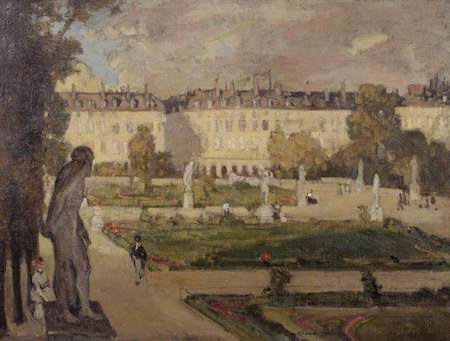
(Alexander Jamieson, The Tuileries Gardens and the Rue de Rivoli: Tate)
He then goes on to quote (203-204) a 95-word passage from Flaubert’s conte, describing the room in which Madame Aubain—whom all the good ladies of Pont-l’Évêque envy for her servant Félicité—sits all day: ‘Un vieux piano supportait, sous un baromètre, un tas pyramidal de boites et de cartons.’ The passage closes with the comment, ‘et tout l’appartement sentait un peu le moisi car le plancher était plus bas que le jardin.’ Ford, in his long paragraph following the French passage, renders this as ‘and all the room will smell a little of mould because the floor is a little lower than the garden.’
Sixteen lines into Ezra Pound’s ‘Canto VII’ (1921) comes this:
Un peu moisi, plancher plus bas que le jardin.
Then:
‘Contre le lambris, fauteuil de paille,
Un vieux piano, et sous le baromètre. . .’[7]
Did Pound read Between St Dennis and St George? He was—as always—busy. Did he read Ford’s earlier propaganda volume, When Blood is Their Argument? Yes and no. On 18 April, he wrote to the lawyer, art collector and patron John Quinn: ‘Have told the Neutral Nations committee to send you copy of F.M.H.’s book which opens entertainingly. haven’t had time to read it.’[8]
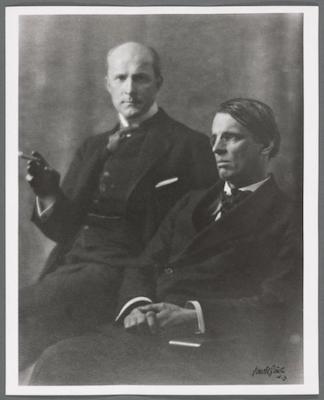
(John Quinn with W. B. Yeats: New York Public Library)
But he would have kept his eye on The Outlook, in which Ford’s weekly columns were appearing. Just two weeks after ‘Un Coeur Simple’, Ford’s article was headed ‘From China to Peru’, an allusion to Samuel Johnson’s The Vanity of Human Wishes (itself an ‘imitation’ of Juvenal’s tenth satire). In it, Ford reviewed, firstly, Yerba Maté by M. A. [Maud Adeline] Cloudesley Brereton, ‘Officier d’Académie, Royal Sanitary Institute, Fellow of the Institute of Hygiene’, the South American connection allowing him to bring in admiring references to Charles Waterton and W. H. Hudson.
Secondly, he turned to Cathay (published in April), ‘Translations by Ezra Pound For the Most Part From the Chinese of Rihaku, From the Notes of the Late Ernest Fenollosa, and the Decipherings of the Professors Mori and Ariga.’ Ford summarised this as ‘renderings of Chinese poems that are a thousand years old—at least I suppose that they are renderings and not part of a mystification by the bard of Idaho—or is it Montana? For, if these are original verses, then Mr Pound is the greatest poet of this day.’[9]
‘We are, in the end, governed so much more by words than by deeds.’ ‘A thousand years’. . . ‘one, indivisible and unchanging’. Simple words and phrases seemingly innocuous in themselves may ring alarm bells later, perhaps especially in an era of such grotesque historical ironies.
Notes
[1] Hilary Mantel, ‘Introduction’, Richard Hughes, The Fox in the Attic (New York: New York Review Books, 2000), xiii.
[2] Frank Budgen, James Joyce and the Making of ‘Ulysses’ and other writings, enlarged edition (1934; London: Oxford University Press, 1972), 20. The sentences are: ‘Perfume of embraces all him assailed. With hungered flesh obscurely, he mutely craved to adore.’ From Chapter VIII, ‘Lestrygonians’: James Joyce, Ulysses (1922; London: The Bodley Head, revised edition, 1969), 214.
[3] Ford Madox Ford, Joseph Conrad: A Personal Remembrance (London: Duckworth, 1924), 160.
[4] Edmund and Jules de Goncourt, Pages From the Goncourt Journal, edited and translated by Robert Baldick (New York: New York Review Books, 2006), 224.
[5] Ford, ‘A Literary Causerie: The Less-Known Flaubert’, Academy, 69 (11 Nov. 1905), 1175.
[6] Ford, A Mirror to France (London: Duckworth, 1926), 16-17; also 36-43; and Portraits From Life (Boston: Houghton Mifflin, 1937), 217; Thus to Revisit (London: Chapman & Hall, 1921), 138, 140.
[7] The Cantos of Ezra Pound, fourth collected edition (London: Faber and Faber, 1987), 24.
[8] The Selected Letters of Ezra Pound to John Quinn, 1915-1924, edited by Timothy Materer (Durham: Duke University Press, 1991), 26.
[9] Ford, ‘From China to Peru’, Outlook, XXXV (19 June 1915), 800-801. T. S. Eliot wrote in Ezra Pound : His Metric and Poetry (1917): ‘“Cathay” will, I believe, rank with the “Sea-Farer” in the future among Mr. Pound’s original work.’ Reprinted in To Criticize the Critic and other writings (London: Faber and Faber, 1978), 181. ‘Rihaku’ is the Romanised version of the Japanese pronunciation of ‘Li Po’ (or ‘Li Bai’).

