
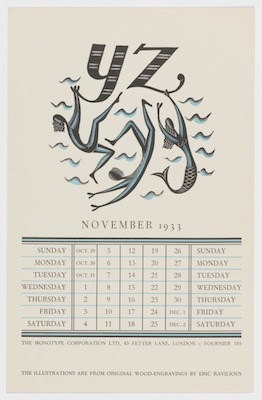
(Eric Ravilious: Fitzwilliam Museum, Cambridge)
Somehow it’s become late November. I was not reduced to silence by the American midterms—I think I was already there. While the Librarian may be engaged downstairs in yoga or Tai Chi, and the cats drowse in winter mode, I am upstairs, not infrequently with the curtains drawn against wholly inadequate daylight, perhaps peering at the census for 1921 (is that her? or that?), or looking through a pencilled list of men named ‘Ellis’ (that one? him?) or interrogating figures in the corner of a Ford Madox Ford letter to the publisher John Lane, finding it implausibly difficult to do sums in pounds, shillings and pence. This country switched to decimal currency fifty-five years ago but I’ve always prided myself on my arithmetical—rather than mathematical—skills. Now, not so much. No satisfying whole numbers to be found and is 32 copies of a poetry book sold really believable for a well-known writer, even if it is the second six-month royalty period of its published life? On the other hand:
‘As for the press and the public. My first book of verse was received with extraordinary enthusiasm by the former. The Times praised it for a column the Daily News for a column and a half; the Academy gave it a page. The Public bought fourteen copies.’[1]
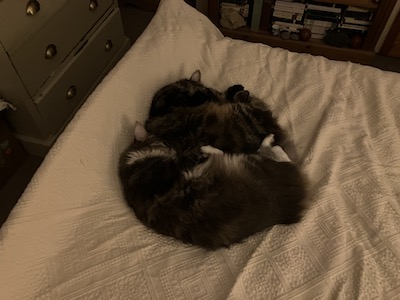
(Cats: wintering in, as opposed to Seamus Heaney’s Wintering Out)
But outside—yes, I thought we had already had the good news for the season: Serbia, Brazil—and Anne Carson winning the Nobel Prize. Then along came the midterms. Texas, Maine, South Carolina, Ohio, Kansas. . . A real pulling back from the abyss; and some hugely impressive—mostly young, radical, articulate—Democrat figures. Bad news often arrives first thing in the morning, the Librarian waking a little earlier and scanning an iPad or laptop. 2016 was a crashingly bad year: that Presidential election and the beginning of what became the lasting lunacy of Brexit. 2024, more complicated, good and bad—the good turning out to be not as good as first appeared, the bad even worse than expected. But this time, though a little bleary, my hearing is unimpaired, and the Librarian is remarking: ‘They’ve taken the Senate and the House.’
With the heating system adjusted by the engineer who arrived a few hours after I phoned and spoke to—rather than with—an automated reception system, and my teeth sorted out (again), all should be, as Henry James tended to remark, ‘all gas and gingerbread’. Huzzah!
And there are still the walks, sometimes in chilly brightness, sometimes in grudging pauses between showers, but always now with recovered greenness and a few persistent birds, not all of them crows. Speaking of corvids, in his autobiography, Jackdaw Cake, Norman Lewis remembers walking in the gardens with the horticulturalist Edward Augustus Bowles: ‘Around us the birds kept up their chorus. A shower came and went, bringing down a little sodden blossom and pelting the surface of the lake with the heavy summer raindrops the dragonflies so effortlessly avoided. The smoke of burning sap from the gardener’s fire tickled the membranes of my nose, a dog barked, a fish splashed, the swifts dived on us with their thin, delirious screeching. Even the rich could possess no finer moment than this.’
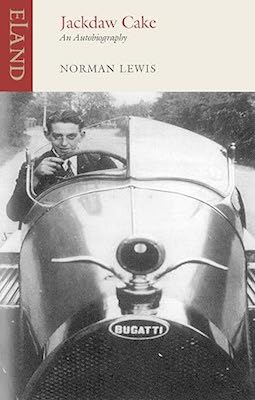
Bowles had remembered from his childhood the royal ferns, orchids and lilies of the valley uprooted ‘to end their days in Victorian conservatories’: ‘This was a place, too, without a past. There must have been heroes, prophets, saints, here too as there had been in Wales but if so no memory of them remained, In Forty Hill, Bull’s Cross and Whitewebbs, we faced the matter-of-fact nothingness of present times from which the imagination offered no escape. Here we were watched by no unseen presences. Who could have imagined Arthur or the enchanter Merlin walking amongst these trees, or Druids working their magic in these fields?’
He is often attentive to the focus on the present moment, later noting that, ‘Like the Arabs, the Sicilians seemed absorbed in current affairs. Just as in Arabic, there is no future tense in the Sicilian dialect, and in discussion I found that there was very little taste or talent for reminiscence.’[2]
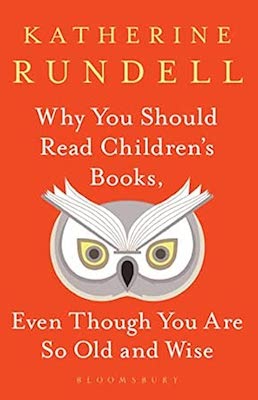
No future tense and no reminiscential tension. For a great many people, of course, the tension concerns forgetting, increasingly so too often—and, inevitably, I can’t remember offhand how often I’ve written about forgetting. There are, no doubt, positives to be found. ‘Life cannot go on without a great a deal of forgetting’, Monsieur Balzac remarks.[3] Julia Blackburn writes that ‘sometimes we need to remember things because only then can we forget.’[4] And here is Katharine Rundell: ‘Children’s fiction does something else too: it offers to help us refind things we may not even know we have lost. Adult life is full of forgetting; I have forgotten most of the people I have ever met; I’ve forgotten most of the books I’ve read, even the ones that changed me forever; I’ve forgotten most of my epiphanies. And I’ve forgotten, at various times in my life, how to read: how to lay aside scepticism and fashion and trust myself to a book.’[5]
Memory loss, stress, dementia, social media. These are not only contemporary issues. Sebastian Haffner, a journalist and law student in the early 1930s, ‘thought modernity itself was partly to blame: people had become yoked to their habits and to mass media, forgetting to stop and think, or to disrupt their routines long enough to question what was going on.’[6]
A hundred years on that seems, yes, familiar. ‘The art remembers, the artist forgets’, Julian Barnes writes, while discussing—yes!—Gustave Flaubert.[7] Sometimes this is quite deliberate, a part of the authorial strategy, in the sense that some books rest on huge quantities of research but don’t announce it to the reader in a barefaced, even complacent manner. Sarah Waters, Hilary Mantel, Sarah Moss come to mind. And here is Kate Atkinson: ‘It’s different with historical novels. I read a lot before I start writing and then I try to forget everything I’ve read, because otherwise the writing can become all about conveying the facts you’ve learned and not much more.’[8]
Another slight memory blank spot – when did I last go to London? Now I can say, with brazen confidence, ‘2026, on the Librarian’s birthday’. A reasonably early train up, tube to Pimlico and Tate Britain for the Vanessa Bell and Duncan Grant: Inside Bloomsbury show. A great deal of it too, over 300 items, some familiar, many not. Some fine Omega stuff—the robe designed by Wyndham Lewis was certainly a new one on me—and rooms full of drawings, paintings, collage, screens, busts, books and photographs. I think Grant was a fine decorative artist but, specifically as painter, I’d say Vanessa Bell certainly has the edge.
Unsurprisingly, it was busy, sometimes impossible to see things in sequence, necessitating a constant zigzagging from wall to wall or room to room. But, in a smaller space, we’d been to an even busier exhibition the day before, primed and prepared for busyness even as we bought our tickets. ‘There’s no quiet time, I’m afraid. It doesn’t stop being busy.’
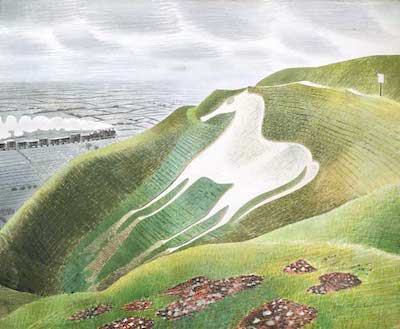
This was at the always—and increasingly—impressive Holburne Museum in Bath, at the far end of the wonderful Great Pulteney Street. Ancient Landscape, Modern Times: Eric Ravilious and the Artists of the Chalk Downs had a fine line-up: as well as Ravilious, there was work by William Nicholson, Paul Nash, John Nash, Tirzah Garwood, Peggy Angus and others, covering around 30 years, from the 1910s. It runs until 10 January 2027.
Rewards too for wandering away from the main path. At the Holburne, some of the Richard Slee ceramics were astonishing and very funny: think candlesticks and swans. At the Tate, pausing to be rocked yet again by David Bomberg’s In the Hold – and wracked yet again by Mark Gertler’s Merry-Go-Round – we happened across Room 12A, a Spotlight Exhibition devoted to Nina Hamnett, more works in one place than we’d ever seen before: fifteen paintings and a pen and ink drawing of a naked Roger Fry, with whom Hamnett had an affair in 1916-18. He did several portraits of her, including nude studies and at least two completed oil paintings, one of them, held at the Courtauld, among his best pictures.
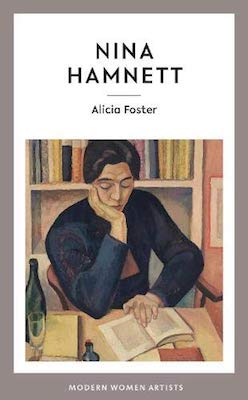
‘She draws like a born sculptor and paints like a born painter’, Walter Sickert wrote of Hamnett in The Cambridge Magazine in June 1918.[9] And so she did: not least in the superb portrait of Sickert himself, with its confident definition, firm lines and subtle shadowing. Here too are the early still life paintings, influenced by William Nicholson at the London School of Art; the self-portraits; The Ring Master; and the portraits of friends and others, The Student (Dolores Courtney), A Gentleman with a Top Hat—and Portrait of a Woman (1917), used for the cover of Alicia Foster’s excellent short book on Hamnett, in the Modern Women Artists series published by Eiderdown Books: https://eiderdownbooks.com/ Fourteen in the series now, I believe, and a few other choice items too. . .
Notes
[1] Ford Madox Ford, ‘Preface’, Collected Poems (London: Max Goschen, 1913 [dated 1914]), 11.
[2] Norman Lewis, Jackdaw Cake: An Autobiography (1985; London: Eland Books, 2013), 67-68, 73, 125.
[3] Honoré de Balzac, Cousin Bette, translated by Marion Ayton Crawford (Penguin, 2004), 442.
[4] Julia Blackburn, Thin Paths: Journeys In and Around an Italian Mountain Village (London: Jonathan Cape, 2011), 193.
[5] Katherine Rundell, Why You Should Read Children’s Books, Even Though You Are So Old and Wise (London: Bloomsbury, 2019), 43-44.
[6] Sarah Bakewell, At the Existentialist Café: Freedom, Being & Apricot Cocktails (London: Chatto & Windus, 2016), 77.
[7] Julian Barnes, Keeping an Eye Open: Essays on Art (London: Jonathan Cape, 2015), 268.
[8] ‘A Q & A with Kate Atkinson’, Death at the Sign of the Rook (London: Transworld, 2024), 320.
[9] Walter Sickert, The Complete Writings on Art, edited by Anna Gruetzner Robins (Oxford: Oxford University Press, 2002), 423.

