Education, chaos, Henry Adams

Henry_Adams__Marian_Hooper_Adams_1883

(Henry Adams at his desk. Massachusetts Historical Society via Wikipedia: photograph by Marion Hooper Adams, 1883.)

‘Said Mr Adams, of the education,
Teach? at Harvard?
Teach? It cannot be done.
and this I had from the monument’

So Ezra Pound, in the first and longest of The Pisan Cantos.[1] That ‘monument’ was the philosopher George Santayana: born in Spain, he went to the United States at the age of eight, later studied at Harvard and taught there for many years before returning to Europe for the last forty years of his long life.

‘Mr Adams’ was not the John Adams to whom Pound so frequently referred, often pairing him with Thomas Jefferson; nor the historian Brooks Adams but his elder brother Henry Adams (born 16 February 1838), also historian—and novelist, and autobiographer.

In early 1939, Pound had put together four quotations, from John Adams, Jefferson, Abraham Lincoln and section 8 of the American Constitution, as an Introductory Text Book, which he asserted ‘should be taught in all American universities as the basis of a true American culture.’[2] Towards the end of that year, he called on Santayana when the latter was in Venice. As David Moody surmises, ‘Possibly feeling rather talked at as by an over-excited teacher’, he told Pound the anecdote about Henry Adams which found its way into the Cantos.[3] But Noel Stock is surely correct in saying that, while Pound seems to make the story apply to Harvard in particular, Santayana in his autobiography implies a more general statement about teaching.[4]

‘Never before had Adams been able to discern the working of law in history, which was the reason of his failure in teaching it, for chaos cannot be taught.’[5] So Adams—writing of himself in the third person, as he does throughout his book—defines the problem. Santayana looked back to that meeting in Persons and Places: ‘“So you are trying to teach philosophy at Harvard,” Mr Adams said’, adding ‘“I once tried to teach history there but it can’t be done. It isn’t really possible to teach anything.”’ Santayana commented dryly, ‘This may be true, if we give very exacting meanings to our terms; but it was not encouraging.’[6]

Fenollosa-and-Mary

(Ernest and Mary Fenollosa, via https://otakusenvenezuela.wordpress.com/ )

For Pound, the main link with Henry Adams—about whom he is not particularly complimentary—is the figure of Ernest Fenollosa, whose notes and direct translations, given to Pound by Fenollosa’s widow, Mary, enabled both the Noh plays and the poems of Cathay; and whose ideas expressed in The Chinese Written Character as a Medium for Poetry had a lasting influence upon Pound.

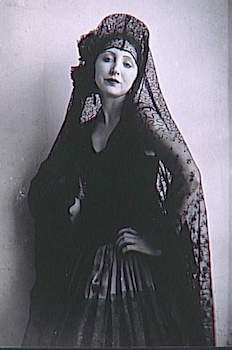
Chapter XX of Adams’ Education is headed ‘Failure (1871); Chapter XXI is headed ‘Twenty Years After (1892). In that large and gaping temporal space, Adams was married to Marion Hooper, known as ‘Clover’ (a talented amateur photographer), in 1872; she committed suicide in December 1885. In the late spring of 1886, Adams, in company with the artist John La Farge, set off westward to Japan. After a week in Tokyo, they moved to a small house, belonging to a Buddhist priest, in the hills, close to the summer villa of Ernest and Mary Fenollosa in Nikko. La Farge emerged from his stay with drawings, sketches and other material for future use—the book, An Artist’s Letters from Japan, and a printed version in the same year of a talk centred on Hokusai—but Adams seems never to have really engaged with Japan.

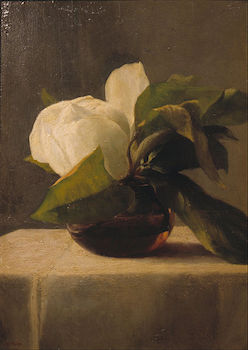
John_LaFarge_Magnolia_1860

(Magnolia by John La Farge, 1860)

In September, Adams and La Farge sailed back across the Pacific to San Francisco. Lawrence Chisolm remarks that, ‘For Adams, return was a prelude to years of wandering, until at last, in The Education of Henry Adams, he transformed the story of his personal searches into a history of Western man.’[7]

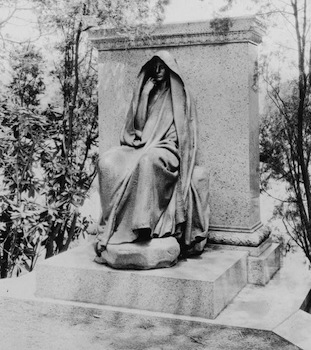
‘His first step, on returning to Washington’, Adams wrote, ‘took him out to the cemetery known as Rock Creek, to see the bronze figure which St. Gaudens had made for him in his absence’ (329). This was the sculptor Augustus Saint-Gaudens; and that ‘bronze figure’ was a memorial to Adams’ wife Clover. Adams discusses his own, and others’, responses to the figure but doesn’t allude to the reason for its being there at all. Robert Hughes suggests that this may in fact have been one legacy of Japan: its inspiration ‘seems to have been a sixth-century wooden figure sheathed in bronze which he saw in the convent of Chugu-ji’.[8]

Marian_Hooper_Adams_Monument

(Augustus Saint-Gaudens, Adams Memorial (1886-1891), Rock Creek, Washington)

Adams once noted that ‘One sees what one brings’ (387)—and he brought an extensive knowledge of artistic and religious history to the moment when ‘he found himself lying in the Gallery of Machines at the Great Exposition of 1900, his historical neck broken by the sudden irruption of forces totally new’ (382). He had seen, at the Louvre and at Chartres, what he judged ‘the highest energy ever known to man’, exercising ‘vastly more attraction over the human mind than all the steam-engines and dynamos ever dreamed of’ (384-385), yet the unprecedented speed and extent of new scientific and technological developments represented now, in 1900, ‘a new avalanche of unknown forces’ which would require ‘new mental powers to control. If this view was correct, the mind could gain nothing by flight or by fight; it must merge in its sensual multiverse, or succumb to it’ (463).

Familiar modernist concerns: speed, fragmentation, instability, multiplicity – but Adams gets in quite early.

(There was an intriguing novel called Panama by Eric Zencey, which sets Henry Adams in Paris in 1892, investigating the disappearance of a young woman connected with the Panama Canal bribery scandal. I’m slightly alarmed to see that it’s over twenty years since I read it.)

References

[1] The Cantos of Ezra Pound, fourth collected edition (London: Faber and Faber, 1987), 433.

[2] Ezra Pound, Selected Prose 1909-1965, edited by William Cookson (London: Faber and Faber, 1973), 129; A. David Moody, Ezra Pound: Poet: A Portrait of the Man and His Work: Volume II: The Epic Years 1921–1939 (Oxford: Oxford University Press, 2014), 299.

[3] A. David Moody, Ezra Pound: Poet: A Portrait of the Man and His Work: Volume III: The Tragic Years 1939-1972 (Oxford: Oxford University Press, 2015), 7.

[4] Noel Stock, The Life of Ezra Pound (Harmondsworth: Penguin Books, 1974), 478.

[5] Henry Adams, The Education of Henry Adams (1918; New York: The Modern Library, 1931), 363: page numbers in brackets refer to this edition.

[6] George Santayana, Persons and Places: The Background of My Life (New York: Charles Scribner’s Sons, 1944), 234.

[7] Lawrence W. Chisolm, Fenollosa, the Far East and American Culture (New Haven: Yale University Press, 1963), 75.

[8] Robert Hughes, American Visions: The Epic History of Art in America (London: The Harvill Press, 1997), 244.


Wintry discontents

Winter

It was St Matthew who observed that God ‘maketh his sun to rise on the evil and on the good, and sendeth rain on the just and on the unjust’ (Matthew 5:45). Still, some people—very few of whom will fall into such clear-cut categories—get a lot more sun than others; or a lot more rain; or snow; or just weather, generally.

BBC weather reports mention strong winds disrupting events at the Winter Olympics in Pyeongchang; a tropical storm threatening the Phillipines; and, just over a week ago, the extreme weather in Moscow. The Russian capital had seen its heaviest snowfall in a day since records began, with more than 2000 trees brought down and air travel disrupted, according to official statements. This followed the breaking of another record in December, when the city registered the least amount of sunshine ever seen in a month there.

And here, in the mild South? Glumly dutiful rain today: no snow, of course (though more Northern parts of the country have had plenty), and it’s not even that cold. I turn the thermostat up one degree and it’s comfortable enough. But yes, some days lately have been pretty murky. ‘We just sat and grew older’, Frank Kermode recalled of his early naval experience in the Second World War, parked off the coast of Iceland, ‘as lightless winter followed nightless summer and the gales swept down the funnel of the fjord’.[1]

Patrick Hamilton was probably right to observe that, certainly in the twentieth century, ‘Wars, on the whole, are remembered by their winters.’[2] In the First World War, 1916-17 was claimed to be ‘the coldest winter in living memory.’[3] And the next year? Holidays for some. ‘Even in the doom-struck winter of 1917-18’, E. S. Turner observed, ‘British newspapers carried advertisements headed, “Where to Winter: Monte Carlo.”’[4]

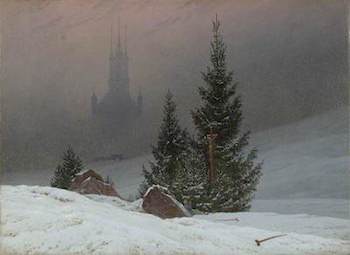
Friedrich, Caspar David, 1774-1840; Winter Landscape

(Caspar David Friedrich, Winter Landscape:
photo credit, The National Gallery)

In war or peace, though, winters take their toll, physically, financially, psychologically, emotionally. ‘Wynter wakeneth al my care’, an anonymous medieval (early fourteenth century) lyricist wrote – or sang, sighing and sorely mourning, ‘When hit cometh in my thoht / Of this worldes joie, hou it geth al to noht.’

Nou hit is, and nou hit nys,
Al so hit ner nere, ywys[5]

(Now it is and now it is not,
As though it had never been, indeed)

White-GWHouse

(http://gilbertwhiteshouse.org.uk/ )

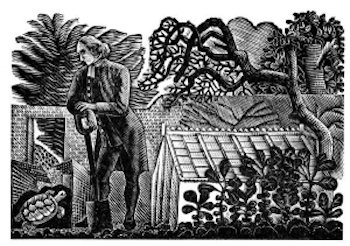
It might well seem that the world’s joy (and much else) was pretty fleeting when the average life expectancy for a male child was not much more than thirty years. In later centuries, people would take a longer view: Gilbert White could look back almost the length of that medieval lifespan when, writing of the winter of 1767-8, he noted that there was ‘reason to believe that some days were more severe than any since the year 1739-40.’[6]

On to Victorian England, where the Reverend Francis Kilvert can record in his diary for Septuagesima Sunday, St Valentine’s Eve, 13 February 1870: ‘the hardest frost we have had yet.’ Arriving at the Chapel, he writes, ‘my beard moustaches and whiskers were so stiff with ice that I could hardly open my mouth and my beard was frozen on to my mackintosh.’[7]

Ah, that old beard and mackintosh combo.

VW-Hut-Int

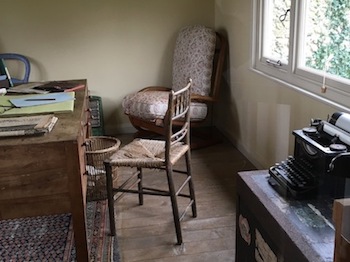
A little later still: though Virginia Woolf defined ‘the greatest pleasure of town life in winter’ as ‘rambling the streets of London’,[8] the disquieting character of the first winter of the war certainly unsettled her. ‘It’s a queer winter—the worst I ever knew, & suitable for the war & all the rest of it’, she wrote in her diary for Friday 22 January 1915. And, three weeks later: ‘I am sure however many years I keep this diary, I shall never find a winter to beat this. It seems to have lost all self control.’[9]

It was in the winter of the next year that D. H. Lawrence retrospectively placed the apocalyptic moment from which there was no real coming back. ‘It was in 1915 the old world ended. In the winter of 1915-1916 the spirit of the old London collapsed, the city, in some way, perished, perished from being a heart of the world, and became a vortex of broken passions, lusts, hopes, fears, and horrors.’[10]

Lady_Ottoline_Morrell

(Ottoline Morrell by George Charles Beresford, 1864-1938)

That was through the eyes, or in the voice, of his protagonist, Richard Somers, still traumatised by his encounters with officialdom. Lawrence’s letters of the time are not, though, hugely different. To Harriet Monroe, he wrote on 15 September 1915:‘This is the real winter of the spirit in England.’ Less than two months later, though, to Ottoline Morrell, he wrote with—if not optimism, then at least a crack of light—‘There must be deep winter before there can be spring.’

DH-Lawrence

(D. H. Lawrence)

No, definitely not optimism. He is advising her to drift and let go. His postscript reads: ‘Only do not struggle – let go and become dark, quite dark.’[11]

References

[1] Frank Kermode, Not Entitled: A Memoir (London: Harper Collins, 1996), 125.

[2] Patrick Hamilton, The West Pier (1951; in The Gorse Trilogy, Black Spring Press, 2007), 30.

[3] Michael Hurd, The Ordeal of Ivor Gurney (Oxford: Oxford University Press, 1978), 94.

[4] E. S. Turner, Dear Old Blighty (London: Michael Joseph 1980), 49.

[5] The Oxford Book of English Verse, 1250-1918, edited by Sir Arthur Quiller-Couch (Oxford: Clarendon Press, 1966), 9, 10.

[6] Gilbert White, The Illustrated History of Selborne (1789; London: Macmillan, 1984), 46.

[7] Kilvert’s Diary, edited by William Plomer, Three volumes (London: Jonathan Cape, 1938, reissued 1969), Volume One (1 January 1870—19 August 1871), 34.

[8] Virginia Woolf, ‘Street Haunting: A London Adventure’, in Selected Essays, edited by David Bradshaw (Oxford: Oxford University Press, 2008), 177.

[9] The Diary of Virginia Woolf, Volume 1: 1915-19, edited by Anne Olivier Bell (Harmondsworth: Penguin, 1979), 26, 33.

[10] D. H. Lawrence, Kangaroo, edited by Bruce Steele, with an introduction and notes by Mac Daly (1923; Cambridge edition, 1994; London: Penguin, 1997), 216.

[11] Letters of D. H. Lawrence II, June 1913-October 1916, edited by George J. Zytaruk and James T. Boulton (Cambridge: Cambridge University Press, 1981), 393, 469.


Ardent and enraged: Ford among the Suffragettes

VH_FMF_Selsey

(Ford Madox Ford and Violet Hunt at Selsey)

On 9 February 1911, The New Age published a letter to the editor from Giessen, in Germany, outlining the writer’s reasons for supporting women’s suffrage:

‘As for the question of militant tactics, I am certainly in favour of them. It is the business of these women to call attention to their wrongs, not to emphasise the fact that they are pure as the skies, candid as the cliffs of chalk, unsullied as the streams, or virginal as spring daffodils. They are, of course, all that—but only in novels. This is politics, and politics is a dirty business. They have to call attention to their wrongs, and they will not do that by being “womanly.” Why should we ask them to be? We cannot ourselves make omelettes without breaking eggs. Why should we ask them to?’[1]

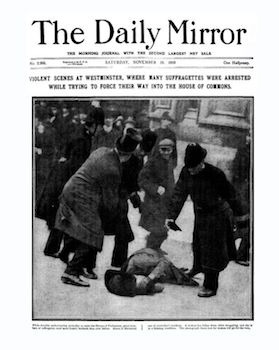
Ford Madox Ford was in Giessen, enmeshed in the maze of the country’s civil law, as part of a ludicrous scheme to secure German citizenship and thus obtain a divorce from his wife Elsie, so that he might marry the novelist (and suffragette) Violet Hunt. His letter came just three months after ‘Black Friday’, 18 November 1910, when the police had physically – and, in some cases, sexually – assaulted the women demonstrators marching on Parliament.

Daily-Mirror-Front-Page-Published-Saturday-19th-November-1910

In his Ancient Lights, which appeared the following month, Ford would assert that, ‘Personally I am an ardent, an enraged suffragette.’[2] He was certainly a productive one. The previous year, he had published, in an English Review editorial, several pages on ‘Women’s Suffrage’, primarily an attack on the Liberal government’s pig-headedness, in particular the devious methods and bad faith shown by Asquith, and the press’s refusal to publish details of abuses together with its readiness to publish more sensational accounts based on dubious sources.[3]

‘In one of His Majesty’s gaols, the doctor officiating at the forcible feeding of one of the women caught her by the hair of the head and held her down upon a bed whilst he inserted—in between her teeth that, avowedly, he might cause her more pain—the gag that should hold her mouth open, and there was forced down her throat one quart of a mixture of raw oatmeal and water. In the barbarous and never to be sufficiently reprehended Middle Ages this punishment was known as the peine forte et dure.’

Ford granted the urgency of some of the major legislation that Winston Churchill and David Lloyd George wished to push through but pointed out, ‘that very urgency makes the necessities of the women by ten times the more urgent. For the reforms that Mr. Lloyd George and his friends desire are precisely social reforms and social reforms precisely concern women even more than men.’ There had been proposals to abolish the House of Lords’ legislative veto: ‘this may be for the good of the people or it may prove the people’s bane. But there can be no doubting that in making these demands Mr. Lloyd George and his friends are asking to be allowed to become the autocratic rulers of the immense body of voiceless and voteless women. As far as the men of the country are concerned the Cabinet will be at least nominally popularly elected. For women they will be mere tyrants.’[4]

Later that year, in four issues of The Vote, Ford published ‘The Woman of the Novelists’, in the form of ‘an open letter’, which became the seventh chapter of his The Critical Attitude (1911).[5] He remarked that, much of the time, when men talked about women, they were, in fact, talking about ‘the Woman of the Novelist!’[6] As readers and consumers of books, women could exert a significant influence over the ways in which male authors portrayed them; but, Ford suggested, ‘it should be a self-evident proposition that it would be much better for you to be, as a sex, reviled in books. Then men coming to you in real life would find how delightful you actually are, how logical, how sensible, how unemotional, how capable of conducting the affairs of the world. For we are quite sure that you are, at least we are quite sure that you are as capable of conducting them as are men in the bulk. That is all we can conscientiously say and all, we feel confident, that you will demand of us.’[7]

Six years after the Representation of the People Act, in the first part of Some Do Not. . ., which can be confidently dated to 1912, Ford has the Tory younger son of a Yorkshire landowning family discuss matters in general, and the Pimlico army clothing factory case in particular, with the young suffragette, Valentine Wannop:

Parades End. Call Sheet #14

(Adelaide Clemens as Valentine Wannop in the BBC/HBO/VRT television adaptation of Parade’s End)

‘Now, if the seven hundred women, backed by all the other ill-used, sweated women of the country, had threatened the Under-Secretary, burned the pillar-boxes, and cut up all the golf greens round his country-house, they’d have had their wages raised to half-a-crown next week. That’s the only straight method. It’s the feudal system at work.’

‘Oh, but we couldn’t cut up golf greens,’ Miss Wannop said. ‘At least the W.S.P.U. debated it the other day, and decided that anything so unsporting would make us too unpopular. I was for it personally.’

Tietjens groaned:

‘It’s maddening,’ he said, ‘to find women, as soon as they get in Council, as muddleheaded and as afraid to face straight issues as men! . . .[8]

Certainly by the following year, golf greens, along with tennis courts, bowling greens and racecourses, were among the casualties as Suffragette protest increased in militancy. It was in 1913 that the Women’s Freedom League published Ford’s pamphlet entitled This Monstrous Regiment of Women.[9] His title derives from the fervid Protestant John Knox, whose First Blast of the Trumpet Against the Monstrous Regiment of Women appeared in 1558, damning rule by women as unnatural and repugnant. It was directed primarily against the Catholic Mary Tudor (as well as the Scots queen Mary Stuart and her mother) but, with monstrously bad timing, appeared just months before the accession to the English throne of Elizabeth – who was not amused.

Portrait-of-Mary-Tudor

(Mary Tudor)

Ford begins his pamphlet, in fact, with the great gains made for England in wealth and power during Elizabeth’s reign, following it with the rejuvenation of the institution of the British throne under Victoria, though he warns against running the theory too hard, given that another queen in that period was Mary, ‘who is generally known as “bloody”’, and also Anne, ‘who is principally known because she is dead’, though her reign, at least at home, ‘was one of comparative peace’. He concludes that, appealing to the reader’s common sense, rather than ‘to prove romantic notions’, he has merely set out to prove, and has surely proved, ‘that in England it has been profitable to have women occupying the highest place of the State.’

One of Ford’s critics remarks, sharply but perhaps not entirely unjustifiably, that Ford ‘took pleasure in feeling more qualified to diagnose the problems with women than women themselves’.[10] It’s certainly arguable that, while his support for women’s suffrage was genuine and sustained, he was often prone to wanting to have his cake and eat it. He was hardly unusual in that: indeed, there have been recent attempts to present such wanting as a coherent political strategy. As Joseph Wiesenfarth remarks, ‘Ford’s personal life suggests that he treated women as equals. He treated them as well and as badly as he treated men’.[11]

Treated – and was treated, at least in Ford’s own view. While at Giessen, he also began writing Women and Men: ‘I have personally been treated badly by men who behaved as if they were wolves. On the other hand I have been badly treated by women who behaved as if they were hyenas.’[12]

On the one hand, wolves; on the other, hyenas. It’s not just the BBC that knows about balance.

References

[1] The New Age, VIII (9 February 1911), 356-357; see Letters of Ford Madox Ford, edited by Richard M. Ludwig (Princeton: Princeton University Press, 1965), 49.

[2] Ford Madox Ford, Ancient Lights and Certain New Reflections (London: Chapman and Hall, 1911), 294.

[3] Ford Madox Ford, ‘The Critical Attitude’, English Review, IV (January, 1910), 332-338.

[4] Ford, ‘The Critical Attitude’, 333, 336.

[5] ‘The Woman of the Novelists’, The Vote, II (27 August, 3 September, 10 September, 17 September, 1910).

[6] Ford Madox Ford, The Critical Attitude (London: Duckworth, 1911), 151, 152.

[7] Ford, The Critical Attitude, 168-169.

[8] Ford Madox Ford, Some Do Not. . . (1924; edited by Max Saunders, Manchester: Carcanet Press, 2010), 145.

[9] The pamphlet is reprinted in Sondra Stang, editor, The Ford Madox Ford Reader (Manchester: Carcanet Press, 1986), 304-317.

[10] James Longenbach, ‘The Women and Men of 1914’, in Helen M. Cooper, Adrienne Auslander Munich and Susan Merrill Squier, editors, Arms and the Woman: War, Gender, and Literary Representation (Chapel Hill: University of North Carolina Press, 1989), 108.

[11] Joseph Wiesenfarth, Ford Madox Ford and the Regiment of Women: Violet Hunt, Jean Rhys, Stella Bowen, Janice Biala (Madison: University of Wisconsin Press, 2005), 27.

[12] Ford Madox Ford, ‘Women and Men—I’, Little Review, IV (January, 1918), 27.

Mr Joyce, that dull book, nymphs

Twat

On my way to the cemetery—just walking, not for any graver purpose—I pass a van (a bit grimy) parked almost opposite the school. When the recent news is of academy schools in dire financial trouble and declining resources allocated to the arts and creative subjects in English schools, how can this not be cheering? Clearly, the writer already possesses the tools necessary to engage in political comment and discussion as it’s generally practised in this country lately, certainly online. More, it’s even spelled correctly.

Perhaps not quite cheering enough to offset all the other stuff. Still, let’s raise a glass for James Joyce’s birthday: ninety-six years today since the guard on the 7 a.m. express train from Dijon handed over two copies of Ulysses, one for the author on his fortieth birthday and one for Sylvia Beach to display in the window of her bookshop, Shakespeare & Company. ‘That dull book,’ he said, when Sylvia told him she was printing a thousand copies, ‘you won’t sell a copy of it.’

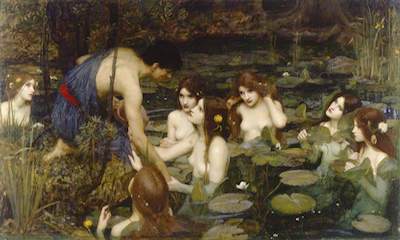
Waterhouse, John William, 1849-1917; Hylas and the Nymphs

(Why yes, it’s Hylas and the Nymphs by J. W. Waterhouse:
photo credit: Manchester Art Gallery)

Joyce had troubles enough in his time, with self-appointed judges and moral guardians, but would probably have been surprised to find a censorious glare turned upon John William Waterhouse. It’s a worrying sign, this lamentable decision of the Manchester Art Gallery to remove Hylas and the Nymphs from public view. Whatever one’s feelings about that specific painting, this policing of the past, the kind of censorship that announces, in the first instance, that it’s not censorship, is unambiguously bad. To claim that such actions are taken to ‘prompt a conversation’ when erasing history only closes down conversations, is disingenuous at best, dishonest at worst. And, alas, it’s given even more ammunition—as is evident from the yards of comments already posted about this news item—to the online (and offline) tribes who moan endlessly that their lives have been irretrievably ruined by those censorious and puritanical feminists who are plotting the ruin of western civilisation.


Books, music-hall, lovers, cats, Colette

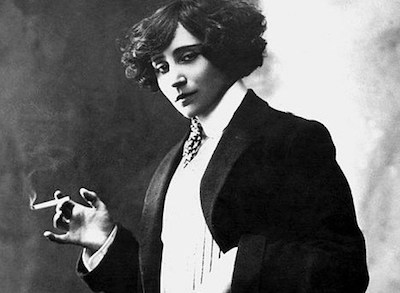
Colette-3

This week’s Times Literary Supplement reprinted a 1985 review of Deep into Mani: Journey to the southern tip of Greece by Peter Greenhalgh and Edward Eliopoulos. The reviewer was Patrick Leigh Fermor, whose evident delight in the book was based on an intimate knowledge of the region described and the existing literature about it (his own Mani had appeared almost thirty years before). He was, then, in his accustomed context. A slightly less familiar one is as translator on the title page of Julie de Carneilhan and Chance Acquaintances by Colette, two novellas written and published during the Nazi occupation of France, which appeared in English in 1952. He ‘usually enjoyed her writing but having to correct the proofs in a rush soured him for Colette.’ Still, the money was useful.[1]

Colette-4

(Via http://www.musee-colette.com/)

Novelist, autobiographer, journalist and short-story writer (and actress and dancer) Colette was born Sidonie-Gabrielle Colette on 28 January 1873, in Saint-Sauveur-en-Puisaye, a village in Burgundy. ‘To those who live in the country and use their eyes everything becomes alike miraculous and simple.’[2] She was allowed, she remembered, to go out at 3.30 in the morning, walking towards the kitchen-gardens. ‘I went alone, for there were no dangers in that free-thinking countryside. It was on that road and at that hour that I first became aware of my own self, experienced an inexpressible state of grace, and felt one with the first breath of air that stirred, the first bird, and the sun so newly born that it still looked not quite round.’[3] As a teenager, she wanted to be a doctor, ‘an ambition all the more extraordinary’ since there were only seven woman doctors in the whole of France at that time.[4]

Famously, Colette’s earliest books were credited to Henri Gauthier-Villars, ‘Willy’, whom she had married when she was 20 (he was fifteen years older): his part in them seems, rather, to have been that of editing, suggesting and prompting. Colette left him in 1906 and worked as a music-hall performer to earn a living. For many years, she was involved with the stage, with literary journals, with music.

‘The opening, last night, was epic. The orchestra conductor, as we saw too late, was not an orchestra conductor but a wine merchant. Musically, the evening was a disaster, for the other numbers as well as our own. Backstage everyone was howling, and the audience booed the conductor. It was stunning!’[5]

She published nearly eighty volumes, which is one point of affinity with another writer whose birth year she shared, Ford Madox Ford—there are perhaps two others: a deep love of France and a complex, mutable relationship between fiction and autobiography.

A wonderfully sensuous writer, she powerfully evokes her early years, her relationship with her mother, her schooldays, the smells, sights and sounds not only of her childhood and girlhood but also of the Paris and Provence of her adult life. She was a mass of contradictions but had a wonderful eye for detail, an ear for tone and feeling, a fiercely intimate relationship with the physical world. ‘We do not look, we never look enough, never attentively enough, never excitedly enough.’[6]

Colette2

Some of her remarks about the South ultimately conquering its conquerors recall similar statements from Ford and Joseph Roth: ‘The barbarians from the north parcel out the land, speculate and deforest, and that is certainly a great pity. But during the course of the centuries how many ravishers have not fallen in love with such a captive? They arrive plotting to ruin her, stop suddenly and listen to her breathing in her sleep, and then, turning silent and respectful, they softly shut the gate in the fence.’[7] She wrote lyrically too about Brittany: ‘I wish you could see Rozven, with its cove of green sea, its complicated rocks, the little woods, the old and new trees, the warm terrace, the rosebushes, my yellow room, and the beach to which the tides bring treasures—mauve coral, polished shells, and sometimes casks of whale oil or benzine, from far-off shipwrecks. And I have a rocky perch, between the sky and the sea . . . ’[8]

Colette’s father, Le Capitaine (Jules-Joseph Colette), died in 1905. He was an ex-captain of the select Zouave infantry, born in Toulon and trained at Saint-Cyr, and had lost his left leg in Italy in 1859. She recalled the row of volumes well-bound in boards, covered in marble paper, on the highest shelves of the family library. The titles, handwritten in Gothic lettering, were, she remarked, not tempting: My Campaigns, The Lessons of ’70, Elegant Algebra, Zouave Songs and others. After the Captain’s death, Colette’s brother went through those books. ‘The dozen volumes bound in boards revealed to us their secret, a secret so long disdained by us, accessible though it was. Two hundred, three hundred, one hundred and fifty pages to a volume: beautiful, cream-laid paper, or thick “foolscap” carefully trimmed, hundreds and hundreds of blank pages. Imaginary works, the mirage of a writer’s career.’[9]

She was divorced from Willy in 1910 and her beloved, maddening mother died two years later. Colette’s daughter Bel-Gazou was born in 1913. the year after her second marriage to Henry de Jouvenel. In the first winter of the war, she managed to get through the lines and join Henri at Verdun.[10] She wrote extensively about that war (and the next one): her reports for Le Matin were later collected as Les Heures Longues, sections of which are translated in Earthly Paradise.

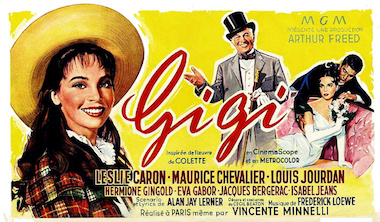
Gigi-film-poster

Admired by Edith Wharton, Cocteau, André Gide, W. H. Auden, Somerset Maugham, she crops up constantly in the literary history of the first half of the twentieth-century. In 1921, she writes to Marcel Proust in response to his sending her an inscribed copy, ‘If I were to tell you that I burrow in its pages every night before going to sleep, you would think I was merely offering you a hollow compliment. But the fact is, Jouvenel gets into bed every night to find me, your book, and my glasses. “I am jealous but resigned,” he says.’[11] As editor, in the office of Le Matin, she advises Georges Simenon to ‘Suppress all the literature and it will work’.[12] In November 1952, when François Mauriac wins the Nobel Prize for Literature, ‘one of the first things he did was to call on Colette, who should have had it, he felt, in his place.’[13]

Chéri and The Last of Chéri, Break of Day, The Vagabond, the other more frankly autobiographical volumes, the stories, the letters: there’s a great deal of pleasure to be had; with the added attraction that she often makes me laugh.

‘It’s curious that the hat which is too small creates an impression of lunacy much more than does the hat that is too large. A lunatic hardly ever puts on his head a hat which is too big. He readily covers himself with a bottle-top, an empty matchbox, a child’s boat turned upside-down, a jampot.’[14]

A jampot is tempting but I’m currently opting for the bottle-top.

References

[1] Artemis Cooper, Patrick Leigh Fermor: An Adventure (London: John Murray, 2012), 263-264; see also the letter to Joan Rayner [January 1952], in Dashing for the Post: The Letters of Patrick Leigh Fermor, selected and edited by Adam Sisman (London: John Murray, 2016), 60.

[2] Colette, My Mother’s House, translated by Una Vincenzo Troubridge and Enid McLeod, in My Mother’s House & Sido (Penguin, 1966), 61.

[3] Colette, Sido, translated by Enid McLeod, in My Mother’s House & Sido, 147.

[4] Judith Thurman, Secrets of the Flesh: A Life of Colette (London: Bloomsbury Publishing, 2000), 54.

[5] To Léon Hamel, Dijon, 22 September 1910: Letters from Colette, selected and translated by Robert Phelps (London: Virago Press, 1982), 17.

[6] Looking Backwards: Recollections [Journal à rebours and De ma fenêtre], translated by David Le Vay (London: Peter Owen, 1975), 149.

[7] Colette, Break of Day [La Naissance du Jour], translated by Enid McLeod (1928; London: The Women’s Press, 1979), 14.

[8] To Louis de Robert, early April 1911: Letters from Colette, 22.

[9] Colette, Sido, in My Mother’s House & Sido, 182.

[10] Colette, Earthly Paradise: An autobiography drawn from her lifetime writing by Robert Phelps (Harmondsworth: Penguin, 1974), 18.

[11] Letters from Colette, 63.

[12] Patrick Marnham, The Man Who Wasn’t Maigret: A Portrait of Georges Simenon (San Diego: Harcourt, Brace, 1994), 112.

[13] Robert Phelps, Belles Saisons: A Colette Scrapbook (London: Secker and Warburg, 1978), 269.

[14] Looking Backwards, 138.

Prince of morticians

Beddoes

In an article in Future in 1917, Ezra Pound wrote in praise of Thomas Lovell Beddoes (who died on this day, 26 January, in 1849), ‘Elizabethan’, he argued, ‘that is, if by being “Elizabethan” we mean using an extensive and Elizabethan vocabulary full of odd and spectacular phrases: very often quite fine ones.’[1] (Before and after this date, Ford Madox Ford was arguing – frequently – that Joseph Conrad was ‘Elizabethan’).[2]

Pound owned a two-volume set of Beddoes’ writings (1890) and was obliged to offer thanks to its editor Edmund Gosse, of whom he had rather less than complimentary things to say on other occasions.

Beddoes published relatively little in his lifetime (he committed suicide at the age of forty-five) and it was the posthumously-published Death’s Jest-Book which Pound was focused upon.

‘Tremble not, fear me not
The dead are ever good and innocent,
And love the living.’ (IV, iii, 111-113)[3]

Pound was concerned to ask ‘why so good a poet should have remained so long in obscurity’. Was it largely a matter of chronology, of which poets are still alive and flourishing or lately dead and widely mourned?

‘No more of friendship here: the world is open:
I wish you life and merriment enough
From wealth and wine, and all the dingy glory
Fame doth reward those with, whose love-spurned hearts
Hunger for goblin immortality.

Live long, grow old, and honour crown thy hairs,
When they are pale and frosty as thy heart.
Away. I have no better blessing for thee.’ (I, ii, 291-298)

‘The patter of his fools,’ Pound says, ‘is certainly the best tour de force of its kind since the Elizabethan patter it imitates’:

‘My jests are cracked, my coxcomb fallen, my bauble confiscated, my cap decapitated. Toll the bell; for oh, for oh! Jack Pudding is no more.’ (I, i, 9-11)

Hanswurst-Jack-Pudding

Jack Pudding
(The Traditional Tune Archive: http://tunearch.org/wiki/Annotation:Jack_Pudding )

‘I try to set out his beauties without much comment, leaving the reader to judge, for I write of a poet who greatly moved me at eighteen, and for whom my admiration has diminished without disappearing.’

Thirty years later, at Pisa, Pound wrote:

Curious, is it not, that Mr Eliot
has not given more time to Mr Beddoes
(T. L.) prince of morticians
where none can speak his language[4]

That last line remembers Death’s Jest-Book once more (quoted in Pound’s essay):

‘Thou art so silent, lady; and I utter
Shadows of words, like to an ancient ghost,
Arisen out of hoary centuries
Where none can speak his language.’ (I, ii, 141-144)

As to our local connection: Beddoes was born in 1803, at 3 Rodney Place, Clifton, Bristol. His father, the eminent medical man, Dr Thomas Beddoes was married to Anna Edgeworth, sister of the novelist, Maria Edgeworth. Four years before the birth of his son, Dr Beddoes had succeeded in establishing the Pneumatic Institution in Hotwells, Bristol, concerned with treatment through the inhalation of various gases. At Hotwells, the first superintendent was Humphry Davy, whose experimental work included investigation of the properties of nitrous oxide (laughing gas). Alethea Hayter suggests that Samuel Taylor Coleridge’s ‘first real habitation to opium’ may have resulted from a recommendation in Dr Thomas Brown’s Elements of Medicine, edited by none other than Dr Beddoes.[5]

If there were dreams to sell,
What would you buy?
Some cost a passing bell;
Some a light sigh,
That shakes from Life’s fresh crown
Only a roseleaf down.
If there were dreams to sell,
Merry and sad to tell,
And the crier rung the bell,
What would you buy?   (Dream-Pedlary, in Poetical Works, I, 46)

The Thomas Lovell Beddoes website is here: http://www.phantomwooer.org/

The poet Alan Halsey, who ran the Poetry Bookshop in Hay-on-Wye for nearly twenty years, has written on Beddoes and edited the 2003 edition of the later text of Death’s Jest-Book. He runs West House Books as both publisher and bookseller. His secondhand catalogue has some very choice items indeed:
http://www.westhousebooks.co.uk/

References

[1] ‘Beddoes (and Chronology)’, reprinted (with incorrect publication year of 1913) in Ezra Pound, Selected Prose 1909-1965, edited by William Cookson (London: Faber and Faber, 1973), 348-353. All Pound quotations from this essay.

[2] See ‘Joseph Conrad’, English Review (December 1911), 69, 70; ‘Literary Portraits – XLI. Mr. Richard Curle and “Joseph Conrad”’, Outlook, XXXIII (20 June 1914), 848, 849; Thus to Revisit (London: Chapman & Hall, 1921), 100; ‘Mr Conrad’s Writing’, Literary Supplement to The Spectator, 123 (17 November 1923), in Critical Essays, edited by Max Saunders and Richard Stang (Manchester: Carcanet Press, 2002), 230; Joseph Conrad (London: Duckworth, 1924), 18, 25; Letters of Ford Madox Ford, edited by Richard M. Ludwig (Princeton: Princeton University Press, 1965), 127.

[3] References to Death’s Jest Book in The Poetical Works of Thomas Lovell Beddoes, edited by Gosse (Dent, 1890), Volume II, 5-158.

[4] ‘Canto 80’, The Cantos of Ezra Pound, fourth collected edition (London: Faber and Faber, 1987), 498.

[5] Alethea Hayter, Opium and the Romantic Imagination (London: Faber and Faber, 1971), 27.


Manning the pump, manning the ship

Collins, William, 1788-1847; The Caves of Ulysses at Sorrento, Naples

(William Collins, The Caves of Ulysses at Sorrento, Naples, 1843
Photo credit: Victoria and Albert Museum)

There’s a moment in Hermione Lee’s biography of Penelope Fitzgerald when, discussing the long period of Fitzgerald’s teaching, she mentions that ‘Her copies of Joyce and Beckett are full of little jokes to herself, as when the citizen in the “Cyclops” episode of Ulysses goes out “to the back of the yard to pumpship”, and she notes: “Has to pee just like Bloom. We’re all human.”’[1] By ‘the citizen’ is meant—or should be meant—not ‘the Citizen’, that violent and foul-mouthed Polyphemus figure but the unidentified narrator of the ‘Cyclops’ episode. ‘So I just went round to the back of the yard to pumpship’.[2]

Pumpship – or pump ship. Yes, perhaps inevitably there comes a time in a man’s life when his thoughts alight and pause on slang terms for urination. Might women be content to be left out of this general discussion? On the basis of my (admittedly very limited) survey, it would seem so. . . .

Don Gifford’s authoritative Ulysses Annotated didn’t find the term worth elucidating, though R. W. Dent’s Colloquial Language in Ulysses has an entry (which basically reproduces Eric Partridge’s).[3] Joyce’s friend Frank Budgen doesn’t enlarge on it either, merely commenting that ‘I’, or ‘the Nameless One’, as he also refers to the narrator, ‘goes out into the yard to pumpship’. But then Budgen, in earlier life, had spent six years at sea.[4]

Bloomsbury-Pie

All this put me in mind of the account in Regina Marler’s Bloomsbury Pie of the discussions between Joanne Trautmann Banks and Nigel Nicolson, the editors of Virginia Woolf’s letters, on the level of annotation to be used there:

‘Having decided, too, that the annotation should insult neither English nor American readers, the editors sometimes battled over what should be explained. The Adirondacks, for instance, were judged too basic. But what about “pumping ship,” or as Virginia used the phrase, in reference to T. S. Eliot’s extreme reserve: “It’s on a par with not pump shipping in front of your wife.” “What’s that?” Trautmann asked, certain they would have to annotate it. “Pumping ship means urinating,” Nicolson told her. “Every Englishman knows that.” Trautmann decided to test his assumption:

So the typists, the cook, and the nanny were asked. Nigel’s children were asked, as was every guest at Nigel’s next dinner party….Only one man knew, a physician, as it happens. I say “as it happens,” because Nigel determined that it was not the doctor’s profession that led to this particular genito-urinary information, but his age and schooling. “Only Old Etonians over 50 know about pumping ship,” Nigel announced. We annotated it.[5]

They did. The note reads ‘Virginia misconstructed this now obsolescent term for urinating.’[6] With a markedly worse misconstruction, E. M. Forster, floundering badly and unappealingly, writes in letters of having ‘pump shitted’ and of ‘pump shitting’.[7]

‘P.S.’, Rupert Brooke wrote in a 1912 letter to James Strachey, ‘When I pump ship, it’s bright green. What does that portend?’[8]  A portentous question.

PF-BlondeB-Slate

(Penelope Knox, ‘the blonde bombshell’, via Slate Magazine )

Penelope Fitzgerald, anyway, seems untroubled by the word ‘pumpship’. To be sure, she wasn’t an Old Etonian over fifty, but two of her uncles had been (though Dillwyn died in 1943, aged only fifty-eight). Back in mid-1930s Oxford, where men at the university outnumbered women by six to one, ‘the blonde bombshell’ then at Somerville College—‘No one was surprised when she got a First after a “congratulatory viva”, at which the candidate is praised rather than quizzed’—surely met a good many Old Etonians (and Harrovians and Rugbeians).[9]

But then a Dubliner, educated at O’Connell, Clongowes and Belvedere, also seems quite untroubled about it, as does ‘the Nameless One’, as fluent in speech as in relieving himself—and admiring too (if grudgingly) of Leopold Bloom’s own fluency:

And of course Bloom had to have his say too about if a fellow had a rower’s heart violent exercise was bad. I declare to my antimacassar if you took up a straw from the bloody floor and if you said to Bloom: Look at, Bloom. Do you see that straw? That’s a straw. Declare to my aunt he’d talk about it for an hour so he would and talk steady.[10]

References

[1] Hermione Lee, Penelope Fitzgerald: A Life (London: Chatto and Windus, 2013), 199.

[2] James Joyce, Ulysses (1922; London: The Bodley Head, revised edition, 1969), 435.

[3] Don Gifford, with Robert J. Seidman, Ulysses Annotated: Notes for James Joyce’s Ulysses, revised and expanded edition (Berkeley: University of California Press, 1989); R. W. Dent, Colloquial Language in Ulysses: A Reference Guide (Newark: University of Delaware Press, 1994), 145; Eric Partridge, A Dictionary of Slang and Unconventional English, edited by Paul Beale, 8th edition (London: Routledge, 1991), 933: nautical slang, late 18th century to c.1870, given there as two words.

[4] Frank Budgen, James Joyce and the Making of ‘Ulysses’ and other writings, enlarged edition (1934; London: Oxford University Press, 1972), 165.

[5] Regina Marler, Bloomsbury Pie: The Story of the Bloomsbury Revival (London: Virago, 1997), 158. She quotes from Trautmann’s piece in Charleston Magazine, 13 (1996), 12. See also Joanna Trautmann Banks, ‘The Editor as Ethicist’, in Virginia Woolf: Interpreting the Modernist Text, edited by James M. Haule and J. H. Stape (London: Palgrave Macmillan, 2002), 29.

[6] Virginia Woolf, The Question of Things Happening: Collected Letters II, 1912-1922 (London: The Hogarth Press, 1980), 572, n1.

[7] Selected Letters of E. M. Forster, Volume One: 1879-1920, edited by Mary Lago and P. N. Furbank (London: Collins, 1983), 95, 238. His editors note, of the letter of 19 October 1908, ‘“Pump shitted”: EMF’s misspelling of “pumpshipped”’ (96, n.3).

[8] Friends and Apostles: The Correspondence of Rupert Brooke and James Strachey, 1905-1914, edited by Keith Hale (New Haven: Yale University Press, 1998), 253. A footnote mentions ‘semen’, so poet and editor appear to have something else in mind here.

[9] Lee, Penelope Fitzgerald, 57. In the 1970s, Fitzgerald became friends with Mary Lago, one of the editors of E. M. Forster’s letters (quoted above)—on which she was probably then working.

[10] Joyce, Ulysses, 410.

Odysseys: man—and woman—of many devices

Turner, Joseph Mallord William, 1775-1851; Ulysses deriding Polyphemus- Homer's Odyssey

(J. M. W. Turner, Ulysses Deriding Polyphemus
Photo credit: National Gallery)

Standing in the bright kitchen, darkness still pressing closely against the windows, waiting for the coffee to brew, I turn the pages of The Odyssey, the first published translation into English of Homer’s epic by a woman, Emily Wilson, (British) Professor of Classics at the University of Pennsylvania.

Thinking of the beginning of the poem in English, the phrase I usually have in my head is ‘Tell me, Muse, of the man of many devices’. I can’t now be sure of precisely where that came from. The closest is the old Loeb edition, translated by Murray, except that he seems to have ‘O Muse’. I thought it might be E. V. Rieu’s prose translation from 1946, the first-ever Penguin Classic, later revised by his son. That was certainly the first version I ever read but the copy I now have begins: ‘Tell me, Muse, the story of that resourceful man’.[1]

‘Sing to me of the man, Muse, the man of twists and turns’, Robert Fagles has it.[2] And Emily Wilson? ‘Tell me about a complicated man.’ The next line begins ‘Muse’—I’d thought at first the opening line ended with a comma but it doesn’t.

Muse, tell me how he wandered and was lost
when he had wrecked the holy town of Troy,
and where he went, and who he met, the pain
he suffered in the storms at sea, and how
he worked to save his life and bring his men
back home.[3]

Not having the Greek for purposes of comparison, I go by ear as, I presume, the vast majority of readers must. Or I simply trust Guy Davenport, who did know Greek and translated Sappho, Herondas, Archilocos and Herakleitos, among others. In his essay ‘Another Odyssey’, he discusses translations by Richmond Lattimore (the ostensible occasion for the essay), Butcher and Lang, Robert Fitzgerald, William Cullen Bryant, William Morris, T. E. Lawrence, Chapman, Pope, Christopher Logue and Samuel Butler—opening with the poet Salvatore Quasimodo’s rendering of the opening lines of the third book of The Odyssey into Italian. Davenport mentions ‘the two most exciting translations from Homer in recent years’—Robert Fitzgerald’s and Christopher Logue’s—and quotes an extract from the nineteenth book of The Iliad as translated first by Lattimore, then by Logue. ‘We have all been taught,’ Davenport comments, ‘to prefer the former, out of a shy dread before Homer’s great original; we instinctively, if we have ever felt a line of poetry before, prefer the latter.’[4] Davenport was writing in 1968 and estimated that there had been at least fifty versions in English of Homer’s second epic poem. There have been around twenty since then, with three just in the past year (Emily Wilson, Peter Green and Anthony Verity).

Wilson-Odyssey

Wilson’s version goes with a swing because she’s opted to use iambic pentameter, the traditional metre of English narrative poetry (she also matches the poems line by line). ‘The original’, she points out, ‘is written in a highly rhythmical form of verse. It reads nothing like prose and nothing like any spoken or nonpoetic kinds of discourse.’ The Odyssey, she argues, ‘needs to have a predictable and distinctive rhythm that can be easily heard when the text is read out loud.’[5] True enough; I can vouch for the efficacy of that rhythm, having begun reading her Odyssey aloud to the Librarian.

The beginning of the poem is a very obvious point of comparison: the address to the muse, which seems straightforward but is, apparently, not. As far as my fingertip decipherings in Liddell and Scott’s dictionary go, Odysseus could be described as ‘much-turned, i.e. much-travelled, wandering’, turning many ways, versatile, ingenious, changeful or manifold. Plenty of scope there, then.

(Emily Wilson discusses the decisions to be made about that single word, polytropos, here:
https://www.nytimes.com/2017/11/02/magazine/the-first-woman-to-translate-the-odyssey-into-english.html )

I’m reminded of the debate over the ‘correct’ rendering of Camus’ ‘maman’ in the first line of The Outsider (or The Stranger, as it’s always been known to the far west of me). I always remember that line as ‘Mother died today’, probably from Stuart Gilbert’s 1946 translation, which was followed only after a long interval by Joseph Laredo’s version, then by translations from Kate Griffith, Matthew Ward and Sandra Smith. ‘Mother’ seems to have shifted only as far as ‘my mother’, with the exception of Ward’s reversion to maman.

It’s a question of relative formality (mother, mum, mummy, mom) but there are obvious cultural differences too, French retaining certain formalities or faint memories of a courtliness which English and American speakers have largely shed. The issue was discussed by Ryan Bloom in The New Yorker (11 May 2012), where, reviewing Camus’ opening sentence—‘Aujourd’hui, maman est morte’­—he concluded: ‘The ordering of words in Camus’s first sentence is no accident: today is interrupted by Maman’s death. The sentence, the one we have yet to see correctly rendered in an English translation of “L’Étranger,” should read: “Today, Maman died.”’
(See: https://www.newyorker.com/books/page-turner/lost-in-translation-what-the-first-line-of-the-stranger-should-be )

‘He observed, that all works which describe manners, require notes in sixty or seventy years, or less’, Boswell remarks of Samuel Johnson.[6] Cultural habits, cultural assumptions, such things change constantly, in both small and fundamental ways. So do expectations of who might read a literary work: their gender, their social class, their level of education. But as to who might read this Odyssey, it’s pretty safe to venture ‘anyone at all’.

References

[1] Homer, The Odyssey, revised translation by D. C. H. Rieu, in consultation with Peter V. Jones (London: Penguin, 1991), 3.

[2] Homer, The Odyssey, translated by Robert Fagles (London: Penguin, 1997), 77.

[3] Homer, The Odyssey, translated by Emily Wilson (New York: Norton, 2017), 105. Caroline Alexander’s The Iliad: A New Translation (Vintage, 2016) is, apparently, the first published version in English of that poem by a woman. See A. E. Stallings’ review of Alexander in The Spectator (9 April 2016).

[4] Guy Davenport, The Geography of the Imagination (Boston: David R. Godine, 1997), 29-44; 36, 37.

[5] Wilson, ‘Translator’s Note’, 81, 82.

[6] James Boswell, Life of Johnson, edited by R. W. Chapman, revised by J. D. Fleeman, (Oxford: Oxford University Press, 1980), 509.

Noises off, spell checkers on

Burne-Jones, Edward, 1833-1898; Love Among the Ruins

(Edward Burne-Jones, Love Among the Ruins
National Trust, Wightwick Manor: photo credit National Trust)

A few days ago, I could hear a frequent but unidentifiable noise: upstairs as well as downstairs. Washing-machine? Sewing-machine? Drill? Just at the edge of the range of my hearing, so that I couldn’t identify the source of it either. Surely from one of the neighbouring houses but which one? Mechanical or electrical; varying duration; it had stopped; no, it hadn’t, it kept on happening. I finally decided that it was workmen taking down the scaffolding from a house thirty or forty metres along the road. But the salient point was that, once aware of the sound, even though it was barely audible, I couldn’t ignore it: the fact of it had lodged in my head and wouldn’t be shifted.

Now an impressive commotion at the door heralds the arrival of a copy of the 1975 edition of Penelope Fitzgerald’s Edward Burne-Jones: A Biography, supplied with promptness and efficiency by G. & J. Chesters of Tamworth. After finishing, The Knox Brothers, Penelope Fitzgerald’s remarkable group biography of her father and three uncles, the only one of her books that I’d not read was Edward Burne-Jones: I’d dipped into it but never read it through properly. Having determined to reread all her fiction—which I’d thought wonderful the first time around even while I was convinced that I’d missed at least half of what there was to see—I added the biographies, intending to start at the beginning.

Penelope_Fitzgerald_A_Life

I had the paperback edition, published by Sutton in 2003, with a brief preface by Christopher Wood. By the time I reached page twenty-five, which mentioned the French city of ‘Chatres’, I was so aware of the errors in the text that it had become as serious a distraction as bolt-removing workmen. But was it just a case of errors carried forward from the original publication? I found a limited preview of that on Google Books and checked a couple of examples. No, these were all Sutton’s own work, so I placed an order for the first edition. Just after I’d done so, I found an endnote in Hermione Lee’s superb biography of Fitzgerald, which mentioned the publishing history of her life of Burne-Jones: it had ‘two reissues, by Hamish Hamilton in 1989, and by Sutton Publishing in 2003, a bad edition full of misprints.’[1] Ah yes.

Long before I did any editorial work, I was a freelance proof-reader for a few years, always desperate for a little extra money. If you take to proofreading and sub-editing, and you have the type of eye and mind that lock on to errors of that sort, it’s impossible to shake the habit off (sometimes tiresome, no doubt, to those not afflicted in the same way). I was once moved to write to the American publisher of an edition of William Faulkner’s Collected Stories that I was reading, pointing out the appalling state of the text; on another occasion, I wrote to John Calder about a Wyndham Lewis novel, suggesting that Lewis’s writing was quite challenging enough without  the addition of occasional gibberish because the proof-reader (if there was one) had nodded off or had recourse to the bottle. In neither case did I hear back. Years later, when I read Pursuit, subtitled ‘The Uncensored Memoirs of John Calder’, I thought ‘unedited too: you should have let me—or, at least, somebody—proofread this, Mr Calder.’[2]

Spalding-Piper

Most recently dispiriting was the case of Frances Spalding’s joint biography of John and Myfanwy Piper, published by Oxford University Press.[3] It’s a beautiful book, six hundred pages long, with an extensive range of illustrations, both in colour and in black and white, well-designed and produced (although, despite my care, several of the colour plates were working themselves loose by the time I’d finished the book). A successful and highly-regarded biographer and art historian; an eminent university press; yet, in the first three pages, I read of a ‘Librian’ (this may be something vaguely astrological but it isn’t a keeper of books and manuscripts) and a sentence that started: ‘After this begun book was begun’, which seemed overgenerous with beginnings. Subsequently, among other delights, there was an antiquarian named William Stukley (referred to again, correctly spelt, within a few lines), an institution called the Royal Collage and a novelist named Henry Greene. Indefinite articles were missed out several times, there was an unsettling reference to Piper’s ‘panting’, Keynsham was shunted into another county and a village named Layock, near Melksham, was  invented for the occasion.

All of which, once again, only served to distract this reader from the text. It is, I know, an open secret that, while publishers generally used to see to this sort of thing, a great many now. . . don’t. Perhaps there’s some uncertainty as to where the burden of responsibility ultimately lies, which makes it all very twenty-first century—but there, I feel a bit of politics coming on. Perhaps better not. . .

References

[1] Hermione Lee, Penelope Fitzgerald: A Life (London: Chatto and Windus, 2013), 457, n.25.

[2] Looking back now, I note Michael Horowitz’s comment, when reviewing the book in The Telegraph (18 March 2002): ‘Calder’s unimpeachable commitment to the defence of literature is heavily sabotaged by misspellings and glaring errors of fact, grammar, punctuation and attribution throughout the memoirs.’ I see that a paperback edition came out at the end of 2016, perhaps proofread for the occasion.

[3] Frances Spalding, John Piper, Myfanwy Piper: Lives in Art (Oxford: Oxford University Press, 2009).


‘I suppose they think I don’t notice’: Ford Madox Ford on enemies

Brown, Ford Madox, 1821-1893; An English Autumn Afternoon

(Ford Madox Brown, English Autumn Afternoon: Birmingham Museum Trust)

On 16 January 1915, Ford Madox Ford (or Ford Madox Hueffer as he then still was) published ‘Enemies’, in his regular series of articles for the weekly periodical Outlook. His editor having signified to Ford that his writing about ‘German culture and the nature of the Prussian State’ (which became his first propaganda book, When Blood is Their Argument) had grown ‘monotonous’ to his readers. Ford now considered the subject of how one should act ‘when one discovers that one is hated’. He had, he said, awoken to the facts that ‘he has been seven times denounced to the British authorities as a German spy, and that the German papers clamorously demand the hanging of the poor present writer as a British variety of the observant tribe.’ And he added: ‘I seem all my life to have been helping over stiles lame dogs who, having recovered the use of their legs, used them for kicking me in the eye.’[1]

Ford_Madox_Brown

(Ford Madox Brown)

That habit was based on advice imparted to him by his much-loved grandfather, the painter Ford Madox Brown: ‘Fordie, never refuse to help a lame dog over a stile. Never lend money; always give it. . . ’[2] It was an attitude that, unsurprisingly, led to occasional difficulties. Alan Judd opens his biography with the story of a Georgian prince (‘every Georgian in Paris was a prince in those days’) who, in 1930s Paris, tapped the impoverished Ford for some cash. ‘Ford had never met the man before but let him have a cheque. The prince was outraged by the smallness of the sum and never visited Ford again, though he kept the cheque. It was for one half of the money Ford owned.’[3]

Literature, particularly, demanded such sacrifices. Ford’s first editorial venture, the English Review, was a critical triumph but a financial disaster. When he was editing his second periodical, the transatlantic review, Ford wrote to Gertrude Stein, ‘indeed I really exist as a sort of half-way house between nonpublishable youth and real money—a sort of green baize swing door that everyone kicks both on entering and on leaving.’[4]

Gertrude_Stein_by_Alvin_Langdon_Coburn

(Gertrude Stein by Alvin Langdon Coburn: Eastman Collection)

It was not just money, of course, but personal relations, the seemingly inevitable rows for various reasons and of various sorts: with Conrad, with Arnold Bennett, with A. E. Coppard, with Hemingway. Ford seemed constantly beset by betrayals or, at least, beset by the suspicion or conviction of betrayals. Violet Hunt forged his name on cheques. A journalist ‘from one of Mr Hearst’s papers’, who terrified both Ford and the bailiff-handyman Standing by his deranged handling of an axe when set to chopping wood, in the end ‘took down by shorthand my best story and sold it to a London magazine for £16 that I could well have done with myself. . . . I don’t know why people do things like that to me. I suppose they think I don’t notice. . . . ’[5]

‘I suppose they think I don’t notice.’ This could be the political slogan stitched on a million tee-shirts. ‘They must think we’re stupid,’ the Librarian murmurs as the latest idiocy is announced. I used to assent but now I hesitate. Marvelling anew at some of the people who still have ministerial jobs and the sheer brass neck of some of the responses to the crisis in the National Health Service, I suspect, rather, that ‘they’ no longer bother, that they have stopped even bothering to pretend. With another major scandal currently in the news, observers can only wonder at the weight of each of the usual factors: greed, gross incompetence, corruption, blindness brought on by ideological dazzlement. Even if you’re relaxed about the constant outsourcing of public service provision to private companies—which I’m not since it seems to me nothing more than governmental evasion of responsibility—it must be pretty obvious even to the true believers that the current system doesn’t actually work.

And it seems that it’s still possible, even usual, more than twenty-five years after the Maxwell debacle, for pension funds to be depleted so that the money can be shovelled into the pockets of the usual corpulent suspects. Remarkable.

‘I am not a combative person,’ Ford writes in his Outlook article. Many of us might say the same. But perhaps we could be made so?


References

[1] Ford Madox Ford, ‘Literary Portraits—LXXI: Enemies’, Outlook (16 January 1915), 79.

[2] Ford Madox Ford, Ancient Lights and Certain New Reflections (London: Chapman and Hall, 1911), 197.

[3] Alan Judd, Ford Madox Ford (London: Collins, 1990), 1.

[4] Letter of 18 September 1924: Letters of Ford Madox Ford, edited by Richard M. Ludwig (Princeton: Princeton University Press, 1965), 162.

[5] Ford Madox Ford, It Was the Nightingale (London: Heinemann, 1934), 148, 150-151.