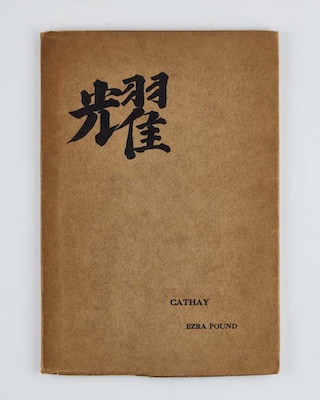
Who has brought this to pass? Who has brought the flaming imperial anger? Who has brought the army with drums and with kettle drums? Barbarous kings.[1]
Reading again Charles Dickens’ first—and astonishingly successful—novel, I was glad, being myself a man of Kent, to be reminded of it by Mr Alfred Jingle: ‘“Splendid—capital—Kent, Sir—Everybody knows Kent—apples, cherries, hops, and women.”’
Further on, nothing worse that morning having happened chez nous than a smear of marmalade on a page, I came across the newspaper editor’s interesting take on research methods:
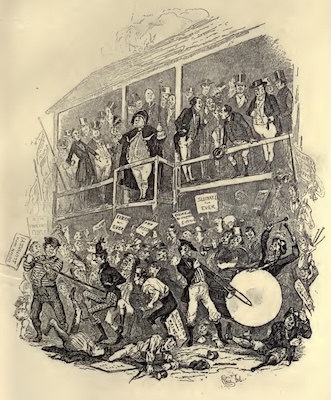
‘Mr. Pott looked dubiously at Bob Sawyer for some seconds, and, turning to Mr. Pickwick, said— “You have seen the literary articles which have appeared at intervals in the Eatanswill Gazette in the course of the last three months, and which have excited such general—I may say such universal attention and admiration?” “Why,” replied Mr. Pickwick, slightly embarrassed by the question, “the fact is, I have been so much engaged in other ways, that I really have not had an opportunity of perusing them.” “You should do so, Sir,” said Pott, with a severe countenance. “I will,” said Mr. Pickwick. “They appeared in the form of a copious review of a work on Chinese metaphysics, Sir,” said Pott. “Oh,” observed Mr. Pickwick—”from your pen I hope?” “From the pen of my critic, Sir,” rejoined Pott with dignity. “An abstruse subject I should conceive,” said Mr. Pickwick. “Very, Sir,” responded Pott, looking intensely sage. “He crammed for it, to use a technical but expressive term; he read up for the subject, at my desire, in the Encyclopaedia Britannica.” “Indeed,” said Mr. Pickwick, “I was not aware that that valuable work contained any information respecting Chinese metaphysics.” “He read, Sir,” rejoined Pott, laying his hand on Mr. Pickwick’s knee, and looking round with a smile of intellectual superiority, “he read for metaphysics under the letter M, and for China under the letter C; and combined his information, Sir!”’[2]
Whether or not its practitioners would admit to it, I suspect that such an approach has not entirely died out in the journalistic—and, perhaps, academic—worlds. It certainly hasn’t died out in preparations, such as they are, for various contemporary military adventures.
Two weeks into March now, so two weeks of the current leaders of Israel and the United States making the world a safer place by gleefully setting large parts of it on fire. They have also encouraged the population of Iran to rise up against their oppressors but done so by the peculiar expedient of slaughtering their families and destroying their homes. An old song but not a good one. Lebanon too has been attacked yet again and civilian deaths are rapidly rising there also.
Here, a former British Prime Minister who dragged the country into an illegal and unsanctioned war—and who will be remembered, despite some positive domestic achievements, for nothing else, in history’s long view—has criticised the current Prime Minister for declining to drag the country immediately into an illegal and unsanctioned war. As things continue to deteriorate, though, he is being dragged rather further than we’d hoped.
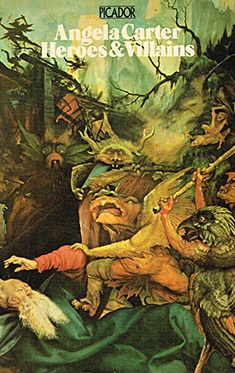
‘And what does the word “city” mean?’ the Professor asks Marianne in Angela Carter’s post-apocalyptic novel: ‘She thought for a while. “Ruins?” she hazarded.’[3]
Well, yes. Apart from destroyed apartment blocks and a girls’ school, the bombs have not spared Tehran’s Golestan Palace, which dates back to the 14th century and is a world heritage site under the protection of UNESCO, which sent to all parties the coordinates of the palace at least ten days ago. The 17th century Chehel Sotoon Palace in Isfahan and other Iranian heritage sites have also been damaged.
‘The tragic statement of the poem’, Guy Davenport wrote of Ezra Pound’s Cantos, ‘is that whereas centuries go into the perfection of a culture, an age of carelessness or ruinous war can destroy a culture in the batting of an eye.’[4]
Carelessness, ruinous war, yes – or barbarous kings.
Notes
[1] Rihaku (Li Po), ‘Lament of the Frontier Guard’, in Cathay, translated by Ezra Pound, ‘from the Notes of the Late Ernest Fenollosa, and the Decipherings of the Professors Mori and Ariga’: Collected Shorter Poems, Second Edition (London: Faber & Faber, 1968), 143.
[2] Charles Dickens, The Posthumous Papersof thePickwick Club (1836-37; edited by Mark Wormald, London: Penguin Books, 1999), 31, 679-680.
[3] Angela Carter, Heroes and Villains (London: Picador, 1972), 7.
[4] Guy Davenport, ‘Foreword’, Cities on Hills: A Study of I–XXX of Ezra Pound’s Cantos (Ann Arbor, Michigan: UMI Research Press, 1983), vii.
The year turns to meteorological spring. Blue sky, crisp air, early blossom, some trees apparently having had advance warning of this.
‘A glimmer of light’, the Librarian observed of the news that the Green party’s Hannah Spencer had won the Gorton and Denton by-election convincingly, followed by predictable slurs from the bad losers and incontinent frothings from the right-wing tabloids. Certainly a glimmer, though seemingly not reaching the relevant offices of the Labour administration, where it would surely have made even more legible the message that the government has been heading in precisely the wrong direction.
Snuffing that candle, though, was news that the President of the United States had been played again, and that the inevitable chaos, destruction and slaughter of civilians was already well underway – again.
Earlier, the most recent stories were all of fallen or ruined princes, royal, self-styled and otherwise. We no longer execute royal personages who have fallen from favour, not since 30 January 1649 anyway. In this country, the last official execution of anyone was in 1964, when, at 08:00 on 13 August, two convicted murderers were hanged simultaneously, one at Liverpool’s Walton prison and the other at Strangeways prison in Manchester. Nearer in time to the demise of Charles I outside the Banqueting House, Whitehall, though, public hangings were both frequent and popular, Samuel Pepys and James Boswell among those attending. ‘There were often as many as 30,000 people; one hanging in Moorfields in 1767 attracted 80,000 spectators.’[1]
Princes in a bad way might prompt in some bookish people a memory of the only line they can confidently ascribe to the poet and travel writer Gérard de Nerval. His ‘El Desdichado’, one of the ‘Chimeras’, begins:
Je suis le ténébreux, – le veuf, – l’inconsolé, Le prince d’Aquitaine à la tour abolie
Richard Sieburth’s translation has:
I am the man of gloom – the widower – the unconsoled, the prince of Aquitaine, his tower in ruins[2]
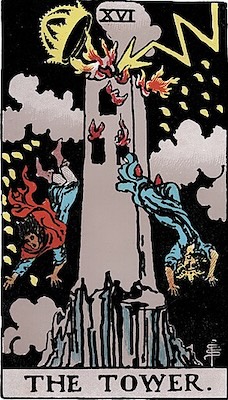
That second line in French is the one made famous by T. S. Eliot’s The Waste Land. One of that poem’s celebrated notes offers for line 429 only the name of the poet and the title of the poem. But an earlier note (to line 46) states that Eliot is ‘not familiar with the exact constitution of the Tarot pack of cards, from which I have obviously departed to suit my own convenience.’ He mentions The Hanged Man (one of the major arcana), The Phoenician Sailor (not a card in the traditional pack), The Merchant (a suit in the minor arcana), The Man with Three Staves (I’ll take a stab at the three of Wands). Oddly, he doesn’t mention The Tower (XVI: also one of the major arcana): the Prince’s is certainly in pretty bad shape and I gather (not being familiar myself with the exact constitution of the Tarot pack, as must be glaringly apparent) that the Tower (upright) is really not a card you want to come up against, connoting as it does chaos and destruction – even reversed, it’s not the ideal companion for an evening.
Princes and towers come unpleasantly together in a familiar, yet still unresolved, episode in English history, Richard of Shrewsbury and his brother, the young Edward V, who went in to the Tower of London but never emerged again. Two likely skeletons turned up during renovations in 1674. Richard III is often named as their murderer though it’s sometimes suggested that Henry VII has a case to answer.
A. E. Waite’s Pictorial Guide to the Tarot was published in 1910 (following the issue of the Rider-Waite Tarot deck, illustrated by Pamela Colman Smith) and reprinted in 1922, the year that The Waste Land also appeared. The illustration of the Tower shows it struck by lightning, a crown knocked off its top and two falling figures.
If not explicitly in the form of the Tarot card, Eliot’s poem has its towers too.
The brisk swell Rippled both shores Southwest wind Carried down stream The peal of bells White towers
Also:
Falling towers Jerusalem Athens Alexandria Vienna London Unreal
A few lines on:
And upside down in air were towers Tolling reminiscent bells, that kept the hours And voices singing out of empty cisterns and exhausted wells.
The Waste Land sometimes appears unsettlingly prophetic, when we read back into it later follies, failures and fiascos. Not too prophetic this time around, let’s hope.
Notes
[1] Lucy Moore, The Thieves’ Opera: The Remarkable Lives and Deaths of Jonathan Wild, Thief-Taker, and Jack Sheppard, House-Breaker (London: Penguin Books, 1998), 220. A figure outstripped by a good many recent football crowds in both England and Scotland but the current population is nearly ten times what it was then.
[2] Gérard de Nerval, Selected Writings, translated with an introduction by Richard Sieburth (London: Penguin Books, 1999), 363.
Sitting at the kitchen table, a cat within the circle of my arms, flanked by James Baldwin and Walter de la Mare, I was thinking about crocuses.
The poet Edmund Blunden, then serving in the 11th Royal Sussex, ‘heard an evening robin in a hawthorn, and in trampled gardens among the luggage of war, as Milton calls it, there was the fairy, affectionate immortality of the yellow rose and blue-grey crocus.’[1] And: ‘The garden is gay with crocuses’, Ford Madox Ford wrote to John Rodker in March 1920, ‘or shd it be crocoi?’ De la Mare himself was not wholly adverse to a crocus: ‘the crocus soon/ Will open grey and distracted/ On earth’s austerity’; ‘as near, that is, as any name can be to a thing—viz, crocus, or comfit, or shuttlecock, or mistletoe, or pantry’; ‘Miss Curtis would no more have dreamed of sharing this old ghost with, say, Miss Mavor, than a crocus would dream of blossoming at the foot of the North Pole.’[2]
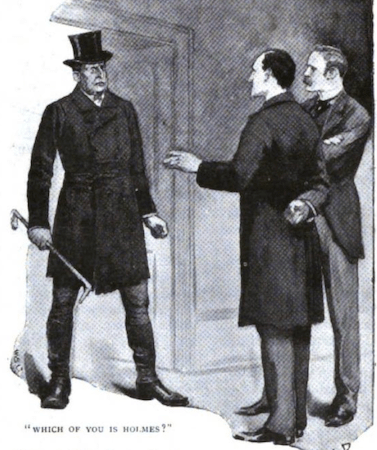
Literary, literary. It was, in fact, while walking in the park, that the Librarian drew my attention to a small group of crocuses, harbingers of spring, a welcome light in the encroaching gloom of the year so far, not least because of seemingly inexhaustible rain. We had rain on twenty-six days out of thirty-one in January. Several places outstripped that, there were floods on the Somerset Levels and elsewhere. But in any case—literary again!—the mention of crocuses always brings to mind Sherlock Holmes, specifically the alarming appearance of the gigantic and ferocious Dr Roylott, who has ‘dashed open’ the door of the sitting-room at 221b Baker Street:
(Illustration by Sidney Paget, Strand Magazine, February 1892)
‘“Which of you is Holmes?” asked this apparition. “My name, sir; but you have the advantage of me,” said my companion quietly. “I am Dr. Grimesby Roylott, of Stoke Moran.” “Indeed, Doctor,” said Holmes blandly. “Pray take a seat.” “I will do nothing of the kind. My stepdaughter has been here. I have traced her. What has she been saying to you?” “It is a little cold for the time of the year,” said Holmes. “What has she been saying to you?” screamed the old man furiously. “But I have heard that the crocuses promise well,” continued my companion imperturbably.’[3]
The promise of crocuses—or should it be crocoi? Promises, promises. Spring, yes, and all that it connotes. Or, perhaps, all that it used to connote.
‘The past has consequences in the present regardless of whether we know what happened in it; learning the history makes those consequences intelligible.’[4]
The month recently ended will soon be a finite, measurable chunk of that past, a blood smear on some historian’s page. Harold Wilson may or may not have said that a week is a long time in politics; Joseph Chamberlain, some eighty years earlier, is fairly reliably recorded as asserting that there’s no use in looking beyond the next fortnight.
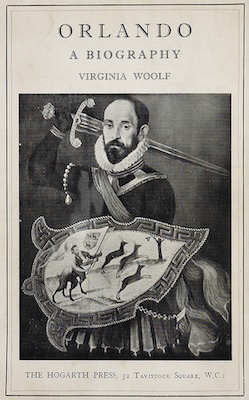
Glancing around at a volatile and feverish world I was about to remark in an email to a friend that—hardly surprisingly—I seemed to be suffering from ‘the English disease’. I meant melancholia but remembered just in time that understanding of the term has varied over time, taking in rickets, a sluggish economy caused by industrial unrest, bronchitis, football hooliganism and more: ‘The English disease, a love of Nature, was inborn in her’, Virginia Woolf wrote of her heroine/ hero Orlando.[5]
(Orlando, Hogarth Press, 1928)
Among the many pleasures of reading published diaries are the references to—or, sometimes, the lack of them, or delayed enlargement on them—what are later viewed as hugely significant events. I was recently reading Helen Garner’s impressive and enjoyable How To End a Story: Collected Diaries, 1978-1998 and seeing ‘The army has entered Tiananmen Square and machine-gunned students’ or ‘People are sitting on top of the Berlin Wall. They’re chipping chunks out of it with chisels, for souvenirs’. I wonder if some of what’s occurring now will be reducible in time to one or three or five lines. In what form will the United States survive? Will liberal or left of centre politicians learn how to do politics in this online, social media age so resistant to accurate information and inconvenient facts? Will Europe get its act—economics, security—together? I note various leaders’ recent responses as they finally accept that the current version of the United States is neither friend nor ally, and recall that appeasement didn’t work too well in the 1930s and is unlikely to do so now.
‘I imagine that one of the reasons people cling to their hates so stubbornly is because they sense, once hate is gone, that they will be forced to deal with pain’, James Baldwin wrote in ‘Notes of a Native Son’, first published as ‘Me and My House’ in November 1955.[6] Adam Shatz’s recent essay about the current situation in the United States, first delivered as a lecture, begins with Baldwin, who is also referenced in the piece’s title, ‘Another Country’ (Baldwin’s third novel). Shatz remarks that, though both parties have been ‘complicit in the creation of the imperial presidency and a neoliberal economic order’, ‘anyone who cares about the stability of the republic might have reason to regret the disintegration of moderate Republicanism, one of the defining structural features of American political life.’[7] We have suffered a version of that in this country too, with the collapse and near-disappearance of moderate Conservatism, those figures to whom we were totally opposed twenty or more years ago appearing now almost as beacons of light, intelligence and sweet reason, compared to the current crew. If I’d seriously believed then that the political landscape would be what it is, that certain individuals would be regarded as acceptable public servants, even as plausible contenders for government office, I would have sought medical help as a matter of urgency. Mais passons. There is always the rain. . .
‘If there’s much more of this’, I say to the Librarian as we trudge wetly home, ‘we might be living in a J. G. Ballard novel.’ We pass the City Farm, where their prize hens are sheltering, huddled together, beneath their chicken coop. It occurs to me that a number of Ballard novels might qualify though I was referring specifically to The Drowned World, which is, of course, concerned with rather more than water: ‘Sometimes he wondered what zone of transit he himself was entering, sure that his own withdrawal was symptomatic not of a dormant schizophrenia, but of a careful preparation for a radically new environment, with its own internal landscape and logic, where old categories of thought would merely be an encumbrance.’[8]
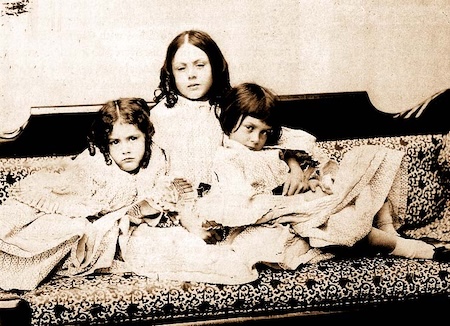
There has been very little brightness. Too often the sliver of sunlight glimpsed earlier in a day is—fittingly, in the current political climate—neither sincere, truthful, friendly or sustained. I’ve had the odd drenching myself but—full-length waterproof coat! umbrella! Englishman!—with no apparent ill-effects. Others have not always been so lucky. Perhaps ‘the most dramatic incident’ of Lewis Carroll’s life, Penelope Fitzgerald remarked, was the river expedition to Nuneham when the whole party, ‘including his aunt, two of his sisters, and Alice herself, got wet through and had to be taken to a friend’s house to dry off. In 1898, almost as an afterthought, Dodgson died of a cold and cough.’[9]
(Edith, Lorina and Alice Liddell)
Needless to say, awash as the country is, the disastrous privatisation of this vital resource, with its attendant greed and incompetence, has resulted in towns and villages running out of water, waiting days for their supplies to be reconnected or warned that they may have to be abandoned in the fairly near future. There is, apparently, a great deal more trouble to come: https://www.theguardian.com/commentisfree/2026/jan/22/what-happens-england-water-run-out-drought-tunbridge-wells
The drought last summer was not as bad as it might have been because preceded by a wet autumn and winter, reservoirs well-filled and groundwater in a healthy state – certainly not as bad as that recalled by the novelist Violet Hunt. ‘We were in for a hot July—it was the year 1911 when heat and drought drove men mad, caused the cattle that supported them to be lean and perish, filled the Courts with murder and rapine, inflamed Strike committees, and incensed three nations to the verge of war for want of a little rain that might have staunched their hissing hatreds.’[10]
‘For want of a little rain.’ Just so.
Notes
[1] Edmund Blunden, Undertones of War (1928; revised edition, Harmondsworth: Penguin Books, 1982), 117.
[2] Respectively, ‘The Children of Stare’, Collected Poems (London: Faber and Faber, 1979), 21; ‘Pigtails Ltd’, Walter de la Mare, Collected Stories for Children, edited by Giles de la Mare (London: Giles de la Mare Publishers Limited, 2006), 7; ‘The Picnic’, Short Stories, 1927-1956, edited by Giles de la Mare (London: Giles de la Mare Publishers Limited, 2001), 180.
[3] Arthur Conan Doyle, ‘The Adventure of the Speckled Band’, in The New Annotated Sherlock Holmes, 2 volumes, edited with notes by Leslie S. Klinger (New York and London: W.W. Norton and Company 2005), I, 241-242..
[4] Sarah Churchwell, The Wrath to Come: Gone With the Wind and the Lies America Tells (London: Head of Zeus, 2022), 11.
[5] Virginia Woolf, Orlando (1928; Oxford: Oxford University Press, 1992), 137.
[6] James Baldwin, ‘Notes of a Native Son’, in Collected Essays, edited by Toni Morrison (New York: Library of America, 1998), 7.
[7] Adam Shatz, ‘Another Country’, London Review of Books 48, 2 (5 February 2026), 3-10.
[8] J. G. Ballard, The Drowned World (London: Fourth Estate, 2012), 14.
[9] Penelope Fitzgerald, ‘In the Golden Afternoon’: A House of Air: Selected Writings, edited by Terence Dooley with Mandy Kirkby and Chris Carduff (London: Harper Perennial, 2005), 81.
[10] Violet Hunt, The Flurried Years (London: Hurst and Blackett, 1926), 177-178.
‘Darknesse and light divide the course of time, and oblivion shares with memory a great part even of our living beings; we slightly remember our felicities, and the smartest stroaks of affliction leave but short smart upon us.’[1]
The leaves are falling faster now, perhaps mostly fallen. Our clocks have gone back an hour and we are on Greenwich Mean Time. The polymath Edward Heron-Allen wrote in his journal on 22 May 1916, ‘The notable feature of the month is the establishment by law on the 20th of “summer time” which Willett, the originator of the idea, never lived to see introduced. At midnight on the 20th we all had to put our clocks on one hour, and in this way an hour of daylight is “added” to the day.’ And, five months later, he noted: ‘I do not think I have recorded that on 30 September we put our clocks back an hour and returned to Greenwich time.’[2]
William Willett, whose 1907 pamphlet, The Waste of Daylight, marked a crucial point in the advance towards ‘summer time’, had died from influenza on 4 March 1915, at the early age of 58, and is buried in St Nicholas churchyard in Chislehurst (as is his second wife.) The 1916 emergency law was passed to change the clocks twice a year as a measure to reduce energy and increase war production. It became a permanent feature when the Summertime Act was passed in 1925.
Leaves falling, darker days, the year in some ways closing down – but all these are in the natural order of things, as—or so we hope—the political convulsions, atrocities in Gaza, Lebanon, Ukraine, Sudan and elsewhere, are not. At least, as Jake Barnes says, at the close of Ernest Hemingway’s The Sun Also Rises, ‘Isn’t it pretty to think so?’
(John Berryman via The Paris Review)
‘Now there is further a difficulty with the light’, John Berryman wrote:
I am obliged to perform in complete darkness operations of great delicacy on my self.[3]
Currently those operations feature slow and sometimes painful analyses of my bafflement and confusion, not always helped by the Librarian’s daily bulletins from the battlefield that is the American election, often delivered in tones of appalled astonishment, while the phrase ‘batshit crazy!’ tends to recur.
What, in some senses, seems self-evident (one candidate sane, the other rather less so) is dwarfed by complexities and nuances almost invisible to us – we’re here and they’re. . . over there. I grasp, more or less, the fact that America is so divided a country now that neither side can—perhaps has no wish to—hear the other. But there is that other complication. While I can see that the appalling and spineless response of the Biden government to the conflict in the Middle East must repel a good many voters, it baffles me that those voters should think that withholding their vote from Harris (and thereby potentially contributing to her defeat) could somehow help the Palestinian people. Surely the precise opposite?
(John Donne, unknown English artist, c.1595)
Well, we’ll know soon enough. People, eh? I think of Katherine Rundell writing that, ‘amid all Donne’s reinventions, there was a constant running though his life and work: he remained steadfast in his belief that we, humans, are at once a catastrophe and a miracle.’ And: ‘He thought often of sin, and miserable failure, and suicide. He believed us unique in our capacity to ruin ourselves. “Nothing but man, of all envenomed things,/Doth work upon itself with inborn sting”. He was a man who walked so often in darkness that it became for him a daily commute.’[4]
Notes
[1] Sir Thomas Browne. Hydriotaphia, or Urn-Buriall, in Selected Writings, edited by Geoffrey Keynes (London: Faber and Faber, 1970), 152.
[2]Edward Heron-Allen’sJournal of the Great War: From Sussex Shore to Flanders Fields, edited by Brian W. Harvey and Carol Fitzgerald (Lewes: Sussex Record Society, 2002), 65, 71.
[3] John Berryman, ‘Dream Song # 67’, The Dream Songs, collected edition (New York: Farrar, Straus and Giroux, 1969), 74.
[4] Katherine Rundell, Super-Infinite: The Transformations of John Donne (London: Faber, 2023), 5-7.
‘At night I trailed from one window recess to another’, the Emperor Hadrian recalls in Marguerite Yourcenar’s novel, ‘from balcony to balcony through the rooms of that palace where the walls were still cracked from the earthquake, here and there tracing my astrological calculations upon the stones, and questioning the trembling stars. But it is on earth that the signs of the future have to be sought.’[1]
So it is. ‘Ghosts await you in the future if they do not follow you from the past’, Sarah Moss wrote, and: ‘No one who knows what happens in the world, what humans do to humans, has any claim to contentment.’[2] Yes. I write pages and delete them, since they serve no real purpose except to relieve my feelings for a short while. The past is not always a foreign country and they do not always do things differently there. As Pankaj Mishra said in his recent ‘Winter Lecture’: ‘It hardly seems believable, but the evidence has become overwhelming: we are witnessing some kind of collapse in the free world.’[3]
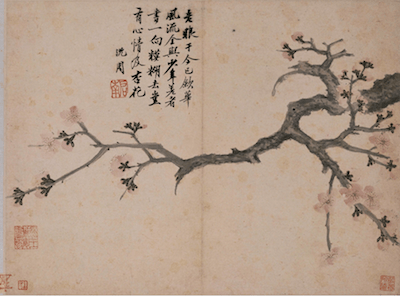
Early summer creeps on, though fitfully. Watching rose petals fall from the bush in a light wind, I remembered Pound’s Canto XIII, the first in which Confucius appears, and which ends:
The blossoms of the apricot blow from the east to the west And I have tried to keep them from falling.[4]
(Shen Zhou, ‘Apricot Blossom’, leaf from the album, Dreaming of Travelling While in Bed: Palace Museum, Beijing)
Ronald Bush observed that: ‘To keep the blossoms of the apricot from falling is to keep nature in a permanent vernal bounty.’[5] It also seems to me to signify cultural contact, the free exchange of ideas, without the limits of borders or nationalism. At that stage, Pound was using Guillaume Pauthier’s translation of Confucian texts in Confucius et Mencius: les quatre livres de philosophie morale et politique de la Chine and had written in ‘Exile’s Letter’:
Intelligent men came drifting in from the sea and from the west border, And with them, and with you especially There was nothing at cross purpose, And they made nothing of sea-crossing or of mountain crossing, If only they could be of that fellowship, And we all spoke out our hearts and minds, and without regret.[6]
On the daily walks we speak our minds but, just lately, exchanges are punctuated by information from our newly downloaded Merlin app, available from Cornell University, which draws on a huge database of bird sounds, sightings and photographs to identify what you’re probably hearing in that nearby tree or passing overhead.
Excuse me, sir, let me just ask about the birdsong: in a world both literally and metaphorically on fire, democracies hanging by a thread, war crimes, liars and knaves in public places – does it help?
Why, yes, a little – rather more than a little, in fact. . .
Notes
[1] Marguerite Yourcenar, The Memoirs of Hadrian, translated by Grace Frick, with Yourcenar (1951; Penguin Books, 2000), 82.
[2] Sarah Moss, Signs for Lost Children (London: Granta Books, 2016), 88-89, 97.
[3] Pankaj Mishra, ‘The Shoah after Gaza’ [Winter Lecture], London Review of Books 46, 5 (7 March 2024).
[4]The Cantos of Ezra Pound, fourth collected edition (London: Faber and Faber, 1987), 60.
[5] Ronald Bush, The Genesis of Ezra Pound’s Cantos (Princeton: Princeton University Press, 1989), 251.
[6] ‘Exile’s Letter’, Ezra Pound: Poems and Translations, edited by Richard Sieburth (New York: Library of America, 2003), 255.
It rains, it rains, From gutters and drains And gargoyles and gables It drips from the tables That tell us the tolls upon grains. Oxen, asses, sheep, turkeys and fowls Set into the rain-soaked wall Of the old Town Hall.[1]
While much of the world is on fire, some of it quite literally, we have been frequently awash with summer rains, though complaining about it less than usual. The United Kingdom as a whole recorded the sixth highest July rainfall since those records began in 1836; Northern Ireland recorded its highest July rainfall ever. In the United States, heat-related deaths are confidently predicted to exceed those of previous years. Beijing reports the heaviest rainfall in 140 years, with many deaths and disappearances. In the Antarctic, sea ice levels are at record lows as we veer towards the final tipping point.
In response to all this, as if mindful of Samuel Beckett’s famous formulation in Worstward Ho—‘Try again. Fail again. Fail better’—politicians are skipping the trying bit and simply failing again, though labouring to fail even worse than before, reaching new depths of dangerous irresponsibility. Are the voters they paw at really as selfish and unthinking as they assume? Or is it just their usual contempt for the proles? Answers on a lump of coal please, tossed into a rising and soon to be overwhelming sea.
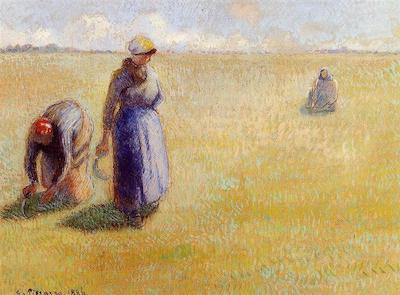
At 05:45, the vegetable boxes are already delivered and I bring them in; by 06:30 the light has deteriorated enough to warrant flipping switches in the kitchen. Surely it’s not that many days back that, in balmy weather, the mowers were out in the park and the air heavy with the distinctive and evocative scent of freshly cut grass. ‘Do you ever feel the smell of freshly cut grass is a cry for help from the grass?’ the (dead) Lily asks Finn in Lorrie Moore’s new novel.[2]
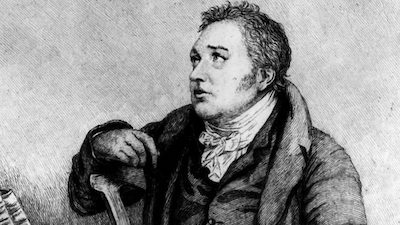
In Alethea Hayter’s fine book—but then she wrote only fine books—Voyage in Vain, she describes how Samuel Taylor Coleridge, en route to Malta, ‘identified himself’ with a sheep in a pen, destined, like the ducks and chickens, ‘to figure on the ship’s menu’. ‘He imagined it as coming from a countryside of flat peaceable meadows, and when he saw it cheerfully eating hay, he pictured its sensations, taking the brightness and sweet murmur of the sea for “dewy grass in sunshine, and the murmur of the trees”.’[3]
On another, more hazardous voyage, late in Moby Dick, Ahab’s anguished raving to the mate has: ‘“and the air smells now, as if it blew from a far-away meadow; they have been making hay somewhere under the slopes of the Andes, Starbuck, and the mowers are sleeping among the new-mown hay. Sleeping? Aye, toil we how we may, we all sleep at last on the field.”’[4]
Sensory commerce between ship and shore.
Helen, thy beauty is to me Like those Nicéan barks of yore, That gently, o’er a perfumed sea, The weary, way-worn wanderer bore To his own native shore.
Of Edgar Allan Poe’s poem ‘To Helen’, Guy Davenport remarked: ‘We can defend perfumed seas, which has been called silly, by noting that classical ships never left sight of land, and could smell orchards on shore, that perfumed oil was an extensive industry in classical times and that ships laden with it would smell better than your shipload of sheep. Poe is normally far more exact than he is given credit for.’[5]
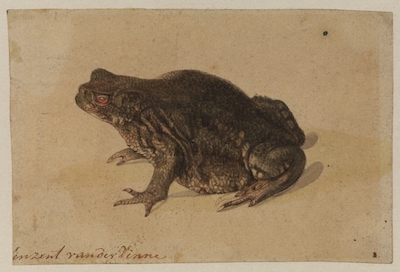
Wet weather tends to steer us to the nearby park, a couple of circuits by varying paths. On drier days, we still head to Arnos Vale, pausing to pluck some rosemary from the bushes in Perrett Park, eyeing in several of our usual locations the blackberries which are nearly, nearly ready. Our walk back from Arnos Vale is along Cemetery Road. At home, I sit down with a cup of tea and a Mick Herron novel called, ah, Down Cemetery Road. And there is Zoë Boehm, thinking of Joe: ‘Larkin, she thought. He’d always been fond of Philip Larkin. Give me your arm, old toad; Help me down Cemetery Road. . .’[6]
Yes, not the famous ‘Toads’:
Why should I let the toad work Squat on my life? Can’t I use my wit as a pitchfork And drive the brute off?
But ‘Toads Revisited’:
What else can I answer,
When the lights come on at four At the end of another year? Give me your arm, old toad; Help me down Cemetery Road.[7]
(Naturally, having drafted this, I see a tweet from Noreen Masud, author of the excellent A Flat Place—‘We can’t live in this world without damaging or being damaged. The point is to be deliberate about which damage to give and take’[8]—with a photograph of the street sign for Cemetery Road and, for heading, that same quote from Larkin: ‘Give me your arm, old toad’. If you believe in coincidences, this is one; if not, not.)
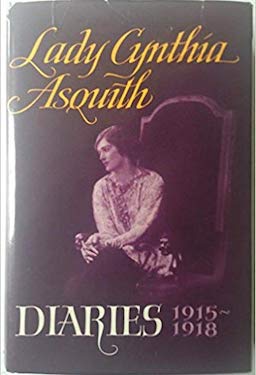
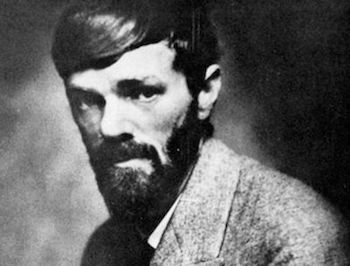
So the news of seemingly endless grotesque and malign misgovernment grinds on, and I think of D. H. Lawrence’s letter to Lady Cynthia Asquith in February 1917: ‘You mustn’t think I haven’t cared about England. I have cared deeply and bitterly. But something is broken.’[9]
I have too – and something is.
Notes
[1] Ford Madox Ford, ‘In the Little Old Market-Place’, Collected Poems (London: Max Goschen, 1913), 36.
[2] Lorrie Moore, I Am Homeless If This Is Not My Home (London: Faber & Faber, 2023), 149.
[3] Alethea Hayter, Voyage in Vain: Coleridge’s Journey to Malta in 1804 (1973; London: Robin Clark, 1993), 70.
[4] Herman Melville, Moby Dick (1851; edited by Harold Beaver, Harmondsworth: Penguin Books, 1972), 653.
[5] Guy Davenport, The Geography of the Imagination (Boston: David R. Godine, 1997), 7.
[6] Mick Herron, Down Cemetery Road (London: John Murray, 2020), 353.
[7] Philip Larkin, Collected Poems, edited by Anthony Thwaite (East St Kilda: The Marvell Press and London: Faber, 2003), 62, 90.
[8] Noreen Masud. A Flat Place: A Memoir (London: Hamish Hamilton, 2023), 210.
[9]Letters of D. H. Lawrence III, October 1916–June 1921, edited by James T. Boulton and Andrew Robertson (Cambridge: Cambridge University Press, 1984), 91.
‘Please compress your last dozen unwritten—or unpublished—blog posts, into a single phrase.’
I think I’d be tempted to go with what are often referred to as D. H. Lawrence’s last words, (which they weren’t, though pretty close to the end): ’This place no good.’[1] He was referring to the Ad Astra sanatorium in Vence, of course. And he was referring to something much wider, of course. I would be referring, not to this house—last refuge of common sense and sweet reasonableness that I can truly rely on—but to the wider world that is being laid waste, particularly this country, where we live and love among the ruins that these dreadful people have reduced us to, are reducing us to. Here, at any rate, we are. Where is that? Phrases like ‘post-apocalypse’ and, yes, ‘among the ruins’ occur more often that they should, possibly because I’ve been reading Lara Feigel’s hugely impressive book on D. H. Lawrence,[2] possibly because I keep getting glimpses of the daily news.
I was reminded somehow (somehow) of Hugh Kenner’s letter to Guy Davenport (13 October 1967). They’d been discussing the name of the couple in whose house Ludwig Wittgenstein had died: was it Parrot or Bevan? Davenport was quoting the 1958 memoir by Norman Malcolm, Kenner citing the viva voce testimony of artist and writer Michael Ayrton. Kenner wrote: ‘Ayrton is in Chicago for 10 days (opening a show) but on his return I shall press him re discrepancies between Parrot and Bevan. Maybe, being English, they spell it Bevan but pronounce it Parrot. He did confirm Parrot the other day.’[3]
(For those not familiar with some of the oddities of English pronunciation of names, try Featherstonehaugh, Auchinlech, Marjoribanks, Woolfhardisworthy or Cholmondley.)[4]
(The Reverend Francis Kilvert – including beard)
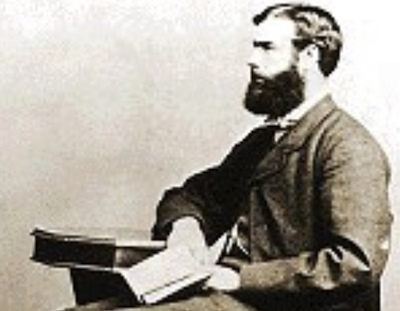
But I digress – old joke, shared among Fordians, Ford’s ‘digressions’ generally being anything but – yes, of course. Yesterday I was thinking of the Reverend Francis Kilvert, writing in October 1873: ‘This morning I went to Bath with my Father and Mother to attend the Church Congress Service at the Abbey at 11. When I got to the West door a stream of fools rushed out crying, “No room, you can’t get in!” I knew they were liars by the way they wagged their beards and as this crew of asses rushed out we rushed in and after waiting awhile worked our way up the north aisle till we reached the open transept and got an excellent place near the pulpit.’[5]
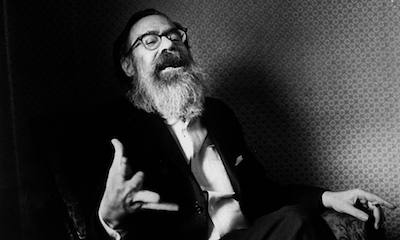
He shows here an impressive confidence in discerning the purveyors of untruths. He himself was undeniably bearded, and there was, clearly, an illegitimate manner in which beards were wagged. ‘But’, as Olive Schreiner once remarked, ‘there is another method.’ Kilvert, no doubt, had the key to it. Or perhaps God—conventionally assumed, certainly then, to resemble a man with a beard—sympathised and helped out a little.
Schreiner had discussed the two methods by which ‘[h]uman life may be painted’, ‘the stage method’ in which characters were ‘duly marshalled at first and ticketed; we know with an immutable certainty that at the right crises each one will reappear and act his part, and, when the curtain falls, all will stand before it bowing.’ And there is, she admits, ‘a sense of satisfaction in this, and of completeness.’ Then: ‘But there is another method—the method of the life we all lead. Here nothing can be prophesied’ and ‘[w]hen the curtain falls no one is ready.’[6]
(Olive Schreiner, via the Irish Times)
It’s an argument for a greater realism, for a narrative reflecting more recognisably the ordinary human experience, echoed, if only in part, by a great many writers subsequently. Perhaps it leans far enough towards ‘mere life’ that the conscious artist might wonder where he or she actually comes in; but, in any case, the talk of stages and footlights and curtains certainly imply that she has in mind Thackeray’s Vanity Fair (1847-8), which begins ‘Before the Curtain’ and ends: ‘Come children, let us shut up the box and the puppets, for our play is played out.’[7]
The attitude to fiction exemplified by that beginning and that conclusion also exercised Ford Madox Ford – on more than one occasion and over some thirty years. He wrote in his ‘Dedicatory Letter’ to Last Post: ‘I have always jeered at authors who sentimentalised over their characters, and after finishing a book exclaim like, say, Thackeray: “Roll up the curtains; put the puppets in their boxes; quench the tallow footlights” . . . something like that.’[8] The following year, in his book on the English novel, he remarked of Thackeray that he ‘must needs write his epilogue as to the showman rolling up his marionettes in green baize and the rest of it’.[9] His final book had a final jab: ‘But what must Mr. Thackeray do but begin or end up his books with paragraphs running: “Reader, the puppet play is ended; let down the curtain; put the puppets back into their boxes. . . ”’[10]
Ford’s main criticisms of Thackeray (and other English novelists) were, firstly, that they were always interpolating moral apothegms or making sly comments about their characters; and secondly, that they committed these, and other misdemeanours while eschewing serious consideration of literary techniques because those were foreign, in short, because they were often too concerned with demonstrating that they were, in the first and most important place, English gentlemen.
I sometimes suspect a bastard version of this in the current, and recent, political situation. Anybody who offers intelligent, knowledgeable or insightful criticism of government policies on the economy, defence, immigration, education, health, social care or, indeed, just about anything else, is termed, by Conservative politicians, commentators, right-wing media hacks, opaquely-funded think tanks and the rest as ‘unpatriotic’ or ‘un-English’ or ‘doing the country down’. Irony-hunters – look no further.
Most of these characters—‘this crew of asses’—are, of course, clean-shaven – but, I suspect, would not have fooled the Reverend Kilvert for a moment.
Notes
[1] At the end of a letter to Maria Huxley [21 February 1930], in The Letters of D. H. Lawrence, Volume VII: November 1928-February 1930, edited by Keith Sagar and James Boulton (Cambridge: Cambridge University Press, 1993), 651.
[2] Lara Feigel, Look! We Have Come Through!: Living with D. H. Lawrence (London: Bloomsbury Publishing, 2022).
[3]Questioning Minds: The Letters of Guy Davenport and Hugh Kenner, edited by Edward M. Burns, two volumes (Berkeley: Counterpoint Press, 2018), II, 948. It was in fact at the home of Dr Edward Bevan and his wife Joan, as detailed in Ray Monk’s Ludwig Wittgenstein: The Duty of Genius (London: Vintage, 1991), 576ff.
[4] Examples from the often invaluable Schott’s Original Miscellany, by Ben Schott ((London: Bloomsbury, 2002), 17.
[5]Kilvert’s Diary, edited by William Plomer, Three volumes (London: Jonathan Cape, 1938, reissued 1969). Volume Two (23 August 1871–13 May 1874), 381.
[6]The Story of an African Farm (1883, under the name Ralph Iron; new edition, Chapman & Hall, 1892), vii-viii.
[7] William Makepeace Thackeray, Vanity Fair: A Novel without a Hero (1848; edited by John Carey, London: Penguin Books, 2003), 5, 809.
[8] Ford Madox Ford, Last Post (1928; edited by Paul Skinner, Manchester: Carcanet Press, 2011), 4-5.
[9] Ford Madox Ford, The English Novel (London: Constable, 1930), 7 (with its slight amendments, this followed the American edition of the previous year).
[10] Ford Madox Ford, The March of Literature: From Confucius to Modern Times (London: Allen & Unwin, 1939), 587.






 Reconstructionary Tales