Beetroot, vertigo, re-reading

Beetroot

Someone tweeted the headline of a Daily Mail article by David Pierce about the Jeremy Corbyn not-much-of-a-story (the left-wing Labour leader having accepted an invitation to Passover Seder from a left-wing Jewish group, which he attended in a personal capacity): ‘They raised a beetroot in the air and shouted f*** capitalism’. The Librarian observed, with some justice, that it sounded like an ordinary family lunch at her parents’ house when we visit. Although, at the risk of seeming pedantic—moi?—it sounds, more specifically, like the Librarian at an ordinary family lunch at her parents’ house.

Post-Easter, the hot cross buns are gone but a few bottles of wine have survived thus far, stoically resigned to their fate. While the Librarian paints the newly plastered walls of the Space formerly known as the Kitchen, I make coffee and busy myself elsewhere, precluded from such things, being a reluctant beneficiary of benign paroxysmal positional vertigo. This means that, for instance, tipping my head to look directly upwards can trigger an intense and disorientating giddiness. Painting ceilings or the upper reaches of walls is not, then, the ideal pastime.

Now I recognise the symptoms—and know it’s only temporary—it’s less alarming. The first time it happened, in the early hours of the morning—and it was the worst attack I’ve had—I thought I was having a stroke. Curiously, the two ambulance-men, who arrived very quickly (I doubt if they would be able to do so now), were the only people I’ve had direct contact with whom I thought genuinely deserved—though they were less likely to be interested in—the crazy sums that are routinely paid to business executives, stockbrokers, university vice-chancellors and the like. With most of the latter, too, it’s clear what they’re taking out of the world but often rather less evident what they’re putting in.

Meanwhile, having reached the end of my re-reading Penelope Fitzgerald phase and moved on to my re-reading Elizabeth Bishop one, I still frantically plug gaps or read books that I could have sworn I’d read years ago, currently Antoine Saint-Exupéry and Hannah Arendt’s Eichmann in Jerusalem. Nevertheless, the oh-my-God-have-you-really-not-read-this-yet pile continues, unaccountably, to grow. It would be delusional to pretend I’m winning.


Back to normal

Morris

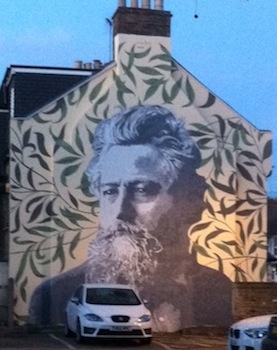
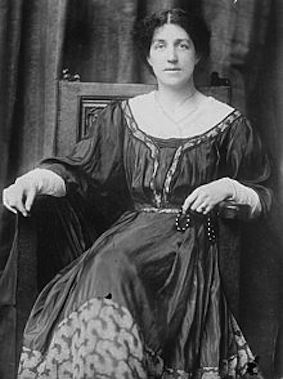
We stayed in Walthamstow in December 2017 mainly to be sure of finally getting to the William Morris Gallery. Housed in a mid-eighteenth century house, in which Morris lived between the ages of fourteen and twenty-two, the Gallery reopened in 2012 after a major redevelopment. We timed the visit to coincide with an exhibition of the work of May Morris, William’s younger daughter, artist and designer of wallpapers, jewellery, embroidery and much else: teacher, lecturer and editor of the 24-volume collected edition of William Morris’s works: http://maymorrisartandlife.co.uk/the-exhibition/

On this occasion of William Morris’s birthday (24 March 1834 – 3 October 1896), I was thinking of Peter Stansky noting that, among other paradoxes, Morris’s strong dislike of the Renaissance had to be set against his providing a fine example of what has become the conventional definition of ‘a Renaissance man’. Opposing the very notion of individual genius was a man of evident individual genius. As Stansky remarked, ‘What Morris was unprepared to recognize was that his was truly the exceptional case.’[1]

May_Morris.Wiki

(May Morris)

The narrator of L. P. Hartley’s The Go-Between remarks at one point, ‘I was in love with the exceptional and ready to sacrifice all normal happenings to it’.[2] Yes, that ‘normal’ – what is it and what has it become? I saw too a photograph, earlier today, in which a ‘March For Our Lives’ demonstrator in Washington held up a placard reading ‘This is not normal’. We said, of course, ‘Back to normal’ as the scheduled strike period ended and the Librarian returned to what was hoped and desired to be precisely that. But normality, like nostalgia, isn’t what it used to be. From the individual and small-scale to the national and supranational, the stable and the commonsensical have taken a vacation of unspecified length.

On that smallest scale—deliveries cancelled; collections missed; a plasterer working in the house—my own ‘normal’ wasn’t shaping up too well and, essentially, I needed to keep out of the way. Work on walls I might have dodged; work on ceilings made things a little trickier. So I walked to the newsagent, then out over the park to the station and caught a train to Bath.

It occurred to me, not for the first time, that, just as cats can immediately spot the one man or woman in the room unsympathetic to cats—and head straight for them—so men on trains with mobile phones and loud voices can pick me out in a crowded carriage—‘Hey, a guy with a book!’—and are thus able to position themselves behind my right ear before getting stuck in to a detailed and repetitive progress report on a telecommunications project, involving several individual contracts. The train ride was thirteen minutes long: when I arrived in Bath, the palms of my hands were slightly damp but I’d suffered no blackouts and the telecommunications man was still in rude health.

(Rex Whistler, The Foreign Bloke; Thomas Gainsborough, Louisa, Lady Clarges: both Victoria Art Gallery, Bath)

So: bookshops, cafés, parks, canal path walking but mainly looking at pictures—David Inshaw’s The River Bank (Ophelia), William Roberts’ The Dressmakers, Gainsborough, Joseph Wright, Thomas Barker—while reading Elizabeth Bishop whenever I could:

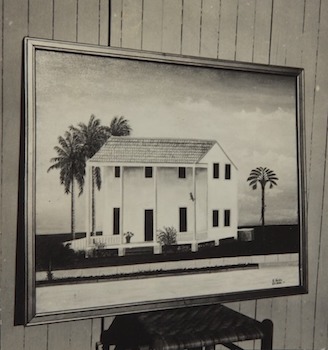
‘Mr. Valdes had a wonderful time, I think. It was rather exhausting for us, though, because he speaks scarcely any English, and he stayed from four till seven. We had sherry, which he seemed to regard as just “wine.” He kept saying “More wine” and he finished off the bottle, while Charlotte and I became sicker and sicker. The high point of the affair was when he and Charlotte imitated mosquitoes and buzzed around the room.’ And, ‘Since our patronage he has changed his sign (a palette stuck on the front of his cottage) from “Sign Painter” to “Artistic Painter”. . . ’[3]

Valdes-painting-key-west

https://brbl-dl.library.yale.edu/vufind/Record/3578226
(Beinecke Rare Book and Manuscript Library, Yale University)

But yes, that ‘normal’. Why Be Happy When You Could Be Normal? Jeanette Winterson entitled her memoir—in the course of which she wrote of the feelings of sympathy shared by people, even when they didn’t know one another, inside the giant tent during the church’s Glory Crusades. ‘The tent was like the war had been for all the people of my parents’ age. Not real life, but a time where ordinary rules didn’t apply. You could forget the bills and the bother. You had a common purpose.’[4] This was something that I already associated with my own late mother, not in a religious context but purely a social one. For my mother, it was a time when class barriers fell away and everyone was nice to one another and pulled together. Rarely, if ever, mentioned were those opportunities provided to—and enthusiastically taken up by—looters, murderers, rapists, black marketeers and fraudsters. It was, quite simply, the most exciting time—perhaps, unambiguously, the best time—of her life. And this widely-held view of the past, particularly that period of the past, had, I suspect, a strong bearing on the recent convulsions in this country.

Ideas of the normal change over time, with age, within social groups; and some are more obvious than others. The general shift to increasingly liberal social values makes the hundreds of capital offences current in the early nineteenth century, famously including such crimes as impersonating a Chelsea pensioner and damaging Westminster Bridge, almost comic now. And it was quite normal in the nineteenth century for the family album to have photographs of the infant dead, choreographed so that, with eyes open, they still seemed to be alive.[5] Now, I’m often struck by the extraordinary lengths to which some people go to avoid or conjure away the whole subject of death.

‘It may well be’, Allan Bloom observed, ‘that a society’s greatest madness seems normal to itself.’[6] A text for the times, you may think. Still, as Herbert Read noted, ‘it is perfectly possible, even normal, to live a life of contradictions.’[7]

So it is, so it is. I wonder, though, whether the possibility of not living a life of contradictions, is fast vanishing – if it has not already left the building.

References

[1] Peter Stansky, Redesigning the World: William Morris, the 1880s, and the Arts and Crafts (Princeton University Press, 1985), 6.

[2] L. P. Hartley, The Go-Between ([1953] Harmondsworth: Penguin, 1971), 94.

[3] To Frani Blough and Margaret Miller, 3 June 1938: One Art: The Selected Letters, edited by Robert Giroux (London: Pimlico, 1996), 75.

[4] Jeanette Winterson, Why Be Happy When You Could Be Normal? (2011; London: Vintage 2012), 70, 71.

[5] Raphael Samuel, Theatres of Memory (London: Verso, 1996), 375.

[6] Allan Bloom, The Closing of the American Mind (New York: Simon and Schuster, 1988), 75.

[7] Herbert Read, Contrary Experiences (London: Faber, 1963), 62.


Talking hats


kensington-high-street-royal-celebration-1903-rchm-copy

( via https://rbkclocalstudies.files.wordpress.com/2012/06/kensington-high-street-royal-celebration-1903-rchm-copy.jpg  )

An abandoned hat on a garden wall reminded me again of how visible an indicator of historical periods hats are. In old film footage of cinema audiences, the most glaring feature is the fact that almost every man and quite a few women are smoking. In old footage of urban street scenes, everyone is wearing a hat – not only workmen, cardinals and private detectives.

Bogart-Marlowe

(Humphrey Bogart as Raymond Chandler’s Philip Marlowe)

Useful to raise when meeting a female acquaintance, to remove when a funeral cortège passed, and on Remembrance Day. Some people still wear them—I have three myself, two that don’t fit while the third is a faltering Panama—but it’s a positive and individual choice these days. As to why such a widespread habit died out – suggestions include changes in social class, baldness and increased car ownership. A few years ago, en route to a crematorium, I saw a youngish man, sitting down on the kerb at a bus stop, catch sight of the cortège and emphatically make the sign of the cross on the frayed jacket buttoned over his chest. Religion was a complicating factor there but a hat to doff would have simplified matters. Philip Larkin, famously, ‘hatless’, took off his cycle-clips ‘in awkward reverence’.[1]

In one of his autobiographical volumes, David Garnett remembers his friend Ralph Wright, who had fought at Gallipoli and had one of his brothers killed beside him; then fought in France. Once, on a bus, passing the Cenotaph, he was deep in a book ‘and an old gentleman tapped him angrily on the shoulder. “Take your hat off, young man. Why don’t you pay some respect to our glorious dead?”

“I am one of our glorious dead,” replied Ralph in a mild voice. Mark Twain would have called this a gross exaggeration but there was a truth in it which applied to thousands of survivors of the war. It was not only the body and the brain that could be killed or wounded, but the spirit.’[2]

A hat is a minor plot device in James Joyce’s story, ‘Counterparts’, when Farringdon is slipping out to the pub – again. ‘The chief clerk glanced at the hat-rack but, seeing the row complete, offered no remark. As soon as he was on the landing, the man pulled a shepherd’s plaid cap out of his pocket, put it on his head and ran quickly down the rickety stairs.’ Farringdon is soon in the snug of O’Neill’s shop, downing a glass of porter – and a caraway seed to take away the smell of the alcohol.[3]

M00968701

(Rose Macaulay via Times Literary Supplement)

Penelope Fitzgerald thought that Rose Macaulay was ‘most characteristically English’ in part because she was ‘given to wearing flat tweed caps, or hats like tea cosies’.[4] By the early years of the Second World War, Mollie Panter-Downes was commenting that Englishwomen ‘have never looked prettier than they do these days when they are dressing more simply, often going hatless, and working so hard that sleep comes easy at night, bombers or no bombers.’[5]

Haydon, Benjamin Robert, 1786-1846; Wellington on the Field of Waterloo

(Benjamin Robert Haydon, Wellington on the Field of Waterloo: Walker Gallery)

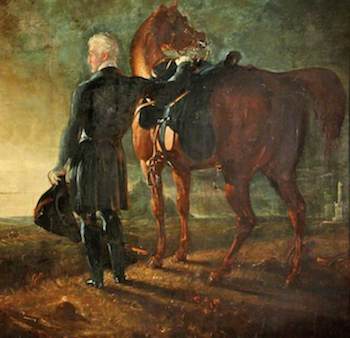
The Duke of Wellington seems to have been very attached, sentimentally as well as (usually) physically, to his hat. Benjamin Haydon had borrowed it because he was painting the Duke’s portrait (the last of several). On the morning after Haydon had shot himself, not very successfully, having to finish the job by cutting his throat, Wellington sent a servant round to Burwood Place to recover his hat, having seen the news in The Times.[6] I find this strongly reminiscent of the Tommy Cooper joke about the man calling round to his neighbour’s, being told he’s died the previous night and, after a lengthy pause as if digesting the news, asking the widow: ‘Did he say anything about a pot of paint?’

The Victorian clergyman and diarist Francis Kilvert recalled that, ‘when people were going to market on Thursday mornings they would exhort one another to come back in good time lest they should be led astray by the Goblin Lantern, and boys would wear their hats the wrong way lest they should be enticed into the fairy rings and made to dance.’[7] (Is this why so many men still wear baseball caps the wrong way round? Get into those fairy rings and dance!) Julian MacLaren-Ross wrote of an acquaintance called Nott: ‘He had one of those faces that once seen is never remembered. In London I used to identify him only by a green tweed hat: of such a shape that, in order to wear it correctly, he’d been obliged to print “BACK” and “FRONT” in ink on the lining, afterwards adding “SIDES” (at my suggestion) to preclude any possibility of error.’[8]

William Gaunt writes that, in the 1830s, ‘The intellectuals of Paris wore the steeple-crowned hats and sinister cloaks of Italian brigands and cultivated disdain for the law-abiding citizen.’[9] This image fed into the various versions told of Wyndham Lewis’s first encounter with Ford Madox Ford, then editing The English Review:

‘He seemed to be Russian. He was very dark in the shadows of the staircase. He wore an immense steeple-crowned hat. Long black locks fell from it. His coat was one of those Russian-looking coats that have no revers. He had also an ample black cape of the type that villains in transpontine melodrama throw over their shoulders when they say “Ha-ha!” He said not a word.’

The mysterious stranger establishes himself ‘immovably against the banisters’ because the editor is attempting to push him down the stairs, and begins ‘fumbling in the pockets of his cape. He produced crumpled papers in rolls. He fumbled in the pockets of his strange coat. He produced crumpled papers in rolls.’[10]

These crumpled rolls of paper resolve themselves into ‘The Pole’, Lewis’s first published story, which appeared in The English Review in May 1909. Opening his book on Lewis with the tale of this encounter, Hugh Kenner comments that, ‘The magician’s gestures owe their meaning to the fact that the rabbit from the hat—like the story from the cape—has no history.’[11] Yes, a man with no history appearing to another man, Ford, who was carrying a great deal of it, some of which he sought to shed.

The Gallery of HMS Calcutta (Portsmouth) c.1876 by James Tissot 1836-1902

(Tissot, The Gallery of H. M. S. Calcutta (Portsmouth): Tate)

From hats to hatters. James Tissot (born Jacques Joseph in Nantes in 1836 – he changed his name to signal his fondness for England and English things – moved from Paris to London in 1871, partly to avoid possible trouble following his participation in the defence of the Paris commune. His mother designed hats, a background that surely influenced the content of many of his paintings: women, often society women, in gorgeous clothes and hats, with details expertly rendered.

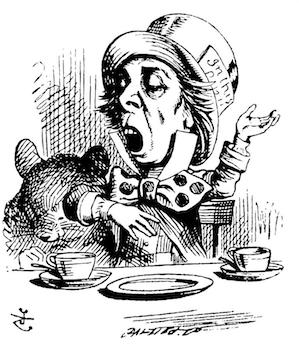
The Mad Hatter is inextricable now from Lewis Carroll, who never actually refers to his Hatter as mad, though the chapter is called ‘A Mad Tea-Party’. The phrase ‘as mad as a hatter’ preceded Alice’s Adventures in Wonderland, as did ‘mad as a March hare’. T. H. White wrote confidently of the man who was, he said, the original of Lewis Carroll’s Hatter, a seventeenth-century eccentric named Robert Crab, ‘a haberdasher of hats at Butterbury’, who subsisted on a diet of dock leaves and grass, and gave all his goods to the poor. Martin Gardner refers to Tenniel basing his drawing on Theophilus Carter, who owned a furniture shop in Oxford, though also detailing other candidates. Carter was mentioned in a letter to The Times from the Reverend Gordon W Baillie: ‘All Oxford called him The Mad Hatter. He would stand at the door of his furniture shop…always with a top hat at the back of his head, which, with a well-developed nose and a somewhat receding chin, made him an easy target for the caricaturist.’[12]

Tenniel-mad-hatter

(John Tenniel, ‘A Mad Tea Party’)

Sharing with William Maxwell another helping of hat lore, Sylvia Townsend Warner wrote to him: ‘Your bedroom fireplace should have had a fire in it. When family pews meant anything, they had fireplaces in them, and the eldest son of the family poked them up before the sermon. At that date you never saw a gentleman on his knees. He remained seated & prayed into his hat. My poor father couldn’t, because if he went to church it was to the school chapel, dressed as such; and for some deep mystical reason you can’t pray into a mortar-board.’[13]

Talking into your hat, that is, rather than talking through it.


References

[1] Philip Larkin, ‘Church Going’, Collected Poems, edited by Anthony Thwaite (East St Kilda: The Marvell Press and London: Faber, 2003), 58.

[2] David Garnett, The Flowers of the Forest (London: Chatto & Windus, 1955), 236.

[3] James Joyce, Dubliners (1914; introduction and notes by Terence Brown, London: Penguin Books, 2000), 84.

[4] Penelope Fitzgerald, ‘A Student of Obliteration’, an introduction to Macaulay’s The World My Wilderness, in A House of Air: Selected Writings, edited by Terence Dooley with Mandy Kirkby and Chris Carduff (London: Harper Perennial, 2005), 299.

[5] Mollie Panter-Downes, London War Notes (1971; edited by William Shawn, new preface by David Kynaston, London: Persephone Books, 2014), 29.

[6] Alethea Hayter, A Sultry Month: Scenes of London Literary Life in 1846 (1965; London: Robin Clark 1992), 103-104.

[7] Francis Kilvert, Kilvert’s Diary, edited by William Plomer, Three volumes (London: Jonathan Cape, 1938, reissued 1969): I, 247.

[8] Julian MacLaren-Ross, Bitten by the Tarantula and other writings (London: Black Spring Press, 2005), 155.

[9] William Gaunt, The Aesthetic Adventure (1945; revised edition, London: Sphere Books, 1975), 10.

[10] Ford Madox Ford, Return to Yesterday: Reminiscences 1894-1914 (London: Victor Gollancz, 1931), 407.

[11] Hugh Kenner, Wyndham Lewis (New York: New Directions, 1964), 6.

[12] T. H. White, England Have My Bones (1934; London: Macdonald Futura, 1981), 42; Martin Gardner, The Annotated Alice: The Definitive Edition (Harmondsworth: Allen Lane, The Penguin Press, 2000), 72-73; The Times, March 19, 1931.

[13] Letter of 9 January 1972: Michael Steinman, editor, The Element of Lavishness: Letters of Sylvia Townsend Warner and William Maxwell, 1938-1978 (Washington: Counterpoint, 2001), 227.


Strait Expectations

Snow-1802-2

It seems unreasonable to charge the weather with bad faith – but somehow I persuaded myself that we had a deal. After the snow two weeks ago, which was more than enough to slake the appetite of the Librarian for such stuff (‘we never get snow’), I thought that was it. We could proceed peaceably enough* towards a convincing Spring. Clearly not.

So today turned out to involve shuffling to the newsagent; reading at length about the harvesting of Facebook data; brief forays to the bird table with suet pellets; making soup; browsing in a few books; and not having a drink just yet.


And tomorrow – ah, perhaps not ‘fresh Woods, and Pastures new’ but certainly a return to what was previously called ‘normality’. The last scheduled University staff strike day was on Friday. Everyone involved is profoundly hopeful that they can simply get on with their work, that there won’t be a need to schedule any more stoppages but, given that the circumstances which brought this situation about have not substantially changed, any natural optimism is being held firmly in check.

‘But our expectations are always higher than the tallest cathedral, the mightiest wave in a storm, the highest leap of a dancer’, Proust wrote (in James Grieve’s translation).

Not this time, Marcel.

 
* Insert dry smile.

The digestion of Milton


Writing of Felix Vallotton and what, he suggests, ‘might be called Vallotton’s law: that the fewer clothes a woman has on in his paintings, the worse the result’, Julian Barnes notes that ‘Vallotton came to the nude through a study of Ingres, proving that great painters, like great writers – Milton, famously – can be pernicious influences.’[1]

I came across this shortly after recalling Jonathan Williams quoting Bentley’s clerihew (‘The digestion of Milton/ Was unequal to Stilton/ He was only feeling so-so/ When he wrote Il Pensoroso’).

And then, a few days ago, waiting for the kettle to boil, I was browsing through a Penguin Classics translation of Virgil’s Eclogues, which had found its way onto the kitchen table, . The notes to the first eclogue mentioned two lines in Milton’s Lycidas derived from this single line of Virgil: ‘siluestrem tenui Musam meditaris auena’, translated there as ‘You meditate the woodland Muse on slender oat’.[2]

Already in trouble and the tea not even made. Mediate on, surely. But then my dictionary actually includes the phrase ‘meditate the muse’, offering as explanation ‘(Latinism, after Milton) to give one’s mind to composing poetry.’ The line in Lycidas does indeed have ‘meditate’ unclothed by a preposition. ‘Slender oat’? A reed pipe, perhaps oat grass, a wild grass that looks like the oat. The old Loeb edition’s version—‘wooing the woodland Muse on slender reed’—is a bit clearer at first glance.

Anyway: Williams, Barnes, Virgil. Three times so close together may be enemy action for Ian Fleming’s Goldfinger; it’s a sign from the gods for the rest of us. So, diverting my attention from ornithology, weird cat behaviour in the garden and university staff strikes, I thought back over the history of my problem with Milton.

One of the great poets, no doubt, no doubt. In the nineteenth century, it seems, few had a bad word to say about him – Blake, Wordsworth, Byron, Keats. In the twentieth century, things went the other way. Ezra Pound—to choose one of his more polite remarks—thought Milton ‘got into a mess trying to write English as if it were Latin.’[3] Enlarging on this elsewhere, he asserted that Milton was using ‘an uninflected language as if it were an inflected one, neglecting the genius of English, distorting its fibrous manner’.[4]

T. S. Eliot took William Hazlitt to task for classifying Dryden and Pope as ‘the great masters of the artificial style of poetry in our language’ as against his chosen poets of the ‘natural’ style: Chaucer, Spenser, Shakespeare and Milton. Reviewing ‘at least four crimes against taste’ that Hazlitt has committed in a single sentence, Eliot observes that ‘the last absurdity is the contrast of Milton, our greatest master of the artificial style, with Dryden, whose style (vocabulary, syntax, and order of thought) is in a high degree natural.’ Eliot is here reviewing a book on Dryden and has more to say on the respective strengths of the two poets but clearly, at this stage (1921, the year before The Waste Land), he finds more to admire in Dryden, whose powers were, he suggests, ‘wider, but no greater, than Milton’s’.[5] Pound comments that ‘Dryden gives T. S. E. a good club wherewith to smack Milton. But with a modicum of familiarity or even a passing acquaintance with Dante, the club would hardly be needed.’ This is turn looks back to Pound’s earlier comment that ‘Dante’s god is ineffable divinity. Milton’s god is a fussy old man with a hobby.’[6]

There are other famous negatives (F. R. Leavis, for one) but none of this has much bearing on my own troubles with Milton. The failure to warm to him, if failure it be, is obviously mine – still, I’m tempted to shovel a good part of the blame onto my old English master, a real Milton enthusiast. That enthusiasm drove him to read Paradise Lost to us, fairly relentlessly, for what seemed an eternity, an approach that drove some pupils to despair, rebellion or the edge of madness; for me, evidently, it erected barricades. ‘For each man kills the thing he loves’ – kills it for other people, in some cases, however good the intentions. I’ve made at least two serious attempts to get back into some sort of relationship with Mr Milton, one of them after reading Philip Pullman’s His Dark Materials trilogy, Pullman being such a strong advocate for Milton, and for Paradise Lost in particular. But it never really took.

Lycidas, though. A relatively short poem. A very literary one too, in the sense of adopting (even if tweaking) a good many conventions; and also retrospectively, since it’s been plundered for a good many book titles and quotations that everyone knows (even when they don’t, quite)—‘Fame is the spur’, ‘Look homeward angel’, ‘Tomorrow to fresh woods and pastures new’. I’ve read it several times, starting, of course, at school. But, as far back as I can remember, even reading Milton’s shorter poems was somehow associated with a sense of task, of obligation. I don’t mind putting in the work but didn’t really experience the pleasure which I thought a reasonable, reciprocal part of the deal.

JohnBerryman_TomBerthiaume

One sidelong approach is by way of John Berryman’s fine short story, ‘Wash Far Away’, which I read again recently. The title comes, of course, from Lycidas: ‘Whilst thee the shores and sounding Seas/ Wash far away, where ere thy bones are hurld’. The poem is a pastoral elegy, occasioned by the death of Edward King, a Cambridge friend of Milton, drowned in the Irish Sea. In Berryman’s story, a professor teaches Lycidas to his class, and the narrative of loss and lament in the poem is juxtaposed with the professor’s own memories and enduring sense of loss of a brilliant and gifted friend who died young. There’s a good deal of quite scholarly Miltonic discussion. Much of it circles around the question of whether the poem is actually ‘about’ King or, in fact, more about Milton himself. Several remarks by the students are surprisingly acute and unsettling—‘The professor studied the lines. He felt, uneasily, as if he had never seen them before’—but the effects of the session are finally positive, the sharpness of memories and the acute sense of loss, brought vividly to mind, seeming to resuscitate the professor, to bring alive again his image of himself as a sentient, emotionally responsive being.[7]

So I glance again, though warily, warily, at my copy of Paradise Lost, glowering in the corner. Ars longa, vita brevis, as someone – was it Seneca? – said. Well, yes – but just how longa? And just how brevis?

References

[1] Julian Barnes, ‘Vallotton: The Foreign Nabi’, in Keeping an Eye Open: Essays on Art (London: Jonathan Cape, 2015), 190.

[2] Virgil The Eclogues, translated by Guy Lee (Harmondsworth: Penguin Books, 1984), 31, 109n. The lines in Lycidas are ‘and strictly meditate the thankless muse’ and ‘But now my oat proceeds’.

[3] Ezra Pound, How To Read (London: Desmond Harmsworth, 1931), 55.

[4] Ezra Pound, ‘Notes on Elizabethan Classicists’, in Literary Essays of Ezra Pound, edited by T. S. Eliot (London: Faber and Faber, 1960), 238.

[5] T. S. Eliot, ‘John Dryden’, in Selected Essays , third enlarged edition (London: Faber and Faber, 1951), 309-310, 314. Dryden was also, of course, a translator of genius. ‘If I had to give my vote to our greatest translator it would go to Dryden’: The Oxford Book of Verse in English Translation, chosen and edited by Charles Tomlinson (Oxford: Oxford University Press, 1980), xvii.

[6] Ezra Pound, ‘Prefatio Aut Cimicium Tumulus’, in Selected Prose 1909-1965, edited by William Cookson (London: Faber and Faber, 1973), 360; The Spirit of Romance (1910; New York: New Directions, 1968), 156-157.

[7] John Berryman, ‘Wash Far Away’, in The Freedom of the Poet (New York: Farrar, Straus and Giroux, 1976), 367-386.

Snow gone, strike on

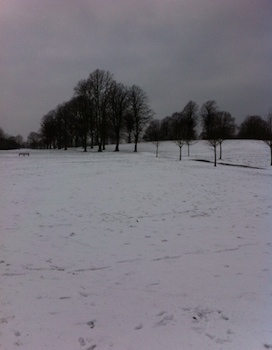
Snow-Park.2

“Mais ou sont les neiges d’antan?” Villon wrote, which Dante Gabriel Rossetti famously translated as ‘But where are the snows of yesteryear?’ We, of course, are wondering where the snows of last Thursday and Friday have gone, as water streams along the gutters, so plentifully, in fact, that there must be a burst main somewhere..

The university was officially shut on Friday, due to the weather. The weekend passed with reading, phone calls and emails; and with the Librarian making bread while I counted the birds coming for food in the garden, a little anxious about how many of the regulars had survived what was reported to be the coldest March day since such records began at the start of the twentieth century. But there have been no obvious casualties: both the male and female blackbirds, the sparrows, the blue tits, the robin and the not-quite-definitely-identified bird (very sparrow-like but with a black cap) have shown up, however briefly And snow outside the back door, deeper than the average cat, whittled down their risk.

Now the world tilts back to whatever passes for normal lately. At the moment, this means the Librarian setting off, with placard and badge, for the picket line. Like most of her colleagues, she would rather be putting her skills and experience to work and, again like most of her colleagues, resents being forced into this position by recalcitrant employers with, pretty evidently, other priorities than their staff or the education of their students.

Those students were sufficiently unimpressed by their vice-chancellor to have occupied his office this morning; and the marches are still demonstrating a high level of support for the strike by university staff:

https://www.bristolpost.co.uk/news/bristol-news/live-bristol-students-occupy-university-1297803

And some lecturers are also less than enthusiastic about recent developments:

https://www.theguardian.com/commentisfree/2018/mar/04/letters-universities-deans-lake-district-churchill-ed-sheeran-impress

Everyone (except, perhaps, the hawks and hardliners) must hope that the scheduled talks move things towards a resolution. But, as the poet said, ‘Today the struggle.’ So for now the strike goes on.


Snow business

Hurley-Mertz leaving hut by trapdoor

Frank Hurley: Mertz leaving the hut via the trapdoor
(Via http://www.sl.nsw.gov.au/stories/antarctica-frank-hurley/home-antarctica )

It’s the first day of spring, meteorologically speaking. It’s also the first day for a while that the Librarian hasn’t held out her arms to the east—or, perhaps, to the south-west—while demanding: ‘Send us snow!’ Today being a pause in the strike (caused by the proposed swingeing cuts to university staff pensions), she set off through falling snow on the two-mile walk to work, possibly thinking that was enough of the white stuff to be going on with, though Storm Emma is expected later today and the Met Office has now issued a red weather warning (signifying ‘danger to life’) for south-west England and south Wales from this afternoon.

I accept that, in the Scandinavian countries, in Canada, Mongolia, Russia, Japan, the United States, Austria, Switzerland, Peru, Bolivia and many more, they look askance at the British habit of cities, roads, airports, schools and railways seizing up whenever seven or eight inches of snow falls. But we have a temperate climate and it’s not economically viable to equip a nation, and adapt its infrastructure, for atypical conditions which occur so rarely. That’s the argument I’ve heard many times, anyway, though the phrase ‘economically viable’ is not a stable one in this country at present, given the prevailing order of priorities.

Worldturndupsidedown . Tenniel-Mad-Hatter

In our neck of the woods, anyway, it’s the mere sight of snow, rather than the fact of snow in March, that’s unusual. Other places—Scotland, the North, parts of Wales, traditionally run on different snow tracks. Late in March, near the Anglo-Welsh border, the Reverend Francis Kilvert recorded: ‘A snowy Palm Sunday. Snow on the Palms. Mr. Venables went to Bettws in a dense snowstorm.’ He discerned compensations though. ‘In the afternoon I had the happiness to have all the poor people to myself. None of the grand people were at Church by reason of the snow. So of course I could speak much better and more freely.’[1]

In London too, again in late March, Ezra Pound reported to his father in 1916 ‘the blizzard, 80 big trees down in the park. Counted twenty from bus-top first day I went down to Piccadilly.’[2]

Not yet having reached The Beginning of Spring in my grand revisiting of Penelope Fitzgerald’s work —it’s set in Moscow just before the First World War, anyway—I’m still able to spot that this first day of English spring is far from springlike. Having made the short trip to the newsagent and back in overcoat and boots (via the front entrance, eschewing all trapdoors), though it was hardly matter for a photograph by Frank Hurley or Herbert Ponting, I decided that was probably enough. Go out to gambol through the snow in the park— or stay in with coffee, reading Julian Barnes on Manet, Courbet and Cézanne?

No need even to toss a coin.

References

[1] Entry for 24 March 1872: Kilvert’s Diary, edited by William Plomer, Three volumes (London: Jonathan Cape, 1938, reissued 1969), Volume Two (23 August 1871—13 May 1874), 157.

[2] Letter to Homer Pound, 7 April 1916: Ezra Pound to His Parents: Letters 1895–1929, edited by Mary de Rachewiltz, David Moody and Joanna Moody (Oxford: Oxford University Press, 2010), 366.


Something to be resisted

Hands-off-pensions-G-Jane-Atkins
(Photograph: Jane Atkins, via The Guardian)

At the kitchen table, the Librarian is looking at the newspaper. ‘What a bloody mess.’ Perhaps the word wasn’t ‘bloody’. A comment on the times: I have not the faintest idea what she is referring to – there are just too many candidates, even sticking to the United Kingdom: the Brexit fiasco (or the fiasco of the level of comment upon it); the Labour policy on Brexit fiasco; the transport fiasco; the benefits or homelessness or education fiascos; the prisons fiasco; the higher education fiasco; the housing fiasco; the local council cuts fiasco; the tax evasion fiasco; the fracking fiasco; the foreign policy fiasco; the Tory leadership fiasco. I surrender.

In fact, she’s referring to the higher education fiasco: a fiddle here, a twiddle there. Either you acknowledge the benefits—to everyone—of a population as well-educated as possible or you don’t. So either you fund higher education properly or you don’t. And, of course, even in the higher education sector, there’s more than one bloody mess. This one—the forthcoming universities strike—is coming up fast.

The Guardian reports that ‘Universities UK (UUK), which represents university employers, has proposed that in order to overcome a £6.1bn deficit in the Universities Superannuation Scheme (USS), the fund should switch from a defined-benefit scheme that gives a guaranteed retirement income to a riskier defined-contribution plan, where pension income is subject to stock market movements.

A UUK spokesperson said the proposed pension changes were a necessary step, made in the best interests of university staff, to put the USS on a sustainable footing for the long term.’

‘Necessary’, ‘best interests’, ‘sustainable’. Nice, but not actually true. Try this:

‘University employers have provoked the largest vote for industrial action ever seen in the higher education sector. They have done this by overseeing what they present as a financial crisis for the University Superannuation Scheme (USS), and by threatening enormous cuts to the pensions of hundreds of thousands of university staff. None of this is necessary. It is the result of the misrepresentation of USS finances, and the desire of a new breed of university managements to cut their pension liabilities and thereby ease the financing of new buildings and campuses.’

https://www.theguardian.com/education/2018/jan/30/university-staff-are-right-to-be-striking

Yes, this kind of behaviour, this kind of pretext, is becoming all too familiar—and is something that needs to be resisted. As it will be.


Ardent and enraged: Ford among the Suffragettes

VH_FMF_Selsey

(Ford Madox Ford and Violet Hunt at Selsey)

On 9 February 1911, The New Age published a letter to the editor from Giessen, in Germany, outlining the writer’s reasons for supporting women’s suffrage:

‘As for the question of militant tactics, I am certainly in favour of them. It is the business of these women to call attention to their wrongs, not to emphasise the fact that they are pure as the skies, candid as the cliffs of chalk, unsullied as the streams, or virginal as spring daffodils. They are, of course, all that—but only in novels. This is politics, and politics is a dirty business. They have to call attention to their wrongs, and they will not do that by being “womanly.” Why should we ask them to be? We cannot ourselves make omelettes without breaking eggs. Why should we ask them to?’[1]

Ford Madox Ford was in Giessen, enmeshed in the maze of the country’s civil law, as part of a ludicrous scheme to secure German citizenship and thus obtain a divorce from his wife Elsie, so that he might marry the novelist (and suffragette) Violet Hunt. His letter came just three months after ‘Black Friday’, 18 November 1910, when the police had physically – and, in some cases, sexually – assaulted the women demonstrators marching on Parliament.
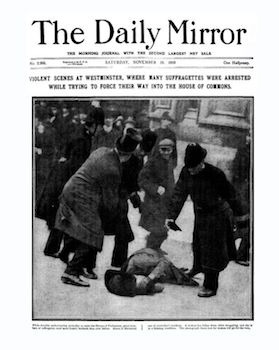
Daily-Mirror-Front-Page-Published-Saturday-19th-November-1910

In his Ancient Lights, which appeared the following month, Ford would assert that, ‘Personally I am an ardent, an enraged suffragette.’[2] He was certainly a productive one. The previous year, he had published, in an English Review editorial, several pages on ‘Women’s Suffrage’, primarily an attack on the Liberal government’s pig-headedness, in particular the devious methods and bad faith shown by Asquith, and the press’s refusal to publish details of abuses together with its readiness to publish more sensational accounts based on dubious sources.[3]

‘In one of His Majesty’s gaols, the doctor officiating at the forcible feeding of one of the women caught her by the hair of the head and held her down upon a bed whilst he inserted—in between her teeth that, avowedly, he might cause her more pain—the gag that should hold her mouth open, and there was forced down her throat one quart of a mixture of raw oatmeal and water. In the barbarous and never to be sufficiently reprehended Middle Ages this punishment was known as the peine forte et dure.’

Ford granted the urgency of some of the major legislation that Winston Churchill and David Lloyd George wished to push through but pointed out, ‘that very urgency makes the necessities of the women by ten times the more urgent. For the reforms that Mr. Lloyd George and his friends desire are precisely social reforms and social reforms precisely concern women even more than men.’ There had been proposals to abolish the House of Lords’ legislative veto: ‘this may be for the good of the people or it may prove the people’s bane. But there can be no doubting that in making these demands Mr. Lloyd George and his friends are asking to be allowed to become the autocratic rulers of the immense body of voiceless and voteless women. As far as the men of the country are concerned the Cabinet will be at least nominally popularly elected. For women they will be mere tyrants.’[4]

Later that year, in four issues of The Vote, Ford published ‘The Woman of the Novelists’, in the form of ‘an open letter’, which became the seventh chapter of his The Critical Attitude (1911).[5] He remarked that, much of the time, when men talked about women, they were, in fact, talking about ‘the Woman of the Novelist!’[6] As readers and consumers of books, women could exert a significant influence over the ways in which male authors portrayed them; but, Ford suggested, ‘it should be a self-evident proposition that it would be much better for you to be, as a sex, reviled in books. Then men coming to you in real life would find how delightful you actually are, how logical, how sensible, how unemotional, how capable of conducting the affairs of the world. For we are quite sure that you are, at least we are quite sure that you are as capable of conducting them as are men in the bulk. That is all we can conscientiously say and all, we feel confident, that you will demand of us.’[7]

Six years after the Representation of the People Act, in the first part of Some Do Not. . ., which can be confidently dated to 1912, Ford has the Tory younger son of a Yorkshire landowning family discuss matters in general, and the Pimlico army clothing factory case in particular, with the young suffragette, Valentine Wannop:

Parades End. Call Sheet #14

(Adelaide Clemens as Valentine Wannop in the BBC/HBO/VRT television adaptation of Parade’s End)

‘Now, if the seven hundred women, backed by all the other ill-used, sweated women of the country, had threatened the Under-Secretary, burned the pillar-boxes, and cut up all the golf greens round his country-house, they’d have had their wages raised to half-a-crown next week. That’s the only straight method. It’s the feudal system at work.’

‘Oh, but we couldn’t cut up golf greens,’ Miss Wannop said. ‘At least the W.S.P.U. debated it the other day, and decided that anything so unsporting would make us too unpopular. I was for it personally.’

Tietjens groaned:

‘It’s maddening,’ he said, ‘to find women, as soon as they get in Council, as muddleheaded and as afraid to face straight issues as men! . . .[8]

Certainly by the following year, golf greens, along with tennis courts, bowling greens and racecourses, were among the casualties as Suffragette protest increased in militancy. It was in 1913 that the Women’s Freedom League published Ford’s pamphlet entitled This Monstrous Regiment of Women.[9] His title derives from the fervid Protestant John Knox, whose First Blast of the Trumpet Against the Monstrous Regiment of Women appeared in 1558, damning rule by women as unnatural and repugnant. It was directed primarily against the Catholic Mary Tudor (as well as the Scots queen Mary Stuart and her mother) but, with monstrously bad timing, appeared just months before the accession to the English throne of Elizabeth – who was not amused.

Portrait-of-Mary-Tudor

(Mary Tudor)

Ford begins his pamphlet, in fact, with the great gains made for England in wealth and power during Elizabeth’s reign, following it with the rejuvenation of the institution of the British throne under Victoria, though he warns against running the theory too hard, given that another queen in that period was Mary, ‘who is generally known as “bloody”’, and also Anne, ‘who is principally known because she is dead’, though her reign, at least at home, ‘was one of comparative peace’. He concludes that, appealing to the reader’s common sense, rather than ‘to prove romantic notions’, he has merely set out to prove, and has surely proved, ‘that in England it has been profitable to have women occupying the highest place of the State.’

One of Ford’s critics remarks, sharply but perhaps not entirely unjustifiably, that Ford ‘took pleasure in feeling more qualified to diagnose the problems with women than women themselves’.[10] It’s certainly arguable that, while his support for women’s suffrage was genuine and sustained, he was often prone to wanting to have his cake and eat it. He was hardly unusual in that: indeed, there have been recent attempts to present such wanting as a coherent political strategy. As Joseph Wiesenfarth remarks, ‘Ford’s personal life suggests that he treated women as equals. He treated them as well and as badly as he treated men’.[11]

Treated – and was treated, at least in Ford’s own view. While at Giessen, he also began writing Women and Men: ‘I have personally been treated badly by men who behaved as if they were wolves. On the other hand I have been badly treated by women who behaved as if they were hyenas.’[12]

On the one hand, wolves; on the other, hyenas. It’s not just the BBC that knows about balance.

References

[1] The New Age, VIII (9 February 1911), 356-357; see Letters of Ford Madox Ford, edited by Richard M. Ludwig (Princeton: Princeton University Press, 1965), 49.

[2] Ford Madox Ford, Ancient Lights and Certain New Reflections (London: Chapman and Hall, 1911), 294.

[3] Ford Madox Ford, ‘The Critical Attitude’, English Review, IV (January, 1910), 332-338.

[4] Ford, ‘The Critical Attitude’, 333, 336.

[5] ‘The Woman of the Novelists’, The Vote, II (27 August, 3 September, 10 September, 17 September, 1910).

[6] Ford Madox Ford, The Critical Attitude (London: Duckworth, 1911), 151, 152.

[7] Ford, The Critical Attitude, 168-169.

[8] Ford Madox Ford, Some Do Not. . . (1924; edited by Max Saunders, Manchester: Carcanet Press, 2010), 145.

[9] The pamphlet is reprinted in Sondra Stang, editor, The Ford Madox Ford Reader (Manchester: Carcanet Press, 1986), 304-317.

[10] James Longenbach, ‘The Women and Men of 1914’, in Helen M. Cooper, Adrienne Auslander Munich and Susan Merrill Squier, editors, Arms and the Woman: War, Gender, and Literary Representation (Chapel Hill: University of North Carolina Press, 1989), 108.

[11] Joseph Wiesenfarth, Ford Madox Ford and the Regiment of Women: Violet Hunt, Jean Rhys, Stella Bowen, Janice Biala (Madison: University of Wisconsin Press, 2005), 27.

[12] Ford Madox Ford, ‘Women and Men—I’, Little Review, IV (January, 1918), 27.
Mr Joyce, that dull book, nymphs

Twat

On my way to the cemetery—just walking, not for any graver purpose—I pass a van (a bit grimy) parked almost opposite the school. When the recent news is of academy schools in dire financial trouble and declining resources allocated to the arts and creative subjects in English schools, how can this not be cheering? Clearly, the writer already possesses the tools necessary to engage in political comment and discussion as it’s generally practised in this country lately, certainly online. More, it’s even spelled correctly.

Perhaps not quite cheering enough to offset all the other stuff. Still, let’s raise a glass for James Joyce’s birthday: ninety-six years today since the guard on the 7 a.m. express train from Dijon handed over two copies of Ulysses, one for the author on his fortieth birthday and one for Sylvia Beach to display in the window of her bookshop, Shakespeare & Company. ‘That dull book,’ he said, when Sylvia told him she was printing a thousand copies, ‘you won’t sell a copy of it.’

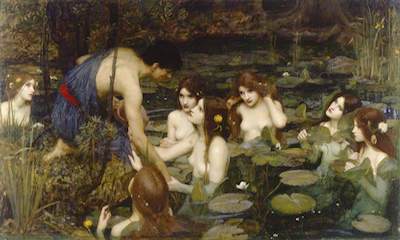
Waterhouse, John William, 1849-1917; Hylas and the Nymphs

(Why yes, it’s Hylas and the Nymphs by J. W. Waterhouse:
photo credit: Manchester Art Gallery)

Joyce had troubles enough in his time, with self-appointed judges and moral guardians, but would probably have been surprised to find a censorious glare turned upon John William Waterhouse. It’s a worrying sign, this lamentable decision of the Manchester Art Gallery to remove Hylas and the Nymphs from public view. Whatever one’s feelings about that specific painting, this policing of the past, the kind of censorship that announces, in the first instance, that it’s not censorship, is unambiguously bad. To claim that such actions are taken to ‘prompt a conversation’ when erasing history only closes down conversations, is disingenuous at best, dishonest at worst. And, alas, it’s given even more ammunition—as is evident from the yards of comments already posted about this news item—to the online (and offline) tribes who moan endlessly that their lives have been irretrievably ruined by those censorious and puritanical feminists who are plotting the ruin of western civilisation.