Ghost-seers and revenants

Shields, Frederick James, 1833-1911; Hamlet and the Ghost

(Frederick James Shields, Hamlet and the Ghost: Manchester Art Gallery)

Saturday’s Guardian carried a paperback review of Lisa Morton’s Ghosts: A Haunted History. It begins: ‘Nearly half of Americans believe in ghosts; the worldwide figure is almost certainly higher’, and adds that Morton shows belief in ghosts to be ‘nearly universal, though the form taken by the “undead spirit” varies across time and space.’[1]

It’s certainly a remarkably prevalent word – and idea – in our culture, in most cultures. Ghostwriter, ghost story, Ghostbuster, ghost train, ghost town, ghost of a chance, give up the ghost, to look like a ghost, ghosts walking over our graves, the ghost in the machine. The Holy Ghost: the Divine Spirit, the third person of the trinity, the Holy Spirit, closer there to the German geist. Ford Madox Ford remembered telling his confessor about his difficulty in conceiving, let along believing in, that ‘Third Person of the Trinity’. The old priest sensibly replied: ‘“Calm yourself, my son, that is a matter for theologians. Believe as much as you can”.’[2]

The poet Thomas Campbell recalled meeting the celebrated astronomer William Herschel in Brighton, in September 1813, feeling that he’d been ‘conversing with a supernatural intelligence’. Herschel completely perplexed him by saying that many distant stars had probably ceased to exist ‘millions of years ago’, ‘and that looking up into the night sky we were seeing a stellar landscape that was not really there at all. The sky was full of ghosts.’[3]

I’d tended to assume that fear of ghosts in the old sense had sensibly diminished in the more than four hundred years since Hamlet and the other witnesses had no doubts at all about what they were seeing when the ghost of the late king appeared to them, or the two hundred and fifty years since James Boswell was so unsettled by talk of ghosts: ‘This was very strong. My mind was now filled with a real horror instead of an imaginary one. I shuddered with apprehension. I was frightened to go home’.[4]

Had interest not steadily shifted to the observer rather than the observed? Henry James’s The Turn of the Screw is an obvious example; and Algernon Blackwood, in the preface to his collected stories, wrote: ‘My interest in psychic matters has always been the interest in questions of extended or expanded consciousness. If a ghost is seen, what is it interests me less than what sees it?’[5]

Ghosts_Almeida

(Ghosts at the Almeida Theatre via The Telegraph)
Lesley Manville as Helene Alving and Jack Lowden as Oswald Alving.

Henrik Ibsen disliked Ghosts as the title chosen by William Archer for his translation of the play into English. Richard Eyre, discussing his 2013 version, rendered the Norwegian Gengangere as ‘“a thing that walks again”, rather than the appearance of a soul of a dead person’ but pointed out that ‘Againwalkers’ was ungainly and the alternative, ‘Revenants’ he found ‘both awkward and French. Ghosts has a poetic resonance to the English ear.’
https://www.theguardian.com/stage/2013/sep/20/richard-eyre-spirit-ibsen-ghosts

Awkward? Arguably. French, most certainly. The 2004 film, Les Revenants, I’ve seen translated as They Came Back, while the recent television series based on it is called The Returned. In any case, the poetic resonance of ‘ghosts’ is certainly true enough in this English ear.

Unsurprisingly, the ‘theatre of war’—‘“theatre” is good. There are those who did not want / it to come to an end’[6]—is a flourishing site of wraiths, phantoms, visitants, revenants and vanishings. ‘Ghosts were numerous in France at that time’, Robert Graves wrote, recalling the second year of the First World War. Later, staying near Harlech at the large Tudor house of the Nicholson family—Graves married Nancy Nicholson, sister of Ben, third child of the painter William Nicholson and his wife Mabel—Graves remembered, ‘It was the most haunted house that I have ever been in, though the ghosts were invisible except in the mirrors.’[7]

Lucy_Masterman

(By Source (WP:NFCC#4), Fair use, https://en.wikipedia.org/w/index.php?curid=51483551)

From France in 1916, Ford Madox Ford wrote to Lucy Masterman, wife of the Liberal politician, then running the British War Propaganda Bureau (Wellington House): ‘Why does nobody write to me? Does one so quickly become a ghost, alas!’[8]

And two and a half years after the Armistice, Siegfried Sassoon, thinking about the war, pulled out his war notebooks and paused on a diary entry of 30 June 1916. ‘The diary makes me realise that I shall never partake of another war. It makes me wonder whether five years ago was real. “Gibson’s face in the first grey of dawn . . . ” Gibson is a ghost but he is more real to-night than the pianist who played Scriabine with such delicate adroitness. I wish I could “find a moral equivalent for war”. To-night I feel as if I were only half-alive. Part of me died with all the Gibsons I used to know.’[9]

Rapid and colossal changes, in agriculture, in urban sprawl, in transport, in technology, in population density, in the widespread loss of natural habitats, the accelerating extinction of species, the rampant carelessness of planning and development, combine to engender common but unpredictable sensations of loss, an uneasiness, an unfocused search for the missing. ‘Our landscape is full of ghosts’, Anna Pavord writes, ‘of hands that have twitched and pulled it into sheep runs and cattle folds, bridleways and burial mounds. It is one of its great strengths.’[10] And Helen Macdonald wrote that ‘The hawk and I have a shared history of these fields. There are ghosts here, but they are not long-dead falconers. They are ghosts of things that happened.’[11]

The self, of course, can become a ghost, or feel like one. Writing to William Maxwell in early 1940, Sylvia Townsend Warner remarked: ‘Being a writer makes one a ghost before one’s time—the kind of ghost that likes a libation. War—or rather a state of things that antedates war—makes one feel more ghostly still’.[12] John Banville’s narrator refers to the self as an indistinct black shape, ‘like the shape that no one at the séance sees until the daguerreotype is developed. I think I am becoming my own ghost.’[13]

STW2

(Sylvia Townsend Warner via  http://sylviatownsendwarner.tumblr.com/)

How many of us are never haunted, by remembered faces, voices, names, the lives unlived, places unvisited, old friends misplaced, acquaintances not pursued, desired lovers untried? We may not use the word ‘ghost’, of course. But sometimes one of the most poignant experiences of the ghostly is not the dead friend or relative or lover, the spirit reluctant to leave building, battlefield or landscape—but the life that was never quite there at the outset, the lost because never held, the almost-life, as in the poem by Julia Copus, her narrator straining to see the longed-for sign of a successful IVF treatment:

She takes it all in, like a small, controlled explosion:
here is the inch-long stiff, absorbent pad –
a stopped tongue, the damp on it still; and the plastic housing

with its cut-out windows. And here is the latex strip
(two lines for yes), the single band of purple
and beside it the silvery ghost of a second line

willed into being – frail as the arm of a sea-frond
trailed in the ocean – but failing to darken or turn
into more than a watermark.[14]


References

[1] P. D. Smith, ‘Out in paperback’ column, which I cannot find online: Guardian review supplement (7 October 2017), 9.

[2] Ford Madox Ford, Provence (London: Allen & Unwin, 1938), 140.

[3] Richard Holmes, The Age of Wonder: How the Romantic Generation Discovered the Beauty and Terror of Science (London: Harper Collins, 2008), 210.

[4] Boswell’s London Journal, 1762-1763, edited by Frederick A. Pottle (London: William Heinemann, 1950), 214.

[5] The Tales of Algernon Blackwood (London: Martin Secker, 1938), xi.

[6] ‘Canto LXXVIII’, The Cantos of Ezra Pound, fourth collected edition (London: Faber and Faber, 1987), 477.

[7] Robert Graves, Goodbye to All That (1929 edition; Harmondsworth: Penguin, 2014), 157, 342; Sanford Schwartz, William Nicholson (New Haven: Yale University Press, 2004), 179-180.

[8] Letter of 6 September 1916: Letters of Ford Madox Ford, edited by Richard M. Ludwig (Princeton: Princeton University Press, 1965), 74.

[9] Siegfried Sassoon, Diaries 1920-1922, edited by Rupert Hart-Davis (London: Faber and Faber, 1981), 73.

[10] Anna Pavord, Landskipping: Painters, Ploughmen and Places (London: Bloomsbury 2016), 43.

[11] Helen Macdonald, H is for Hawk (London: Jonathan Cape, 2014), 240.

[12] Michael Steinman, editor, The Element of Lavishness: Letters of Sylvia Townsend Warner and William Maxwell, 1938-1978 (Washington: Counterpoint, 2001), 8.

[13] John Banville, The Sea (London: Picador, 2006), 194.

[14] Julia Copus, ‘Ghost’, in The World’s Two Smallest Humans (London: Faber and Faber, 2012), 50.

‘We poets in our youth’

Redcliffe_Church_via_OBI.tumblr

(George Shepherd, Via https://www.oldbookillustrations.com/ )

‘The weather was brilliant’, the Reverend Francis Kilvert recorded in his diary, Friday 24 October 1873, when he attended the Bristol Music Festival. ‘We walked first to St Mary Redcliffe Church and remained to service in the beautiful Lady Chapel at 11 o’clock.’[1]

This imposing church, some of it dating back to the twelfth century, is about a mile from where I sit at this moment. Bristol boasts a giddily multifarious literary-historical line-up, those who have lived, visited or worked here ranging from Richard Hakluyt, Maria Edgeworth and Thomas Lovell Beddoes to Walter Savage Landor, Angela Carter and Charles Tomlinson. Edmund Burke was Member of Parliament, Humphry Davy experimented with laughing gas (often on himself) and Daniel Defoe may have met Alexander Selkirk, the ‘original’ of Robinson Crusoe, in a tavern in King Street. But traces of English Romanticism show up particularly strongly in any blood sample taken from the city’s literary history, and St Mary Redcliffe’s is a name that recurs often.

On this day, 4 October, in 1795, Samuel Taylor Coleridge, poet—recently, though briefly, having served with the Fifteenth Light Dragoons under the name Silas Tomkyn Comberbache—was married to Miss Sara Fricker in St Mary Redcliffe. He was not quite twenty-three, she a year or two older. The marriage would not be a conspicuous success but, in and around this year, Coleridge was meeting and often enchanting other figures who would be crucially important to his life and art.

‘SOUTHEY! thy melodies steal o’er mine ear
Like far-off joyance, or the murmuring
Of wild bees in the sunny showers of Spring –
Sounds of such mingled import as may cheer

The lonely breast, yet rouse a mindful tear’.[2]

Coleridge and Southey first met in Oxford in June 1794. Coleridge and his travelling companion, Joseph Hucks, had just begun a walking tour which would extend to more than five hundred miles in just over a month. The three-day stopover was transformed into a three-week stay, essentially because of this encounter between Coleridge and the twenty-year-old Southey, who ‘wrote bad poetry at tremendous speed’ and, though a self-proclaimed atheist and democrat, ‘with strong Jacobin sympathies’, was at that stage destined for the church.[3] Southey was a Bristol man, born above the family draper’s shop in Wine Street in August 1774, educated at Westminster School and then Balliol College. Coleridge’s friendship with him—like his friendships with several other men of letters—would be prone to convulsions, smarts and sorties but it started out with a tremendous velocity.

Coleridge

(Coleridge, 1975, by Peter Vandyke: © National Portrait Gallery)

By the time he and Hucks moved on from Oxford, Coleridge had established with Southey plans for a community on the banks of the Susquehanna river in Pennsylvania, which would sustain itself through farming (two or three hours’ daily labour) and would be grandly based on the principles of ‘Pantisocracy’, a Coleridgean coining, from Greek roots, meaning, more or less, government by all. The ‘astonishing’ speed with which this all happened ‘was testimony not only to the transforming effect they had on one another, but to the very weak foundations upon which the whole enterprise rested.’[4]

Within the next three months, Coleridge would meet Thomas Poole, radical, philanthropist and essayist, then living in Bristol, who would become a lifelong friend; and his future wife, Sara Fricker.

‘My gaze! Proud towers, and Cots more dear to me,
Elm-shadowed Fields, and prospect-bounding Sea.
Deep sighs my lonely heart: I drop the tear:
Enchanting spot! O were my Sara here.’[5]

In August and September, Coleridge composed other poems looking forward to his marriage: ‘The Eolian Harp’, the first of his celebrated ‘Conversation’ poems; and ‘Lines Written at Shurton Bars’, in which he ‘even dares to anticipate metaphorically the soon-to-be-enjoyed sexual congress with Sara (‘And so shall flash my love-charg’d eye/ When all the heart’s big ecstasy/ Shoots rapid through the frame!’).[6]

Still, there were hints for Sara of the absences and unreliability to come:

‘O Peace, that on a lilied bank dost love
To rest thine head beneath an olive tree,
I would, that from the pinions of thy dove
One quill withouten pain ypluck’d might be!
For O! I wish my Sara’s frowns to flee,
And fain to her some soothing song would write,
Lest she resent my rude discourtesy,
Who vowed to meet her ere the morning light,
But broke my plighted word—ah! false and recreant wight!’[7]

In August or September 1795, Coleridge met William Wordsworth, in Bristol: most likely at the house of John Pinney, a hugely wealthy merchant whose fortune was founded on sugar and slaves.

(The University of Bristol Library Special Collections include the Pinney family papers: accounts, letter-books, family and estate papers, mainly relating to Dorset and the West Indies, 1650-1986. See https://www.bristol.ac.uk//library/resources/specialcollections/archives/#pinney )

WW-Robert-Hancock-1798

(William Wordsworth, 1798, by Robert Hancock: © National Portrait Gallery)

In that same busy period, he quarrelled with Southey: though they were reconciled in the autumn of the following year, their Pantisocracy scheme, hardly surprisingly, fell through. And, less than six weeks after the Coleridge wedding, on 13 November 1795, Southey also married—also in St Mary Redcliffe Church. His bride was Edith Fricker, a sister of Coleridge’s wife.

In later years, when the Southeys lived in Keswick, at Greta Hall, they also supported Sara Coleridge and her children. And where was Coleridge then? In London, perhaps; or Germany; or South Wales; or Scotland; or Malta; or Sicily; or Italy. In September 1798, Lyrical Ballads, the landmark volume by Wordsworth and Coleridge, was published in Bristol by Joseph Cottle. Thereafter, Coleridge nursed an increasingly hopeless love for Sara Hutchinson (whom he addressed in print as ‘Asra’, not quite an unbreakable code), sister to Mary—whom Wordsworth would marry in 1802; there were quarrels and reconciliations; unfinished poems; accusations of plagiarism; lectures, marathon conversations, table-talk—and opium.

The early celebration of French revolutionary principles fell entirely away in the cases of both Wordsworth and Coleridge—and fell away even more steeply, perhaps, in that of Robert Southey, with whom Byron’s ‘Dedication’ to Don Juan was concerned (the first two Cantos appeared in 1819), though he had begun his ‘Preface’ with a swipe at Wordsworth’s unintelligibility and here jabbed at Coleridge’s recent preoccupations.

Byron-Thomas-Phillips

(Byron by Thomas Phillips)

Bob Southey! You’re a poet – Poet Laureate,
And representative of all the race;
Although ‘tis true that you turned out a Tory at
Last, yours has lately been a common case.
And now my epic renegade, what are ye at
With all the Lakers, in and out of place?
A nest of tuneful persons, to my eye
Like ‘four and twenty blackbirds in a pye,

Which pye being opened they began to sing’
(This old song and new simile holds good),
‘A dainty dish to set before the King’
Or Regent, who admires such kind of food.
And Coleridge too has lately taken wing,
But like a hawk encumbered with his hood,
Explaining metaphysics to the nation;
I wish he would explain his explanation.[8]

There were major achievements still to come from Coleridge, though, barring his restless revising, few of these were in the field of poetry, after the first years of the nineteenth century, and some—the Notebooks—would be barely visible in his lifetime. Wordsworth too, after the publication of Poems in Two Volumes (1807), is generally viewed in terms of poetic decline. In ‘Resolution and Independence’, written in the first half of 1802, though not published until 1807, Wordsworth’s narrator thinks of Chatterton, ‘the marvellous Boy’, whose brief life and tragic death were inextricably linked to St Mary Redcliffe Church, where his father was sexton and found the papers in the Muniment Room which led to Chatterton’s ‘discovery’ of the poet Thomas Rowley.[9] The same stanza concludes with two famous lines:

We Poets in our youth begin in gladness;
But thereof comes in the end despondency and madness.[10]

And yes, ‘sadness’ would have scanned—and would have rhymed too. But it just wouldn’t have cut the mustard, somehow. . .

References

[1] Francis Kilvert, Kilvert’s Diary, edited by William Plomer, Three volumes (London: Jonathan Cape, 1938, reissued 1969). Volume Two (23 August 1871—13 May 1874), 386.

[2] ‘To Robert Southey of Balliol College, Oxford, Author of the “Retrospect”, and Other Poems’, in Samuel Taylor Coleridge, The Complete Poems, edited by William Keach (London: Penguin Books, 1997), 74.

[3] Richard Holmes, Coleridge: Early Visions (London: Hodder and Stoughton, 1989), 61-62.

[4] Tom Mayberry, Coleridge and Wordsworth: The Crucible of Friendship, revised edition (Stroud: Sutton Publishing, 2000), 22-23.

[5] ‘Lines composed while climbing the left ascent of Brockley Coomb, Somersetshire, May, 1795: Coleridge, The Complete Poems, 80.

[6] Rosemary Ashton, The Life of Samuel Taylor Coleridge (Oxford: Blackwell, 1997), 74-75; Coleridge, The Complete Poems, 87-88, 89-91.

[7] ‘Lines in the manner of Spenser’: Coleridge, The Complete Poems, 81.

[8] Lord Byron, Don Juan, edited by T. G. Steffan, E. Steffan and W. W. Pratt (London: Penguin Books, 1996), 37, 41. Southey accepted the post of Poet Laureate in 1813. Byron had assisted Coleridge financially, sending him £100 in February 1816: Ashton, The Life of Samuel Taylor Coleridge, 295. On the Pye joke, see an earlier post: https://reconstructionarytales.blog/2017/08/21/sorrows-joys-magpies/

[9] On Chatterton, see Richard Holmes, ‘Thomas Chatterton: The Case Re-opened’, in Sidetracks: Explorations of a Romantic Biographer (London: Harper Collins, 2000), 5-50; Alistair Heys, editor, From Gothic to Romantic: Thomas Chatterton’s Bristol (Bristol: Redcliffe Press, 2005).

[10] William Wordsworth, edited by Stephen Gill (Oxford: Oxford University Press, 2012), 232.


A Turn around the Cemetery

Arnos-Vale-1

2 October. Taking time away from news bulletins detailing mass murder, police brutality, terrorism and gross political irresponsibility, I take a turn around the cemetery, where the dead seem quite peacefully disposed.

They were calmer times in Westmorland, even though Britain and France were at war, when Dorothy Wordsworth recorded details of her day (and William’s) that Thursday, 2 October 1800. ‘A very rainy morning. We walked after dinner to observe the torrents. I followed Wm to Rydale, he afterwards went to Butterlip How. I came home to receive the Lloyds. They walked with us to see Churnmilk force and the Black quarter. The black quarter looked marshy, and the general prospect was cold, but the Force was very grand. The Lychens are now coming out afresh. I carried home a collection in the afternoon. We had a pleasant conversation about the manners of the rich—avarice, inordinate desires, and the effeminacy unnaturalness and the unworthy objects of education. After the Lloyds were gone we walked—a showery evening. The moonlight lay upon the hills like snow.’[1]

In Arnos Vale, I can hear, from far off, the workmen busy at the end of Sydenham Road. Wind buffets the trees. A woman in dark glasses walks three dogs towards me, one black, two matching white. We exchange half-smiles, nothing too risky.

Arnos-Vale-2

The wind pauses and the birdsong is more audible. Two, three Red Admirals in as many minutes pass me. The wind was only drawing breath. Gathered again, it gusts, leans, stills. There’s a sudden rush of children’s voices as the doors of the nearby school slap open and they spill into the playground.

On another 2 October, 1940, into the second year of another war, Josie Brinton wrote from Alexandria to her mother in Tennessee, ‘I know how worried you must be and it’s useless to tell you not to be but what else can I say. If you saw the carefree life everyone leads here you’d wonder what all the excitement was about’. Italian troops had crossed the border from Libya into Egypt three weeks earlier. Josie went on to recount the story current in Alexandria that ‘in the Mediterranean now all the English sailors had to do was lean over the side of their ships and shout “waiter” to have an Italian submarine come to the surface!’[2]

Alexandria-1940

(Alexandria, 1940 via histclo.com)

I used to be friends with a man who drove a Volkswagen Beetle. Drivers of this car would salute—or at least, acknowledge—one another, hooting, flashing their lights or simply waving. As a consequence, the whole world seethed with Beetle drivers: they were everywhere. Just so, romantic love will narrow all the people in the world to women with red hair or blue dresses, to men with slight stoops or yellow scarves. Now the streets are full of men of about my age, all equipped with rucksacks exactly like mine, all walking purposefully (when I am) or sauntering unhurriedly, without direction (when I am).

But there are no such men in the cemetery today: men with matching dogs, yes, but nothing more (I have no dog to match). And I notice again how often here the magpies are in pairs, as though companionship were more necessary, or at least a little more desirable, in the company of the dead.

References

[1] Journals of Dorothy Wordsworth, edited by Mary Moorman (Oxford: Oxford University Press, 1973), 41.

[2] Michael Haag, Alexandria: City of Memory (Yale University Press, 2004), 180.


Difficult demands, corresponding charms

Macdonald-books

I drift back—early enough to cook the dinner—from a couple of days in California in the company of Ross Macdonald, not for the first time. The thirteenth occasion, I think. I must have seen, in a previous life, one of the films featuring Macdonald’s private eye Lew Archer, either Harper (1966, based on The Moving Target) or The Drowning Pool (1975), both starring Paul Newman. There was a later film, Blue City (1986), based on an early Macdonald novel, not a Lew Archer book. But I only started reading Macdonald a few years ago, decades after going through the whole of Chandler and of Hammett (one of whose books made a strong impression on the sixteen-year-old Macdonald).

Ross Macdonald was born Kenneth Millar in Los Gatos, California, though his parents were Canadian. After a difficult childhood, he studied at the University of Western Ontario and eventually received a PhD from the University of Michigan in 1952: his dissertation was on Coleridge.

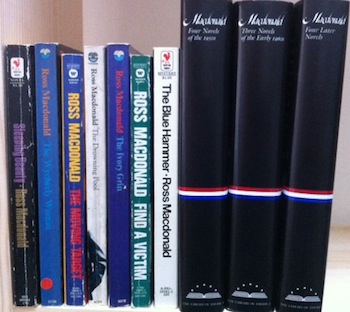
While I wait for The Archer Files to make its way through the postal system, I review my collection of Macdonalds: seven mass market paperbacks jostle the three handsome Library of America volumes which, between them, contain eleven full-length novels. The last of these, Four Later Novels, published this year, is a recent arrival on my shelves and awaits the week’s holiday towards the end of the year—probably, if I can last that long.

tspa_0099971f

(Kenneth Millar/ Ross Macdonald via Library of America)

Inclusion in the Library of America series probably hints at the status that Macdonald has achieved in the view of some influential readers, since The Goodbye Look (1969) prompted the New York Times Book Review notice by William Goldman (‘the finest series of detective novels ever written by an American’).

Thirty-three years before the first Library of America volume of Macdonald’s work appeared—the series was launched in 1982, with eight volumes published that year—Hugh Kenner published an essay, ‘Classics by the Pound’, which began by detailing some comparisons between the products of that list and ‘the esteemed French series Bibliothèque de la Pléiade’, not least the fact that early volumes suggest a tendency to play it safe, perhaps influenced too much by potential copyright problems with more recent writers. Kenner went on to remark that ‘one difference’ between Harriet Beecher Stowe and Ross Macdonald was that Macdonald, ‘in devising his fables of modern identity, wrote them as things called “detective stories,” handled at Harvard with tongs’, while Stowe’s ‘famous eleven-Kleenex tract, sanctified by a testimonial of Lincoln’s, soars aloft into the Disneyfied sunsets of Literature.’ But, he added, a hundred years hence, should the Library of America series still be around, ‘it either will have atrophied into total irrelevance or else will have managed to embalm three novels by Ross Macdonald. Just watch. And you read it here first.’[1]

Kenner

(Hugh Kenner)

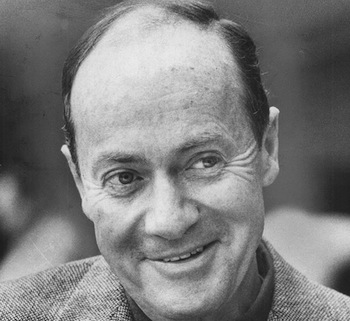
Ah, literary history. The friendship between Kenner and Macdonald dated back to 1950, when Kenner was teaching at the University of California, Santa Barbara. Kenner acknowledged his gratitude to Macdonald—Kenneth Millar—‘for his patience in expunging the flaws from the manuscript’ of Wyndham Lewis (1954); Macdonald reviewed Kenner’s Gnomon and his The Invisible Poet (on T. S. Eliot), while Kenner would contribute a piece to a collection of essays, memoirs, poems and photographs, Inward Journey: Ross Macdonald, edited by Ralph B. Sipper, published in 1984.[2] But the friendship ran into trouble long before the Sipper volume.

Sleeping Beauty (1973), my most recent outing in the Los Angeles/Santa Barbara area, is one of his most intricately plotted, with the trademark Macdonald complexities of generations of family history, unsuspected interrelations, threatening secrets and vulnerabilities, this one set against the backdrop of a disastrous oil spill. (Macdonald was politically engaged and environmentally concerned: when an underwater oil well blew out off Santa Barbara in early 1969, both Macdonald and his wife, novelist Margaret Millar, took part in the ensuing protests.)

Sleeping Beauty is dedicated to Eudora Welty. Two years earlier, the New York Times Book Review had run, on its front page, Eudora Welty’s hugely positive review of The Underground Man. The two writers’ correspondence had begun the previous spring and would develop into a close personal relationship. In January 1973, following Welty’s appearance on William F. Buckley’s Firing Line television programme, Macdonald mentioned that Buckley had recently been in Santa Barbara, ‘house guest of an old friend of mine, Hugh Kenner—a friendship that began to lose its virtue about the time that Hugh became literary godfather of the National Review, and has now eroded—but a friendship that I regret. In the late forties and early fifties Hugh and I taught each other a good deal, he more than I. Who is our most brilliant literary scholar? Alas, it is Hugh Kenner.—This summer he leaves Santa Barbara for Johns Hopkins.’[3]

Yes, that was the issue. Kenner had become friends with Buckley in the late 1950s and published his first contribution to Buckley’s conservative National Review in November 1957, his last more than forty years later. (My own knowledge of Buckley is pretty limited but I thought Best of Enemies, the 2015 documentary about the televised debates between Buckley and Gore Vidal in 1968 was tremendous: funny too.)

eudora-welty.paris.review

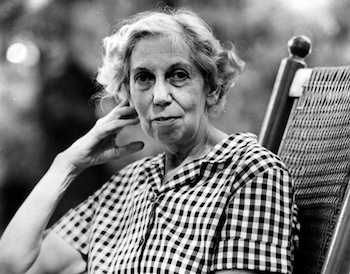
(Eudora Welty via The Paris Review)

Is there a Ford Madox Ford connection somewhere here—apart from Kenner? Indeed there is. In the spring of 1971, Welty mentioned to Macdonald that she was writing a review of Arthur Mizener’s biography of Ford (‘I’m not sure if I can stand Arthur Mizener on Ford, anyway [ . . . ] I’ve been reading all the Ford I can, to get a little balance.’ In his reply, Macdonald mentioned having seen a part of the biography and being struck by ‘what seemed to me its rather dull antipathy towards its subject.’ And it’s true that, while Arthur Mizener made some valuable contributions to the body of biographical work on Ford, what queers the pitch is that he really disliked Ford and ends up not believing a word he says, hardly the best frame of mind to foster insight and understanding. Ford had to wait another couple of decades before Alan Judd and Max Saunders corrected the Mizener view.

Another of Macdonald’s friends was Richard W. Lid, whose book, Ford Madox Ford: The Essence of His Art had appeared in 1964, dedicated ‘To Kenneth Millar’. Macdonald’s letter went on to mention this: ‘Dick wrote his own book on Ford—an analysis of the major novels which I think is the best thing done on him so far. Could be I’m prejudiced: I worked on it with Dick—this in confidence—and in fact he dedicated it to me. So when you told me you were involved with Ford, it closed another circle, dear Miss Welty, with a tinkle. But it’s no coincidence, is it? All writers admire Parade’s End and love The Good Soldier, and hate to see them fall into fumbling hands, unimaginative hands.’[4]

Thanking him for his letter—and Macdonald’s own copy of Lid’s book which he’d sent her—Eudora Welty said it was just what she needed ‘at this very point, when Mizener in his jovial disparagement was about to get me down.’ She claimed to see the traces of Macdonald’s work on the chapter devoted to The Good Soldier, ‘in the awareness of what Ford is doing in that marvelous book’, adding: ‘I don’t need to tell you I undertook the review not for love of Mizener but for love of Ford.’[5]

Eudora Welty’s review of Mizener’s biography is included in The Eye of the Story, a selection of essays and reviews. In that book, the review is immediately followed by her appreciation of Macdonald’s The Underground Man: ‘In our day it is for such a novel as The Underground Man that the detective form exists. I think it also matters that it is the detective form, with all its difficult demands and its corresponding charms, that makes such a novel possible.’[6]

We know that Ford greatly appreciated Welty’s writing.[7] I like to think that he would have admired Macdonald’s work too—‘fables of modern identity’ indeed.

References

[1] Hugh Kenner, Mazes (Athens: University of Georgia Press, 1995), 118, 123, 124.

[2] Hugh Kenner, Wyndham Lewis (1954; New York: New Directions, 1964), viii; other details are from Hugh Kenner: A Bibliography, edited by Willard Goodwin (Albany, New York: Whitston Publishing Company, 2001).

[3] Suzanne Marrs and Tom Nolan, editors, Meanwhile There Are Letters: The Correspondence of Eudora Welty and Ross Macdonald (New York: Arcade Publishing, 2015), 109-110.

[4] Meanwhile There Are Letters, 11, 12.

[5] Meanwhile There Are Letters, 13.

[6] Eudora Welty, The Eye of the Story: Selected Essays and Reviews (London: Virago Press, 1987), 258: review of Mizener, The Saddest Story: A Biography of Ford Madox Ford, 241-250; review of The Underground Man, 251-260. The book is dedicated ‘To Kenneth Millar’.

[7] Letters of Ford Madox Ford, edited by Richard M. Ludwig (Princeton: Princeton University Press, 1965), 310; Sondra Stang, editor, The Ford Madox Ford Reader (Manchester: Carcanet Press, 1986), 510-512.


Acts of Attention

Vermeer-Lacemaker

(Johannes Vermeer, The Lacemaker)

Concentration: the focusing of all one’s attention; the keeping of the mind fixed on something.

Towards the end of the first year of the Great War, Friday 16 July 1915, Vera Brittain noted in her diary, ‘I find it very difficult to read just now, especially fiction; the immense realities of the present crowd in upon my mind, making concentration almost impossible & fictitious events quite trivial.’[1]

The present certainly offers plenty of ‘immense realities’—not all of them likely to foster optimism—though I’m not finding it difficult to read. Still, concentration is a little trickier these days. There’s the matter of intensity; but also the question of duration. The rate at which I read varies wildly—a crime novel, however good, demands a different kind of attention from, say, The Anathemata of David Jones—but on average, if I manage a hundred or a hundred and fifty pages in a day, that’s pretty good going. Yet I remember—how many years ago?—reading a Dickens novel, perhaps Little Dorrit or Our Mutual Friend, and reading four hundred or four hundred and fifty pages in a day.

So I seem to have lost that ability to stick to a single task, a single object of interest, for that length of time; but, of course, this is in large part because of the various distractions that can break my concentration and the habits I’ve lapsed into of allowing myself to be distracted.

Still, when I read of people who go crazy after eight hours without a phone, or who check their texts or emails every five minutes, a hundred and fifty times a day, I feel entirely dissociated from such patterns of behaviour. I’m not so easily distracted, am I? Just how often do I check the damned thing? In any case, here, sitting by the back door, reading, yes, Michel Leiris (‘Like many men, I have made my descent into Hell, and like some, I have more or less returned from it’),[2] my attention is caught—too easily caught—by a movement outside. And I mean this as a serial event: wind in the leaves, birds on the fence or on the bird table or, perhaps, this—neither a bird nor a plane:

Cat-tree

That cat—the visiting cat—is absurdly prone to distraction: a leaf, a fly, a cloud, gulls passing overhead, any of these will do. We have confidently diagnosed ADHD or the feline version of it. Yet, come to think of it, such behaviour has become typically human.

I was remembering—and getting almost right, from memory—an early passage in Aldous Huxley’s Island, when Will Farnaby, hearing the mynah bird utter its one-word message—‘Attention’—yet again, turns to Doctor MacPhail:

“Attention to what?” he asked, in the hope of eliciting a more enlightening answer than the one he had received from Mary Sarojini.
“To Attention,” said Dr MacPhail.
“Attention to attention?”
“Of course.”[3]

Paying attention: a transaction. We hand over a portion of ourselves and receive in return—what? It varies, of course, but, ideally, an addition, an augmentation, an enlargement of the self. Colette lamented that ‘We do not look, we never look enough, never attentively enough, never excitedly enough.’[4] What is enough? As John Ames, the narrator of Marilynne Robinson’s Gilead, observes, ‘This is an interesting planet. It deserves all the attention you can give it.’[5]

Not that it is simply a question of giving it attention. Don Gifford recalled the tale of Thoreau’s young friend Ellery Channing being reduced to tears because, as he himself admitted, ‘he knew so little about what merited recording that he returned home from his nature walks day after day with an empty notebook.’[6] And Robert Richardson writes of Thoreau ‘eagerly’ reading Ruskin and Gilpin, ‘whose work starts from the often ignored fact that the uneducated eye simply does not notice most of what is in front of it. Until our attention is called to this detail or that feature, we rarely scrutinize our surroundings, “in the full, clear sense of the word, we do not see.”’[7]

EstruscanPlaces

Attention at such a pitch is sometimes seen as a sacramental act: the Latin root of the word means an oath or a pledge. Of Leopold Bloom in Joyce’s Ulysses, Declan Kiberd observes, ‘To each and every detail of the surrounding world he gives that close attention which is the nearest modern equivalent of prayer.’[8] D. H. Lawrence, writing of augury and divination, pointed out that there is ‘no other way when you are dealing with life.’ You may pray to a personal god or rationally mull things over but it amounts to the same thing in the end: ‘it is all the same process, ultimately: of divination.’ And he asserts that: ‘All it depends on is the amount of true, sincere, religious concentration you can bring to bear on your object. An act of pure attention, if you are capable of it, will bring its own answer. And you choose that object to concentrate upon which will best focus your consciousness. Every real discovery made, every serious and significant decision ever reached, was reached and made by divination. The soul stirs, and makes an act of pure attention, and that is a discovery.’[9]

An act of pure attention seems like something to aim at. Or, failing that, a hundred or so pages in a day punctuated by phones, emails, whirring birds and treed cats.

 
References

[1] Vera Brittain, Chronicle of Youth: Vera Brittain’s Diary 1913-1917, edited by Alan Bishop (London: Gollancz 1981), 221.

[2] Michel Leiris, Manhood: A Journey from Childhood into the Fierce Order of Virility, translated by Richard Howard (1939; Chicago: University of Chicago Press, 1992), 6. I’m still in the midst of it—it may not all be as cheerful as that quotation suggests.

[3] Aldous Huxley, Island (1962; London: Vintage, 2005), 21.

[4] Colette, Looking Backwards: Recollections [Journal à rebours and De ma fenêtre], translated by David Le Vay (London: Peter Owen, 1975), 149.

[5] Marilynne Robinson Gilead (London: Virago 2008), 32.

[6] Don Gifford, The Farther Shore: A Natural History of Perception (London: Faber, 1990), 11-12.

[7] Robert D. Richardson, Jr., Henry Thoreau: A Life of the Mind (Berkeley: University of California Press, 1986), 53.

[8] Declan Kiberd, Ulysses and Us: The Art of Everyday Living (London: Faber and Faber, 2009), 89.

[9] D. H. Lawrence, Etruscan Places (1932), in D. H. Lawrence and Italy (London: Penguin Books, 1997), 54-55.


Circumspect and right

Mauve, Anton, 1838-1888; Shepherdess
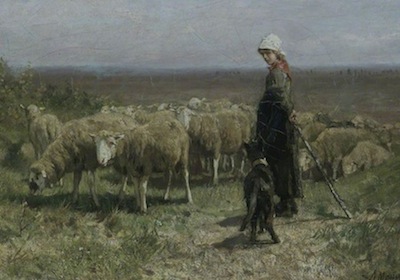
Anton Mauve, The Shepherdess (National Museum of Wales, Cardiff)

Early in Ford Madox Ford’s Some Do Not. . ., the first volume of the Parade’s End tetralogy, Christopher Tietjens and Vincent Macmaster are talking together in a railway carriage (their topics of conversation ranging over many of the novel’s themes).

“I’m thinking,” Tietjens said, “thinking how not to be too rude.”
“You want to be rude,” Macmaster said bitterly, “to people who lead the contemplative. . . the circumspect life.”
“It’s precisely that,” Tietjens said. He quoted:

‘She walks the lady of my delight,
A shepherdess of sheep;
She is so circumspect and right:
She has her thoughts to keep.’”[1]

As the note says, these lines are from ‘The Shepherdess’, one of the best-known lyrics by Alice Meynell. She was born on this day, 22 September, in 1847 and died on 27 November 1922 (within a month or so from the probable start date of Ford’s writing of Some Do Not . . .). ‘The Shepherdess’ had first appeared in Meynell’s 1901 Later Poems, was reissued in a 1914 volume of that title, and was collected several times thereafter, usually in editions  issued by Burns and Oates, the Catholic publishing house of which her husband Wilfrid was manager.

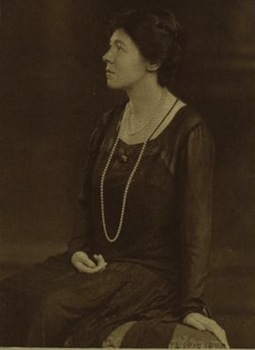
Alice_Meynell

Curiously, the 1939 revision of The Oxford Book of English Verse, 1250-1918, edited by Sir Arthur Quiller-Couch, includes this poem under the title ‘The Lady of the Lambs’—which somehow makes it worse—and, in the version Tietjens quotes, the third and fourth lines of Meynell’s stanza have been promoted to the first and second lines. Then, too, while Tietjens has ‘thoughts to keep’, Meynell, characteristically, has ‘soul’.

Born Alice Thompson, she spent much of her early life in Italy, where she was educated mainly by her father. After the family returned to England in 1864, Alice converted to Catholicism at the age of twenty-five and, in 1877, married Wilfred Meynell, with whom she co-edited several magazines and had eight children between 1879 and 1891. They were friends with the leading Victorian poets (Tennyson, Meredith, Coventry Patmore) and famously took in the destitute, opium-addicted and—at that stage—suicidal poet Francis Thompson, who lived with them for the best part of twenty years, though he also spent time in a Franciscan monastery in North Wales.

Meynell was highly popular and also critically applauded but her public persona of piety and ‘femininity’ have complicated later reactions to her, not least because of her involvement with the struggle for women’s suffrage: critical of the Women’s Social and Political Union’s methods, she joined the Women Writers Suffrage League, formed in 1908 by the playwright and novelist Cicely Hamilton.

The enduring response to that image of the pure and impeccably virtuous Angel in the House, which prompted Ford’s use of Meynell’s poem at this juncture, also underlies D. H. Lawrence’s letter to his agent, James Pinker, about the decision of Chatto and Windus to omit the poem ‘Song of a Man who is loved’ (and one other poem, plus several lines in others) from the collection Look! We have Come Through! Lawrence remarked of the poem that ‘I’m sure Alice Meynell might print it without reproach.’[2]

Probably not. The poem ends:

So I hope I shall spend eternity
With my face buried between her breasts;
And my still heart full of security,
And my still hands full of her breasts.[3]

Perhaps, then, his publisher’s nervousness was not a complete mystery in wartime England, just two years after the prosecution of The Rainbow.

hyde2
William Hyde, from London Impressions

The Lawrence connection with the Meynell family is probably the one of greatest interest, though their story breaks off in several directions which reward pursuit. Another Ford connection which suggests itself  is through Edward Hyde, an artist and illustrator whom Ford greatly admired and knew well. Hyde provided the illustrations (‘Photogravure plates’) for Ford’s 1900 volume, The Cinque Ports. Ford published an appreciation of the artist in January 1898 and, in December of that year, there was a private view of Hyde’s ‘London Impressions’, to accompany the publication of his book of that title: Hyde’s illustrations accompaned a series of essays by Alice Meynell. The volume was priced at eight guineas—‘equal to a house servant’s wages for a year’—and, at the private view, Arthur Balfour (who would become Prime Minister in the summer of 1902) bought two of Hyde’s pictures on the spot.[4]

One more connection is that to David Garnett, through Francis Meynell, the youngest of the children, who founded the famous Nonesuch Press, which produced its first title in 1923. Garnett was a partner in the Press, together with Francis and his wife Vera. He was also, of course, a friend of Lawrence and the Nonesuch titles would include an edition of Lawrence’s Love Among the Haystacks, in the year of his death—with a memoir by David Garnett.

Nonesuch-DHL

Just two days ago, it was the anniversary of the launching of Georgian Poetry, 20 September 1912, in Edward Marsh’s rooms in Gray’s Inn. Present were Rupert Brooke, Marsh, Wilfred Gibson, John Drinkwater, Harold Monro and Arundel del Ré. Brooke and Marsh were the prime movers at the earliest stage but both Francis and Alice Meynell have been credited with awakening that interest in contemporary verse in Marsh which led to the production of the anthology and its successors.[5]

But the best-known connection is that with D. H. Lawrence, whose closest contact with the Meynell family occurred from late January to the end of July in 1915. He and Frieda had been invited to stay on the Meynell estate at Greatham, just a few miles from Pulborough in West Sussex (where Ford Madox Ford first lived with Stella Bowen between June 1919 and August 1920). The cottage was lent to the Lawrences by Viola Meynell; and their stay there produced one story, ‘England, My England’, which has provoked a good deal of criticism of Lawrence for his apparent ‘ruthlessness’ in using figures and events ‘from life’.[6]

The cottage was also the venue for a much-disputed visit by Ford and Violet Hunt. They saw—and quarrelled with—Frieda Lawrence; unless Frieda quarrelled with Catherine Wells, wife of H. G. And Lawrence himself was not present. Almost certainly. . .[7]

D_H_Lawrence_1915

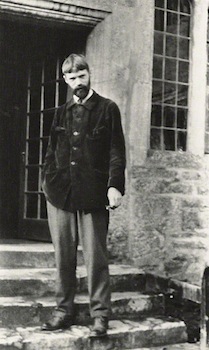
(D. H. Lawrence, 1915)

David Garnett visited, in the company of his friend Francis Birrell, and the pair were invited to breakfast with the Meynells. Garnett remembered that ‘Wilfred Meynell, the Patriarch, was rustling the pages of the Observer, the room was full of dark, madonna-like girls and women, the Poetess [Alice] lay stretched upon a couch’.[8]

Viola Meynell, herself the author of more than twenty books, was an early supporter of Lawrence. The typescript of The Rainbow dates from February 1915 to 31 May 1915, and Viola was one of its three, possibly four, typists.[9] It was also to Viola that Lawrence announced that he was ‘going to begin a book about Life.’[10]

‘It is the Meynells’ place’, Lawrence wrote to his friend William Hopkins before he and Frieda set off. ‘You know Alice Meynell, Catholic poetess rescuer of Francis Thompson.’[11] Thompson had died only eight years earlier, his Selected Poems appearing posthumously, though his critical standing was already high, his best-known poem probably ‘The Hound of Heaven’. As late as 1952, Viola would publish Francis Thompson and Wilfrid Meynell: A Memoir.

Alice Meynell’s poems have not lasted well. To modern eyes—certainly to mine—they’re redolent of a kind of Victorian self-parody: very conventional, often sentimental, worthy, rather thin and clunky. Perhaps some of the essays, introductions and reviews have survived in ruder health. There was a centenary volume of her prose and poetry, published in 1947 by Jonathan Cape, with an introduction by Vita Sackville-West. It’s noticeable that, in that 400-page book, the selection of her poems doesn’t begin until page 357. That selection includes a poem entitled ‘The Lady Poverty—‘The Lady Poverty was fair / But she has lost her looks of late’—which, in 1932, George Orwell mentioned when trying to settle on a title for his first book. He thought of calling it ‘The Lady Poverty’ or ‘Lady Poverty’—but settled instead on Down and Out in Paris and London, which finally appeared on 9 January 1933.[12]

On the other hand, Alice Meynell: Prose and Poetry­—circumspectly, perhaps—does not include ‘The Shepherdess.’

References

[1] Ford, Some Do Not. . . (1924; edited by Max Saunders, Manchester: Carcanet Press, 2010), 26.

[2] To Pinker, 3 August 1917: Letters of D. H. Lawrence III, October 1916–June 1921, edited by James T. Boulton and Andrew Robertson (Cambridge: Cambridge University Press, 1984), 145-146 and notes.

[3] D. H. Lawrence, The Complete Poems, edited by Vivian de Sola Pinto and F. Warren Roberts (Harmondsworth: Penguin Books, 1977), 250.

[4] Ford, ‘William Hyde: An Illustrator of London’, The Artist, XXI (January 1898), 1-6; Jerrold Northrop Moore, The Green Fuse: Pastoral Vision in English Art, 1820-2000 (Woodbridge, Suffolk: Antique Collectors’ Club, 2007), 90.

[5] Robert H. Ross, The Georgian Revolt: Rise and Fall of a Poetic Ideal, 1910-1922 (London: Faber and Faber, 1967), 120, 103-104.

[6] Mark Kinkead-Weekes, D. H, Lawrence: Triumph to Exile, 1912-1922 (Cambridge: Cambridge University Press, 1996), 252-255.

[7] Max Saunders reviews the evidence—and some related assertions—in Ford Madox Ford: A Dual Life, two volumes (Oxford: Oxford University Press, 1996), I, 476-478.

[8] David Garnett, Great Friends (London: Macmillan, 1979), 86.

[9] The Rainbow, edited Mark Kinkead-Weekes, introduction and notes Anne Fernihough (Cambridge, 1989; Penguin edition with new editorial matter, 1995), 1 (‘A Note on the Text’). One of the other typists was Eleanor Farjeon.

[10] Letter of 2 March 1915: Letters of D. H. Lawrence II, June 1913-October 1916, edited by George J. Zytaruk and James T. Boulton (Cambridge: Cambridge University Press, 1981), 299. This was ‘The Crown’.

[11] Letters of D. H. Lawrence II, 259. Eric Gill was only brought into contact with this prominent Catholic family when he was commissioned by Everard Meynell to carve the tomb for Thompson in St Mary’s Roman Catholic Cemetery in Kensal Green: Fiona MacCarthy, Eric Gill (London: Faber & Faber, 1990), 112.

[12] George Orwell, A Kind of Compulsion: 1903-1936, edited by Peter Davison, revised and updated edition (London: Secker and Warburg, 2000), 253.


Margins and Montague

Cat-hair

What a menu of news: a major earthquake in Mexico, another hurricane battering the Caribbean, and leading politicians well down to their usual standard, whether of dishonest posturing or reckless and irresponsible ranting. Sidestepping further gloom, I decide to forego the pleasures of the churchyard shortcut—a man shooting up on the steps a few weeks ago, two agitated women clearly waiting for The Man a few days ago—and take another route, the way I used to walk to work, to call at the baker, the deli and the fishmonger. I pause only long enough for the visiting cat to successfully deposit some hair on the leg of my trousers before setting off.

The fishmonger is open but seems a little unready, as none of the fish is labelled yet. ‘Am I a bit early?’ I wonder. No, no, he says, then asks casually if I know exactly what I want and mentions, when I come to pay, that he’d prefer a card transaction because he hasn’t sorted out a float yet. But no, I’m not too early, he’s just ‘marginally, marginally late.’ How marginal is that, precisely?

Henry-Thoreau

Margin: an edge or border, blank edge on the page of a book, something allowed more than is needed. ‘I love a broad margin to my life’, Thoreau wrote—and elsewhere: ‘The really efficient laborer will be found not to crowd his day with work, but will saunter to his task surrounded by a wide halo of ease and leisure. There will be a wide margin for relaxation to his day.’[1] This is (possibly) not an experience of work and working conditions commonly shared by those on zero-hour contracts in the United Kingdom’s contemporary employment paradise.

I saunter, pausing from time to time to check that the two cartons of double cream—‘Keep upright’—in my rucksack are in fact keeping upright. I am thinking of margins, firstly of that blank edge of a book’s page. W. J. Jackson wrote a book entirely about the notes that found their way there: Marginalia: Readers Writing in Books (Yale University Press, 2002) and the British Library holds William Blake’s copy of the three-volume set of the Works of Sir Joshua Reynolds, with their extensive annotations in Blake’s hand (there are—of course—books and articles wholly devoted to these).

When Sr Joshua Reynolds died
All Nature was degraded;
The King dropd a tear into the Queens ear;
And all his Pictures Faded.[2]

reynolds-joshua-works-B20132-53

Blake’s copy of Reynolds’ Works: British Library.
(‘To Generalize is to be an Idiot  To Particularize is the Alone Distinction of Merit—General Knowledges are those Knowledges that Idiots possess’)

In Lawrence Durrell’s Sebastian, ‘In the margin of a book she had borrowed from Sutcliffe’, Constance ‘had found the scribbled words: “The same people are also others without realising it.”’[3] Robert Phelps wrote to James Salter: ‘Scrapbooks, footnotes, almanacs, letters, diaries, questionnaires, marginalia, memos, alphabets . . . how I love them. Pasolini once called himself a “pasticheur.” I think I am an annotator. The story exists for the scribbled notes in the margin.’[4]

Secondly, that edge or border, often physical, often psychological and sometimes both at the same time. In war, certainly in the First World War, that sense of being on the edge of things, never having sufficient information to know what was actually going on, worsened by feeling abandoned or forgotten. Eric Leed wrote: ‘Astonishing numbers of those who wrote about their experience of war designate No Man’s Land as their most lasting and disturbing image. This was a term that captured the essence of an experience of having been sent beyond the outer boundaries of social life, placed between the known and the unknown, the familiar and uncanny. The experience of war was an experience of marginality, and the “change of character” undergone by the combatant could adequately be summarized as marginalization.’[5]

David Jones writes of John Ball and his comrades (‘Here they sat, his friends, serving their harsh novitiate’), in contrast to the Army Service Corps, Base-wallahs, Staff-wallahs and the like: ‘but these sit in the wilderness, pent like lousy rodents all the day long; appointed scape-beasts come to the waste-lands, to grope; to stumble at the margin of familiar things—at the place of separation.’[6]

‘Marginal’ is often applied to those figures that are viewed as of secondary importance, off-centre: but in some disciplines, the centre has an unsettling habit of shifting.[7] Certainly, in the arts, the ‘canon’ broadens and deepens constantly as some of the most important figures of previous generations are found not to last, the new questions addressed to them getting little or nothing in reply.

Montague-Capt-Cadge-censors

(C. E. Montague and Captain Cadge as army censors via Spartacus International

That third margin, the ‘something allowed more than is needed’, is a critical element in the title story of C. E. Montague’s Action (1928), part of our recent haul from Hay-on-Wye. It concerns Christopher Bell, ‘reigning sovereign’ of a dynasty of Manchester merchant princes, who wakes one morning to feel a numbness down one side of his body. He has fought in the Great War, during which he lost his beloved wife, and is a keen climber. Facing a future of invalid-chair and male nurse, and after a couple of humiliating allowances being made for his condition, he revolts. He won’t commit suicide but, reading of a great climber’s ‘greatest adventures’, Bell wonders how big a margin of safety had attended that successful expedition: ‘what if such a party were to try paring and paring away at that pretty wide margin?’ He returns to an old haunt, Zinal, in the Swiss canton of Valais, in late September. His target is a glacier with ice ‘steep and bare and blue’—with an overhang: ‘nowhere in the whole thousand feet of ascent would a man have a foothold to stand on, unless he made it.’ He climbs conscientiously until genuinely exhausted: ‘that was the end, he felt, of all possible effort’. Then a falling ice-axe and the standard Alpine cry for help, alerts him to a drama just above the overhang: a woman at the end of a rope which her husband desperately hangs on to above her. Bell is galvanised into heightened, unthinking action, and all three are eventually saved. In the Weisshorn hut, while she sleeps, he tells the man, Gollen, who’s a doctor, his symptoms. Gollen talks about artists, saints, raised to the uttermost through action, ‘“every bit of your consciousness taken up into some ecstasy of endeavour that’s passion and peace.”’ Looking out at the mountain under the moon, Gollen asks, when Bell says it’s ‘all right’, whether it’s all right enough. Bell says oh yes, he’s ‘sticking on’.

Thirty pages in my pocket edition,[8] and a story, ‘inspired by a report of a climber who had died of exposure on Kinder Scout following a mountain storm on New Year’s Day 1922’, which manages to touch on a surprising number of themes, the effects of the recent war, masculinity, heroism, trauma and recovery.[9]

Montague himself might be regarded as a ‘marginal’ man but is of great interest to those working in and around the Great War, especially those concerned with its after-effects, social and cultural, through the nineteen-twenties.

There’s an informative page on Montague at Spartacus International:
http://spartacus-educational.com/Jmontague.htm
and he also crops up on Josh Levithan’s remarkable site, A Century Back
http://www.acenturyback.com/
and on George Simmers’ excellent Great War Fiction blog:
https://greatwarfiction.wordpress.com/

Some very good criticism on Montague can be found in Andrew Frayn’s Writing Disenchantment: British First World War Prose, 1914-30 (Manchester: Manchester University Press, 2014) and in his essay, ‘“What a victory it might have been”: C. E. Montague and the First World War’, in Trudi Tate and Kate Kennedy, editors, The Silent Morning: Culture and Memory After the Armistice (Manchester: Manchester University Press, 2015), 131-148.

Montague is a fascinating figure who really illuminates some important aspects of the post-war period—and I’m still reading him.

 
References

[1] Henry David Thoreau, Walden, edited by Jeffrey S. Cramer (New Haven and London: Yale University Press, 2004), 108 and note.

[2] The Complete Poetry & Prose of William Blake, newly revised edition, edited by David V. Erdman (New York: Anchor Books, 1988), 641. This edition also includes Blake’s underlinings and annotations in works by Swedenborg, Lavater, Bacon, Wordsworth, Edward Young and others.

[3] Durrell, Sebastian or Ruling Passions (1983), in the Avignon Quintet, one-volume edition (London: Faber and Faber, 2004), 978.

[4] Memorable Days: The Selected Letters of James Salter and Robert Phelps, edited by John McIntyre (Berkeley, California: Counterpoint, 2010), 38.

[5] Eric J. Leed, No Man’s Land: Combat and Identity in World War I (Cambridge: Cambridge University Press, 1979), 15.

[6] David Jones, In Parenthesis (1937; London: Faber and Faber 1963), 70.

[7] So the first two, at least, of Piers Gray’s Marginal Men: Edward Thomas; Ivor Gurney; J. R. Ackerley (Basingstoke: Macmillan, 1991) are much more visible twenty-five years later.

[8] C. E. Montague, Action (1928; London: Chatto & Windus, Phoenix Library, 1936), 1-31.

[9] Paul Gilchrist, ‘Mountains, Manliness and Post-war Recovery: C.E. Montague’s “Action”’, Sport in History, 33:3 (2013), 288 and passim.


Autumn comes but once a year

Branch

The season turns. I wear a jacket for the first time in months, with a faint but definite sensation of relief. Strolling around in a shirt is fine—but where do you put things? In summer, I always have to carry a bag, not least because a good many shirt makers seem unacquainted with the concept of pockets. In any case: book, phone, notebook, memory sticks, black pen, red pen, pencil (rubber, pencil sharpener), tissues, sugar free sweets? What you need, my man, is a jacket.

We have had a week of uneasy, rather schizophrenic weather, some of it quite lively—though even the reported 70 m.p.h. around Avonmouth would likely seem a soothing breeze to the poor, battered Caribbean and southern United States. Yesterday, though, when I walked through the park, everything was so calm, bright, untroubled, so normal, that I experienced one of my apocalyptic moments. Unsurprisingly, these occur more often these days, given the last fifteen months or so and tend to consist of images of mayhem overlaying the scene in front of my eyes, the mown grass, trimmed flowerbeds, relaxed adults, playing children, gambolling dogs somehow provoking and evoking their opposite. That opposite is, of course, the ‘normal’ for a great many people: if not barrel bombs, snipers and nerve gas, then insufficient food, filthy water, inadequate shelter. And, always, the fear.

But in Bath, again, there are crowds of people at their ease, tourists from every part of the world as well as locals revelling in what may be one of the last really warm days of the year. We thread our way through, reach the bookshop, head directly home again.

New-Books

I revisit George Orwell’s essay ‘Inside the Whale’, looking at his explanation of why the young British writers in the thirties had turned to Communism, one of which was ‘the softness and security of life in England itself’. ‘With all its injustices,’ Orwell went on, ‘England is still the land of habeas corpus, and the overwhelming majority of English people have no experience of violence or illegality.’[1] This is still true, of course, though Orwell would find the current state of the country rather more worrying than he did then, I suspect, even though his essay was published in March 1940. The ordeal of the Blitz was still to come yet, bad as that was, other countries—Poland, Japan, China, Yugoslavia, the Soviet Union and, of course, Germany itself—fared far worse.

Yes, we have been lucky: but that luck has had its negative effects. One is an enduring fixation on the Second World War and a largely mythical version of our country’s role in it. This oddly skewed version of history, with its inflated view of our current relative importance in the world is constantly reinforced by the virulently anti-EU and anti-immigration sections of the press. Yet we also see, on an almost daily basis, a markedly tangential relation to reality displayed by some senior politicians, including cabinet ministers. Elsewhere, there seems a curious sense of paralysis and exhaustion, as if a period of extreme complexity and challenge were ended, rather than barely begun. Almost a century ago, John Maynard Keynes, in the aftermath of the First World War, wrote:

Keynes_Consequences

‘In this autumn of 1919, in which I write, we are at the dead season of our fortunes. The reaction from the exertions, the fears, and the sufferings of the past five years is at its height. Our power of feeling or caring beyond the immediate questions of our own material well-being is temporarily eclipsed. The greatest events outside our own direct experience and the most dreadful anticipations cannot move us.’[2]

There are dreadful anticipations enough. But, as the saying goes, we must bet: we are in the game. Okay, not actually a saying: this is Pascal on the ‘wager’ of whether or not God exists. (The comments that ‘Reason cannot decide anything. There is an infinite chaos separating us’ seem worryingly topical.)[3]

It is this we learn after so many failures,
The building of castles in sand, of queens in snow,

That we cannot make any corner in life or in life’s beauty,
That no river is a river which does not flow.[4]


References

[1] George Orwell, ‘Inside the Whale’, in A Patriot After All: 1940-1941, edited by Peter Davison, revised and updated edition (London: Secker and Warburg, 2000), 103.

[2] John Maynard Keynes, The Economic Consequences of the Peace (London: Macmillan, 1919), 278.

[3] Blaise Pascal, Pensées and Other Writings, translated by Honor Levi (Oxford: Oxford University Press, 2008), 154; the English phrasing is more that of John Fowles, in The Aristos (London: Pan Books, 1968), 220.

[4] Louis MacNeice, ‘Autumn Journal’, in Collected Poems, edited by Peter McDonald (London: Faber, 2007), 102.


‘Tiring people! Without manners!’

Prometheus

(Ancient Greek vase painting: Prometheus pecked)

‘Tiring people! Without manners! . . . They would presumably run the world now. It would be a tiresome world.’[1]

So Christopher Tietjens, on the Western Front in the latter stages of the First World War. Writing a couple of years before Ford Madox Ford’s novel is actually set, Ezra Pound, thinking of Henry James, wrote in ‘I Vecchii’:

They will come no more,
The old men with beautiful manners.[2]

I was thinking of manners as I stood in the newsagent’s yesterday. In front of me, a man held a phone clamped to his ear while he vaguely pushed small piles of coins around on the counter. The shopkeeper waited patiently. I stood behind phone man, holding my newspaper, scanning the headlines. Eventually, I flapped my paper a couple of times. It might have seemed no more than a small, nervous spasm; or it might have sounded like a voice from a dense, black cloud, saying: ‘I am the great Death Bird, your Apocalypse Now. And in the afterlife, I shall eat your liver daily, as did the eagle to Prometheus, unless you move your sorry and mannerless arse now!’

In any case, he shifted the necessary distance, even murmuring—could it have been ‘Sorry?’ Perhaps. It may, of course, have been ‘Sherry’, ‘Surrey’ or even ‘Slurry’. When I used to walk to work, I would pass, most mornings, a wide blonde woman with three children. I would sometimes linger a little on the pavement, just out of curiosity, but no, my presence always remained wholly unregistered and I always had to step into the road. I was reminded of how, when I was bookselling, we reached the point at which we had to explain to indignant customers that, if they wanted to buy something from us, they had to finish their phone business first since it was damned rude to think they could do both simultaneously. They gazed in moonfaced, baffled wonder. Rude? Whassat?

Different times, different manners. A great many people seem unable to distinguish ‘deference’ from common courtesy. I always thought that the best defence against undue deference was to be equally polite to everyone: cleaners, computer scientists, cloakrooms attendants and countesses. Others apparently believe that the safest way is to be equally offensive to everyone. It is, I suppose, a point of view.

1906-House-Party-at-Goodwood-with-Edward-VII1

(Goodwood House 1906 via periodliving.co.uk)

In earlier periods, there certainly was deference; and there was a class-based expectation of unearned respect. Writing of the aftermath of the complete destruction of Edwardian England, Samuel Hynes observed that the ‘conclusive factor’ in this was ‘the attitude of the soldiers themselves towards their elders, the Old Men in Whitehall who had sent them into battle. The mood of bitterness that emerged from the First World War has no like in any other war that England has fought; no other British army felt itself so betrayed, or so scorned the causes for which it had fought. In that mood the post-war generation rejected altogether the world-before-the-war – its propriety, its overstuffed luxury, its conceptions of society and manners, its confidence in England and in Progress.’[3]

And, of course, manners change. Boswell recalled Samuel Johnson’s observation that ‘all works which describe manners, require notes in sixty or seventy years, or less’. Elsewhere, he remarked of the Letters of Lord Chesterfield to his son—purportedly instructing him in etiquette and the worldly arts—that ‘They teach the morals of a whore and the manners of a dancing master’.[4] It was with the Doctor in mind that Norman Lewis wrote of several men of his acquaintance in wartime Italy who were impoverished descendants of eminent families: ‘They had grand manners, and hearing them talk one sometimes seemed to be listening to Dr Johnson in an Italian translation.’[5]

Moore-via-Spectator

(Marianne Moore, via The Spectator)

Of George Moore, W. B. Yeats remarked that he ‘lacked manners , but had manner’.[6] It’s a useful distinction. By all accounts, Marianne Moore’s manners were faultless but Randall Jarrell commented that, ‘Sometimes, in her early work, she has not a tone but a manner, and a rather mannered manner at that’.[7] (It was also Jarrell who remarked that, ‘to Americans, English manners are far more frightening than none at all’.)[8]

My favourite exposition on such matters is Guy Davenport’s, who records ‘the best display of manners on the part of a restaurant’ he’d witnessed, at the Imperial Ramada Inn in Lexington, Kentucky. Davenport went there in the company of the photographer Ralph Eugene Meatyard (‘disguised as a businessman’), the poet – and Trappist – Thomas Merton (‘in mufti, dressed as a tobacco farmer with a tonsure’) and an editor from Fortune magazine, ‘who had wrecked his Herz car coming from the airport and was covered in spattered blood from head to toe’. The meal was served, Davenport adds, ‘with no comment whatsoever from the waitresses, despite Merton’s downing six martinis and the Fortune editor stanching his wounds with all the napkins.’

thomas-merton

(Thomas Merton)

‘Who has manners anymore, anyhow?’ Davenport asks. ‘Nobody, to be sure; everybody, if you have the scientific eye.’ And so it proves.[9]

So manners, or the perceptions of them, or expectations of them, are constantly revised. Once or twice I’ve tried to remember this: when I was young and someone older said in my hearing that something or other ­– a product, a company, a service – used to be much better, did I think: ‘That’s just because you’re old and sentimental and living in the past; when I’m your age, everything that is brilliant now will still be brilliant then’? My general sense of collapse and disintegration is sometimes sharpened by specific moments that neither confirm nor deny that general sense but merely serve as punctuation marks. As I walk across the pedestrian crossing, carefully avoiding the arrestingly ugly vehicle which some bulky fool has stranded there by moving forward when his path was not clear; or read the newspaper; or watch the news on any day at all, I sometimes suspect that there are no more questions about the future of the species that need detain us. We can fool around with the word ‘extinction’, making whatever anagrams are available but no other raw material than that is called for. (‘Toxic in ten’ occurs to me – the countdown has begun.)

Sometimes, though, in the optimistic moments that still startle me from time to time, fluttering up abruptly like birds almost stepped on at the edges of paths, I wonder how much of it is not boorish and antisocial but simply heedless. The slack-brained noddies cycling on pavements or wandering into the road or leaving their toddlers to stray into ponds or ditches or the jaws of dragons while they moon over their mobile phones and other handheld toys, the featherheads I must walk around while they drift unseeingly across whichever planet may be accommodating them ­– it may not be enemy action, may not be expressly designed to make me bury my head in my hands and whisper the word ‘doomed’. Yet sometimes it’s actively damaging: I recall Nick Carraway’s reflections as F. Scott Fitzgerald’s Great Gatsby draws to its close:

daisy-buchanan-tom-buchanan

(Carey Mulligan and Joel Edgerton  in Baz Luhrmann’s 2013 The Great Gatsby).

‘They were careless people, Tom and Daisy—they smashed up things and creatures and then retreated back into their money or their vast carelessness, or whatever it was that kept them together, and let other people clean up the mess they had made.’[10]

Ah, the other people. Yes.


References

[1] Ford, A Man Could Stand Up— (1926; edited by Sara Haslam, Manchester: Carcanet, 2011), 119.

[2] ‘Moeurs Contemporaines: VII’, Personae: The Shorter Poems of Ezra Pound, edited by Lea Baechler and A. Walton Litz (New York: New Directions, 1990), 180.

[3] Samuel Hynes, An Edwardian Turn of Mind (1968; London: Pimlico, 1991), 14.

[4] James Boswell, Life of Johnson, edited by R. W. Chapman, revised by J. D. Fleeman, (Oxford: Oxford University Press, 1980), 509, 188.

[5] Norman Lewis, Naples ’44: An Intelligence Officer in the Italian Labyrinth ((1978; London: Eland Books, 2002), 50.

[6] W. B. Yeats, Autobiographies (London: Macmillan, 1955), 443.

[7] Randall Jarrell, ‘Her Shield’, Poetry and the Age (1955; London: Faber & Faber, 1973), 177.

[8] Randall Jarrell, Pictures from an Institution (1954; Chicago: University of Chicago Press, 2010), 12.

[9] Guy Davenport, ‘The Anthropology of Table Manners from Geophagy Onward’, in The Geography of the Imagination (Boston: David R. Godine, 1997), 348, 349-350.

[10] Fitzgerald, The Great Gatsby (1926; edited by Ruth Prigozy, Oxford: Oxford University Press, 1998), 142.


The Sea – and James Agee

Beach

We have been to see the sea. We see it fairly often in any case but this time it was for a long, hard look, the window of the sitting-room of the rented apartment giving straight out onto the smaller beach and a wide view of the sea.

We are, of course, acquitted of the need to fashion trenchant or memorable remarks about it. It has all been done so many, many times before. ‘MER: N’a pas de fond. Image de l’infini. Donne de grandes pensées,’ Gustave Flaubert wrote, a hundred and fifty years ago, in his posthumously published Dictionnaire des idées reçues. Bottomless, a symbol of infinity, prompting deep thoughts.[1] That more or less covers it.

The fact is that gazing at a calm sea or, indeed, a restless one, is as transfixing as staring into an open fire, far more so, in fact. I might have added ‘watching other people work’ but this is often oddly gender-specific: men will watch for hours while other men dig a hole but perhaps they are ex-diggers themselves, so the watching is simply an exercise in nostalgia. Certainly, I can regard the open sea for a considerable period of time without strain; and have seen innumerable other people—regardless of gender—doing the same.

Agee

(© Walker Evans, 1937; via Smithsonian American Art Museum)

Writing of summer evenings in Knoxville, 1915, James Agee describes at length ‘the fathers of families’ all ‘hosing their lawns.’ After closely describing the varied sounds emitted by the hoses, singly and in concert, and then the dwindling and final ceasing of such activity, he notes that the locusts ‘carry on this noise of hoses on their much higher and sharper key.’ There is, again, the doubled effect, of the individual and the choral:

‘They are all around in every tree, so that the noise seems to come from nowhere and everywhere at once, from the whole shell heaven, shivering in your flesh and teasing your eardrums, the boldest of all the sounds of night. And yet it is habitual to summer nights, and is of the great order of noises, like the noises of the sea and of the blood her precocious grandchild, which you realize you are hearing only when you catch yourself listening.’[2]

That wonderful sentence is echoed for me, in another book published that same year, Lawrence Durrell’s Bitter Lemons, in which he stands with the Hodja (teacher) as darkness falls over the sea. ‘It was a blessed moment—a sunset which the Greeks and Romans knew—in which the swinging cradle-motion of the sea slowly copied itself into the consciousness, and made one’s mind beat with the elemental rhythm of the earth itself.’[3]

Bitter-Lemons

That ‘great order of noises’ evokes for me a faint tang of the divine, as of a religious order, which may not be fanciful, since religion played a significant part in Agee’s development: from the age of about ten, he lived for years in the dormitory at St Andrew’s School, established by Episcopal monks of the Order of the Holy Cross. His short novel The Morning Watch is set in such an institution, and centres on the thoughts and emotions of a young boy, Richard, in the early hours of Good Friday.

‘Knoxville: Summer 1915’ now stands as a brief prologue to Agee’s major novel, A Death in the Family. The central event, the death of the father in an automobile accident, is drawn from Agee’s boyhood: his own father died in just that way when James was seven. It’s an uneven but often very powerful book. The unevenness, or variations in control, focus and intensity, derive in part from the fact that Agee did not live to effect final revisions, which means, on occasion, that choices haven’t been made and words or phrases overlap and blur into one another. Then, too, the first editors chose to italicise sections of the book which they feel are not strictly part of the story: these are the reflections of the boy, Rufus, but it’s highly problematic to decide what is or is not ‘part of the story’ when that story largely comprises an intense recall of the events and its consequences: psychological, emotional and religious. The italics, anyway, are a little disconcerting at first – though only at first – recalling Faulkner’s The Sound and the Fury. Agee explores the reactions (and fears and repressions) of several members of the extended family, sometimes with a startlingly close-up, penetrative stare. Not formally perfect then, not aesthetically neat, but very effective, often strong, sometimes delicate.

Agee worked on A Death in the Family for several years from the late 1940s. When he died in 1955, it was completed, with the addition of ‘Knoxville : Summer 1915’, by the editors at McDowell, Obolensky (Agee’s friend David McDowell, was one of the co-founders), who also produced books by Hugh Kenner and William Carlos Williams, among others. Published in 1957, Agee’s novel won the Pulitzer Prize the following year. The University of Tennessee Press published a scholarly edition of the ‘restored’ manuscript ten years ago, edited by Michael A. Lofaro, professor of American literature and American and cultural studies at the University of Tennessee, Knoxville.

There’s a nice photograph by Helen Levitt, dating from 1939, which sat on my desktop for a while: Agee sitting at the wheel of his convertible beside his second wife, Alma, with, in the back seat, the young Delmore Schwartz.

Agee-Alma-Schwartz

Walker Evans Archive, Metropolitan Museum of Art © Estate of Helen Levitt (1913-2009)

Clouds of cigarette smoke, inevitably, drift up from the front seat; and all three are facing forward, Agee in what looks like a corduroy cap, Schwartz with his intent, distinctive profile; Alma, with her headscarf slipping back a little, gazing slightly down and, perhaps, inwards, maybe already sensing trouble to come. Here’s another photograph of Alma, by the great Walker Evans, taken in Brooklyn in 1939.

Alma-Agee

Walker Evans Archive, 1994 © Walker Evans Archive, The Metropolitan Museum of Art

Evans took the photographs which are so integral a part of the classic book he produced with Agee, published as Let Us Now Praise Famous Men (included in the Agee volume together with A Death in the Family and Agee’s shorter fiction: his novella The Morning Watch and a handful of short stories).

Much of Agee’s creative energy went into his film criticism (and co-writing the screenplay for The African Queen; he wrote the script for Charles Laughton’s 1955 The Night of the Hunter too, though Laughton cut it substantially). Agee also adapted ‘The Bride Comes to Yellow Sky’ by Stephen Crane. He appeared in a minor role in the film, which was released in a two-part Face to Face, the second section being an adaptation of Conrad’s The Secret Sharer.

That last detail interests the Ford Madox Ford scholar, because of Ford’s very specific allusions to Crane’s story,[4] and because several commentators have seen in Conrad’s novella evidence of his complicated attitude towards the collaboration with Ford (which produced two full-length novels and a long short story) and its ending.[5]

When her marriage to Agee broke down, Alma moved to Mexico with their young son, Joel; then back briefly to New York, then Mexico again, where she finally married the writer and political activist Bodo Uhse. She had some interesting encounters while working in a Mexico City Gallery, coming to know Diego Rivera, David Siqueiros and Pablo Neruda. In 1948, Alma, Bodo and Joel moved to East Germany. Joel later wrote a memoir called Twelve Years: An American Boyhood in East Germany (2000), published by the University of Chicago Press. Also for Chicago, Joel Agee has translated from German a number of volumes by writers including Rilke and Hans Erich Nossack, but principally, Friedrich Dürrenmatt: The Pledge, The Assignment, The Inspector Barlach Mysteries and the three-volume Selected Works.

Alma lived into her mid-sixties, dying in 1988: her memoir, Always Straight Ahead, appeared in 1993. But one striking fact about Agee’s generation of writers is how many of them failed even to attain that age. Agee himself died at 45, suffering a massive heart attack in a New York taxicab, while Delmore Schwartz died in a shabby hotel at 52. Weldon Kees was 41, John Berryman managed 57, and Robert Lowell 60. The slightly older R. P. Blackmur died – very slightly older – at just 61.

References

[1] Published in 1913: Robert Baldick’s translation of The Dictionary of Received Ideas is included in the A. J. Krailsheimer translation of Bouvard and Pécuchet (London: Penguin Books, 1976).

[2] James Agee, Let Us Now Praise Famous Men, A Death in the Family, and Shorter Fiction, edited by Michael Sragow (New York: Library of America, 2005), 470, 471.

[3] Lawrence Durrell’s Bitter Lemons (London: Faber and Faber, 1957), 240.

[4] See Ford, Thus to Revisit (London: Chapman & Hall, 1921), 108; and, particularly, ‘Stevie and Co.’, in New York Essays (New York: William Edwin Rudge, 1927). 29.

[5] See Frederick R. Karl, Joseph Conrad: The Three Lives (London: Faber and Faber, 1979), 673; letter from Thomas C. Moser, quoted in Zdzisław Najder, Joseph Conrad: A Chronicle, translated by Halina Carroll-Najder (Cambridge: Cambridge University Press, 1985), 361; Max Saunders, Ford Madox Ford: A Dual Life, two volumes (Oxford: Oxford University Press, 1996), I, 149.