Past presents, present pasts


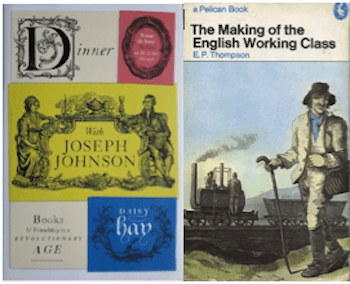
Reading Daisy Hay’s Dinner With Joseph Johnson: Books & Friendship in a Revolutionary Age, I came to the pages dealing with the contortions of William Pitt’s increasingly repressive administration in its attempts to shut down protest in the 1790s, particularly the recasting of the 1351 Act, which had made it a crime to ‘compass and imagine’ the death of the King, that is, to intend the death of the king, as it was commonly understood. ‘Pitt’s lawyers redefined it, so that an act of imagining alone became a crime. To commit treason one needed merely to have imagined the King’s death, not to have acted to advance it. Writing and speaking thus became treasonable.’ Since the government was appointed in the King’s name, any action which threatened ‘the security and stability of government legally constituted an attempt to “levy war” on the King himself. Political protest thus became treasonable by its very nature.’[1]

I was reminded, unsurprisingly, of a very much more recent decline and fall—but reminded  also of the first undergraduate essay I wrote on my History course, about the French Revolution or, rather, the domestic effects in this country of the dramatic events in France. The marker’s comments included the suggestion, I recall, that I try to refrain from running before I could walk (but also queried my use of the word ‘climactic’, about which I was right and they were wrong, not that I ever dwell on that at all). I’d read fairly widely, and, I suspect not unusually, the book I found most stimulating—and exciting—was E. P. Thompson’s The Making of the English Working Class. I didn’t make a habit of reading 900-page history books but made an exception for this one. At that time, Margaret Thatcher’s government tended to behave as though anything that couldn’t be measured, weighed and, ideally, made a profit from, didn’t exist, so I was strongly drawn to such sentiments as followed Thompson’s assertion that definitive answers to such a controversy as that over the effect on standards of living of the Industrial Revolution still evaded us. ‘For beneath the word “standard” we must always find judgements of value as well as questions of fact. Values, we hope to have shown, are not “imponderables” which the historian may safely dismiss with the reflection that, since they are not amenable to measurement, anyone’s opinion is as good as anyone else’s. They are, on the contrary, those questions of human satisfaction, and of the direction of social change, which the historian ought to ponder if history is to claim a position among the significant humanities.’

Still, the quotation most familiar to readers of the book, certainly the last few words of it, is the intention stated in the ‘Preface’: ‘I am seeking to rescue the poor stockinger, the Luddite cropper, the “obsolete” hand-loom weaver, the “utopian” artisan, and even the deluded follower of Joanna Southcott, from the enormous condescension of posterity.’ That last phrase is often quoted and recalled but sometimes as if it simply refers to the assumption that, coming later, we simply know and understand more. As Thompson notes further on, though, ‘for those who live through it, history is neither “early” nor “late”. “Forerunners” are also the inheritors of another past.’[2]


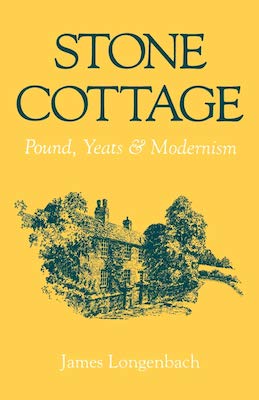
(James Longenbach, poet, teacher and fine scholar, died 29 July this year)

Tricky business, the past. That familiar quotation briefly conjured up another, William Faulkner’s ‘The past is never dead. It’s not even past’, which he puts into the mouth of one of his recurring characters, the lawyer (and occasional amateur sleuth), Gavin Stevens, in Requiem for a Nun. I noticed a few days ago how many literary anniversaries cropped up on 19 December: Constance Garnett’s ‘heroic life’ began at 11 a.m. on that day in 1861;[3] the French writer Colette was married to Henry de Jouvenel in 1912, a simple civil ceremony in the mairie of the sixteenth arrondissement: ‘Madame Colette Willy, woman of letters, notorious lesbian, bare-breasted music-hall star, and social pariah, was now the baroness de Jouvenel des Ursins, and the wife of one of Paris’s most influential political journalists.’[4] From Coleman’s Hatch the following year, Ezra Pound wrote to William Carlos Williams, in a letter that reads with great poignancy now: ‘I am very placid and happy and busy. Dorothy is learning Chinese. I’ve all old Fenollosa’s treasures in mss.’ And: ‘Have just bought two statuettes from the coming sculptor, Gaudier-Brzeska. I like him very much [ . . . ] We are getting our little gang together after five years of waiting.’[5] A little over seven months before German forces cross the Belgian frontier near a place called Gemmenich. . .

But I was thinking, particularly, of David Jones: poet, painter and, for a while, soldier, enlisted in the 15th (London Welsh) Battalion of the Royal Welsh Fusiliers. For two weeks, his battalion was billeted in farm outbuildings in Warne, a mile south of Rocquetoire, ‘all this time the cold rain continuing, more rain than in any December for 39 years.’ On 19 December they boarded ‘grey-painted London buses for La Gorgue, near Estaires.’ They were headed for the front line at Neuve Chapelle.


(David Jones via The Spectator)

‘In the trenches’, Thomas Dilworth wrote of Jones, ‘he became convinced that any distinction between past and present was superficial, accidental, largely unreal. History had not ended; it continued.’[6] In his  ‘Autobiographical Talk’ (1954), Jones said: ‘You see by what close shaves some of us are what we are, and you see how accidents of long past history can be of importance to us in the most intimate sense, and can determine integral things about us.’[7] Like other literary soldiers—Blunden, Sassoon, Ford, Graves among them—the war haunted his later life and writing, perhaps to a greater extent than most of the others. ‘Decades afterwards, a door slamming or a car backfiring would startle him back to the trenches. In distant thunder, he heard artillery.’[8]

Close shaves and roads not taken. Year’s end, year’s turning: there’s a strong tendency to look both forward and back, reviewing what’s past and anticipating, hoping or—increasingly, these days—dreading what’s to come. For some, such reviews have a tendency to ripple outwards, to include peripheral as well as central figures, the gone as well as the present, not only the dead but the lost, the ghosts of those still living, somewhere, but in places either no longer known to us or just inaccessible, for varied reasons: neglect, forgetfulness, estrangement – or those unexceptional divergences in the trajectories of all individuals’ lives. There in their hundreds, perhaps thousands: friends, colleagues, acquaintances, fellow students, fellow teachers, lovers, almost-lovers, antagonists, the watchers and the watched, the lives that touched us, held us, struck us, changed us, missed us by inches—or by a country mile. ‘If I thought I was not thinking about the past’, Deborah Levy wrote, ‘the past was thinking about me.’[9]


Yes. We are not only subjects but objects, not only observers but observed. That’s the sort of thing that can easily slip a person’s mind as they look about themselves, so much to see, so much to learn, so much to talk about, read about, write about, think about. Recounting his work on an illustrated history of exploration, an impossibly huge task, the contributions sent to his publishers routinely thousands of words too long, Eric Newby comments: ‘I had, and still have, the conviction that I must let the reader know if I discover anything interesting, and unfortunately so many things are interesting. At least they are to me.’[10]

Things certainly look grim just now – and have done this past year, three years, decade, steadily worsening. And not only individuals get lost. The things we—some of us—care about are under threat and under attack, some are already gone and we won’t be getting them back. But after all it isn’t after all, not yet all, anyway. We are still here, still there, the more energetic actively resisting while others, on occasion, discover something interesting, at least to us – and let others know.

So: a wave from the bunker to any passer-by. And, to various friends who, in Auden’s phrase, ‘show an affirming flame’: Joyeux Noël, Buon Natale, Feliz Navidad, Nadolig Llawen – and Happy Holidays.


Notes

[1] Daisy Hay, Dinner With Joseph Johnson: Books and Friendship in a Revolutionary Age (London: Chatto & Windus, 2022),

[2] E. P. Thompson, The Making of the English Working Class (1963; revised edition with new preface, Harmondsworth: Penguin Books, 1980), 485, 12, 648.

[3] Richard Garnett, Constance Garnett: A Heroic Life (London: Sinclair-Stevenson, 1991), 11.

[4] Judith Thurman, Secrets of the Flesh: A Life of Colette (London: Bloomsbury Publishing, 2000), 247.

[5] Letters of Ezra Pound, 1907-1941, edited by D. D. Paige (London: Faber and Faber, 1951), 65.

[6] Thomas Dilworth, David Jones in the Great War (London: Enitharmon Press, 2012), 62, 63, 93.

[7] In Epoch and Artist (London: Faber and Faber, 1973), 25.

[8] Thomas Dilworth, David Jones: Engraver, Soldier, Painter, Poet (London: Jonathan Cape, 2017), 54

[9] Deborah Levy, Things I Don’t Want to Know (London: Penguin Books, 2018), 162.

[10] Eric Newby, ‘Walking the Plank’, in Departures and Arrivals (London: Harper Collins, 1999), 39.

Frost, wine, hyacinth girls


(John William Buxton Knight, Old December’s Bareness Everywhere: Tate)

December: how is it? Bloody cold but sometimes, walking on frosty ground under chilled blue skies, the stark trees nodding as you go – quite beautiful. In December, I – what shall I say, what did I do? Walked, read, ate, drank, wrote a little. Bought and carried home, in fact, a Christmas tree, just this afternoon. The world, despite my repeated requests, did not cease to go to hell, barely paused, in fact. Thank all the gods there are for wine.

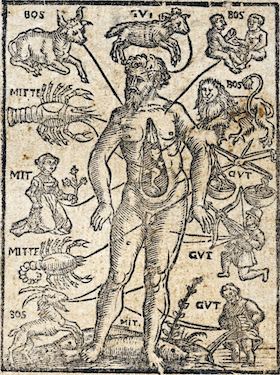
In December, ‘Melancholy and Phlegm much increase, which are heavy, dull, and cold, and therefore it behoves all that will consider their healths, to keep their heads and bodies very well from cold, and to eat such things as be of a hot quality.’[1] Ah, yes. Though millions of poor souls in Brexit Britain can only lament and reflect that the chance would be a damned fine thing, forced as they are to choose between eating and heating – and an increasing number able to do neither.


(He came, he saw, he. . .)

Do I still hold my breath when panting runners pass me on the paths in the park? Why yes, I do, but am immeasurably improved in other areas, a few other areas, one or two other areas. Item: dinner with the doyen of Ford Madox Ford studies, Professor Max Saunders, an excellent choice for my first foray into after-dark city streets in something approaching three years. Item: another foray—and another indoor event, though this one with neither wine nor sausages—to see Lyndall Gordon, whose books on T. S. Eliot and Emily Dickinson I’d read and admired, in conversation with Noreen Masud, lecturer in Twentieth-Century Literature at the University of Bristol.

The event was prompted by the publication of Gordon’s new book, The Hyacinth Girl: T. S. Eliot’s Hidden Muse, drawing heavily on the Emily Hale letters in Princeton’s Special Collections, which were finally made available to readers in January 2020. It was a fascinating conversation, not least because of the intelligent exchanges about how we approach those artists whose attitudes or language or assumptions, are sometimes unsettling—or worse—to modern sensibilities. Considering writers of a hundred or more years ago, well, frankly, that’s most of them. We can pick at this, blush at that, throw up our hands here—or just throw up there—and then, often, we just read the work or look at the picture or listen to the music and all that other stuff is, for however short or long a time, simply blown away.


(Emily Hale and T. S. Eliot via New York Times)

So the conversation was consistently interesting – but before it even started, Niamh Cusack read, wonderfully, The Waste Land. Oh, my. ‘That was a blast’, I said to the Librarian afterwards, ‘several times, I didn’t know whether to shout or cry.’ Nor did I. How many times have I read it, all of it, bits of it? I have no idea. Many lines were familiar enough for me to realise my lips were shaping the words along with the reader. At other times, it was completely unfamiliar, a voice from a cloud. ‘I’ve never heard it read by a woman before’, the Librarian remarked. An early chunk of ‘A Game at Chess’ seemed to have passed me by entirely. Echoes and repetitions heard as if for the first time spilled over me. When Niamh Cusack pronounced Sanskrit words, I could feel the Librarian’s gaze on me but steadfastly refused to meet it. I knew she was thinking of my own pronunciation, which I’d picked up from Charles Tomlinson when he read the poem to members of the English Department however many years ago – he explained that he’d been to a performance of sacred Indian music and made his way backstage to ask (as you do): ‘How would you pronounce this?’ It’s occurred to me since that, of course, there would probably be no one way to do so, any more than would be the case if individuals in Yorkshire and Cornwall (or Mississippi and New Jersey) were asked about pronunciation. But when the lines, ‘I think we are in rats’ alley / Where the dead men lost their bones’ cropped up, I was morally obliged to meet her gaze simply because that’s my stock answer to the question, in practically any context: ‘What do you think?’

What do I think? I think that I can’t remember when I last heard words read aloud which made it genuinely difficult for me to stay in my seat. There is something extraordinary about a poem that has been so much read, read about, explained, analysed, annotated, contextualised, parodied, worshipped and damned to within an inch of its life – still striking the ear like thunder, singing in the blood, chafing the nerves and knocking the pulses.

Art, yes, I’ve heard tell of it. Isn’t that the stuff that bears endless repetition because no two readings or viewings or listenings are the same? The cornucopia, the horn of plenty, the Holy Grail, in fact. You could go on long journeys and undergo all manner of ordeals and challenges, battle with ghosts and gods, move through enchanted chambers, withstand the amorous attentions of maidens of surpassing beauty, slay monsters – or you could simply take a book off the shelf (the right book for you, mind, the right book now, at this juncture).


By a knight of ghosts and shadows,
I summoned am to tourney
      Ten leagues beyond
      The wild world’s end –
Methinks it is no journey.

It is, of course. It is.

Notes

[1] Richard Saunders, Apollo Anglicanus, quoted by Bonnie Blackburn and Leofranc Holford-Strevens, The Oxford Companion to the Year (Oxford: Oxford University Press, 1999), 481.

Infinite presents


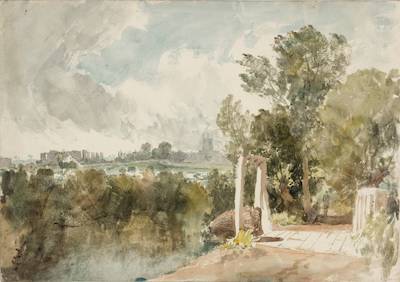
(J. M. W. Turner, A Church and Village seen from a Riverside Footpath: Tate)

I was thinking about—or idly musing upon—the infinite, arrived at by the usual wandering off footpaths. Decanting a packet of ground coffee into the regular tin, I was prompted by the resulting level to look at the net weight printed on the packet. It had lessened by some ten per cent, diminished by one-tenth (‘No, we haven’t put our prices up’). But then there has been, inevitably, a strong and widespread sensation of lessening, of shrinkage over the past few years. The narrowness of nationalist discourse, the closing of borders, the hostility to refugees and migrants, together with the pandemic, lockdowns, withdrawals either voluntary or enforced, now a metaphorical or literal huddling together against cold, hunger, discomfort, all in worsening weather.

Often placed against that diminishment are, precisely, ideas of freedom, expansion, movement through time and space. Art, then, or memory, or history, or imagination. Borders, walls, boundaries, limits of any kind set aside, evaded, vaulted over. The infinite – notions of which can swing to both positive and negative poles, depending on the viewer.

I thought of Ford Madox Ford recalling his ‘most glorious memory of England’, in the 1890s, hundreds of Jewish refugees from the Russian pogroms, landing at Tilbury Docks, falling on their knees and kissing the sacred soil of Liberty. ‘It was not of course because they were Jews or were martyrs. And I daresay it was not merely because England was my country. It was pride in humanity.’ But because of ‘an Order in Council’, that route would now be narrowed or blocked: ‘This then was the last of England, the last of London . . .’ And: ‘One had been accustomed to think of London as the vastest city in the world . . . as being, precisely, London, the bloody world!’ But now? ‘Ease then was gone; freedom was no more; the great proportions were diminished . . .’[1]


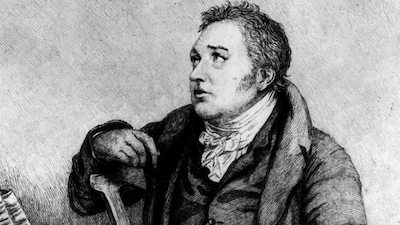
(Samuel Taylor Coleridge via the BBC)

One of the most famous instances of infinitude is that of Samuel Taylor Coleridge, in Chapter XIII of the Biographia, where he summarises his distinction between imagination and fancy: ‘The primary IMAGINATION I hold to be the living Power and prime Agent of all human Perception, and as a repetition in the finite mind of the eternal act of creation in the infinite I AM.’[2] This was one of the main targets of another, later, celebrated statement, by T. E. Hulme: ‘Here is the root of all romanticism: that man, the individual, is an infinite reservoir of possibilities’ – against which, Hulme’s version of the classical: ‘Man is an extraordinarily fixed and limited animal whose nature is absolutely constant. It is only by tradition and organisation that anything decent can be got out of him.’[3]

Hulme was primarily a philosopher – a poet only in miniature. I suspect that artists generally tend more towards embracing the positive than feeling repelled or threatened by the negative. ‘We must consume whole worlds to write a single sentence and yet we never use up a part of what is available’, James Salter wrote to Robert Phelps. ‘I love the infinities, the endlessness involved . . . ’[4] Laura Cumming, writing in praise of Jan Van Eyck, observed that: ‘His art is so lifelike it was once thought divine. But he does not simply set life before us as it is – an enduring objection to realism, that it is no more than mindless copying – he adjusts it little by little to inspire awe at the infinite variety of the world and our existence within it; the astonishing fact that it contains not just all this but each of our separate selves.’[5]

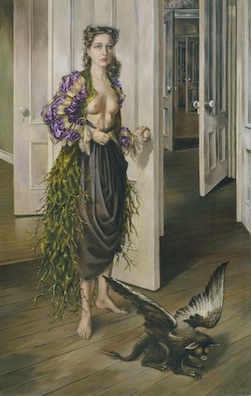
In an entry dated ‘[Saturday 24 November 1984]’, Annie Ernaux wrote: ‘One image haunts me: a big window wide open and a woman (myself) gazing out at the countryside. A springtime, sun-drenched landscape that is childhood. She is standing before a window giving onto childhood. The scene always reminds me of a painting by Dorothea Tanning – Birthday. It depicts a woman with naked breasts: behind her, a series of open doors stretch into infinity.’[6]


(Dorothea Tanner, Birthday (1942): Philadelphia Museum of Art)

Is that a wish to see the world, one’s personal world, as an unending series of opened doors? Or simply an observation, a belief, a conviction that this is how the world actually is, that much of what we assume to be fixed, unalterable, closed, finite, is nothing of the sort? Some observers, actors, participants, acknowledge the infinite nature of ideas, of the abstract but, certainly in specific circumstances—the Second World War, in the case of Ronald Duncan, pacifist and farmer—choose to turn away from them: ‘We were people used to dealing with ideas which are infinitely pliable, and for the first time were in contact with things which are rigid, brittle’, Duncan wrote. ‘Contact with things is infinitely more satisfying than contact with ideas. And if we are honest we must admit that few of us are capable of holding abstract conceptions in our heads. If we manage it, it gives us little pleasure. Somehow or other we have fallen into the rot of thinking that pigs and poetry are incompatible. They are not.’[7]

Pigs and poetry. Why, yes. In immediate postwar Sussex, Ford Madox Ford bred pigs and wrote poetry—A House (1921), Mister Bosphorus and the Muses (1923)—though, admittedly, the pigs died or had to be sold off at bacon prices when Ford and Stella Bowen moved to France. Staying in the realm of the abstract—or more abstract, at least, than pigs—I think of Sarah Churchwell, already author of a book on Fitzgerald and the world of Jay Gatsby, writing in 2018: ‘Gatsby’s famous ending, in other words, describes the narrowing of the American dream, from a vision of infinite human potential to an avaricious desire for the kind of power wielded by stupid white supremacist plutocrats who inherited their wealth and can’t imagine what to do with it beyond using it to display their dominance.’[8]

There are, though, different kinds of dominance, some more insidious than others, habits so ingrained as not to be seen any longer as habits, procedures so immediate, so automatic, so normalised as to seem – natural. Annie Ernaux has written of the worldwide web as ‘the royal road for the remembrance of things past’ and adds: ‘Memory became inexhaustible, but the depth of time, its sensation conveyed through the odour and yellowing of paper, bent-back pages, paragraphs underscored in an unknown hand, had disappeared. Here we dwelled in the infinite present.’[9]

The more I look at it, the more unsettling that final phrase is. . .

Notes


[1] Ford Madox Ford, It Was the Nightingale (London: Heinemann, 1934), 85-88.

[2] Samuel Taylor Coleridge, Biographia Literaria or Biographical Sketches of My Literary Life and Opinions, edited by James Engell and W. Jackson Bate (Princeton: Princeton University Press, 1984), I, 304.

[3] T. E. Hulme, ‘Romanticism and Classicism’, in Speculations: Essays on Humanism and the Philosophy of Art, edited by Herbert Read (Second edition, London: Routledge & Kegan Paul, 1936), 116.

[4] Memorable Days: The Selected Letters of James Salter and Robert Phelps, edited by John McIntyre (Berkeley, California: Counterpoint, 2010), 39.

[5] Laura Cumming, A Face to the World: On Self-Portraits (London: Harper Press, 2010), 13.

[6] Annie Ernaux, I Remain in Darkness, translated by Tanya Leslie (London: Fitzcarraldo Editions, 2020), 37-38.

[7] Ronald Duncan, All Men Are Islands: An Autobiography (London: Rupert Hart-Davis, 1964), 245, 226.

[8] Sarah Churchwell, Behold, America: A History of America First and the American Dream (London: Bloomsbury Publishing, 2018), 141. The earlier book was Careless People: Murder, Mayhem and the Invention of The Great Gatsby (2013).

[9] Annie Ernaux, The Years, translated by Alison L. Strayer (London: Fitzcarraldo Editions, 2019), 209-210.

Scholars and storytellers


(J. R. R. Tolkien: Reuters via The Guardian)

The incomparable Guy Davenport was born on 23 November 1927 (he died in 2005). I remember making some notes about him in connection with J. R. R. Tolkien some years back, when the company I worked for represented Cornell University Press. In 2013 the press reissued a book first published in 1979, six years after Tolkien’s death, a collection of pieces entitled J. R. R. Tolkien, Scholar and Storyteller: Essays in Memoriam. It included contributions from a wide range of friends, colleagues and former students. The first part contains the Times obituary; Tolkien’s 1959 ‘Valedictory Address’ to the University of Oxford; and a personal remembrance by a friend of forty years’ standing. The second part consists of critical essays concerned with the literatures of Old Norse, Old English and Middle English, Tolkien’s own main scholarly interests. The last part comprises three pieces on Tolkien’s famous fictions and concludes with a bibliography of his writings, compiled by Humphrey Carpenter (Tolkien’s biographer).[1]

‘The first professor to harrow me with the syntax and morphology of Old English,’ Davenport writes, ‘had a speech impediment, wandered in his remarks, and seemed to think that we, his baffled scholars, were well up in Gothic, Erse, and Welsh, the grammar of which he freely alluded to. How was I to know that he had one day written on the back of one of our examination papers, “In a hole in the ground there lived a hobbit”?’[2]


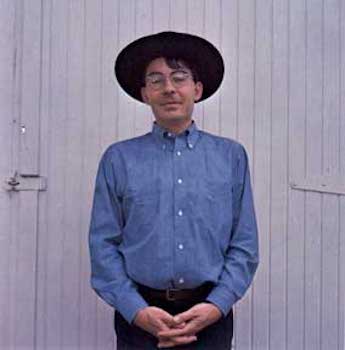
(One genius by another; or, Jonathan Williams’ photograph of Guy Davenport – ‘in Quakerish garb’ – Lexington, 1964: Portrait Photographs (London: Coracle Press, 1979).

After graduating from Duke University, Davenport was awarded a Rhodes Scholarship and studied at Merton College, Oxford, from 1948 to 1950. His thesis on James Joyce was directed by J. I. M. Stewart; his examiner was David Cecil. Davenport was drafted into the army on his return to the United States and served two years before taking a job at Washington University, St Louis. At Harvard, he worked as graduate assistant to Archibald MacLeish and wrote his dissertation, Cities on Hills, on the first thirty of Pound’s Cantos, under Harry Levin’s direction. It was published a little over twenty years later.

Davenport finished reading Lord of the Rings in March 1963, writing to Hugh Kenner that it was ‘a major work’. He went on: ‘What imagination! Never does his invention run out, on and on. I have a feeling that he has summed up 500 years of literature from the Mabinogion through Von Essenbach to the High Victorians. He has done well in prose what Spenser probably could not have finished in verse. It makes the “realistic” novel look like a skinned knee criss-crossed with band-aids.’[3]

In October 1963, Kenner was two-thirds of the way through the trilogy, remarking of the plans to reissue the work in paperback, ‘It could not fail to do good to anyone who read it through! one of the few books for which there is point in winning a larger public’ (I, 427). Davenport responded three days later: ‘I glow that you like Tolkien. He provides a vocabulary, both of phrases and imagery. Gandalf began life, in The Hobbit, as Sherlock [Holmes] in an astrologer’s gown. Frank Meyer [book review and cultural editor of National Review],[4] who is not uninfluenced in his fight with the Bolsheviki by Gandalf’s war upon the Orcs, got me onto Tolkien. [Stan] Brakhage heavily influenced by Tolkien, his other influence being Pound’ (I, 430)


In ‘Hobbitry’, Davenport noted that he’d talked to Tolkien’s son, Christopher—under whose steady hand the published Tolkien canon has expanded significantly—as well as to his friend ‘Hugo’ Dyson, who said of Tolkien, ‘His was not a true imagination, you know. He made it all up.’ ‘I have tried for fifteen years’, Davenport comments, ‘to figure out what Dyson meant by that remark.’ And he talked to a history teacher, Allen Barnett, who had been a classmate of Tolkien’s and remembered how he ‘could never get enough of my names of Kentucky folk. He used to make me repeat family names like Barefoot and Boffin and Baggins and good country names like that.’

Ah.

Tolkien’s readers run into millions, of course, the viewers of the films based on his books surely running into tens of millions by now. An intriguing if unanswerable question is what proportion of those readers and viewers have a sense of the main focus of his scholarly work.

 ‘Practically all the names of Tolkien’s hobbits are listed in my Lexington phone book’, Davenport writes, ‘and those that aren’t can be found over in Shelbyville.’ He concludes: ‘I despaired of trying to tell Barnett what his talk of Kentucky folk became in Tolkien’s imagination. I urged him to read The Lord of the Rings but as our paths have never crossed again, I don’t know that he did. Nor if he knew that he created by an Oxford fire and in walks along the Cherwell and Isis the Bagginses, Boffins, Tooks, Brandybucks, Grubbs, Burrowses, Goodbodies, and Proudfoots (or Proudfeet, as a branch of the family will have it) who were, we are told, the special study of Gandalf the Grey, the only wizard who was interested in their bashful and countrified ways.’


Notes

[1] J. R. R. Tolkien, Scholar and Storyteller: Essays in Memoriam, edited by Mary Salu and Robert T. Farrell (Cornell University Press, 9780801478871, 325pp, paperback).

[2] ‘Hobbitry’, in The Guy Davenport Reader, edited by Erik Reese (Berkeley: Counterpoint, 2013), 273.

[3] Questioning Minds: The Letters of Guy Davenport and Hugh Kenner, edited by Edward M. Burns, two volumes (Berkeley: Counterpoint Press, 2018), I, 287. I’ve lifted several details of Davenport’s biography from this superb edition.

[4] As Erik Reece, who knew Davenport well and is his literary executor, wrote, ‘And though he reviewed books for right-wing National Review, he did so simply because Hugh Kenner got him the job, not because he felt any allegiance to William F. Buckley or the conservative movement’: ‘Afterword, Remembering Guy Davenport’,  Reader, 440.

Files in the clouds


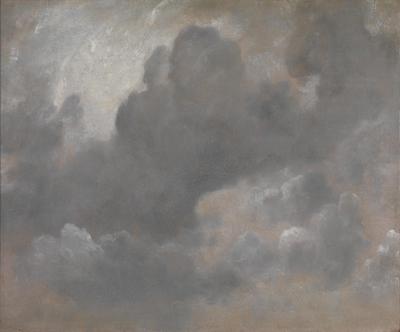
(John Constable, Cloud Study: Tate)

The double entry bookkeeping has been a complicated affair just lately; calculating the current balance, that is to say. A madman rushing downstairs yelling ‘All my data’s disappeared!’ was, I suppose, the climax, of a sort. ‘Don’t give yourself a heart attack’, the Librarian advised, adding as an afterthought: ‘Don’t give anyone else one either.’ I suspect I may not be entirely sound on the matter of clouds (data storage rather than weather). I am slowly rebuilding or making visible again a small empire of letters (including Letters). Or so I believe.

Three weeks ago, my phone died; the Librarian set wheels in motion, juggled SIM cards and chargers and I now have, again, a mobile phone that would not be unfamiliar to a consumer around 2013. A few days after the phone death, the lefthand lens of my expensive new glasses fell out. I made it to the optician eventually, the delay due to a bout of Benign Paroxysmal Positional Vertigo (yes) as well as rainfall of  deranged frequency and evangelical fervour. When the vertigo receded, a semi-deafness remained, which has made the last few days challenging and sometimes frankly mysterious. Another winter project.

On the other hand – ah well. But wait, yes, on the other hand, the US midterms – after the molten hell of 2016 and the depressing fiasco of 2019, anyone even remotely on the side of the angels will take ‘not as bad as expected’ as something of a triumph.

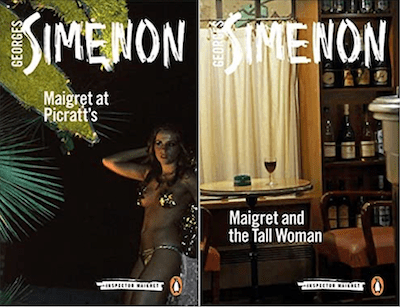
My reading was also zigzagging with fiendish indecision and smouldering bad temper, until I settled on a run of Penguin Maigrets. Monsieur Georges Simenon for a coherent fictional world and for uplift—‘It was one of those bleak days when you wonder what you’re on earth for in the first place and why you’re going to so much trouble to stay here’—perhaps not always for uplift.[1]


And after all, the weekend just gone: Somerset, good company, food and drink, the Librarian’s birthday, careful maintenance of a diplomatic distance between a young black Labrador and Harry the cat; fish and chips from Herbie’s at Lyme Regis, eaten on a bench on the Cobb. A cloudless day, dazzling blue, the harbour like a millpond – it all changed later but we’d had our visit by then and the sky and sea could do what they liked. Nothing else, in any case, could go wrong after the run of recent delights—except that I had an odd message thanking me for reporting my debit card stolen. Scam, obviously, a message to be immediately deleted. Then an email from someone with whom I have a direct debit arrangement, saying they’d been unable to collect payment. Information that I parked somewhere behind my left ear while we sat in the gardens above the front at Lyme Regis, drinking hot chocolate.

And now we are home, while the rain reliably descends and Harry the cat has no reason to throw up (not being on the back seat of a car) and my reading assumes its usual chaotic character. Finally picking up the phone to call about my lost card, which was not after all sitting on my desk as I’d confidently claimed, I learn that a new card has already been ordered and will be with me soon. The only narrative that makes sense is that I dropped the card on Friday when I was collecting the car, that someone picked it up and handed it in at the nearby branch of my bank rather than running up fantastic bills from online or contactless purchases. I was reminded of Ford’s writing, in The Good Soldier, ‘The instances of honesty that one comes across in this world are just as amazing as the instances of dishonesty.’[2]

As for that data: the crucial files now seem to be in three or four places, cloudbound and deskbound. Are some of them just duplicates? Could one or more versions be safely deleted? Who knows? Will I be putting it to the test? Of course not. . .


Notes

[1] Georges Simenon, Maigret at Picrat’s (1951; translated by William Hobson, London: Penguin Books, 2016), 23.

[2] Ford Madox Ford, The Good Soldier: A Tale of Passion (1915; edited by Max Saunders, Oxford: Oxford University Press, 2012), 34.

Out, brief candles

(Joseph Wright of Derby, Firework Display at Castel Sant’Angelo: Birmingham Museums Trust)

Walking to the Victorian cemetery, we pass a spent rocket on the pavement. I thought briefly of Mr Leopold Bloom on Sandymount shore, Gerty MacDowell leaning far, far back to watch the fireworks in the night sky and the, ah, stimulated Mr Bloom having to recompose ‘with careful hand’ his wet shirt. ‘My fireworks. Up like a rocket, down like a stick.’[1] The morning after Guy Fawkes’ Night: on the previous evening, we travelled the one hundred and twenty metres to a bonfire in the park. ‘People’, the Librarian reminded me, ‘you’re among people.’ True enough. Several hundred of them, in fact. But it was all in the open air and the only physical contact with a stranger was with the large dog that took a liking to my right leg. Positioned painfully near two young males of the species, the Librarian remarked that ‘boys are horrible’. I know, I said, I used to be one. After a slow start, the flames took a firm hold, climbed, threw glowing embers high into the air. Guy Fawkes. Of course, the effigies burned on the fires used to represent the Pope or various prominent Catholics, while, half a century before Mr Fawkes’ indiscretion, Mary Tudor, Bloody Mary, devoted a fair bit of energy, in her five-year rule as Queen of England, to the immolation of Protestants. One of the Oxford martyrs burnt at the stake in 1555, Hugh Latimer, is supposed to have said to another, Nicholas Ridley (the third was Thomas Cranmer, Archbishop of Canterbury): ‘Be of good comfort, and play the man, Master Ridley; we shall this day light such a candle, by God’s grace, in England, as I trust shall never be put out.’ 

Candles, ah, literary candles: Wilfred Owen, D. H. Lawrence, Virginia Woolf, Aldous Huxley, Josephine Tey, Ford Madox Ford. . .

(Matthias Stom, An Old Woman and a Boy by Candlelight: Birmingham Museums Trust)

‘Do you happen to know Haydn’s symphony? . . . It is a piece that begins with a full orchestra, each player having beside him a candle to light his score. They play that delicate, cheerful-regretful music of an eighteenth century that was already certain of its doom. . . As they play on the contrabassist takes his candle and on tiptoe steals out of the orchestra; then the flautist takes his candle and steals away . . . .The music goes on—and the drum is gone, and the bassoon . . . and the hautbois, and the second . . . violin. . . . Then they are all gone and it is dark. . . .’[2]

Well, yes. ‘For it is not unusual in human beings who have witnessed the sack of a city or the falling to pieces of a people, to desire to set down what they have witnessed for the benefit of unknown heirs or of generations infinitely remote; or, if you please, just to get the sight out of their heads.’[3]

Ford wrote that even before the outbreak of the First World War, long before our current malaise, with—on bad days—its irrefutably apocalyptic tinge. Still, on a later occasion, there’s this: ‘But I couldn’t keep on writing. I was obsessed with the idea of a country, patrie, republic, body politic, call it what you will[ . . .] Yes: I had a vision of a country.’[4]

It is often, to be sure, hard to keep on writing. Still – a vision of a country. Some people look back in search of it, others look forward, while a good many others clearly don’t care or, contrary to that Dylan song, really do need a weatherman to know which way the wind blows. Emerging reluctantly from the fictional worlds of P. G. Wodehouse and Kate Atkinson,[5] I find the political landscape essentially unchanged. (I’m reminded that one of Atkinson’s Jackson Brodie novels is called When Will There Be Good News? No answer is required, as they say.) Perhaps, after the destructive antics of Boris Johnson and the deranged flurry of Liz Truss, some hard-pressed members of the public—even members of the so-called Conservative party—experienced a fleeting frisson of relief that there was now an unelected, right-wing multimillionaire in 10 Downing Street, poised to announce massive cuts in public spending. But in any case he fell at the first hurdle, with his appalling cabinet appointments or reappointments, squandering his one clear chance in sordid little deals; then at the second hurdle of the climate emergency, the subsequent scuffles and scrambles all profoundly unconvincing.

It’s odd that so many of the people who recur obsessively to the Second World War and the defeat of Nazism now seem not to notice or to care that countries long held up as beacons of freedom and democracy are a heartbeat away from – what’s the current phrase, ‘post-fascism’? Leaving aside the worrying recent developments in Sweden, Italy and Israel, the United States is clearly at a crisis point, on the verge of knowing for sure whether or not its two hundred and fifty year old experiment with democracy has effectively ended. Here, the Home Secretary – a scandalous appointment, then a more scandalous reappointment – channels the sort of malignant rhetoric which refugees from Hitler’s regime would find only too familiar, while the Public Order Bill, designed to limit the right to protest to such an extent that it’s effectively removed altogether, might, with trifling revisions in wording, sit quite happily in the legislative registers of China, Iran or Putin’s Russia.

Ah well. If there was settled weather for a while, it is changed and changing now, for sure. As they have it in the Scottish play:

Banquo: It will be rain tonight.
First Murderer: Let it come down.
(They fall upon Banquo)


Notes

[1] James Joyce, Ulysses (1922; London: The Bodley Head, revised edition, 1969), 482, 483.

[2] Ford Madox Ford, Provence (London: Allen & Unwin, 1938), 261.

[3] Ford Madox Ford, The Good Soldier: A Tale of Passion (1915; edited by Max Saunders, Oxford: Oxford University Press, 2012), 12.

[4] Ford Madox Ford, No Enemy (1929; edited by Paul Skinner Manchester: Carcanet Press, 2002), 132.

[5] Kate Atkinson’s long novel, Life After Life (London: Transworld, 2014), is centrally concerned with bearing witness, as several characters—and the author herself—make clear: Ursula (472), Miss Woolf (457-458), ‘Author Note’ (618).

Parrot or Bevan; or, wagging the beards

(D. H. Lawrence)

‘Please compress your last dozen unwritten—or unpublished—blog posts, into a single phrase.’

I think I’d be tempted to go with what are often referred to as D. H. Lawrence’s last words, (which they weren’t, though pretty close to the end): ’This place no good.’[1] He was referring to the Ad Astra sanatorium in Vence, of course. And he was referring to something much wider, of course. I would be referring, not to this house—last refuge of common sense and sweet reasonableness that I can truly rely on—but to the wider world that is being laid waste, particularly this country, where we live and love among the ruins that these dreadful people have reduced us to, are reducing us to. Here, at any rate, we are. Where is that? Phrases like ‘post-apocalypse’ and, yes, ‘among the ruins’ occur more often that they should, possibly because I’ve been reading Lara Feigel’s hugely impressive book on D. H. Lawrence,[2] possibly because I keep getting glimpses of the daily news.

I was reminded somehow (somehow) of Hugh Kenner’s letter to Guy Davenport (13 October 1967). They’d been discussing the name of the couple in whose house Ludwig Wittgenstein had died: was it Parrot or Bevan? Davenport was quoting the 1958 memoir by Norman Malcolm, Kenner citing the viva voce testimony of artist and writer Michael Ayrton. Kenner wrote: ‘Ayrton is in Chicago for 10 days (opening a show) but on his return I shall press him re discrepancies between Parrot and Bevan. Maybe, being English, they spell it Bevan but pronounce it Parrot. He did confirm Parrot the other day.’[3]

(For those not familiar with some of the oddities of English pronunciation of names, try Featherstonehaugh, Auchinlech, Marjoribanks, Woolfhardisworthy or Cholmondley.)[4]

(The Reverend Francis Kilvert – including beard)

But I digress – old joke, shared among Fordians, Ford’s ‘digressions’ generally being anything but – yes, of course. Yesterday I was thinking of the Reverend Francis Kilvert, writing in October 1873: ‘This morning I went to Bath with my Father and Mother to attend the Church Congress Service at the Abbey at 11. When I got to the West door a stream of fools rushed out crying, “No room, you can’t get in!” I knew they were liars by the way they wagged their beards and as this crew of asses rushed out we rushed in and after waiting awhile worked our way up the north aisle till we reached the open transept and got an excellent place near the pulpit.’[5]

He shows here an impressive confidence in discerning the purveyors of untruths. He himself was undeniably bearded, and there was, clearly, an illegitimate manner in which beards were wagged. ‘But’, as Olive Schreiner once remarked, ‘there is another method.’ Kilvert, no doubt, had the key to it. Or perhaps God—conventionally assumed, certainly then, to resemble a man with a beard—sympathised and  helped out a little.

Schreiner had discussed the two methods by which ‘[h]uman life may be painted’, ‘the stage method’ in which characters were ‘duly marshalled at first and ticketed; we know with an immutable certainty that at the right crises each one will reappear and act his part, and, when the curtain falls, all will stand before it bowing.’ And there is, she admits, ‘a sense of satisfaction in this, and of completeness.’ Then: ‘But there is another method—the method of the life we all lead. Here nothing can be prophesied’ and ‘[w]hen the curtain falls no one is ready.’[6]

(Olive Schreiner, via the Irish Times)

It’s an argument for a greater realism, for a narrative reflecting more recognisably the ordinary human experience, echoed, if only in part, by a great many writers subsequently. Perhaps it leans far enough towards ‘mere life’ that the conscious artist might wonder where he or she actually comes in; but, in any case, the talk of stages and footlights and curtains certainly imply that she has in mind Thackeray’s Vanity Fair (1847-8), which begins ‘Before the Curtain’ and ends: ‘Come children, let us shut up the box and the puppets, for our play is played out.’[7]

The attitude to fiction exemplified by that beginning and that conclusion also exercised Ford Madox Ford – on more than one occasion and over some thirty years. He wrote in his ‘Dedicatory Letter’ to Last Post: ‘I have always jeered at authors who sentimentalised over their characters, and after finishing a book exclaim like, say, Thackeray: “Roll up the curtains; put the puppets in their boxes; quench the tallow footlights” . . . something like that.’[8] The following year, in his book on the English novel, he remarked of Thackeray that he ‘must needs write his epilogue as to the showman rolling up his marionettes in green baize and the rest of it’.[9] His final book had a final jab: ‘But what must Mr. Thackeray do but begin or end up his books with paragraphs running: “Reader, the puppet play is ended; let down the curtain; put the puppets back into their boxes. . . ”’[10]

(James Elder Christie, Vanity Fair: Glasgow Museums Resource Centre)

Ford’s main criticisms of Thackeray (and other English novelists) were, firstly, that they were always interpolating moral apothegms or making sly comments about their characters; and secondly, that they committed these, and other misdemeanours while eschewing serious consideration of literary techniques because those were foreign, in short, because they were often too concerned with demonstrating that they were, in the first and most important place, English gentlemen.

I sometimes suspect a bastard version of this in the current, and recent, political situation. Anybody who offers intelligent, knowledgeable or insightful criticism of government policies on the economy, defence, immigration, education, health, social care or, indeed, just about anything else, is termed, by Conservative politicians, commentators, right-wing media hacks, opaquely-funded think tanks and the rest as ‘unpatriotic’ or ‘un-English’ or ‘doing the country down’. Irony-hunters – look no further.

Most of these characters—‘this crew of asses’—are, of course, clean-shaven – but, I suspect, would not have fooled the Reverend Kilvert for a moment.

Notes

[1] At the end of a letter to Maria Huxley [21 February 1930], in The Letters of D. H. Lawrence, Volume VII: November 1928-February 1930, edited by Keith Sagar and James Boulton (Cambridge: Cambridge University Press, 1993), 651.

[2] Lara Feigel, Look! We Have Come Through!: Living with D. H. Lawrence (London: Bloomsbury Publishing, 2022).

[3] Questioning Minds: The Letters of Guy Davenport and Hugh Kenner, edited by Edward M. Burns, two volumes (Berkeley: Counterpoint Press, 2018), II, 948. It was in fact at the home of Dr Edward Bevan and his wife Joan, as detailed in Ray Monk’s Ludwig Wittgenstein: The Duty of Genius (London: Vintage, 1991), 576ff.

[4] Examples from the often invaluable Schott’s Original Miscellany, by Ben Schott ((London: Bloomsbury, 2002), 17.

[5] Kilvert’s Diary, edited by William Plomer, Three volumes (London: Jonathan Cape, 1938, reissued 1969). Volume Two (23 August 1871–13 May 1874), 381.

[6] The Story of an African Farm (1883, under the name Ralph Iron; new edition, Chapman & Hall, 1892), vii-viii.

[7] William Makepeace Thackeray, Vanity Fair: A Novel without a Hero (1848; edited by John Carey, London: Penguin Books, 2003), 5, 809.

[8] Ford Madox Ford, Last Post (1928; edited by Paul Skinner, Manchester: Carcanet Press, 2011), 4-5.

[9] Ford Madox Ford, The English Novel (London: Constable, 1930), 7 (with its slight amendments, this followed the American edition of the previous year).

[10] Ford Madox Ford, The March of Literature: From Confucius to Modern Times (London: Allen & Unwin, 1939), 587.

Passing by – or bypassing

(Unknown Artist, Two Figures Roll Out a Scroll of Paper with a Landscape Design on It, Watched by a Third: Wellcome Collection)

‘Any good news?’
‘There’s a goldfinch singing in the tree in the garden.’
‘Any bad news?’
(Unrolling forty-foot long scroll): ‘Where should I begin?’

A weird couple of weeks, my daughter’s text read. You might well say so. A new monarch and a new Prime Minister. Mutterings, stray black ties, then confirmation that London Bridge had, indeed, fallen. Some things since then, I gather, have gone extremely well, as smoothly as many years of rehearsals and preparations and a large wad of public money could make them; others seem be going extraordinarily badly. It was sobering, for instance, to hear of people threatened with arrest for being in charge of blank sheets of paper, not so long after British expressions of outrage and disbelief at the same phenomenon on the streets of Putin’s Moscow. By degrees, quite reasonable displays of decorum and respect began lapsing into absurdity: the often excruciating media coverage was predictable, perhaps less so some of the cancellations and closures: football matches, kids’ fun runs, bicycle racks, condom vending machines, guinea pig awareness week. . .

Since then, we’ve had the unedifying spectacle of a government clearly in hock to the fossil fuel industry, now augmented by the reckless vandalism proposed, first, by the latest Secretary of State for Business, Energy and Industrial Strategy, perhaps the most preposterous appointment in an era notorious for such appointments; second, a frankly disgusting mini-budget, focused solely on shovelling yet more money into the hands of those already stinking of the stuff. Never fear, the proles will pay. And their progeny, of course, unto the second or third generation.

The weather has changed, most evidently the early mornings: Harry the cat exchanging the briefest of greetings with the outside air before drifting back upstairs to the bedroom while I pull the back door discreetly shut; and the butter harder to spread. I note with just a touch of disquiet that the next Nicolas Freeling book I shall read—and here a footnote to ‘good news’, three Van der Valk novels in the nice green Penguin jackets—is titled Gun before Butter.


And there was The Queue. I read that a quarter of a million people chose to queue for many hours to pass the Queen’s coffin. Millions more watched the television for hours, although at least as many millions, probably more, got on with their lives in various other ways. As for The Queue: I’ve read explanations of the several credible reasons for people being there but, though Elizabeth II had been on the throne for almost the whole of my life and my mother died at much the same age as the Queen, the one never reminded me of the other (nor was there any grandmotherly resemblance) and I feel no need for a version of ‘something larger than myself’ that involves a huge crowd – the sight of one, even on a screen, still brings me out in a rash. And I am, anyway, I suppose, of the sizeable constituency that admired and respected the late Queen for the way she fulfilled her role while believing that the role itself was past its sell-by date and that this should really be the juncture at which the whole issue is debated, from the ground up (especially from the ground up). But I suspect that substantial elements of the country are neither willing nor able to engage with such matters.

In the Victorian cemetery where we walk, we skirted a wedding in full swing when we were there a while ago, a mass of people on the steps of the building, anyway: cameras, hats, smart clothes, excited chatter. A little earlier on that same afternoon, a funeral had, I think, just finished. We were passing what seemed to be the aftermath of a wake, two or three staff in the late stages of tidying the outdoor venue, sweeping up, rearranging tables and benches. And that near-miss was probably funeral enough for me for a while.

I was, I recall, rather more exercised by the possibility that I’d confused, at some stage, Norman MacColl, editor of the Athenaeum, with Dugald Sutherland MacColl, painter, critic and Keeper of prestigious galleries (the Tate and the Wallace Collection), but also wanting to check on that other connection between moonrise and ‘Henri Beyle who wrote as Stendhal’. Was I in fact thinking of Stonehenge in another context? Fairly specialised concerns, to be sure, but then a lot of people have interests that would fall under that heading for a majority of passers-by.

That’s the crucial point about passers-by, of course. They pass by. As do I, in a great many circumstances, as do I.

Toiling optimists

(Thomas Fenwick, Late Autumn Landscape: University of Edinburgh)

A new month, the first of the meteorological autumn. On 2 September 1774, the naturalist Gilbert White observed that: ‘Many birds which become silent about Midsummer reassume their notes again in September; as the thrush, blackbird, wood-lark, willow-wren, &c.; hence August is by much the most mute month, the spring, summer, and autumn through. Are birds induced to sing again because the temperament of autumn resembles that of spring?’[1] Birds here, particularly the bluetits, are certainly singing, though a little warily. Still, who would not be wary just now?

The trees in the parks had already been misled into thinking that autumn had arrived. The weather generally has dried again, with a warm, slightly unhealthy feel to the breeze. The constants remain. . . constant – that is, the workmen, still, after months, making those thunderous noises of drilling and hammering that you associate with the beginnings of a job like that, not the late stages. Surely by now it should be no louder than the seductive murmur of a paintbrush on skirting-board or garden fence, the feathering of a soft broom, the occasional faint squeal of a cloth on clean glass. As well as the workmen, of course, the howl of ambulance sirens and the relentless overhead roar of damned aeroplanes, each one shaving just a little more off the lifespan of homo sapiens on this earth.

As for the news—from time to time, the Librarian, referencing the late Leonard Cohen just a little too appositely, will inquire, in passing: ‘You Want It Darker’? My response is most often ‘God, no!’ while, inside my mildly floundering but at-straw-grasping mind, another refrain runs: ‘It’s not dark yet but it’s getting’ there.’[2] Really, monsieur D.? Not there yet? O, optimist! But that was, of course, twenty-five years ago, which can make all the difference in the life histories of failed states.


What do you find to boast of in our age,
To boast of now, my friendly sonneteer,
And not to blush for, later? By what line
Do you entrain from Mainz to Regions saner?
Count our achievements and uplift my heart;
Blazen our fineness. Optimist, I toil
Whilst you crow cocklike.

So Ford Madox Ford began a poem, ‘Canzone à la Sonata’, dedicated to ‘E. P.’, that is, Ezra Pound, then in Giessen, the German town in which Ford stayed while pursuing a madcap scheme to secure a divorce from his wife under German law by qualifying for citizenship of that country. It was the setting for the famous ‘Giessen roll’, Ford diving headlong to the floor and writhing about in agony in response to the archaisms in Pound’s new collection of poems. The poem’s title indicates its target: ‘canzone’, a poetic form, not a style. It guys, as Ford often did, the conventional picture of the inspired and youthful lyric poet, and queries the price of exclusion paid by the optimistic singer. His inquiring ‘By what line/ Do you entrain from Mainz to Regions saner’ alludes to the poetic line but also employs an image that Ford would recur to often: the use of the railway journey as intersection of illusory stability, permanence, stasis and radical circumstantial alteration, whether in personal relationships or the larger configurations of history. Indeed, a poem called ‘In the Train’ occurs four pages earlier than ‘Canzone’ in the published volume, High Germany. By early 1912, in fact, Ford was perfectly aware of the threat from Germany, though his own history of involvement with that country was already immensely complicated and soon to become more so.


Optimist –  so many shades of meaning, interpretation, claim or confession there. People with their glasses half-full, half-empty – surely, just order another drink, to be on the safe side. The word defines not only individuals but eras: ‘It is difficult to think of an important Edwardian optimist’, Samuel Hynes wrote. ‘So that if “Edwardian” is to be used as an adjective identifying a literary tone, that tone must be one of social awareness and anxious concern.’[3]

More positively, it can evoke recovery, rebuilding, resurgence. Doris Lessing, remembering her arrival in Britain in the early 1950s, wrote: ‘There was still that post-war effervescence, the feeling that suppressed energies were exploding, the arrival of working-class or at least not middle-class talent into the arts, and, above all, the political optimism, which has so completely evaporated.’[4] More upbeat too was Margery Allingham’s view of her detective, Albert Campion, seeing in that extraordinary individual the virtues of the ordinary man (which, of course, enabled him to perform the feats of detection and deduction that qualified him to serve as her central character): ‘The optimism of a healthy mind is indefatigable, however, and as time went on even Campion began to see the events here recorded from that detached distance so often miscalled true perspective.’[5]

I am, of course, keeping my own optimism firmly within bounds: a true perspective in a healthy mind, as they say. Possibly.


Notes

[1] Gilbert White, The Illustrated History of Selborne (London: Macmillan, 1984), 94.

[2] Bob Dylan, ‘Not Dark Yet’, Track 7 on Time Out of Mind (1997).

[3] Samuel Hynes, ‘Introduction: A Note on “Edwardian”’, in Edwardian Occasions: Essays on English Writing in the Early Twentieth Century (London: Routledge & Kegan Paul, 1972), 8.

[4] Doris Lessing, Walking in the Shade (1997; London: Fourth Estate, 2013), 280.

[5] Margery Allingham, Death of a Ghost (London: Penguin Books, 1942), 176.

Striding, gliding, sliding into autumn

(Utagawa Hiroshige, Sudden Shower at Shōno: Metropolitan Museum of Art)

‘She can’t be completely stupid’, the Librarian says, in a rare moment of optimism, ‘she went to Oxford.’ And for a moment I almost wish I could find in that a good knockdown argument. Alas.

The heat, which changed many individual patterns of behaviour, was succeeded by several days of rain, which didn’t, and then by something balanced, pleasant, relaxing – or it would have been had the workmen in the neighbouring house, who have been there for months now, not chosen one morning to drill directly into my head. They showed too a remarkable willingness to persist, to graft, I suppose, thus refuting the latest reports of the witless witterings of—good grief!—the odds-on favourite for the leadership of the Conservative Party and thus, under our generally nineteenth-century political arrangements, Prime Minister of the United Kingdom of Great Britain and Northern Ireland.

Upstairs—and sometimes downstairs too—I bother archivists, occasionally in this country but far more often in the United States. The happy result of this is that, even as I pour a drink in the evening, goods news sometimes arrives from the Midwest or the west coast. An archivist has unearthed a previously unlisted letter from Ford Madox Ford to a publisher, a literary agent, a New York hostess, a budding author. I scrawl a message of heartfelt gratitude. Librarians and archivists may yet save the world.

Downstairs, I linger over Robert Lowell, Lafcadio Hearn and Mary Midgley. Dear Cal is of course his usual unfailingly cheerful self and emphatically not a daddy’s boy. ‘He was a man who treated even himself with the caution and uncertainty of one who has forgotten a name, in this case, his own.’[1] Hearn shuns the usual ragbag of common sense and scepticism by numbers: ‘I hold that the Impossible bears a much closer relation to fact than does most of what we call the real and the commonplace.’[2]

And Mary Midgley—I remember, a few years back, seeing an interview with, or brief statement from, the Green Party Brighton MP Caroline Lucas and Sophie Walker, then leader of the Women’s Equality Party. I found myself thinking, quite explicitly, My God! If we had people like that in charge of this country, there might be some hope. It wouldn’t be the complete bloody basket-case it is. Mary Midgley was a person like that: hugely intelligent, well-informed, intellectually curious. I read her memoir because my curiosity was piqued by the highly enjoyable volume by Benjamin Lipscomb, The Women Are Up To Something: How Elizabeth Anscombe, Philippa Foot, Mary Midgley, and Iris Murdoch Revolutionized Ethics (New York: Oxford University Press, 2022),[3] one of those valuable books which, like those of the wonderful Sarah Bakewell, are able to convince me—at least while I’m reading them—that I understand philosophy.


Midgley discusses, at one point, the idea that thought, like life, occurs in complex patterns, linked together, which have to be sorted out and dealt with on their merits. ‘This does not mean that our work is impossibly complicated. It does not mean that we cannot know anything until we know everything. Human cultures contain all sorts of convenient ways of breaking up the world into manageable handfuls and dealing with one part at a time. And we can keep continuously developing these ways so that they can correct one another. In this way, quite a lot of the time we do get things right. Attending to the background pattern of questions and answers does not tip us into a helpless relativism. But it is perfectly true that this approach does stop us hoping for a universal scientific formula underlying all thought. We cannot, as Descartes hoped, find a single path to infallible certainty. But then luckily we do not need to.’

Indeed. I confess, though, that one of my favourite moments in the book is an account of a discussion group which included Carmen Blacker, later a distinguished Japanese scholar. ‘It was Carmen who supplied me with the best example I have ever met of the diversity of moral views. When I raised the topic of conflicting customs, “Oh, I see”, she said. “Like, there’s a verb in classical Japanese which means to try out one’s new sword on a chance wayfarer?”’ Midgley later used this in an article with that name.[4]

Light rain, the faintest murmuring, and a soft soughing in the branches and leaves above the fence. Harry the cat is crouched at the open back door, snuffing up late August early evening English air. He has noticed, I think, that my method of serving his teatime bowl approximates more and more to that of Henry James’s butler, as recalled by Ford Madox Ford:

‘His methods of delivery were startling. He seemed to produce silver entrée dishes from his coat-tails, wave them circularly in the air and arrest them within an inch of your top waistcoat button. At each such presentation James would exclaim with cold distaste: “I have told you not to do that!” and the butler would retire to stand before the considerable array of plate that decorated the sideboard.’[5]

We are sliding into autumn. There is an acknowledged cost-of-living crisis. But then, come to that, there is a crisis in every area of public life, from education to social care, from farming to transport, from library provision to news media to the raw sewage fouling our coastal waters. Given our current electoral system, there’s little we can do at present: turn down the heating a degree or two, hope for a mild winter—and do our level best to resist trying out new swords on chance wayfarers.


Notes

[1] Robert Lowell, Memoirs, edited with a preface by Steven Gould Axelrod and Grzegorz Kosc (Faber & Faber 2022), 18.

[2] Lafcadio Hearn, ‘The Eternal Haunter’, in Japanese Ghost Stories, edited by Paul Murray (London: Penguin Books, 2019), 33.

[3] Benjamin J. B. Lipscomb, The Women Are Up To Something: How Elizabeth Anscombe, Philippa Foot, Mary Midgley, and Iris Murdoch Revolutionized Ethics (New York: Oxford University Press, 2022).

[4] Mary Midgley, The Owl of Minerva: A Memoir (London: Routledge, 2007), 72, 160.

[5] Ford Madox Ford, Return to Yesterday (London: Gollancz, 1931), 14.