Rules of the Game

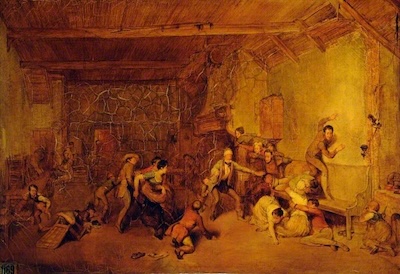
(David Wilkie, Blind Man’s Bluff: Sheffield Museums)

Sunshine, breeze. People walking or taking their dog for a walk or taking their phone for a walk, so intent upon that small screen that they will likely miss the apocalypse which, given the current derangements, may be sooner than expected and certainly sooner than hoped.

Oddly—or perhaps not—several features of recent and current news bring to mind Gilbert Murray’s The Stoic Philosophy. This was the Conway Memorial Lecture, delivered at South Place Institute, 16 March 1915, and published in volume form later that year.

Murray (1866-1957) is less well-known these days but was for many years an extremely familiar name in some circles: from 1908-1936 he was the Regius Professor of Greek at Oxford, and a very prolific translator and interpreter of ancient Greek literature and philosophy, particularly drama. He published almost a hundred books in all, including at least thirty volumes of translation and another twenty of classical studies. Born in Sydney, Australia, he came of an Irish Catholic family and was a consistent supporter of Irish Home Rule. His ashes are interred in Poets’ Corner, Westminster Abbey
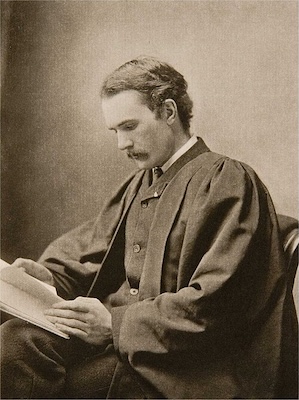
(Gilbert Murray)

He crops up several times in Ford Madox Ford’s letters in the period of the First World War, once as a signatory (one of 52) of a public letter, which appeared in The Guardian on 18 Sept. 1914, ‘British Authors and the War’, subheaded ‘Allies’ Righteous Cause’, setting out why the signatories supported Britain’s engagement in the war. His name was one of six which appeared both there and among the fifty signatories of another letter more than six years later, also published in The Guardian (1 Jan. 1921) but in several other newspapers also: ‘The State of Ireland. An Urgent Appeal for Mediation. Manifesto by the Arts and Professions’, a protest against the current policy being pursued in Ireland by the British government,[1] or, as Margaret Cole remembered it: ‘a propaganda campaign against the Black-and-Tans and the English occupation of Ireland’.[2]

The Stoic Philosophy is not a long book—a little more than 50 pages of Murray’s text, plus appendices and the Chairman’s introduction—and appeared at a serious historical juncture, just six months into the war which did not end war. It deals with major issues: philosophy, religion, history, the nature of matter, of reality: nevertheless, it seems to have been Murray’s comment on the 4th century BCE philosopher Zeno’s response to questioners that stuck in my head. Zeno of Citium is a major player here, being the founder of the Stoic philosophy, and Murray likens his strategy to that of the Duke of Wellington, when dealing with a subaltern who appears sceptical of the ageing Duke’s story, concerning an occasion during the Peninsula War when his servant opened a bottle of port and found that it contained a rat. The subaltern suggests that it must have been a very large bottle and the Duke retorts that it was ‘a damned small bottle’. The subaltern then comments that it must then have been a very small rat. The Duke replies that it was ‘a damned large rat’. ‘And there’, Murray concludes, ‘the matter has rested ever since.’[3]

Still, rats aside, there is plenty of interest in a relatively small space. Murray remarks of Zeno that ‘[t]he time of his coming is certainly significant. It was a time when landmarks had collapsed, and human life was left, as it seemed, without a guide’.

And: ‘Two questions lay before him—how to live and what to believe. His real interest was in the first, but it could not be answered without first facing the second. For if we do not in the least know what is true or untrue, real or unreal, we cannot form any reliable rules about conduct or anything else’ (22-23). And, towards the end: ‘Life becomes, as the Stoics more than once tell us, like a play which is acted or a game played with counters. Viewed from outside, the counters are valueless; but to those engaged in the game their importance is paramount. What really and ultimately matters is that the game shall be played as it should be played’ (50).

The game – or The Game. This does not mean—or need not mean—life viewed as trivial or to be taken lightly. It points towards a recognition of rules, of recognized forms and formations, though the outcome, the result—at, so to speak, the final whistle—is, of course, always the same.

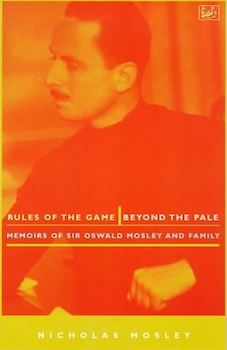
I remind myself that the first volume of the novelist Nicholas Mosley’s Memoirs of Sir Oswald Mosley and Family was Rules of the Game (the second was Beyond the Pale).

In the year of Murray’s lecture, Sigmund Freud was thinking about literature, particularly fiction: ‘It is an inevitable result of all this that we should seek in the world of fiction, in literature and in the theatre compensation for what has been lost in life. There we still find people who know how to die – who, indeed, even manage to kill someone else. There alone too the condition can be fulfilled which makes it possible for us to reconcile ourselves with death: namely, that behind all the vicissitudes of life we should still be able to preserve a life intact. For it is really too sad that in life it should be as it is in chess, where one false move may force us to resign the game, but with the difference that we can start no second game, no return-match. In the realm of fiction we find the plurality of lives which we need. We die with the hero with whom we have identified ourselves; yet we survive him, and are ready to die again just as safely with another hero.’[4]

In literature, and the arts generally, of course, you may break the rules of the game (once you have established to your own satisfaction what they actually are) without inflicting serious harm on others: while the same cannot confidently be said of politics, psychiatry, medicine or physics. Nor need its implications end with, or be restricted to, the human. In No More Parades, Ford Madox Ford has Christopher Tietjens thinking ‘good-humouredly’ about his official religion: God the great English landowner; Christ, an almost too benevolent land steward, son of the owner; the Third Person of the Trinity the spirit of the estate, ‘the Game, as it were, as distinct from the players of the Game.’[5]
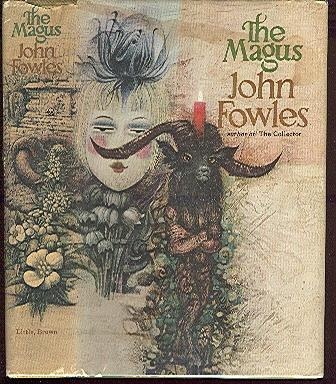

An element of the game occurred also to John Fowles when, with the figures of Heraclitus and Pascal hovering about his shoulders, he wrote of what he sometimes termed the Godgame (working title of his novel The Magus): ‘Put dice on the table and leave the room; but make it clear to the players that you were never there before you left the room.’[6]

The first task is to identify the rules of the game, the second to understand them or, perhaps, to understand what understanding in this context might amount to. Or is it, before all else, to confirm that it is in fact a game? Or is the attempt to confirm that itself the game?

Perhaps a little early in the day for such philosophical demands – or stoicism in the face of such questions. Barely one coffee in – and many hours away from an aperitif. . .

But a supplementary question must be: what of those who ignore the rules of the game or fail to understand them or whose ego obscures too much of the world, the people in it, their motives for what they do or say or fail to do or say?
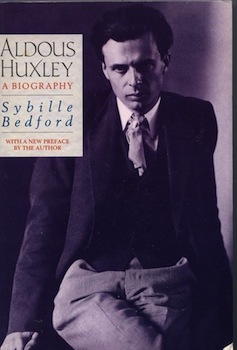

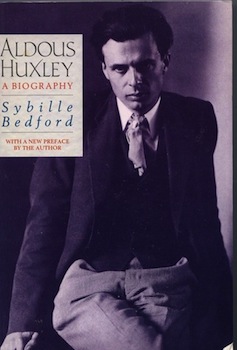
Sybille Bedford related the story of Aldous Huxley aboard a ship when, off North Borneo, a sailor was threatening to run amok with a dagger. While the ship’s officers conferred and the passengers stood huddled together, Huxley reflected on ‘the precarious artificiality of all that seemed most solid and fundamental in our civilization, of all that we take for granted. An individual has only to refuse to play the game of existence according to the current rules to throw the rule-observing players into bewildered consternation . . .
‘They are appalled, they are at a loss, they are helpless.’[7]

We have moved on from that, of course – and from more than the dagger, we fondly hope.


Notes

[1] The other five signatories to both letters were Arnold Bennett, G. K. Chesterton, Jane Harrison, Arthur Quiller-Couch and May Sinclair

[2] Margaret Cole, Growing Up into Revolution (Longmans, Green & Co, 1949), 83.

[3] Gilbert Murray, The Stoic Philosophy (New York: The Knickerbocker Press, G. B. Putnam’s Sons, 1915), 24-25.

[4] Sigmund Freud, ‘Thoughts for the Times on War and Death’ (1915), in Civilization, Society and Religion, edited by Albert Dickson (London: Penguin Books, 1991), 79.

[5] Ford Madox Ford, No More Parades (1925), edited by Joseph Wiesenfarth (Manchester: Carcanet Press, 2011), 96.

[6] John Fowles, The Aristos (London: Pan Books, 1968), 21-22.

[7] Sybille Bedford, Aldous Huxley: A Biography (Two volumes, 1973; one volume edition, with a new preface, London: Pan Macmillan, 1993), 173.

On the other hand


There was, is, a saying:
‘Till April is dead
Change not a thread’

Perhaps less a suggestion to heavy users of social media than a body blow to personal hygiene. All Fools’ Day, I finally troubled to find out, is of French origin, the poisson d’avril—April fish—persons to be hoaxed or have a cardboard fish attached to their backs or simply to be sent on some ridiculous errand. The April fish, because of its abundance in that month, is the mackerel – and the French maquereau also meaning ‘pimp’, occasional complications, or extensions of the idea, were always likely to arise.[1]

‘Whan that Aprille with his shoures soote’ or no, rather, as has been very often quoted of late, ‘the cruellest month’. Some days begin well enough. After breakfast, sitting at the kitchen table with Wodehouse or Lawrence or Mary Wollstonecraft (‘more tea, Mary?’), the cat at the back door or already upstairs again, sprawled on the bed with the Librarian, who is speaking French back at her iPad or looking at her timetable, clouds on the breezier days moving, steadily stately galleons, above the trees and houses, maybe the quick crossword done, even a sentence written that stays written.

But the news is always there, whether just arriving or already waiting. The worst is still from Ukraine, of course, the continued targeting and murder of civilians, and names that will not be forgotten by historians of atrocity: Borodyanka, Bucha, Mariupol, Kramatorsk.

‘Far from his illness’, W. H. Auden wrote of W. B. Yeats, ‘The wolves ran on through the evergreen forests’.[2] To those deluged in grief or fighting for their lives, it’s often shocking that things go on elsewhere – perhaps not as normal, or as before, but they go on. Apsley Cherry-Gerrard, youngest member of Scott’s second Antarctic expedition, who had gone to the war with his health still shaky, was invalided out of the army with what was eventually diagnosed as ulcerative colitis. While men died in their hundreds of thousands on the other side of the channel, Cherry found himself, in 1916, alone in the family home for the first time. ‘There, in the stillness behind the high yew hedge, he watched the oaks and beeches flower and observed the progress of a family of robins nesting in the willow. He noted the arrival of a hen sparrowhawk, and listed the species of tits hovering around the fruit trees. It was a stay against the chaos of the war, and he absorbed himself in the smallness of his garden while the world went mad.’[3]

A few months after the end of that war, Aldous Huxley—who had, in fact, volunteered but was, inevitably, rejected on health grounds because of his famously poor eyesight, following a serious infection years before—wrote to his brother Julian: ‘great events are both terrifying and boring, terrifying because one may be killed and boring because they interfere with the free exercise of the mind—and after all, that freedom is the only thing in the world worth having and the people who can use it properly are the only ones worthy of the least respect: the others are all madmen, pursuing shadows and prepared at any moment to commit acts of violence. The prospects of the universe seem to me dim and dismal to a degree.’[4]

Well, yes. On the other hand – there are goldfinches in our garden. . .


Notes

[1] Bonnie Blackburn and Leofranc Holford-Strevens, The Oxford Companion to the Year (Oxford: Oxford University Press, 1999), 140, 142-143.

[2] Auden, ‘In Memory of W. B. Yeats (d. Jan. 1939)’, W. H. Auden, The English Auden: Poems, Essays and Dramatic Writings, 1927-1939, edited by Edward Mendelson (London: Faber, 1977), 241.

[3] Sara Wheeler, Cherry: A Life of Apsley Cherry-Gerrard (London: Jonathan Cape, 2001), 185.

[4] Aldous Huxley, Letters of Aldous Huxley, edited by Grover Smith (London: Chatto and Windus, 1969), 173-174

A vast quantity of letters (and a counting pony)

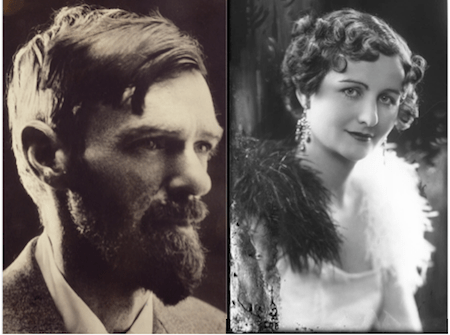
(D. H. Lawrence/ Nancy Mitford: both © National Portrait Gallery)

In a letter partly about letters, Nancy Mitford wrote to Hamish Erskine on 24 October 1932: ‘The others have all gone off to a circus but I remain here by the fire & with D. H. Lawrence’s letters. Terrible to have reached an age (or a stage) when one would rather hear about a pony counting to 9 with its foot than bother to go & see it do so. Lawrence’s letters are terrifying – would you read them if I sent them to you? But they must be read – all & carefully or no use & there is a vast quantity of them.’ Mitford added a postscript: ‘The children are back – the pony counted to 20 AND LAUGHED OUT LOUD. Well well.’[1]

That selection of Lawrence’s letters, edited by Aldous Huxley, had appeared the previous month and was reprinted before the end of the year. It was certainly a hefty volume, coming in at almost 900 pages, though Mitford’s ‘vast quantity’ would be thrust into sharp perspective fifty years on by the Cambridge edition of the letters, which increased Huxley’s 790 items by a factor of more than 7, added invaluable annotations and restored the excisions which Huxley had made—‘cutting out feeling-hurting passages, uninteresting bits and things which are repeated in several letters to different people . . . tho’ it’s often worth keeping repetitions because of the subtle variations’.[2] Understandably, he felt he needed to tread a little warily since his edition was appearing only two years after Lawrence’s death at the early age of 44. Huxley had first proposed to Frieda Lawrence that they produce a memorial volume, ‘reminiscences by various people interspersed with Lawrence’s own letters’, offering (‘this goes without saying’) to do whatever work was involved for nothing. But the idea ‘petered out’.[3]


Lawrence and Huxley had met in 1915, apparently at the home of Lady Ottoline Morrell. She suggested to Lawrence that the two of them should get to know one another and Lawrence wrote to Huxley a week or so later, inviting him to tea.[4] They met again in the mid-1920s and Huxley was very important to the Lawrences in the last years of Lawrence’s life.[5]

If, like Orwell, Huxley was not a great novelist—Brave New World and Island, like Animal Farm and 1984, tend to be viewed as fables or satires rather than ‘straight’ novels—he was certainly a significant writer and an extraordinarily interesting figure: Sybille Bedford’s great affection for him is made wholly understandable in her biography of him. 

A year into the First World War—he was then 21—Huxley wrote a letter to a family friend of the Huxleys, the concert violinist Jelly d’Aranyi: ‘This war impresses on me more than ever the fact that friendship, love, whatever you like to call it is the only reality.’ He went on: ‘You never knew my mother—I wish you had because she was a very wonderful woman’ (Julia Huxley had died in 1908). ‘I have just been reading again what she wrote to me just before she died. The last words of her letter were “Dont be too critical of other people and ‘love much’”–and I have come to see more and more how wise that advice was. It’s a warning against a rather conceited and selfish fault of my own and it’s a whole philosophy of life.’[6]

Certainly, that advice—if not always easy to follow—is, yes, not bad. Really not bad at all.


Notes


[1] The Letters of Diana Mitford, edited by Charlotte Mosley (London: Hodder & Stoughton, 1993), 51. To a Guy Davenport reader, the counting pony can only recall the typing dog that caused the Stan Brakhage–Joseph Cornell contretemps: see ‘Pergolesi’s Dog’ in Davenport’s Every Force Evolves a Form (Berkeley: North Point Press, 1987), 144-146.

[2] To Dorothy Brett, 10 March 1931: Letters of Aldous Huxley, edited by Grover Smith (London: Chatto and Windus, 1969), 346-347.

[3] Sybille Bedford, Aldous Huxley: A Biography (London: Pan Macmillan, 1993), 235.

[4] Letters of D. H. Lawrence II, June 1913–October 1916, edited by George J. Zytaruk and James T. Boulton (Cambridge: Cambridge University Press, 1981), 452, n.2  and 467-468.

[5] David Ellis, D. H. Lawrence: Dying Game, 1922-1930 (Cambridge: Cambridge University Press, 1998), 312, and later instances indexed.

[6] Huxley, Letters, 83.

Differences and pretexts

Crows

To his brother Julian, two months after the end of the First World War, Aldous Huxley wrote that freedom ‘is the only thing in the world worth having and the people who can use it properly are the only ones worthy of the least respect: the others are all madmen, pursuing shadows and prepared at any moment to commit acts of violence. The prospects of the universe seem to me dim and dismal to a degree.’[1]

The Guardian recently reported the results of a poll jointly conducted by academics from Cardiff University and the University of Edinburgh. They found that a majority of voters in England, Wales and Scotland surveyed ‘believe that the possibility of some level of violence against MPs is a “price worth paying” in order to get their way on Brexit’: of the Leave voters who took part in the study, this was true of 71% in England, 60% in Scotland and 70% in Wales. And all this just a little more than three years after the murder of MP Jo Cox by an extreme right-wing terrorist who shouted ‘Britain first!’ Perhaps even more depressing, the majority of remain voters also felt that the risk of violence towards MPs was worth it if it meant the United Kingdom would stay in the EU – 58% in England, 53% in Scotland and 56% in Wales.

(As a cheering footnote, voters overwhelmingly felt that the potential destruction of the country’s farming and fishing industries would also be a price worth paying for getting the result they wanted in the Brexit negotiations.)

https://www.theguardian.com/uk-news/2019/oct/24/majority-of-voters-think-violence-against-mps-is-price-worth-paying-for-brexit

To-West-Bay-Trees

‘The point to be made about the GREAT TRADE ROUTE’, Ford Madox Ford wrote to E. C. Cumberlege of Oxford University Press on 27 October 1936, ‘is that it is not the book of a meditative gentleman who stands before ruined temples and pours mournful soliloquies on old unhappy things, but as it were the testament of a man usually of action who has spent a long life not only on writing and study but on digging, editing, carpentry, cooking, small holding, fighting both literally and metaphorically and in every kind of intrigue that could advance what he considers to be the cause of good letters…’[2]

Great Trade Route was published by Oxford in January 1937 (and by Allen and Unwin in the United Kingdom). ‘But no sort of civilization is possible’, Ford writes there, ‘when difference of opinions can be considered a pretext for murder . . . or even for physical violence.’[3]

A good many political and social commentators have lately been asking: ‘What sort of country do we want to be?’ Or, perhaps more realistically: ‘What sort of country has this become?’ The answer to the first question must be: better than this. And the second? It’s complicated – at least, we hope so.


Notes

[1] Letters of Aldous Huxley, edited by Grover Smith (London: Chatto and Windus, 1969), 173-174.

[2] Ford Madox Ford, Letters of Ford Madox Ford, edited by Richard M. Ludwig (Princeton: Princeton University Press, 1965), 264.

[3] Ford Madox Ford, Great Trade Route (London: Allen & Unwin, 1937), 291.

‘A large expensive audience’; or Charity begins at Lady Sibyl’s home

Eliot  aldous-huxley


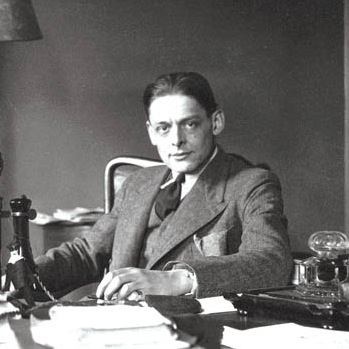
Exactly one hundred years ago today, there was a poetry reading, in aid of charity, held at the home of Lady Sibyl Colefax, later a highly successful interior decorator. Those taking part included Aldous Huxley, the actress and later playwright Viola Tree (daughter of Herbert Beerbohm Tree), Robert Nichols, T. S. Eliot and the Sitwells.

In a letter to his mother, some ten days later, Eliot told her: ‘I assisted in a poetry reading last week at the house of some rich person for the benefit of something. A hundred and fifty people were induced to pay 10/6 each, so it was rather a rich audience. Edmund Gosse presided, and a number of “young poets” of whom I believe I was the oldest, read. It was rather amusing, as the audience and most of the poets were very solemn, and I read some light satirical stuff, and some of them didn’t know what to make of it.’[1]

The broad-backed hippopotamus
Rests on his belly in the mud;
Although he seems so firm to us
He is merely flesh and blood.

Flesh and blood is weak and frail,
Susceptible to nervous shock;
While the True Church can never fail
For it is based upon a rock.

Forty years later, reading at Columbia, Eliot remarked: ‘This is a poem which I originally read, I remember, at a poetry reading for the benefit of some Red Cross affair with Sir Edmund Gosse in the chair, and he was profoundly shocked. On the other hand, the late Arnold Bennett liked it better than anything I’d written up to the time of his death, and kept asking me to write “another Hippopotamus.”. . . it’s the only poem of mine which I’ve any reason to suppose that James Joyce ever read.’ Eliot also read ‘A Cooking Egg’ at the charity event and, as Richard Aldington mentions in his autobiography, the poem’s  mention of Sir Alfred Mond provoked ‘a rumpus in the audience’, as Lady Mond ‘sailed indignantly out of the room’.[2]  (In fact, Joyce parodied The Waste Land in a letter to Harriet Weaver; and also wrote of it  in a notebook, ‘T. S. Eliot ends idea of poetry for ladies.’)[3]

Viola-Tree
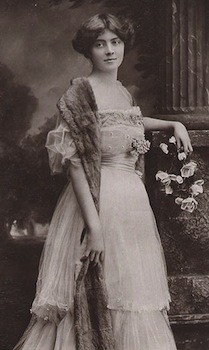
(Viola Tree)

Aldous Huxley was a little more expansive about the evening, in a letter of 13 December 1917 to his brother Julian. ‘I spent a strange day yesterday in town—being a performing poet for the sake of charity or something before a large expensive audience of the BEST PEOPLE. Gosse in the chair—the bloodiest little old man I have ever seen—dear Robbie Ross stage-managing, Bob Nichols thrusting himself to the fore as the leader of us young bards (bards was the sort of thing Gosse called us)—then myself, Viola Tree, a girl called McLeod and troops of Shufflebottoms, alias Sitwells bringing up the rear: last and best, Eliot. But oh—what a performance: Eliot and I were the only people who had any dignity: Bob Nichols raved and screamed and hooted and moaned his filthy war poems like a Lyceum villain who hasn’t learnt how to act: Viola Tree declaimed in a voice so syrupy and fruity and rich, that one felt quite cloyed and sick by two lines: the Shufflebottoms were respectable but terribly nervous: the Macleod became quite intoxicated by her own verses: Gosse was like a reciter at a penny reading. The best part of the whole affair was dinner at the Sitwells’ afterwards’.[4]

Nichols was one of the earliest war poets to achieve significant success. He was friends with both Graves and Sassoon—and Huxley, subsequently—and was close at hand when D. H. Lawrence died in March 1930 (Sybille Bedford prints his long letter to Dr Henry Head in her biography of Huxley).[5] Nichols’ poetry hasn’t lasted too well, unable as he was to evade the grip of the poetic conventions of the period even under the unprecedented pressures of the war.

They are bringing him down,
He looks at me wanly.
The bandages are brown,
Brown with mud, red only—
But how deep a red! in the breast of the shirt,
Deepening red too, as each whistling breath
Is drawn with the suck of a slow-filling squirt
While waxen cheeks waste to the pallor of death.
O my comrade![6]

Nichols

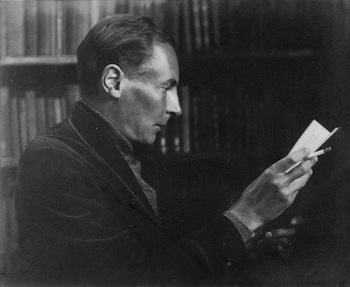
(Robert Nichols)

Aldous Huxley, on the other hand, is barely known as a poet even to those familiar with his novels and essays, though his first four published books were all volumes of poetry. While at Oxford, Robert Graves commented in a letter to Siegfried Sassoon, he had seen ‘a lot of the Garsington people [Lady Ottoline Morrell’s house] who were charming to me, and of the young Oxford poets, Aldous Huxley, Wilfred Childe and Thomas Earp – exceptionally nice people but a trifle decayed, as you might say.’[7]

In the previous year’s The Burning Wheel, Huxley—albeit a trifle decayed—had written ‘A Canal’:

No dip and dart of swallows wakes the black
Slumber of the canal: —a mirror dead
For lack of loveliness remembered
From ancient azures and green trees, for lack
of some white beauty given and flung back,
Secret, to her that gave: no sun has bled
To wake an echo here of answering red;
The surface stirs to no leaf’s wind-blown track. . .[8]

Garsington would loom larger for Sassoon a few months later when he went to consult Philip and Ottoline Morrell and ask their advice about his intended protest. Sassoon’s famous statement followed soon after his meeting in London with Bertrand Russell and Middleton Murry. Psychiatric treatment with W. H. R. Rivers at Craiglockhart—and a meeting with the young Wilfred Owen—beckoned.

References

[1] Valerie Eliot and Hugh Haughton, editors, The Letters of T. S. Eliot. Volume I: 1898–1922, revised edition (London: Faber and Faber, 2009), 240-241.

[2] The Poems of T. S. Eliot. Volume I: Collected and Uncollected Poems, edited by Christopher Ricks and Jim McCue (London: Faber & Faber, 2015), 43, 521, 510. Aldington, Life for Life’s Sake (London: Cassell, 1968), 204.

[3] Richard Ellmann, James Joyce, new and revised edition (Oxford: Oxford University Press, 1983), 572, 495.

[4] Aldous Huxley, Letters of Aldous Huxley, edited by Grover Smith (London: Chatto and Windus, 1969), 141.

[5] Sybille Bedford, Aldous Huxley: A Biography (London: Pan Macmillan, 1993), 225-228.

[6] Robert Nichols, ‘Casualty’, in Robert Giddings, The War Poets (London: Bloomsbury, 2000), 84.

[7] Letter of 26 March 1917: In Broken Images: Selected Letters of Robert Graves, 1914-1946, edited by Paul O’Prey (London: Hutchinson, 1982), 66-67.

[8] See Bedford, Aldous Huxley, 67.

Carrington and the Quangle-Wangle

Brett_Carrington_Hiles

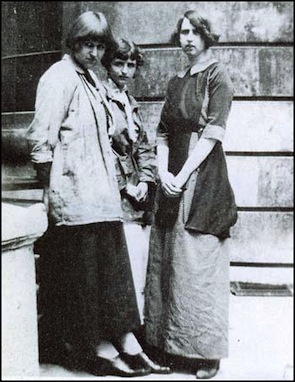
Carrington, Barbara Hiles, Dorothy Brett, 1911: http://spartacus-educational.com/ARTbrett.htm

To Dorothy Brett, 1 December 1918, Aldous Huxley wrote: ‘I saw Carrington not long ago, just after the armistice, and thought her enchanting; which indeed I always do whenever I see her, losing my heart completely as long as she is on the spot, but recovering it as soon as she is no longer there. We went to see the show at the Omega, where there was what I thought an admirable Gertler and a good Duncan Grant and a rather jolly Vanessa Bell. Carrington and I had a long argument on the fruitful subject of virginity: I may say it was she who provoked it by saying that she intended to remain a vestal for the rest of her life. All expostulations on my part were vain.’[1]

Aldous Huxley and Dora Carrington spent time together at Lady Ottoline Morrell’s Garsington Manor, sleeping on the roof when the heat indoors became unbearable. ‘Strange adventures with birds, and peacocks, and hordes of bees. Shooting stars, other things.’[2] There’s little doubt that Huxley made use of Carrington when creating the character of Mary Bracegirdle in Crome Yellow. To Gerald Brenan in December 1921, Carrington remarked on the character, adding: ‘But it’s a book which makes one feel very very ill. I don’t advise you [to] read it.’[3]

Huxley-Dorothy-Wilding-NPG

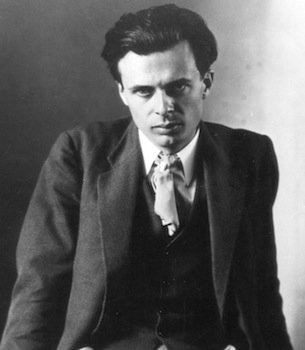
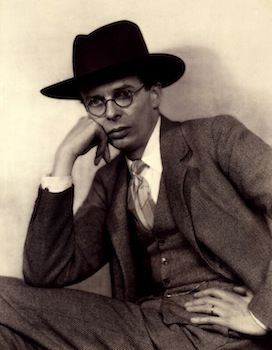
Aldous Huxley by Dorothy Wilding, © National Portrait Gallery, London. Probably not the right hat, then: ‘In later years he wore no hat—except occasionally a French beret—but then he still sported a black hat with a very large brim indeed, to all effects a sombrero. “Here”, the St John Hutchinson’s young children would cry when they saw his long form ambling up their garden path, “Here comes the Quangle-Wangle!”’[7]

In January 1919, Carrington experienced what her biographer terms ‘a disturbing dream about a furtive encounter with the creator of the virginal “Mary Bracegirdle” which took place in her mother’s house, only weeks after her father’s death’.[4] Carrington wrote to Strachey: ‘Such a nightmare last night, with Aldous in bed. Everything went wrong, I couldn’t lock the door; all the bolts were crooked. At last, I chained it with a watch chain to two nails. Then I had a new pair of thick pyjamas on and he got so cross because I wouldn’t take them off and they were all scratchy. Everything got in a mess, and he got so angry, and kept trying to find me in the bed by peering with his eye-glass, and I thought all the time how I could account to my mother for the mess on my pyjamas!’[5] 

Carrington, Dora, 1893-1932; Spanish Boy, the Accordion Player

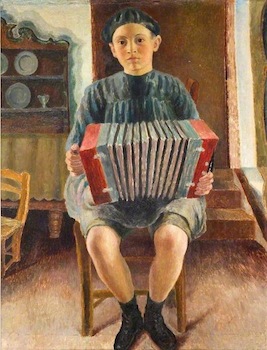
Carrington, Spanish Boy, the Accordion Player, c.1924. (Photo credit: The Higgins Art Gallery & Museum, Bedford)

Carrington’s tendency to make such vivid impressions on those she met meant that confronting fictional versions of herself was a not infrequent ordeal. Gilbert Cannan’s Mendel: A Story of Youth (1916), dedicated to ‘D. C.’, had been a rather more brazen affair, drawing with little disguise on Carrington’s relationship with Mark Gertler: ‘How angry I am over Gilbert’s book! Everywhere this confounded gossip, and servant-like curiosity. It’s ugly, and so damned vulgar. People cannot be vulgar over a work of art, so it is Gilbert’s fault for writing as he did. . . . ’[6]

Carrington-Letters

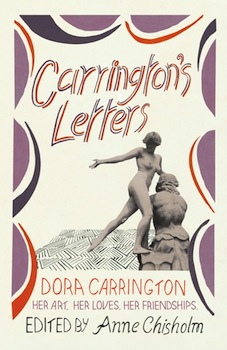
Lively stuff. The new collection of Carrington’s letters, edited by Anne Chisholm, biographer of Nancy Cunard and Frances Partridge, came out last week. We should finally get to the bookshop in the next few days and secure a copy. Somebody in the house is expecting it for Christmas. Apparently.

References

[1]  Letters of Aldous Huxley, edited by Grover Smith (London: Chatto and Windus, 1969), 172.

[2] To Lytton Strachey, August 1916, Carrington: Letters and Extracts from her Diaries, chosen and with an Introduction by David Garnett (New York: Holt, Rinehart and Winston, 1971), 35.

[3] Carrington: Letters and Extracts from her Diaries, 200.

[4] Gretchen Gerzina, Carrington: A Life of Dora Carrington, 1893-1932 (London: John Murray, 1989), 141.

[5] Carrington: Letters and Extracts from her Diaries, 127.

[6] Carrington to Gertler, 1 November 1916, in Mark Gertler, Selected Letters, edited by Noel Carrington (London: Rupert Hart-Davis, 1965), 254.

[7] Sybille Bedford, Aldous Huxley: A Biography (London: Pan Macmillan, 1993), 127.


Acts of Attention

Vermeer-Lacemaker

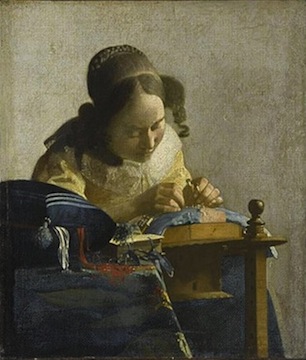
(Johannes Vermeer, The Lacemaker)

Concentration: the focusing of all one’s attention; the keeping of the mind fixed on something.

Towards the end of the first year of the Great War, Friday 16 July 1915, Vera Brittain noted in her diary, ‘I find it very difficult to read just now, especially fiction; the immense realities of the present crowd in upon my mind, making concentration almost impossible & fictitious events quite trivial.’[1]

The present certainly offers plenty of ‘immense realities’—not all of them likely to foster optimism—though I’m not finding it difficult to read. Still, concentration is a little trickier these days. There’s the matter of intensity; but also the question of duration. The rate at which I read varies wildly—a crime novel, however good, demands a different kind of attention from, say, The Anathemata of David Jones—but on average, if I manage a hundred or a hundred and fifty pages in a day, that’s pretty good going. Yet I remember—how many years ago?—reading a Dickens novel, perhaps Little Dorrit or Our Mutual Friend, and reading four hundred or four hundred and fifty pages in a day.

So I seem to have lost that ability to stick to a single task, a single object of interest, for that length of time; but, of course, this is in large part because of the various distractions that can break my concentration and the habits I’ve lapsed into of allowing myself to be distracted.

Still, when I read of people who go crazy after eight hours without a phone, or who check their texts or emails every five minutes, a hundred and fifty times a day, I feel entirely dissociated from such patterns of behaviour. I’m not so easily distracted, am I? Just how often do I check the damned thing? In any case, here, sitting by the back door, reading, yes, Michel Leiris (‘Like many men, I have made my descent into Hell, and like some, I have more or less returned from it’),[2] my attention is caught—too easily caught—by a movement outside. And I mean this as a serial event: wind in the leaves, birds on the fence or on the bird table or, perhaps, this—neither a bird nor a plane:

Cat-tree

That cat—the visiting cat—is absurdly prone to distraction: a leaf, a fly, a cloud, gulls passing overhead, any of these will do. We have confidently diagnosed ADHD or the feline version of it. Yet, come to think of it, such behaviour has become typically human.

I was remembering—and getting almost right, from memory—an early passage in Aldous Huxley’s Island, when Will Farnaby, hearing the mynah bird utter its one-word message—‘Attention’—yet again, turns to Doctor MacPhail:

“Attention to what?” he asked, in the hope of eliciting a more enlightening answer than the one he had received from Mary Sarojini.
“To Attention,” said Dr MacPhail.
“Attention to attention?”
“Of course.”[3]

Paying attention: a transaction. We hand over a portion of ourselves and receive in return—what? It varies, of course, but, ideally, an addition, an augmentation, an enlargement of the self. Colette lamented that ‘We do not look, we never look enough, never attentively enough, never excitedly enough.’[4] What is enough? As John Ames, the narrator of Marilynne Robinson’s Gilead, observes, ‘This is an interesting planet. It deserves all the attention you can give it.’[5]

Not that it is simply a question of giving it attention. Don Gifford recalled the tale of Thoreau’s young friend Ellery Channing being reduced to tears because, as he himself admitted, ‘he knew so little about what merited recording that he returned home from his nature walks day after day with an empty notebook.’[6] And Robert Richardson writes of Thoreau ‘eagerly’ reading Ruskin and Gilpin, ‘whose work starts from the often ignored fact that the uneducated eye simply does not notice most of what is in front of it. Until our attention is called to this detail or that feature, we rarely scrutinize our surroundings, “in the full, clear sense of the word, we do not see.”’[7]

EstruscanPlaces

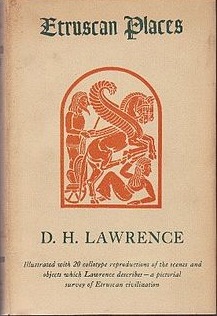
Attention at such a pitch is sometimes seen as a sacramental act: the Latin root of the word means an oath or a pledge. Of Leopold Bloom in Joyce’s Ulysses, Declan Kiberd observes, ‘To each and every detail of the surrounding world he gives that close attention which is the nearest modern equivalent of prayer.’[8] D. H. Lawrence, writing of augury and divination, pointed out that there is ‘no other way when you are dealing with life.’ You may pray to a personal god or rationally mull things over but it amounts to the same thing in the end: ‘it is all the same process, ultimately: of divination.’ And he asserts that: ‘All it depends on is the amount of true, sincere, religious concentration you can bring to bear on your object. An act of pure attention, if you are capable of it, will bring its own answer. And you choose that object to concentrate upon which will best focus your consciousness. Every real discovery made, every serious and significant decision ever reached, was reached and made by divination. The soul stirs, and makes an act of pure attention, and that is a discovery.’[9]

An act of pure attention seems like something to aim at. Or, failing that, a hundred or so pages in a day punctuated by phones, emails, whirring birds and treed cats.

 
References

[1] Vera Brittain, Chronicle of Youth: Vera Brittain’s Diary 1913-1917, edited by Alan Bishop (London: Gollancz 1981), 221.

[2] Michel Leiris, Manhood: A Journey from Childhood into the Fierce Order of Virility, translated by Richard Howard (1939; Chicago: University of Chicago Press, 1992), 6. I’m still in the midst of it—it may not all be as cheerful as that quotation suggests.

[3] Aldous Huxley, Island (1962; London: Vintage, 2005), 21.

[4] Colette, Looking Backwards: Recollections [Journal à rebours and De ma fenêtre], translated by David Le Vay (London: Peter Owen, 1975), 149.

[5] Marilynne Robinson Gilead (London: Virago 2008), 32.

[6] Don Gifford, The Farther Shore: A Natural History of Perception (London: Faber, 1990), 11-12.

[7] Robert D. Richardson, Jr., Henry Thoreau: A Life of the Mind (Berkeley: University of California Press, 1986), 53.

[8] Declan Kiberd, Ulysses and Us: The Art of Everyday Living (London: Faber and Faber, 2009), 89.

[9] D. H. Lawrence, Etruscan Places (1932), in D. H. Lawrence and Italy (London: Penguin Books, 1997), 54-55.