Let not a monument give you or me hopes,
Since not a pinch of dust remains of Cheops.
(Byron, Don Juan, I, 219)
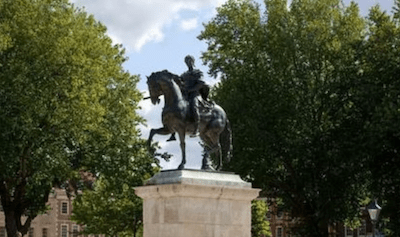
Walking to and from the Watershed, meeting my elder daughter, prior to her birthday, and her travels to Germany and France, we cross Queen Square. It’s a famous Bristol feature, dating in its present form from 1700 and named after the queen two years later. The statue of William III, ‘Dutch William’, by John Michael Rysbrack (originally Jan Michiel Rijsbrack), stands in the centre. The Bristol riots of October 1831, following the House of Lords blocking a Reform Bill, left nearly a hundred buildings in the square burned to the ground, their cellars looted, including the Mansion House. Four rioters were hanged and scores sent to prison. Estimates of those who actually died in the riots ranged up to 250. The rebuilding went on for decades.
Approaching the monument, I felt a flicker of uncertainty as to whether I would pass it on the left or the right. It really doesn’t matter to me but it certainly did to William Faulkner’s Benjy Compson, 33 years old but with the mind of a child and no sense of time. The closing pages portray, you might say, Benjy’s sound and his brother Jason’s fury. Luster, 14 year old son of the Compson family’s black servant Dilsey, in the driving seat, swings the horse, Queenie, to the left at the Confederate monument. ‘For an instant Ben sat in an utter hiatus. Then he bellowed. Bellow on bellow, his voice mounted, with scarce interval for breath. There was more than astonishment in it, it was horror; shock; agony eyeless, tongueless; just sound’ – provoking Jason to rush furiously across the square and on to the step. ‘With a backhanded blow he hurled Luster aside and caught the reins and sawed Queenie about and doubled the reins back and slashed her across the hips. He cut her again and again, into a plunging gallop, while Ben’s hoarse agony roared about them, and swung her about to the right of the monument. Then he struck Luster over the head with his fist.
‘“Don’t you know any better than to take him to the left?” he said.’
When the horse moves again Ben hushes at once. ‘The broken flower drooped over Ben’s feet and his eyes were empty and blue and serene again as cornice and façade flowed smoothly once more from left to right; post and tree, window and doorway, and signboard, each in its ordered place.’[1]
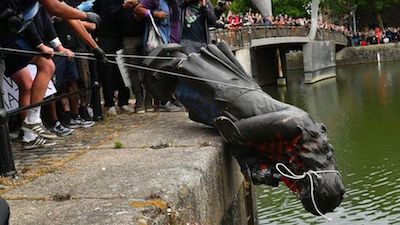
(The Colston statue taking a dip, Bristol, June 2020)
Monuments (not just Confederate ones) are a tricky business, of course. Rysbrack also produced a sculpture of Edward Colston, the Bristol slave trader and philanthropist, another statue of whom, created in 1895 by John Cassidy, was toppled into Bristol Harbour by protesters in June 2020. There have been many other contested monuments, Cecil Rhodes, Columbus and James Cook among them.
But other figures, perhaps in other ages, provoke quite different, and often more positive, emotions and reactions. Of the stone monument of Tsubo-no-ishibumi on the ancient site of the Taga castle in the village of Ichikawa (about six feet tall and three feet wide), Bashō wrote:
‘In this ever-changing world where mountains crumble, rivers change their courses, roads are deserted, rocks are buried, and old trees yield to young shoots, it was nothing short of a miracle that this monument alone had survived the battering of a thousand years to be the living memory of the ancients. I felt as if I were in the presence of the ancients themselves, and forgetting all the troubles I had suffered on the road, rejoiced in the utter happiness of this joyful moment, not without tears in my eyes.’[2]
Also in Japan is the monument to Ernest Fenollosa, in Uyeno Park, Tokyo. He had suffered his final, fatal heart attack in September 1908, at his home in London, while his step-daughter Erwin Scott (‘Noshi’, aged sixteen), was reading Dante Gabriel Rossetti’s ‘The Blessed Damozel’ to him. His ashes remained for a short while in Highgate cemetery but were then transported to Japan, to the hills overlooking Lake Biwa and the gardens of Miidera Temple, where they were reburied on the first anniversary of his death. The inscription, chosen by his students, read: ‘To the merit of our Sensei [teacher], high like the mountains and eternal like the water.’[3]
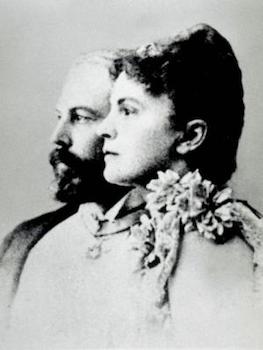
(Ernest and Mary Fenollosa)
It is not always a case of a specified and designated monument, but may be something that becomes so, such as the Esnoga synagogue that Steven Nadler wrote of: ‘Almost alone among the synagogues of Holland, this unmistakeable monument to Jewish achievement was left standing, undamaged, by the Nazis. Inside the hechal [ark of the Torah] is a Torah said to be the one brought to Amsterdam from Emden in 1602 by Moses Uri Halevi.’[4]
A monument might also serve as a complex representation of parallels and comparisons, whether discerned or imposed, as in Ezra Pound’s focus upon—or obsession with—the condottiere Sigismondo Malatesta’s monument to his wife Isotta. Pound was writing the Malatesta Cantos in the early 1920s and, Lawrence Rainey writes, ‘On the simplest level Pound seeks to suggest that the Tempio’s construction heralds a new cultural era, the dawn of the Renaissance and the spring of a neopagan revival.’ Of more urgent personal interest, though, he wished ‘to discern a parallel between himself and Sigismondo Malatesta’, and ‘between the magnum opus he wished to write and the unfinished monument of Rimini.’[5] That the Cantos (like the Tempio) ultimately remained unfinished was not then envisaged, and remains a curious historical irony.
‘Exegi monumentum aere perennius’, Horace wrote (Odes, Book III), and Pound translated it:
This monument will outlast metal and I made it
More durable than the king’s seat, higher than pyramids.
Gnaw of the wind and rain?
Impotent
The flow of the years to break it, however many.[6]
One might argue of some of these names that it’s a bit soon to tell – but Horace (Quintus Horatius Flaccus) has lasted over 2030 years so far, and seems to be holding on quite well. . .
Notes
[1] William Faulkner, The Sound and the Fury (1929), in Novels 1926-1929, edited by Joseph Blotner and Noel Polk (New York: Library of America, 2006), 1123-1124. In ‘Appendix. Compson: 1699-1945’ (1141), Faulkner wrote of Luster that he was ‘a man, aged 14’, who was ‘not only capable of the complete care and security’ of Benjy, a man ‘twice his age and three times his size, but could keep him entertained.’
[2] Matsuo Bashō, The Narrow Road to the Deep North and other travel sketches, translated by Nobuyuki Yuasa (London: Penguin Books, 1966), 113.
[3] Lawrence W. Chisolm, Fenollosa: The Far East and American Culture (New Haven: Yale University Press, 1963), 211, 35.
[4] Steven Nadler, Rembrandt’s Jews (Chicago: University of Chicago Press, 2003), 162.
[5] Lawrence S. Rainey, Ezra Pound and the Monument of Culture: Text, History, and the Malatesta Cantos (Chicago: University of Chicago Press, 1991), 38, 43.
[6] Ezra Pound: Poems and Translations, edited by Richard Sieburth (New York: Library of America, 2003), 1146.

 Reconstructionary Tales