Fetch a flitch of bacon


(John Frederick Herring II, ‘Farmyard with Saddlebacks’: Haworth Art Gallery)

The year has turned but, unfortunately, the direction of human travel has not, bringing to mind the old ballad:

It was mirk, mirk night, there was nae starlight,
They waded thro’ red blude to the knee;
For a’ the blude that’s shed on the earth
Rins through the springs of that countrie.[1]

We have long passed ‘that blessed season’, which Saki so liked, ‘between the harshness of winter and the insincerities of summer’.[2] I read hungrily, if not always strictly relevantly to the projects currently in train.

‘Every time I consider autobiography’, Guy Davenport wrote to the author and publisher W. C. Bamberger in June 2000, ‘my mind instantly runs to senseless (but satisfying) recrimination.’ He went on to detail the losses – due to carelessness or dishonesty – of valued letters, priceless association copies of books, drawings made to accompany essays or stories, which were jettisoned by editor or publisher once the material had been printed. ‘One of them was a Greek mask I’d worked on for a week, pen and ink, perhaps the finest drawing I’ve ever done.’ He added: ‘And there’s the art book with color plates that a fellow grad student at Harvard borrowed and kept his place with a slice of bacon,’ before concluding: ‘L’enfer, c’est les autres.’[3]


(Portrait of Lady Charlotte Harley as Ianthe: drawn by Richard Westall, engraved by W. Finden)

Bacon, you say. . . . Francis and Roger and Francis, and how many more? There was Lady Charlotte, wife of Colonel Anthony Bacon of the Lancers and daughter of the Earl of Oxford. Bacon was involved in the War of the Brothers, 1832-1834 (Pedro and Miguel) in Portugal, in the cause of Dom Pedro. Charlotte was the ‘Ianthe’ to whom, at the age of ten, Byron wrote his introductory stanzas at the beginning of Childe Harold.[4]

Such is thy name with this my verse entwined;
And long as kinder eyes a look shall cast
On Harold’s page, Ianthe’s here enshrined
Shall thus be first beheld, forgotten last[5]

There was Sir Nicholas Bacon, Keeper of the Great Seal to Queen Elizabeth I, who built a fine house mentioned by Ronald Blythe in his discussion of Stiffkey, a Norfolk village more famous since for the rector, Harold Davidson, who was defrocked after being charged with immorality – and died as a result of being mauled by a lion.[6] Francis – not the painter – supplies two epigraphs to Dorothy Sayers in her 1935 novel, Gaudy Night.[7] More entertainingly on the bacon front, Peter Vansittart writes that, until the Hundred Years’ War, the patron saint of England was Edward the Confessor. ‘Then Edward III, in debt to Genoese bankers, replaced him with their patron, the more aggressive St George, who was not to escape the attention of the supreme English ironist, Gibbon: he dismissed George as a dishonest bacon contractor, loathed by Christian and pagan alike.’[8]

Anyone fretfully wondering how long it will take Ford Madox Ford to rock up can now put their mind at rest. In Ancient Lights, Ford segued from a memory of Dante Gabriel Rossetti’s limericks to an anecdote about ‘another poet, a descendant of many Pre-Raphaelites, of whom it was related that whilst reading his friend’s valuable books at that friend’s breakfast table he was in the habit of marking his place with a slice of bacon.’ He added that he knew this anecdote to be untrue.[9] How might he be so sure? Slip forward twenty years and Ford is remembering his doctor, Tebb, with whom Ford stayed for a while when the good doctor was treating him in the late stages of a breakdown. He writes of Tebb inventing ‘one of the most ingenious lies’ about his guest: that Ford marked his place in Tebb’s ‘priceless first editions and incredibly sumptuous large paper copies with a slice of bacon.’[10]

Reading the recently published collection of shorter pieces by Hilary Mantel—and reminding myself of just how funny she can be—I come across an article, written for Vogue, on perfumes. Mantel remarks: ‘What women have always wanted to know is what scent drives men wild; researchers have the answer, say Turin and Sanchez [co-authors of the book Perfumes: The Guide], and it’s bacon.’[11] It’s just possible that this news may not have brought unalloyed delight to those inquiring women.

Bacon features largely in Ford’s letters around the end of the First World War, given the twin factors of meat rationing (introduced in 1918) and Ford’s own pig-breeding ambitions. ‘I got as far as the above’, he wrote to Stella Bowen in a letter that stretched over two days (28-29 April 1919), ‘when sleep overtook me—or rather sleepiness, for, when I went to bed I cd not get to sleep. I fancy an unmixed diet of bacon is telling on my liver.’[12]


William Cobbett – farmer, MP, soldier, traveller, radical journalist, printer, avid dispenser of practical advice to the common people (‘The Poor Man’s Friend’) – who took a positive view of pigs, wrote in his Cottage Economy:

A couple of flitches of bacon are worth fifty thousand Methodist sermons and religious tracts. The sight of them upon the rack tends more to keep a man from poaching and stealing than whole volumes of penal statutes, though assisted by the terrors of the hulks and the gibbet.[13]

It was also a matter of personal preference. On one of his famous rural rides, he arrived at Ashurst ‘(which is the first parish in Kent on quitting Sussex)’, where, ‘for want of bacon’, he was ‘compelled to put up with bread and cheese for myself. I waited in vain for the rain to cease or to slacken, and the want of bacon made me fear as to a bed.’[14] So he rode on through the night and the driving rain. Better drenched than baconless.

No mention of pork or bacon, unsurprisingly, in our Syrian and Palestinian cookbooks, nor, surely, in Claudia Roden’s The Book of Jewish Food? But yes, there is an entry in her index, which turns out to be connected with her visit to El Molino in Granada, a centre for research into the history of Spanish food. She was told that some Marranos, forced by the Inquisition to convert to Christianity, ‘made a point of cooking pork to protect themselves from charges by the Inquisition of continuing to practise their old religion.’[15]

The Librarian and I were recently comparing our inability to remember jokes. Some people have a repertoire of hundreds, others recall not a single one. The Librarian offers only one: it concerns the Pink Panther and she first heard it decades ago. I cudgel my brains and offer a knock knock joke dredged from some long unvisited cerebral recess:

Knock knock! (Who’s there?) Egbert! (Egbert who?) Egbert not bacon!

A brief, pitying smile. She murmurs, with visible effort, ‘That’s quite funny.’

It’s the way I tell them.


Notes

[1] ‘Thomas the Rhymer’, in The Oxford Book of Ballads, edited by Arthur Quiller-Couch (Oxford: Oxford University Press, 1910, reprinted 1932), 3.

[2] ‘The Romancers’, The Short Stories of Saki (London: The Bodley Head, 1930), 311.

[3] Guy Davenport, I Remember This Detail: 40 Letters to Bamberger Books, edited by W. C. Bamberger (Whitmore Lake, Michigan: Bamberger Books, 2022), 79-80. The French sentence is Jean Paul Sartre’s famous line from his play Huis Clos (No Exit).

[4] Rose Macaulay, They Went to Portugal (1946; London, Penguin Books, 1985), 307.

[5] Lord Byron, Selected Poems, edited by Susan J. Wolfson and Peter J. Manning (London: Penguin Books, 1996), 60.

[6] Ronald Blythe, The Age of Illusion: England in the Twenties and Thirties 1919-40 (Harmondsworth: Penguin, 1964), 156.

[7] Dorothy Sayers, Gaudy Night (1935; London: Hodder and Stoughton, 2016), Chapters 3 and 17.

[8] Peter Vansittart, In Memory of England: A Novelist’s View of History (London: John Murray, 1998), 42.

[9] Ford Madox Ford, Ancient Lights and Certain New Reflections (London: Chapman and Hall, 1911), 44, 45.

[10] Ford Madox Ford, Return to Yesterday: Reminiscences 1894-1914 (London: Victor Gollancz, 1931), 305.

[11] Hilary Mantel, ‘At First Sniff’ (2009), in A Memoir of My Former Self: A Life in Writing, edited by Nicholas Pearson (London: John Murray 2023), 332. I also learn from this that Burger King, yes, released a meat-infused scent called ‘Flame Grilled’.

[12] Correspondence of Ford Madox Ford and Stella Bowen, edited by Sondra J. Stang and Karen Cochran (Bloomington & Indianapolis: Indiana University Press, 1994), 109-110.

[13] William Cobbett, Cottage Economy (1823; Oxford University Press, 1979), 103. In past centuries, pigs ‘were kept by everyone, fed economically on scraps, waste, and wild food’: Alan Davidson, The Oxford Companion to Food, Second Edition by Tom Jaine (Oxford: Oxford University Press, 2006), 49.

[14] William Cobbett, Rural Rides, edited by George Woodcock (1830 edition; Harmondsworth: Penguin Books, 1983), 171-172.

[15] Claudia Roden, The Book of Jewish Food (London: Viking, 1997), 332.

Advice Notes


(Marianne North, Foliage and Flowers of a Madagascar Tree at Singapore, Marianne North Gallery; photo credit: Board of Trustees of the Royal Botanic Gardens, Kew)

I see that Mick Jagger—Sir Michael Philip Jagger, rather—is eighty this year. We lived abroad for a few years because of my father’s job while the Beatles and the Rolling Stones were getting going. ‘Not Fade Away’ must have been the first Stones song I heard when we came back to England; and it was another year before Jagger sang: ‘Well I told you once and I told you twice, But you never listen to my advice’—a slight friction there between ‘telling’ and ‘advice’? Unsurprising, perhaps, that it could have been the last time.

I’ve always been wary of advice, both giving and receiving. ‘I never myself took anyone’s advice’, Ford Madox Ford remarked, ‘and I do not imagine that many people will take mine.’[1] Robert Lowell appears to have taken it, though with mixed results, telling Flannery O’Connor in 1952: ‘Ford used to say that you could tell if a writer was any good from the first sentence—I found this advice useful when manuscript-reading for Sheed and Ward, though it led to fatal misunderstandings in my interviews with students at Iowa . . . ’[2]

I wouldn’t say ‘never’, I’m sure I’ve taken it from time to time but rarely with enthusiasm. Giving it as well, being too conscious of the tendency in many people, myself not excluded, to react negatively to such gestures, even embracing the opposite, sometimes ending up, metaphorically or literally, in a rainstorm without an umbrella. Though, it now occurs to me, I can advise, or at least suggest, that eating beetroot for lunch while reading a book you care about is best avoided.

Politicians, newspapers, television channels and radio stations are profligate dispensers of the stuff. I can recall the days when doctors and the BBC, anyway, were viewed with near-unanimity as reliable sources. Now people unwilling or unable to distinguish between blanket mistrust and informed scepticism are easy prey. Some conversations, to be sure, are best kept private when so much of the world appears to have gone mad-dog. To be appalled by so many governments is hardly a novelty, though, and my intake of news bulletins remains. . . careful.


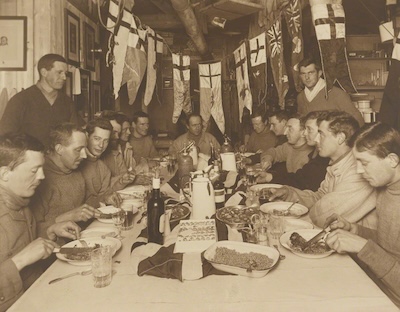
(Herbert George Ponting, ‘Captain Scott’s Birthday, 6 June 1911’, National Portrait Gallery, London; photo credit, NPG. Cherry is the third seated man along on the left)

‘Defeats on the Western Front in March catapulted the nation into shock’, Sara Wheeler wrote in her biography of Apsley Cherry-Garrard, recalling the period of the First World War. ‘The Times rallied as usual to shore up public confidence, issuing advice on all fronts, including the stern “Don’t think you know better than Haig”, even though most people over the age of ten probably did.’[3]

On all fronts, not just the Western one.

In Penelope Fitzgerald’s The Blue Flower, a novel based on the life of the 18th century writer  Novalis, Fritz meets Sophie’s elder sister Friederike (‘the Mandelsloh’): ‘“I thank you for your advice,” said Fritz. “I think, indeed, that women have a better grasp on the whole business of life than we men have. We are morally better than they are, but they can reach perfection, we can’t. And that is in spite of the fact that they particularise, we generalise.”
   “That I have heard before. What is wrong with particulars? Someone has to look after them.”’[4]

Yes, those particulars. Colette was a generous dispenser of advice, not least to the young Georges Simenon when she was literary editor at Le Matin, telling him that, though on the right track, ‘he should drop “the literature”. “Pas de littérature!” she said. “Supprimez toute la littérature et ça ira!”’[5] To a young woman writer who had sought her advice, she replied: ‘When you are capable of certifying that today’s work is equal to yesterday’s, you will have earned your stripes. For I am convinced that talent is nothing other than the possibility of resembling oneself from one day to the next, whatever else befalls you.’[6] But she also served as a magazine’s regular agony aunt, sharing her expertise in matters of dress, cosmetics and, always, love.


(Colette, plus—of course—a cat)

On dress and cosmetics, I am probably unreliable; but I was writing recently about aeroplanes, though hardly straying from my usual temporal zone, the first two or three decades of the twentieth century. The context was Ford Madox Ford’s war but a lot of the material I had to draw on related to Guy Davenport—some of which has gone into blog posts here—as well as other writers of Ford’s time, references to whom had to be whittled down or eliminated. Every time I approached the suggested word limit, things spiralled out of control again as some other alleyway beckoned. I remembered that line of W. B. Yeats: ‘My thoughts were a great excitement, but when I tried to do anything with them, it was like trying to pack a balloon into a shed in a high wind.’[7]

The Davenport material went, leaving only a faint shadow of his 1991 response to Laurence Zachar’s remark that: ‘A proportionately large part of your work is Utopian. It deals with happy people, in an ideal place where there is no violence’, when Davenport commented of  “The Aeroplanes at Brescia”, ‘there’s the implicit sense that aeroplanes were going to stop all wars; the Wright brothers wrote a famous letter to the War Department which paid no attention to it, saying: with the aeroplane, there can be no more troop movements because they can be observed from the air, and therefore no more wars.’[8]

When his story, or assemblage—drawing on Franz Kafka’s first published work, a report on the 1909 air show—appeared in the Hudson Review, a paragraph on the final page put the assertion that wars would cease with the coming of the aeroplane into the mouth of Max Brod’s engineer brother Otto but Davenport may have felt that such an unbearably painful irony was too easy, too heavy-handed. It was omitted when revised for book publication.[9]


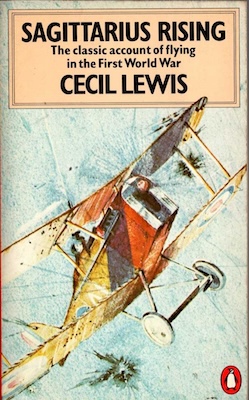
Another twist on that occurred to me when I was rereading the memoir by Cecil Lewis, Sagittarius Rising, who was in his teens when he joined the Royal Flying Corps. By the time he was posted to Home Establishment, he had survived eight months overseas, including four months of the Somme battle, and spent 350 hours in the air, during a period when pilots were lasting, on average, three weeks. Within little more than a month after the Armistice, he had been demobilised and secured a civilian job with Vickers. He was then twenty years old.

Writing in the mid-1930s, he looked back to the failure of the postwar conferences, aimed at ensuring peace, to take note of air power, finally waking to the significance of that power with a shudder of horror. ‘No wonder. Frontiers were gone. Security was gone. No man could hope for peace or prosperity under the threat of a violent death. The days of war were over: massacre had taken their place, wholesale massacre of the community in which children would retch their lives away, women would be blinded and men powerless to protect or succour. The end of civilization was in sight.’[10]


Notes

[1] Ford Madox Ford, Return to Yesterday: Reminiscences 1894-1914 (London: Victor Gollancz, 1931), 251-252.

[2] The Letters of Robert Lowell, edited by Saskia Hamilton (New York: Farrar, Straus and Giroux, 2005), 187.

[3] Sara Wheeler, Cherry: A Life of Apsley Cherry-Garrard (London: Jonathan Cape, 2001), 199.

[4] Penelope Fitzgerald, The Blue Flower (1995; London: Everyman, 2001), 364.

[5] Patrick Marnham, The Man Who Wasn’t Maigret: A Portrait of Georges Simenon (San Diego: Harcourt Brace & Company 1994), 112.

[6] Judith Thurman, Secrets of the Flesh: A Life of Colette (London: Bloomsbury Publishing, 2000), 409.

[7] W. B. Yeats, Autobiographies (London: Macmillan, 1955), 41.

[8] Laurence Zachar, ‘Guy Davenport. Lexington, Kentucky: December 1991’, Effets de voix (Tours: Presses universitaires François Rabelais, 1994).
See: http://books.openedition.org/pufr/3904 (accessed 20 January 2021).

[9] Guy Davenport, ‘The Aeroplanes at Brescia’, Hudson Review, 22, 4 (Winter, 1969-1970), 567-585; Tatlin! Six Stories (New York: Scribner’s, 1974), 52-70.

[10] Cecil Lewis, Sagittarius Rising (1936; Harmondsworth: Penguin, 1977), 152-153.

Things going better, bitte


(Not a Sequoia)

‘We drove up once to the Sequoia forest’, Christopher Isherwood told W. I. Scobie, ‘and I remember Stravinsky, so tiny, looking up at this enormous giant Sequoia and standing there for a long time in meditation and then turning to me and saying: “That’s serious.”’[1]

Sometimes, even for those long-practised in weathering it, the news becomes so distressing—and the public pronouncements of senior politicians so disgusting—that it’s best to pause, assuming you’re in the luxurious position of being able to do so.

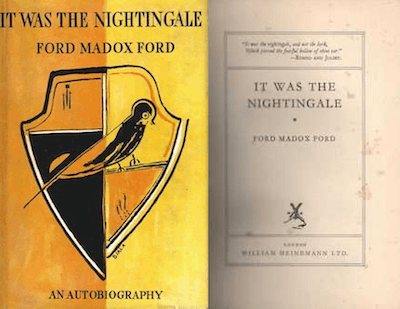
Ford Madox Ford or, let’s say, the narrator, does just that on page fifteen of It Was the Nightingale, which I’m currently reading for—let’s say the fifth time, not to sound too crazy. He pauses ‘with one foot off the kerb at the corner of the Campden Hill waterworks’. He is ‘about to cross the road. But, whilst I stood with one foot poised in air, suddenly I recognised my unfortunate position. . . .’ His rendering of the reflections that occur to him in that position appear to end, or pause, around page 88.


A few years back, I was writing about Ford and comedy, about genres and how comic writing is not viewed using the same critical criteria as ‘serious’ writing, discussing mostly the novels by Ford that might be regarded as comic: farces, satires for the most part. I was struck by a passage in a Guy Davenport essay:

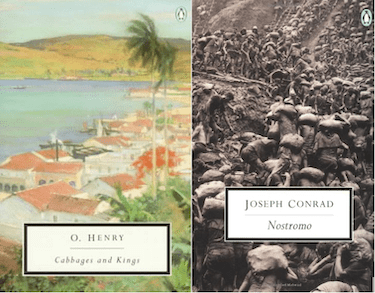
‘When Nostromo and Cabbages and Kings were published in 1904, we were beginning to make a distinction not among the four large types of literature which Northrop Frye has named comedy, romance, tragedy, and satire, or spring, summer, autumn, and winter spirits of the imagination, but between comic and serious. Some writers, like Shakespeare, Mark Twain, and Bernard Shaw, were allowed to be both at once, but with the understanding that the comic was being put in the service of the serious. The seriousness of the comic writer could only be sentimentality, and his business was to entertain, not to instruct’.[2]


Davenport writes as an admirer of O. Henry, a fat selection of whose stories he edited and introduced for Penguin Books. ‘To those friends who knew his past’, he writes there, ‘O. Henry always compared himself to Lord Jim.’ His introduction ranges over the classics—unsurprisingly, Davenport being both classicist and modernist—and some of the writers, possibly unexpected, who have admired O. Henry’s stories, among them Cesare Pavese, the Russians of the Constructivist movement, Yevgeny Zamyatin. Alluding to practitioners of the New Comedy, he remarks: ‘Miserable as our century is, we can still boast that for seventy years of it we had P. G. Wodehouse, the Menander de nos jours, and for ten years O. Henry.’[3]

Ford being one of those who was surely ‘allowed to be both at once’, I tried to convey how many comic moments—certainly passages that made me laugh—there were in the ‘serious’ books, not excluding The Good Soldier and Parade’s End.[4] I’ve wondered since whether I shouldn’t simply have said: Well, just read It Was the Nightingale. But no. It’s perfectly possible to explain, or attempt in accepted ways to do so, why you think a writer or a painter is good, what they succeed in, their distinctive personal characteristics. But explaining why someone is funny? Can it be done? You might explain why you personally find something funny but that may sound, to a reluctant or sceptical listener, as interesting and persuasive as your last night’s dream.

I quoted the estimable Frank Budgen on his friend, author of the comic masterpiece, Ulysses: ‘one day Joyce laughed and said to me: “Some people were up at our flat last night and we were talking about Irish wit and humour. And this morning my wife said to me, “[w]hat is all this about Irish wit and humour? Have we any book in the house with any of it in? I’d like to read a page or two.”’[5]

If the reader doesn’t find Ulysses funny, I suspect it’s because it feels intimidating too: this huge book, full of words, phrases, constructions, comparisons, images and symbols that you’re never come across before. Not, anyway, in those contexts and those combinations. Worse, it’s the Greatest Novel of the century or one that defined an era or the justification for the whole modern movement or—but is it funny? Well, yes, probably not if you go through it on tiptoe or hands and knees, peering warily about you as you go. But if you can relax, telling yourself that you’ll come back to it with a pick and shovel at some later date but just not now – pour a glass (leave the bottle) and sit back in that comfortable chair – things may go better.

I linger over that phrase—‘things may go better’—just for a moment, you understand. How could I not?

Notes


[1] Writers at Work. The Paris Review Interviews: 4th Series, edited by George Plimpton (Harmondsworth: Penguin Books, 1977), 232.

[2] ‘The Artist as Critic’, in Every Force Evolves a Form (Berkeley: North Point Press, 1987), 79.

[3] ‘Introduction’ to O. Henry, Selected Stories (New York: Penguin Books, 1993), xi, xv. Possible additions to these inheritors of the New Comedy are ‘the exotic and manic S. J. Perelman and the gentle, whimsical Thurber’.

[4] ‘Ford and Comedy’, Sara Haslam, Laura Colombino and Seamus O’Malley, editors, The Routledge Research Companion to Ford Madox Ford (London: Routledge, 2019), 427-440.

[5] Frank Budgen, James Joyce and the Making of ‘Ulysses’ and other writings, enlarged edition (1934; London: Oxford University Press, 1972), 38.

Sirens and syrens


(Herbert James Draper, Ulysses and the Sirens: Ferens Art Gallery)

—I know you think I’m obsessed with sirens.
—Yes.
—But there were three at once just now. And at least a dozen or more, so far today.
—Think of where we are.
—Arterial junction on this side of the city. But still . . .

But still. Sirens. Or Syrens? The meaning of which, the Merriam-Webster Dictionary sternly pronounces, is ‘chiefly British spelling of siren’. Elsewhere, ‘syren’ is simply termed ‘old-fashioned’.

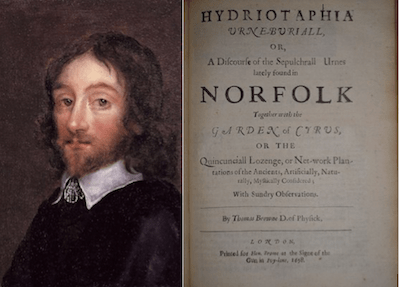
‘What song the sirens sang, or what name Achilles assumed when he hid himself among women, though puzzling questions, are not beyond conjecture’, Sir Thomas Browne wrote in chapter 5 of his Urn Burial.[1] His editor points out that those questions had been put by the emperor Tiberius to test the grammarians. Or, according to Suetonius, in his life of that strikingly unpleasant Roman, ‘his greatest passion was for mythology, to the extent that he made himself seem foolish and absurd; for he used to make trial of scholars, a class of men on whom [ . . . ] he was especially keen: “Who was Hecuba’s mother? What was Achilles’ name when he was among the virgins? What songs used the Sirens to sing?”’[2]


Sleight of hand, yes, siren to siren: but both rub shoulders under the one dictionary heading. A beckoning and a warning; a come-on and a note of caution. The mythological nymphs whose singing required Homer’s hero to be bound to his ship’s mast while his crew had their ears stuffed with beeswax; but also a signalling or warning instrument, as well as an American genus of eel-like amphibians (typically living in muddy pools). The proposed derivation is suitably tortuous: Middle English from Old French from Late Latin from Greek (Seirēn).

‘I imagine’, Ford Madox Ford wrote, ‘that I should prefer to be where Christobel low-lieth and to listen to the song the syrens sang. But I am in London of the nineteen tens, and I am content to endure the rattles and the bangs—and I hope to see them rendered.’[3] He had used the phrase—‘what songs the Sirens sang’—a year earlier; and would use it, or a variant of it, on several later occasions.[4]  In 1931, reporting fierce storms in the South of France to the novelist Caroline Gordon, one of which had drowned seventeen men, he added: ‘the Mediterranean being a treacherous syren’.[5]

Ford also recalled, from his days of editing the English Review, a piece by Norman Douglas called Syrens, ‘which was, I think, the most beautiful thing we printed.’ That Douglas essay begins: ‘It was the Emperor Tiberius who startled his grammarians with the question, what songs the Sirens sang.’[6]

Not that Ford and Douglas were the only ones with Sirens on their mind. E. M. Forster was at it too. In his ‘The Story of the Siren’, a Sicilian boatman tells the English narrator the story of his brother’s sighting of the Siren, when he dives for silver coins. Permanently changed, he marries a woman similarly bewitched, who is murdered by a priest while pregnant, religion and popular superstition having conspired to produce the conviction among the villagers that the couple’s child would empower the Siren, that the Pope would then die and the world be turned upside down.[7]


Also in 1920, the writer John Rodker’s recently created Ovid Press issued an edition of 200 copies of Ezra Pound’s Hugh Selwyn Mauberley, with initials and colophon by Edward Wadsworth, who had been briefly associated with the Omega Workshops, then with the Vorticists, contributing five illustrations and a review of Kandinsky’s On the Spiritual in Art to the first issue of Blast.

The third stanza of Mauberley:

ἴδμεν γάρ τοι πάνθ᾽ ὅσ᾽ ἐνὶ Τροίῃ εὐρείῃ
Caught in the unstopped ear;
Giving the rocks small lee-way
The chopped seas held him, therefore, that year.

The first line, from Homer’s Odyssey (Bk.XII, 189), ‘For we know all the toils that are in wide Troy’, is, precisely, from the Sirens’ song, its transmission unimpeded by that ‘unstopped ear’ (while ‘lee-way’ is Pound’s bilingual rhyme with Τροίῃ, and those choppy seas or, rather, that ‘therefore’, suitably disturbs the rhythm of the final line).[8]


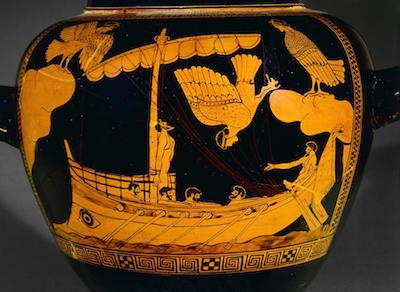
Richard Buxton notes that the Sirens are ‘depicted by post-Homeric sources as women above the waist and birds below it’ and prints the image of an Attic vase, which the British Museum dates to c.480-470 BC, one of the Sirens having thrown herself off a cliff onto the ship, ‘perhaps because the safe passage of Odysseus’ vessel marks a defeat for the Sirens’ power’. [9]

https://www.britishmuseum.org/collection/object/G_1843-1103-31

In May 1940, after the Nazi invasion of the Lowlands, Mollie Panter-Downes noted that ‘the bus changing gear at the corner sounds ridiculously like a siren for a second, as it used to do in the first edgy days of the war.’[10] But even those of us (now most of us) not old enough to recall the originals have been made familiar with the sound of air raid sirens by film and television dramas.

Things were a little more makeshift in the earlier war. When the Gothas, heavy wide-spanned biplanes, virtually took over from Zeppelins the attacks on London in the summer of 1917, E. S. Turner wrote: ‘Belatedly the Government introduced a proper warning system of maroons [fireworks used as signals or warnings]; one of the earlier methods had been to send out a fast open car with a bugler (sometimes a Boy Scout) standing in the back, or a policeman hard-pedalling a cycle with a ‘Take Cover’ notice. Engine drivers had their own way of sounding “All Clear”; they blew a cock-a-doodle-do on their whistles.’[11] Hard luck if your attention was elsewhere when that policeman cycled by.

Dropping off the car on returning from Somerset, we are almost deafened by a rush and cacophony of wailing vehicles, both ambulance and police. I suspect I know what song those sirens sing.


Notes

[1] Browne, Selected Writings, edited by Claire Preston (Manchester: Carcanet Press, 1995), 105. Thetis sent her son Achilles to the court of King Lycomedes on Skyros to avoid his being sent to war with Troy, where he was destined to die. He disguised himself as a girl under the name of Pyrrha but was tracked down by Odysseus.

[2] Suetonius, Live of the Caesars, edited and translated by Catharine Edwards (Oxford: Oxford University Press, 2000), 132.

[3] Ford, ‘On a Notice of “Blast”’, Outlook, XXXVI (31 July 1915), 144. Coleridge’s ‘Christabel’ may have wantonly embraced Tennyson’s 1830 poem ‘Claribel’ (‘Where Claribel low-lieth’) here.

[4] Ford, ‘Literary Portraits XXVIII—Mr Morley Roberts and Time and Thomas Waring’, Outlook, XXXIII (21 March 1914), 390; Thus to Revisit (London: Chapman & Hall, 1921), 7; The Marsden Case (London: Duckworth, 1923), 44; and ‘Somewhere the sirens smiled’, in The Rash Act (1933; Manchester: Carcanet Press, 1982), 187.

[5] Brita Lindbergh-Seyersted, A Literary Friendship: Correspondence Between Caroline Gordon & Ford Madox Ford (Knoxville: The University of Tennessee Press, 1999), 11-12.

[6] Ford Madox Ford, Return to Yesterday (London: Gollancz, 1931), 408-409; Norman Douglas, ‘Sirens’, English Review, II, ii (May 1909), 202-214.

[7] Forster’s story was ‘hand-printed by the Woolfs’ and published in a limited edition in July 1920: The Diary of Virginia Woolf, Volume 2: 1920-24, edited by Anne Olivier Bell, assisted by Andrew McNeillie (Harmondsworth: Penguin, 1981), 51-52 and n.; E. M. Forster, Collected Short Stories (London: Penguin Books, 1954), 179-187.

[8] Hugh Selwyn Mauberley, in Ezra Pound: Poems and Translations, edited by Richard Sieburth (New York: Library of America, 2003), 549.

[9] Richard Buxton, The Complete World of Greek Mythology (London: Thames & Hudson, 2004), 142.

[10] Mollie Panter-Downes, London War Notes (1971; edited by William Shawn, new preface by David Kynaston, London: Persephone Books, 2014), 64.

[11] E. S. Turner, Dear Old Blighty (London: Michael Joseph 1980), 123.

Notes to self


(Lily Delissa Joseph, Teatime, Birchington Ben Uri Gallery & Museum)

‘Are you writing?’ my elder daughter asks, when the Librarian and I meet her for tea at the Watershed café.
‘Mainly footnotes’, I answer.
Footnotes! We have been here before.

In Last Post, the final volume of Ford Madox Ford’s Parade’s End tetralogy, Sylvia Tietjens reflects on the damage she has managed to inflict on her estranged husband Christopher. The ancestral home, Groby, has been let to rich Americans and Mrs de Bray Pape, in the course of her ‘improvements’, has brought down Groby Great Tree and has also mangled the dovecote:

But apparently it was going to mangle the de Bray Papes to the tune of a pretty penny, and apparently Mr. Pape might be expected to give his wife no end of a time…. Well, you can’t expect to be God’s Vice-gerent of England without barking your shins on old, hard things.[1]

‘Vice-gerent’? Not something I’d come across, as far as I could recall. I consulted a reference book or two and the resultant footnote read: ‘Properly not hyphenated, though in practice it often is. Applied to priests and, specifically, to the Pope, it does mean representative of God or Christ. The Papist Ford may be punning on Popes and Papes here.’ Under the more familiar ‘viceregent’, one of the dictionaries I peered into had: ‘often blunderingly for vicegerent’. A fairly easy mistake to make, I’d have thought: if annotating at all, the decision to footnote the word was hardly controversial. But the key phrase there is probably ‘if annotating at all’.

I suspect that quite a few readers still object to annotation on principle: how can you familiarise yourself with, and come to know, the language of Shakespeare if you stop for a footnote and a species of translation into modern English every couple of words? But such a question, posed on a quiet country road, is soon drowned out by traffic on a highway which can lead to unsettling termini. What? You’re reading The Tale of Genji, War and Peace and the Icelandic Sagas in translation? Are you planning simply to waste the next two hundred years of your life?

But then plays and poetry perhaps present slightly different criteria for discussion than do novels. Narrative, story, that determined forward movement, certainly a quicker reading – do you really want to pause for footnotes there, lose momentum, weaken the impetus, misplace a thread or two? And there are, after all, different kinds of footnote. A term likely to be unfamiliar to some, even most, readers can be briefly illuminated. But here’s a scene from Ford’s A Man Could Stand Up—, the third volume of his Parade’s End tetralogy. Christopher Tietjens, in the trenches during Ludendorff’s great offensive of Spring 1918, waits amidst the strafe for the enemy attack:

Noise increased. The orchestra was bringing in all the brass, all the strings, all the woodwind, all the percussion instruments. The performers threw about biscuit tins filled with horse-shoes; they emptied sacks of coal on cracked gongs, they threw down forty-storey iron houses. It was comic to the extent that an operatic orchestra’s crescendo is comic. Crescendo! …. Crescendo! CRRRRRESC…. The Hero must be coming! He didn’t![2]

In an earlier scene, two volumes (and a World War) back, Tietjens had walked on a path across a Kentish field with, ahead of him, the young suffragette Valentine Wannop:

“God’s England!” Tietjens exclaimed to himself in high good humour. “Land of Hope and Glory!” —F natural descending to tonic, C major: chord of 6-4, suspension over dominant seventh to common chord of C major. . . . All absolutely correct! Double basses, cellos, all violins: all wood wind: all brass. Full grand organ: all stops: special vox humana and key-bugle effect…”[3]


(Francis Sydney Muschamp, Scarborough Spa at Night, Scarborough Art Gallery

In 1939, in one of the last pieces he wrote before his death, certainly one of the very last he published, we see this: ‘Now then, the full orchestra of all the seven arts, all brass, all percussion, all wind, all strings, all wood wind, is away.’[4]

One kind of reader will respond: ‘So what?’ Another kind of reader: ‘Annotate it to within an inch of its life.’ I’m somewhere in between though a good deal—a great deal—closer to the inch-mob than to the so whats?

Ah, but annotate one, two or all (disregarding the option of ‘none’)? If one, which one? The first because chronologically earlier? The second, then the third, because they look back to the first? And is the point of doing so that he repeats himself – or likely to be taken as such by a reader less familiar with the Ford canon? All writers repeat themselves, to a greater or lesser degree, a fact often made apparent only by – annotation. Repetition is rarely exact repetition and is, in any case, often a part of a deliberate artistic programme or policy. Ask Miss Gertrude Stein. And, while not everyone finds recurrence of interest, some of us do (to a worrying degree, perhaps). A phrase or a moment recalled twenty, thirty or more years later; a play or a poem referred to repeatedly – I’m curious to know why. The writer, painter, composer may be the most admired, so the poet or novelist refers over and over to Dante, to Joyce, to Donne, to Cézanne, to Bach. T. S. Eliot, composing or assembling The Waste Land, draws on Shakespeare’s The Tempest at least half a dozen times, as Matthew Hollis reminded me over breakfast this morning.[5]

But, briefly, the arguments for my annotation habit in the arena of Fordian letters are three. Firstly, words drop from sight or change their usage and may present to a reader blank spots in a text which can be simply and painlessly repaired by a note, as can the names of now-forgotten writers and editors and society figures, defunct periodicals and the like; secondly, many critical texts are intended to be read by several kinds of reader, from the casual browser to the professional scholar, who can ignore them or pore over them, according to taste and occasion – and some of them will be extremely glad to know of echoes, recurrences, patterns and connections; thirdly, you have to take your fun where you can find it.

On Tuesday, half the recycling was not collected – for no explicable reason. Yesterday, a Spring month, here in the south of England, snow was falling. Mere anarchy is loosed upon the world.

Should I annotate that last sentence? Probably not.


Notes

[1] Ford Madox Ford, Last Post (1928; edited by Paul Skinner, Manchester: Carcanet Press, 2011), 163.

[2] Ford Madox Ford, A Man Could Stand Up— (1926; edited by Sara Haslam, Manchester: Carcanet Press, 2011), 79.

[3] Ford Madox Ford, Some Do Not. . . (1924; edited by Max Saunders, Manchester: Carcanet Press, 2010), 133.

[4] Ford Madox Ford, ‘A Paris Letter’, Kenyon Review, I (Winter 1939), 20.

[5] Matthew Hollis, The Waste Land: A Biography of a Poem (London: Faber, 2022), 282. Elsewhere, he discusses the afterlife of the notes that Eliot was obliged to add to meet the publisher Liveright’s demands for a volume of a certain length: ‘For all Eliot’s ambivalence, the notes are now forever fused with the poem’ (376). As they are. But I don’t see that as a clear and present danger in this case.

Infinite presents


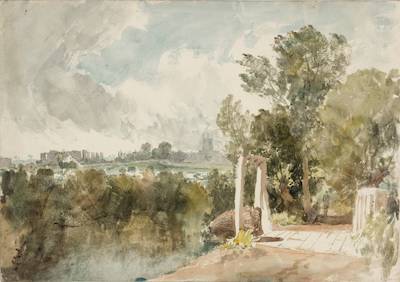
(J. M. W. Turner, A Church and Village seen from a Riverside Footpath: Tate)

I was thinking about—or idly musing upon—the infinite, arrived at by the usual wandering off footpaths. Decanting a packet of ground coffee into the regular tin, I was prompted by the resulting level to look at the net weight printed on the packet. It had lessened by some ten per cent, diminished by one-tenth (‘No, we haven’t put our prices up’). But then there has been, inevitably, a strong and widespread sensation of lessening, of shrinkage over the past few years. The narrowness of nationalist discourse, the closing of borders, the hostility to refugees and migrants, together with the pandemic, lockdowns, withdrawals either voluntary or enforced, now a metaphorical or literal huddling together against cold, hunger, discomfort, all in worsening weather.

Often placed against that diminishment are, precisely, ideas of freedom, expansion, movement through time and space. Art, then, or memory, or history, or imagination. Borders, walls, boundaries, limits of any kind set aside, evaded, vaulted over. The infinite – notions of which can swing to both positive and negative poles, depending on the viewer.

I thought of Ford Madox Ford recalling his ‘most glorious memory of England’, in the 1890s, hundreds of Jewish refugees from the Russian pogroms, landing at Tilbury Docks, falling on their knees and kissing the sacred soil of Liberty. ‘It was not of course because they were Jews or were martyrs. And I daresay it was not merely because England was my country. It was pride in humanity.’ But because of ‘an Order in Council’, that route would now be narrowed or blocked: ‘This then was the last of England, the last of London . . .’ And: ‘One had been accustomed to think of London as the vastest city in the world . . . as being, precisely, London, the bloody world!’ But now? ‘Ease then was gone; freedom was no more; the great proportions were diminished . . .’[1]


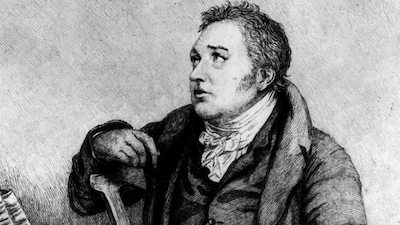
(Samuel Taylor Coleridge via the BBC)

One of the most famous instances of infinitude is that of Samuel Taylor Coleridge, in Chapter XIII of the Biographia, where he summarises his distinction between imagination and fancy: ‘The primary IMAGINATION I hold to be the living Power and prime Agent of all human Perception, and as a repetition in the finite mind of the eternal act of creation in the infinite I AM.’[2] This was one of the main targets of another, later, celebrated statement, by T. E. Hulme: ‘Here is the root of all romanticism: that man, the individual, is an infinite reservoir of possibilities’ – against which, Hulme’s version of the classical: ‘Man is an extraordinarily fixed and limited animal whose nature is absolutely constant. It is only by tradition and organisation that anything decent can be got out of him.’[3]

Hulme was primarily a philosopher – a poet only in miniature. I suspect that artists generally tend more towards embracing the positive than feeling repelled or threatened by the negative. ‘We must consume whole worlds to write a single sentence and yet we never use up a part of what is available’, James Salter wrote to Robert Phelps. ‘I love the infinities, the endlessness involved . . . ’[4] Laura Cumming, writing in praise of Jan Van Eyck, observed that: ‘His art is so lifelike it was once thought divine. But he does not simply set life before us as it is – an enduring objection to realism, that it is no more than mindless copying – he adjusts it little by little to inspire awe at the infinite variety of the world and our existence within it; the astonishing fact that it contains not just all this but each of our separate selves.’[5]

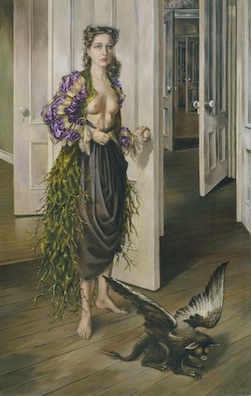
In an entry dated ‘[Saturday 24 November 1984]’, Annie Ernaux wrote: ‘One image haunts me: a big window wide open and a woman (myself) gazing out at the countryside. A springtime, sun-drenched landscape that is childhood. She is standing before a window giving onto childhood. The scene always reminds me of a painting by Dorothea Tanning – Birthday. It depicts a woman with naked breasts: behind her, a series of open doors stretch into infinity.’[6]


(Dorothea Tanner, Birthday (1942): Philadelphia Museum of Art)

Is that a wish to see the world, one’s personal world, as an unending series of opened doors? Or simply an observation, a belief, a conviction that this is how the world actually is, that much of what we assume to be fixed, unalterable, closed, finite, is nothing of the sort? Some observers, actors, participants, acknowledge the infinite nature of ideas, of the abstract but, certainly in specific circumstances—the Second World War, in the case of Ronald Duncan, pacifist and farmer—choose to turn away from them: ‘We were people used to dealing with ideas which are infinitely pliable, and for the first time were in contact with things which are rigid, brittle’, Duncan wrote. ‘Contact with things is infinitely more satisfying than contact with ideas. And if we are honest we must admit that few of us are capable of holding abstract conceptions in our heads. If we manage it, it gives us little pleasure. Somehow or other we have fallen into the rot of thinking that pigs and poetry are incompatible. They are not.’[7]

Pigs and poetry. Why, yes. In immediate postwar Sussex, Ford Madox Ford bred pigs and wrote poetry—A House (1921), Mister Bosphorus and the Muses (1923)—though, admittedly, the pigs died or had to be sold off at bacon prices when Ford and Stella Bowen moved to France. Staying in the realm of the abstract—or more abstract, at least, than pigs—I think of Sarah Churchwell, already author of a book on Fitzgerald and the world of Jay Gatsby, writing in 2018: ‘Gatsby’s famous ending, in other words, describes the narrowing of the American dream, from a vision of infinite human potential to an avaricious desire for the kind of power wielded by stupid white supremacist plutocrats who inherited their wealth and can’t imagine what to do with it beyond using it to display their dominance.’[8]

There are, though, different kinds of dominance, some more insidious than others, habits so ingrained as not to be seen any longer as habits, procedures so immediate, so automatic, so normalised as to seem – natural. Annie Ernaux has written of the worldwide web as ‘the royal road for the remembrance of things past’ and adds: ‘Memory became inexhaustible, but the depth of time, its sensation conveyed through the odour and yellowing of paper, bent-back pages, paragraphs underscored in an unknown hand, had disappeared. Here we dwelled in the infinite present.’[9]

The more I look at it, the more unsettling that final phrase is. . .

Notes


[1] Ford Madox Ford, It Was the Nightingale (London: Heinemann, 1934), 85-88.

[2] Samuel Taylor Coleridge, Biographia Literaria or Biographical Sketches of My Literary Life and Opinions, edited by James Engell and W. Jackson Bate (Princeton: Princeton University Press, 1984), I, 304.

[3] T. E. Hulme, ‘Romanticism and Classicism’, in Speculations: Essays on Humanism and the Philosophy of Art, edited by Herbert Read (Second edition, London: Routledge & Kegan Paul, 1936), 116.

[4] Memorable Days: The Selected Letters of James Salter and Robert Phelps, edited by John McIntyre (Berkeley, California: Counterpoint, 2010), 39.

[5] Laura Cumming, A Face to the World: On Self-Portraits (London: Harper Press, 2010), 13.

[6] Annie Ernaux, I Remain in Darkness, translated by Tanya Leslie (London: Fitzcarraldo Editions, 2020), 37-38.

[7] Ronald Duncan, All Men Are Islands: An Autobiography (London: Rupert Hart-Davis, 1964), 245, 226.

[8] Sarah Churchwell, Behold, America: A History of America First and the American Dream (London: Bloomsbury Publishing, 2018), 141. The earlier book was Careless People: Murder, Mayhem and the Invention of The Great Gatsby (2013).

[9] Annie Ernaux, The Years, translated by Alison L. Strayer (London: Fitzcarraldo Editions, 2019), 209-210.

Out, brief candles

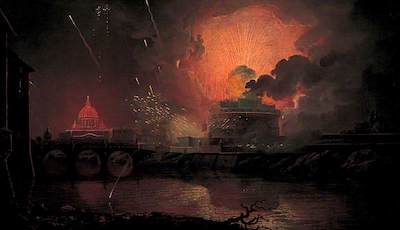
(Joseph Wright of Derby, Firework Display at Castel Sant’Angelo: Birmingham Museums Trust)

Walking to the Victorian cemetery, we pass a spent rocket on the pavement. I thought briefly of Mr Leopold Bloom on Sandymount shore, Gerty MacDowell leaning far, far back to watch the fireworks in the night sky and the, ah, stimulated Mr Bloom having to recompose ‘with careful hand’ his wet shirt. ‘My fireworks. Up like a rocket, down like a stick.’[1] The morning after Guy Fawkes’ Night: on the previous evening, we travelled the one hundred and twenty metres to a bonfire in the park. ‘People’, the Librarian reminded me, ‘you’re among people.’ True enough. Several hundred of them, in fact. But it was all in the open air and the only physical contact with a stranger was with the large dog that took a liking to my right leg. Positioned painfully near two young males of the species, the Librarian remarked that ‘boys are horrible’. I know, I said, I used to be one. After a slow start, the flames took a firm hold, climbed, threw glowing embers high into the air. Guy Fawkes. Of course, the effigies burned on the fires used to represent the Pope or various prominent Catholics, while, half a century before Mr Fawkes’ indiscretion, Mary Tudor, Bloody Mary, devoted a fair bit of energy, in her five-year rule as Queen of England, to the immolation of Protestants. One of the Oxford martyrs burnt at the stake in 1555, Hugh Latimer, is supposed to have said to another, Nicholas Ridley (the third was Thomas Cranmer, Archbishop of Canterbury): ‘Be of good comfort, and play the man, Master Ridley; we shall this day light such a candle, by God’s grace, in England, as I trust shall never be put out.’ 

Candles, ah, literary candles: Wilfred Owen, D. H. Lawrence, Virginia Woolf, Aldous Huxley, Josephine Tey, Ford Madox Ford. . .

(Matthias Stom, An Old Woman and a Boy by Candlelight: Birmingham Museums Trust)

‘Do you happen to know Haydn’s symphony? . . . It is a piece that begins with a full orchestra, each player having beside him a candle to light his score. They play that delicate, cheerful-regretful music of an eighteenth century that was already certain of its doom. . . As they play on the contrabassist takes his candle and on tiptoe steals out of the orchestra; then the flautist takes his candle and steals away . . . .The music goes on—and the drum is gone, and the bassoon . . . and the hautbois, and the second . . . violin. . . . Then they are all gone and it is dark. . . .’[2]

Well, yes. ‘For it is not unusual in human beings who have witnessed the sack of a city or the falling to pieces of a people, to desire to set down what they have witnessed for the benefit of unknown heirs or of generations infinitely remote; or, if you please, just to get the sight out of their heads.’[3]

Ford wrote that even before the outbreak of the First World War, long before our current malaise, with—on bad days—its irrefutably apocalyptic tinge. Still, on a later occasion, there’s this: ‘But I couldn’t keep on writing. I was obsessed with the idea of a country, patrie, republic, body politic, call it what you will[ . . .] Yes: I had a vision of a country.’[4]

It is often, to be sure, hard to keep on writing. Still – a vision of a country. Some people look back in search of it, others look forward, while a good many others clearly don’t care or, contrary to that Dylan song, really do need a weatherman to know which way the wind blows. Emerging reluctantly from the fictional worlds of P. G. Wodehouse and Kate Atkinson,[5] I find the political landscape essentially unchanged. (I’m reminded that one of Atkinson’s Jackson Brodie novels is called When Will There Be Good News? No answer is required, as they say.) Perhaps, after the destructive antics of Boris Johnson and the deranged flurry of Liz Truss, some hard-pressed members of the public—even members of the so-called Conservative party—experienced a fleeting frisson of relief that there was now an unelected, right-wing multimillionaire in 10 Downing Street, poised to announce massive cuts in public spending. But in any case he fell at the first hurdle, with his appalling cabinet appointments or reappointments, squandering his one clear chance in sordid little deals; then at the second hurdle of the climate emergency, the subsequent scuffles and scrambles all profoundly unconvincing.

It’s odd that so many of the people who recur obsessively to the Second World War and the defeat of Nazism now seem not to notice or to care that countries long held up as beacons of freedom and democracy are a heartbeat away from – what’s the current phrase, ‘post-fascism’? Leaving aside the worrying recent developments in Sweden, Italy and Israel, the United States is clearly at a crisis point, on the verge of knowing for sure whether or not its two hundred and fifty year old experiment with democracy has effectively ended. Here, the Home Secretary – a scandalous appointment, then a more scandalous reappointment – channels the sort of malignant rhetoric which refugees from Hitler’s regime would find only too familiar, while the Public Order Bill, designed to limit the right to protest to such an extent that it’s effectively removed altogether, might, with trifling revisions in wording, sit quite happily in the legislative registers of China, Iran or Putin’s Russia.

Ah well. If there was settled weather for a while, it is changed and changing now, for sure. As they have it in the Scottish play:

Banquo: It will be rain tonight.
First Murderer: Let it come down.
(They fall upon Banquo)


Notes

[1] James Joyce, Ulysses (1922; London: The Bodley Head, revised edition, 1969), 482, 483.

[2] Ford Madox Ford, Provence (London: Allen & Unwin, 1938), 261.

[3] Ford Madox Ford, The Good Soldier: A Tale of Passion (1915; edited by Max Saunders, Oxford: Oxford University Press, 2012), 12.

[4] Ford Madox Ford, No Enemy (1929; edited by Paul Skinner Manchester: Carcanet Press, 2002), 132.

[5] Kate Atkinson’s long novel, Life After Life (London: Transworld, 2014), is centrally concerned with bearing witness, as several characters—and the author herself—make clear: Ursula (472), Miss Woolf (457-458), ‘Author Note’ (618).

Parrot or Bevan; or, wagging the beards

(D. H. Lawrence)

‘Please compress your last dozen unwritten—or unpublished—blog posts, into a single phrase.’

I think I’d be tempted to go with what are often referred to as D. H. Lawrence’s last words, (which they weren’t, though pretty close to the end): ’This place no good.’[1] He was referring to the Ad Astra sanatorium in Vence, of course. And he was referring to something much wider, of course. I would be referring, not to this house—last refuge of common sense and sweet reasonableness that I can truly rely on—but to the wider world that is being laid waste, particularly this country, where we live and love among the ruins that these dreadful people have reduced us to, are reducing us to. Here, at any rate, we are. Where is that? Phrases like ‘post-apocalypse’ and, yes, ‘among the ruins’ occur more often that they should, possibly because I’ve been reading Lara Feigel’s hugely impressive book on D. H. Lawrence,[2] possibly because I keep getting glimpses of the daily news.

I was reminded somehow (somehow) of Hugh Kenner’s letter to Guy Davenport (13 October 1967). They’d been discussing the name of the couple in whose house Ludwig Wittgenstein had died: was it Parrot or Bevan? Davenport was quoting the 1958 memoir by Norman Malcolm, Kenner citing the viva voce testimony of artist and writer Michael Ayrton. Kenner wrote: ‘Ayrton is in Chicago for 10 days (opening a show) but on his return I shall press him re discrepancies between Parrot and Bevan. Maybe, being English, they spell it Bevan but pronounce it Parrot. He did confirm Parrot the other day.’[3]

(For those not familiar with some of the oddities of English pronunciation of names, try Featherstonehaugh, Auchinlech, Marjoribanks, Woolfhardisworthy or Cholmondley.)[4]

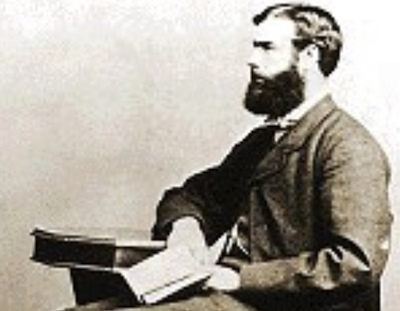
(The Reverend Francis Kilvert – including beard)

But I digress – old joke, shared among Fordians, Ford’s ‘digressions’ generally being anything but – yes, of course. Yesterday I was thinking of the Reverend Francis Kilvert, writing in October 1873: ‘This morning I went to Bath with my Father and Mother to attend the Church Congress Service at the Abbey at 11. When I got to the West door a stream of fools rushed out crying, “No room, you can’t get in!” I knew they were liars by the way they wagged their beards and as this crew of asses rushed out we rushed in and after waiting awhile worked our way up the north aisle till we reached the open transept and got an excellent place near the pulpit.’[5]

He shows here an impressive confidence in discerning the purveyors of untruths. He himself was undeniably bearded, and there was, clearly, an illegitimate manner in which beards were wagged. ‘But’, as Olive Schreiner once remarked, ‘there is another method.’ Kilvert, no doubt, had the key to it. Or perhaps God—conventionally assumed, certainly then, to resemble a man with a beard—sympathised and  helped out a little.

Schreiner had discussed the two methods by which ‘[h]uman life may be painted’, ‘the stage method’ in which characters were ‘duly marshalled at first and ticketed; we know with an immutable certainty that at the right crises each one will reappear and act his part, and, when the curtain falls, all will stand before it bowing.’ And there is, she admits, ‘a sense of satisfaction in this, and of completeness.’ Then: ‘But there is another method—the method of the life we all lead. Here nothing can be prophesied’ and ‘[w]hen the curtain falls no one is ready.’[6]

(Olive Schreiner, via the Irish Times)

It’s an argument for a greater realism, for a narrative reflecting more recognisably the ordinary human experience, echoed, if only in part, by a great many writers subsequently. Perhaps it leans far enough towards ‘mere life’ that the conscious artist might wonder where he or she actually comes in; but, in any case, the talk of stages and footlights and curtains certainly imply that she has in mind Thackeray’s Vanity Fair (1847-8), which begins ‘Before the Curtain’ and ends: ‘Come children, let us shut up the box and the puppets, for our play is played out.’[7]

The attitude to fiction exemplified by that beginning and that conclusion also exercised Ford Madox Ford – on more than one occasion and over some thirty years. He wrote in his ‘Dedicatory Letter’ to Last Post: ‘I have always jeered at authors who sentimentalised over their characters, and after finishing a book exclaim like, say, Thackeray: “Roll up the curtains; put the puppets in their boxes; quench the tallow footlights” . . . something like that.’[8] The following year, in his book on the English novel, he remarked of Thackeray that he ‘must needs write his epilogue as to the showman rolling up his marionettes in green baize and the rest of it’.[9] His final book had a final jab: ‘But what must Mr. Thackeray do but begin or end up his books with paragraphs running: “Reader, the puppet play is ended; let down the curtain; put the puppets back into their boxes. . . ”’[10]

(James Elder Christie, Vanity Fair: Glasgow Museums Resource Centre)

Ford’s main criticisms of Thackeray (and other English novelists) were, firstly, that they were always interpolating moral apothegms or making sly comments about their characters; and secondly, that they committed these, and other misdemeanours while eschewing serious consideration of literary techniques because those were foreign, in short, because they were often too concerned with demonstrating that they were, in the first and most important place, English gentlemen.

I sometimes suspect a bastard version of this in the current, and recent, political situation. Anybody who offers intelligent, knowledgeable or insightful criticism of government policies on the economy, defence, immigration, education, health, social care or, indeed, just about anything else, is termed, by Conservative politicians, commentators, right-wing media hacks, opaquely-funded think tanks and the rest as ‘unpatriotic’ or ‘un-English’ or ‘doing the country down’. Irony-hunters – look no further.

Most of these characters—‘this crew of asses’—are, of course, clean-shaven – but, I suspect, would not have fooled the Reverend Kilvert for a moment.

Notes

[1] At the end of a letter to Maria Huxley [21 February 1930], in The Letters of D. H. Lawrence, Volume VII: November 1928-February 1930, edited by Keith Sagar and James Boulton (Cambridge: Cambridge University Press, 1993), 651.

[2] Lara Feigel, Look! We Have Come Through!: Living with D. H. Lawrence (London: Bloomsbury Publishing, 2022).

[3] Questioning Minds: The Letters of Guy Davenport and Hugh Kenner, edited by Edward M. Burns, two volumes (Berkeley: Counterpoint Press, 2018), II, 948. It was in fact at the home of Dr Edward Bevan and his wife Joan, as detailed in Ray Monk’s Ludwig Wittgenstein: The Duty of Genius (London: Vintage, 1991), 576ff.

[4] Examples from the often invaluable Schott’s Original Miscellany, by Ben Schott ((London: Bloomsbury, 2002), 17.

[5] Kilvert’s Diary, edited by William Plomer, Three volumes (London: Jonathan Cape, 1938, reissued 1969). Volume Two (23 August 1871–13 May 1874), 381.

[6] The Story of an African Farm (1883, under the name Ralph Iron; new edition, Chapman & Hall, 1892), vii-viii.

[7] William Makepeace Thackeray, Vanity Fair: A Novel without a Hero (1848; edited by John Carey, London: Penguin Books, 2003), 5, 809.

[8] Ford Madox Ford, Last Post (1928; edited by Paul Skinner, Manchester: Carcanet Press, 2011), 4-5.

[9] Ford Madox Ford, The English Novel (London: Constable, 1930), 7 (with its slight amendments, this followed the American edition of the previous year).

[10] Ford Madox Ford, The March of Literature: From Confucius to Modern Times (London: Allen & Unwin, 1939), 587.

Toiling optimists

(Thomas Fenwick, Late Autumn Landscape: University of Edinburgh)

A new month, the first of the meteorological autumn. On 2 September 1774, the naturalist Gilbert White observed that: ‘Many birds which become silent about Midsummer reassume their notes again in September; as the thrush, blackbird, wood-lark, willow-wren, &c.; hence August is by much the most mute month, the spring, summer, and autumn through. Are birds induced to sing again because the temperament of autumn resembles that of spring?’[1] Birds here, particularly the bluetits, are certainly singing, though a little warily. Still, who would not be wary just now?

The trees in the parks had already been misled into thinking that autumn had arrived. The weather generally has dried again, with a warm, slightly unhealthy feel to the breeze. The constants remain. . . constant – that is, the workmen, still, after months, making those thunderous noises of drilling and hammering that you associate with the beginnings of a job like that, not the late stages. Surely by now it should be no louder than the seductive murmur of a paintbrush on skirting-board or garden fence, the feathering of a soft broom, the occasional faint squeal of a cloth on clean glass. As well as the workmen, of course, the howl of ambulance sirens and the relentless overhead roar of damned aeroplanes, each one shaving just a little more off the lifespan of homo sapiens on this earth.

As for the news—from time to time, the Librarian, referencing the late Leonard Cohen just a little too appositely, will inquire, in passing: ‘You Want It Darker’? My response is most often ‘God, no!’ while, inside my mildly floundering but at-straw-grasping mind, another refrain runs: ‘It’s not dark yet but it’s getting’ there.’[2] Really, monsieur D.? Not there yet? O, optimist! But that was, of course, twenty-five years ago, which can make all the difference in the life histories of failed states.


What do you find to boast of in our age,
To boast of now, my friendly sonneteer,
And not to blush for, later? By what line
Do you entrain from Mainz to Regions saner?
Count our achievements and uplift my heart;
Blazen our fineness. Optimist, I toil
Whilst you crow cocklike.

So Ford Madox Ford began a poem, ‘Canzone à la Sonata’, dedicated to ‘E. P.’, that is, Ezra Pound, then in Giessen, the German town in which Ford stayed while pursuing a madcap scheme to secure a divorce from his wife under German law by qualifying for citizenship of that country. It was the setting for the famous ‘Giessen roll’, Ford diving headlong to the floor and writhing about in agony in response to the archaisms in Pound’s new collection of poems. The poem’s title indicates its target: ‘canzone’, a poetic form, not a style. It guys, as Ford often did, the conventional picture of the inspired and youthful lyric poet, and queries the price of exclusion paid by the optimistic singer. His inquiring ‘By what line/ Do you entrain from Mainz to Regions saner’ alludes to the poetic line but also employs an image that Ford would recur to often: the use of the railway journey as intersection of illusory stability, permanence, stasis and radical circumstantial alteration, whether in personal relationships or the larger configurations of history. Indeed, a poem called ‘In the Train’ occurs four pages earlier than ‘Canzone’ in the published volume, High Germany. By early 1912, in fact, Ford was perfectly aware of the threat from Germany, though his own history of involvement with that country was already immensely complicated and soon to become more so.


Optimist –  so many shades of meaning, interpretation, claim or confession there. People with their glasses half-full, half-empty – surely, just order another drink, to be on the safe side. The word defines not only individuals but eras: ‘It is difficult to think of an important Edwardian optimist’, Samuel Hynes wrote. ‘So that if “Edwardian” is to be used as an adjective identifying a literary tone, that tone must be one of social awareness and anxious concern.’[3]

More positively, it can evoke recovery, rebuilding, resurgence. Doris Lessing, remembering her arrival in Britain in the early 1950s, wrote: ‘There was still that post-war effervescence, the feeling that suppressed energies were exploding, the arrival of working-class or at least not middle-class talent into the arts, and, above all, the political optimism, which has so completely evaporated.’[4] More upbeat too was Margery Allingham’s view of her detective, Albert Campion, seeing in that extraordinary individual the virtues of the ordinary man (which, of course, enabled him to perform the feats of detection and deduction that qualified him to serve as her central character): ‘The optimism of a healthy mind is indefatigable, however, and as time went on even Campion began to see the events here recorded from that detached distance so often miscalled true perspective.’[5]

I am, of course, keeping my own optimism firmly within bounds: a true perspective in a healthy mind, as they say. Possibly.


Notes

[1] Gilbert White, The Illustrated History of Selborne (London: Macmillan, 1984), 94.

[2] Bob Dylan, ‘Not Dark Yet’, Track 7 on Time Out of Mind (1997).

[3] Samuel Hynes, ‘Introduction: A Note on “Edwardian”’, in Edwardian Occasions: Essays on English Writing in the Early Twentieth Century (London: Routledge & Kegan Paul, 1972), 8.

[4] Doris Lessing, Walking in the Shade (1997; London: Fourth Estate, 2013), 280.

[5] Margery Allingham, Death of a Ghost (London: Penguin Books, 1942), 176.

Striding, gliding, sliding into autumn

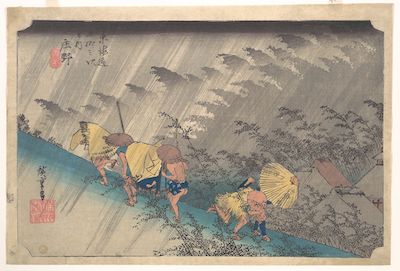
(Utagawa Hiroshige, Sudden Shower at Shōno: Metropolitan Museum of Art)

‘She can’t be completely stupid’, the Librarian says, in a rare moment of optimism, ‘she went to Oxford.’ And for a moment I almost wish I could find in that a good knockdown argument. Alas.

The heat, which changed many individual patterns of behaviour, was succeeded by several days of rain, which didn’t, and then by something balanced, pleasant, relaxing – or it would have been had the workmen in the neighbouring house, who have been there for months now, not chosen one morning to drill directly into my head. They showed too a remarkable willingness to persist, to graft, I suppose, thus refuting the latest reports of the witless witterings of—good grief!—the odds-on favourite for the leadership of the Conservative Party and thus, under our generally nineteenth-century political arrangements, Prime Minister of the United Kingdom of Great Britain and Northern Ireland.

Upstairs—and sometimes downstairs too—I bother archivists, occasionally in this country but far more often in the United States. The happy result of this is that, even as I pour a drink in the evening, goods news sometimes arrives from the Midwest or the west coast. An archivist has unearthed a previously unlisted letter from Ford Madox Ford to a publisher, a literary agent, a New York hostess, a budding author. I scrawl a message of heartfelt gratitude. Librarians and archivists may yet save the world.

Downstairs, I linger over Robert Lowell, Lafcadio Hearn and Mary Midgley. Dear Cal is of course his usual unfailingly cheerful self and emphatically not a daddy’s boy. ‘He was a man who treated even himself with the caution and uncertainty of one who has forgotten a name, in this case, his own.’[1] Hearn shuns the usual ragbag of common sense and scepticism by numbers: ‘I hold that the Impossible bears a much closer relation to fact than does most of what we call the real and the commonplace.’[2]

And Mary Midgley—I remember, a few years back, seeing an interview with, or brief statement from, the Green Party Brighton MP Caroline Lucas and Sophie Walker, then leader of the Women’s Equality Party. I found myself thinking, quite explicitly, My God! If we had people like that in charge of this country, there might be some hope. It wouldn’t be the complete bloody basket-case it is. Mary Midgley was a person like that: hugely intelligent, well-informed, intellectually curious. I read her memoir because my curiosity was piqued by the highly enjoyable volume by Benjamin Lipscomb, The Women Are Up To Something: How Elizabeth Anscombe, Philippa Foot, Mary Midgley, and Iris Murdoch Revolutionized Ethics (New York: Oxford University Press, 2022),[3] one of those valuable books which, like those of the wonderful Sarah Bakewell, are able to convince me—at least while I’m reading them—that I understand philosophy.


Midgley discusses, at one point, the idea that thought, like life, occurs in complex patterns, linked together, which have to be sorted out and dealt with on their merits. ‘This does not mean that our work is impossibly complicated. It does not mean that we cannot know anything until we know everything. Human cultures contain all sorts of convenient ways of breaking up the world into manageable handfuls and dealing with one part at a time. And we can keep continuously developing these ways so that they can correct one another. In this way, quite a lot of the time we do get things right. Attending to the background pattern of questions and answers does not tip us into a helpless relativism. But it is perfectly true that this approach does stop us hoping for a universal scientific formula underlying all thought. We cannot, as Descartes hoped, find a single path to infallible certainty. But then luckily we do not need to.’

Indeed. I confess, though, that one of my favourite moments in the book is an account of a discussion group which included Carmen Blacker, later a distinguished Japanese scholar. ‘It was Carmen who supplied me with the best example I have ever met of the diversity of moral views. When I raised the topic of conflicting customs, “Oh, I see”, she said. “Like, there’s a verb in classical Japanese which means to try out one’s new sword on a chance wayfarer?”’ Midgley later used this in an article with that name.[4]

Light rain, the faintest murmuring, and a soft soughing in the branches and leaves above the fence. Harry the cat is crouched at the open back door, snuffing up late August early evening English air. He has noticed, I think, that my method of serving his teatime bowl approximates more and more to that of Henry James’s butler, as recalled by Ford Madox Ford:

‘His methods of delivery were startling. He seemed to produce silver entrée dishes from his coat-tails, wave them circularly in the air and arrest them within an inch of your top waistcoat button. At each such presentation James would exclaim with cold distaste: “I have told you not to do that!” and the butler would retire to stand before the considerable array of plate that decorated the sideboard.’[5]

We are sliding into autumn. There is an acknowledged cost-of-living crisis. But then, come to that, there is a crisis in every area of public life, from education to social care, from farming to transport, from library provision to news media to the raw sewage fouling our coastal waters. Given our current electoral system, there’s little we can do at present: turn down the heating a degree or two, hope for a mild winter—and do our level best to resist trying out new swords on chance wayfarers.


Notes

[1] Robert Lowell, Memoirs, edited with a preface by Steven Gould Axelrod and Grzegorz Kosc (Faber & Faber 2022), 18.

[2] Lafcadio Hearn, ‘The Eternal Haunter’, in Japanese Ghost Stories, edited by Paul Murray (London: Penguin Books, 2019), 33.

[3] Benjamin J. B. Lipscomb, The Women Are Up To Something: How Elizabeth Anscombe, Philippa Foot, Mary Midgley, and Iris Murdoch Revolutionized Ethics (New York: Oxford University Press, 2022).

[4] Mary Midgley, The Owl of Minerva: A Memoir (London: Routledge, 2007), 72, 160.

[5] Ford Madox Ford, Return to Yesterday (London: Gollancz, 1931), 14.