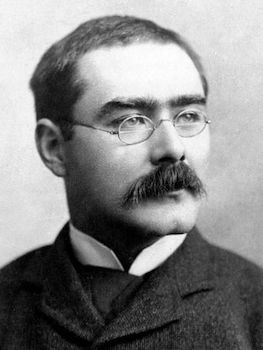

Good Wood

(The Boppard Altarpiece, Panel: limewood, pine, paint & gilt: Victoria & Albert Museum)

Back in the day—not that day, another one—a woman had been on the throne of England for around sixty years.

Walk wide o’ the Widow at Windsor,
For ’alf o’ Creation she owns:
We ’ave bought ’er the same with the sword an’ the flame,
An’ we’ve salted it down with our bones.[1]

Yes, back then, a while and a world ago, when Queen Victoria was not quite gone, Rudyard Kipling had dropped in on the west coast of the United States. ‘There was wealth—unlimited wealth—in the streets’, he wrote of San Francisco, ‘but not an accent that would not have been dear at fifty cents.’ He was disappointed by the disparity between the fine and expensive clothes worn by the women he saw and their voices, ‘the staccato “Sez he”,“Sez I,” that is the mark of the white servant-girl all the world over.’

He felt, that is to say, that ‘fine feathers ought to make fine birds.’ But, ‘Wherefore, revolving in my mind that these folk were barbarians, I was presently enlightened and made aware that they also were the heirs of all the ages, and civilised after all.’ Luckily for this much-travelled traveller, he’s been accosted by ‘an affable stranger of prepossessing experience, with a blue and an innocent eye.’

It’s true that the man has peered into the hotel register and read ‘Indiana’ for the ‘India’ that Kipling has actually come from but, for the moment, the drinks and cigars that he presses upon the famous writer are welcome.[2]

Ford Madox Ford referred numerous times to Kipling, often admiringly, but almost always—and, to me, unaccountably—focusing on the early work. Some of that is wonderful but the later stories, becoming often more complex, more oblique, more modernist, somehow get lost sight of, not only by Ford but by several other major writers of the time, as if Kipling were a known quantity and need not be kept any longer in sight.

But I was thinking mostly of that phrase tucked into the Kipling lines, which recurs several times elsewhere. ‘We are the heirs of all the ages,’ Ford wrote in early September 1913, in an essay which provided the ‘Preface’ to his Collected Poems a few weeks later and in which the same line sits.[3] He had written nearly a decade earlier of ‘all the dead Londons that have gone to the producing of this child of all the ages’, and in his 1910 novel, A Call, Grimshaw remarks to Pauline: ‘We’re the children of the age and of all the ages. . .’[4]

(Kipling/ Tennyson)

Those words look back to ‘Locksley Hall’—‘I the heir of all the ages, in the foremost files of time’—by Alfred Tennyson, a poet that Ford was generally unenthusiastic about, seeing him as one of the stifling ‘Victorian Great’ figures. Yet Tennyson’s work so saturated the second half of the nineteenth century that familiarity with it was unavoidable for any serious reader.[5]

It’s a point so obvious, so banal, so unremarkable, that huge numbers of people must fail utterly to remark it. We are the heirs, the inheritors, of all that has gone before. Not just the books, the music, the paintings—which people like me are only too ready to bang on about—but the housing, the streets, the scars on the landscape, what were the mining villages, what were the dockyards and shipyards, what were the council estates, the public libraries, the youth clubs, the community centres, the rivers, the fields and hedgerows, the birds and the butterflies, the very flavour of the air. And we are also the ones who will, in our turn, bequeath or pass on or let fall the things which others will inherit and be the heirs to. As far as we have influence and agency, what will our legacy to them look like?

After January—the first rule of that month being: survive January!—I venture a little further afield to gauge the State of Things. The news, astonishingly, is Not Good. For weeks, my main focus has been the life and letters of Ford Madox Ford in the 1920s, though, on occasion, I dipped my toes into world news, not wishing to have my leg taken off just above the knee by sharks should I venture too far in.

In the United States, things are evidently shaping up to be as bad as any sane person would expect, far worse, in fact. But there’s enough derangement here to satisfy any eager watchers at the gates of Bedlam, not least a government apparently possessed of a talent to choose every time precisely the wrong policy, facing in the the wrong direction and benefiting the wrong people.

On the bright side, though—O optimist!—the Chinese New Year celebrations have welcomed in the Year of the Snake, are still welcoming it, I suppose, since this involves not only animal but also zodiac elements. This is then the Year of the Wood Snake – also known as the Year of the Green Snake, wood being associated with the colour green. The Spring Festival, I gather, takes place over fifteen days, ending with the Lantern Festival on 12 February, and is estimated to be celebrated by some two billion people in numerous countries, not only China but Indonesia, Malaysia, Singapore, Vietnam and their diasporas.

The snake may have had a bad press—certainly a bad Judaeo-Christian press—but I read that, in Chinese astrology, as a wood animal, it’s understood to represent good luck, renewal, flexibility, tolerance. Wood is good!
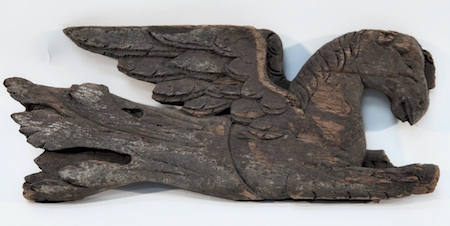
(‘Hippocamp’, a wooden carving in the form of a winged horse, originally part of the panelling inside Stafford Castle: Staffordshire County Museum Service)

This in turn brings to mind the recent piece following the death of David Lynch, which touched on Twin Peaks: The Return, and had a nice quote from Michael Horse, who played the series’ Deputy Sheriff Hawk: ‘When they did the premiere of The Return, the executives had not seen it, and they said: “Mr Lynch, would you say a few words?” And he comes out; he goes: “This project has a lot of wood in it. I like wood.”’
https://www.theguardian.com/tv-and-radio/2025/jan/23/an-oral-history-of-twin-peaks-david-lynch-madchen-amick-joan-chen

We all like wood, no?  Wood nymphs, woodwind, woodbine, woodpeckers, woodlands – as a child, I had a pet woodlouse for a short time, though it didn’t end well. Woodcuts, wood engravings. Albrecht Dürer, Hiroshige, Käthe Kollwitz, Robert Gibbings, Thomas Bewick, Clare Leighton, David Jones, Gwen Raverat. Harriet Baker wrote of woodcuts made by Carrington and Vanessa Bell: ‘Carving directly into soft wood, the markings of tools and the tremors of hands were as much a part of the final pieces as form and composition.’[6]

The French historian Fernand Braudel gave wood a significant role in the lessening of the effects of the Black Death which, he argued, ‘did not, as used to be thought, arrive in Central Europe in the thirteenth century, but in the eleventh at the latest.’ His analysis of the retreat of the disease in the 18th century mentioned stone’s replacing wood in domestic architecture after major urban fires; the general increase in personal and domestic cleanliness, and the removal of small domestic mammals from dwellings, all factors that resulted in the lessening impact of fleas. He also discussed the enormous significance of wood being used everywhere: ‘One of the reasons for Europe’s power lay in its being so plentifully endowed with forests. Against it, Islam was in the long run undermined by the poverty of its wood resources and their gradual exhaustion.’[7]
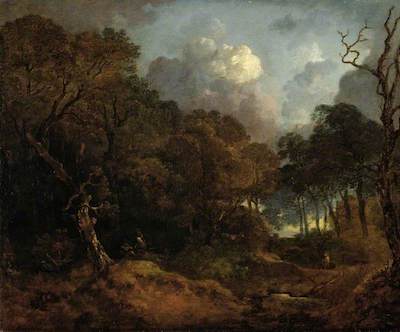
(Thomas Gainsborough, A Forest Road: Fitzwilliam Museum, Cambridge)

The gradual exhaustion of resources. Here we are again. Not so gradual now, I suspect, but in any case a phrase to tingle the tongues of those who, as previously noted, are custodians of the past and guardians of the future. Which is us, of course, even those currently making war on their own children and grandchildren.

In September 1911, Ezra Pound spent a Sunday afternoon with G. R. S. Mead, a scholar of hermetic philosophy, early Christianity and Gnosticism, the occult and theosophy: he had served as private secretary to Madame Blavatsky during her last years. He had founded the Quest Society in 1909 and invited Pound to give a lecture, which would be published subsequently in the quarterly review, The Quest. Pound delivered his lecture early in 1912 and it appeared in the October issue of the review with the title ‘Psychology and Troubadours’. Twenty years later, it was incorporated into Pound’s The Spirit of Romance.[8] It’s years since I read it but one sentence, particularly, lodged in my memory and remains intact: ‘We have about us the universe of fluid force, and below us the germinal universe of wood alive, of stone alive.’[9]

Pound, like Henri Gaudier-Brzeska, Guy Davenport wrote, ‘had conceived the notion that cultures awake with a brilliant springtime and move through seasonal developments to a decadence. This is an ideas from Frobenius, who had it from Spengler, who had it from Nietzsche, who had it from Goethe.’[10]

Yes. Never mind third runways, never mind nuclear power stations on every corner, never mind mimicking anti-immigrant messages from other political parties that run on that sort of fuel. If a body is bleeding to death in front of you—how can I put this?—it may be best, before all else, to try to stop the bleeding.

Touch wood. Good wood. Touch good wood.


Notes

[1] ‘The Widow at Windsor’, Rudyard Kipling’s Verse: Inclusive Edition, 1885-1918 (New York: Doubleday, Page & Co., 1925), 471.

[2] Rudyard Kipling, From Sea to Sea (2 volumes: Macmillan, 1900), I: 479-480

[3] Ford Madox Ford, ‘The Poet’s Eye’,  New Freewoman, I, 6 (1 September 1913), 109; ‘Preface’ to Collected Poems (London: Max Goschen, 1914 [1913]), 20.

[4] Ford Madox Ford, England and the English, edited by Sara Haslam (Manchester: Carcanet Press, 2003), 4; Ford Madox Ford, A Call: The Tale of Two Passions (1910; with an afterword by C. H. Sisson, Manchester: Carcanet Press, 1984), 23.

[5] Alfred Tennyson, Poems: A Selected Edition, edited by Christopher Ricks (London: Longman, 1989), 192.

[6] Harriet Baker, Rural Hours: The Country Lives of Virginia Woolf, Sylvia Townsend Warner & Rosamond Lehmann (London: Allen Lane, 2024), 73.

[7] Fernand Braudel, Civilization and Capitalism, 15th – 18th Century. Volume I: The Structures of Everyday Life: The Limits of the Possible (London: Fontana Books, 1985). Translated from the French; revised by Sîan Reynolds, 83, 84, 363.

[8] Ezra Pound, Ezra Pound to His Parents: Letters 1895–1929, edited by Mary de Rachewiltz, David Moody and Joanna Moody (Oxford: Oxford University Press, 2010), 260; A. David Moody, Ezra Pound: Poet: A Portrait of the Man and His Work: Volume I: The Young Genius 1885–1920 (Oxford: Oxford University Press, 2007), 159.

[9] Ezra Pound, The Spirit of Romance (1910; New York: New Directions, 1968), 92.

[10] Guy Davenport, The Geography of the Imagination (Boston: David R. Godine, 1997), 22.

All, or mostly, at sea


(Pound’s ‘Canto I’, initial by Henry Strater)

I see that, 118 years ago today—a nice round number, as they say—Ezra Pound, on a fellowship from the University of Pennsylvania to study Spanish literature in Madrid,  ‘went down to the ship’, specifically the König Albert, and left New York, landing at Gibraltar on 7 May. On that later day, he wrote to his parents to announce his arrival, mentioning that he’d been reading Rudyard Kipling’s From Sea to Sea and quoting from that work: ‘Imagine a shipload of people to whom time is no object, who have no desires beyond three meals a day and no emotions save those caused by a casual cockroach.’ He added: ‘for this voyage. deduct the cock roach, as the boat is clean.’[1]

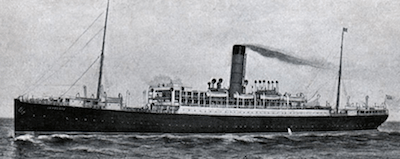
Pound went down to the ship on several occasions in this early part of his life: the European tours with his Aunt Frank Weston in 1898 and 1902; the 1906 trip;  the departure on 17 March 1908, on Cunard Royal Mail Steamship Slavonia, to Gibraltar in March, then Venice for much of the summer and on to London in August 1908.[2] In 1911, after  more than six months in the United States, he returned to Europe, boarding S. S. Mauretania on 22 February 1911. Then followed something of a pause in those sailings, before he boarded the Rex in Genoa, 13 April 1939 – that pause being a little over 28 years.[3]


(S. S. Slavonia)

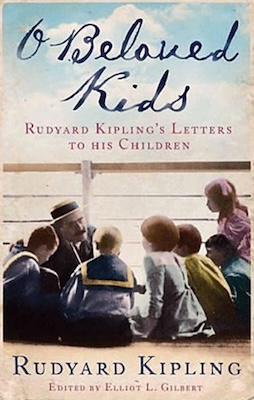
Kipling himself went down to ships a great deal more often than ‘the Idaho kid’. Born in Bombay—now Mumbai—he was taken to England, aged two, by his mother when she travelled there to give birth to her second child, Alice (‘Trix’). Then they returned to India. Aged 5, he took ship again, he and his sister being left in Southsea at ‘The House of Desolation’ as Kipling later termed it.[4] He was there for five years. In 1882, he sails back to India, returning to England seven years later via Rangoon, Singapore, Hong Kong, Yokohama, San Francisco and New York. His trip around the world follows in 1891. The following year sees more voyaging, to America and Japan. After the return to England the frequent trips to winter in South Africa begin – and there’s more to come, including the West Indies and South America.[5]

Much of the 1890s journeying fed into the many letters and sketches which provided the material for the two-volume From Sea to Sea and Other Sketches, as well as the later Letters of Travel (1892-1913). In that sense, the voyages were not simply leisure; yet Kipling could somehow combine work and play to a striking degree. Immediately preceding the lines quoted by Pound in the letter to his parents, Kipling writes: ‘Now we are lying off Moulmein [later renamed Mawlamyine] in a new steamer which does not seem to run anywhere in particular. Why she should go to Moulmein is a mystery; but as every soul on the ship is a loafer like myself, no one is discontented.’[6]

He wrote again about his experience of a specific ship in the article, ‘Sea Travel’, first published as ‘Egypt of the Egyptians’ in Nash’s Magazine (June 1914). Some of the men working on the ship brought back vivid memories of his early years in India: ‘Serangs [lascar boatswains] used to be very kind to little white children below the age of caste.’ Then: ‘Most familiar of all was the ship itself. It had slipped my memory, nor was there anything in the rates charged to remind me, that single-screws still lingered in the gilt-edged passenger trade.’ This was an exciting discovery for some ‘North Atlantic passengers’, who were ‘as pleased about it as American tourists at Stratford-on-Avon.’ The passengers are disembarking at Port Said, towards which the ‘one-screw tub thumped gingerly’. Kipling has leisure to observe the table linen, the glassware, the poor waiting service, the cabins lacking curtains and other dispiriting features: ‘time and progress had stood still with the P. & O.’ He then gets into conversation with other passengers and is entertained by the telling of several stories but ‘no stories could divert one long from the peculiarities of that amazing line which exists strictly for itself.’ He reflects on the glory days of the Peninsular and Oriental Steam Navigation Company and concludes that: ‘To-day it neither feeds nor tends its passengers, nor keeps its ships well enough to put on any airs at all.’[7]


Ships and stories. His biographers explore his love of both. He would later enjoy trips on Royal Navy vessels but in From Sea to Sea the author of Barrack-Room Ballads (1892) remarked that: ‘The blue-jacket is a beautiful creature, and very healthy, but . . . I gave my heart to Thomas Atkins long ago, and him I love’ (I, 292). Marghanita Laski observes that, ‘As a traveller, his chosen transport was the most comfortable steamer available, and even so, if the sea was at all rough, he was usually seasick.’[8] Nevertheless, a remarkable number of articles, fictions and poems centre on, or strongly feature, Matthew Arnold’s ‘unplumb’d, salt, estranging sea’.[9]

When I was a child and my father was posted to Singapore, we flew out and sailed back. I can’t be entirely sure of the ship’s name but believe it was the S. S. Oriana, at that stage owned by the Orient Steam Navigation Company. The flight out had its moments—an impressive bout of air sickness, melting tarmac under the feet at the airport in Tehran, brief stops at Istanbul and Mumbai, I think—but the voyage home, three years later, unsurprisingly, had far more. Pyramids and Tutankhamen in Cairo, fierce heat and alley cats in Aden, light and colour in Lisbon. Sea, sky, the shipboard entertainment uncritically consumed, the table tennis tournaments, ferreting about in forbidden corners, running like lunatics up and down stairs and along narrow corridors. Even a fine romance –as fine, at least, as an inexperienced thirteen-year-old could make it. . .


(A boy on a camel)

At that age, it occurs to me, Kipling’s work was appearing for the first time in The Scribbler, a family magazine, in collaboration with May and Jenny Morris (daughters of William and Jane), and Philip and Margaret Burne-Jones (children of Edward and Georgiana). More precocious than some, that Kipling.

Notes


[1] Ezra Pound, Ezra Pound to His Parents: Letters 1895–1929, edited by Mary de Rachewiltz, David Moody and Joanna Moody (Oxford: Oxford University Press, 2010), 72n., 73.

[2] J. J. Wilhelm, Ezra Pound in London and Paris, 1908-1925 (University Park: Pennsylvania State University Press, 1990), 66.

[3] A. David Moody, Ezra Pound: Poet: A Portrait of the Man and His Work: Volume II: The Epic Years 1921–1939 (Oxford: Oxford University Press, 2014), 301.

[4] Rudyard Kipling, Something of Myself, edited by Thomas Pinney (Cambridge: Cambridge University Press, 2008), 7; and see the story, ‘Baa Baa, Black Sheep’, in Wee Willie Winkie, edited by Hugh Haughton (London: Penguin Books, 1989), 260-288. An ‘English Heritage’ blue plaque is on the house now: I see it’s not so very far from where I lived in Southsea for several years.

[5] Much of the chronology lifted from Norman Page’s indispensable A Kipling Companion (London: Macmillan, 1989), 1-7.

[6] Rudyard Kipling, From Sea to Sea and Other Sketches: Letters of Travel, 2 volumes (London: Macmillan, 1900), I, 230.

[7] Rudyard Kipling, Letters of Travel (1892-1913) (London: Macmillan, 1920), 210, 211, 219.

[8] Marghanita Laski, From Palm to Pine: Rudyard Kipling Abroad and at Home (London: Sidgwick & Jackson, 1987), 142.

[9] ‘To Marguerite – Continued’, Poetry and Criticism of Matthew Arnold, edited by A. Dwight Culler (Boston: Houghton Mifflin, 1961), 81. Familiar to some readers from its use in John Fowles’ The French Lieutenant’s Woman.

Definite and indefinite gardeners


The man standing at the front door of the house we were renting in East Devon said: ‘I’m the gardener.’ We’d seen him from the living-room window a few days earlier, standing amidst the sea of fallen leaves, spending a while raking up enough of them to fill a couple of wheelbarrows. Now he wanted to do about fifteen minutes’ strimming: pretty noisy but not for long. Was that okay? Of course, I said.

I was reading a Maigret novel that day, Georges Simenon’s 1947 Maigret se fâche, translated by Ros Schwartz as Maigret Gets Angry. Maigret, in retirement with his wife at their house in Meung-sur-Loire, is fighting a battle against the Colorado beetle in defence of his aubergines: in the hot sun, he is ‘barefoot in his wooden clogs, his blue linen trousers riding down his hips, making them look like an elephant’s hindquarters, and a farmer’s shirt with an intricate pattern that was open at the neck, revealing his hairy chest.’ The formidable Madame Bernadette Amorelle marches in through the ‘little green door in the garden wall that led on to the lane and was used only by people they knew’ and, straight away, has ‘mistaken Maigret for the gardener.’[1]

(Georges Simenon: Photograph, Bettmann/CORBIS via The Guardian)

Maigret does, then, look a likely candidate for the role of gardener, at least in Madame Amorelle’s eyes; and, of course, he is a gardener – but not only that. What does a – or the – gardener look like? In Kipling’s story of that title, which has generated a remarkable quantity of commentary, criticism and speculation, the reader isn’t told. The gardener here is defined by what he does rather than how he looks or how he’s dressed: ‘A man knelt behind a line of headstones – evidently a gardener, for he was firming a young plant in the soft earth.’ When Helen Turrell leaves the war cemetery—still in the making but with more than twenty thousand dead already—she sees. in the distance ‘the man bending over his young plants; and she went away, supposing him to be the gardener.’[2]

The last half dozen words echo John 20:15, where Mary Magdalene, discovering that the body of Christ has gone from the sepulchre, finds him standing behind her, though she doesn’t immediately recognise that it is him. He asks why she’s weeping and she, ‘supposing him to be the gardener’, asks where the body has been taken. Are we to take Kipling’s gardener to represent Christ? A lot of readings do precisely that but there’s no real need to do so. Just as Helen Turrell and the people around her in the village will believe what they wish to believe and structure their lives around their chosen stories while leaving some things open or unsaid, the reader does also – or can do. He’s gardening, then – but we have moved from ‘evidently’ to ‘supposing’, so is he the gardener?

Here is one version of the meeting between Ford Madox Ford and Joseph Conrad, who would collaborate on three books in the next decade:

Conrad stood looking at the view. His hands were in the pockets of his reefer-coat, the thumbs sticking out. His black, torpedo beard pointed at the horizon. He placed a monocle in his eye. Then he caught sight of me.
I was very untidy, in my working clothes. He started back a little. I said: ‘I’m Hueffer.’ He had taken me for the gardener.[3]

Untidy; working clothes; but again, Ford is a gardener and odd-jobman. He just happens to be also—even by 1898—poet, novelist, biographer, art critic and writer of fairy tales.


Kipling’s story was first published in April 1925 and collected in 1926; this autobiographical volume of Ford’s in 1931. An earlier account of the initial meeting between the two writers occurs in Joseph Conrad: A Personal Remembrance. There, Conrad is carrying a child—his son Borys had been born eight months earlier—and, while the word ‘gardener’ is not specifically mentioned, Ford recalls that he had been ‘overcome by one of those fits of agricultural enthusiasm that have overwhelmed him every few years, so that such descriptive writers as have attended to him have given you his picture in a startling alternation as a Piccadilly dude in top hat, morning coat and spats, and as an extremely dirty agricultural labourer.’ At the time of his meeting with Conrad, he was ‘trying to make ten lettuces grow where before had been ten thousand nettles and was writing articles for the Outlook on the usage of the potato as an extirpator of thistles, in sand.’[4]

Does ‘extremely dirty’ trump ‘very untidy’? The point is that he’s getting stuck in, as he would do for much of his life: irrigating, planting, growing things, pruning. What might have been ‘experiments’ in 1898 became, at times during the 1930s in Provence, a rather more critical affair: feeding himself and his partner Janice Biala, keeping them alive in those periods when they had, quite literally, no money at all.

We might be prompted to remember the discussions that Ford would recall a quarter of a century later than that first meeting, as he crafted his memoir of Conrad:

Then we would debate: What is the practical, literary difference between ‘Penniless’ and ‘Without a penny’? You wish to give the effect, with the severest economy of words, that the disappearance of the Tremolino had ruined them, permanently, for many years…. Do you say then, penniless, or without a penny? … You say Sans le sou: that is fairly permanent. Un sans le sou is a fellow with no money in the bank, not merely temporarily penniless. But ‘without a penny’ almost always carries with it, ‘in our pockets.’ If we say then ‘without a penny’, that connoting the other, ‘We arrived in Marseilles without a penny in our pockets.’ . . . Well, that would be rather a joke: as if at the end of a continental tour you had got back to town with only enough just to pay your cab-fare home. Then you would go to the bank. So it had better be ‘penniless.’ That indicates more a state than a temporary condition. . . . Or would it be better to spend a word or two more on the exposition? That would make the paragraph rather long and so dull the edge of the story. . . .  (Joseph Conrad 85-86)

 (Stevie Smith, via the BBC)

‘Penniless’ or ‘without a penny’? A garden in which you grow the food to keep your family this side of starvation—it helps if you’re a good cook, which Ford certainly was—or a garden to be maintained, tidied, to please the aesthetic sense and lift the spirits. Stevie Smith’s Pompey Casmilus needs cheering up much of the time; and can appreciate the positive effect of work done: ‘Yesterday the gardener was here, and now the garden, newly prinked and tidied, the paths as neat and formal as a parade, shines beneath this early morning sun that has broken through to break the rain and storm clouds of past months. How very spry the garden looks, like a good child that has a washed face and a clean pinafore.’[5]


We don’t grow our food here, though we did manage some tomatoes a year or two back. We have one gardener; and two other residents that benefit from her efforts. Still, she’s a gardener, rather than the gardener, while Harry is the cat and I – am something other. . .


Notes

[1] Georges Simenon, Maigret Gets Angry (Maigret se fâche, 1947), translated by Ros Schwartz (London: Penguin Books, 2015), 3, 4, 9.

[2] Rudyard Kipling, ‘The Gardener’, in Debits and Credits, (1926; edited by Sandra Kemp, London: Penguin Books, 1987), 287.

[3] Ford Madox Ford, Return to Yesterday: Reminiscences 1894-1914 (London: Victor Gollancz, 1931), 52.

[4] Ford Madox Ford, Joseph Conrad: A Personal Remembrance (London: Duckworth, 1924), 15-16. Conrad would later confirm that ‘The first time I set eyes on you was in your potato-patch’: letter of 15 December 1921, quoted by Max Saunders, Ford Madox Ford: A Dual Life, two volumes (Oxford: Oxford University Press, 1996), I, 521n4.

[5] Stevie Smith, Over the Frontier (1938; London: Virago Press, 1980), 115.

‘England have my bones’

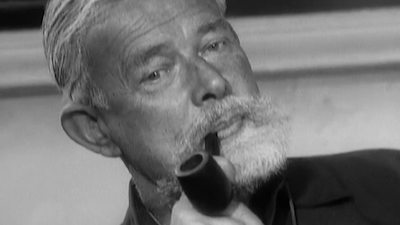
(T. H. White on Alderney: BBC)

‘Heaven take my soul, and England keep my bones!’ are Arthur’s last words in Shakespeare’s King John (IV.iii.10), as he leaps from a castle wall. T. H. White, author of The Goshawk and The Once and Future King (another Arthur), among many other books, had a slightly different version, the last four words of which gave him the title of his 1936 volume: ‘God keep my soul/ And England have my bones.’ It ended up, he said, as ‘a book about the tangible side of country life’, adding that: ‘Fishermen will be maddened by the flying, aviators by the snakes, zoologists by the instructions for playing darts.’ Trying to imagine ’the kind of person who will bear with every digression’, he concluded that, should such a person exist, ‘he will be an amateur like myself: a reader with a forgiving mind, not a critical one: somebody not fascinated by sherry parties, who can see the point of an England defined by negatives.’[1]

White’s letter to David Garnett (his second) asking Garnett to look at England Keep My Bones marked the beginning of their nearly thirty-year friendship, ‘a friendship which, reversing the usual order, ripened into acquaintance’, Sylvia Townsend Warner explained, ‘for they met seldom, and never for long at a time. In fact, they were better apart. When they met, they got on each other’s nerves.’

(Sylvia Townsend Warner via NYRB; and her biography of White)

But then, with strangers, as another friend remembered, White ‘could be quite odious; rude and suspicious if he thought they were lionizing them, still more if he thought they weren’t; shouting down anyone who disagreed with his more preposterous assertions or even ventured to interrupt.’[2]

White’s book is often lyrical, but also marked by frequently pugnacious or arresting statement—‘Nowadays we don’t know where we live, or who we are’ (3), ‘I felt happy and interested, as if I had been condemned to death’ (20-21), and ‘Even sitting in the same chair rots one’s soul. Decent men ought to break all their furniture every six months’ (65). There are curious anecdotes and details, such as the origins of Lewis Carroll’s Mad Hatter (42) and, writing of ‘the shire’ in which he lives, located about half-way between ‘the doze of Norfolk and the fierce friendliness of Gloucestershire’ (4), he notes that it boasted the first recorded beheading and the last person to be gibbeted (110). But there are also evocative statements such as ‘Falling in love is a desolating experience, but not when it is with a countryside’ (22), which seem expressly designed to be plundered by people like me – and have been. The book’s devotion to ‘outdoor pursuits’ prompted the reviewer James Agate to remark—quite understandably, I think—‘It is about subjects in which I am not even faintly interested. It is entrancing’ (quoted by Warner, 87).

It was on this day 85 years ago, 18 August 1935, that White scored 180 with three darts—‘for the first and last time in three or four thousand games of darts’—in The Rose and Crown at Burwash, ‘of which the proper pronunciation is Burridge’ as Henry James remarked to Ford Madox Ford (who already knew).[3] ‘It was not a landlord’s board’, White added, by which I take him to mean that if the target areas for the highest scoring darts are slightly enlarged there is a correspondingly larger chance of successful, happy, and thus higher-spending, punters. ‘Burwash’ may, though, be pronounced ‘Burrish’: it certainly was by a helpful National Trust volunteer, to whom I put the specific question on my one visit to Bateman’s, the fine Jacobean house in which Rudyard Kipling—a story of whom was the occasion of James’s pronouncing the name to Ford—made his home between 1902 and his death in 1936. I bought a bag of flour from the 17th century—and still working—mill which could at that time be seen in action most Wednesday and Saturday afternoons.

(Batemans: National Trust)

The setting is remarkable: the house itself, the garden, the 1928 Rolls Royce Phantom 1 – and the mill. Kipling installed a turbine generator in 1902 and, in the autumn of that same year, published a short story, ‘Below the Mill Dam’. The story, collected in Traffics and Discoveries (1904), largely comprises a conversation between the cat and the rat and is widely seen as a political fable expressing Kipling’s dislike of the attitudes and policies exemplified by Arthur Balfour. David Gilmour, author of The Long Recessional: The Imperial Life of Rudyard Kipling, thinks the cat is Balfour (or at least talks like him): ‘there is no problem identifying the prototype of the Grey Cat’.[4]

That memorable visit to East Sussex was heavily Ford Madox Ford-related: he lived for years in the area, and his books—ten, fifteen, twenty years later—are saturated with its place-names and roads and buildings and outlooks. But, with an hour or two to spare in the afternoon, with Bateman’s on the route back to the station, Kipling-world became irresistible. Perhaps I’ll get back there – sometime – for a longer, slower look.

Notes

[1] England Have My Bones (1934; London: Macdonald Futura, 1981), v-vi.

[2] Sylvia Townsend Warner, T. H. White: A Biography (New York: Viking, 1968), 86; John Verney in the ‘Foreword’, 6.

[3] Ford, Return to Yesterday (London: Gollancz, 1931), 7.

[4] David Gilmour, The Long Recessional: The Imperial Life of Rudyard Kipling (London: John Murray, 2002), 181.

Tales of reconstruction

FMF-No-Enemy Kipling-Traffics

The latest Times Literary Supplement (3 January 2020) has a feature in which various writers select a book currently unavailable that they believe warrants reissuing: ‘Some nominations for out-of-print books that deserve to be rediscovered and republished’. Some interesting choices, a few of them enlightening, one or two slightly puzzling in the way they’re presented. Some, though not all, comment briefly on the recent publication history of their selected title. Internet searches have made tracking down secondhand copies a much less strenuous affair, while an increasing number of books now are available, or at least can be ordered, in rather disgusting print on demand versions, the older ones often simply scanned in, so with texts ranging from unreliable to unreadable.

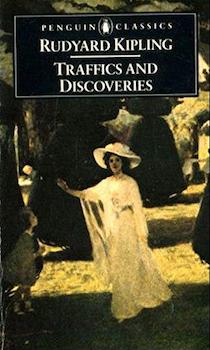
Several books I’d not heard of at all—which was presumably the point, or one of them—and some are triumphantly on the money. Ruth Scurr, for one, with her highlighting of the wonderful Alethea Hayter; and Elizabeth Lowry chooses Kipling’s Traffics and Discoveries, which is a fine collection: she quite rightly mentions ‘They’ and ‘Mrs Bathurst’ and I assumed that they at least would be included in the intriguingly titled Collected Stories from Everyman. The second one is but, bafflingly, while ‘A Sahib’s War’ and ‘“Wireless”’ are, ‘They’ is not. The Everyman is a handsome volume but even 900 pages is not enough to gather up all the best, or a wholly representative range, of Kipling’s stories, as several editors have no doubt discovered.

Still, the main points of interest for this reader were, firstly, the title of the piece: ‘Tales of reconstruction’; and secondly, the book whose subtitle provides the TLS heading: Ford Madox Ford’s No Enemy: A Tale of Reconstruction. It’s chosen by the estimable Alexandra Harris: it was published, as she says, in 1929, and mostly written ten years earlier.

It’s of particular interest because, firstly, that’s where the name of this blog comes from; secondly, because while some of the contributors mention recent reprints, Harris doesn’t add anything to that ‘1929’. There was, though, a 1984 Ecco Press edition, a straight reprint of the original Macaulay edition; then the first UK edition, which I edited for Carcanet Press in 2002. It went out of print a few years back and Carcanet haven’t reprinted it but, after a couple of years when secondhand copies advertised on the ABE website were offered at ridiculous prices, there are several copies currently available for quite reasonable sums.

The Carcanet volume didn’t attract much attention when it appeared, less than I’d expected for the first British edition of a book by a major British writer, after a gap of more than seventy years. A short but invaluable notice from Alan Judd, eminent novelist and biographer of Ford; and a very brief review in the Guardian by someone who seemed to have read the first dozen pages and left it at that. For Alexandra Harris, it is ‘one of the most arrestingly original books I know about the experience of landscape.’ She adds that Ford ‘finds a language of numbness and revelation that anticipates Woolf’s “moments of being”; he works through layers and collages that we might now associate more readily with Sebald.’

That’s well said: though I may be biased, having mentioned Sebald in my 2002 introduction. A very interesting feature anyway: and a few titles I’ll certainly look out for. Perhaps not the Ford though: I seem to have several copies already.


Cooking, cleaning, washing the pig

; Chinese People Washing Three Large, White Elephants

(Unknown artist, ‘Chinese people washing three large, white elephants’: Wellcome Collection)

07:30 and my Spelt loaf is underway. But I actually enjoy bread making so can this count as housework? Cooking, fine, washing up and vacuuming, okay; ironing, less so; cleaning, much less so.

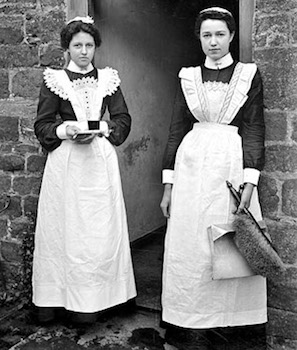
When Rudyard Kipling moved into Bateman’s in September in 1902, the house and thirty-three acres costing £9300, he was, Andrew Lycett notes, looking forward to washing his 335 apple trees ‘with oil, limewash, salt and soap’ as recommended in the agricultural textbooks.[1] Would that count as housework? Probably not. Gardening or perhaps, on that scale, farming—‘We began with tenants – two or three small farmers on our very few acres – from whom we learned that farming was a mixture of farce, fraud, and philanthropy that stole the heart out of the land’—and would Kipling have done that work himself? He certainly had views on domestic service – of some of the people he met on his return from India to England: ‘They derided my poor little Gods of the East, and asserted that the British in India spent violent lives “oppressing” the Native. (This in a land where white girls of sixteen, at twelve or fourteen pounds per annum, hauled thirty and forty pounds weight of bath-water at a time up four flights of stairs!)’[2]

Batemans

http://www.kiplingsociety.co.uk/batemans.htm

D. H. Lawrence might turn his hand to sweeping floors and baking bread—and the Skeptic philosopher Pyrrhon of Elis was, apparently, ‘known to dust the house and sweep the floors for his sister, and was once seen washing the pig’[3]—but the real (male) literary demon when it comes to housework is Patrick White, whose letters are littered with references to the daily tasks. ‘I seem to spend all my time washing up and preparing for the next meal’, he wrote to Frederick Glover and, on the eve of a long trip to Europe, remarked to Mollie McKie: ‘Still, it will be a change not to do the washing up for a few months. I did go away for a few days recently. but found myself washing up in self-defence as my hosts were so bad at the sink.’ To Geoffrey Dutton, he confided that: ‘My rheumatics only left after house-cleaning days: I suppose all the stooping and stretching drove them out; so you can tell Max [Harris] that is another good reason not to keep a “char”.’ Later, furious at a review of one of his plays which asked what Patrick White knew about suburbia since he was brought up ‘in a mansion’, he told Mary Benson: ‘I had lived in suburbia for twelve years, between sink and stove, and scrubbing my own floors, before writing that play.’ Again to Dutton, describing a call from a friend, he noted in passing that ‘I was labouring at the house-cleaning when the telephone went’.[4]

White-Letters

When White and Manoly Lascaris moved to the house in Martin Road in October 1964, White’s biographer records, they had a cleaning woman for a short time but White stated that, ‘after doing everything in the way of house-cleaning ourselves over the last fifteen years, I find it a great strain having somebody else about, and I am always relieved when those mornings are over.’ She didn’t last and, ‘Once again, he took up the broom and Hoover himself.’[5]

How long does all this stuff take? How long should it take? Judith Flanders writes that most Victorian houses (above a certain social level, of course) ‘operated a system that ran more or less as follows:

Monday: laundry

Tuesday: servant’s room [if time was allowed for it at all, her note adds], one bedroom

Wednesday: remaining bedrooms

Thursday: drawing room, breakfast room, morning room

Friday: dining room and polishing the silver

Saturday: hall, stairs, kitchen, passageways

Sunday: collect, sort and soak laundry ready for Monday’[6]

Edwardian-maids

http://www.edwardianpromenade.com/occupations/general-servants-time-table/

Lucy Lethbridge, writing of the Edwardian period, notes that ‘Cotton, woven in the great textile factories of the industrial Midlands, needed mangling, starching, bleaching and pressing to keep its appearance. For the working-class housewife, washing her own family’s clothes took up two full days of the week.’ Midway through the twentieth century, ‘In 1950 a survey of full-time housewives showed that they spent an average of seventy hours a week on housework; in a survey in 1970 that average had risen to seventy-seven hours.’[7]

Leaving aside the fact that ‘labour-saving devices’ are assumed to do precisely that—and surely they became more widely available in those twenty years—seventy-seven hours? Really? Eleven hours a day every day of the week? Madness. I shall continue to cook, wash up, hoover and sweep a bit – and make bread. As for the bathroom and shower. . . the Librarian and I will draw lots.

 
References

[1] Harry Ricketts, The Unforgiving Minute: A Life of Rudyard Kipling (London: Chatto and Windus, 1999), 278; Andrew Lycett, Rudyard Kipling (London: Weidenfeld, 1999), 347.

[2] Rudyard Kipling, Something of Myself: For My Friends Known and Unknown, (1936; edited by Robert Hampson, Harmondsworth: Penguin, 1987), 146, 87.

[3] ‘Pyrrhon of Elis’, in The Jules Verne Steam Balloon: Nine Stories by Guy Davenport (San Francisco: North Point Press, 1987), 25.

[4] Patrick White, Letters, edited by David Marr (London: Jonathan Cape, 1994), 123, 125, 352, 436-437, 493.

[5] David Marr, Patrick White: A Life (London: Vintage, 1992), 447.

[6] Judith Flanders, The Victorian House: Domestic Life from Childbed to Deathbed (London: Harper Collins, 2003), 106-107.

[7] Lucy Lethbridge, Servants: A Downstairs View of Twentieth-century Britain (London: Bloomsbury, 2013), 76, 308.


Fording Kipling

Sadler, John, 1843-1908; The Anchorite's Cell, Chester

(John Sadler, The Anchorite’s Cell, Chester: Grosvenor Museum)

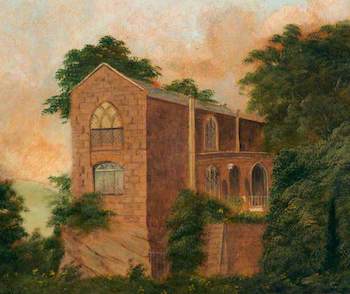
In 1877, Rudyard Kipling’s mother took her children from Lorne Lodge in Southsea—‘the House of Desolation’—to Golding’s Hill, on the edge of Epping Forest. In Kipling and the Children, Roger Lancelyn Green mentions that a part of the young Kipling’s reading there was Meinhold’s Sidonia the Sorceress, ‘a shibboleth of the Pre-Raphaelite circle (Morris later reprinted it at the Kelmscott Press)’. Later in the book, Green cites Edward A. Freeman’s reference to the legends of how Harold survived the Battle of Hastings: ‘Harold is supposed to have become a hermit, visiting many shrines but finally settling in the cell still shown as his near St. John’s Church, Chester.’[1]

The two details together reminded me of The Young Lovell, the last novel that Ford Madox Ford published before The Good Soldier, and which he described in a letter to his agent, dated 17 March 1913.[2]

‘The date is towards the end of the XVth Century, running up to the beginnings of the Reformation, though it isn’t in that sense concerned with religion. The action takes place in Northumberland and the story contains any number of things concerning “The Percy out of Northumberland”, the Bishops Palatine of Durham, the besieging of castles, border raids, and so on with what is called “a strong element of the supernatural” and a vigorous love interest.’[3]

Edward_Burne-Jones_Sidonia_von_Bork

(Edward Burne-Jones, Sidonia von Bork: Tate)

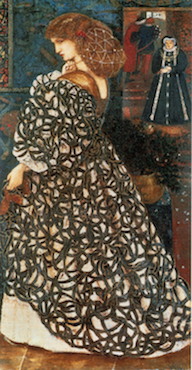
Sidonia the Sorceress, by Wilhelm Meinhold, was indeed ‘a shibboleth of the Pre-Raphaelite circle’, read and recommended by Dante Gabriel Rossetti, William Morris, Edward Burne-Jones (who painted watercolours depicting two of the book’s characters), Oscar Wilde (whose mother had translated it), Ford’s grandfather, Ford Madox Brown, and his brother Oliver (who wrote a book on witches). This is part of the ‘strong element of the supernatural’ contained in Ford’s novel.[4]

FMF-via_Arts_Desk

(Ford Madox Ford: via The Arts Desk)

The legend about Harold ending as a hermit in an anchorite’s cell is mirrored in the closing pages of The Young Lovell, where, in the aftermath of a great battle, Lovell’s body is walled up in a hermit’s cell while his spirit disports in paradise with the goddess Venus. Ford’s story is set in 1486, the year after the death of Richard III at the Battle of Bosworth Field. Historically, then, it follows not merely a battle but a war, since Bosworth Field was the last decisive battle in the Wars of the Roses, as Richard was the last king of the House of York and the last king of the Plantagenet dynasty.

Francis Lovell was a noted supporter of Richard: he disappeared in 1487, presumed dead. Mysteriously, though, when building work was carried out on his ancestral home, Minster Lovell, in 1708, a man’s skeleton was apparently discovered ‘in a vault’, seated at a table, surrounded by papers and with a dog’s skeleton at his feet – all crumbled to dust as soon as air was admitted to the room.[5] Max Saunders also connects Ford’s novel with a Victorian ballad called ‘The Mistletoe Bough’, in which a young bride disappears: her skeleton is eventually found in a trunk, in which she had been accidentally locked while playing hide-and-seek. The husband in the ballad is twice referred to as ‘Young Lovell’.[6]

Rudyard_Kipling .

(Rudyard Kipling)

The Ford–Kipling relationship or, rather, the lack of it, remains an enduring object of interest to me. They were not quite exact contemporaries (Kipling was eight years older) but had very similar Pre-Raphaelite backgrounds; and significant figures in Kipling’s case, the painter Edward Burne-Jones (Kipling’s uncle) and Crom Price (headmaster of United Services College at Westward Ho, scene of the Stalky & Co stories), were aligned not only in their artistic tastes and convictions but also in their anti-imperialist politics. So when Kipling veered off the path that he might have appeared to be cruising along, it was not only Pre-Raphaelitism that he diverged from – he moved camp politically too. Of course, while Ford wrote a lot about the Pre-Raphaelites, he also struggled at times to free himself from the inevitable weight of his familial and cultural connections. As for his politics: they tend to resist any attempt at tidy analysis, since he claims at various points to be strongly Tory, while simultaneously arguing the case for black South Africans at the time of the Boer War, or for Irish Home Rule; and ending as an equally unclassifiable pacifist, anarchist eco-warrior in the 1930s.

Ford’s complex dealings with England and Englishness would also seem to connect with Kipling’s own – his ‘foreignness’ that long sojourn in India, to set against Ford’s German family.  But, while Ford wrote several times about Kipling, as poet and short-story writer, Kipling displayed no evidence of knowing that Ford was even in the world. Yet, despite his many references to Kipling, Ford always seems to locate his best work in the Indian tales, barely mentioning anything thereafter. For me, apart from Kim and a scattering of the early stories, the work of greatest interest starts in Traffics and Discoveries (1904), running all the way through to Limits and Renewals (1932). And those more complex, oblique, often puzzling later stories are sufficiently ‘modern’ to make Ford’s apparent dismissal of them frankly odd.

Still, as literary lives, theirs were very different from one another. Ford’s literary connections were enormous and ranged over three generations, while Kipling’s friends, especially in later life, tended not to be writers. He became quite hostile to London literary society, in fact, and wrote satirical stories about it or  referring to it – they tend not to be among his best.

No, I certainly haven’t explained it satisfactorily to myself. Perhaps a minor mystery, but still one that I’m unlikely to lose interest in any time soon.


References

[1] Roger Lancelyn Green, Kipling and the Children (London: Elek, 1965), 49, 204.
And see: http://chester.shoutwiki.com/wiki/Hermitage

[2] He did publish Ring For Nancy in the United States around the same time but this was a slightly revised version of The Panel, a novel published in the UK a year earlier.

[3] Ford Madox Ford to James B. Pinker, Letters of Ford Madox Ford, edited by Richard M. Ludwig (Princeton: Princeton University Press, 1965), 56.

[4] I review Ford’s sources for the novel in ‘“Pretty Big and Serious”: Ford Madox Ford and The Young Lovell’, in Laura Colombino and Max Saunders, editors, The Edwardian Ford Madox Ford, International Ford Madox Ford Studies 12 (Amsterdam: Rodopi, 2013), 237-255.

[5] See, for instance, James Gairdner, ‘Francis, Viscount Lovel: Minster Lovel’, Notes & Queries, 5th series, X (1878), 28-29.

[6] Max Saunders, ‘The Case of The Good Soldier’, in Max Saunders and Sara Haslam, editors, Ford Madox Ford’s The Good Soldier: Centenary Essays (Amsterdam: Brill/Rodopi, 2015), 147, n.17.