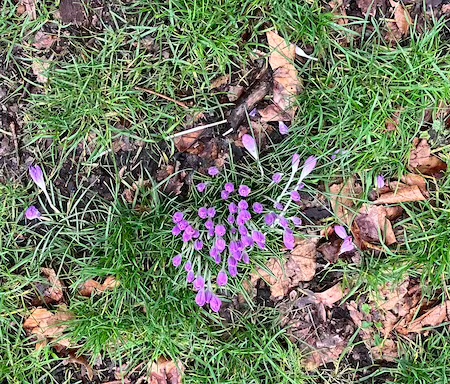
Crocuses promising well and not waiting for rain


Sitting at the kitchen table, a cat within the circle of my arms, flanked by James Baldwin and Walter de la Mare, I was thinking about crocuses.

The poet Edmund Blunden, then serving in the 11th Royal Sussex, ‘heard an evening robin in a hawthorn, and in trampled gardens among the luggage of war, as Milton calls it, there was the fairy, affectionate immortality of the yellow rose and blue-grey crocus.’[1] And: ‘The garden is gay with crocuses’, Ford Madox Ford wrote to John Rodker in March 1920, ‘or shd it be crocoi?’ De la Mare himself was not wholly adverse to a crocus: ‘the crocus soon/ Will open grey and distracted/ On earth’s austerity’; ‘as near, that is, as any name can be to a thing—viz, crocus, or comfit, or shuttlecock, or mistletoe, or pantry’; ‘Miss Curtis would no more have dreamed of sharing this old ghost with, say, Miss Mavor, than a crocus would dream of blossoming at the foot of the North Pole.’[2]

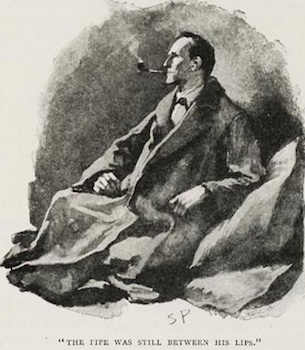
Literary, literary. It was, in fact, while walking in the park, that the Librarian drew my attention to a small group of crocuses, harbingers of spring, a welcome light in the encroaching gloom of the year so far, not least because of seemingly inexhaustible rain. We had rain on twenty-six days out of thirty-one in January. Several places outstripped that, there were floods on the Somerset Levels and elsewhere. But in any case—literary again!—the mention of crocuses always brings to mind Sherlock Holmes, specifically the alarming appearance of the gigantic and ferocious Dr Roylott, who has ‘dashed open’ the door of the sitting-room at 221b Baker Street:
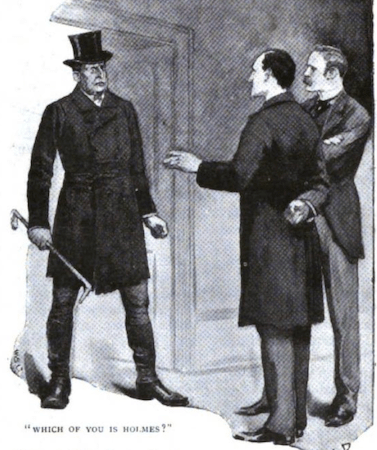
(Illustration by Sidney Paget, Strand Magazine, February 1892)

‘“Which of you is Holmes?” asked this apparition.
“My name, sir; but you have the advantage of me,” said my companion quietly.
“I am Dr. Grimesby Roylott, of Stoke Moran.”
“Indeed, Doctor,” said Holmes blandly. “Pray take a seat.”
“I will do nothing of the kind. My stepdaughter has been here. I have traced her. What has she been saying to you?”
“It is a little cold for the time of the year,” said Holmes.
“What has she been saying to you?” screamed the old man furiously.
“But I have heard that the crocuses promise well,” continued my companion imperturbably.’[3]

The promise of crocuses—or should it be crocoi? Promises, promises. Spring, yes, and all that it connotes. Or, perhaps, all that it used to connote.

‘The past has consequences in the present regardless of whether we know what happened in it; learning the history makes those consequences intelligible.’[4]

The month recently ended will soon be a finite, measurable chunk of that past, a blood smear on some historian’s page. Harold Wilson may or may not have said that a week is a long time in politics; Joseph Chamberlain, some eighty years earlier, is fairly reliably recorded as asserting that there’s no use in looking beyond the next fortnight.

Glancing around at a volatile and feverish world I was about to remark in an email to a friend that—hardly surprisingly—I seemed to be suffering from ‘the English disease’. I meant melancholia but remembered just in time that understanding of the term has varied over time, taking in rickets, a sluggish economy caused by industrial unrest, bronchitis, football hooliganism and more: ‘The English disease, a love of Nature, was inborn in her’, Virginia Woolf wrote of her heroine/ hero Orlando.[5]
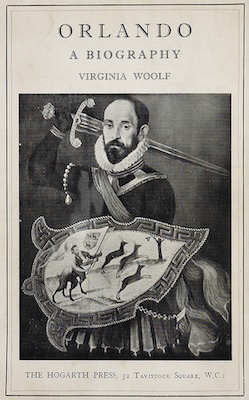
(Orlando, Hogarth Press, 1928)

Among the many pleasures of reading published diaries are the references to—or, sometimes, the lack of them, or delayed enlargement on them—what are later viewed as hugely significant events. I was recently reading Helen Garner’s impressive and enjoyable How To End a Story: Collected Diaries, 1978-1998 and seeing ‘The army has entered Tiananmen Square and machine-gunned students’ or ‘People are sitting on top of the Berlin Wall. They’re chipping chunks out of it with chisels, for souvenirs’. I wonder if some of what’s occurring now will be reducible in time to one or three or five lines. In what form will the United States survive? Will liberal or left of centre politicians learn how to do politics in this online, social media age so resistant to accurate information and inconvenient facts? Will Europe get its act—economics, security—together? I note various leaders’ recent responses as they finally accept that the current version of the United States is neither friend nor ally, and recall that appeasement didn’t work too well in the 1930s and is unlikely to do so now.

‘I imagine that one of the reasons people cling to their hates so stubbornly is because they sense, once hate is gone, that they will be forced to deal with pain’, James Baldwin wrote in ‘Notes of a Native Son’, first published as ‘Me and My House’ in November 1955.[6] Adam Shatz’s recent essay about the current situation in the United States, first delivered as a lecture, begins with Baldwin, who is also referenced in the piece’s title, ‘Another Country’ (Baldwin’s third novel). Shatz remarks that, though both parties have been ‘complicit in the creation of the imperial presidency and a neoliberal economic order’, ‘anyone who cares about the stability of the republic might have reason to regret the disintegration of moderate Republicanism, one of the defining structural features of American political life.’[7] We have suffered a version of that in this country too, with the collapse and near-disappearance of moderate Conservatism, those figures to whom we were totally opposed twenty or more years ago appearing now almost as beacons of light, intelligence and sweet reason, compared to the current crew. If I’d seriously believed then that the political landscape would be what it is, that certain individuals would be regarded as acceptable public servants, even as plausible contenders for government office, I would have sought medical help as a matter of urgency. Mais passons. There is always the rain. . .
‘If there’s much more of this’, I say to the Librarian as we trudge wetly home, ‘we might be living in a J. G. Ballard novel.’ We pass the City Farm, where their prize hens are sheltering, huddled together, beneath their chicken coop. It occurs to me that a number of Ballard novels might qualify though I was referring specifically to The Drowned World, which is, of course, concerned with rather more than water: ‘Sometimes he wondered what zone of transit he himself was entering, sure that his own withdrawal was symptomatic not of a dormant schizophrenia, but of a careful preparation for a radically new environment, with its own internal landscape and logic, where old categories of thought would merely be an encumbrance.’[8]

There has been very little brightness. Too often the sliver of sunlight glimpsed earlier in a day is—fittingly, in the current political climate—neither sincere, truthful, friendly or sustained. I’ve had the odd drenching myself but—full-length waterproof coat! umbrella! Englishman!—with no apparent ill-effects. Others have not always been so lucky. Perhaps ‘the most dramatic incident’ of Lewis Carroll’s life, Penelope Fitzgerald remarked, was the river expedition to Nuneham when the whole party, ‘including his aunt, two of his sisters, and Alice herself, got wet through and had to be taken to a friend’s house to dry off. In 1898, almost as an afterthought, Dodgson died of a cold and cough.’[9]
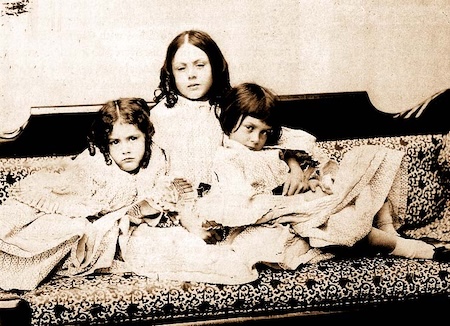
(Edith, Lorina and Alice Liddell)

Needless to say, awash as the country is, the disastrous privatisation of this vital resource, with its attendant greed and incompetence, has resulted in towns and villages running out of water, waiting days for their supplies to be reconnected or warned that they may have to be abandoned in the fairly near future. There is, apparently, a great deal more trouble to come: https://www.theguardian.com/commentisfree/2026/jan/22/what-happens-england-water-run-out-drought-tunbridge-wells

The drought last summer was not as bad as it might have been because preceded by a wet autumn and winter, reservoirs well-filled and groundwater in a healthy state – certainly not as bad as that recalled by the novelist Violet Hunt. ‘We were in for a hot July—it was the year 1911 when heat and drought drove men mad, caused the cattle that supported them to be lean and perish, filled the Courts with murder and rapine, inflamed Strike committees, and incensed three nations to the verge of war for want of a little rain that might have staunched their hissing hatreds.’[10]

‘For want of a little rain.’ Just so.


Notes

[1] Edmund Blunden, Undertones of War (1928; revised edition, Harmondsworth: Penguin Books, 1982), 117.

[2] Respectively, ‘The Children of Stare’, Collected Poems (London: Faber and Faber, 1979), 21; ‘Pigtails Ltd’, Walter de la Mare, Collected Stories for Children, edited by Giles de la Mare (London: Giles de la Mare Publishers Limited, 2006), 7; ‘The Picnic’, Short Stories, 1927-1956, edited by Giles de la Mare (London: Giles de la Mare Publishers Limited, 2001), 180.

[3] Arthur Conan Doyle, ‘The Adventure of the Speckled Band’, in The New Annotated Sherlock Holmes, 2 volumes, edited with notes by Leslie S. Klinger (New York and London: W.W. Norton and Company 2005), I, 241-242..

[4] Sarah Churchwell, The Wrath to Come: Gone With the Wind and the Lies America Tells (London: Head of Zeus, 2022), 11.

[5] Virginia Woolf, Orlando (1928; Oxford: Oxford University Press, 1992), 137.

[6] James Baldwin, ‘Notes of a Native Son’, in Collected Essays, edited by Toni Morrison (New York: Library of America, 1998), 7.

[7] Adam Shatz, ‘Another Country’, London Review of Books 48, 2 (5 February 2026), 3-10.

[8] J. G. Ballard, The Drowned World (London: Fourth Estate, 2012), 14.

[9] Penelope Fitzgerald, ‘In the Golden Afternoon’: A House of Air: Selected Writings, edited by Terence Dooley with Mandy Kirkby and Chris Carduff (London: Harper Perennial, 2005), 81.

[10] Violet Hunt, The Flurried Years (London: Hurst and Blackett, 1926), 177-178.
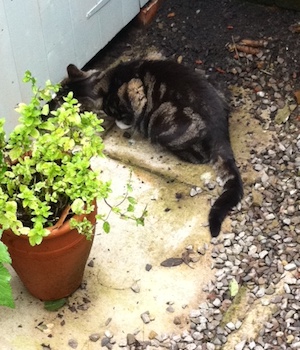
Smelling a rat

H-ratting

(Harry, student of current affairs, smelling a rat)

I was thinking again about rats, prompted not only by the current political situation, though that possesses strong indicators, but, in the first instance, by seeing a brown rat—not the endangered black rat—shoot across the garden and, on a later occasion, help itself to seeds on the bird table, having shinned up a long, smooth pole to reach it. I invited the cat to deal with the situation (perhaps you know the story of James Joyce and Ernest Hemingway out on the town in Paris, where the half-blind Joyce would get into fights, be unable to locate his opponent and simply say ‘Deal with him, Hemingway, deal with him!’)—but Harry showed no inclination to do so. It was not a particularly small rat.

The second instance was my nightly reading to the Librarian, not for the first time, Conan Doyle. Devotees of the Sherlock Holmes stories will recall that, in ‘The Adventure of the Sussex Vampire’, Holmes alludes to the giant rat of Sumatra, ‘a story for which the world is not yet prepared.’ Leslie Klinger notes the discovery made by Guy G. Musser and Cameron Newcomb of a species Sundamys infraluteus, weighing in excess of 22 pounds and 24 inches long (including the tail), a discovery reported in a 270-page article in 1983.

Then too there is ‘The Boscombe Valley Mystery’:

‘The Coroner: Did your father make any statement to you before he died?
Witness: He mumbled a few words, but I could only catch some allusion to a rat.
The Coroner: What did you understand by that?
Witness: It conveyed no meaning to me. I thought that he was delirious.’

Later, Watson asks Holmes: ‘What of the rat, then?’ His friend produces a map of the Colony of Victoria (he has wired to Bristol for it the previous night).

‘He put his hand over part of the map. “What do you read?”
“ARAT,” I read.
“And now?” He raised his hand.
“BALLARAT.”’

Aha! That was Charles McCarthy trying to utter the name of his murderer, John Turner, formerly Black Jack of Ballarat. [1]

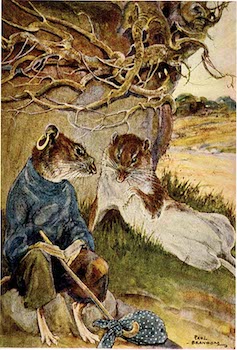
Rats are affectionately observed or referenced by Colette—‘I have a little Rat [Colette de Jouvenel, otherwise Bel-Gazou, born 3 July 1913], and I have paid the price: thirty hours without respite, chloroform and forceps’[2]—and Kenneth Grahame, whose The Wind in the Willows appeared in 1908, though his rat was a water-vole.

Paul-Bransom-Wind-Willows

(Paul Bransom, from The Wind in the Willows)

The First World War, specifically life in the trenches on the Western Front, introduced new rat-perspectives, from David Jones:

You can hear the silence of it:
you can hear the rat of no-man’s-land
rut-out intricacies,
weasel-out his patient workings,
scrut, scrut, sscrut,
harrow out-earthly, trowel his cunning paw;
redeem the time of our uncharity, to sap his own amphibious paradise.[3]

and from Isaac Rosenberg, in ‘Break of Day in the Trenches’ (‘Only a live thing leaps my hand,/ A queer sardonic rat’).

Rats—and ferrets—bulked fairly large in Ford Madox Ford’s war too. When a French Minister in wartime Paris asked how he could be of use to Second Lieutenant Hueffer, Ford expressed his desire for some ferrets. ‘First of everything in the world—of everything in the whole world!—comes your battalion. And the ferrets of my battalion had all died suddenly; and the last thing they had said to me had been: Don’t forget to get us some ferrets. If you had seen the rats of Locre you would have understood.’ But, he adds, ‘the Minister had not seen the rats of Locre so he had not understood…. ’[4] Closer to the time of that ministerial incomprehension—‘“Quoi,” he asked. “What is a ferret?”’—the Francophile Ford wrote: ‘There are no ferrets in France, not in the Ministries, not in the Jardin des Plantes et d’Acclimatation. That is perhaps a defect of France, but I have perceived no other.’[5]

Another species of entente cordiale had emerged in the sixteenth century, with John Florio’s translation of the Essays of Michel de Montaigne. Sarah Bakewell writes: ‘But while Montaigne always moved forward, Florio winds back on himself and scrunches his sentences into ever tighter baroque spirals until their meaning disappears in a puff of syntax. The real magic happens when the two writers meet. Montaigne’s earthiness holds Florio’s convolutions in check, while Florio gives Montaigne an Elizabethan English quality, as well as a lot of sheer fun.’ So, ‘Where Montaigne writes, “Our Germans, drowned in wine” (nos Allemans, noyez dans le vin), Florio has “our carowsing tosspot German souldiers, when they are most plunged in their cups, and as drunke as Rats”’. And, wonderfully, ‘A phrase which the modern translator Donald Frame renders calmly as “werewolves, goblins, and chimeras” emerges from Floriation as “Larves, Hobgoblins, Robbin-good-fellowes, and other such Bug-beares and Chimeraes” – a piece of pure Midsummer Night’s Dream.’

Miranda_-_The_Tempest_JWW

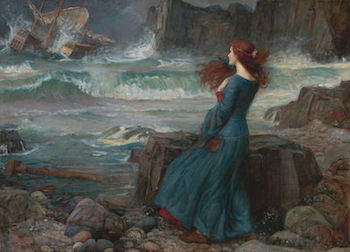
(J. W. Waterhouse, Miranda)

And yes, as she goes on to say, Shakespeare did know John Florio, ‘was among the first readers of the Essays translation’ and left strong traces of that reading in several of his plays.[6] Or, if not Montaigne, then rats:

A rotten carcase of a butt, not rigg’d,
Nor tackle, sail, nor mast; the very rats
Instinctively have quit it (The Tempest, I, ii)


Notes

[1] Arthur Conan Doyle, The New Annotated Sherlock Holmes, 2 volumes, edited with notes by Leslie S. Klinger (New York and London: W.W. Norton and Company 2005), II, 556-557; I, 111, 125.

[2] To Georges Wague, mid-July 1913: Colette, Letters from Colette, selected and translated by Robert Phelps (London: Virago Press, 1982), 36.

[3] David Jones, In Parenthesis (1937; London: Faber, 1963), 54.

[4] Ford Madox Ford, No Enemy (1929; edited by Paul Skinner, Manchester: Carcanet Press, 2002), 133.

[5] Ford Madox Ford, ‘Trois Jours de Permission’, in War Prose, edited by Max Saunders (Manchester: Carcanet Press, 1999), 51. The editor points out in his headnote (49) that the ferrets recur in several other Ford works. The story of ‘Ford’s rat’ is in Joseph Conrad (1924), 40-41.

[6] Sarah Bakewell, How To Live: A Life of Montaigne in one question and twenty attempts at an answer (London: Vintage 2011), 277-279.


A matter of fact, a matter of error

Evoe .

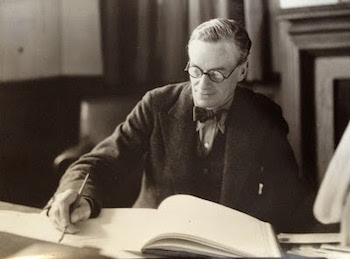
(‘Evoe’, Edmund Knox via Jot101: http://www.jot101.com/ )

On my way through the park, I pass four people, each accompanied by an average of 2.75 dogs. It seems a little excessive but the total is dominated by the woman gripping five leads, to each of which is attached to a dog of such slender proportions that, taken all together, they would barely comprise a single, ordinary-sized dog.

Perhaps I was taking refuge in such arithmetical precision because I’d been thinking of error, specifically of writers’ errors, even more specifically of novelists’ errors and wondering whether that was a contradiction in itself.

Penelope-Fitzgerald-Guardian

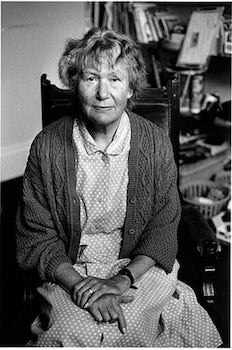
(Penelope Fitzgerald via The Guardian)

Edmund Knox, later ‘Evoe’ of Punch and father of Penelope Fitzgerald, began his editorial career as a boy, taking charge of the family newspaper, The Bolliday Bango. His brothers, ‘Dilly’, classical scholar and later code breaker, Wilfred, priest and teacher, and Ronald, the celebrated Catholic theologian, translator and writer of detective stories, all contributed to the Bango’s production. One venture was the detection of ‘a number of inaccuracies, even downright contradictions, in the Sherlock Holmes stories’. They sent a list of these to Arthur Conan Doyle, ‘in an envelope with four dried orange pips, in allusion to the threatening letter in The Sign of Four’, but received no reply.

Later, in 1911, Ronnie Knox expanded that original letter into a paper given to the Gryphon Club in Trinity College, Oxford. ‘A satire on all higher scholarship, including his brother’s work on Herondas and his correspondence with German textual experts’, which entailed Ronnie’s invention of Professors Ratzegger and Sauwosch. ‘He set out to show, strictly from internal evidence, that the Return stories are clumsy inventions by Watson, who had taken to drink. This would account, for instance for his neglect of his practice, and the ludicrous errors he makes in the colour of Holmes’s dressing-gown.’

Holmes-dressing-gown

(Sherlock Holmes by Sidney Paget)

It also prompted a letter from Conan Doyle to Ronnie, expressing ‘the amusement – and also the amazement’ with which he had read the article, going on to explain ‘the vexed point’ about the bicycle tracks in ‘The Adventure of the Priory School’.[1]

Studies in the Literature of Sherlock Holmes, the title under which it was published the following year and reprinted several times since, is widely credited with inaugurating Sherlockian studies, ‘The Game’, the world in which Holmes and Watson are real people and Conan Doyle a useful agent. Knox pointed out that the incident of Percy Trevor’s bulldog biting Holmes on his way down to chapel was ‘clearly untrue, since dogs are not allowed within the gates at either University’, while an Oxford scholarship paper including ‘only half a chapter of Thucydides’ was also absurdly improbable. ‘And, worst of all, the dummy in the Baker Street window is draped in the old mouse-coloured dressing-gown! As if we had forgotten that it was in a blue dressing-gown that Holmes smoked an ounce of shag tobacco at a sitting, while he unravelled the dark complication of The Man with the Twisted Lip![2]

A remarkable proportion of the annotations in Leslie Klinger’s edition of the Holmes canon are concerned with inconsistencies or contradictions while the majority of the ‘capsule’ entries on individual stories in Dick Riley and Pam McAllister’s compilation refer to ‘Oddities and Discrepancies’.[3]

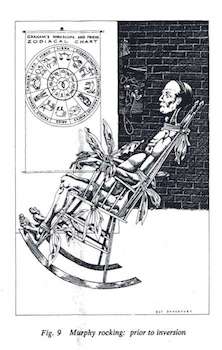
There are degrees and types of ‘error’, of course: firstly, internal, those inconsistencies within the Holmes canon, a man writing prolifically and often hurriedly, over long periods of time and great stretches of material, with occasional lapses hardly surprising. An ‘error’ of a slightly different kind is in the opening passage of Samuel Beckett’s Murphy, where a man has tied himself to a rocking-chair with seven scarves: their positions are detailed but total only six. There are other practical improbabilities and impossibilities (how the last scarf was tied, for instance), concerning which Hugh Kenner remarks: ‘A novel, in short, is a novel, not a map of the familiar world, and Beckett’s novels differ from most in the consistency of their insistence upon this principle.’[4]

Davenport-Murphy-rocking

(Guy Davenport, ‘Murphy rocking: prior to inversion’. Drawing in Hugh Kenner’s The Stoic Comedians: Flaubert, Joyce, and Beckett, facing p. 98)

Indeed. But many novels, not excluding Joyce’s Ulysses, occupy a space so close to that familiar world that their breaths mingle. Joyce said he wanted ‘to give a picture of Dublin so complete that if the city one day disappeared from the earth it could be reconstructed out of my book.’[5] That implies a certain documentary accuracy, a topographical precision – even in a work whose hero is an advertising canvasser based on Homer’s ‘man of many devices’.

In Ford Madox Ford’s Some Do Not. . ., Christopher Tietjens, home on leave, proposes as spiritual adviser to their son the priest who has appeared earlier in the novel: ‘Sylvia stood up, her eyes blazing out of a pallid face of stone: “Father Consett,” she said, “was hung on the day they shot Casement. They dare not put it into the papers because he was a priest and all the witnesses Ulster witnesses. . . . And yet I may not say this is an accursed war.”’[6]

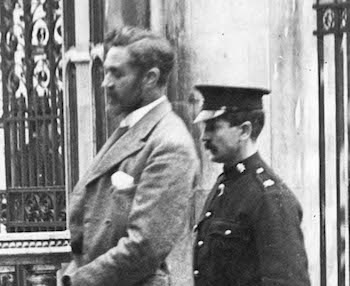
casement-Irish-Post

(Roger Casement via The Irish Post)

Roger Casement was hanged, not shot, in August 1916. A reviewer of Some Do Not. . . took Ford to task for his ‘inaccuracy’, as Ford noted in his dedicatory letter to the second volume in the sequence, No More Parades, where he discussed his reasons for referring to Casement’s being hanged, specifically his conversation with a woman who could not, she said, bear the thought that the English had hanged him.[7] In his Joseph Conrad: A Personal Remembrance, also published in 1924, Ford wrote about Conrad’s encounter with Casement in Africa and remarked that it was ‘as unspeakably painful to him when later Casement, loathing the Belgians so much for their treatment of the natives on the Congo, took up arms against his own country and was, to our eternal discredit, hanged, rather than shot in the attempt to escape’.[8]

Joyce went to enormous trouble to get the details of 1904 Dublin ‘right’. Ford too worried about factual accuracy in, particularly, the constituent parts of Parade’s End. He had always had ‘the greatest contempt’ for novels that were written with an obvious moral purpose. ‘But when I sat down to write that series of volumes, I sinned against my gods to the extent of saying that I was going—to the level of the light vouchsafed me—to write a work that should have for its purpose the obviating of all future wars.’ Given that intention, the rest followed: ‘So it was my duty to be sure of my details. For technical facts as facts I have no respect whatever. Normally I rather despise myself for playing for factual accuracy in a novel. It did no harm to Shakespeare not to know that Bohemia has no sea-coast or even to believe in the fabled virtues of the mandrake. I would just as gladly make such slips as not. But they give weapons to fools and if, in this case, I failed in factual correctness, I should betray the cause for which I was working.’[9]

One more. ‘It is my sense’, Guy Davenport wrote, ‘that I am always telling a story rather than projecting an illusory, fictional world. I am aware of the trap in argument whereby we can seem to square a story with reality, and I felt wonderfully helpless when various critics jumped on my “mistakes.” One brave Boston soul swore he was at that air show in Brescia, that Kafka wasn’t there (the crowd was estimated by La Sentinella Bresciana to be 50,000), and that Blériot did not look like my description. A Russian has written to know why I have Lenin speaking in a dialect he wouldn’t have used. And so on.’[10]

‘Wonderfully helpless’. Yes, in which world do you start? Or rather, when you’re standing up to your waist in water, in a strong current: which bank do you push for? A great many novelists now begin with ‘research’; some, alas, seem never to leave it, while the fiction is swept downstream.

As to facts, among other inhabitants of that borderland. . .

‘Facts do not find their way into the world in which our beliefs reside; they did not produce our beliefs; they do not destroy them; they may inflict on them the most constant refutations without weakening them.’[11]


References

[1] Penelope Fitzgerald, The Knox Brothers (London: Macmillan, 1977), 50, 105-106.

[2] Studies in the Literature of Sherlock Holmes, reprinted in Blackfriars, I, 3 (June 1920), 156, 158, 159 – essay downloadable here: https://www.lib.umn.edu/pdf/holmes/Blackfriars_v1n3_1920_RA_Knox.pdf

[3] Arthur Conan Doyle, The New Annotated Sherlock Holmes, 2 volumes, edited with notes by Leslie S. Klinger (New York and London: W.W. Norton and Company 2005); Dick Riley and Pam McAllister, The Bedside, Bathtub and Armchair Companion to Sherlock Holmes (New York: Continuum, 1999).

[4] Hugh Kenner, A Reader’s Guide to Samuel Beckett (1973; Syracuse: Syracuse University Press, 1996), 58.

[5] Frank Budgen, James Joyce and the Making of ‘Ulysses’ and other writings, enlarged edition (1934; London: Oxford University Press, 1972), 69.

[6] Ford Madox Ford, Some Do Not. . . (1924; edited by Max Saunders, Manchester: Carcanet Press, 2010), 218.

[7] Ford Madox Ford, No More Parades (1925; edited by Joseph Wiesenfarth, Manchester: Carcanet Press, 2011), 5-6.

[8] Ford Madox Ford, Joseph Conrad (London: Duckworth, 1924), 101, 129. All this and more elucidated by Max Saunders’ note in Some Do Not. . ., 218.

[9] Ford Madox Ford, It Was the Nightingale (London: Heinemann, 1934), 205, 206.

[10] Guy Davenport, ‘Ernst Machs Max Ernst’, The Geography of the Imagination (Boston: David R. Godine, 1997), 376.

[11] Marcel Proust, The Way by Swann’s, translated by Lydia Davis (London: Allen Lane, 2002), 149.