Birth days (and other kinds)

‘Birth, and copulation, and death.
That’s all the facts when you come to brass tacks:
Birth, and copulation, and death.’
            (Fragment of an Agon)[1]

Is T. S. Eliot’s Sweeney a little too concise here? You may be thinking, in some moods yes, in some moods no. You may even be thinking it a little too expansive. But most people, I suspect, might want to add a bit.

Take today, for instance, 17 December. The celebrated translator of Russian literature, Constance Garnett, died at 03:00 on this day in 1946. Over 70 English versions, of Turgenev, Dostoevsky, Chekhov, Goncharov, Tolstoy. Dorothy Sayers, author of superb detective stories and translator of Dante, died in 1957, also on this day.

The middle term: throw in a wedding (and assume a positive). On 17 December 1914, the painter Paul Nash and Margaret Odeh—‘Bunty’—were married in St Martin-in-the-Fields by ‘the young pacifist vicar the Reverend Dick Sheppard.’[2] Cue the opening stanza of W. H. Auden’s Letter to Lord Byron:

Excuse, my lord, the liberty I take
   In thus addressing you. I know that you
Will pay the price of authorship and make
   The allowances an author has to do.
   A poet’s fan-mail will be nothing new.
And then a lord—Good Lord, you must be peppered,
Like Gary Cooper, Coughlin, or Dick Sheppard.[3]

Gary Cooper, at least, will still be a familiar name; the other two, these days, rather less so, though not to historians of the 1920s and 1930s: Sheppard, the priest whose sermons, broadcast by the BBC, made him a national figure, and who later founded the Peace Pledge Union; Charles Coughlin, the Catholic priest who was also a widely-known broadcaster, though his anti-Semitic and pro-Fascist sympathies made his output rather different.
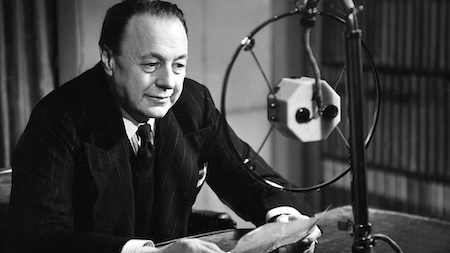
(Dick Sheppard broadcasting from St Martin-in-the-Fields: BBC)

On 17 December 1941, Sylvia Townsend Warner wrote to her friend Paul Nordoff: ‘Luckily, I have a tough memory for what I like, and I have most of it tucked away somewhere behind my ears.’[4] Just ten days after the attack on Pearl Harbor, then, a reminder if one were needed that on another 17 December—1903—Wilbur Wright’s fourth and last flight carried him  852 feet in 59 seconds.

The implications of that pioneering effort emerged with gradually increasing force and clarity a decade or so later. In 1915, Ezra Pound wrote to his parents (17 December): ‘Lewis has enlisted. That about takes the lot.’ He added: ‘I suppose we will go to France after the war. if it ever ends.’[5] Bombardier Wyndham Lewis would later recall that: ‘The war was a sleep, deep and animal, in which I was visited by images of an order very new to me. Upon waking I found an altered world: and I had changed, too, very much.’[6]

A few years on (17 December 1958) and the great Australian novelist Patrick White was writing to his friend and publisher Ben Huebsch—the rock on which White’s career was built, David Marr remarks—about his novel, Riders in the Chariot. ‘I shall want somebody here to check the Jewish parts after a second writing. I feel I may have given myself away a good deal, although passages I have been able to check for myself, seem to have come through either by instinct or good luck, so perhaps I shall survive. After all, I did survive the deserts of Voss.’ And in another letter to Huebsch, five months later, he returned to this: ‘What I want to emphasise through my four “Riders” – an orthodox refugee intellectual Jew, a mad Erdgeist [Earth spirit] of an Australian spinster, an evangelical laundress, and a half-caste aboriginal painter – is that all faiths, whether religious, humanistic, instinctive, or the creative artist’s act of praise, are in fact one.’[7] (I reread all Patrick White’s books seven years ago and I’m damned if I don’t feel almost ready to do it again. . .)
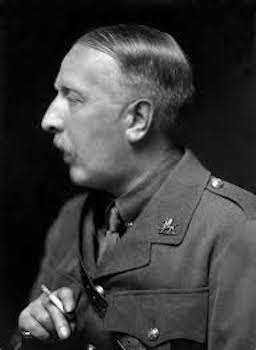
(Ford via New York Review of Books)

But then – why not celebrate? 17 December birthdays, yes: Humphry Davy, John Greenleaf Whittier, Erskine Caldwell, Paul Cadmus, Penelope Fitzgerald, Jacqueline Wilson, John Kennedy Toole – and the primary focus, or beginning spark, of all this anniversary rambling, Ford Madox Ford, 152 today.

His birthdays weren’t always joyous: at a party in 1901, he nearly choked on a chicken bone ‘and was prostrate for some days’.[8] In 1916, he was in a Red Cross Hospital in Rouen, writing to Joseph Conrad a couple of days later: ‘As for me—c’est fini de moi, I believe, at least as far as fighting is concerned—my lungs are all charred up & gone—they appeared to be quite healed, but exposure day after day has ended in the usual stretchers and ambulance trains’. In 1920, he spent at least a small portion of his birthday writing to Thomas Hardy, asking him to sign a manifesto protesting against British government policy in Ireland. It was published on 1 January 1921 in the Manchester Guardian and other papers. Fifty writers, artists and academics signed it but Thomas Hardy was not among them.

Past lives, past struggles, victories, defeats. Surely there is comfort to be found there, that they were faced with things we recognise only too well—not only the individual battles but the more general ones, against Fascism, vicious racism, authoritarianism, the hijacking of news, of the sources of information, the assaults on free speech, on civil liberties, on democratic rights—and came through. And we?

Optimism, pessimism. One up, one down; Monday, Tuesday; left hand; right hand. I liked Guy Davenport on the judicious estimate of his own make-up, reporting to Hugh Kenner that his friend Steve Diamant’s photographs included one that served as the author photograph on the dust jacket of Tatlin!, Davenport’s first collection of stories, or assemblages: ‘Guy beaming in the Dionysian priest’s chair, the Theatre, Athens. I had no notion such a radiant smile was in me. It cured a third of my paranoia and an eighth of my Calvinist pessimism to see it.’[9]

A whole eighth. Some photograph, some smile.


Notes

[1] T. S. Eliot, The Complete Poems and Plays (London: Faber and Faber, 1969), 122.

[2] Ronald Blythe, First Friends: Paul and Bunty, John and Christine – and Carrington (London: Viking, 1999), 77; David Boyd Haycock, A Crisis of Brilliance (London: Old Street Publishing, 2009), 238-9.

[3] W. H. Auden, The English Auden: Poems, Essays and Dramatic Writings, 1927-1939, edited by Edward Mendelson (London: Faber, 1977), 169.

[4] Sylvia Townsend Warner, Letters, edited by William Maxwell (London: Chatto & Windus, 1982), 76.

[5] Ezra Pound, Ezra Pound to His Parents: Letters 1895–1929, edited by Mary de Rachewiltz, David Moody and Joanna Moody (Oxford: Oxford University Press, 2010), 358.

[6] Wyndham Lewis, Rude Assignment: A narrative of my career up-to-date (London: Hutchinson, 1950), 129.

[7] Patrick White, Letters, edited by David Marr (London: Jonathan Cape, 1994), 151, 153. Marr’s remark about Huebsch’s importance is in ‘The Cast of Correspondents’, 638.

[8] Arthur Mizener, The Saddest Story: A Biography of Ford Madox Ford (London: The Bodley Head, 1972), 73.

[9] Questioning Minds: The Letters of Guy Davenport and Hugh Kenner, edited by Edward M. Burns, two volumes (Berkeley: Counterpoint Press, 2018), I, 630.
Oxford Days (a few)


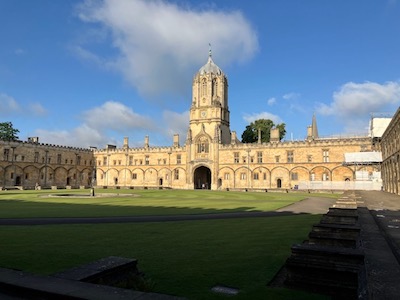
(Tom Quad, Christ Church College)

‘Even when we protested the invasion of Iraq’, I said to the Librarian, recalling that day some twenty years earlier when we shuffled along London streets in company with over a million others, ‘I think we moved more quickly than this.’

‘This’ was our glacial progress up St Aldates in Oxford on a sunny afternoon, together with residents, tourists, American and other participants in the Oxford Experience, or those embarked upon the countless other summer courses and programmes, and many hundreds of—mainly Japanese—children dressed in the Gryffindor house colours of scarlet and gold, concerned to take in the Harry Potter vibrations from New College, the Bodleian Library and Christ Church College. Tour guides in their dozens hoisted small flags or halted in gateways with uplifted arms. Lanyards in their hundreds bobbed or swung. Some individuals, either on home turf or away, looked vague, a little stunned, reminding me of the passage in Rory Stewart’s memoir, where he described Steve Hilton, David Cameron’s director of strategy, moving into the corridor and another room. ‘He seemed to be searching for something – although I couldn’t tell whether it was a cat, an idea, or his shoes.’[1]

On High Street or Broad Street, Broad Walk, Christ Church Meadow, by rivers and canals, on bridges and benches, crowds ebbed and flowed – but mainly flowed. We are soon to be visible in a thousand physical or virtual photograph albums. I said, at one point, ‘Okay, if it’s a child of ten or younger having a photograph taken, we’ll pause. Otherwise, we plough straight on.’ The Librarian agreed but soon lowered the qualifying age to eight, then six. Minutes later, it was down to zero. Thereafter, we ploughed straight on.


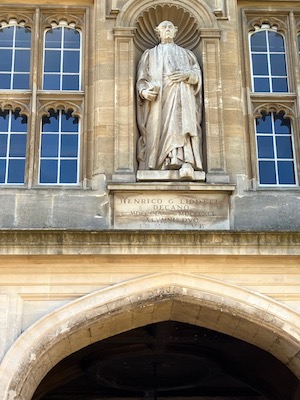
(Alice Liddell’s dad, Henry George Liddell, dean of Christ Church from 1855)

Oxford! The literary references the word throws up are astonishing, even excluding the people that only studied there. Lewis Carroll, or rather, Charles Dodgson, haunts the place, but other names rampage through a distracted memory: Philip Pullman, Dorothy Sayers’ Gaudy Night, John Wain, P. D. James, Iris Murdoch, Hardy’s Jude and Colin Dexter’s Morse, C. S. Lewis and J. R. R. Tolkien. A random footnote fact I gathered since that visit was that Edward De Vere, seventeenth Earl of Oxford, was educated not at Oxford, as one might reasonably expect, but at Queen’s College, Cambridge. Attempts were later made to claim him as the ‘real’ author of Shakespeare’s plays, an idea launched by the splendidly named John Thomas Looney. De Vere was the nephew of Arthur Golding, translator of Ovid, his Metamorphoses ‘the most beautiful book in the language’, in Ezra Pound’s words.[2] A man skilled in ‘fourteeners’ (that many syllables in a line):

Then sprang up first the golden age, which of it selfe maintainde,
The truth and right of every thing unforst and unconstrainde.
There was no feare of punishment, there was no threatning lawe
In brazen tables nayled up, to keep the folke in awe.
There was no man would crouch or creepe to Judge with cap in hand,
They lived safe without a Judge, in everie Realme and lande.

Here Daphne flees from Apollo:

And as shee ran the meeting windes hir garments backewarde blue,
So that hir naked skinne apearde behinde hir as she flue,
Hir goodly yellowe golden haire that hanged loose and slacke,
With every puffe of ayre did wave and tosse behind hir backe.[3]

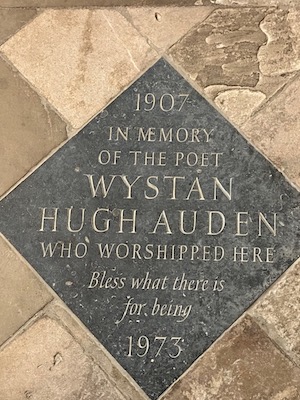
One name occurs on the ground as well as in the mind, the memorial plaque in Christ Church Cathedral (astonishing vaulted ceiling, stained glass by Burne-Jones and others, the St Frideswide Shrine). W. H. Auden came to the College to study biology, switched to English Literature in his second year and graduated (with a third class degree) in 1928. Nearly 30 years later, he became Oxford Professor of Poetry, and returned to Christ Church to live (part of the time) in 1972, the year before his death.


Wot, no Ford Madox Ford notes? Perhaps a sly one. In Some Do Not. . ., Christopher Tietjens, in a mood verging on ‘high good humour’, walks through a Kentish field with Valentine Wannop, a scene, a day, a walk which will recur in both their memories. Among those things that the best people must know are the local names (and the stories behind them) of the plants and flowers they pass. Tietjens—younger son, mathematician, member of the English public official class, who will also, in time, be lover, soldier and antique dealer—tells over to himself the words, the names, the language:

In the hedge: Our lady’s bedstraw: dead-nettle: bachelor’s button (but in Sussex they call it ragged robin, my dear: So interesting!) cowslip (paigle, you know, from the old French pasque, meaning Easter): burr, burdock (farmer that thy wife may thrive, let not burr and burdock wive!); violet leaves, the flowers of course over; black briony; wild clematis: later it’s old man’s beard; purple loose-strife. (That our young maids long purples call and liberal shepherds give a grosser name. So racy of the soil!) …[4]

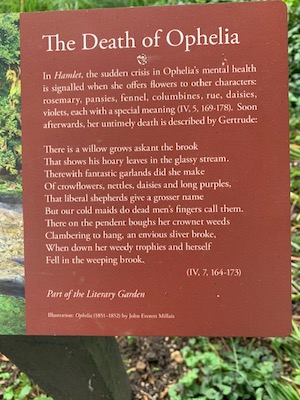
In the wonderful Botanic Garden, the country’s oldest, one section is the Literary Garden, featuring plants that occur in literature, Alice in Wonderland, Agatha Christie (a great user of poisons) and others, including William Shakespeare:

Yes, those liberal shepherds grossly naming again. Modernists though Joyce, Eliot, Woolf, Wyndham Lewis and Ford were, they were not Futurists rejecting the past—a little more selective than that: ‘BLAST years 1837 to 1900’ and, indeed, ‘BLESS SHAKESPEARE for his bitter Northern Rhetoric of humour’—and they all had frequent recourse to that Elizabethan. . .


Notes

[1] Rory Stewart, Politics on the Edge: A Memoir from Within (London: Jonathan Cape, 2023), 100.

[2] Ezra Pound, The ABC of Reading (London: Faber and Faber, 1961), 127

[3] Extracts in The Oxford Book of Classical Verse, edited by Adrian Poole and Jeremy Maule (Oxford: Oxford University Press, 2000), 394; The Oxford Book of Verse in English Translation, Chosen and Edited by Charles Tomlinson (Oxford: Oxford University Press, 1980), 38.

[4] Ford Madox Ford, Some Do Not. . . (1924; edited by Max Saunders, Manchester: Carcanet Press, 2010), 132.

On the other hand


There was, is, a saying:
‘Till April is dead
Change not a thread’

Perhaps less a suggestion to heavy users of social media than a body blow to personal hygiene. All Fools’ Day, I finally troubled to find out, is of French origin, the poisson d’avril—April fish—persons to be hoaxed or have a cardboard fish attached to their backs or simply to be sent on some ridiculous errand. The April fish, because of its abundance in that month, is the mackerel – and the French maquereau also meaning ‘pimp’, occasional complications, or extensions of the idea, were always likely to arise.[1]

‘Whan that Aprille with his shoures soote’ or no, rather, as has been very often quoted of late, ‘the cruellest month’. Some days begin well enough. After breakfast, sitting at the kitchen table with Wodehouse or Lawrence or Mary Wollstonecraft (‘more tea, Mary?’), the cat at the back door or already upstairs again, sprawled on the bed with the Librarian, who is speaking French back at her iPad or looking at her timetable, clouds on the breezier days moving, steadily stately galleons, above the trees and houses, maybe the quick crossword done, even a sentence written that stays written.

But the news is always there, whether just arriving or already waiting. The worst is still from Ukraine, of course, the continued targeting and murder of civilians, and names that will not be forgotten by historians of atrocity: Borodyanka, Bucha, Mariupol, Kramatorsk.

‘Far from his illness’, W. H. Auden wrote of W. B. Yeats, ‘The wolves ran on through the evergreen forests’.[2] To those deluged in grief or fighting for their lives, it’s often shocking that things go on elsewhere – perhaps not as normal, or as before, but they go on. Apsley Cherry-Gerrard, youngest member of Scott’s second Antarctic expedition, who had gone to the war with his health still shaky, was invalided out of the army with what was eventually diagnosed as ulcerative colitis. While men died in their hundreds of thousands on the other side of the channel, Cherry found himself, in 1916, alone in the family home for the first time. ‘There, in the stillness behind the high yew hedge, he watched the oaks and beeches flower and observed the progress of a family of robins nesting in the willow. He noted the arrival of a hen sparrowhawk, and listed the species of tits hovering around the fruit trees. It was a stay against the chaos of the war, and he absorbed himself in the smallness of his garden while the world went mad.’[3]

A few months after the end of that war, Aldous Huxley—who had, in fact, volunteered but was, inevitably, rejected on health grounds because of his famously poor eyesight, following a serious infection years before—wrote to his brother Julian: ‘great events are both terrifying and boring, terrifying because one may be killed and boring because they interfere with the free exercise of the mind—and after all, that freedom is the only thing in the world worth having and the people who can use it properly are the only ones worthy of the least respect: the others are all madmen, pursuing shadows and prepared at any moment to commit acts of violence. The prospects of the universe seem to me dim and dismal to a degree.’[4]

Well, yes. On the other hand – there are goldfinches in our garden. . .


Notes

[1] Bonnie Blackburn and Leofranc Holford-Strevens, The Oxford Companion to the Year (Oxford: Oxford University Press, 1999), 140, 142-143.

[2] Auden, ‘In Memory of W. B. Yeats (d. Jan. 1939)’, W. H. Auden, The English Auden: Poems, Essays and Dramatic Writings, 1927-1939, edited by Edward Mendelson (London: Faber, 1977), 241.

[3] Sara Wheeler, Cherry: A Life of Apsley Cherry-Gerrard (London: Jonathan Cape, 2001), 185.

[4] Aldous Huxley, Letters of Aldous Huxley, edited by Grover Smith (London: Chatto and Windus, 1969), 173-174