Fording Kipling

Sadler, John, 1843-1908; The Anchorite's Cell, Chester

(John Sadler, The Anchorite’s Cell, Chester: Grosvenor Museum)

In 1877, Rudyard Kipling’s mother took her children from Lorne Lodge in Southsea—‘the House of Desolation’—to Golding’s Hill, on the edge of Epping Forest. In Kipling and the Children, Roger Lancelyn Green mentions that a part of the young Kipling’s reading there was Meinhold’s Sidonia the Sorceress, ‘a shibboleth of the Pre-Raphaelite circle (Morris later reprinted it at the Kelmscott Press)’. Later in the book, Green cites Edward A. Freeman’s reference to the legends of how Harold survived the Battle of Hastings: ‘Harold is supposed to have become a hermit, visiting many shrines but finally settling in the cell still shown as his near St. John’s Church, Chester.’[1]

The two details together reminded me of The Young Lovell, the last novel that Ford Madox Ford published before The Good Soldier, and which he described in a letter to his agent, dated 17 March 1913.[2]

‘The date is towards the end of the XVth Century, running up to the beginnings of the Reformation, though it isn’t in that sense concerned with religion. The action takes place in Northumberland and the story contains any number of things concerning “The Percy out of Northumberland”, the Bishops Palatine of Durham, the besieging of castles, border raids, and so on with what is called “a strong element of the supernatural” and a vigorous love interest.’[3]

Edward_Burne-Jones_Sidonia_von_Bork

(Edward Burne-Jones, Sidonia von Bork: Tate)

Sidonia the Sorceress, by Wilhelm Meinhold, was indeed ‘a shibboleth of the Pre-Raphaelite circle’, read and recommended by Dante Gabriel Rossetti, William Morris, Edward Burne-Jones (who painted watercolours depicting two of the book’s characters), Oscar Wilde (whose mother had translated it), Ford’s grandfather, Ford Madox Brown, and his brother Oliver (who wrote a book on witches). This is part of the ‘strong element of the supernatural’ contained in Ford’s novel.[4]

FMF-via_Arts_Desk

(Ford Madox Ford: via The Arts Desk)

The legend about Harold ending as a hermit in an anchorite’s cell is mirrored in the closing pages of The Young Lovell, where, in the aftermath of a great battle, Lovell’s body is walled up in a hermit’s cell while his spirit disports in paradise with the goddess Venus. Ford’s story is set in 1486, the year after the death of Richard III at the Battle of Bosworth Field. Historically, then, it follows not merely a battle but a war, since Bosworth Field was the last decisive battle in the Wars of the Roses, as Richard was the last king of the House of York and the last king of the Plantagenet dynasty.

Francis Lovell was a noted supporter of Richard: he disappeared in 1487, presumed dead. Mysteriously, though, when building work was carried out on his ancestral home, Minster Lovell, in 1708, a man’s skeleton was apparently discovered ‘in a vault’, seated at a table, surrounded by papers and with a dog’s skeleton at his feet – all crumbled to dust as soon as air was admitted to the room.[5] Max Saunders also connects Ford’s novel with a Victorian ballad called ‘The Mistletoe Bough’, in which a young bride disappears: her skeleton is eventually found in a trunk, in which she had been accidentally locked while playing hide-and-seek. The husband in the ballad is twice referred to as ‘Young Lovell’.[6]

Rudyard_Kipling .

(Rudyard Kipling)

The Ford–Kipling relationship or, rather, the lack of it, remains an enduring object of interest to me. They were not quite exact contemporaries (Kipling was eight years older) but had very similar Pre-Raphaelite backgrounds; and significant figures in Kipling’s case, the painter Edward Burne-Jones (Kipling’s uncle) and Crom Price (headmaster of United Services College at Westward Ho, scene of the Stalky & Co stories), were aligned not only in their artistic tastes and convictions but also in their anti-imperialist politics. So when Kipling veered off the path that he might have appeared to be cruising along, it was not only Pre-Raphaelitism that he diverged from – he moved camp politically too. Of course, while Ford wrote a lot about the Pre-Raphaelites, he also struggled at times to free himself from the inevitable weight of his familial and cultural connections. As for his politics: they tend to resist any attempt at tidy analysis, since he claims at various points to be strongly Tory, while simultaneously arguing the case for black South Africans at the time of the Boer War, or for Irish Home Rule; and ending as an equally unclassifiable pacifist, anarchist eco-warrior in the 1930s.

Ford’s complex dealings with England and Englishness would also seem to connect with Kipling’s own – his ‘foreignness’ that long sojourn in India, to set against Ford’s German family.  But, while Ford wrote several times about Kipling, as poet and short-story writer, Kipling displayed no evidence of knowing that Ford was even in the world. Yet, despite his many references to Kipling, Ford always seems to locate his best work in the Indian tales, barely mentioning anything thereafter. For me, apart from Kim and a scattering of the early stories, the work of greatest interest starts in Traffics and Discoveries (1904), running all the way through to Limits and Renewals (1932). And those more complex, oblique, often puzzling later stories are sufficiently ‘modern’ to make Ford’s apparent dismissal of them frankly odd.

Still, as literary lives, theirs were very different from one another. Ford’s literary connections were enormous and ranged over three generations, while Kipling’s friends, especially in later life, tended not to be writers. He became quite hostile to London literary society, in fact, and wrote satirical stories about it or  referring to it – they tend not to be among his best.

No, I certainly haven’t explained it satisfactorily to myself. Perhaps a minor mystery, but still one that I’m unlikely to lose interest in any time soon.


References

[1] Roger Lancelyn Green, Kipling and the Children (London: Elek, 1965), 49, 204.
And see: http://chester.shoutwiki.com/wiki/Hermitage

[2] He did publish Ring For Nancy in the United States around the same time but this was a slightly revised version of The Panel, a novel published in the UK a year earlier.

[3] Ford Madox Ford to James B. Pinker, Letters of Ford Madox Ford, edited by Richard M. Ludwig (Princeton: Princeton University Press, 1965), 56.

[4] I review Ford’s sources for the novel in ‘“Pretty Big and Serious”: Ford Madox Ford and The Young Lovell’, in Laura Colombino and Max Saunders, editors, The Edwardian Ford Madox Ford, International Ford Madox Ford Studies 12 (Amsterdam: Rodopi, 2013), 237-255.

[5] See, for instance, James Gairdner, ‘Francis, Viscount Lovel: Minster Lovel’, Notes & Queries, 5th series, X (1878), 28-29.

[6] Max Saunders, ‘The Case of The Good Soldier’, in Max Saunders and Sara Haslam, editors, Ford Madox Ford’s The Good Soldier: Centenary Essays (Amsterdam: Brill/Rodopi, 2015), 147, n.17.

The digestion of Milton


Writing of Felix Vallotton and what, he suggests, ‘might be called Vallotton’s law: that the fewer clothes a woman has on in his paintings, the worse the result’, Julian Barnes notes that ‘Vallotton came to the nude through a study of Ingres, proving that great painters, like great writers – Milton, famously – can be pernicious influences.’[1]

I came across this shortly after recalling Jonathan Williams quoting Bentley’s clerihew (‘The digestion of Milton/ Was unequal to Stilton/ He was only feeling so-so/ When he wrote Il Pensoroso’).

And then, a few days ago, waiting for the kettle to boil, I was browsing through a Penguin Classics translation of Virgil’s Eclogues, which had found its way onto the kitchen table, . The notes to the first eclogue mentioned two lines in Milton’s Lycidas derived from this single line of Virgil: ‘siluestrem tenui Musam meditaris auena’, translated there as ‘You meditate the woodland Muse on slender oat’.[2]

Already in trouble and the tea not even made. Mediate on, surely. But then my dictionary actually includes the phrase ‘meditate the muse’, offering as explanation ‘(Latinism, after Milton) to give one’s mind to composing poetry.’ The line in Lycidas does indeed have ‘meditate’ unclothed by a preposition. ‘Slender oat’? A reed pipe, perhaps oat grass, a wild grass that looks like the oat. The old Loeb edition’s version—‘wooing the woodland Muse on slender reed’—is a bit clearer at first glance.

Anyway: Williams, Barnes, Virgil. Three times so close together may be enemy action for Ian Fleming’s Goldfinger; it’s a sign from the gods for the rest of us. So, diverting my attention from ornithology, weird cat behaviour in the garden and university staff strikes, I thought back over the history of my problem with Milton.

One of the great poets, no doubt, no doubt. In the nineteenth century, it seems, few had a bad word to say about him – Blake, Wordsworth, Byron, Keats. In the twentieth century, things went the other way. Ezra Pound—to choose one of his more polite remarks—thought Milton ‘got into a mess trying to write English as if it were Latin.’[3] Enlarging on this elsewhere, he asserted that Milton was using ‘an uninflected language as if it were an inflected one, neglecting the genius of English, distorting its fibrous manner’.[4]

T. S. Eliot took William Hazlitt to task for classifying Dryden and Pope as ‘the great masters of the artificial style of poetry in our language’ as against his chosen poets of the ‘natural’ style: Chaucer, Spenser, Shakespeare and Milton. Reviewing ‘at least four crimes against taste’ that Hazlitt has committed in a single sentence, Eliot observes that ‘the last absurdity is the contrast of Milton, our greatest master of the artificial style, with Dryden, whose style (vocabulary, syntax, and order of thought) is in a high degree natural.’ Eliot is here reviewing a book on Dryden and has more to say on the respective strengths of the two poets but clearly, at this stage (1921, the year before The Waste Land), he finds more to admire in Dryden, whose powers were, he suggests, ‘wider, but no greater, than Milton’s’.[5] Pound comments that ‘Dryden gives T. S. E. a good club wherewith to smack Milton. But with a modicum of familiarity or even a passing acquaintance with Dante, the club would hardly be needed.’ This is turn looks back to Pound’s earlier comment that ‘Dante’s god is ineffable divinity. Milton’s god is a fussy old man with a hobby.’[6]

There are other famous negatives (F. R. Leavis, for one) but none of this has much bearing on my own troubles with Milton. The failure to warm to him, if failure it be, is obviously mine – still, I’m tempted to shovel a good part of the blame onto my old English master, a real Milton enthusiast. That enthusiasm drove him to read Paradise Lost to us, fairly relentlessly, for what seemed an eternity, an approach that drove some pupils to despair, rebellion or the edge of madness; for me, evidently, it erected barricades. ‘For each man kills the thing he loves’ – kills it for other people, in some cases, however good the intentions. I’ve made at least two serious attempts to get back into some sort of relationship with Mr Milton, one of them after reading Philip Pullman’s His Dark Materials trilogy, Pullman being such a strong advocate for Milton, and for Paradise Lost in particular. But it never really took.

Lycidas, though. A relatively short poem. A very literary one too, in the sense of adopting (even if tweaking) a good many conventions; and also retrospectively, since it’s been plundered for a good many book titles and quotations that everyone knows (even when they don’t, quite)—‘Fame is the spur’, ‘Look homeward angel’, ‘Tomorrow to fresh woods and pastures new’. I’ve read it several times, starting, of course, at school. But, as far back as I can remember, even reading Milton’s shorter poems was somehow associated with a sense of task, of obligation. I don’t mind putting in the work but didn’t really experience the pleasure which I thought a reasonable, reciprocal part of the deal.

JohnBerryman_TomBerthiaume

One sidelong approach is by way of John Berryman’s fine short story, ‘Wash Far Away’, which I read again recently. The title comes, of course, from Lycidas: ‘Whilst thee the shores and sounding Seas/ Wash far away, where ere thy bones are hurld’. The poem is a pastoral elegy, occasioned by the death of Edward King, a Cambridge friend of Milton, drowned in the Irish Sea. In Berryman’s story, a professor teaches Lycidas to his class, and the narrative of loss and lament in the poem is juxtaposed with the professor’s own memories and enduring sense of loss of a brilliant and gifted friend who died young. There’s a good deal of quite scholarly Miltonic discussion. Much of it circles around the question of whether the poem is actually ‘about’ King or, in fact, more about Milton himself. Several remarks by the students are surprisingly acute and unsettling—‘The professor studied the lines. He felt, uneasily, as if he had never seen them before’—but the effects of the session are finally positive, the sharpness of memories and the acute sense of loss, brought vividly to mind, seeming to resuscitate the professor, to bring alive again his image of himself as a sentient, emotionally responsive being.[7]

So I glance again, though warily, warily, at my copy of Paradise Lost, glowering in the corner. Ars longa, vita brevis, as someone – was it Seneca? – said. Well, yes – but just how longa? And just how brevis?

References

[1] Julian Barnes, ‘Vallotton: The Foreign Nabi’, in Keeping an Eye Open: Essays on Art (London: Jonathan Cape, 2015), 190.

[2] Virgil The Eclogues, translated by Guy Lee (Harmondsworth: Penguin Books, 1984), 31, 109n. The lines in Lycidas are ‘and strictly meditate the thankless muse’ and ‘But now my oat proceeds’.

[3] Ezra Pound, How To Read (London: Desmond Harmsworth, 1931), 55.

[4] Ezra Pound, ‘Notes on Elizabethan Classicists’, in Literary Essays of Ezra Pound, edited by T. S. Eliot (London: Faber and Faber, 1960), 238.

[5] T. S. Eliot, ‘John Dryden’, in Selected Essays , third enlarged edition (London: Faber and Faber, 1951), 309-310, 314. Dryden was also, of course, a translator of genius. ‘If I had to give my vote to our greatest translator it would go to Dryden’: The Oxford Book of Verse in English Translation, chosen and edited by Charles Tomlinson (Oxford: Oxford University Press, 1980), xvii.

[6] Ezra Pound, ‘Prefatio Aut Cimicium Tumulus’, in Selected Prose 1909-1965, edited by William Cookson (London: Faber and Faber, 1973), 360; The Spirit of Romance (1910; New York: New Directions, 1968), 156-157.

[7] John Berryman, ‘Wash Far Away’, in The Freedom of the Poet (New York: Farrar, Straus and Giroux, 1976), 367-386.

Jubilant jaunty Jonathan

JW-via-New-Directions

(Jonathan Williams, via New Directions Publishing Corporation)

In 1973, William Blissett, on a visit to the poet and painter David Jones, went with him through a list of queries about In Parenthesis, one of them ‘yon’s wick as Swale-side rat’. Yorkshire dialect, Jones told him, quick, alert, artful. He was surprised that the Oxford English Dictionary gave only ‘wicked’: that was ‘not what he meant at all.’ Blissett added: ‘He remembers a Yorkshireman in his unit who used to pass things to him, saying “’ere ye are, wick’un.”’[1]

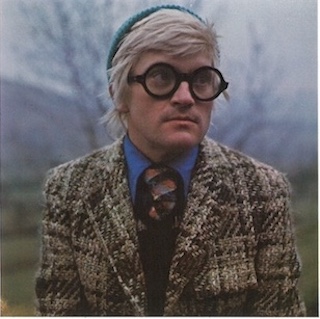
That rang a bell with this Southerner and the ringing sound was traced to the fine collection of Portrait Photographs by Jonathan Williams, with a short preface by Hugh Kenner.[2] One of the photographs is of David Hockney and beside it Williams wrote: ‘I worry sometimes that La Grande Chic will gobble up David and turn him into High Society’s current stand-in for Cecil Beaton or Noel Coward. But, maybe that argument is neither nowt nor summat, as they say in the West Riding where he comes from. Our David is wick as a lop and still knows what’s what.’

JW-DH

(David Hockney by Jonathan Williams)

‘Wick as a lop’, yes, that was the phrase. Getting on for forty years later and Hockney still knows what’s what, is still working endlessly, exploring, experimenting, trying stuff out and giving pleasure. Not bad going.

Jonathan Williams (born 8 March 1929), was poet, publisher, photographer, essayist. He studied at Black Mountain College and, with David Ruff, founded The Jargon Society in 1951. It published an extraordinary range of writers, mainly poets, including Robert Duncan, Mina Loy, Louis Zukofsky, Paul Metcalf, Kenneth Patchen, Robert Creeley and Denise Levertov, though its all-time bestseller seems to have been White Trash Cooking. Following Williams’ death in March 2008, his long-time partner, the poet Thomas Meyer, took the decision to present The Jargon Society’s inventory and publication rights to the Black Mountain College Museum & Arts Center: see http://jargonbooks.com/

Niedecker-TG

Charles Olson’s early Maximus volumes appeared from Jargon. So too did Lorine Niedecker’s beautiful T & G: The Collected Poems (1936-1966), printed by the Falcon Press in Philadelphia, in September 1969. Niedecker lived most of her life on Black Hawk Island, Wisconsin.

Black Hawk held: In reason
land cannot be sold,
only things to be carried away,
and I am old.

Young Lincoln’s general moved,
pawpaw in bloom,
and to this day, Black Hawk,
reason has small room.[3]

In the early 1960s, as Niedecker wrote to Louis Zukofsky, ‘Letter from Jonathan says he reads my poems to English audiences but tho the response was good, “very tentative. The English tend to want a lot of ‘profound talk’ in everything, and they are so non-sensual that they find it difficult to enjoy anything else. . .”’.[4] Williams was also given to ‘reading and slide-showing tours around the Republic in his Volkswagen, The Blue Rider’. He is, Guy Davenport wrote, ‘the iconographer of poets in our time, and of the places and graves of poets gone on to Elysium.’[5]

Williams’ own poems were written in the Pennine Dales and the Appalachian Mountains. Hugh Kenner’s observation that ‘Jonathan Williams is our Catullus and our Johnny Appleseed’ hints at the hybrid nature of the poetry.[6] It’s hugely various, veering from high modernism to folk art, exploratory, a little crazy, jaunty, ingenious, funny, often splendidly indecent. From two-line epigrams through acrostics, clerihews and what Williams calls ‘Meta-fours’, four words to a line, these and others often skirting the edge of nonsense, if not toppling over; there’s the fifty-page Mahler; and then many ‘found’ poems. They may be literally so, reshaped from newspaper reports or postcards or public notices; but the term could be applied more widely, to Williams looking and listening with close attention to ordinary lives in the Appalachians or in Cumbria. Guy Davenport quotes such a poem, suggesting that it demonstrates its author having learned from William Carlos Williams’ insistence that ‘the poet’s business is to let the world speak for itself’:

UNCLE IV SURVEYS HIS DOMAIN FROM HIS ROCKER OF A SUNDAY AFTERNOON AS AUNT DORY STARTS TO CHOP THE KINDLIN

Mister Williams
lets youn me move
tother side the house

the woman
choppin wood’s
mite nigh the awkerdist thing
I seen.[7]

As with many of Marianne Moore’s poems or, for that matter, Ezra Pound’s ‘In a Station of the Metro’, the title is an integral part of the text of the poem. It contains twenty words; the poem itself, twenty-one.

Williams quotes with approval Bentley’s Milton clerihew:

The digestion of Milton
Was unequal to Stilton.

He was only feeling so-so
When he wrote Il Pensoroso.

And devises many of his own:

Why did Professor J. R. R. Tolkien
never really come clean

about the scientologists in cupboards
in the House of L. Ron Hubbard?

or (one of my favourites):

Gertrude Stein
arose at nine

and arose and arose
and arose.[8]

GD-JW-Poet

His acrostic on Guy Davenport’s name ends with the line, ‘To keep afloat the Ark of Culture in these dark and tacky times!’ His prefatory ‘A Greeting to the Reader’ mentioned that Davenport ‘has been reading the poems since the 1960s.’[9] The two writers had enjoyed a long and fertile friendship, apparently damaged by the publication of A Garden Carried in a Pocket: Letters 1964-1968, including material that Davenport had specifically asked Williams to omit.[10]

Jubilant Thicket appeared in 2005, the year of Davenport’s death. One of the last poems in it is for Lorine Niedecker:

she seined words
as others stars
or carp

laconic as
a pebble
in the Rock River

along the bank
where the peony flowers
fall

her tall friend
the pine tree
is still there

to see[11]


Tremendous collection of photographs of Williams’ life here:
http://jacketmagazine.com/38/jw-life-pictures.shtml

Jeffery Beam’s obituary here:
http://www.ashevillepoetryreview.com/2010/issue-18/the-truffle-hound-of-american-poetry


References

[1] William Blissett, The Long Conversation: A Memoir of David Jones (Oxford: Oxford University Press, 1981), 123; see David Jones, In Parenthesis, (1937; London: Faber, 1963), 114.

[2] Jonathan Williams, Portrait Photographs (London: Coracle Press, 1979): the Hockney portrait is Plate 22.

[3] Taken from Lorine Niedecker, Collected Works, edited by Jenny Penberthy (Berkeley: University of California Press, 2002), 99.

[4] Letter of 3 February 1963, Jenny Penberthy, Niedecker and the Correspondence with Zukofsky, 1931-1970 (Cambridge: Cambridge University Press, 1993), 328.

[5] Guy Davenport, ‘Ralph Eugene Meatyard’, in The Geography of the Imagination (Boston: David R. Godine, 1997), 368; ‘Jonathan Williams’, first published as introduction to Williams’ An Ear in Bartram’s Tree, then as a pamphlet from Jim Lowell’s Asphodel Bookshop; reprinted in The Geography of the Imagination, 180-189.

[6] Dust jacket blurb quoted by Willard Godwin, Hugh Kenner: A Bibliography (Albany, New York: Whitston, 2001), 402.

[7] Jonathan Williams, Jubilant Thicket: New & Selected Poems (Port Townsend, Washington: Copper Canyon Press, 2005), 136.

[8] Jonathan Williams, Jubilant Thicket, 101, 102, 108.

[9] Jonathan Williams, Jubilant Thicket, 114, ix.

[10] W. C. Bamberger, editor, Guy Davenport and James Laughlin: Selected Letters (New York: W. W. Norton & Co., 2007), 139n.

[11] Jonathan Williams, Jubilant Thicket, 273.

Snow gone, strike on

Snow-Park.2

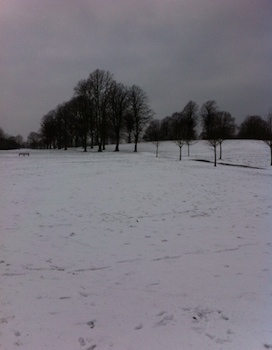
“Mais ou sont les neiges d’antan?” Villon wrote, which Dante Gabriel Rossetti famously translated as ‘But where are the snows of yesteryear?’ We, of course, are wondering where the snows of last Thursday and Friday have gone, as water streams along the gutters, so plentifully, in fact, that there must be a burst main somewhere..

The university was officially shut on Friday, due to the weather. The weekend passed with reading, phone calls and emails; and with the Librarian making bread while I counted the birds coming for food in the garden, a little anxious about how many of the regulars had survived what was reported to be the coldest March day since such records began at the start of the twentieth century. But there have been no obvious casualties: both the male and female blackbirds, the sparrows, the blue tits, the robin and the not-quite-definitely-identified bird (very sparrow-like but with a black cap) have shown up, however briefly And snow outside the back door, deeper than the average cat, whittled down their risk.

Now the world tilts back to whatever passes for normal lately. At the moment, this means the Librarian setting off, with placard and badge, for the picket line. Like most of her colleagues, she would rather be putting her skills and experience to work and, again like most of her colleagues, resents being forced into this position by recalcitrant employers with, pretty evidently, other priorities than their staff or the education of their students.

Those students were sufficiently unimpressed by their vice-chancellor to have occupied his office this morning; and the marches are still demonstrating a high level of support for the strike by university staff:

https://www.bristolpost.co.uk/news/bristol-news/live-bristol-students-occupy-university-1297803

And some lecturers are also less than enthusiastic about recent developments:

https://www.theguardian.com/commentisfree/2018/mar/04/letters-universities-deans-lake-district-churchill-ed-sheeran-impress

Everyone (except, perhaps, the hawks and hardliners) must hope that the scheduled talks move things towards a resolution. But, as the poet said, ‘Today the struggle.’ So for now the strike goes on.


Bunting Nodding

Lawrence, Thomas, 1769-1830; Homer Reciting his Poems

(Homer Reciting His Poems: Thomas Lawrence, Tate)

Francis Wyndham once observed that what he’d always wanted to do in his fiction was ‘to write about the hours and hours and hours, the enormous proportion of life which is spent in a kind of limbo, even in people’s active years. It seems to me that it isn’t sufficiently celebrated.’[1]

He meant it, I think, in a secular sense: an uncertain period of waiting, for decisions or resolutions, rather than the borderlands of Hell, unbaptised infants and the rest; nor, presumably, a Caribbean dance. My Chambers dictionary adds the helpful ‘unsatisfactory state of consignment or oblivion’.

Ah, oblivion. Yes, I’d apply that to many people passed in the street, plugged in to various devices, oblivious at least to the world through which they’re walking. Oblivious too are some of the passing motorists, a few of whom are busily and hazardously engaged with their mobile phones or make-up or breakfast, all the while keeping their speed up to 50 m.p.h. to avoid bits of themselves dropping off.

‘Dropping off’ recalls me to a deeper state than limbo: actually nodding off. Having nodded off, actually or almost, at staff meetings and conferences, in cinemas and theatres, readings, lectures and presentations, I think of Homer nodding. (A lot of links assume that ‘Homer’ means ‘Simpson’ rather than ‘dead, blind Greek epic poet’ but the latter is meant here.) The phrase, ‘even Homer nods’, deriving originally from Horace, is now pressed into service often and in wildly divergent contexts. There was, naturally, a band called ‘Even Homer Nods’ — though the soporific qualities of such a lengthy name presumably prompted them to the snappier version which succeeded it: ‘The Nods’. There is also a racehorse, I gather, an Irish chestnut gelding (with the full-length moniker).

Bunting_Poems

My worst instance of dropping off—certainly the occasion when I least wanted to—was at a reading by Basil Bunting (to whom birthday wishes are due: born 1 March 1900) a few years before he died. Not having taken the precaution of writing down detailed directions to the venue, I wandered around unfamiliar parts of the city for a couple of hours. Early on, I established the habit of popping into a pub for advice every so often and downing a quick drink. The various bar staff that I consulted had conflicting views on where the small theatre was, so I arrived late and the worse for wear. The attendance was appalling but would not have surprised Bunting, I suspect. He read a number of translations from the Persian and some early poems, certainly his ‘Villon’, but I may have slumbered through at least a third of the incomparable ‘Briggflatts’. I have two recordings of the poem (both by Bunting) but that live performance must have been one of his last—one of the true last chances.

As the player’s breath warms the fipple the tone clears.
It is time to consider how Domenico Scarlatti
condensed so much music into so few bars
with never a crabbed turn or congested cadence,
never a boast or a see-here; and stars and lakes
echo him and the copse drums out his measure,
snow peaks are lifted up in moonlight and twilight
and the sun rises on an acknowledged land.[2]

Later, though, I read an account of how Bunting had attended a lecture by Robert Duncan, slept through the greater part of it, snoring audibly, then woken at the end to exclaim how much he’d enjoyed it: ‘I like talks like that.’[3] So yes, even Bunting nodded.

References

[1] Quoted in the text of Rachel Cooke’s interview with Wyndham (The Observer, August 2008):  http://www.guardian.co.uk/books/2008/aug/17/francis.wyndham.interview

[2] Briggflatts, IV: The Poems of Basil Bunting, edited by Don Share(London: Faber and Faber, 2016), 56.

[3] J. M. Edelstein, in Madeira & Toasts for Basil Bunting’s 75th Birthday, edited by Jonathan Williams (Highlands, North Carolina: Jargon Society, 1977), unpaginated, but see also Richard Burton, A Strong Song Tows Us: The Life of Basil Bunting ((Oxford: Infinite Ideas, 2013), 419.


Snow business

Hurley-Mertz leaving hut by trapdoor

Frank Hurley: Mertz leaving the hut via the trapdoor
(Via http://www.sl.nsw.gov.au/stories/antarctica-frank-hurley/home-antarctica )

It’s the first day of spring, meteorologically speaking. It’s also the first day for a while that the Librarian hasn’t held out her arms to the east—or, perhaps, to the south-west—while demanding: ‘Send us snow!’ Today being a pause in the strike (caused by the proposed swingeing cuts to university staff pensions), she set off through falling snow on the two-mile walk to work, possibly thinking that was enough of the white stuff to be going on with, though Storm Emma is expected later today and the Met Office has now issued a red weather warning (signifying ‘danger to life’) for south-west England and south Wales from this afternoon.

I accept that, in the Scandinavian countries, in Canada, Mongolia, Russia, Japan, the United States, Austria, Switzerland, Peru, Bolivia and many more, they look askance at the British habit of cities, roads, airports, schools and railways seizing up whenever seven or eight inches of snow falls. But we have a temperate climate and it’s not economically viable to equip a nation, and adapt its infrastructure, for atypical conditions which occur so rarely. That’s the argument I’ve heard many times, anyway, though the phrase ‘economically viable’ is not a stable one in this country at present, given the prevailing order of priorities.

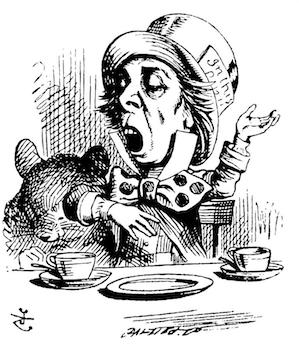
Worldturndupsidedown . Tenniel-Mad-Hatter

In our neck of the woods, anyway, it’s the mere sight of snow, rather than the fact of snow in March, that’s unusual. Other places—Scotland, the North, parts of Wales, traditionally run on different snow tracks. Late in March, near the Anglo-Welsh border, the Reverend Francis Kilvert recorded: ‘A snowy Palm Sunday. Snow on the Palms. Mr. Venables went to Bettws in a dense snowstorm.’ He discerned compensations though. ‘In the afternoon I had the happiness to have all the poor people to myself. None of the grand people were at Church by reason of the snow. So of course I could speak much better and more freely.’[1]

In London too, again in late March, Ezra Pound reported to his father in 1916 ‘the blizzard, 80 big trees down in the park. Counted twenty from bus-top first day I went down to Piccadilly.’[2]

Not yet having reached The Beginning of Spring in my grand revisiting of Penelope Fitzgerald’s work —it’s set in Moscow just before the First World War, anyway—I’m still able to spot that this first day of English spring is far from springlike. Having made the short trip to the newsagent and back in overcoat and boots (via the front entrance, eschewing all trapdoors), though it was hardly matter for a photograph by Frank Hurley or Herbert Ponting, I decided that was probably enough. Go out to gambol through the snow in the park— or stay in with coffee, reading Julian Barnes on Manet, Courbet and Cézanne?

No need even to toss a coin.

References

[1] Entry for 24 March 1872: Kilvert’s Diary, edited by William Plomer, Three volumes (London: Jonathan Cape, 1938, reissued 1969), Volume Two (23 August 1871—13 May 1874), 157.

[2] Letter to Homer Pound, 7 April 1916: Ezra Pound to His Parents: Letters 1895–1929, edited by Mary de Rachewiltz, David Moody and Joanna Moody (Oxford: Oxford University Press, 2010), 366.


Put it more simply, Larry

durrell.via.theamericanreader.com

(Lawrence Durrell via theamericanreader.com )

When I went to the Ford Madox Ford conference in Swansea in September 2013, I remember thinking, as the train entered Wales, that the change was physically apparent. Could I really look out of a train window and say ‘that’s Wales’? I felt I could but would have been hard put to it if I were challenged to say precisely how and why. But I did, quite abruptly, recall the opening lines of a poem by R. S. Thomas, whose title I could not then remember, and sat leaning against the window, listening to the voice in my head:

To live in Wales is to be conscious
At dusk of the spilled blood
That went into the making of the wild sky,
Dyeing the immaculate rivers
In all their courses.
It is to be aware,
Above the noisy tractor
And hum of the machine
Of strife in the strung woods,
Vibrant with sped arrows.[1]

No, that’s not quite what I heard. The third line had ‘to’ instead of ‘into’, the fourth and fifth lines had vanished from my memory, I had ‘the noise of the tractor’ and ‘the hum’. But not too bad since I hadn’t read the poem for a good thirty years. At home, seeming not to have any R. S. Thomas, I took down from the shelves four or five anthologies of post-1945 poetry, all containing poems by Thomas but not that one. Then I remembered that the hugely important and influential series of Penguin Modern Poets had featured Thomas in the very first volume. I’d owned that, more, at least the first ten volumes in the series, for years. Penguin Modern Poets 10: The Mersey Sound—Roger McGough, Adrian Henri and Brian Patten—was the bestseller, which took everyone by surprise. Where did my copies go? I’m not sure. Perhaps they didn’t go anywhere. It was just me that went. In any case, the Thomas poem, ‘A Welsh Landscape’, yes, was in the initial volume.

RST-via-Telegraph

(R. S. Thomas via The Telegraph)

It was in April 1962 that Penguin Books launched Penguin Modern Poets. Each volume contained representative selections from three poets and that first volume included, together with Thomas, Elizabeth Jennings – and Lawrence Durrell (born on this day, 27 February 1912, in Jalandhar, India). I don’t know how far the series had gone before I came to it but there was a handful of poems of which I recalled parts, sometimes only a few lines, for years.

PMP1

The Thomas was one and another, in the same volume, was by Durrell. It was called ‘The Parthenon’, dedicated ‘For T. S. Eliot’, and it was the direct, colloquial beginning that stuck in my head:

Put it more simply: say the city
Swam up here swan-like to the shallows,
Or whiteness from an overflowing jar
Settled into this grassy violet space,
Theorem for three hills,

Went soft with brickdust, clay and whitewash,
On a plastered porch one morning wrote
Human names, think of it, men became the roads.[2]

Looking at it now, of course, I’m struck by more details: the conversational opening phrase followed by the word ‘say’; the artful sibilants, ‘swam’ to ‘swan’ then, with the modifying ‘like’, shifting to ‘shallows’. The word ‘jar’ in a grassy space would prompt me to look back at Keats’s ‘Ode on a Grecian Urn’ via Wallace Stevens, whose ‘Anecdote of the Jar’ begins:

I placed a jar in Tennessee,
And round it was upon a hill.
It made the slovenly wilderness
Surround that hill.[3]

This is purely because of the strong recollection of one of my lecturers—surely John Reid?—reading the Stevens poem and looking encouragingly out at his audience: ‘What does that remind you of? What’s Stevens doing there?’ Pause. Then, with a kind of resonant despair: ‘It’s Keats! The urn!’ Packed rows of blank faces gave back whatever was the equivalent then of ‘Yeah, whatever’.

Durrell’s insertion of the word ‘Theorem’ is a nice touch too. He refers often to scientific or mathematical matters, a continuum or simultaneity here, a Freudian slap there, his range of interests always extended beyond the narrowly ‘artistic’. Firmly established in Sommières, he played with the ideas of opposing characteristics of North and South, discerning in France’s great figures ‘a pattern of talents: for scientists, philosophers and thinkers tend to be of northern stock, while the poets, artists and men of action come from the Mediterranean southern fringes.’[4] From Corfu in the mid-1930s, he wrote to his friend Alan Thomas, ‘What do you read when you spend a wet Monday alone? Myself I read one of the sciences.’ But he slyly added: ‘The most exact one to date is demonology. It is fun to follow the growth of science out of magic and demonology, and see it declining again in our time back to magic, its parent.’[5]

Whenever I find myself quoting one of those ‘Cypriot Greek proverbs’ that Durrell used as epigraphs to several chapters in Bitter Lemons, such as ‘A fool throws a stone into the sea and a hundred wise men cannot pull it out’, I’m reminded that, a little further on, he casually notes that, ‘No Greek can resist aphorism; its form will make him believe it to be true, even if it is false.’[6]

A bit more R. S. Thomas followed that early reading of the poems—and a lot more Durrell. The novels, the travel books, essays, letters; plus the connected stuff, the related writers, the sacred places. Greece, Alexandria, Provence. Miller, Cavafy, Seferis, Anaïs Nin. And, of course, the stimulus of conversation, a decade and a half in the office with my friend Andrew, a thoroughgoing Durrellian.

Nin-Brassai

(‘Darling Anaïs, I do feel for you in your cutoffness, and there seems nothing to say to you that will make you less conscious of the distance of light and air which lies between us; the war goes bitter and deep in me – it makes everything taste of ash.’—Letter from Durrell in Greece, quoted in The Journals of Anaïs Nin: Volume Three, 15.
Portrait of Anaïs Nin by the wonderful Brassaï [Gyula Halász, 1899-1984], 1932.)

Durrell was so prolific that, inevitably, some of the writing is a bit hit and miss. But with that range of cultures and countries and curiosities there are plenty of highlights, often cropping up in unexpected places or small-scale pieces or, say, in departures and returns. He writes of April 1941 when, lying ‘on the pitch-dark deck of a caique nosing past Matapan towards Crete’, he thinks back to ‘that green rain upon a white balcony, in the shadow of Albania’, with ‘a regret so luxurious and so deep that it did not stir the emotions at all. Seen through the transforming lens of memory the past seemed so enchanted that even thought would be unworthy of it.’[7] And revisiting Corfu, long afterwards: ‘As for the people . . . Memory does not grow older by a second per thousand years in Greece. Step off the ship and everywhere you will fall upon remembered faces, be instantly recognized and embraced: and I don’t mean only by friends, but by everyone who remembers you in that once, nearly twenty years ago, you gave his son a lesson or let him shine your shoes. Because they remember you they possess you, and you belong to them.’ And then, ‘there is nothing to do but surrender yourself. Strong-willed men break down and cry like babies. No good. The steady flow of hospitality ends only when you are lovingly hospitalized or carried aboard a departing ship on a stretcher.’[8]

Again, rereading The Alexandria Quartet a while back, with that slight nervousness attendant on a revisiting of a past favourite, was as provoking and pleasurable as I hoped it would be. Durrell’s rarely less than diverting, even when he’s being exasperating, a thought that occurred to me when deeply implicated in the more than 1300 pages of The Avignon Quintet, with its maddening hall of mirrors, characters repeatedly dissolving into novelists writing other characters, who are then revealed to be characters in someone else’s novel, while I mutter, ‘Cut it out, Larry’, every ten pages – but read on. ‘There is only trial and error on a journey like this, and no signposts’, as Durrell wrote on another occasion.[9]

Joyeux anniversaire, Larry. Or even, Aürós aniversari.

The International Lawrence Durrell Society site is here: http://www.lawrencedurrell.org/


References

[1] R. S. Thomas, ‘Welsh Landscape’, Collected Poems: 1945-1990 (London: Dent, 1993), 37.

[2] Lawrence Durrell, Collected Poems 1931-1974 (London: Faber and Faber, 1985), 134.

[3] Wallace Stevens, The Collected Poems (New York: Vintage Books, 1982), 76.

[4] Lawrence Durrell, Caesar’s Vast Ghost: Aspects of Provence (London: Faber and Faber, 1990), 26.

[5] Alan G. Thomas, editor, Spirit of Place: Mediterranean Writings (1969; London : Faber and Faber, 1988), 47.

[6] Lawrence Durrell, Bitter Lemons (London: Faber and Faber, 1959), 152, 235.

[7] Lawrence Durrell, Prospero’s Cell (1945; London: Faber and Faber, 1962), 133.

[8] Lawrence Durrell, ‘Oil for the Saint: Return to Corfu’, Holiday, Philadelphia, (October 1966), in Spirit of Place, 286, 290.

[9] Lawrence Durrell, The Black Book (1938; London: Faber and Faber, 1977), 233.


Wrenching pension tensions

Fuseli-incubus-nightmare
(‘My God, that’s no way to run a university. What are these creatures?’
Henry Fuseli: The Nightmare, c. 1790-1791 version. )

It’s getting on for ten years now since the Times Higher Education’s ‘The Poppletonian’, Laurie Taylor’s weekly bulletin from that hotbed of learning and stringent academic standards, featured as the ‘Thought for the Week’, the famous contribution by Jennifer Doubleday, Head of Personal Development: ‘What if the hokey-cokey is really what it’s all about?’

I wondered then – and I wonder now. On the home front, even taking precedence over the Punch and Judy Brexit show at the moment is the ongoing strike in defence of university pensions. Have there been surprises? Not really. The major news outlets, for the most part, refer to ‘the lecturers’ strike’: perhaps they genuinely don’t realise that it’s other professionals—librarians, clerical and technical staff—too. Lazy journalism, anyway, as is the consistent presentation of the £6.1 billion pension fund ‘deficit’ as an established fact rather than a projection based on disputed figures. There may have been surprise at the degree of contempt with which university employers evidently view their staff, who are, after all, the people who keep running the campuses from which those employers derive their astronomical salaries. But perhaps nobody’s surprised at all, given the violent changes inflicted on the higher education system in recent years and some of the people that have been put in charge of what used to be endearingly called ‘centres of learning’. I suppose the term is ‘profit centres’ now.

Things are beginning to liven up, anyway. After the Minister for Universities called on Universities UK and the University and College Union, to ‘get back to the negotiating table, without pre-conditions’, UUK agreed to resume talks – but they would not ‘re-open the Joint Negotiating Committee decision made on 23 January’. It was precisely because of that decision, of course, that university staff went on strike in the first place.

See https://www.ucu.org.uk/article/9358/University-and-College-Union-response-to-UUK-call-for-talks

Then, too, articles and documentaries are appearing now which suggest a strong family resemblance between the revelations about expenses claimed by vice-chancellors (and their senior colleagues) and the MP expenses scandal of glorious memory. And more people seem to be querying the very odd arrangements whereby some vice-chancellors are pulling in up to £90,000—on top of those teeteringly high salaries—for sitting on that very committee which proposes slashing the pensions of university staff.

So much of this stuff is what we call in this country ‘how things are done’ or, if we’re feeling bold, ‘conflict of interest’—if it occurs in other countries, we seem to know precisely what to call it.


Foxes, Graces, Fatal Flowers

Maitland, Paul Fordyce, 1863-1909; Boats Moored on the Thames

(Paul Fordyce Maitland, Boats Moored on the Thames: York Museums Trust)

On a cold and blue and almost cloudless day, I pass through the park, between the bobbing magpies. Once you recognise the sight and sound of them, they’re everywhere. In our small garden yesterday, I watched a magpie take into its beak three, four, five suet pellets, and was put in mind of the fox.

Six or seven years ago, looking out of the window of my mother’s first-floor flat in Sutton, I would sometimes see foxes jogging along beside the railway line, about fifty metres away. At the end of the short garden was a garage with a flat roof and the downstairs neighbour used to throw food up onto it. One morning a fox appeared there – the roof was accessible from a low wall nearby. It took up items of food into its long jaws, meat and vegetables, five, six, seven pieces and, at the last, added a whole egg. Then it made its way down off the roof and emerged at the side of the track, all the food still apparently in place, undamaged, before padding off in the direction of home where, presumably, its cubs were waiting.

There are times when something occupying our minds or strongly present for a while—and it might be anything, from a car, a song or a woman’s name to a painting, a terrace of houses or a body of writing—exerts a powerful centripetal force. Details of things seen or heard fly to it and stick like burrs. Sounds and sights, images, phrases, connect with an audible click.

Since I’m reading or, mostly, rereading Penelope Fitzgerald’s books at present, when I walked in the park yesterday and heard the skirl of bagpipes launching into ‘Amazing Grace’, it was enough to recall the novel I’d just finished. Offshore, which won the Booker Prize in 1979, is set on the barges moored on Chelsea Reach and is dedicated ‘To Grace and all who sailed in her’. Grace is the name of the central character Nenna James’s barge, as it was the name of Fitzgerald’s, ‘a battered, patched, caulked, tar-blackened hulk’. The ‘great consolation was that a Thames barge, because of the camber of the deck, never sinks completely.’ On this point, Fitzgerald remarked, she could ‘give evidence, because we went down twice, and on both occasions the deck stayed just above water’, although Grace was finally ‘towed away to the Essex marshes to be broken up.’[1] After one of those disasters, Fitzgerald ‘went back to her teaching the next day, looking more than usually dishevelled, and said to her class: “I’m sorry I’m late, but my house sank.”’[2]

Bavarian-Gentian

Similarly, thoughts of that fox recalled Fitzgerald’s letter in response to Frank Kermode’s review of her final novel, The Blue Flower, which centres on the life of the German Romantic poet Friedrich von Hardenberg, who wrote as ‘Novalis’. ‘I hope you won’t mind me writing to thank you for your review of The Blue Flower. I started from D. H. Lawrence’s “fatal flower of happiness” at the end of The Fox, having always wondered how DHL knew it was blue, and never quite managed to find out all I wanted to, partly because Novalis’ letters to Sophie have disappeared, buried in her grave I daresay.’[3]

Kermode had written of Fitzgerald: ‘She has the gift of knowing, or seeming to know, everything necessary, and as it were knowing it from the inside, conveying it by gleams and fractions, leaving those who feel so disposed to make it explicit.’ And, of the object of Fritz’s quest, ‘The visionary blue flower dominates his imagination, but in the waking life of Fritz von Hardenberg the part of the flower was played by Sophie von Kühn’.[4]

Sophie was the twelve-year-old girl with whom the poet fell in love. They became engaged on her thirteenth birthday but she died of tuberculosis just two years later. Novalis himself died before reaching thirty.

The end of ‘The Fox’ has ‘poor March’ musing on how, ‘The more you reached after the fatal flower of happiness, which trembles so blue and lovely in a crevice just beyond your grasp, the more fearfully you became aware of the ghastly and awful gulf of the precipice below you, into which you will inevitably plunge, as into the bottomless pit, if you reach any further. You pluck flower after flower – it is never the flower.’[5]

And the ending of Offshore? The two weakest characters, drunk and more than usually incapable, drift off in the storm, when the anchor comes clear and the mooring-ropes pull free under the strain. ‘It was in this way that Maurice, with the two of them clinging on for dear life, put out on the tide.’[6]

A craft that should be firmly linked to those of its close neighbours becoming unmoored and drifting off into the open sea because of intoxicated incompetence. Not a fable for our time, obviously.

References

[1] Penelope Fitzgerald, ‘Curriculum Vitae’, in A House of Air: Selected Writings, edited by Terence Dooley with Mandy Kirkby and Chris Carduff (London: Harper Perennial, 2005), 477-478.

[2] Hermione Lee, Penelope Fitzgerald: A Life (London: Chatto and Windus, 2013), 158.

[3] Penelope Fitzgerald to Frank Kermode, 3 October [1995], in So I Have Thought of You: The Letters of Penelope Fitzgerald, edited by Terence Dooley (London: Fourth Estate, 2008), 453.

[4] Frank Kermode, ‘Dark Fates’, review of The Blue Flower, London Review of Books, 17, 19 (5 October, 1995), 7.

[5] D. H. Lawrence, ‘The Fox’, in The Complete Short Novels, edited by Keith Sagar and Melissa Partridge (London: Penguin Books, 2000), 203.

[6] Penelope Fitzgerald, Offshore (1979; London: Everyman, 2003), 131.


Something to be resisted

Hands-off-pensions-G-Jane-Atkins
(Photograph: Jane Atkins, via The Guardian)

At the kitchen table, the Librarian is looking at the newspaper. ‘What a bloody mess.’ Perhaps the word wasn’t ‘bloody’. A comment on the times: I have not the faintest idea what she is referring to – there are just too many candidates, even sticking to the United Kingdom: the Brexit fiasco (or the fiasco of the level of comment upon it); the Labour policy on Brexit fiasco; the transport fiasco; the benefits or homelessness or education fiascos; the prisons fiasco; the higher education fiasco; the housing fiasco; the local council cuts fiasco; the tax evasion fiasco; the fracking fiasco; the foreign policy fiasco; the Tory leadership fiasco. I surrender.

In fact, she’s referring to the higher education fiasco: a fiddle here, a twiddle there. Either you acknowledge the benefits—to everyone—of a population as well-educated as possible or you don’t. So either you fund higher education properly or you don’t. And, of course, even in the higher education sector, there’s more than one bloody mess. This one—the forthcoming universities strike—is coming up fast.

The Guardian reports that ‘Universities UK (UUK), which represents university employers, has proposed that in order to overcome a £6.1bn deficit in the Universities Superannuation Scheme (USS), the fund should switch from a defined-benefit scheme that gives a guaranteed retirement income to a riskier defined-contribution plan, where pension income is subject to stock market movements.

A UUK spokesperson said the proposed pension changes were a necessary step, made in the best interests of university staff, to put the USS on a sustainable footing for the long term.’

‘Necessary’, ‘best interests’, ‘sustainable’. Nice, but not actually true. Try this:

‘University employers have provoked the largest vote for industrial action ever seen in the higher education sector. They have done this by overseeing what they present as a financial crisis for the University Superannuation Scheme (USS), and by threatening enormous cuts to the pensions of hundreds of thousands of university staff. None of this is necessary. It is the result of the misrepresentation of USS finances, and the desire of a new breed of university managements to cut their pension liabilities and thereby ease the financing of new buildings and campuses.’

https://www.theguardian.com/education/2018/jan/30/university-staff-are-right-to-be-striking

Yes, this kind of behaviour, this kind of pretext, is becoming all too familiar—and is something that needs to be resisted. As it will be.