Among the trees

Trees-VP

‘This house looks out on a great rampart of trees; all day they are motionless in the strong sun’, Sylvia Townsend Warner wrote to Llewellyn Powys in the summer of 1933, from Frankfort Manor, Sloley, Norwich. ‘But at dusk they seem to creep silently across the lawn, until looking from my window I seem to see their enormous foreheads pressed to the pane. I have never lived with trees before. They take some mastering; but I think I shall be on good terms with them even before I see them naked.’[1]

In Tolkien’s Lord of the Rings, the Ents are a race of huge tree-like beings who stride across the country to take part in the battle against Saruman. But the image of trees walking is an old one. In St Mark’s gospel, the blind man, his sight only partially restored when touched once by Christ, ‘looked up, and said, I see men as trees walking.’ His sight will be fully restored when touched for a second time, so that he sees ‘every man clearly’ (Mark 8:24-25). This is explicitly echoed in Elizabeth Bowen’s description of a young woman called Emmeline, at a party, looking down the hall. ‘There she saw men as trees walking, her mind already at home in the dusk of her white room outside the lamplight.’[2]

ent_Tolkien

(Tolkien’s Ents: from The Two Towers)

Shakespeare’s Macbeth, told that he’ll never be defeated until Great Birnam Wood comes to Dunsinane to oppose him, says with understandable confidence: ‘That will never be./ Who can impress the forest, bid the tree/ Unfix his earthbound root?’ But every soldier in the approaching army carries a bough cut from the trees of Birnam Wood, to ‘shadow/ The numbers of our host, and make discovery/ Err in report of us’, as Malcolm says. Very much men as trees walking.

Trees are miracles of growth, sometimes reaching enormous heights from tiny beginnings. They bear fruit, shed leaves, are cut down and die, take on other forms. Unsurprisingly, they’re everywhere in the world’s religions and mythologies: Yggdrasil, the tree of life that connects the nine worlds of Norse cosmology; the Bo tree under which the Buddha sat and attained enlightenment; sacred fig trees in Jainism and Hinduism; the Christian tree of the knowledge of good and evil; the tree of life in the Kabbalah; many more.

They’re everywhere in literature too: oak, willow, laurel, olive, cypress, yew. The elm alone traces a path from Homer and Virgil through Chaucer and Milton to Thomas Gray and Tennyson.

‘I love the fitful gust that shakes/ The casement all the day’, John Clare declared:

And from the mossy elm tree takes
The faded leaves away,
Twirling them by the window-pane
With thousand others down the lane. (‘Autumn’)

Not everyone is, or remains, enamoured. ‘On the way’, William Carlos Williams wrote:

we passed a long row
of elms. She looked at them
awhile out of
the ambulance window and said,

What are all those
fuzzy-looking things out there?
Trees? Well, I’m tired
of them and rolled her head away.[3]

‘I wrapped my tears in an ellum leaf/ And left them under a stone’, Ezra Pound wrote in an early poem.[4] In a what leaf? Is that an Idaho thing – or Philadelphia, or New York? But then here’s Mr Faulkner of Mississippi: ‘The buggy was drawn by a white horse, his feet clopping in the thin dust; spidery wheels chattering thin and dry, moving uphill beneath a rippling shawl of leaves. Elm. No: ellum. Ellum.’[5]

Ah, these Americans. Perhaps one more. ‘“They come down like ellum-branches in still weather. No warnin’ at all.”’ This is in Rudyard Kipling’s ‘An Habitation Enforced’, an early example of his ‘healing’ stories, this one involving a very rosy picture of Edwardian England, where the death of Mr Iggulden prompts Mrs Betts to make that observation to Sophie Chapin (who has found the old man dead in his fireside chair).[6] The Chapins are American—her family there comes from Connecticut—but this is Mrs Betts speaking, a local woman, long resident here. So: Idaho, Mississippi —Sussex.

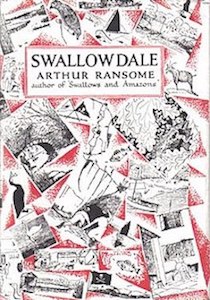
Swallowdale

At this time of year, walking on a slowly thickening carpet of leaves, with the odd branch fallen in an occasionally fiercer wind, the trees in my local park impress themselves even more closely than usual on my attention. They certainly have a positive effect on people—some people, most people?—and there’s something curiously heartening in the sight of newly-planted saplings. New growth but also a distinctive kind of latent energies, a gathering of strength.

‘“Sleep like young trees and get up like young horses, as my old nanny in Australia used to say”, their mother tells the Walker children in Arthur Ransome’s Swallowdale.[7]


References

[1] Sylvia Townsend Warner, Letters, edited by William Maxwell (London: Chatto & Windus, 1982), 25.

[2] Elizabeth Bowen, To the North ([1932] Harmondsworth: Penguin Books, 1945), 26. In Edmund Blunden’s Undertones of War (1928; edited by John Greening, Oxford: Oxford University Press, 2015), 58, ‘Willow-trees seemed moving men.’

[3] William Carlos Williams, ‘The Last Words of My English Grandmother’, in The Collected Poems, Volume 1: 1900-1939, edited by A. Walton Litz and Christopher MacGowan (Manchester: Carcanet Press, 1987), 465.

[4] ‘La Fraisne’, in Ezra Pound: Poems and Translations, edited by Richard Sieburth (New York: Library of America, 2003), 23.

[5] William Faulkner, The Sound and the Fury (1929), in Novels 1926-1929, edited by Joseph Blotner and Noel Polk (New York: Library of America, 2006), 972.

[6] Rudyard Kipling, Actions and Reactions (London: Macmillan and Co., 1909), 20.

[7] Arthur Ransome, Swallowdale (1931; London: Jonathan Cape, 1985), 30.

Elation, Misprints, Anthony Burgess

Ink-Trade

I’ve been poring over the intended final proofs of the first issue of the Ford Madox Ford journal, looking for misprints, of course, those tiny details that are capable of provoking rage or despair in some individuals, as I’m only too aware. I’ve reacquainted myself with the well-known phenomenon of staring at a word a dozen times before noticing, at the thirteenth attempt, that a letter is missing. Still, since I’ve come close on past occasions to dismissing out of hand people who can’t spell Ford Madox Ford’s name or who jam an apostrophe into Finnegans Wake, I can hardly rule out a similar intolerance in others, potential readers of our journal.

FMF-Logo

I’ve now reached the point where I tacitly assume that there will be errors in every book I read. Novels are less affected by the virus but anything with a lot of names, places and book titles is at risk. Usually, these are minor lapses, probably invisible unless you have that proofreading or editorial predilection – but not always. I’ve just been reading a highly enjoyable selection of journalism by Anthony Burgess, The Ink Trade (edited by Will Carr, Manchester: Carcanet Press, 2018) and, while ‘the playgoing pubic’ is mildly amusing, to be told that, in Gerard Manley Hopkins’ ‘The Windhover’, the word ‘buckle’ ‘resents a forceful ambiguity which is at the root of the strength of the poem’, gives me pause to frown. Resents? Presents? Represents? Interesting, anyway, to learn that, apart from Shakespeare, the two writers that have meant much to him are James Joyce – hardly a secret, that one – and Hopkins.

In any case, the book offers so many pleasures that it warrants a high degree of tolerance to such errors. There are sixty items, uncollected and several unpublished, with numerous reminders of Burgess’s energy, erudition, wit and wide-ranging enthusiasms. On censorship, Henry Miller, Nabokov, Erica Jong, A. S. Byatt, Evelyn Waugh and Malcolm Lowry; Ellmann on Wilde, V. S. Naipaul, Graham Greene and Kingsley Amis. Burgess is always readable, often provocative, generally engaging. Remembering Earthly Powers, whose main protagonist was reputedly based on, or drew upon, Somerset Maugham, it’s salutary to be reminded of Burgess’s considerable and genuine regard for Maugham’s writing. He describes Cakes and Ale as ‘a textbook of literary criticism as well as a superb novel’ and, though he proposes to modify that to ‘a superb work of fiction’, since the book may be seen as an inflated short story, he adds that some of Maugham’s stories are ‘among the best in the language.’ Of his first reading of The Waste Land: ‘I was only fifteen, and I understood very little of the poem, but I recognised that it was important. I seemed to hear a door, a long way down one of my mind’s corridors, trying to creak open but not quite making it.’ That last sentence is right on the money.

He writes often and well on Joyce, of course, is consistent in his championing of Ford—‘without doubt the greatest British novelist of the century’—offers some clear and often compelling insights into the writing of fiction (‘The problem for all fiction writers is to decide who is telling the story’), is always fascinated by language, slang, class differences in speech and pronunciation. I liked this, from an unpublished piece (a version of a speech given at the Tate in 1991): ‘I say that a thing portrays beauty when it induces a feeling of elation which is unrelated to the biological or the utilitarian. The orgasm produces elation because that is nature’s bribe to ensure the continuation of the race, even through that bribe is thwarted. The elation of health, or its recovery, or financial success, the winning of a difficult game doesn’t call into being the praise or near-worship of an artefact. The elation is probably the elation of a kind of metaphysical discovery, and that discovery is very frequently a sense of unity which only the arts can convey.’

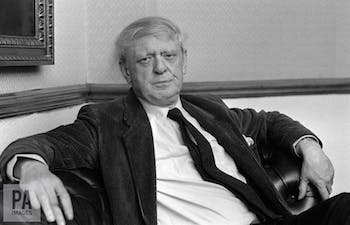
Burgess

(Anthony Burgess via theconversation.com)

That word ‘elation’ caught my eye because it recurs in several Jonathan Williams contexts, usually when he was quoting Louis Zukofsky to the effect that the function of poetry is ‘to record & elate’ (or, on occasion, ‘to elate and record’), while Elite/Elate was the title of his 1979 Selected Poems. It’s ironic that Burgess is mentioned in a Williams essay only in a negative context: ‘In one of the Sunday papers, Mr. Anthony Burgess considered it withering and simple enough to call [Zukofsky] “a New Yorker, a Communist, a Jew, and a poet” (I think in that order)’.

Still, Burgess and Zukofsky at least have in common the valuing of ‘elation’ as a desirable effect of literature or the arts and an indispensable element in the perception of beauty.

My other recent Burgess-spotting came in my fat volume of Patrick White’s letters. Writing to Marshall Best, his American publisher, in 1970, White commented that Burgess had seemingly ruffled a gathering of Australian writers with a talk given at the Adelaide Festival, in which he asserted that, ‘A country is only remembered for its art. Rome is remembered for Vergil, Greece for Homer, and Australia may be remembered for Patrick White.’ According to the newspaper report, no one clapped. ‘How I wish I had been watching and listening at a hole in the wall’, White remarked.


Dog Days

Dog

We’ve had a dog as houseguest for the past few days while her owners disport themselves in Portugal – quite an old dog now, a little doddery and pretty set in her ways but still fine company. This means that the Librarian is rousted from her bed at an unearthly hour to share with me the joy of walking to the park before sunrise, clutching small black bags, a torch and pockets full of dog treats.

During the very hot summer of 1925, the poet Charlotte Mew spent some time in a cottage near Rye, in Sussex, with Alida Munro, the wife of Harold Monro, poet, proprietor of the Poetry Bookshop, and publisher of The Poetry Review, Poetry and Drama and The Chapbook. He also produced, at his own expense, volumes by several poets, including both Pound’s Des Imagistes and the Georgian Poetry anthologies. After his death a few years later, Pound wrote: ‘I doubt if any death in, or in the vicinity of, literary circles could have caused as much general regret as that of Mr Harold Monro’.[1] The Monros went through a succession of weekend cottages, in Essex and Hampshire as well as Sussex.[2] ‘All of them had earth closets and well-water, and had to be adapted to the needs of six dogs and a cat. Harold Monro, meanwhile, was often abroad, seeking cures for what Alida called “the enemy” though she also felt that the continent, where wine was sixpence a bottle, was “not the place to fight such a battle”.’[3]

Six dogs. One, two, three. . .But this can only recall Beatrix Potter’s tale:

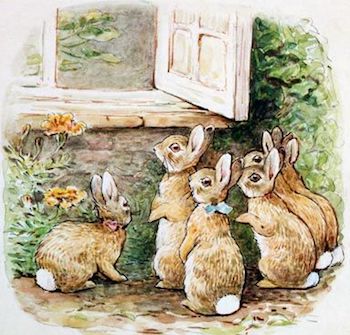
Flopsy-Bunnies

‘Mr. McGregor climbed down on to the rubbish heap—
“One, two, three, four! five! six leetle rabbits!” said he as he dropped them into his sack. The Flopsy Bunnies dreamt that their mother was turning them over in bed. They stirred a little in their sleep, but still they did not wake up.’

Do dogs in literature outnumber cats? A glance at the index to the Oxford Dictionary of Quotations suggests that they do – by quite a margin. Walking with dogs, hunting with dogs, playing with dogs in ways that are impossible with cats—it seems likely enough. Certainly dogs in literature, as in life, fill many roles. Roger Grenier includes one in his title, begins with a reference in his preface to Odysseus’ dog Argos—who recognises his returned master as several people who know him signally fail to do—and opens with the story of how, ‘A few years ago, whenever a tourist visited Paul Valéry’s famous oceanside cemetery at Sète and asked the caretaker to show him the location of Paul Valéry’s tombstone, the caretaker would wake up his dog and give the command, “Valéry!” Whereupon the dog, all on its own, would lead the tourist to the poet’s grave.’[4]

Familiarity with canine expressions, characteristics and perceived associations with both social classes and individuals, are also fertile ground. In Elizabeth Bowen’s The Last September, Gerald ‘turned in thought to confident English country, days like the look in a dog’s eye, rooms small in the scope of firelight, neighbourly lights through trees.’[5] In Henry Green’s novel Nothing, Mrs Haye considers whether it would not be kinder to have Ruffles, the old, blind dog, put down: ‘Yet he had been such a good servant, for ten years he had barked faithfully at friends. And the only time he had not barked was when the burglars had come that once, when they had eaten the Christmas cake, and had left the silver.’ Almost immediately afterwards, when the aged retainer William comes in, ‘carrying one of the silver inkstands as if it had been a chalice’, the same sentiments are rehearsed. William is so old and feeble that he can barely do his share of the work. ‘But what could one do? He had served her for years, he had been a most conscientious servant, and it was only the night when the burglars did come that he had been asleep. However, they had only eaten the Christmas cake, they had left the silver.’[6]

Kipling-TSAD

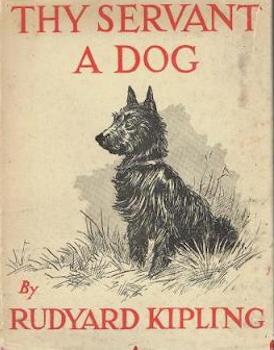
‘Thou good and faithful servant’. Rudyard Kipling made good use of dogs in several of his stories while the 1930 volume, Thy Servant a Dog, contained three stories told from the dogs’ point of view. Collected Dog Stories (1934) gathered them all.

In Somerset Maugham’s Of Human Bondage, Norah claims not to believe in churches and parsons but accepts God, not believing that he ‘minds much about what you do as long as you keep your end up and help a lame dog over a stile when you can.’[7]

Just so, Ford Madox Ford remembered his grandfather, the painter Ford Madox Brown, ‘laying down a rule of life for me. He said: “Fordie, never refuse to help a lame dog over a stile. Never lend money: always give it. When you give money to a man that is down, tell him that it is to help him to get up; tell him that when he is up he should pass on the money you have given him to any other poor devil that is down. Beggar yourself rather than refuse assistance to any one whose genius you think shows promise of being greater than your own.”’ Ford adds: ‘This is a good rule of life. I wish I could have lived up to it.’[8]   To a surprising degree, he did.

Then too, while authorial comment may be frowned upon, a fictional dog can be persuaded to stand in for its creator. In Patrick White’s story, ‘A Cheery Soul’, the dreadful Miss Docker, so noisily ‘doing good’ all over the place, in fact does immense harm. But when, at the end of the story, she tries to attract a blue cattle-dog, offering to allow it ‘every licence’ if it will come home with her, ‘the dog turned, and lifted his leg on the suppliant, and walked stiffly off.’[9] I think ‘stiffly’ is the indispensable word there.

Our period of stewardship ends soon. There will no longer be the unwavering scrutiny of my every move in the kitchen; urination and defecation will not be quite so prominent in my thoughts; I shall feel a little disorientated for a while, leaving the house without reaching for the dog’s lead, the bags and the treats; and the Librarian will stay in bed a little longer.

 
References

[1] Ezra Pound, ‘Harold Monro’ (1932), in Polite Essays (1937; New York: Books for Libraries Press, 1966), 3.

[2] Joy Grant, Harold Monro and the Poetry Bookshop (Berkeley: University of California Press, 1967), 209.

[3] Penelope Fitzgerald, Charlotte Mew And Her Friends (1984; London: Flamingo, 2002), 209.   Fitzgerald tried for years to interest a publisher in a book on The Poetry Bookshop but never succeeded in doing so.

[4] Roger Grenier, The Difficulty of Being a Dog (Chicago: University of Chicago Press, 2002), vii, 1.

[5] Elizabeth Bowen, The Last September (1929; Collected edition, London: Jonathan Cape, 1948), 123.

[6] Henry Green, Nothing (1950; in Nothing, Doting, Blindness, London: Vintage Books, 2008), 382-383.

[7] Somerset Maugham, Of Human Bondage (Harmondsworth: Penguin Books, 1969), 318.

[8] Ford Madox Ford, Ancient Lights and Certain New Reflections (London: Chapman and Hall, 1911), 197-198.

[9] Patrick White, The Burnt Ones (Harmondsworth: Penguin Books, 1968), 188.


Gammon and spinach. Ha!

Millais, John Everett, 1829-1896; Autumn Leaves

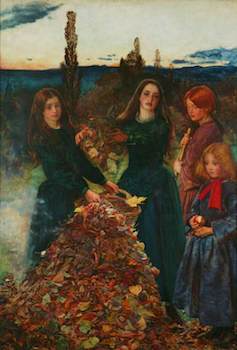
(John Everett Millais, Autumn Leaves, 1856: Manchester Art Gallery)

Autumn Leaves. Autumn, on the contrary, now definitely arrives in a flurry of contradictory weather, though, really, we need to borrow the American term, ‘fall’.

‘Let us stop this war’, Edmund Blunden wrote, ‘and walk along to Beaucourt before the leaves fall. I smell autumn again.’[1]

‘But, my Marguerite, how strange it all is!’, Colette wrote to her friend Marguerite Moreno, ‘I have the fleeting confidence of people who fall out of a clock tower and for a moment sail through the air in a comfortable fairy-world, feeling no pain anywhere . . . ’[2]

‘What are the chances’, the Librarians wonders aloud, ‘of an adult standing up and saying: This Brexit business was a terrible, terrible idea, which everyone surely realises by now, if they didn’t know already. So let’s just scrap the whole thing.’ Not good, I think, the chances are not so good. I recall the note I came across a few days ago, from a William Faulkner novel: ‘They all talked at once, their voices insistent and contradictory and impatient, making of unreality a possibility, then a probability, then an incontrovertible fact, as people will when their desires become words.’[3]

Magpie

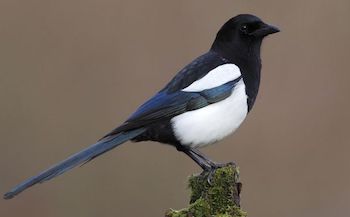
I was also remembering the magpies in the park last week. It began with an evident squabble between two birds, who kept fluttering a few feet off the ground, jabbing at one another and coming to earth again: a couple of minutes later, they were racing around above my head, one obviously pursuer and one pursued but keeping only inches apart, however abruptly the lines of their flight paths veered and soared. But the most striking thing was the way in which the dispute spread and the speed at which it did so: at least two more pairs were scuffling with one another almost immediately, while more and more magpies kept arriving, then gathered in groups of three or four in the branches of surrounding trees. And all the while, their distinctive chatter, more than twenty of them by the end, scattered over four or five locations. They all had something to shout about, they all insisted on outshouting others and weren’t above getting physical if they disagreed.

Doctor-maggotty

I stood on the path for a good ten minutes, thinking: magpie Brexit? In Beatrix Potter’s The Tale of the Pie and the Patty-Pan, the local doctor is a magpie by the name of Dr Maggotty. He has the disconcerting habit of shouting ‘Gammon!’ or ‘Spinach!’ and, ultimately, ‘Gammon and spinach! Ha ha HA!’ Why does that last ejaculation oddly suggest a sly commentary on our current political woes?

Still, I’ve always liked magpies and been impressed by their acumen, as well as the wealth of folklore and superstition associated with them. Patrick White’s biographer reveals that, by the end of his second year at university, White realised that he didn’t have ‘a scholar’s mind’ and wouldn’t get a brilliant degree. ‘This discovery hurt him at first’, Marr writes, ‘and he was nagged by a sense of intellectual inadequacy until he came to see that he had another kind of intelligence, a “magpie mind” that found ideas as he needed them and seized any image that caught his eye.’[4]

Magpies-Bagpipe

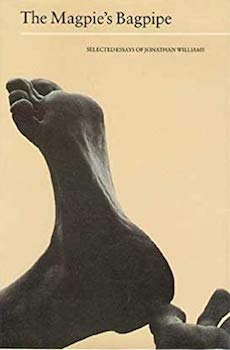
Then, very recently, in the Jonathan Williams festschrift I was reading, I came across the writer and folklorist Gary Carden’s remark that, over the years, he had ‘often searched for a fitting icon or symbol’ for Williams. Carden focused on Williams’ ability to perceive talent and to spot what others missed. ‘Finally, I can pick my icon’, Carden announced. ‘Jonathan is a magpie!’ He wrote of watching a magpie stalking through a landfill site and extracting something that caught his eye, to carry home and give it ‘a choice setting’, while Williams, he added, did much the same thing, having ‘waded through the wreckage of our culture’, sometimes finding ‘the real thing’.[5]

Indeed, Williams published his first book of essays under the title of The Magpie’s Bagpipe (1982) – and the avian theme continued with his second essay collection, Blackbird Dust (2000).

‘Gammon and spinach! Ha ha HA!’ Hold that thought. I am certainly holding that thought.

 
References

[1] Edmund Blunden, Undertones of War (1928; Harmondsworth: Penguin, 1982), 90.

[2] Letter of 11 June 1925: Letters from Colette, selected and translated by Robert Phelps (London: Virago Press, 1982), 90.

[3] William Faulkner, The Sound and the Fury (1929), in Novels 1926-1929, edited by Joseph Blotner and Noel Polk (New York: Library of America, 2006), 967.

[4] David Marr, Patrick White: A Life (London: Vintage, 1992), 128.

[5] Gary Carden, ‘The Bard of Scaly Mountain’, in Jeffery Beam and Richard Owens, editors, Jonathan Williams: The Lord of Orchards, (Westport: Prospecta Press, 2017), 49.


Sleep and his brother Death

Turner, Joseph Mallord William, 1775-1851; Death on a Pale Horse (?)

(Turner, Death on a Pale Horse (?): Tate Britain)

On 28 August 1967, after hearing the news of her friend Alyse Gregory’s death, Sylvia Townsend Warner wrote in her diary, ‘As for me, I think sadly that my store of congenial minds is running very low. Never mind, so am I. And she is safe at least. Sleep and his brother Death have seen to that.’[1]

‘Sleep and his brother Death’. That sibling naming, though not the sentiments, recall David Jones’ In Parenthesis: ‘But sweet sister death has gone debauched today and stalks on this high ground with strumpet confidence, makes no coy veiling of her appetite but leers from you to me with all her parts discovered.’[2]

Allyson Booth writes of the etymological relationship between sleep and death—‘bed’ derived from the word meaning ‘to bury’, ‘cemetery’ derived from a word meaning ‘a place to sleep’, and of how the First World War literally undermined ‘a soldier’s confidence in the stability of death and a corpse’s embodiment of death’ in the churned-up ground of the Western Front as men walked and slipped and fought on the bodies of the fallen.[3]

But this is, so they say, a time of peace; and the fact is that, certainly once we reach a certain age, we are increasingly likely to witness or commemorate the death that is viewed as relief rather than tragedy. Some deaths, seeming to occur absurdly early, can still fall into that category – though some, of course, are simply an affront, a spitting in the eye of the universe and an insult to nature.

Only with the 18th century did the number of births gain over that of deaths; and this became the pattern regularly thereafter.[4] It was in 1918 that deaths overtook births again. ‘Coffins that had been stockpiled during the war, as there were no bodies to put in them, were suddenly in short supply. The Leicester railway workshops turned to coffin manufacturing and Red Cross ambulances were employed as hearses.’[5]

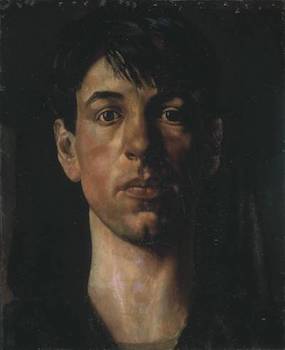
Self-Portrait 1914 by Sir Stanley Spencer 1891-1959

(Stanley Spencer, Self-Portrait: Tate Gallery)

Sometimes, death constitutes no serious interruption to a process possessing its own rules and impetus. Stanley Spencer’s correspondence with his former wife Hilda continued after her death, beginning with a December 1950 letter and continuing until his own death nine years later. There was never any reference to her being dead and some of his letters ran to scores of pages.[6]

And the approach of death is sometimes neither feared nor unwelcome. In Patrick White’s novel The Riders in the Chariot, though Himmelfarb is near death in Mrs Godbold’s house, ‘He was as content by now as he would ever have allowed himself to be in life. Children and chairs conversed with him intimately.’[7] The importance of chairs – and tables – as solid, honest, real is a recurrent motif in White’s work.

Walter Savage Landor does a nice line in stoic acceptance of the inevitable ending:

To my ninth decad I have tottered on,
And no soft arm bends now my steps to steady;
She, who once led me where she would, is gone,
So when he calls me, Death shall find me ready.

Landor

And perhaps one more:

I strove with none, for none was worth my strife;
Nature I loved, and next to Nature, Art;
I warmed both hands before the fire of life;
It sinks, and I am ready depart.[8]

And Ali Smith writes of how ‘many things get forgiven in the course of a life: nothing is finished or unchangeable except death and even death will bend a little if what you tell of it is told right’.[9]

That’s something to aim for: bend death a little. Tell it right.

 
References

[1] Sylvia Townsend Warner, The Diaries of Sylvia Townsend Warner, edited by Claire Harman (London: Virago Press, 1995), 312.

[2] David Jones, In Parenthesis (1937; London: Faber and Faber, 1963), 162.

[3] Allyson Booth, Postcards From the Trenches: Negotiating the Space Between Modernism and the First World War (New York: Oxford University Press, 1996), 59-63

[4] Fernand Braudel, Civilization and Capitalism, 15th – 18th Century. Volume I: The Structures of Everyday Life: The Limits of the Possible, translated from the French and revised by Sîan Reynolds. (London: Fontana Books 1985), 73.

[5] Juliet Nicolson, The Great Silence, 1918-1920 (London: John Murray, 2009), 94.

[6] Maurice Collis, Stanley Spencer: A Biography (London: Harvill Press, 1962), 214.

[7] Patrick White, Riders in the Chariot (1961; Harmondsworth: Penguins Books, 1964), 432.

[8] Nick Rennison and Michael Schmidt, editors, Poets on Poets (Manchester: Carcanet Press, in association with Waterstones, 1997), 231; Daniel Karlin, editor, The Penguin Book of Victorian Verse (London: Penguin Books, 1997), 18.

[9] Ali Smith, How to be both (London: Hamish Hamilton, 2014), 95.

Thin crusts, modern girls: John Buchan

JB_Buchan_in_library

John Buchan in the library
https://archives.queensu.ca/exhibits/buchan/family

‘You may say that everyone who had taken physical part in the war was then mad’, Ford Madox Ford wrote a dozen years after the Armistice. Objects that ‘the earlier mind labelled as houses’, that had seemed to be ‘cubic and solid permanences’, had been revealed as thin shells that could be crushed like walnuts, he went on. ‘Nay, it had been revealed to you that beneath Ordered Life itself was stretched, the merest film with, beneath it, the abysses of Chaos. One had come from the frail shelters of the Line to a world that was more frail than any canvas hut.’[1]

In John Buchan’s Huntingtower (1922), the poet John Heritage remarks to Dickson McCunn, ‘I learned in the war that civilization anywhere is a very thin crust.’[2] And here is Andrew Lumley in The Power-House: ‘“You think that a wall as solid as the earth separates civilisation from barbarism. I tell you the division is a thread, a sheet of glass. A touch here, a push there, and you bring back the reign of Saturn.”’[3]

On the face of it, the two novelists could hardly appear less alike, one a modernist with a markedly artistic background, whose work sold poorly for most of his life; the other a hugely successful writer of popular fiction, keen sportsman, son of a minister of the Free Church of Scotland, very traditional, a seemingly paradigmatic establishment figure: Lord Tweedsmuir, Governor General of Canada, born in Perth on this day, 26 August, 1875. Still, they were almost exact contemporaries: Buchan published his first book at the age of nineteen—Ford’s was published shortly before his eighteenth birthday—and produced more than a hundred in total (as against Ford’s eighty). I’ve read around a quarter of Buchan’s titles, ten of them more than once, I see. The ‘shockers’ like The Thirty-Nine Steps are by far the best-known but those made up a relatively small part of Buchan’s huge output: even fiction comprises barely one-third of it.

Walton

(Izaak Walton: Dean & Co © National Portrait Gallery, London)

In a more detailed sense, even confining the matter to Huntingtower, a reader infected with the Ford Madox Ford virus might be pencilling faint marks in the margin against such lines as ‘Finally he selected Izaak Walton’ and ‘the seeing eye’ (16), ‘Poetry’s everywhere, and the real thing is commoner among drabs and pot-houses and rubbish-heaps than in your Sunday parlours’ (26)[4] and ‘a white cottage in a green nook’ (31), as well as the editor’s citing of a passage in Buchan’s autobiography dealing with his feelings about the war (xx). Buchan writes there, ‘I acquired a bitter detestation of war, less for its horrors than for its boredom and futility, and a contempt for its panache. To speak of glory seemed a horrid impiety.’[5]

Before all else, Buchan writes a rattling good yarn and I enjoy his books enormously for themselves. Those thrillers and adventure stories and romances largely achieve exactly what they set out to do, while their limitations are fairly obvious, not least to Buchan himself. Writing to his sister Anna about her second novel The Setons (she wrote under the name of O. Douglas), Buchan remarked: ‘In Elizabeth you draw a wonderful picture of a woman (a thing I could about as much do as fly to the moon).’[6]

The_39_Steps_1935_British_poster

Oh Carroll! (character added by Hitchcock) https://en.wikipedia.org/w/index.php?curid=38053736

Of course, hundreds of other writers have written rattling good yarns, made a living and duly faded from view; but many of Buchan’s books have not only survived but seem to be in a state of constantly improving health. They certainly possess qualities or contain features, often hard to pin down and specify, which have enabled that continued vitality. David Daniell refers to Buchan’s writing novels ‘with a mixture of surface pace of action and a deeper density of content which have a timeless quality’.[7]

For me, one of the pleasures is noticing the many ways in which a writer superficially so different from the usual modernist cast list overlaps with them, inhabits a recognisably similar world. His writing may be aimed at an audience quite unlike those aimed at by Joyce or Woolf or Ford; and he may not be fragmenting narratives or operating tricky timeframes or incorporating extra-literary discourses or multilingual puns but the overlap is certainly there for me.

This is largely because much of his work is set in and around the First World War, particularly in the years following it, perhaps my main area of interest. And although Buchan himself inhabited a world of prominent political and diplomatic figures, there remained a touch of the outsider, not least because of the war. Rejected for the army on grounds of both age and health, he visited France and Flanders as correspondent for The Times and took increasingly senior roles in information and intelligence but, as Andrew Lownie writes, Buchan ‘emerged from the First World War physically and emotionally shattered. Many of his closest friends had been killed and this loss of his immediate circle reinforced his sense of being displaced.’[8]

A good deal of his writing, then, is concerned with the terrain that most engages me: with the effects of the war both on individuals who were actively engaged in the fighting and those who were not, with shifting perceptions and understanding of shell-shock, with radical jolts in social relations, the rising threat of fascism, the ‘new Vienna doctrine’ and shifts in fashion and femininity, as the Edwardian ‘hourglass’ shape was replaced with the ‘tubular look’.[9]

Flapper
https://www.collectorsweekly.com/

This last is an example of the fascinating detail that can be followed for a short stretch or for many, many miles. While there is never (to my mind) any convincing strain of homoeroticism, here in Huntingtower is Saskia: ‘her slim figure in its odd clothes was curiously like that of a boy in a school blazer’ (70); in Mr Standfast, Mary is described as moving ‘with the free grace of an athletic boy’.[10] In John Macnab, Janet’s face ‘had a fine hard finish which gave it a brilliancy like an eager boy’s’ and later she looks to Sir Archie ‘like an adorable boy.’[11] Finally, in The Dancing Floor, Mollie Nantley says of Koré that she is ‘utterly sexless – more like a wild boy’, while Leithen reflects that, ‘These children [both youths and girls] looked alert and vital like pleasant boys, and I have always preferred Artemis to Aphrodite.’[12]

Artemis: virginal, eternally young, independent of men, athletic, the huntress. In C. E. Montague’s Rough Justice, Molly, ‘the young Artemis’, has a job as ‘games mistress’,[13] as does Valentine Wannop in Ford’s A Man Could Stand Up–, though a good many other male novelists and poets of the period would far rather, I think, have embraced Aphrodite. Trudi Tate mentions Lawrence and Faulkner as seeming ‘to disapprove of these androgynous figures’,[14] and one would immediately add Joyce. All non-combatants, I notice, which is either irrelevant or a thought for another time.

Catherine Carswell

Writing of her single meeting with Buchan in the summer of 1932, Catherine Carswell, novelist and friend (and biographer) of D. H. Lawrence, observed that, ‘A traditionalist in so many respects, he was yet a champion of the modern girl, delighting in her independences, even in her defiances, frowning neither upon her sometimes extravagant make-up nor upon her occasions for wearing trousers. As among the goddesses, his preference was for Artemis.’[15]

Ah, the modern girl. In The Dancing Floor (213), Buchan writes: ‘Virginity meant nothing unless it was mailed, and I wondered whether we were not coming to a better understanding of it. The modern girl, with all her harshness, had the gallantry of a free woman. She was a crude Artemis, but her feet were on the hills. Was the blushing, sheltered maid of our grandmother’s days no more than an untempted Aphrodite?’

Buchan is not a modernist novelist and not a part of any literary movement, though he doesn’t seem as wholly removed from the literary world as Kipling, who sometimes seems not to have known any writers other than Rider Haggard. Buchan and his wife knew Elizabeth Bowen, Rose Macaulay, Hugh MacDiarmid, Walter de la Mare, Robert Graves, T. E. Lawrence – and Virginia Woolf, whose novels Buchan admired. Woolf had known Buchan’s wife Susan for many years and one of her last letters was written to Susan, though unposted: Leonard Woolf sent it on in the month following Virginia’s death.[16]

There have, naturally, been recurrent complaints about Buchan as racist, anti-Semitic, sexist: the usual fare. There have been equally recurrent rebuttals and, indeed, what a lot of it comes down to seems to be complaints that people a hundred years ago didn’t wholly share the social attitudes that we – that most of us, we hope – share today. Still, one clue to his books lasting is, I suspect, the way that certain artists fall out of fashion because of their content or attitudes or language but then, after a further period of time has elapsed, come into focus again, far enough back now to be viewed objectively and enjoyed without fretting about ‘relevance’ or current orthodoxies. Here’s Graham Greene, looking back to the 1930s:

‘An early hero of mine was John Buchan, but when I re-opened his books I found I could no longer get the same pleasure from the adventures of Richard Hannay. More than the dialogue and the situation had dated: the moral climate was no longer that of my boyhood. Patriotism had lost its appeal, even for a schoolboy, at Passchendaele, and the Empire brought first to mind the Beaverbrook Crusader, while it was difficult, during the years of the Depression, to believe in the high purposes of the City of London or of the British Constitution. The hunger-marchers seemed more real than the politicians. It was no longer a Buchan world.’[17]

Not a Buchan world; yet, although the attitudes towards the threats may have changed over the years, some of the current threats themselves—the threat of fascism, attempts to subvert democracy, ‘fake news’ (that blood relation of propaganda)—seem worryingly familiar. But, alas, Richard Hannay, Edward Leithen, Sandy Arbuthnot and Archie Roylance will not be saving us this time around.


References

[1] Ford Madox Ford, It Was the Nightingale (London: Heinemann, 1934), 48, 49.

[2] John Buchan, Huntingtower (1922; edited by Ann Stonehouse, Oxford: Oxford University Press, 1996), 116.

[3] John Buchan, The Power-House (1916; Edinburgh: B&W Publishing, 1993), 38.

[4] See Ford Madox Ford on ‘the portable zinc dustbin’, in the ‘Preface’ to Collected Poems (London: Max Goschen, 1913 [dated 1914]), 16-17.

[5] John Buchan, Memory Hold-the-Door (London: Hodder and Stoughton, 1940), 167.

[6] Quoted by Janet Adam Smith, John Buchan: A Biography (Oxford: Oxford University Press, 1985), 284.

[7] David Daniell, The Interpreter’s House: A Critical Assessment of the Work of John Buchan (London: Thomas Nelson, 1975), 209.

[8] Andrew Lownie, John Buchan: The Presbyterian Cavalier (London: Constable, 1995), 297.

[9] Martin Pugh, ‘We Danced All Night’: A Social History of Britain Between the Wars (London: The Bodley Head, 2008), 171.

[10] John Buchan, Mr Standfast (1919; Oxford: Oxford University Press, 1993, edited by William Buchan), 11.

[11] John Buchan, John Macnab (1925; edited with an introduction by David Daniell, Oxford: Oxford University Press, 1994), 125, 182.

[12] John Buchan, The Dancing Floor (1926; edited with an introduction by Marilyn Deegan, Oxford: Oxford University Press, 1997), 57, 51.

[13] C. E. Montague, Rough Justice (London: Chatto & Windus 1926), 171.

[14] Trudi Tate, Modernism, History and the First World War (Manchester: Manchester University Press, 1998), 115n.

[15] Catherine Carswell, ‘John Buchan: A Perspective’, in John Buchan by His Wife and Friends (London: Hodder and Stoughton, 1947), 160.

[16] Virginia Woolf, Leave the Letters Till We’re Dead: Collected Letters VI, 1936-41, edited by Nigel Nicolson and Joanne Trautmann Banks (London: The Hogarth Press, 1994), 483 and n.

[17] Graham Greene, Ways of Escape (London: Vintage, 1999), 69.
Temperature normal – sometimes

Borogroves-toves-raths

(Sir John Tenniel, ‘Borogroves, toves, raths’)

‘Delirium would seem to be the fate of all societies which become content in secured wealth and gradually forget the conditions of labour and service upon which alone that security can be maintained.’[1]

 
Writing to Eudora Welty in 1996, William Maxwell told her that he was sending ‘a lifetime of correspondence’ to the University of Illinois Library but couldn’t bear to dispose of his letters from Charles and Susan Shattuck without rereading them.

‘Reading the letters has plunged me into such a fit of remembering, not only of them but of almost everything else, that I couldn’t sleep because my mind was racing so. It made me realize that remembering can be a kind of illness, and perhaps I have it.’[2]

It can be; I may have it too. But if it’s the other way around, I’ve had a touch of that too lately, encountering people I’ve not seen for years, some of them dead, of course, but also with the tendency to turn into others or, indeed, into narrow staircases or resistant thickets or animals—among them, white rabbits, though not, to my recollection, Grace Slick.

Even though I’ve been luckier than a great many other people in the matter of general health, I’ve still had far more serious medical conditions than this in my life—‘I want you to go to hospital’, my doctor said once, years ago and, when I mumbled vaguely about dates and appointments, he said, ‘I mean now. Immediately.’ So peritonitis was happily avoided—but I can’t remember feeling so generally ill. And yes, the nights have been the worst but I’m still frustrated by the sheer physical effort involved in such major undertakings as putting on clothes or lifting a dropped spoon from the floor. (For the most part, the Librarian, visibly puzzled by the circumstances which have landed her with this most unnatural role, buckles to and tends.)

‘Space the doses evenly throughout the day.’

We all experience illness; some are never free of it; a part of ordinary life, it also offers the means of luring or urging the poet, the painter, the storyteller into strange and often arresting terrain. Illness is so various, involves its own related places, its own rituals, its own company. If we are not ill now, we have been and we will be.

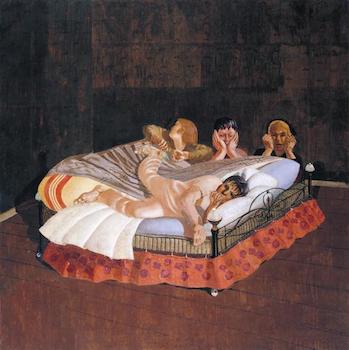
The Centurion's Servant 1914 by Sir Stanley Spencer 1891-1959

Stanley Spencer, The Centurion’s Servant: Tate Gallery
© Estate of Stanley Spencer

Discussing Stanley Spencer’s The Centurion’s Servant —‘a person walking only it is lying down’, the painter remarked— Kenneth Pople notes that, in Spencer’s childhood Cookham, it was the custom to pray round the sickbed. Family recollections included an episode in which one of the older Spencer boys developed pneumonia. The illness reached a stage at which the anxiously watching women dispatched young Sydney Spencer to run to his father, then working across the Thames at Hedsor, ‘to tell him that “the crisis has come”; a message which reached Pa’s ears as ‘“Christ has come.”’[3]

Alethea Hayter quotes Coleridge—‘“I appear to myself like a sick physician, feeling the pang acutely, yet deriving a wonted pleasure from examining its process and developing its causes”’—and comments that, ‘He was speaking metaphorically, but illness, like anything else for him, could become an allegory and was interesting for that reason. Anything, however intrinsically repugnant, could be used as a symbol which would make a poem.’[4]

The warring elements of my recent nights have been the sleeplessness for hours at a time but, on the other hand, a seething and feverish onslaught of images tap-dancing on the insides of my eyelids. Lying still can, of course, be a quite exhausting business.

‘This medicine may colour your urine. This is harmless.’

Kipling-via-BBC

Edmund Wilson’s assertion that ‘[t]he theme of inescapable illness dominates the whole later Kipling’ is a reminder of just how many impressive stories this applies to, when postwar trauma is included, as it must be.[5] Yet, as J. M. S. Tompkins points out, the theme of healing predates the war, emerging in Actions and Reactions (1909), with its opening story ‘An Habitation Enforced’ and its concluding one, ‘The House Surgeon’.[6] In later stories, it is sometimes the ritual and fellowship of the masonic lodge that is the healing power: ‘In the Interests of the Brethren’, ’Fairy-Kist’, ‘The Janeites’.

‘Ah!’ Conrad’s Marlow says, ‘but it was something to have at least a choice of nightmares.’ (I think we can all wholeheartedly second that.) And: ‘I admit my behaviour was inexcusable, but then my temperature was seldom normal in these days.’[7]

My own temperature promises to be—and, importantly, to stay—normal, any day now. Yes. I think so. Any day now.


References

[1] C. F. G. Masterman, The Condition of England (London: Methuen, 1911), 34.

[2] Suzanne Marrs, editor, What There Is to Say, We Have Said: The Correspondence of Eudora Welty and William Maxwell (Boston and New York: Houghton Mifflin Harcourt, 2011), 441.

[3] Kenneth Pople. Stanley Spencer: A Biography (London: Harper Collins, 1991), 63.

[4] Alethea Hayter, Voyage in Vain: Coleridge’s Journey to Malta in 1804 (1973; London: Robin Clark, 1993), 152.

[5] Edmund Wilson, ‘The Kipling That Nobody Read’, in Andrew Rutherford, editor, Kipling’s Mind and Art (Stanford: Stanford University Press, 1964), 67.

[6] J. M. S. Tompkins, The Art of Rudyard Kipling, second edition (Lincoln: University of Nebraska Press, 1965), Chapter Six, ‘Healing’.

[7] Joseph Conrad, Heart of Darkness with The Congo Diary, edited by Robert Hampson (London: Penguin Books, 1995), 103, 114.


Still feeling the heat – but smelling the rain

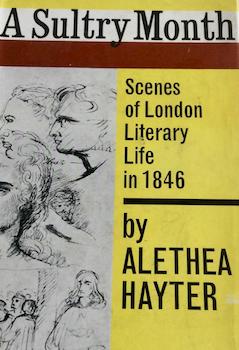
Sultry-month

It was ‘the hottest summer month that anyone could remember. For the first twenty-two days of the month the average day temperature was 84° in the shade, 105° in the sun. Kent had had six weeks without rain and midday temperatures of 104° to 116°.’ Alethea Hayter is writing here, in A Sultry Month, about June 1846, though the period covered by her book extends over the first two weeks of July as well.

It was, she adds, ‘murderous weather. Wherrymen, out in boats on the Thames all day, died of sunstroke; farm-labourers died of heat-stroke after a day’s mowing; many people all over the country were drowned while bathing.’ But there were also ‘sudden and violent storms all over the country, many people were killed by lightning, in some places the very air smelt of fire, and the raindrops that fell were the largest ever seen.’[1]

It’s been murderous weather enough in Greece and Japan, to name but two. Still, we tend to look at temperatures with a comparative eye. Only 86°F? In the past few days, I see that Arizona has been running up temperatures of 111° while Basra recorded 45C (113°F). But in 1846 there was no refrigeration; workers’ rights were minimal or non-existent; and in many places the water was quite unfit to drink: a Royal Commission, reporting in 1844 and 1845, inquired among much else into the water-supply of fifty large towns and found that it was good in only six cases.[2]

As for the dangers—no sun cream and no health professionals advising you to slap it on. Half a century after Hayter’s sultry month, Roy Porter notes, the Danish physician Niels Finsen (1860-1904) suggested ‘that ultraviolet rays were bactericidal, and so could be useful against conditions like lupus. Many early hospital radiology departments provided both radiation and ultraviolet light therapy, and Finsen’s researches stimulated high-altitude tuberculosis sanatoria and inspired the unfortunate belief that sun-tans were healthy.’[3]

Sun-tans. Sunbaths. Sun. In his story of that title, D. H. Lawrence writes of a woman and her child sent away to the sun. ‘It was not just taking sunbaths. It was much more than that. Something deep inside her unfolded and relaxed, and she was given.’ Naked by the cypress trees when the husband, in his suit and tie, returns after many weeks. ‘She had always been mistress of herself, aware of what she was doing, and held tense for her own power. Now she felt inside her quite another sort of power, something greater than herself, flowing by itself. Now she was vague, but she had a power beyond herself.’ She becomes intimate with a peasant, seen from a distance—though her next child will be her husband’s.[4]

‘It is strange how different the sun-dried, ancient, southern slopes of the world are, from the northern slopes’, Lawrence wrote in another context. ‘It is as if the god Pan really had his home among these sun-bleached stones and tough, sun-dark trees. And one knows it all in one’s blood, it is pure, sun-dried memory.’[5]

Lawrences-Bynner-Teotihuacan-1923

D. H. Lawrence, Frieda and Witter Bynner at Teotihuacan, Mexico, 1923: site of the Pyramid of the Sun

He was not always so positive about the beneficial effects of the sun. Immediately following ‘Sun’ in the Collected Stories is ‘The Woman Who Rode Away’: the sun reaching a certain point in the sky is the moment at which the woman will be sacrificed under the knife of the old priest. ‘The Shadow in the Rose Garden’ has a woman encountering her ex-lover Archie, the rector’s son, now a lunatic after contracting sunstroke during military service in Africa.

Rupert Brooke’s death from blood poisoning in 1915 was first reported as sunstroke. Lawrence attributed this to the sun-god, Phoebus Apollo: ‘He was slain by bright Phoebus shaft – it was in keeping with his general sunniness [ . . . ] Bright Phoebus smote him down. It is all in the saga.’[6]

In Patrick White’s Voss, Laura Trevelyan takes charge of Rose Portion’s baby. Her relationship with the child wonderfully exemplifies Laura’s own complex and courageous character: ‘They were the baby’s days. There was a golden fuzz of morning in the garden. She could not bring herself to tread upon the tender flesh of rose petals that were showered at her feet. To avoid this, she would walk round by another way, though it meant running the gauntlet of the sun. Then her duty was most delicious. She was the living shield, that rejoiced to deflect the most savage blows. Other pains, of desert suns, of letters unwritten, of the touch of his man’s hands, with their queer pronounced finger-joints, would fluctuate, as she carried her baby along the golden tunnels of light.’[7]

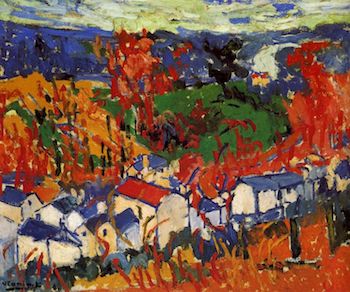
Vlaminck-maisons-et-arbres

Maurice de Vlaminck, Maisons et Arbres, 1906.

Julian Barnes remarks that Fauvism was ‘all about heat’ and that ‘the journey towards analytic and then synthetic cubism also plays out in terms of temperature.’ Fauvism ‘is all pinks and mauves, with shouty blues and hilarious oranges: the sun is ferocious, whatever the sky in the picture may pretend.’ Classical Cubism was suspicious of colour, Braque embracing rich browns, greens, greys. ‘By 1910-11 you could have any colour you liked, so long as it was grey, brown or beige.’[8]

HD-via-ND

(H. D. via New Directions)

‘O wind, rend open the heat’, H. D. wrote:

cut apart the heat,
rend it to tatters.

Fruit cannot drop
through this thick air—
fruit cannot fall into heat
that presses up and blunts
the points of pears
and rounds the grapes.

Cut the heat—
plough through it,
turning it on either side
of your path.[9]

But now the cloud is thickening and darkening, and the quickening wind smells of rain, all of this perfectly natural, since I’ve just watered the tomato plants. . .

 
References

[1] Alethea Hayter, A Sultry Month: Scenes of London Literary Life in 1846 (London: Faber and Faber, 1965), 47.

[2] Llewellyn Woodward, The Age of Reform: 1815-1870, second edition (Oxford: Oxford University Press, 1962), 463.

[3] Roy Porter, The Greatest Benefit to Mankind: A Medical History of Humanity from Antiquity to the Present (London: Harper Collins, 1997), 607.

[4] D. H. Lawrence, ‘Sun’, in The Collected Short Stories of D. H. Lawrence (London: William Heinemann, 1974), 493-508.

[5] D. H. Lawrence, Twilight in Italy, in D. H. Lawrence and Italy (London: Penguin Books, 1997), 163.

[6] Paul Delany, The Neo-Pagans: Friendship and Love in the Rupert Brooke Circle (London: Macmillan, 1987), 211; Letters of D. H. Lawrence II, June 1913-October 1916, edited by George J. Zytaruk and James T. Boulton (Cambridge: Cambridge University Press, 1981), 330-331.

[7] Patrick White, Voss (London: Eyre & Spottiswoode, 1957), 247.

[8] Julian Barnes, Keeping an Eye Open: Essays on Art (London: Jonathan Cape, 2015), 195.

[9] H. D., ‘Garden’, in Collected Poems 1912-1944, edited by Louis L. Martz (Manchester: Carcanet Press, 1984), 25.


Pronouns, tales of the tribe and which side are you on?

Stone-wall

‘I sit in one of the dives
On Fifty-Second Street
Uncertain and afraid
As the clever hopes expire
Of a low dishonest decade’.

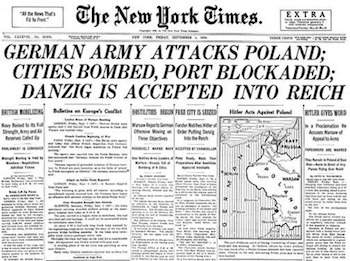
So, famously, W. H. Auden begins ‘September 1, 1939’. This was the day on which Germany invaded Poland. The British and French declarations of war followed two days later. Lately, I’ve been thinking more about the final stanza:

‘Defenceless under the night
Our world in stupor lies;
Yet, dotted everywhere,
Ironic points of light
Flash out wherever the Just
Exchange their messages:
May I, composed like them
Of Eros and of dust,
Beleaguered by the same
Negation and despair,
Show an affirming flame.’[1]

Sept 1 NYT

We are, of course, slurring our way towards the close of a low, dishonest decade, not for the first time. And a lot of us are feeling ‘beleaguered’, for sure. But the point on which you catch your clothes—or your skin—is those damn pronouns. ‘We’, ‘’us’, ‘them’. And ‘the Just? Us, obviously, though, again, query ‘us’ (itself usefully contained in the words ‘dust’ and ‘Just’), and note Auden’s use of ‘them’.

‘There is no mystery about the Cantos, they are the tale of the tribe’, Ezra Pound wrote towards the close of the decade of which Auden was writing, ‘—give Rudyard credit for his use of the phrase’.[2] But which tribe? He meant, I’d say, the collective human tribe; and was echoing a talk given by Kipling thirty years earlier.[3]

We are, it seems, reverting to tribes again. ‘Everybody’s shouting “Which side are you on”?’, Bob Dylan sang on Desolation Row. It’s a topical question, for sure. One of the songs performed by Natalie Merchant and her guitarist Erik Della Penna in an outstanding show in Bath the other evening was the song Dylan probably alluded to, Which Side Are You On?, its lyrics written in 1931 by poet and activist Florence Reece, its melody borrowed from either the ballad Jack Munro or the hymn Lay the Lily Low. Reece’s husband Sam was an organizer for the mineworkers’ union in Harlan County, Kentucky, which was locked in a fierce struggle with the mine owners, who hired men, including a sheriff, to intimidate Reece.

Merchant-Tour

The lines of battle would have been starkly drawn then, as they were in the context of Auden’s poem. For the bosses or for the workers; for or against fascism, genocide, armed conquest. And now? Pretty clear, you’d think—but no, seemingly not. You couldn’t make it up, I hear people say. End of days, the Librarian comments, watching the news from America or, nearer, groups of zealots wielding disproportionate power or divulging ‘the will of the people’—a slightly risky business since just 37% of the electorate actually voted to leave the European Union.

‘Probability? Nothing is so improbable as what is true’, Ambrose Bierce wrote in a critique of the realist novelist, William Dean Howells. ‘It is the unexpected that occurs; but that is not saying enough; it is also the unlikely—one might almost say the impossible.’[4] And, in an ‘Author’s Note’ to her huge novel of the French Revolution, Hilary Mantel remarked, ‘The reader may ask how to tell fact from fiction. A rough guide: anything that seems particularly unlikely is probably true.’[5]

I seem to come across half a dozen lucid, intelligent articles a week that set out or summarise where we’ve got to and how—and the dangers that we—the people and the democratic process which defines and enables us—are facing. And I know that, for the most part, their only readers are those who already know some or all of this stuff and will have reached similar conclusions. But what of the others?

One of the most baffling and frequently recurring questions is ‘just what would it take?’ And, in the United States, for instance, the answer seems to be that nothing Donald Trump might do, or leave undone, would disappoint or alienate his core supporters. Even after the recent Presidential trip to Europe, when he attacked his European allies, trashed the British Prime Minister’s policies and prioritised Mr Putin’s assurances over the painstaking work and unambiguous conclusions of his own intelligence services, nearly 80% of Republicans ‘approved of his handling of the Russian president at the post-summit press conference’, while 85% ‘think the justice department investigation into Russia’s meddling in US elections is a distraction.’

The former White House communications director, Anthony Scaramucci, was quoted as saying that, ‘They couldn’t care less about what happened in Russia. They love this guy, they think this guy’s for them. These are low information, emotional voters and they like what they see in the president. They think he’s working for them.’[6]

The phrase ‘low information’ rang a bell. One of the most striking ironies about the EU referendum is that a great many of those who voted in what would turn out to be the bitterest and most divisive electoral contest in living memory appear not to pay much attention to politics at all. The endless revisiting of Brexit ‘heartlands’ by journalists that still want to understand and explain it is not particularly enlightening but I’ve been struck by the number of times that people are quoted as saying that they don’t follow current affairs, that politics is ‘nothing to do with them’. The related irony is the widespread belief that their votes don’t really make any difference in General Elections—largely true given our antiquated electoral system and the huge proportion of ‘safe seats’—but that in this one case, the ill-conceived and worse-designed referendum, their votes actually did make a difference.

But I was remembering too a passage in Sarah Churchwell’s Behold, America, where she’s citing a 1923 essay in Vanity Fair by the hugely influential journalist and political commentator, Walter Lippmann. ‘Education and the White Collar Class’ stressed the importance of widening access to higher education: without it, America would be left with ‘a literate and uneducated democracy’. Churchwell points out that ‘the distinction between literacy and education was crucial: what would happen to a nation in which voters could read, but weren’t well informed?’ What, indeed? ‘An uneducated but literate democracy would, Lippmann warned, elect the incompetent, the corrupt and the fascistic.’[7]

Lippmann

We have in this country a largely literate democracy but not, I tend to feel, a very well-informed one on the whole. There are several reasons for this: some gaping holes in the standard educational fare, the poor quality of much of the national press, the increased distancing of government from people, the emasculation of local councils, the sheer noise of social media and the apparent illusion that because there’s so much available information it must somehow be absorbed into the mind—or simply through the skin perhaps. Then the effect of recent administrations has tended to produce indifference, a widespread lack of interest in the political process and an inability to take seriously what are genuine threats, now that there are factions in positions of power  perfectly willing to see this country crash and burn rather than their view of it not prevail.

In the wake of the First World War, Pound wrote:

Died some pro patria, non dulce non et decor. . .

walked eye-deep in hell
believing in old men’s lies, then unbelieving
came home, home to a lie,
home to many deceits,
home to old lies and new infamy;

usury age-old and age-thick
and liars in public places.[8]

‘Liars in public places’: surely never more so than now. We are all—or rather, some of us are—wearing that tee-shirt.


References

[1] W. H. Auden, The English Auden: Poems, Essays and Dramatic Writings, 1927-1939, edited by Edward Mendelson (London: Faber, 1977), 245-247.

[2] Ezra Pound, Guide to Kulchur (1938; New York: New Directions, 1970), 194; see too Selected Letters, 1907-1941, edited by D. D. Paige (New York: New Directions, 1971), 294.

[3] Rudyard Kipling, ‘Literature’, in A Book of Words (London: Macmillan, 1928), 3-8. See Michael André Bernstein, The Tale of the Tribe: Ezra Pound and the Modern Verse Epic (Princeton: Princeton University Press, 1980), 7-8.

[4] Ambrose Bierce, ‘The Short Story’ (1897), in Tales of Soldiers and Civilians and Other Stories, edited by Tom Quirk (Harmondsworth: Penguin Books 2000), 259.

[5] Hilary Mantel, A Place of Greater Safety (Harmondsworth: Penguin Books, 1993), x.

[6] David Smith, ‘Solid support: why Trump voters don’t care about Putin controversy’, The Guardian (Saturday 21 July 2018), 26.

[7] Sarah Churchwell, Behold, America: A History of America First and the American Dream (London: Bloomsbury Publishing, 2018), 109, 110.

[8] Hugh Selwyn Mauberley, IV, Ezra Pound: Poems and Translations, edited by Richard Sieburth (New York: Library of America, 2003), 551.


Reading, rallying, resisting

Demo1

Rereading The Solid Mandala, I come across this snatch of dialogue between the two brothers, Waldo—competent, rational, self-professed writer of genius who hasn’t actually written anything much—and Arthur, regarded as mentally challenged, ‘short of a shingle’, a hopeless burden on his brother.

‘He said: “One day perhaps I’ll be able to explain – not explain, because it’s difficult for me, isn’t it, to put into words – but to make you see. Words are not what make you see.”
‘“I was taught they were,” Waldo answered in hot words.
‘“I dunno,” Arthur said. “I forget what I was taught. I only remember what I’ve learnt.”’

A good many people forget what they’ve been taught, of course. And a fair number seem not to have learnt anything much: some of them, oddly, are in important political positions.

Patrick-White-Speaks

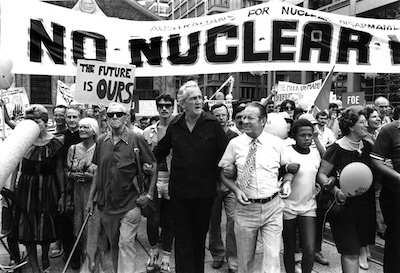
White, in contrast, learned and remembered an extraordinary amount. And, in the last twenty years of his life, he became increasingly active politically, both writing and speaking, against the depredations of developers and local politicians, cultural provincialism, the mining and export of uranium, the continued mistreatment and exploitation of Australian Aborigines, hostility to immigrants, the Vietnam War and the proliferation of nuclear weapons.

White-Hiroshima

(Patrick White and Tom Uren, Hiroshima Day demonstration, Sydney, 1984)
https://www.portrait.gov.au/magazines/26/the-activist-a-list

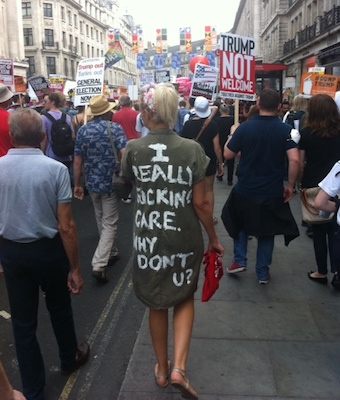
So I read Patrick White on the train, en route and coming home again. In between, in the company of wife and elder daughter, I move slowly from Regents Park to Trafalgar Square, along with a hundred thousand other people [update five days later: I was far too restrained: more like 250,000], of all kinds, classes, ages and nationalities (quite a few Americans). It was tremendously encouraging to see so many individuals and families opposing racism, misogyny, the forcible separation of young children from their parents, serial untruths, environmental vandalism and the degradation of the office of United States President – and restating the case for decency, truthfulness, peace, justice, honesty, equitable treatment of individuals: all quite reasonable standards and expectations, you might think, and so inevitably trashed by rags like the Daily Mail.

Demo3 Demo2

Still, it may finally have dawned on a few more of those people who have been mouthing the words ‘US trade deal’ with semi-religious fervour that, while the United States has historically been an ally of Great Britain, this President is not. His main concern is to fracture alliances, treaties and agreements, and to separate nations if he can from positions of collective strength to positions of individual weakness, so they can be more easily bullied and exploited. And on we go.