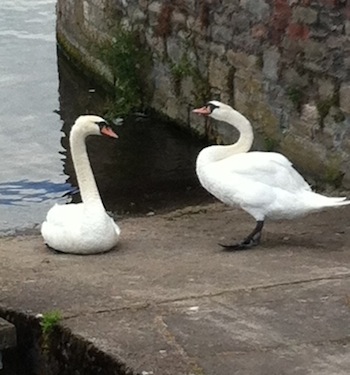
Very fine swans indeed

Swans.1

In Pavannes and Divisions, his prose collection of June 1918, Ezra Pound included ‘A Retrospect’, a group of ‘early essays and notes’, gathered from a period of some four or five years. Towards the close, under the heading ‘Only Emotion Endures’, Pound wrote: ‘Surely it is better for me to name over the few beautiful poems that still ring in my head than for me to search my flat for back numbers of periodicals and rearrange all that I have said about friendly and hostile writers.’[1]

The poets he names are, for the most part, predictable: Yeats, William Carlos Williams, Richard Aldington, H. D., Ford Madox Ford, James Joyce; and, of course, T. S. Eliot (‘I am almost a different person when I come to take up the argument for Eliot’s poems’). Two others are rather less expected: Alice Corbin, for instance, who, as well as a poet, was associate editor of Poetry magazine, for which Pound served as foreign correspondent, writing to her often in the 1912-1917 period.[2] He mentions her ‘One City Only’, which he himself published in his Catholic Anthology, 1914-1915. The second he alludes to—‘another ending “But sliding water over a stone”’—is ‘Love me at last’, published in Poetry in December 1914:
https://www.poetryfoundation.org/poetrymagazine/browse?contentId=12993

The other slightly surprising inclusion is Padraic Colum—surprising, I mean, because, once again, this is a poet with a very traditional style yet with an evident appeal to Pound, even though he has been through the Imagist and Vorticist periods and publishes early versions of the first three Cantos in the summer of 1917. Indeed, it’s Colum whom he names first of all: ‘The first twelve lines of Padraic Colum’s “Drover”; his “O Woman shapely as a swan, on your account I shall not die”’.

The ‘first twelve lines’ of Colum’s ‘A Drover’ are:

To Meath of the pastures,
From wet hills by the sea,
Through Leitrim and Longford
Go my cattle and me.
I hear in the darkness
Their slipping and breathing.
I name them the bye-ways
They’re to pass without heeding.
Then the wet, winding roads,
Brown bogs with black water;
And my thoughts on white ships
And the King o’ Spain’s daughter.

Very simple; the kind of inversion (‘Go my cattle and me’) that you’d expect to set Pound’s teeth on edge. Yet this is quite skilled stuff: the subtle lengthening of lines to avoid the thud of the metronome; a light alliteration that never hits you over the head; the varies use of feminine line-endings; the twelfth line’s hint at a traditional children’s rhyme. Another twenty-four lines, though, beginning: ‘O! farmer, strong farmer!’ are less appealing, a bit more prone to poeticism and cliché.

The other poem, ‘I Shall Not Die’, begins:

O woman, shapely as the swan,
On your account I shall not die:
The men you’ve slain — a trivial clan —
Were less than I.
I ask me shall I die for these —
For blossom teeth and scarlet lips —
And shall that delicate swan-shape
Bring me eclipse?[3]

The swan, Michael Ferber notes, ‘has long been one of the most popular birds in poetry, not least because of the association of swans with poets themselves.’[4] There has certainly been an astonishing procession of literary swans, hardly surprising if the swan is the bird both of Apollo (god of poetry and music) and of Venus, goddess of love: from classical literature through to Shakespeare (the swan of Avon), Pope, Shelley, Elizabeth Barrett Browning and others. Among modern poets, the poet of swans is surely Yeats, who draws on the complex mythological links between Leda, Helen of Troy— long a Yeatsian symbol for Maud Gonne—and Clytemnestra in ‘Leda and the Swan’.[5] A swan is there too in that volume’s title poem, ‘The Tower’ when, mindful of death (in a section beginning ‘It is time that I wrote my will’), Yeats writes of ‘the hour’

When the swan must fix his eye
Upon a fading gleam,
Float out upon a long
Last reach of glittering stream
And there sing his last song.

Perhaps most memorable is the title poem of the wonderful 1919 volume, The Wild Swans at Coole. The weight and balance of those lines, ostensibly unremarkable language, in five six-line stanzas:

The trees are in their autumn beauty,
The woodland paths are dry,
Under the October twilight the water
Mirrors a still sky;
Upon the brimming water among the stones
Are nine-and-fifty swans.

There are phrases in this poem that echo lines in ‘Easter 1916’, which will appear in Michael Robartes and the Dancer in 1921 but which Yeats himself dates ‘September 25, 1916’—he held it back for political rather than poetical reasons.[6]
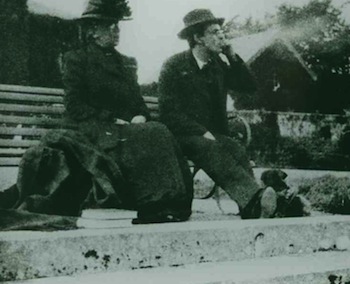
Yeats_Lady_Gregory.Coole.1915

(Yeats and Lady Gregory, Coole Park, 1915: http://yeats2015.com/event/major-exhibition-explores-w-b-yeats-connections-with-the-west/ )

The attractions of the swan for the poet are evident enough, I think: its colour, the purity of whiteness but with that intense dash of black and yellow on its bill; the grace of the curve and sweep of its body and wings and neck, the extraordinary spectacle of its landing on water; the size and strength and grandeur of it; the long history, traditions, myths and symbols attached to the bird: in brief, beauty and transformation.[7]

Transformation. I have a vague childhood memory of Danny Kaye, who’d starred as the title character in the 1952 Hollywood musical, Hans Christian Anderson, singing one of the songs from the film: ‘The Ugly Duckling’. There was an album of the songs released subsequently but I may simply have heard it played on the radio: it was internationally successful at the time. The duckling outsider turns out, of course, to be a very fine swan indeed (‘Me, a swan?’ ‘I am a swan’).
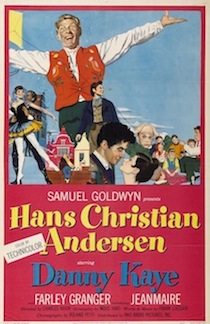
Danny_Kaye_HCA

In 1959, Ezra Pound wrote from Rapallo to William Cookson, who had just launched, in close association with Pound, Agenda, the highly influential poetry magazine (still current). At the top of the letter is a suggested ‘Motto for Agenda No 3 or 4’: ‘How can anyone go antisemite in a world that contains Danny Kaye’.[8]

I picture Cookson opening that letter and reading that line; then lowering his forehead to beat it softly but repeatedly against the desktop. But perhaps not.


References

[1] Reprinted in Literary Essays of Ezra Pound, edited by T. S. Eliot (London: Faber & Faber, 1960), 14: all quotations from the same page.

[2] See The Letters of Ezra Pound to Alice Corbin Henderson, edited by Ira B. Nadel (Austin: University of Texas Press, 1993).

[3] Selected Poems of Padraic Colum, edited by Sanford Sternlicht (New York: Syracuse University Press, 1989), 41-42, 24.

[4] Michael Ferber, A Dictionary of Literary Symbols (Cambridge: Cambridge University Press, 1999), 214.

[5] See A. Norman Jeffares, A New Commentary on the Poems of W. B. Yeats (London: The Macmillan Press, 1984), 247-249.

[6] Collected Poems of W. B. Yeats (London: Macmillan London Ltd., 1950), 223, 147, 204. ‘Easter 1916’, though privately printed in an edition of twenty-five, ‘stayed out of public circulation’ until its publication in the New Statesman (23 October 1920): see R. F. Foster, W. B. Yeats: A Life. II. The Arch-Poet (Oxford: Oxford University Press, 2003), 58-64.

[7] On the complex, often destructive—and class-ridden—history of the swan, see Mark Cocker and Richard Mabey, Birds Britannica (London: Chatto & Windus, 2005), 60-69.

[8] ‘Some Letters to William Cookson 1956-1970’, Agenda, 17, 3-4 — 18, 1 (3 issues: Autumn-Winter-Spring, 1979/80) ‘Twenty-First Anniversary Ezra Pound Special Issue’, 39.
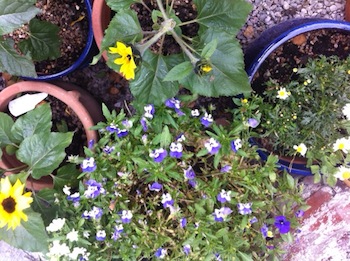
Cultivating our garden

Pots

We are cultivating our garden—at least, my wife is. Watering, deadheading, repotting, composting. A small space, containing less than a dozen pots. Nevertheless, whether window-box or rolling acres, a garden is, both practically and symbolically, an almost inexhaustible resource.

Gardens

‘When Voltaire ends Candide with the famous declaration “Il faut cultiver notre jardin,” the garden in question must be viewed against the background of the wars, pestilence, and natural disasters evoked by the novel’, Robert Pogue Harrison writes. ‘The emphasis on cultivation is essential. It is because we are thrown into history that we must cultivate our garden.’[1]

Indeed. It’s striking that two of the most interesting museums in London, the Garden Museum and the Imperial War Museum, are physically so close, a very manageable walk apart.

Garden.Museum2

(Garden Museum, Lambeth, London)

Harrison’s book is an examination of the many ways gardens evoke the human condition, from the ancient world to the homeless people in contemporary New York. Throughout history, the garden has served as a check against the destruction and losses of history. In  the ancient world, gardens were associated with self-cultivation and self-improvement, both essential to serenity and enlightenment, and the association has endured.

Meanwhile the mind, from pleasure less,
Withdraws into its happiness;
The mind, that ocean where each kind
Does straight its own resemblance find,
Yet it creates, transcending these,
Far other worlds, and other seas;
Annihilating all that’s made
To a green thought in a green shade.[2]

The garden can be read and understood as this tiny, immediate space—and also as the city, the nation, the planet we inhabit. From the tiny to the immense and back again. That Latin root, colere, means both to till (to tend, to care for) and to worship. ‘Cultivate’ and ‘culture’ are not merely neighbouring words in the dictionary: to civilise. Civis, citizen. Caring for the citizens—all of them, not just a carefully selected few.

Edward Fitzgerald, translator of the Rubaiyat of Omar Khayyam and champion letter writer, certainly saw gardens in terms of art, of the cultivated. ‘I am quite sure gardens should be formal and unlike general Nature’, he wrote to Frederick Tennyson (elder brother of Alfred). ‘I much prefer the old French and Dutch gardens to what are called the English.’[3]

Samuel Johnson used the sense in which the garden, as domestic setting, may be contrasted with the agricultural one, to comment on an incident in which Methodist students were expelled from Oxford for constantly praying in public: ‘Sir, I believe they might be good beings; but they were not fit to be in the University of Oxford. A cow is a very good animal in the field; but we turn her out of a garden.’[4]

IWN_film_poster copy

(Film poster for the new documentary on Ford, directed by Paul Lewis and Ryan Poe)

Ford Madox Ford, himself a smallholder and accomplished gardener, often used gardening metaphors. He alluded once to his concern, not for the commercial novelist but for ‘a queer, not easily defined fellow. To him writing has the aspects of an art. One’s art is a small enclosed garden within whose high walls one moves administering certain manures and certain treatments in order to get certain effects. One thinks that people ought to like these effects, say of saxifrages against granite.’ He never tired of experimenting with potatoes. ‘Of, say, fifty different plants by the end of 1922 I had succeeded in selecting nine that seemed to be reasonably new varieties and two that apparently resisted all the diseases they were likely to meet.’[5]

Curiously, by the end of 1922, Ford had published just over fifty books.


References

[1] Harrison, Gardens: An Essay on the Human Condition (Chicago: University of Chicago Press, 2008), x.

[2] Andrew Marvell, ‘The Garden’, in The Complete Poems edited by Elizabeth Story Donno (Harmondsworth: Penguin Books, 1985), 101.

[3] The Letters of Edward Fitzgerald, edited by Alfred McKinley Terhune and Annabelle Burdick Terhune, four volumes (Princeton: Princeton University Press, 1980), II, 56.

[4] James Boswell, Life of Johnson, edited by R. W. Chapman, revised by J. D. Fleeman, (Oxford: Oxford University Press, 1980), 490.

[5] Ford, It Was the Nightingale (London: Heinemann, 1934), 108.


Turning to the Sunflowers

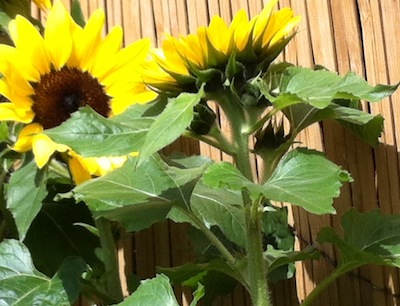
Sunflowers_4_small

On a day disfigured by news of another mass murder, this time in London, I turn to our new dwarf sunflowers, as the sunflower itself is fabled to turn toward the sun. Helianthus annuus, ‘frequently appearing on rubbish-tips and in unexpected places in gardens, usually from birdseed’, Richard Mabey notes.[1]

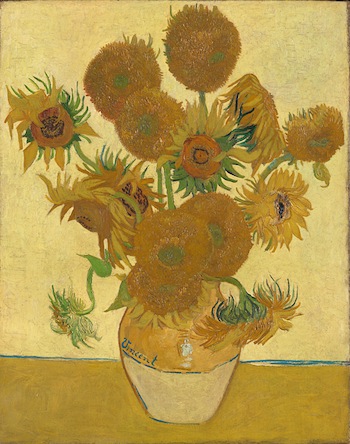
‘I am hard at it, painting with the enthusiasm of a Marseillais eating bouillabaisse, which won’t surprise you when you know that what I’m at is the painting of some big sunflowers,’ Vincent van Gogh wrote to his brother Theo.

Van_Gogh_Sunflowers

(Vincent van Gogh, ‘Sunflowers’: National Gallery)

‘I have three canvases going—1st, three huge flowers in a green vase, with a light background, a size 15 canvas; 2nd, three flowers, one gone to seed, having lost its petals, and one a bud against a royal-blue background, size 25 canvas; 3rd, twelve flowers and buds in a yellow vase (size 30 canvas). The last one is therefore light on light, and I hope it will be the best. Probably I shall not stop at that. Now that I hope to live with Gauguin in a studio of our own, I want to make decorations for the studio. Nothing but big flowers. Next door to your shop, in the restaurant, you know there is a lovely decoration of flowers; I always remember the big sunflowers in the window there.’[2]

Sunflowers.1

In ‘Morality and the Novel’, D. H. Lawrence writes of ‘the living moment’, of the ‘business’ of art being ‘to reveal the relation between man and his circumambient universe’ at that moment. His first example is this: ‘When van Gogh paints sunflowers, he reveals, or achieves, the vivid relation between himself, as man, and the sunflower, as sunflower, at that quick moment of time. His painting does not represent the sunflower itself. We shall never know what the sunflower itself is. And the camera will visualize the sunflower far more perfectly than van Gogh can.
‘The vision on the canvas is a third thing, utterly intangible and inexplicable, the offspring of the sunflower itself and van Gogh himself. The vision on the canvas is for ever incommensurable with the canvas, or the paint, or van Gogh as a human organism, or the sunflower as a botanical organism. You cannot weigh nor measure nor even describe the vision on the canvas. It exists, to tell the truth, only in the much-debated fourth dimension. In dimensional space it has no existence.
‘It is a revelation of the perfected relation, at a certain moment, between a man and a sunflower.’[3]

Allen Ginsberg’s ‘Sunflower Sutra’ remembers an occasion with Jack Kerouac but looks back to William Blake:

‘Look at the sunflower, he said, there was a dead gray shadow against the sky, big as a man, sitting dry on top of a pile of ancient sawdust—
—I rushed up enchanted—it was my first sunflower, memories of Blake—’[4]

ginsberg-flower

(Allen Ginsberg: https://bluerailroad.wordpress.com/allen-ginsberg-an-interview/)

Blake’s Songs of Experience included ‘Ah Sun-flower!’

Ah Sun-flower! weary of time,
Who countest the steps of the Sun:
Seeking after that sweet golden clime
Where the travellers journey is done.

Where the Youth pined away with desire,
And the pale Virgin shrouded in snow:
Arise from their graves and aspire,
Where my Sun-flower wishes to go.[5]

Hardly a cheerful poem, to be sure: ‘his terrible lyric on the sunflower’, the flower ‘which wistfully follows the sun across the sky all day, a perfect symbol of the “vegetable” life rooted in this world and longing to be free.’[6] It’s a flower, too, associated strongly with a painter—Vincent—who killed himself at the age of thirty-seven.

Not uncomplicatedly life-affirming, then, but clearly hugely attractive to a great many poets and painters. And forget those, anyway, for the moment, because what strikes me most often is people that say simply: ‘I love sunflowers’ or ‘Aren’t they beautiful?’ Quite basic, no doubt: the shape of a sun, the colour of sunlight. But an immediate, powerful, and genuine response or sense of connection.

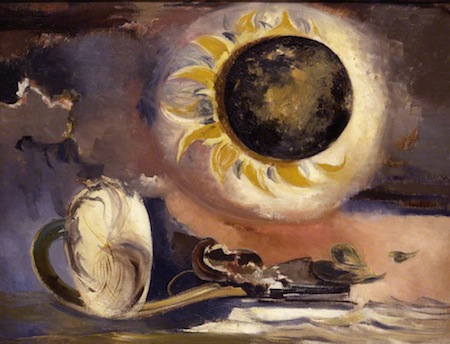
Paul Nash planned a series of four sunflower paintings but completed only Solstice of the Sunflower (1945), the year of his death, and 1944’s The Eclipse of the Sunflower.

Nash, Paul, 1889-1946; Eclipse of the Sunflower

(Photo credit: British Council Collection)

Last word to Conrad Aiken:

Each morning we devour the unknown.
Each day we find, and take, and spill, or spend, or lose, a sunflower splendor of which none knows the source.[7]

References

[1] Mabey, Flora Britannica (London: Sinclair-Stevenson, 1996), 379.

[2] The Complete Letters of Vincent van Gogh, second edition (London: Thames & Hudson, 1978), III, 18-19.

[3] D. H. Lawrence, Phoenix: The Posthumous Papers of D. H. Lawrence, edited and with an introduction by Edward D. McDonald (London: William Heinemann, 1936), 527.

[4] Ginsberg, Selected Poems 1947-1995 (London: Penguin Books, 2001), 60.

[5] The Complete Poetry & Prose of William Blake, newly revised edition, edited by David V. Erdman (New York: Anchor Books, 1988), 25. There is a short video of Ginsberg reading this poem: https://www.youtube.com/watch?v=jySDWBowDnY

[6] Northrop Frye, Fearful Symmetry: A Study of William Blake (1947; Princeton: Princeton University Press, 1969), 74.

[7] ‘A Letter from Li Po’: Conrad Aiken, Selected Poems (New York: Oxford University Press, 1961), 248.

Poppies by the million

Poppy.2

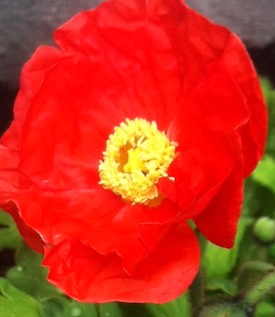
We bought a poppy plant at the garden centre yesterday and it had bloomed already this morning, even under such a glowering sky.

Apart from its fiery beauty, the poppy is blessed or cursed with an extraordinary array of literary, artistic, historical, mythological and medicinal associations, but is most widely recognised in the context of Armistice Day in the United Kingdom and the Commonwealth countries.

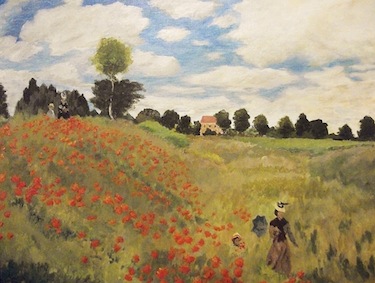
As for the paintings: leafing through art books once to settle on the one half-remembered picture after passing a school where a flowerbed had been thickly planted with poppies, I realised just how many there were to choose from. John Constable and Mary Fedden, Angelica Garnett and Vincent Van Gogh, Vanessa Bell and Georgia O’Keeffe, Christopher Wood and Ivon Hitchens, real one and paper ones by William Nicholson (in the early years, people wore real poppies on Armistice Day). But I finally decided that I must have been thinking either of Claude Monet:

Poppy_Field_Near_Argenteuil

(Claude Monet, Poppy Field Near Argentuil)

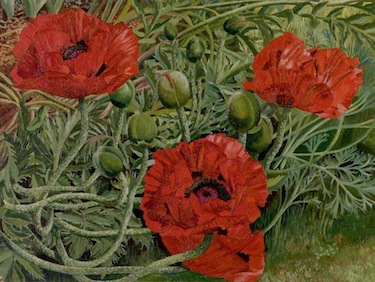
or, yes, of Stanley Spencer, whose irises and poppies stick in the mind just as surely as his resurrections, figures on beds, swans, soldiers and shipbuilding.

Spencer, Stanley, 1891-1959; Poppies

(Stanley Spencer, Poppies, 1938. Newark Town Hall Museum and Art Gallery:
© the estate of Stanley Spencer; all rights reserved 2014, Bridgeman Images)

And literary associations? The poppy’s connection with the First World War often takes off from the Canadian John McCrae’s poem, first published anonymously in Punch in December 1915:

In Flanders fields the poppies blow
Between the crosses, row on row,
That mark our place; and in the sky
The larks, still bravely singing, fly

Scarce heard amid the guns below.

ending:

We shall not sleep, though poppies grow
In Flanders fields.[1]

Edmund Blunden wrote, in ‘Vlamertinghe: Passing the Chateau, July, 1917’:

Bold great daisies’ golden lights,
Bubbling roses’ pinks and whites—
Such a gay carpet! poppies by the million;
Such damask! such vermilion!
But if you ask me, mate, the choice of colour
Is scarcely right; this red should have been duller.[2]

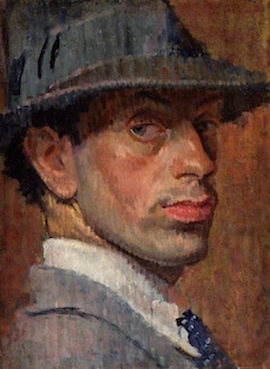
Rosenberg, Isaac, 1890-1918; Isaac Rosenberg

(Isaac Rosenberg, Self-Portrait, 1914: National Portrait Gallery, London)

The one that most stays with me, though, is probably Isaac Rosenberg’s ‘Break of Day in the Trenches’, which ends:

Poppies whose roots are in man’s veins
Drop, and are ever dropping;
But mine in my ear is safe—
Just a little white with the dust.[3]

But then I think of a holiday in Greece more than fifteen years ago now, a vivid memory of Mycenae, with everywhere the bright clusters of blood-red poppies.

The poppy’s literary associations begin in classical texts, usually there the ‘sleep-bearing’ or garden poppy, the source of opium. Alethea Hayter notes that, ‘In an Egyptian medical treatise of the sixteenth century B. C., Theban physicians were advised to prescribe opium for crying children just as, three and a half millennia later, Victorian babies were dosed with the opiate Godfrey’s Cordial by their nurses to keep them quiet.’[4]

The ancient Greeks and Romans grew poppies in their gardens and ate the seeds, often mixed with honey.[5] The link between the poppy and sleep is implicit in the last lines of McCrae’s poem. Hypnos, the god of sleep, holds a poppy in the representations of him in Roman and Hellenistic sculpture. He worked in partnership with his brother Thanatos, god of death, to remove fallen warriors from the battlefield.[6]

The most notable association, though, is probably with Demeter who, frantic from the loss of her daughter Persephone, who had been carried off by the god of the underworld, ‘soothed her grief with the narcotic juice of the poppy’. The plant ‘has the reputation of giving life, hence the association of the poppy with Demeter, the earth goddess who bestowed fertility on fields.’[7] Alethea Hayter mentions the legend that tells of Demeter, in her search for Persephone, reaching Sicyon, ‘once called Mecone, the city of poppies’, and gathering their flowers. Slitting the seed-cases, she tasted the juice and ‘forgot her sorrows’. She was sometimes portrayed, then, holding a poppy instead of the more established sheaf of corn: the flower ‘adorned her altars and its drug was perhaps used in her rites at Eleusis, to bring forgetfulness of the sorrow of the dying year and to share, by a short winter sleep of the emotions, in the death and re-birth of the plants’.[8]

In his poem ‘In the Trenches’, Richard Aldington wrote:

But that each rush and crash
Of mortar and shell,
Each cruel bitter shriek of bullet
That tears the wind like a blade,
Each wound on the breast of earth,
Of Demeter, our Mother,
Wound us also[9]

In Homer’s Iliad, Teukros, aiming an arrow straight at Hector, misses him and strikes instead Gorgythion:

He bent drooping his head to one side, as a garden poppy
bends beneath the weight of its yield and the rains of springtime;
so his head bent slack to one side beneath the helm’s weight.[10]

This is how Alice Oswald renders that passage:

And now the arrow flies through GIORGYTHION
Somebody’s darling son

As if it was June
A poppy being hammered by the rain
Sinks its head down
It’s exactly like that
When a man’s neck gives in
And the bronze calyx of his helmet
Sinks his head down[11]

Death as slackening, bending, as sinking into sleep, all consciousness and memory gone. Hypnos and Thanatos, sleep and death, lived in Hades, near Lethe, the river of forgetfulness.

Allen Ginsberg, in ‘A Supermarket in California’, addressed to Walt Whitman, ends:

‘Ah, dear father, graybeard, lonely old courage-teacher, what America did you have when Charon quit poling his ferry and you got out on a smoking bank and stood watching the boat disappear on the black waters of Lethe?’[12]

Also.Poppy

One more Poppy. . . .


References

[1] Robert Giddings, The War Poets (1988; London: Bloomsbury, 2000), 55-57.

[2] Blunden, Undertones of War (1928; London: Penguin Books, 1982), 256.

[3] Isaac Rosenberg (21st-Century Authors), edited by Vivien Noakes (Oxford: Oxford University Press, 2008), 106.

[4] Alethea Hayter, Opium and the Romantic Imagination (London: Faber and Faber, 1971), 19. Godfrey’s Cordial was a mixture of opium, treacle, water and spices. See also Hayter’s introduction to Thomas de Quincey, Confessions of an English Opium Eater (Harmondsworth: Penguin Books, 1971), 14-15.

[5] See Michael Ferber, A Dictionary of Literary Symbols (Cambridge: Cambridge University Press, 1999), 160-161. See also: http://classicalanthology.theclassicslibrary.com/2015/02/17/poppies-in-classical-poetry-homer-catullus-virgil-dante-contributed-by-jane-mason-and-david-bevan/

[6] I. Aghion, C. Barbillon, F. Lissarragne, Gods and Heroes of Classical Antiquity (Paris: Flammarion, 1996), 162-163.

[7] Hellmut Baumann, Greek Wild Flowers and plant lore in ancient Greece, translated and augmented by William T. Stearn and Eldwyth Ruth Stearn (London: The Herbert Press, 1993), 69.

[8] Hayter, Opium and the Romantic Imagination, 20.

[9]The Complete Poems of Richard Aldington (London: Allen Wingate, 1948), 62.

[10] Homer, The Iliad of Homer, translated by Richard Lattimore (Chicago: University of Chicago Press, 1961), 190, Bk.V., ll.306-308.

[11] Alice Oswald, Memorial (London: Faber and Faber, 2011), 32.

[12] Ginsberg, Selected Poems 1947-1995 (London: Penguin Books, 2001), 59.