The digestion of Milton


Writing of Felix Vallotton and what, he suggests, ‘might be called Vallotton’s law: that the fewer clothes a woman has on in his paintings, the worse the result’, Julian Barnes notes that ‘Vallotton came to the nude through a study of Ingres, proving that great painters, like great writers – Milton, famously – can be pernicious influences.’[1]

I came across this shortly after recalling Jonathan Williams quoting Bentley’s clerihew (‘The digestion of Milton/ Was unequal to Stilton/ He was only feeling so-so/ When he wrote Il Pensoroso’).

And then, a few days ago, waiting for the kettle to boil, I was browsing through a Penguin Classics translation of Virgil’s Eclogues, which had found its way onto the kitchen table, . The notes to the first eclogue mentioned two lines in Milton’s Lycidas derived from this single line of Virgil: ‘siluestrem tenui Musam meditaris auena’, translated there as ‘You meditate the woodland Muse on slender oat’.[2]

Already in trouble and the tea not even made. Mediate on, surely. But then my dictionary actually includes the phrase ‘meditate the muse’, offering as explanation ‘(Latinism, after Milton) to give one’s mind to composing poetry.’ The line in Lycidas does indeed have ‘meditate’ unclothed by a preposition. ‘Slender oat’? A reed pipe, perhaps oat grass, a wild grass that looks like the oat. The old Loeb edition’s version—‘wooing the woodland Muse on slender reed’—is a bit clearer at first glance.

Anyway: Williams, Barnes, Virgil. Three times so close together may be enemy action for Ian Fleming’s Goldfinger; it’s a sign from the gods for the rest of us. So, diverting my attention from ornithology, weird cat behaviour in the garden and university staff strikes, I thought back over the history of my problem with Milton.

One of the great poets, no doubt, no doubt. In the nineteenth century, it seems, few had a bad word to say about him – Blake, Wordsworth, Byron, Keats. In the twentieth century, things went the other way. Ezra Pound—to choose one of his more polite remarks—thought Milton ‘got into a mess trying to write English as if it were Latin.’[3] Enlarging on this elsewhere, he asserted that Milton was using ‘an uninflected language as if it were an inflected one, neglecting the genius of English, distorting its fibrous manner’.[4]

T. S. Eliot took William Hazlitt to task for classifying Dryden and Pope as ‘the great masters of the artificial style of poetry in our language’ as against his chosen poets of the ‘natural’ style: Chaucer, Spenser, Shakespeare and Milton. Reviewing ‘at least four crimes against taste’ that Hazlitt has committed in a single sentence, Eliot observes that ‘the last absurdity is the contrast of Milton, our greatest master of the artificial style, with Dryden, whose style (vocabulary, syntax, and order of thought) is in a high degree natural.’ Eliot is here reviewing a book on Dryden and has more to say on the respective strengths of the two poets but clearly, at this stage (1921, the year before The Waste Land), he finds more to admire in Dryden, whose powers were, he suggests, ‘wider, but no greater, than Milton’s’.[5] Pound comments that ‘Dryden gives T. S. E. a good club wherewith to smack Milton. But with a modicum of familiarity or even a passing acquaintance with Dante, the club would hardly be needed.’ This is turn looks back to Pound’s earlier comment that ‘Dante’s god is ineffable divinity. Milton’s god is a fussy old man with a hobby.’[6]

There are other famous negatives (F. R. Leavis, for one) but none of this has much bearing on my own troubles with Milton. The failure to warm to him, if failure it be, is obviously mine – still, I’m tempted to shovel a good part of the blame onto my old English master, a real Milton enthusiast. That enthusiasm drove him to read Paradise Lost to us, fairly relentlessly, for what seemed an eternity, an approach that drove some pupils to despair, rebellion or the edge of madness; for me, evidently, it erected barricades. ‘For each man kills the thing he loves’ – kills it for other people, in some cases, however good the intentions. I’ve made at least two serious attempts to get back into some sort of relationship with Mr Milton, one of them after reading Philip Pullman’s His Dark Materials trilogy, Pullman being such a strong advocate for Milton, and for Paradise Lost in particular. But it never really took.

Lycidas, though. A relatively short poem. A very literary one too, in the sense of adopting (even if tweaking) a good many conventions; and also retrospectively, since it’s been plundered for a good many book titles and quotations that everyone knows (even when they don’t, quite)—‘Fame is the spur’, ‘Look homeward angel’, ‘Tomorrow to fresh woods and pastures new’. I’ve read it several times, starting, of course, at school. But, as far back as I can remember, even reading Milton’s shorter poems was somehow associated with a sense of task, of obligation. I don’t mind putting in the work but didn’t really experience the pleasure which I thought a reasonable, reciprocal part of the deal.

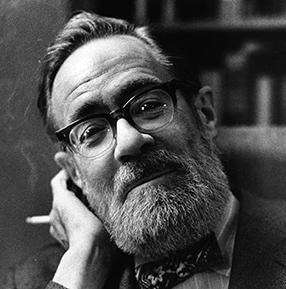
JohnBerryman_TomBerthiaume

One sidelong approach is by way of John Berryman’s fine short story, ‘Wash Far Away’, which I read again recently. The title comes, of course, from Lycidas: ‘Whilst thee the shores and sounding Seas/ Wash far away, where ere thy bones are hurld’. The poem is a pastoral elegy, occasioned by the death of Edward King, a Cambridge friend of Milton, drowned in the Irish Sea. In Berryman’s story, a professor teaches Lycidas to his class, and the narrative of loss and lament in the poem is juxtaposed with the professor’s own memories and enduring sense of loss of a brilliant and gifted friend who died young. There’s a good deal of quite scholarly Miltonic discussion. Much of it circles around the question of whether the poem is actually ‘about’ King or, in fact, more about Milton himself. Several remarks by the students are surprisingly acute and unsettling—‘The professor studied the lines. He felt, uneasily, as if he had never seen them before’—but the effects of the session are finally positive, the sharpness of memories and the acute sense of loss, brought vividly to mind, seeming to resuscitate the professor, to bring alive again his image of himself as a sentient, emotionally responsive being.[7]

So I glance again, though warily, warily, at my copy of Paradise Lost, glowering in the corner. Ars longa, vita brevis, as someone – was it Seneca? – said. Well, yes – but just how longa? And just how brevis?

References

[1] Julian Barnes, ‘Vallotton: The Foreign Nabi’, in Keeping an Eye Open: Essays on Art (London: Jonathan Cape, 2015), 190.

[2] Virgil The Eclogues, translated by Guy Lee (Harmondsworth: Penguin Books, 1984), 31, 109n. The lines in Lycidas are ‘and strictly meditate the thankless muse’ and ‘But now my oat proceeds’.

[3] Ezra Pound, How To Read (London: Desmond Harmsworth, 1931), 55.

[4] Ezra Pound, ‘Notes on Elizabethan Classicists’, in Literary Essays of Ezra Pound, edited by T. S. Eliot (London: Faber and Faber, 1960), 238.

[5] T. S. Eliot, ‘John Dryden’, in Selected Essays , third enlarged edition (London: Faber and Faber, 1951), 309-310, 314. Dryden was also, of course, a translator of genius. ‘If I had to give my vote to our greatest translator it would go to Dryden’: The Oxford Book of Verse in English Translation, chosen and edited by Charles Tomlinson (Oxford: Oxford University Press, 1980), xvii.

[6] Ezra Pound, ‘Prefatio Aut Cimicium Tumulus’, in Selected Prose 1909-1965, edited by William Cookson (London: Faber and Faber, 1973), 360; The Spirit of Romance (1910; New York: New Directions, 1968), 156-157.

[7] John Berryman, ‘Wash Far Away’, in The Freedom of the Poet (New York: Farrar, Straus and Giroux, 1976), 367-386.

Jubilant jaunty Jonathan

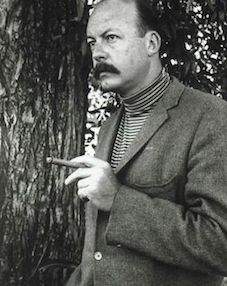
JW-via-New-Directions

(Jonathan Williams, via New Directions Publishing Corporation)

In 1973, William Blissett, on a visit to the poet and painter David Jones, went with him through a list of queries about In Parenthesis, one of them ‘yon’s wick as Swale-side rat’. Yorkshire dialect, Jones told him, quick, alert, artful. He was surprised that the Oxford English Dictionary gave only ‘wicked’: that was ‘not what he meant at all.’ Blissett added: ‘He remembers a Yorkshireman in his unit who used to pass things to him, saying “’ere ye are, wick’un.”’[1]

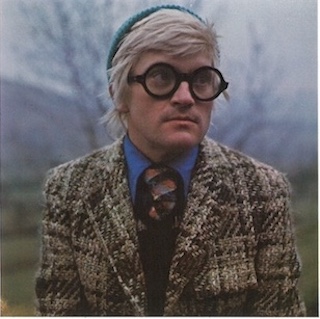
That rang a bell with this Southerner and the ringing sound was traced to the fine collection of Portrait Photographs by Jonathan Williams, with a short preface by Hugh Kenner.[2] One of the photographs is of David Hockney and beside it Williams wrote: ‘I worry sometimes that La Grande Chic will gobble up David and turn him into High Society’s current stand-in for Cecil Beaton or Noel Coward. But, maybe that argument is neither nowt nor summat, as they say in the West Riding where he comes from. Our David is wick as a lop and still knows what’s what.’

JW-DH

(David Hockney by Jonathan Williams)

‘Wick as a lop’, yes, that was the phrase. Getting on for forty years later and Hockney still knows what’s what, is still working endlessly, exploring, experimenting, trying stuff out and giving pleasure. Not bad going.

Jonathan Williams (born 8 March 1929), was poet, publisher, photographer, essayist. He studied at Black Mountain College and, with David Ruff, founded The Jargon Society in 1951. It published an extraordinary range of writers, mainly poets, including Robert Duncan, Mina Loy, Louis Zukofsky, Paul Metcalf, Kenneth Patchen, Robert Creeley and Denise Levertov, though its all-time bestseller seems to have been White Trash Cooking. Following Williams’ death in March 2008, his long-time partner, the poet Thomas Meyer, took the decision to present The Jargon Society’s inventory and publication rights to the Black Mountain College Museum & Arts Center: see http://jargonbooks.com/

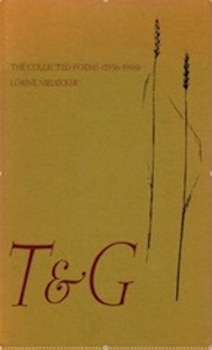
Niedecker-TG

Charles Olson’s early Maximus volumes appeared from Jargon. So too did Lorine Niedecker’s beautiful T & G: The Collected Poems (1936-1966), printed by the Falcon Press in Philadelphia, in September 1969. Niedecker lived most of her life on Black Hawk Island, Wisconsin.

Black Hawk held: In reason
land cannot be sold,
only things to be carried away,
and I am old.

Young Lincoln’s general moved,
pawpaw in bloom,
and to this day, Black Hawk,
reason has small room.[3]

In the early 1960s, as Niedecker wrote to Louis Zukofsky, ‘Letter from Jonathan says he reads my poems to English audiences but tho the response was good, “very tentative. The English tend to want a lot of ‘profound talk’ in everything, and they are so non-sensual that they find it difficult to enjoy anything else. . .”’.[4] Williams was also given to ‘reading and slide-showing tours around the Republic in his Volkswagen, The Blue Rider’. He is, Guy Davenport wrote, ‘the iconographer of poets in our time, and of the places and graves of poets gone on to Elysium.’[5]

Williams’ own poems were written in the Pennine Dales and the Appalachian Mountains. Hugh Kenner’s observation that ‘Jonathan Williams is our Catullus and our Johnny Appleseed’ hints at the hybrid nature of the poetry.[6] It’s hugely various, veering from high modernism to folk art, exploratory, a little crazy, jaunty, ingenious, funny, often splendidly indecent. From two-line epigrams through acrostics, clerihews and what Williams calls ‘Meta-fours’, four words to a line, these and others often skirting the edge of nonsense, if not toppling over; there’s the fifty-page Mahler; and then many ‘found’ poems. They may be literally so, reshaped from newspaper reports or postcards or public notices; but the term could be applied more widely, to Williams looking and listening with close attention to ordinary lives in the Appalachians or in Cumbria. Guy Davenport quotes such a poem, suggesting that it demonstrates its author having learned from William Carlos Williams’ insistence that ‘the poet’s business is to let the world speak for itself’:

UNCLE IV SURVEYS HIS DOMAIN FROM HIS ROCKER OF A SUNDAY AFTERNOON AS AUNT DORY STARTS TO CHOP THE KINDLIN

Mister Williams
lets youn me move
tother side the house

the woman
choppin wood’s
mite nigh the awkerdist thing
I seen.[7]

As with many of Marianne Moore’s poems or, for that matter, Ezra Pound’s ‘In a Station of the Metro’, the title is an integral part of the text of the poem. It contains twenty words; the poem itself, twenty-one.

Williams quotes with approval Bentley’s Milton clerihew:

The digestion of Milton
Was unequal to Stilton.

He was only feeling so-so
When he wrote Il Pensoroso.

And devises many of his own:

Why did Professor J. R. R. Tolkien
never really come clean

about the scientologists in cupboards
in the House of L. Ron Hubbard?

or (one of my favourites):

Gertrude Stein
arose at nine

and arose and arose
and arose.[8]

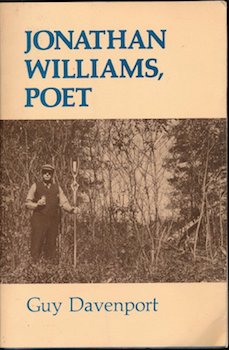
GD-JW-Poet

His acrostic on Guy Davenport’s name ends with the line, ‘To keep afloat the Ark of Culture in these dark and tacky times!’ His prefatory ‘A Greeting to the Reader’ mentioned that Davenport ‘has been reading the poems since the 1960s.’[9] The two writers had enjoyed a long and fertile friendship, apparently damaged by the publication of A Garden Carried in a Pocket: Letters 1964-1968, including material that Davenport had specifically asked Williams to omit.[10]

Jubilant Thicket appeared in 2005, the year of Davenport’s death. One of the last poems in it is for Lorine Niedecker:

she seined words
as others stars
or carp

laconic as
a pebble
in the Rock River

along the bank
where the peony flowers
fall

her tall friend
the pine tree
is still there

to see[11]


Tremendous collection of photographs of Williams’ life here:
http://jacketmagazine.com/38/jw-life-pictures.shtml

Jeffery Beam’s obituary here:
http://www.ashevillepoetryreview.com/2010/issue-18/the-truffle-hound-of-american-poetry


References

[1] William Blissett, The Long Conversation: A Memoir of David Jones (Oxford: Oxford University Press, 1981), 123; see David Jones, In Parenthesis, (1937; London: Faber, 1963), 114.

[2] Jonathan Williams, Portrait Photographs (London: Coracle Press, 1979): the Hockney portrait is Plate 22.

[3] Taken from Lorine Niedecker, Collected Works, edited by Jenny Penberthy (Berkeley: University of California Press, 2002), 99.

[4] Letter of 3 February 1963, Jenny Penberthy, Niedecker and the Correspondence with Zukofsky, 1931-1970 (Cambridge: Cambridge University Press, 1993), 328.

[5] Guy Davenport, ‘Ralph Eugene Meatyard’, in The Geography of the Imagination (Boston: David R. Godine, 1997), 368; ‘Jonathan Williams’, first published as introduction to Williams’ An Ear in Bartram’s Tree, then as a pamphlet from Jim Lowell’s Asphodel Bookshop; reprinted in The Geography of the Imagination, 180-189.

[6] Dust jacket blurb quoted by Willard Godwin, Hugh Kenner: A Bibliography (Albany, New York: Whitston, 2001), 402.

[7] Jonathan Williams, Jubilant Thicket: New & Selected Poems (Port Townsend, Washington: Copper Canyon Press, 2005), 136.

[8] Jonathan Williams, Jubilant Thicket, 101, 102, 108.

[9] Jonathan Williams, Jubilant Thicket, 114, ix.

[10] W. C. Bamberger, editor, Guy Davenport and James Laughlin: Selected Letters (New York: W. W. Norton & Co., 2007), 139n.

[11] Jonathan Williams, Jubilant Thicket, 273.

Bunting Nodding

Lawrence, Thomas, 1769-1830; Homer Reciting his Poems

(Homer Reciting His Poems: Thomas Lawrence, Tate)

Francis Wyndham once observed that what he’d always wanted to do in his fiction was ‘to write about the hours and hours and hours, the enormous proportion of life which is spent in a kind of limbo, even in people’s active years. It seems to me that it isn’t sufficiently celebrated.’[1]

He meant it, I think, in a secular sense: an uncertain period of waiting, for decisions or resolutions, rather than the borderlands of Hell, unbaptised infants and the rest; nor, presumably, a Caribbean dance. My Chambers dictionary adds the helpful ‘unsatisfactory state of consignment or oblivion’.

Ah, oblivion. Yes, I’d apply that to many people passed in the street, plugged in to various devices, oblivious at least to the world through which they’re walking. Oblivious too are some of the passing motorists, a few of whom are busily and hazardously engaged with their mobile phones or make-up or breakfast, all the while keeping their speed up to 50 m.p.h. to avoid bits of themselves dropping off.

‘Dropping off’ recalls me to a deeper state than limbo: actually nodding off. Having nodded off, actually or almost, at staff meetings and conferences, in cinemas and theatres, readings, lectures and presentations, I think of Homer nodding. (A lot of links assume that ‘Homer’ means ‘Simpson’ rather than ‘dead, blind Greek epic poet’ but the latter is meant here.) The phrase, ‘even Homer nods’, deriving originally from Horace, is now pressed into service often and in wildly divergent contexts. There was, naturally, a band called ‘Even Homer Nods’ — though the soporific qualities of such a lengthy name presumably prompted them to the snappier version which succeeded it: ‘The Nods’. There is also a racehorse, I gather, an Irish chestnut gelding (with the full-length moniker).

Bunting_Poems

My worst instance of dropping off—certainly the occasion when I least wanted to—was at a reading by Basil Bunting (to whom birthday wishes are due: born 1 March 1900) a few years before he died. Not having taken the precaution of writing down detailed directions to the venue, I wandered around unfamiliar parts of the city for a couple of hours. Early on, I established the habit of popping into a pub for advice every so often and downing a quick drink. The various bar staff that I consulted had conflicting views on where the small theatre was, so I arrived late and the worse for wear. The attendance was appalling but would not have surprised Bunting, I suspect. He read a number of translations from the Persian and some early poems, certainly his ‘Villon’, but I may have slumbered through at least a third of the incomparable ‘Briggflatts’. I have two recordings of the poem (both by Bunting) but that live performance must have been one of his last—one of the true last chances.

As the player’s breath warms the fipple the tone clears.
It is time to consider how Domenico Scarlatti
condensed so much music into so few bars
with never a crabbed turn or congested cadence,
never a boast or a see-here; and stars and lakes
echo him and the copse drums out his measure,
snow peaks are lifted up in moonlight and twilight
and the sun rises on an acknowledged land.[2]

Later, though, I read an account of how Bunting had attended a lecture by Robert Duncan, slept through the greater part of it, snoring audibly, then woken at the end to exclaim how much he’d enjoyed it: ‘I like talks like that.’[3] So yes, even Bunting nodded.

References

[1] Quoted in the text of Rachel Cooke’s interview with Wyndham (The Observer, August 2008):  http://www.guardian.co.uk/books/2008/aug/17/francis.wyndham.interview

[2] Briggflatts, IV: The Poems of Basil Bunting, edited by Don Share(London: Faber and Faber, 2016), 56.

[3] J. M. Edelstein, in Madeira & Toasts for Basil Bunting’s 75th Birthday, edited by Jonathan Williams (Highlands, North Carolina: Jargon Society, 1977), unpaginated, but see also Richard Burton, A Strong Song Tows Us: The Life of Basil Bunting ((Oxford: Infinite Ideas, 2013), 419.


Put it more simply, Larry

durrell.via.theamericanreader.com

(Lawrence Durrell via theamericanreader.com )

When I went to the Ford Madox Ford conference in Swansea in September 2013, I remember thinking, as the train entered Wales, that the change was physically apparent. Could I really look out of a train window and say ‘that’s Wales’? I felt I could but would have been hard put to it if I were challenged to say precisely how and why. But I did, quite abruptly, recall the opening lines of a poem by R. S. Thomas, whose title I could not then remember, and sat leaning against the window, listening to the voice in my head:

To live in Wales is to be conscious
At dusk of the spilled blood
That went into the making of the wild sky,
Dyeing the immaculate rivers
In all their courses.
It is to be aware,
Above the noisy tractor
And hum of the machine
Of strife in the strung woods,
Vibrant with sped arrows.[1]

No, that’s not quite what I heard. The third line had ‘to’ instead of ‘into’, the fourth and fifth lines had vanished from my memory, I had ‘the noise of the tractor’ and ‘the hum’. But not too bad since I hadn’t read the poem for a good thirty years. At home, seeming not to have any R. S. Thomas, I took down from the shelves four or five anthologies of post-1945 poetry, all containing poems by Thomas but not that one. Then I remembered that the hugely important and influential series of Penguin Modern Poets had featured Thomas in the very first volume. I’d owned that, more, at least the first ten volumes in the series, for years. Penguin Modern Poets 10: The Mersey Sound—Roger McGough, Adrian Henri and Brian Patten—was the bestseller, which took everyone by surprise. Where did my copies go? I’m not sure. Perhaps they didn’t go anywhere. It was just me that went. In any case, the Thomas poem, ‘A Welsh Landscape’, yes, was in the initial volume.

RST-via-Telegraph

(R. S. Thomas via The Telegraph)

It was in April 1962 that Penguin Books launched Penguin Modern Poets. Each volume contained representative selections from three poets and that first volume included, together with Thomas, Elizabeth Jennings – and Lawrence Durrell (born on this day, 27 February 1912, in Jalandhar, India). I don’t know how far the series had gone before I came to it but there was a handful of poems of which I recalled parts, sometimes only a few lines, for years.

PMP1

The Thomas was one and another, in the same volume, was by Durrell. It was called ‘The Parthenon’, dedicated ‘For T. S. Eliot’, and it was the direct, colloquial beginning that stuck in my head:

Put it more simply: say the city
Swam up here swan-like to the shallows,
Or whiteness from an overflowing jar
Settled into this grassy violet space,
Theorem for three hills,

Went soft with brickdust, clay and whitewash,
On a plastered porch one morning wrote
Human names, think of it, men became the roads.[2]

Looking at it now, of course, I’m struck by more details: the conversational opening phrase followed by the word ‘say’; the artful sibilants, ‘swam’ to ‘swan’ then, with the modifying ‘like’, shifting to ‘shallows’. The word ‘jar’ in a grassy space would prompt me to look back at Keats’s ‘Ode on a Grecian Urn’ via Wallace Stevens, whose ‘Anecdote of the Jar’ begins:

I placed a jar in Tennessee,
And round it was upon a hill.
It made the slovenly wilderness
Surround that hill.[3]

This is purely because of the strong recollection of one of my lecturers—surely John Reid?—reading the Stevens poem and looking encouragingly out at his audience: ‘What does that remind you of? What’s Stevens doing there?’ Pause. Then, with a kind of resonant despair: ‘It’s Keats! The urn!’ Packed rows of blank faces gave back whatever was the equivalent then of ‘Yeah, whatever’.

Durrell’s insertion of the word ‘Theorem’ is a nice touch too. He refers often to scientific or mathematical matters, a continuum or simultaneity here, a Freudian slap there, his range of interests always extended beyond the narrowly ‘artistic’. Firmly established in Sommières, he played with the ideas of opposing characteristics of North and South, discerning in France’s great figures ‘a pattern of talents: for scientists, philosophers and thinkers tend to be of northern stock, while the poets, artists and men of action come from the Mediterranean southern fringes.’[4] From Corfu in the mid-1930s, he wrote to his friend Alan Thomas, ‘What do you read when you spend a wet Monday alone? Myself I read one of the sciences.’ But he slyly added: ‘The most exact one to date is demonology. It is fun to follow the growth of science out of magic and demonology, and see it declining again in our time back to magic, its parent.’[5]

Whenever I find myself quoting one of those ‘Cypriot Greek proverbs’ that Durrell used as epigraphs to several chapters in Bitter Lemons, such as ‘A fool throws a stone into the sea and a hundred wise men cannot pull it out’, I’m reminded that, a little further on, he casually notes that, ‘No Greek can resist aphorism; its form will make him believe it to be true, even if it is false.’[6]

A bit more R. S. Thomas followed that early reading of the poems—and a lot more Durrell. The novels, the travel books, essays, letters; plus the connected stuff, the related writers, the sacred places. Greece, Alexandria, Provence. Miller, Cavafy, Seferis, Anaïs Nin. And, of course, the stimulus of conversation, a decade and a half in the office with my friend Andrew, a thoroughgoing Durrellian.

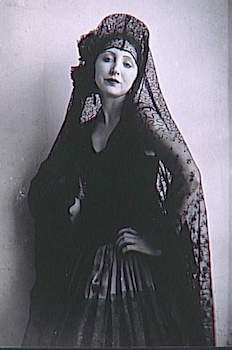
Nin-Brassai

(‘Darling Anaïs, I do feel for you in your cutoffness, and there seems nothing to say to you that will make you less conscious of the distance of light and air which lies between us; the war goes bitter and deep in me – it makes everything taste of ash.’—Letter from Durrell in Greece, quoted in The Journals of Anaïs Nin: Volume Three, 15.
Portrait of Anaïs Nin by the wonderful Brassaï [Gyula Halász, 1899-1984], 1932.)

Durrell was so prolific that, inevitably, some of the writing is a bit hit and miss. But with that range of cultures and countries and curiosities there are plenty of highlights, often cropping up in unexpected places or small-scale pieces or, say, in departures and returns. He writes of April 1941 when, lying ‘on the pitch-dark deck of a caique nosing past Matapan towards Crete’, he thinks back to ‘that green rain upon a white balcony, in the shadow of Albania’, with ‘a regret so luxurious and so deep that it did not stir the emotions at all. Seen through the transforming lens of memory the past seemed so enchanted that even thought would be unworthy of it.’[7] And revisiting Corfu, long afterwards: ‘As for the people . . . Memory does not grow older by a second per thousand years in Greece. Step off the ship and everywhere you will fall upon remembered faces, be instantly recognized and embraced: and I don’t mean only by friends, but by everyone who remembers you in that once, nearly twenty years ago, you gave his son a lesson or let him shine your shoes. Because they remember you they possess you, and you belong to them.’ And then, ‘there is nothing to do but surrender yourself. Strong-willed men break down and cry like babies. No good. The steady flow of hospitality ends only when you are lovingly hospitalized or carried aboard a departing ship on a stretcher.’[8]

Again, rereading The Alexandria Quartet a while back, with that slight nervousness attendant on a revisiting of a past favourite, was as provoking and pleasurable as I hoped it would be. Durrell’s rarely less than diverting, even when he’s being exasperating, a thought that occurred to me when deeply implicated in the more than 1300 pages of The Avignon Quintet, with its maddening hall of mirrors, characters repeatedly dissolving into novelists writing other characters, who are then revealed to be characters in someone else’s novel, while I mutter, ‘Cut it out, Larry’, every ten pages – but read on. ‘There is only trial and error on a journey like this, and no signposts’, as Durrell wrote on another occasion.[9]

Joyeux anniversaire, Larry. Or even, Aürós aniversari.

The International Lawrence Durrell Society site is here: http://www.lawrencedurrell.org/


References

[1] R. S. Thomas, ‘Welsh Landscape’, Collected Poems: 1945-1990 (London: Dent, 1993), 37.

[2] Lawrence Durrell, Collected Poems 1931-1974 (London: Faber and Faber, 1985), 134.

[3] Wallace Stevens, The Collected Poems (New York: Vintage Books, 1982), 76.

[4] Lawrence Durrell, Caesar’s Vast Ghost: Aspects of Provence (London: Faber and Faber, 1990), 26.

[5] Alan G. Thomas, editor, Spirit of Place: Mediterranean Writings (1969; London : Faber and Faber, 1988), 47.

[6] Lawrence Durrell, Bitter Lemons (London: Faber and Faber, 1959), 152, 235.

[7] Lawrence Durrell, Prospero’s Cell (1945; London: Faber and Faber, 1962), 133.

[8] Lawrence Durrell, ‘Oil for the Saint: Return to Corfu’, Holiday, Philadelphia, (October 1966), in Spirit of Place, 286, 290.

[9] Lawrence Durrell, The Black Book (1938; London: Faber and Faber, 1977), 233.


Prince of morticians

Beddoes

In an article in Future in 1917, Ezra Pound wrote in praise of Thomas Lovell Beddoes (who died on this day, 26 January, in 1849), ‘Elizabethan’, he argued, ‘that is, if by being “Elizabethan” we mean using an extensive and Elizabethan vocabulary full of odd and spectacular phrases: very often quite fine ones.’[1] (Before and after this date, Ford Madox Ford was arguing – frequently – that Joseph Conrad was ‘Elizabethan’).[2]

Pound owned a two-volume set of Beddoes’ writings (1890) and was obliged to offer thanks to its editor Edmund Gosse, of whom he had rather less than complimentary things to say on other occasions.

Beddoes published relatively little in his lifetime (he committed suicide at the age of forty-five) and it was the posthumously-published Death’s Jest-Book which Pound was focused upon.

‘Tremble not, fear me not
The dead are ever good and innocent,
And love the living.’ (IV, iii, 111-113)[3]

Pound was concerned to ask ‘why so good a poet should have remained so long in obscurity’. Was it largely a matter of chronology, of which poets are still alive and flourishing or lately dead and widely mourned?

‘No more of friendship here: the world is open:
I wish you life and merriment enough
From wealth and wine, and all the dingy glory
Fame doth reward those with, whose love-spurned hearts
Hunger for goblin immortality.

Live long, grow old, and honour crown thy hairs,
When they are pale and frosty as thy heart.
Away. I have no better blessing for thee.’ (I, ii, 291-298)

‘The patter of his fools,’ Pound says, ‘is certainly the best tour de force of its kind since the Elizabethan patter it imitates’:

‘My jests are cracked, my coxcomb fallen, my bauble confiscated, my cap decapitated. Toll the bell; for oh, for oh! Jack Pudding is no more.’ (I, i, 9-11)

Hanswurst-Jack-Pudding

Jack Pudding
(The Traditional Tune Archive: http://tunearch.org/wiki/Annotation:Jack_Pudding )

‘I try to set out his beauties without much comment, leaving the reader to judge, for I write of a poet who greatly moved me at eighteen, and for whom my admiration has diminished without disappearing.’

Thirty years later, at Pisa, Pound wrote:

Curious, is it not, that Mr Eliot
has not given more time to Mr Beddoes
(T. L.) prince of morticians
where none can speak his language[4]

That last line remembers Death’s Jest-Book once more (quoted in Pound’s essay):

‘Thou art so silent, lady; and I utter
Shadows of words, like to an ancient ghost,
Arisen out of hoary centuries
Where none can speak his language.’ (I, ii, 141-144)

As to our local connection: Beddoes was born in 1803, at 3 Rodney Place, Clifton, Bristol. His father, the eminent medical man, Dr Thomas Beddoes was married to Anna Edgeworth, sister of the novelist, Maria Edgeworth. Four years before the birth of his son, Dr Beddoes had succeeded in establishing the Pneumatic Institution in Hotwells, Bristol, concerned with treatment through the inhalation of various gases. At Hotwells, the first superintendent was Humphry Davy, whose experimental work included investigation of the properties of nitrous oxide (laughing gas). Alethea Hayter suggests that Samuel Taylor Coleridge’s ‘first real habitation to opium’ may have resulted from a recommendation in Dr Thomas Brown’s Elements of Medicine, edited by none other than Dr Beddoes.[5]

If there were dreams to sell,
What would you buy?
Some cost a passing bell;
Some a light sigh,
That shakes from Life’s fresh crown
Only a roseleaf down.
If there were dreams to sell,
Merry and sad to tell,
And the crier rung the bell,
What would you buy?   (Dream-Pedlary, in Poetical Works, I, 46)

The Thomas Lovell Beddoes website is here: http://www.phantomwooer.org/

The poet Alan Halsey, who ran the Poetry Bookshop in Hay-on-Wye for nearly twenty years, has written on Beddoes and edited the 2003 edition of the later text of Death’s Jest-Book. He runs West House Books as both publisher and bookseller. His secondhand catalogue has some very choice items indeed:
http://www.westhousebooks.co.uk/

References

[1] ‘Beddoes (and Chronology)’, reprinted (with incorrect publication year of 1913) in Ezra Pound, Selected Prose 1909-1965, edited by William Cookson (London: Faber and Faber, 1973), 348-353. All Pound quotations from this essay.

[2] See ‘Joseph Conrad’, English Review (December 1911), 69, 70; ‘Literary Portraits – XLI. Mr. Richard Curle and “Joseph Conrad”’, Outlook, XXXIII (20 June 1914), 848, 849; Thus to Revisit (London: Chapman & Hall, 1921), 100; ‘Mr Conrad’s Writing’, Literary Supplement to The Spectator, 123 (17 November 1923), in Critical Essays, edited by Max Saunders and Richard Stang (Manchester: Carcanet Press, 2002), 230; Joseph Conrad (London: Duckworth, 1924), 18, 25; Letters of Ford Madox Ford, edited by Richard M. Ludwig (Princeton: Princeton University Press, 1965), 127.

[3] References to Death’s Jest Book in The Poetical Works of Thomas Lovell Beddoes, edited by Gosse (Dent, 1890), Volume II, 5-158.

[4] ‘Canto 80’, The Cantos of Ezra Pound, fourth collected edition (London: Faber and Faber, 1987), 498.

[5] Alethea Hayter, Opium and the Romantic Imagination (London: Faber and Faber, 1971), 27.


Odysseys: man—and woman—of many devices

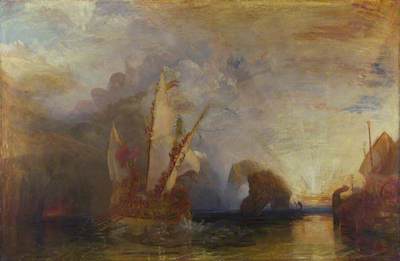
Turner, Joseph Mallord William, 1775-1851; Ulysses deriding Polyphemus- Homer's Odyssey

(J. M. W. Turner, Ulysses Deriding Polyphemus
Photo credit: National Gallery)

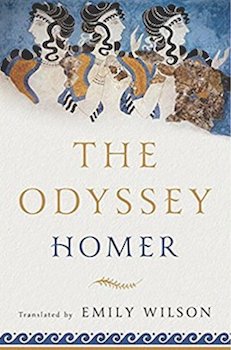
Standing in the bright kitchen, darkness still pressing closely against the windows, waiting for the coffee to brew, I turn the pages of The Odyssey, the first published translation into English of Homer’s epic by a woman, Emily Wilson, (British) Professor of Classics at the University of Pennsylvania.

Thinking of the beginning of the poem in English, the phrase I usually have in my head is ‘Tell me, Muse, of the man of many devices’. I can’t now be sure of precisely where that came from. The closest is the old Loeb edition, translated by Murray, except that he seems to have ‘O Muse’. I thought it might be E. V. Rieu’s prose translation from 1946, the first-ever Penguin Classic, later revised by his son. That was certainly the first version I ever read but the copy I now have begins: ‘Tell me, Muse, the story of that resourceful man’.[1]

‘Sing to me of the man, Muse, the man of twists and turns’, Robert Fagles has it.[2] And Emily Wilson? ‘Tell me about a complicated man.’ The next line begins ‘Muse’—I’d thought at first the opening line ended with a comma but it doesn’t.

Muse, tell me how he wandered and was lost
when he had wrecked the holy town of Troy,
and where he went, and who he met, the pain
he suffered in the storms at sea, and how
he worked to save his life and bring his men
back home.[3]

Not having the Greek for purposes of comparison, I go by ear as, I presume, the vast majority of readers must. Or I simply trust Guy Davenport, who did know Greek and translated Sappho, Herondas, Archilocos and Herakleitos, among others. In his essay ‘Another Odyssey’, he discusses translations by Richmond Lattimore (the ostensible occasion for the essay), Butcher and Lang, Robert Fitzgerald, William Cullen Bryant, William Morris, T. E. Lawrence, Chapman, Pope, Christopher Logue and Samuel Butler—opening with the poet Salvatore Quasimodo’s rendering of the opening lines of the third book of The Odyssey into Italian. Davenport mentions ‘the two most exciting translations from Homer in recent years’—Robert Fitzgerald’s and Christopher Logue’s—and quotes an extract from the nineteenth book of The Iliad as translated first by Lattimore, then by Logue. ‘We have all been taught,’ Davenport comments, ‘to prefer the former, out of a shy dread before Homer’s great original; we instinctively, if we have ever felt a line of poetry before, prefer the latter.’[4] Davenport was writing in 1968 and estimated that there had been at least fifty versions in English of Homer’s second epic poem. There have been around twenty since then, with three just in the past year (Emily Wilson, Peter Green and Anthony Verity).

Wilson-Odyssey

Wilson’s version goes with a swing because she’s opted to use iambic pentameter, the traditional metre of English narrative poetry (she also matches the poems line by line). ‘The original’, she points out, ‘is written in a highly rhythmical form of verse. It reads nothing like prose and nothing like any spoken or nonpoetic kinds of discourse.’ The Odyssey, she argues, ‘needs to have a predictable and distinctive rhythm that can be easily heard when the text is read out loud.’[5] True enough; I can vouch for the efficacy of that rhythm, having begun reading her Odyssey aloud to the Librarian.

The beginning of the poem is a very obvious point of comparison: the address to the muse, which seems straightforward but is, apparently, not. As far as my fingertip decipherings in Liddell and Scott’s dictionary go, Odysseus could be described as ‘much-turned, i.e. much-travelled, wandering’, turning many ways, versatile, ingenious, changeful or manifold. Plenty of scope there, then.

(Emily Wilson discusses the decisions to be made about that single word, polytropos, here:
https://www.nytimes.com/2017/11/02/magazine/the-first-woman-to-translate-the-odyssey-into-english.html )

I’m reminded of the debate over the ‘correct’ rendering of Camus’ ‘maman’ in the first line of The Outsider (or The Stranger, as it’s always been known to the far west of me). I always remember that line as ‘Mother died today’, probably from Stuart Gilbert’s 1946 translation, which was followed only after a long interval by Joseph Laredo’s version, then by translations from Kate Griffith, Matthew Ward and Sandra Smith. ‘Mother’ seems to have shifted only as far as ‘my mother’, with the exception of Ward’s reversion to maman.

It’s a question of relative formality (mother, mum, mummy, mom) but there are obvious cultural differences too, French retaining certain formalities or faint memories of a courtliness which English and American speakers have largely shed. The issue was discussed by Ryan Bloom in The New Yorker (11 May 2012), where, reviewing Camus’ opening sentence—‘Aujourd’hui, maman est morte’­—he concluded: ‘The ordering of words in Camus’s first sentence is no accident: today is interrupted by Maman’s death. The sentence, the one we have yet to see correctly rendered in an English translation of “L’Étranger,” should read: “Today, Maman died.”’
(See: https://www.newyorker.com/books/page-turner/lost-in-translation-what-the-first-line-of-the-stranger-should-be )

‘He observed, that all works which describe manners, require notes in sixty or seventy years, or less’, Boswell remarks of Samuel Johnson.[6] Cultural habits, cultural assumptions, such things change constantly, in both small and fundamental ways. So do expectations of who might read a literary work: their gender, their social class, their level of education. But as to who might read this Odyssey, it’s pretty safe to venture ‘anyone at all’.

References

[1] Homer, The Odyssey, revised translation by D. C. H. Rieu, in consultation with Peter V. Jones (London: Penguin, 1991), 3.

[2] Homer, The Odyssey, translated by Robert Fagles (London: Penguin, 1997), 77.

[3] Homer, The Odyssey, translated by Emily Wilson (New York: Norton, 2017), 105. Caroline Alexander’s The Iliad: A New Translation (Vintage, 2016) is, apparently, the first published version in English of that poem by a woman. See A. E. Stallings’ review of Alexander in The Spectator (9 April 2016).

[4] Guy Davenport, The Geography of the Imagination (Boston: David R. Godine, 1997), 29-44; 36, 37.

[5] Wilson, ‘Translator’s Note’, 81, 82.

[6] James Boswell, Life of Johnson, edited by R. W. Chapman, revised by J. D. Fleeman, (Oxford: Oxford University Press, 1980), 509.

Delirium, poetry, snacks

There was a time when Penguin published a series of modern European poets (and Penguin Modern Poets and a lot of anthologies). They still publish poets, of course, but they were giants in those days, and a great many people read for the first time, in slim Penguin paperbacks, such luminaries as Akhmatova, Apollinaire, Prévert, Miroslav Holub, Ungaretti, Quasimodo, Yevtushenko, Montale, Rilke, Blok, a volume of four Greek poets—and who could fault the selection of Cavafy, Elytis, Gatsos and Seferis?

Even in such glittering company, Miroslav Holub stood out a little for me. A scientist (immunologist), a Czech, writing often in very short lines, sometimes reminiscent of William Carlos Williams’ ‘three-ply line’.[1] The Penguin edition came out fifty years ago but a later Bloodaxe collection included some of the translations from that edition, by George Theiner and Ian Milner. Some of the older translations have stuck in my head for years: ‘In the microscope’, ‘The root of the matter’, Žito the magician’, ‘Wings’ and, perhaps particularly, ‘Love’.

Two thousand cigarettes.
A hundred miles
from wall to wall.
An eternity and a half of vigils
blanker than snow.

Tons of words
old as the tracks
of a platypus in the sand.

A hundred books we didn’t write.
A hundred pyramids we didn’t build.

Sweepings.
Dust.

Bitter
as the beginning of the world.

Believe me when I say
it was beautiful.[2]

I lay in bed roughing out another version during my recent bout of flu, from which I’m gradually emerging: ‘Two thousand tissues/ a hundred hacking coughs from hour to hour/ Believe me when I say/ it was delirious’. The Librarian, still recovering from her own bad case of flu, was shoved unceremoniously into the role of nurse-helper. Initially a little shell-shocked by such unaccustomed role reversal, she rose to the occasion to the extent of coffees, hot lemon drinks and a visually spectacular sandwich, delivered to the accompaniment of eloquent words of encouragement (‘Good luck with that’).

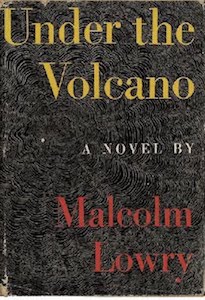
Macdonald-Four-Later      Lowry-Under

The coughing, the delirium, the headaches, even the catarrh, all finally diminish. But time is often out of joint. Taking to my bed mid-evening, seemingly on the point of collapse, I get up again at 01:30, having woken at fifteen-minute intervals for the past hour and now feeling wide awake. Downstairs, I rotate hot drinks and snacks, and tuck into a Ross Macdonald novel. ‘Late afternoon sunlight spilled over the mountains to the west. The light had a tarnished elegiac quality, as if the sinking sun might never rise again. On the fairway behind the house the golfers seemed to be hurrying, pursued by their lengthening shadows.’[3]

Suit the book to the illness or at least to the stage on the road to wellness. I remember being ill and feverish, many years ago, while reading Malcolm Lowry’s Under the Volcano. Coincidentally, there was a dramatisation of the book on the radio and I lay in bed listening to it—deliriously. Lowry’s novel is itself hallucinatory and to the voices already in my head were added those coming over the airwaves. Altogether that accumulation of deliriums, if that’s the right plural, produced a pronouncedly weird effect. I wasn’t sure who was in the worst state, Lowry or his central character Geoffrey Firmin or me. I’ve since read Under the Volcano again (when in rude health) and whittled those candidates down a bit.

References

[1] Paul Mariani, William Carlos Williams: A New World Naked (New York: W. W. Norton, 1990), 539-540; Hugh Kenner, The Pound Era (London: Faber and Faber, 1972), 542.

[2] ‘Love’, translated by Ian Milner, in Miroslav Holub, The Fly (Newcastle upon Tyne: Bloodaxe Books, 1987), 40.

[3] Ross Macdonald, The Instant Enemy, in Four Later Novels, edited by Tom Nolan (New York: Library of America, 2017), 413.


The Heights of Poetry

Haydon-WW-Helvellyn
(Wordsworth by Benjamin Haydon, © National Portrait Gallery, London)

‘Great writers in our time have tended to be tall,’ the six-feet-four Hugh Kenner remarks in the context of his first meeting with the five-feet-ten Ezra Pound. ‘T. S. Eliot, five-eleven-and-a-half—a figure I obtained after bumping my head on his six-foot office door. W. B. Yeats and James Joyce, each five-eleven; Sam Beckett, six-two. Save for psychic height, the physical Pound was a midget among giants.’[1]

Such considerations have cropped up before. I find—dear, dear, the Internet again—that Havelock Ellis, physician, sexologist, eugenicist, in an 1897 article, ‘Genius and Stature’, and his 1904 book, A Study of English Genius, asserted that men of genius—sorry, women, not this time—tended to be either shorter than average or, more frequently, taller than average. Those of average height scored markedly less well and the findings were complicated by the social class of the subjects (the poorer classes, unsurprisingly, tended to be physically smaller). In 1885, a certain Henry Troutbeck claimed to have examined Chaucer’s remains during the preparations for Robert Browning’s burial: he was five feet six inches (not bad for the fourteenth century, surely). Alas, further investigation showed that Browning’s grave was far enough away from Chaucer’s to to make this a bit implausible; then, too, it seems that, in any case, ‘the location of Chaucer’s bones remains somewhat doubtful.’[2]

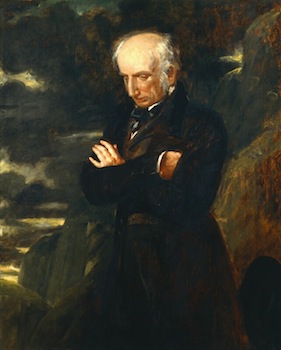
Certainly, poets come in all sizes. Measuring them precisely is a tricky business, though Benjamin Haydon, when beginning his portrait of Wordsworth on Helvellyn, surveyed the poet in detail and found him to be exactly 5 feet 9⅞ inches tall. (He also did a drawing of him ‘with and without his false teeth.’)[3] Alexander Pope, apparently, came in at four feet six inches, while Edith Sitwell measured around six feet—or five feet eleven inches, by official reckoning.[4] On 20 October 1915, Wilfred Owen underwent his second medical examination at the Artists’ Rifles headquarters. A year earlier, his height of five feet five inches would have disqualified him but the standard had been lowered since then. He officially entered the British Army the following day.[5] Keats was around five feet and one inch—‘around’? Timothy Hilton has him at 5’ 0¾” , as does Robert Gittings, while Andrew Motion has ‘five feet and a fraction of an inch’—but what fraction?[6] And Keats was how much shorter than Charles Olson?

charles_olson_writing_at_black_mountain_college
(Charles Olson writing at Black Mountian College)

Olson (born 27 December 1910) was roughly six foot eight or nine, Robert Creeley wrote; or six feet seven inches, as some say; twenty-one inches taller than Keats, Guy Davenport remarks (‘in his stocking feet taller by half again than Alexander the Great’), which would make him six feet ten inches.[7] Damned tall, anyway, large, everything about him large, the ambition, the format of the volumes of Maximus poems from Cape Goliard, vocabulary, geographical and historical reach.

Sometimes he’s absurdly overpitched, sometimes opaque, sometimes just crazy, sometimes inspired, sometimes visionary. Sometimes he’s just on the money.

Try:

What has he to say?
In hell it is not easy
to know the traceries, the markings
(the canals, the pits, the mountings by which space
declares herself, arched, as she is, the sister,
awkward stars drawn for teats to pleasure him, the brother
who lies in stasis under her, at ease as any monarch or
a happy man[8]

or

It is undone business
I speak of, this morning,
with the sea
stretching out
from my feet

or

I am not at all aware
that anything more than that
is called for. Limits
are what any of us
are inside of

or, ah:

The upshot is
(and this the books did not tell us) the race
does not advance, it is only
better preserved[9]

George Butterick, the Olson scholar who edited the Collected Poems (nearly 650 pages of non-Maximus poems) and The Maximus Poems for the University of California Press, cites in this connection Emerson’s ‘Self-Reliance’: ‘Society never advances. It recedes as fast on one side as it gains on the other. It undergoes continual changes [… ] but this change is not amelioration. For every thing that is given, something is taken.’[10]

T. S. Eliot, along similar—though not the same—lines wrote that the artist must ‘be quite aware of the obvious fact that art never improves, but that the material of art is never quite the same’. And that the mind of Europe ‘is a mind which changes, and that this change is a development which abandons nothing en route, which does not superannuate either Shakespeare, or Homer, or the rock drawing of the Magdalenian draughtsmen.’[11]

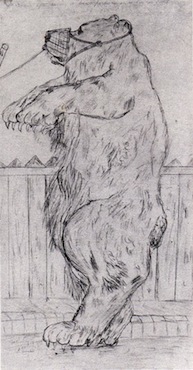
On a more individual note, David Jones, putting on his wall in 1958 a drawing of a dancing bear he’d produced in 1903, at the age of seven, wrote to a friend: ‘“It’s much the best drawing I’ve ever done, which shows how, in the arts, there ain’t no such thing as getting better as you get older!”’ Again, in 1967, Jones wrote of this drawing, ‘there are few of my subsequent works which I prefer to that.’[12] The assertion held in a wider perspective in Jones’s case too. Though moved and impressed by books that he read by Teilhard de Chardin, he thought Teilhard’s ‘idea of evolution towards union with God naïve — like any belief in general progress. In art, for example, “Picasso is no improvement over Lascaux.”’[13]
Jones-dancing-bear
(David Jones, ‘The Bear’ (1903), via Apollo magazine)

Is that true? Individually, the issue is complicated by a general acceptance of the fact that advancing age must inevitably be accompanied by a loss of powers—but it’s a fact often confounded by extraordinary artistic performances from writers and painters in their seventies, eighties and even nineties: among others, Georgia O’Keeffe, Charles Tomlinson, Rose Macaulay, Sybille Bedford, W. B. Yeats, Titian, Thomas Hardy, Penelope Fitzgerald, Isak Dinesen, Louise Bourgeois, Ezra Pound—and David Jones himself.

And more generally? Those of us who grew up with the unexamined optimism common enough in those days, a version of the Whig interpretation of history (the inevitable and continuing advance of progress over the forces of reaction) have had rude awakenings enough in this new age of unreason. As for the arts—it’s a good, a constant question. In the essay already quoted, Eliot wrote: ‘Someone said: “The dead writers are remote from us because we know so much more than they did”. Precisely, and they are that which we know.’ That actually accounts for a large part of the confident assertion that painters, poets, novelists—and critics—are better or smarter or more profound than those in earlier periods: they are simply positioned later in history. Our own age knows a great deal that people in the early twentieth and nineteenth and eighteenth centuries didn’t know; but we’d be fools to think that those earlier ages didn’t know a great many other things that are completely lost to us now.

It has to be said, though, that, as a general rule, we’re taller than they were.

References

[1] Hugh Kenner, The Elsewhere Community (New York: Oxford University Press, 2000), 35.

[2] Thomas A. Prendergast, Chaucer’s Dead Body: From Corpse to Corpus (London: Routledge, 2003), 106, 108, 59.

[3] See Alethea Hayter, A Sultry Month: Scenes of London Literary Life in 1846 (London: Robin Clark 1992), 142-143.

[4] Pope mentioned in Hugh Kenner’s review of Maynard Mack’s Alexander Pope: A Life (1986), in Historical Fictions (Athens: University of Georgia Press, 1995), 253; ‘Sitwell’s passport recorded her height as five feet eleven but she was often reported as being well over six feet’: Rosemary Hill, ‘No False Modesty’, a review of Richard Greene, Edith Sitwell: Avant-Garde Poet (London: Virago Press, 2011), in London Review of Books, 33, 20 (20 October 2011), 25.

[5] Dominic Hibberd, Wilfred Owen: A New Biography (London: Weidenfeld & Nicolson, 2002), 164.

[6] Timothy Hilton, Keats and his World (London: Thames & Hudson, 1971), 56; Robert Gittings, John Keats (Harmondsworth: Penguin Books, 1971), 135; Andrew Motion, Keats (London: Faber and Faber, 1997), 36.

[7] Robert Creeley, ‘Introduction’ to Charles Olson, Selected Writings (New York: New Directions, 1966), 1; Guy Davenport, ‘Olson’, in The Geography of the Imagination (Boston: David R. Godine, 1997), 80.

[8] Charles Olson, ‘In Cold Hell, in Thicket’, in The Collected Poems of Charles Olson, edited by George F. Butterick (Berkeley: University of California Press, 1997), 155. The reference here is to the Egyptian sky-goddess Nut, arching over and around her earth-god brother and lover Geb (‘her starry belly was painted inside the sarcophagi of Egyptian kings’): Robert von Hallberg, Charles Olson: The Scholar’s Art (Cambridge: Harvard University Press, 1978), 145.

[9] Charles Olson, The Maximus Poems, edited by George F. Butterick (Berkeley: University of California Press, 1985), 57, 21, 59.

[10] George Butterick, A Guide to the Maximus Poems of Charles Olson (Berkeley: University of California Press, 1980), 86. See Ralph Waldo Emerson, Essays and Lectures, edited by Joel Porte (New York: Library of America, 1983), 279—I’ve quoted very slightly more than Butterick does.

[11] Eliot, ‘Tradition and the Individual Talent’, in Selected Essays, third enlarged edition (London: Faber and Faber, 1980), 16.

[12] Thomas Dilworth, David Jones: Engraver, Soldier, Painter, Poet (London: Jonathan Cape, 2017), 11; David Jones, ‘A Note to the Illustrations’, Agenda, Vol. 5, Nos. 1-3, Special David Jones issue (Spring-Summer, 1967), 2.

[13] Dilworth, David Jones, 314.
 

Sleep and his brother

Archer, James, 1823-1904; La mort d'Arthur

(James Archer, La mort d’Arthur: Manchester Art Gallery)

Commanded by ‘Zeus the cloud-gatherer’, Apollo ‘did exactly as he was told’.

He carried Sarpedon out of the line of fire,
Washed him properly in a stream, in running water,
And rubbed supernatural preservative over him
And wrapped him up in imperishable fabrics
And handed him over to the speedy chaperons,
Sleep and his twin brother Death, who brought him
In no time at all to Lycia’s abundant farmland.’[1]

Michael Longley is rendering here a part of Homer’s Book XVI of the Iliad. What Zeus says to his son Apollo about another of his sons, Sarpedon, almost exactly repeats what Zeus’s wife Hera has earlier said to her husband when he expressed his wish to rescue Sarpedon from the murderous attention of Patroclus. Hera, reasonably enough, pointed out that, were he to save Sarpedon from his battlefield death, then other gods and goddesses might feel a little aggrieved, since many ‘sons of the immortals’ were engaged in the fight. Essentially, she says, while Zeus has the power to reprieve Sarpedon, to do so ‘would upset the balance of the world’.[2]

Running soldiers, vase, 6th century BC Attic (Greek) (detail)

Sleep and death. With characteristic elegance, Alice Oswald writes:

Sarpedon the son of Zeus
Came to this unseen ungrowing ground
Came from his cornfields from his leafy river
From his kingdom of paths and apple groves
And was killed by a spear
Then for a long time he lay crumpled as linen
Until two soft-voiced servants Sleep and Death
Carried him home again[3]

Richmond Lattimore has them as ‘swift messengers’[4] but I rather like that explicit characterisation of them as servants rather than masters. Given the acceptance of fate and its workings, what could be more natural than sleep or, indeed, death?

In Finland, I gather, 27th July is Sleepy Head Day, when the last person sleeping in the house tends to be doused with water. The tradition dates back to the Middle Ages and is supposedly related to the legend of the Seven Sleepers of Ephesus, who hid in a cave to escape religious persecution and woke centuries later. There are long sleeps, absurdly long sleeps—and mythical sleeps. Legend insists that King Arthur and his knights are not dead but only sleeping until they are needed again. Malory wrote: ‘Yet som men say in many p[art]ys of Inglonde that kynge Arthur ys nat dede but h[ad] by the wyll of oure Lord Jesu into another place; and men say that he shall com agayne, and he shall wynne the Holy Crosse.’[5] Tracing the ways in which Arthur’s memory was kept alive, through oral tradition, folk tales and ballads, to flourish in Victorian Britain, in Morris, Swinburne and most evidently in Tennyson’s Idylls of the King, Peter Ackroyd suggests that this is ‘the true significance of Arthur: by not dying, by being perpetually reborn, he represents the ideas of the English imagination.’[6]

Marguerite_Yourcenar

(Marguerite Yourcenar)

Some are deprived of the sleep they desire: Alethea Hayter writes of the opium addict that: ‘He is unable to sleep, and sometimes seems to be waiting for someone who never comes.’[7] For others, sleep is not wanted at all. The narrator of Michael Ondaatje’s novel remarks that ‘Sleep is a prison for a boy who has friends to meet. We were impatient with the night, up before sunrise surrounded the ship.’[8] Sleep has its risks and dangers, its shifting borders. ‘But what interests me here’, Marguerite Yourcenar has her emperor Hadrian say, ‘is the specific mystery of sleep partaken of for itself alone, the inevitable plunge risked each night by the naked man, solitary and unarmed, into an ocean where everything changes, the colors, the densities, and even the rhythm of breathing, and where we meet the dead.’[9] And the Old Gypsy Woman says to the narrator of Antonio Tabucchi’s Requiem, ‘Listen, my dear, this can’t go on, you can’t live in two worlds at once, in the world of reality and the world of dreams, that kind of thing leads to hallucinations, you’re like a sleepwalker walking with your arms outstretched, and everything you touch becomes part of your dream’.[10]

One of my favourite sleeping anecdotes occurs in a Sylvia Townsend Warner letter to her friend George Plank. ‘I will sit down to tell you about two very old & distant cousins of mine, brother & sister, who live together. She is in her nineties: he is a trifle younger. They were sitting together, he reading, she knitting. Presently she wanted something, and crossed the room to get it. She tripped, & fell on her back. So she presently said: Charlie, I’ve fallen & I can’t get up. He put down his book, turned his head, looked at her, and fell asleep.’[11]

So there’s that to look forward to.
References

[1] Michael Longley, ‘Sleep & Death’, Snow Water (London: Jonathan Cape, 2004), 42.

[2] Malcolm M. Willcock, A Companion to the Iliad (Chicago: University of Chicago Press, 1976), 185.

[3] Alice Oswald, Memorial (London: Faber and Faber, 2011), 61.

[4] Homer, The Iliad of Homer, translated by Richmond Lattimore (Chicago: University of Chicago Press, 1961), 348, line 671.

[5] The Works of Sir Thomas Malory, edited by Eugène Vinaver (London: Oxford University Press, 1964), 873.

[6] Peter Ackroyd, Albion (London: Chatto & Windus, 2002), 118.

[7] Alethea Hayter, Opium and the Romantic Imagination (London: Faber, 1971), 69.

[8] Michael Ondaatje, The Cat’s Table (London: Vintage Books, 2012), 30.

[9] Marguerite Yourcenar, The Memoirs of Hadrian, translated by Grace Frick, with Yourcenar (1951; Penguin Books, 2000), 26.

[10] Antonio Tabucchi, Requiem, translated by Margaret Jull Costa (London: Harvill, 1994), 25.

[11] Letter of 14 February, 1960: Sylvia Townsend Warner, Letters, edited by William Maxwell (London: Chatto & Windus, 1982), 180.


Winter solstice; nothing political

Lights2

Winter solstice. The shortest, least lighted day. The darkest hour before the dawn, and all that. So we can expect some brightening soon? Answers on a speck of dust, please, to a post office box located somewhere out in mid-ocean.

Is it possible, on such a day, not to stray into political lament or harangue in this new age of unreason, at the end of what feels like a very long year or rather, eighteen months, which is how long it is since, in Jonathan Meades’ summary, ‘[t]he aim of the 52 per cent that shot itself in the foot was so poor that it also shot the 48 per cent.’?[1]

Face-to-the-world

It’s possible. Difficult but possible, if only by concentrating on quite other things, such as the obvious advantage of new bookshelves in the kitchen being the option of browsing while the kettle boils or the grill heats up. You might gather useful, or useless, or at least diverting facts such as that Gustave Courbet had himself photographed more than any other nineteenth-century French painter.[2] Or, say, insights into the problems of novel-writing:

Unstrung-Harp

‘Several weeks later, the loofah trickling on his knees, Mr Earbrass mulls over an awkward retrospective bit that ought to go in Chapter II. But where? Even the voice of the omniscient author can hardly afford to interject a seemingly pointless anecdote concerning Ladderback in Tibet when the other characters are feverishly engaged in wondering whether to have the pond at Disshiver Cottage dragged or not.’[3]

Or, say, this cheering news of the use to which Mary Cassatt put her share of the 1879 Impressionist exhibition’s earnings: ‘[ . . . ] Mary bought a Monet and a Degas; by that time she already owned pictures of Pissarro, Renoir, Sisley, and Monet; her impulse, like Degas’, was ever to put money not earmarked for necessities, into pictures.’[4] I’m thinking how pleasant it would be: not needing to be rich, simply having the good taste to want ‘a Monet and a Degas’ and, of course, to have that sense of priorities.

21 December, something cheering. Let me see. Yes, that day in 1944, Sylvia Townsend Warner writes to Ben Huebsch of Viking Press about her wonderful novel The Corner That Held Them, reviewed by Kate Macdonald earlier this year here:

https://katemacdonald.net/2017/05/22/sylvia-townsend-warner-the-corner-that-held-them/

‘At this moment you should have up to p.182. I have killed off a lot more ladies in the next bit you will get, so much creating and killing off makes me feel as providential as Providence. Ralph, however, is still with us. He is to live into an old age serene and bright and die without a pang of conscience.’ Four months later, she writes to him to say: ‘It will be long—about 180,000 I believe. It is also what one calls powerful. If dropped from a suitable height it would wipe out the state of Vermont.’[5]

confucius

(Confucius: K’ung Fu-Tse)

Meanwhile, reflecting—obviously, not at all in a political way—on the news of the day, of altogether too many recent days, an extract from Ezra Pound’s ‘Canto XIII’ pops into my head:

And Kung raised his cane against Yuan Jang,
Yuan Jang being his elder,
For Yuan Jang sat by the roadside pretending to
be receiving wisdom.
And Kung said “You old fool, come out of it,
“Get up and do something useful.”
And Kung said
“Respect a child’s faculties
“From the moment it inhales the clear air,
“But a man of fifty who knows nothing
Is worthy of no respect.”[6]

References

[1] Jonathan Meades, ‘In the loop: The gulf between the arts and art: a personal view’ (edited text of a speech given at the annual dinner of the Royal Academy of Arts in London), Times Literary Supplement (20 October 2017), 14.

[2] Laura Cumming, A Face to the World: On Self-Portraits (London: Harper Press, 2010), 194.

[3] Edward Gorey, The Unstrung Harp; or, Mr Earbrass Writes a Novel, in Amphigorey: Fifteen Books by Edward Gorey (New York: Perigee Books, 1981), unpaginated.

[4] Nancy Hale, Mary Cassatt: A biography of the great American painter (New York: Doubleday, 1975), 94.

[5] Sylvia Townsend Warner, Letters, edited by William Maxwell (London: Chatto & Windus, 1982), 88, 92.

[6] The Cantos of Ezra Pound, fourth collected edition (London: Faber and Faber, 1987), 58-59.