Pilots, poets, bays

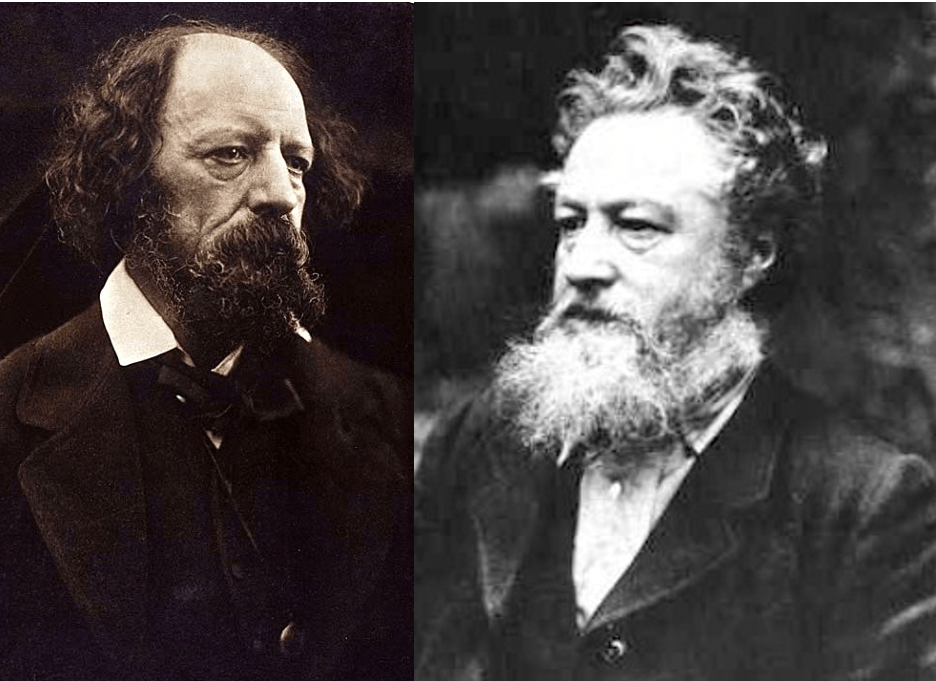
Alfred Lord Tennyson died on 6 October 1892, having served as Queen Victoria’s Poet Laureate for over forty years, the longest ever tenure – though a later octogenarian, John Masefield, came very close. Tennyson’s funeral, which took place six days after his death, was a pretty grand affair. His remains were, the Times reported, ‘consigned to their last resting-place in Poets’ Corner, Westminster’ – the grave of Robert Browning, who had died three years previously, is immediately adjacent to Tennyson’s. All the leading members of the royal family sent representatives (Sir Henry Ponsonby, Sir Dighton Probyn, Lord Edward Cecil) and the place was thronged with bishops, lords and ladies, the pall-bearers including the Duke of Argyll and Lord Kelvin. Conan Doyle, Ellen Terry, John Burns, Frederic Harrison and Henry Irving were among the mourners. In the street outside, vendors were offering, for a penny, copies of the poet’s 1889 lyric, ‘Crossing the Bar’ (author portrait included):

Sunset and evening star,
   And one clear call for me!
And may there be no moaning of the bar,
   When I put out to sea,

But such a tide as moving seems asleep,
   Too full for sound and foam,
When that which drew from out the boundless deep
Turns again home.

Twilight and evening bell,
   And after that the dark!
And may there be no sadness of farewell,
   When I embark;

For though from out our bourne of Time and Place
   The flood may bear me far,
I hope to see my Pilot face to face
When I have crost the bar.[1]

Tennyson was 80 when he wrote it, so unsurprisingly aware that the encounter with his ‘Pilot’ was not that far off.

Edward Burne-Jones was particularly excited that the city of Mantua ‘had sent bay from Virgil’s birthplace to lay in the tomb.’ In fact, ‘bay’ and ‘pilot’ occurred in another ‘literary’ interment context a few years later, though William Morris’s ‘country funeral’, Fiona MacCarthy observes, ‘was the absolute antithesis of Tennyson’s burial in Westminster Abbey in 1892.’[2]
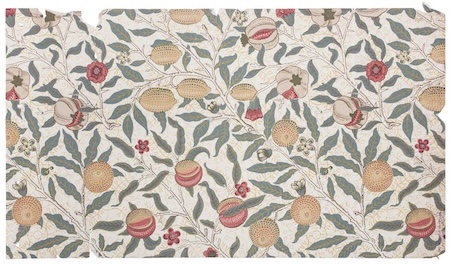
(William Morris, Fruit (Wallpaper): William Morris Society: Kelmscott House)

Morris died on 3 October 1896. He was only 62 but such a tireless worker, such a tireless maker, of pictures, poems, translations, tapestries, stained-glass windows, fabrics, carpets, furniture, illuminated books, wallpapers, prose romances and more that, as is often remarked, the primary cause of his death was simply being William Morris. His funeral took place on 6 October, exactly four years after the death of Tennyson. The body had to be transported from Paddington to Lechlade by train (a form of transport that Morris disliked intensely), then taken by cart to Kelmscott Church.

It was a cold wet morning, and the day turned stormy later. In that week’s issue of the Saturday Review (10 October 1896), there were pieces on Morris by George Bernard Shaw, Arthur Symons – and R. B. Cunninghame Graham, whose account of the day on which ‘the most striking figure of our times’ was buried, began with that weather. ‘As we never associated William Morris with fine weather, rather taking him to be a pilot poet lent by the Vikings to steer us from the doldrums in which we now lie all becalmed in smoke to some Valhalla of his own creation beyond the world’s end, it seemed appropriate that on his burial day the rain descended and the wind blew half a gale from the north-west.’ He noted of the arrival at Lechlade: ‘There, unlike Oxford, the whole town was out’, and added that the open haycart on which the coffin was transported to Kelmscott Church was ‘driven by a man who looked coeval with the Saxon Chronicle.’[3]

‘Over the coffin were thrown two pieces of Oriental embroidered brocade, and a wreath of bays was laid at his head’, the Daily News reported. The mourners included, alongside painters, publishers and printers, workmen from Merton Abbey (where the tapestry, weaving and fabric printing workshops were sited), Kelmscott villagers and members of the Art Workers’ Guild, all in their daily working clothes. The architect William Lethaby wrote: ‘It was the only funeral I have ever seen that did not make me ashamed to have to be buried.’[4]

(William Morris, Kelmscott Press Edition of ‘Godefrey of Boloyne’ by William Caxton: William Morris Society: Kelmscott House)

Morris continues to attract enormous biographical and scholarly interest, and warrants it all. So many arts, so many crafts, so many connections, so widespread and generative an influence, cropping up in all manner of places, often the expected ones, sometimes less so. Ezra Pound read Morris to the young Hilda Doolittle, ‘in an orchard under blossoming—yes, they must have been blossoming—apple trees.’ And: ‘It was Ezra who really introduced me to William Morris. He literally shouted “The Gilliflower of Gold” in the orchard. How did it go? Hah! hah! La belle jaune giroflée. And there was “Two Red Roses across the Moon” and “The Defence of Guenevere.”’[5] Pound read Morris to Yeats too, in Stone Cottage at the edge of Ashdown Forest, his translations of the Icelandic sagas.[6] Yeats would later recall of Morris’s prose romances that they were ‘the only books I was ever to read slowly that I might not come too quickly to the end.’[7]
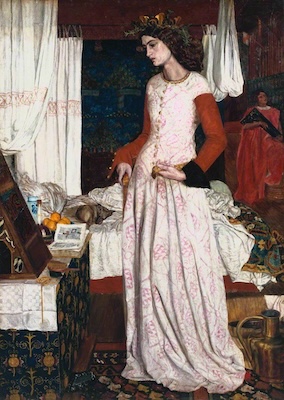
(William Morris, La Belle Iseult: Tate)

Fiona MacCarthy remarks that ‘There was a neurotic basis to his fluency. On a good day he could write 1,000 lines of verse’, and some readers will find some of the longer poems soporific.[8] Penelope Fitzgerald wrote that the lyrics, in her opinion were ‘far the most important part’ of his  poetry and, ‘If I could keep them I would cheerfully sweep all the sagas and Earthly Paradises under the carpet.’[9] Other readers, in Morris’s own time, and since, have felt quite differently. Yeats continued to be one of them. In October 1933, he reported to his old friend (and ex-lover) Olivia Shakespear (Pound’s mother-in-law) his attempt to read Morris’s long poem The Story of Sigurd the Volsung to his daughter and then to his wife: ‘and last night when I came to the description of the birth of Sigurd and that wonderful first nursing of the child, I could hardly read for my tears. Then when Anne had gone to bed I tried to read it to George and it was just the same.’[10]

This is probably the passage he refers to, early in Book II:

Then she held him a little season on her weary and happy breast
And she told him of Sigmund and Volsung and the best sprung forth from the best:
She spake to the new-born baby as one who might understand,
And told him of Sigmund’s battle, and the dead by the sea-flood’s strand,
And of all the wars passed over, and the light with darkness blent.

So she spake, and the sun rose higher, and her speech at last was spent,
And she gave him back to the women to bear forth to the people’s kings,
That they too may rejoice in her glory and her day of happy things.[11]

For other admirers of Morris, it may be the campaigner, the Socialist, or perhaps the designer and producer of stained-glass, fabrics, stories, the late romances, the lectures and the essays:

‘To give people pleasure in the things they must perforce use, that is one great office of decoration; to give people pleasure in the things they must perforce make. That is the other use of it.’
     ‘Does not our subject look important enough now? I say that without those arts, our rest would be vacant and uninteresting, our labour mere endurance, mere wearing away of body and mind.’[12]
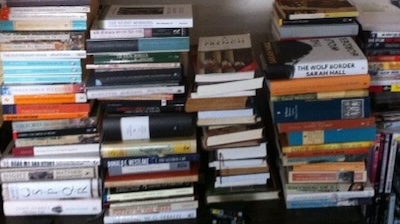
Yes, the allusions to damaging and artificial divisions are often wonderfully suggestive of other divisions causing much wider harms – as, of course, they continue to do. And, though I may be prejudiced in this regard, I like his idea, in ‘The Beauty of Life’, of ‘the fittings necessary to the sitting-room of a healthy person’. The first of these is ‘a book-case with a great many books in it’. Oddly, he never seems to mention, let alone recommend, piles of books everywhere else. . .


Notes

[1] Tennyson: A Selected Edition, edited by Christopher Ricks (Harlow: Longman Group, 1989), 665-666.

[2] Fiona MacCarthy, William Morris: A Life for Our Time (London: Faber & Faber, 1994), 631, 673-675.

[3] R. B. Cunninghame Graham, ‘With the North-West Wind’, Saturday Review (10 October 1896), Vol. 82, Issue 2137, 389-390.

[4] Quoted by Philip Henderson, William Morris: His Life, Work and Friends (Harmondsworth: Pelican Books, 1973), 429.

[5] H. D., End to Torment: A Memoir of Ezra Pound, edited by Norman Holmes Pearson and Michael King (Manchester: Carcanet Press, 1980), 22-23.

[6] James Longenbach, Stone Cottage: Pound, Yeats and Modernism (New York: Oxford University Press, 1990), 142-143.

[7] W. B. Yeats, ‘The Trembling of the Veil [1922]: Four Years’, in Autobiographies (London: Macmillan, 1955), 141.

[8] MacCarthy, William Morris, ix.

[9] Penelope Fitzgerald to Dorothy Coles, 5 June [1992], So I Have Thought of You: The Letters of Penelope Fitzgerald, edited by Terence Dooley (London: Fourth Estate, 2008), 460.

[10] The Letters of W. B. Yeats, edited by Allan Wade (London: Rupert Hart-Davis, 1954), 816.

[11] William Morris, The story of Sigurd the Volsung and the fall of the Niblungs (London: Ellis & White, 1877), 80-81.

[12] ‘The Lesser Arts’, in William Morris: The Selected Writings, edited by G. D. H. Cole (London: The Nonesuch Press, 1934), 496.
Bloody Sundays

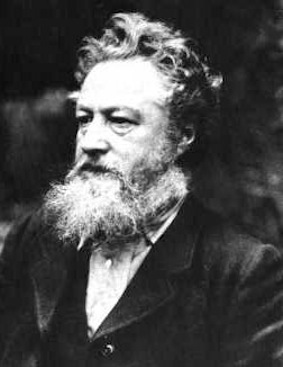
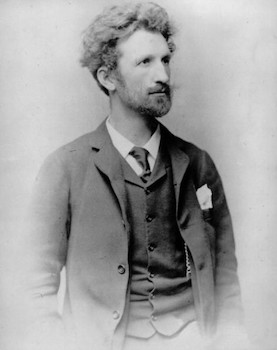
morris.portrait Cunninghame_Graham

(William Morris; Robert Cunninghame Graham)

Bloody Sunday. Most often—before the film buffs’ recall of the 1971 John Schlesinger film Sunday Bloody Sunday, starring Glenda Jackson, Peter Finch and Murray Head—the phrase triggers memories of the Bogside area of Derry, 30 January 1972, when thirteen unarmed demonstrators were killed by British troops (a fourteenth died later), an event whose aftereffects are still very much with us.

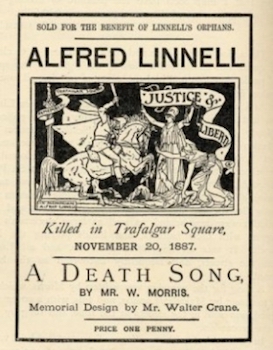
But there was an earlier ‘Bloody Sunday’, 13 November 1887, when tens of thousands of protesters, in and around Trafalgar Square, were blocked—and columns of demonstrators broken up—by police, and troops. The politician John Burns and the writer and radical MP Robert Cunninghame Graham were among those beaten and imprisoned. It was, Fiona MacCarthy remarks, ‘the scene of the most ruthless display of establishment power that London has ever seen.’ There were more than 400 arrests and more than 200 marchers were treated in hospital, ‘only a fraction of the many people injured.’ A law copyist, Alfred Linnell, was killed, probably beneath the hooves of a police horse. William Morris, who had been present at ‘Bloody Sunday’, quickly produced a pamphlet, its cover by Walter Crane, sales of which went to the Linnell family. The funeral, another occasion for mass demonstration, was held on 18 December, the pall-bearers including Morris, Cunninghame Graham, the crusading journalist W. T. Stead and Annie Besant.[1]

alfred-linnell_300x384

(Working Class Movement Library:
https://www.wcml.org.uk/contents/creativity-and-culture/art/walter-crane/)

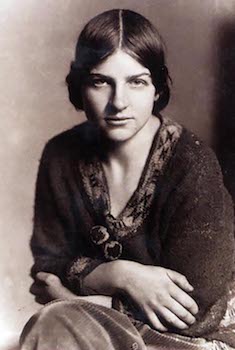
Here’s another socialist, half a century later, Naomi Mitchison, on a research trip to Edinburgh, 13 November 1941:

Going along Princes Street and up the Mount to St Giles, felt a queer kind of pride and anger; the lion flag was flying on some building, I could have kissed it. Walked into Parliament Hall, with its bloody awful stained glass—all the pictures are put away—and thought of James VI’s remark when young “There is ane hole in this Parliament” and suddenly felt the most passionate and disconcerting longing to be a member of the first Scots Parliament under the New Order, or maybe the Supreme Soviet of Scotland, working with the others all over Europe.’[2]

Mitchison

(Naomi Mitchison)

A hole in this Parliament rather than this Parliament in a hole. Those were the days, eh?

On one more 13 November, this one exactly one hundred years ago, an essay by a certain Ezra Pound: ‘Capital v. Labour is not the only conflict; there is also the endless conflict between the furnished and the half-furnished mind.’[3]


Notes

[1] Fiona MacCarthy, William Morris: A Life for Our Time (London: Faber & Faber, 1994), 567-572.

[2] Naomi Mitchison, Among You Taking Notes . . . The Wartime Diary of Naomi Mitchison, 1939-1945, edited by Dorothy Sheridan (London: Victor Gollancz, 1985), 169.

[3] Ezra Pound, ‘The Revolt of Intelligence. I’, New Age, XXVI, 2 (13 November, 1919), 22.


Back to normal

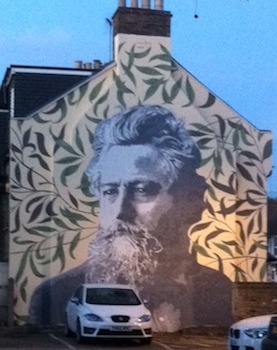
Morris

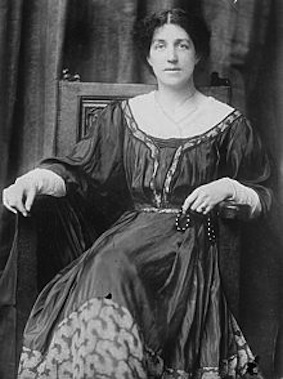
We stayed in Walthamstow in December 2017 mainly to be sure of finally getting to the William Morris Gallery. Housed in a mid-eighteenth century house, in which Morris lived between the ages of fourteen and twenty-two, the Gallery reopened in 2012 after a major redevelopment. We timed the visit to coincide with an exhibition of the work of May Morris, William’s younger daughter, artist and designer of wallpapers, jewellery, embroidery and much else: teacher, lecturer and editor of the 24-volume collected edition of William Morris’s works: http://maymorrisartandlife.co.uk/the-exhibition/

On this occasion of William Morris’s birthday (24 March 1834 – 3 October 1896), I was thinking of Peter Stansky noting that, among other paradoxes, Morris’s strong dislike of the Renaissance had to be set against his providing a fine example of what has become the conventional definition of ‘a Renaissance man’. Opposing the very notion of individual genius was a man of evident individual genius. As Stansky remarked, ‘What Morris was unprepared to recognize was that his was truly the exceptional case.’[1]

May_Morris.Wiki

(May Morris)

The narrator of L. P. Hartley’s The Go-Between remarks at one point, ‘I was in love with the exceptional and ready to sacrifice all normal happenings to it’.[2] Yes, that ‘normal’ – what is it and what has it become? I saw too a photograph, earlier today, in which a ‘March For Our Lives’ demonstrator in Washington held up a placard reading ‘This is not normal’. We said, of course, ‘Back to normal’ as the scheduled strike period ended and the Librarian returned to what was hoped and desired to be precisely that. But normality, like nostalgia, isn’t what it used to be. From the individual and small-scale to the national and supranational, the stable and the commonsensical have taken a vacation of unspecified length.

On that smallest scale—deliveries cancelled; collections missed; a plasterer working in the house—my own ‘normal’ wasn’t shaping up too well and, essentially, I needed to keep out of the way. Work on walls I might have dodged; work on ceilings made things a little trickier. So I walked to the newsagent, then out over the park to the station and caught a train to Bath.

It occurred to me, not for the first time, that, just as cats can immediately spot the one man or woman in the room unsympathetic to cats—and head straight for them—so men on trains with mobile phones and loud voices can pick me out in a crowded carriage—‘Hey, a guy with a book!’—and are thus able to position themselves behind my right ear before getting stuck in to a detailed and repetitive progress report on a telecommunications project, involving several individual contracts. The train ride was thirteen minutes long: when I arrived in Bath, the palms of my hands were slightly damp but I’d suffered no blackouts and the telecommunications man was still in rude health.

(Rex Whistler, The Foreign Bloke; Thomas Gainsborough, Louisa, Lady Clarges: both Victoria Art Gallery, Bath)

So: bookshops, cafés, parks, canal path walking but mainly looking at pictures—David Inshaw’s The River Bank (Ophelia), William Roberts’ The Dressmakers, Gainsborough, Joseph Wright, Thomas Barker—while reading Elizabeth Bishop whenever I could:

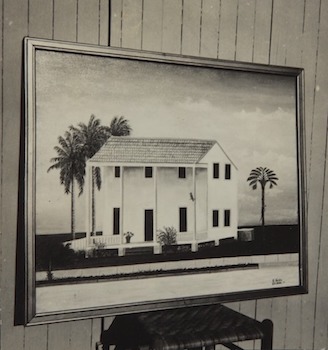
‘Mr. Valdes had a wonderful time, I think. It was rather exhausting for us, though, because he speaks scarcely any English, and he stayed from four till seven. We had sherry, which he seemed to regard as just “wine.” He kept saying “More wine” and he finished off the bottle, while Charlotte and I became sicker and sicker. The high point of the affair was when he and Charlotte imitated mosquitoes and buzzed around the room.’ And, ‘Since our patronage he has changed his sign (a palette stuck on the front of his cottage) from “Sign Painter” to “Artistic Painter”. . . ’[3]

Valdes-painting-key-west

https://brbl-dl.library.yale.edu/vufind/Record/3578226
(Beinecke Rare Book and Manuscript Library, Yale University)

But yes, that ‘normal’. Why Be Happy When You Could Be Normal? Jeanette Winterson entitled her memoir—in the course of which she wrote of the feelings of sympathy shared by people, even when they didn’t know one another, inside the giant tent during the church’s Glory Crusades. ‘The tent was like the war had been for all the people of my parents’ age. Not real life, but a time where ordinary rules didn’t apply. You could forget the bills and the bother. You had a common purpose.’[4] This was something that I already associated with my own late mother, not in a religious context but purely a social one. For my mother, it was a time when class barriers fell away and everyone was nice to one another and pulled together. Rarely, if ever, mentioned were those opportunities provided to—and enthusiastically taken up by—looters, murderers, rapists, black marketeers and fraudsters. It was, quite simply, the most exciting time—perhaps, unambiguously, the best time—of her life. And this widely-held view of the past, particularly that period of the past, had, I suspect, a strong bearing on the recent convulsions in this country.

Ideas of the normal change over time, with age, within social groups; and some are more obvious than others. The general shift to increasingly liberal social values makes the hundreds of capital offences current in the early nineteenth century, famously including such crimes as impersonating a Chelsea pensioner and damaging Westminster Bridge, almost comic now. And it was quite normal in the nineteenth century for the family album to have photographs of the infant dead, choreographed so that, with eyes open, they still seemed to be alive.[5] Now, I’m often struck by the extraordinary lengths to which some people go to avoid or conjure away the whole subject of death.

‘It may well be’, Allan Bloom observed, ‘that a society’s greatest madness seems normal to itself.’[6] A text for the times, you may think. Still, as Herbert Read noted, ‘it is perfectly possible, even normal, to live a life of contradictions.’[7]

So it is, so it is. I wonder, though, whether the possibility of not living a life of contradictions, is fast vanishing – if it has not already left the building.

References

[1] Peter Stansky, Redesigning the World: William Morris, the 1880s, and the Arts and Crafts (Princeton University Press, 1985), 6.

[2] L. P. Hartley, The Go-Between ([1953] Harmondsworth: Penguin, 1971), 94.

[3] To Frani Blough and Margaret Miller, 3 June 1938: One Art: The Selected Letters, edited by Robert Giroux (London: Pimlico, 1996), 75.

[4] Jeanette Winterson, Why Be Happy When You Could Be Normal? (2011; London: Vintage 2012), 70, 71.

[5] Raphael Samuel, Theatres of Memory (London: Verso, 1996), 375.

[6] Allan Bloom, The Closing of the American Mind (New York: Simon and Schuster, 1988), 75.

[7] Herbert Read, Contrary Experiences (London: Faber, 1963), 62.