Pikes, balloons and a touch of mastiff

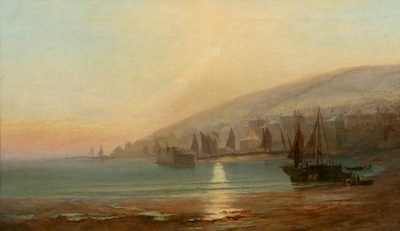
(Henry Martin, ‘A December Morning in Mount’s Bay’: Penlee House Gallery and Museum)

December. Originally, as the name hints, the tenth month of the year. Blackburn and Holford-Strevens quote Richard Saunders’ 1697 Apollo Anglicanus, The English Apollo: ‘In December Melancholy and Phlegm much increase, which are heavy, dull, and cold, and therefore it behoves all that will consider their healths, to keep their heads and bodies very well from cold, and to eat such things as be of a hot quality.’[1] Not a lot to argue with there. Today at least is cold, clear and dry, so proper winter weather.

‘North Point has just accepted The Jules Verne Steam Balloon, for next fall’, Guy Davenport wrote to the poet and New Directions publisher James Laughlin on 1 December 1986. ‘Nine stories, dedicated to Humph’s memory, nine being a cat number.’[2] And the book does indeed carry a dedication to Davenport’s recently deceased cat, ‘For my friend Humphry 1971-1986’.
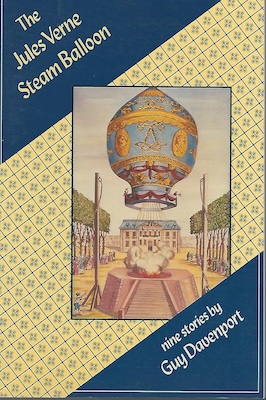
Curiously, on the same date as Davenport’s letter, the first ever ascent in a hydrogen balloon was recorded. This was ten days after the first manned Montgolfier balloon flight, launched from the hill of La Muette on 21 November 1783. It was 70 feet high, and powered by a six-foot open brazier, burning straw. The intrepid voyagers were Pilâtre de Rozier and the Marquis d’Arlandes, a major in the Garde Royale. The later ascent was made by Dr Alexander Charles, who had, in effect, invented ‘nearly all the features of the modern gas balloon in a single brilliant design.’ Launched from Tuileries Gardens on 1 December 1783, with Charles’ scientific assistant M. Robert, it attracted ‘what has been estimated as the biggest crown in pre-Revolutionary Paris, upwards of 400,000 people, about half the total population of the city.’[3]

Two hours later, the balloonists landed some 27 miles away and Charles asked Robert to step out of the basket. Then he reached 10,000 feet in ten minutes, observing his instruments and making notes until his hand became too cold to grasp the pen. ‘I was the first man ever to see the sun set twice in the same day. The cold was intense and dry, but supportable. I had acute pain in my right ear and jaw. But I examined all my sensations calmly. I could hear myself living, so to speak.’ Then he gently released the gas-valve and, within 35 minutes, was back on the ground, three miles from the first landing-point: an almost vertical ascent. It was the first solo flight in history. He wrote that: ‘Never has a man felt so solitary, so sublime,—and so utterly terrified.’ Charles never flew again.[4]

From that to. . . this. I was reminded of a passage in Thomas Medwin’s record of talking with Lord Byron at Pisa in 1822: ‘I suppose we shall soon travel by air-vessels; make air instead of sea voyages; and at length find our way to the moon . . . Where shall we set bounds to the power of steam? Who shall say “Thus far shalt thou go, and no farther?” We are at present in the infancy of science.’[5]

In fact, his daughter Ada was then an infant scientist, just six years old: later  Countess Lovelace, she was a mathematician and pioneer computer scientist, associated particularly with Charles Babbage and his Analytical Engine. Ada would, like her father, die in her 37th year—and was buried beside him.

(Hogarth, ‘A Rake’s Progress: 1–The Rake Taking Possession of the Estate’: Sir John Soane’s Museum)

I’ve lately been reading Jenny Uglow’s wonderful Hogarth biography and in his 37th year, Hogarth began 1734 with prints of The Fair (later called Southwark Fair) ready for sale though those of The Rake’s Progress had been delayed. One detail that—inevitably—caught my eye was the reference to the story told by John Nichols, in his Biographical Anecdotes of William Hogarth.[6] He wrote there that Hogarth ‘boasted that he could draw a Serjeant with his pike, going into an alehouse, and his Dog following him, with only three strokes;—which he executed thus:

A. The perspective line of the door.
B. The end of the Serjeant’s pike, who is gone in.
C. The end of the Dog’s tail, who is following him.
There are similar whims of the Caracci.’[7]

In 1914, Ford Madox Ford published ‘On Impressionism’, an essay in two parts, in Harold Monro’s Poetry and Drama (June and December issues). ‘Let us approach this matter historically’, Ford begins the second section of his first article, ‘—as far as I know anything about the history of Impressionism, though I must warn you that I am a shockingly ill-read man. Here, then, are some examples: do you know, for instance, Hogarth’s drawing of the watchman with the pike over his shoulder and the dog at his heels going in at a door, the whole being executed in four lines? Here it is:
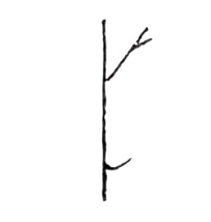
Now, that is the high-watermark of Impressionism; since, if you look at those lines for long enough, you will begin to see the watchman with his slouch hat, the handle of the pike coming well down into the cobble-stones, the knee-breeches, the leathern garters strapped round his stocking, and the surly expression of the dog, which is bull-hound with a touch of mastiff in it.’

Apart from the reversing of the image, the three strokes have become four. ‘The Impressionist must always exaggerate.’[8] Though a good many of the pikes I’ve seen pictured have one or more short curved blades at the top. . .
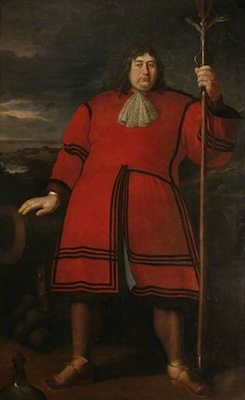
(Godfrey Kneller, Anthony Payne (c.1612-1691), the Cornish Giant: Cornish Museum and Art Gallery)

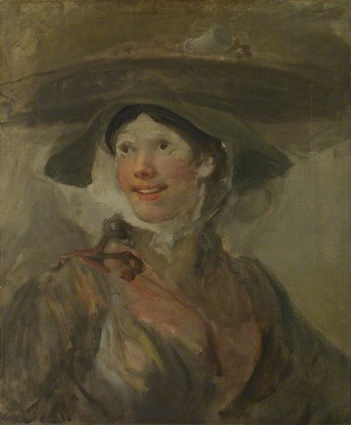
Hogarth has always had his admirers, and often been viewed chiefly as a satirist, like Swift or Pope, an acerbic commentator on the age’s hypocrisy, excesses and corruption. One of those admirers is the extraordinary painter, writer and central figure of Vorticism—‘Vorticism, in fact, was what I, personally, did, and said, at a certain period’—Wyndham Lewis and, interestingly, the single work of Hogarth’s he refers to several times is The Shrimp Girl, a superbly captured street-seller, ‘a moment caught on the wing’, Hogarth succeeding in conveying ‘all the movement in the girl’s body as he loaded his brush with pinks, vermilions and green—the bright colours of the rococo palette—and made fast curving strokes to outline the fall of her shoulders and breasts’.
(William Hogarth, Shrimp Girl: National Gallery)

After his death, Hogarth’s widow Jane ‘would tell visitors who saw The Market Wench, as it was known, “They say he could not paint flesh. There’s flesh and blood for you; – them!”’[9] In a characteristically combative statement late in life, Lewis cited that picture again: ‘Hogarth’s Shrimp Girl shows what splendid painting can be done in England. But since that eighteenth-century explosion there have been only the Pre-Raphaelites, and so it must be admitted that painting is not our forte.’

Lewis’s blindness had ended his five years as art critic of The Listener—see his remarkable final piece there, ‘The Sea-Mists of the Winter’—and there is a poignant closing paragraph to this essay too:

‘The question is not how a thing is done, but the thing that is done. However, unless the thing is beautifully painted, it never comes to life. I have never seen the original of the Shrimp-Girl, but several colour plates of it. I am blind, but, if I could see, I would do a large design of something like a Jabberwock outraging an eagle.’[10]


Notes

[1] Bonnie Blackburn and Leofranc Holford-Strevens, The Oxford Companion to the Year (Oxford: Oxford University Press, 1999), 481.

[2] W. C. Bamberger, editor, Guy Davenport and James Laughlin: Selected Letters (New York: W. W. Norton & Co., 2007), 36.

[3] Julian Barnes, Levels of Life (London: Cape, 2013), 12; Richard Holmes. The Age of Wonder: How the Romantic Generation Discovered the Beauty and Terror of Science  (London: Harper Collins, 2008), 129-131; L. T. C. Rolt, The Aeronauts (London: Longman, 1966), 50.

[4] Holmes, The Age of Wonder, 132.

[5] Thomas Medwin, Conversations with Byron, (1824), quoted by Fiona MacCarthy, Byron: Life and Legend (London: John Murray, 2002), 70.

[6] Hogarth: A Life and a World (London: Faber and Faber, 1997), 55.

[7] See Biographical Anecdotes of William Hogarth, Third edition (London: Printed by and Ford John Nichols in Red-Lion-Passage, Fleet-Street, 1785), 63.

[8] Ford Madox Ford, ‘On Impressionism I’, Poetry and Drama (June 1914), 169-170.

[9] Uglow, Hogarth, 408, 409.

[10] Wyndham Lewis, ‘The Vorticists’, Vogue (September 1956), in Wyndham Lewis On Art: Collected Writings 1913-1956, edited by Walter Michel and C. J. Fox (London: Thames & Hudson, 1969), 457, 458; the earlier quotation is from the introduction to the catalogue of the 1956 retrospective exhibition, Tate Gallery, July-August 1956 in this same volume, 451. For other references to this picture, see 327, 329, 404.
The teeth of the evidence – or the evidence of teeth

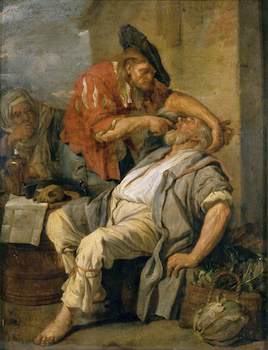
Fear-and-Loathing . Toorenvliet, Jacob, c.1635-1719; The Dentist

(Hunter Thompson; Jacob Toorenvliet, The Dentist: Brighton and Hove Museums and Art Galleries)

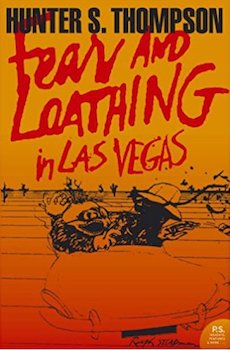
‘We were somewhere around Barstow on the edge of the desert when the drugs began to take hold. I remember saying something like “I feel a bit lightheaded; maybe you should drive. …” And suddenly there was a terrible roar all around us and the sky was full of what looked like huge bats, all swooping and screeching and diving around the car, which was going about 100 miles an hour with the top down to Las Vegas. And a voice was screaming: “Holy Jesus! What are these goddamn animals?”’

Hunter S. Thompson, Fear and Loathing in Las Vegas, of course. And against this, what? ‘We were somewhere around Bridport when the toothache took hold.’ No. But the pain was real, one hundred per cent genuine pain; I gather that Thompson’s account was, say, seventy-five per cent actual, the rest invention. Still, that particular seventy-five is scary enough.

‘Why don’t you’, the Librarian inquires mildly, ‘just go to the dentist?’ Ah yes. There are subtle undercurrents here. On the phone to the Librarian’s mum, I ask: ‘How’s your tooth?’ ‘Quiet at the moment. How’s yours?’ ‘The same. Are you going to the dentist?’ ‘Do I want to disturb it? Won’t that just stir it up? Are you going?’ ‘Not sure yet.’ Yes. Why don’t you just . . . ?

I fleetingly recall an entry in Francis Kilvert’s diary about a dentist called Gaine and his discovery that a combination of concentrated carbolic acid and arsenious acid ‘will destroy the nerve almost entirely without pain.’[1] So much acid and no pain – almost? It sounds agonisingly unlikely. My recent dental visits have, in fact, been pretty uneventful. But teeth – a serious business. Probably the worst pain I remember is tooth-related: a mere bagatelle, most women would think, familiar as they are with chronic period pains, let alone the pains of childbirth, but I’m not too keen to go through it again.

Teeth bulked large in Ford Madox Ford’s life. In August 1911, he had ‘an awful week of dentistry’ in Paris and came to meet Violet Hunt at the Gare du Nord, ‘toothless and feckless’. He had had ‘four teeth cut one morning without gas. The dentist said he must have a week or ten days rest before beginning the lower jaw.’[2] Five years later, in March 1917, here is Ford’s friend Ezra Pound, writing to Alice Corbin Henderson: ‘Ford has been in hospital. All we know for certain is that his false teeth fell out.?? Ague or shell shock.???’[3]

Pound, teeth and Englishmen. ‘NO englishman is ever sufficiently evolved to stand civility’, he wrote to Wyndham Lewis in March 1939, when some encounter had clearly put him in a major snit. ‘KICK the bastards in the jaw FIRST.’ Commenting on this in the piece he wrote for a 1950 collection of essays assembled by Peter Russell, Lewis recalled it as: ‘There’s only one thing to do with an Englishman—kick him in the teeth’. Lewis explained that it concerned ‘a young English bibliophile’ he had sent to Rapallo’, adding that Pound’s patience ‘must have been sorely tried.’[4]

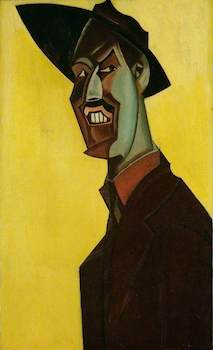
Lewis, Wyndham, 1882-1957; Mr Wyndham Lewis as 'Tyro'

(‘Mr Wyndham Lewis as a Tyro’, Ferens Art Gallery © Estate of Mrs G. A. Wyndham Lewis; The Wyndham Lewis Memorial Trust)

Also tooth-related was ‘one of the great tragedies’ of Ford’s life, which occurred just before the First World War, when Ford was in Germany with the Liberal politician Charles Masterman and his wife. The landlord of the Hotel zur Post in Trêves, as a reward for having brought him ‘a British Excellency’, presented Ford with a bottle of 1813 brandy. ‘In the Mosel there is a stone that is only uncovered in years of great drought – which are years of glorious vintages. On such years they chain a barrel of brandy to that stone. When it is again uncovered they remove the old barrel and chain on a new one. That stone had not been uncovered since 1813. The bottle that the host gave me had been filled from the 1813 barrel.’ During the night, Masterman had toothache. ‘He poured by degrees the whole of that 1813 brandy into his mouth and spat it out again. By ringing the bell he could have procured a bottle of 1913 brandy for one franc fifty.’[5]

But then, as early as the turn of the century, teeth were an issue. When Joseph Conrad and Ford were collaborating on the novel that became The Inheritors and Conrad reluctantly attended to a female character—a part of what he usually termed ‘Ford’s women’—to the extent of granting her ‘good hair, good eyes and some charm’, it was ‘only with difficulty’, Ford recalled, ‘that he was restrained from adding good teeth to the catalogue. “Why not good teeth? Good teeth in a woman are part of her charm. Think of when she laughs. You would not have her not have good teeth. They are a sign of health. Your damn woman has to be healthy, doesn’t she?”’[6] By way of compensation, perhaps, the book does contain a dramatic critic who ‘furtively took a set of false teeth out of his waistcoat pocket; wiped them with a bandanna handkerchief, and inserted them in his mouth.’[7]

‘Do you know what Maupassant said about England?’, Colette wrote to Léopold Marchand in 1921, ‘“Too many toothbrushes and not enough bidets!”’[8] About bidets he was surely right but how many toothbrushes is ‘too many’?

Good night. Don’t forget to brush your teeth.


References

[1] Francis Kilvert, Kilvert’s Diary, edited by William Plomer, three volumes (London: Jonathan Cape, 1938, reissued 1969): II, 100.

[2] See Max Saunders, Ford Madox Ford: A Dual Life, two volumes (Oxford: Oxford University Press, 1996), I, 346. And see Alan Judd, Ford Madox Ford (London: Collins, 1990), 388: ‘Never for long could he forget those teeth that Violet had paid for.’

[3] The Letters of Ezra Pound to Alice Corbin Henderson, edited by Ira B. Nadel (Austin: University of Texas Press, 1993), 201.

[4] Pound/Lewis: The Letters of Ezra Pound and Wyndham Lewis, edited by Timothy Materer (London: Faber and Faber, 1985), 208 and n.

[5] Ford Madox Ford, Return to Yesterday: Reminiscences 1894-1914 (London: Victor Gollancz, 1931), 425.

[6] Ford Madox Ford, Joseph Conrad: A Personal Remembrance (London: Duckworth, 1924), 144.

[7] Ford Madox Ford and Joseph Conrad, The Inheritors: An Extravagant Story (1901; Liverpool: Liverpool University Press, 1999), 31.

[8] Colette, Letters from Colette, selected and translated by Robert Phelps (London: Virago Press, 1982), 63.

A Visit to ‘The Enemy’: Wyndham Lewis Up North

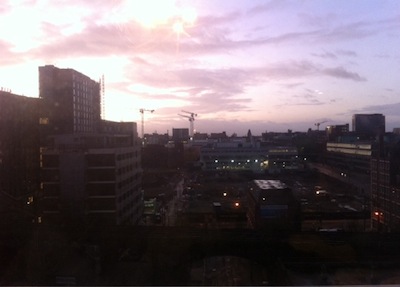
Manchester-early

(Manchester, early morning)

To Manchester, primarily to see the Wyndham Lewis exhibition or perhaps—depending on which witness was consulted—to visit Chetham’s and John Rylands libraries; or even to take full advantage of room service in the hotel.

I was last in Manchester almost exactly thirteen years ago and my strongest memories from that visit were of extraordinarily impressive public buildings, friendly people and a vibrant city centre which felt good to walk around. Nothing has changed for me in those respects, and there is still that positive feeling as you walk around the centre, despite some of the trouble that Manchester has had to weather recently.

Coming from Bristol, we could only lament that city’s lost opportunities as we sampled the Metrolink on a tram out to the Quays and Imperial War Museum North.

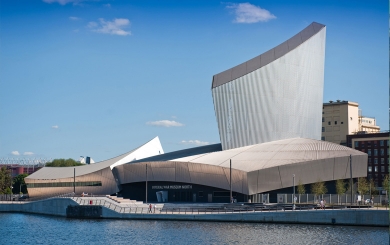
IWM-North

(IWM North)

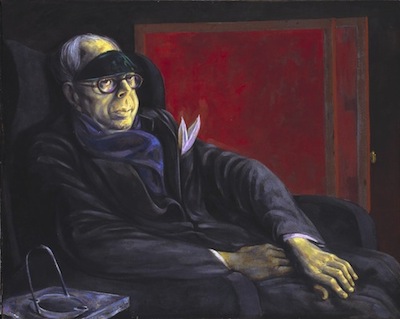
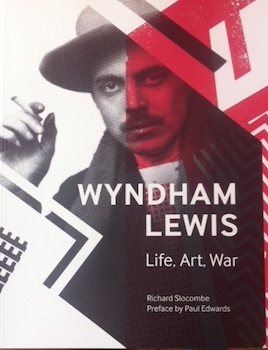
And so to Wyndham Lewis: Life, Art, War. This is a tremendous exhibition, covering the whole of Lewis’s career but also, invaluably, including much of the related, contextual artistic work: designs from Roger Fry’s Omega Workshops, paintings by Vorticist allies, and ending with Michael Ayrton’s poignant portrait of the elderly—and blind—Lewis wearing his eyeshade.

Portrait of Wyndham Lewis 1955 by Michael Ayrton 1921-1975

(Michael Ayrton, Wyndham Lewis, 1955: Tate © Estate of Michael Ayrton)

Some of the Lewis artworks I’d seen before, at an exhibition in Cardiff. Having dug out the catalogue by Jane Farrington (with contributions by John Rothenstein, Richard Cork and Omar Pound), I see that it was in 1980, that it actually started in Manchester (not, as I mistakenly thought, London) and that A Battery Shelled (1919) wasn’t included in that exhibition. I believe the only piece that didn’t make the move was the famous and controversial portrait of T. S. Eliot, which had to return home to Durban, so I was glad to catch up with it here.

I do remember the almost overwhelming impact of walking into that space in the National Museum of Wales in Cardiff and seeing the remarkable range of his work for the first time, a range that I’d never really suspected before, an effect that was heightened by the fact that, when I viewed the exhibition, I was alone for much of that time. Walking around the IWM exhibition the other day, in fact, there were few enough people for each of us to take our time and see things properly, and to go back and look again—increasingly rare in recent years: in several other exhibitions I’ve been to lately, you’d have to stand on a stepladder to see half of the exhibits over the heads of the crowds.

WL-Exhbtn

Whether I’d seen them before or not, the pieces I found myself scribbling the titles of on this occasion included Smiling Woman Ascending a Stair (c.1911-12), The Vorticist (1912), The Crowd (1914-15), Two Missionaries (1917), Figures in the Air (1927), The Surrender of Barcelona (1936) and, of course, A Battery Shelled (1919)—the scale and force of that canvas draws you back for a second or third viewing. I still find several of the portraits hugely impressive: Eliot and Pound, Edith Sitwell, Naomi Mitchison in particular, the instantly recognisable figure of Nancy Cunard – and portraits of Lewis’s wife Froanna, one of them, the superb 1938 The Mexican Shawl, more usually to be found back in Bristol.

Lewis, Wyndham, 1882-1957; Mexican Shawl

Wyndham Lewis, The Mexican Shawl
© Wyndham Lewis Memorial Trust / Bridgeman Images. Photo credit: Bristol Museums, Galleries & Archives

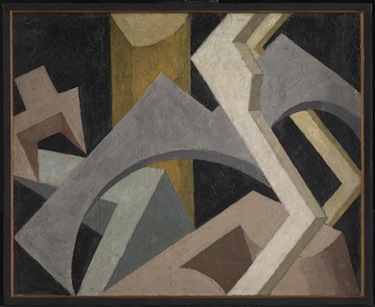
But, again, some of the indispensable elements for me were the extras: the journals (Blast, The Tyro, The Enemy), the books (including Lewis’s astonishingly ill-judged titles of the 1930s) and the artworks by others: one of my favourites being Jessica Dismorr’s Abstract Composition (1915).

Abstract Composition c.1915 by Jessica Dismorr 1885-1939

There are also works by Wadsworth, Bomberg, Atkinson, and the wonderful William Roberts painting, The Vorticists at the Restaurant de la Tour Eiffel: Spring, 1915, with Lewis looming centrally and a little larger than everyone else. Then, too, the Gaudier-Brzeska pieces: the Horace Brodzky, yes, but primarily the stunning Bird Swallowing a Fish: once you’ve seen the bomb or torpedo in the shape of that fish, you never get past it again.

Bird Swallowing a Fish c.1913-4, cast 1964 by Henri Gaudier-Brzeska 1891-1915

Henri Gaudier-Brzeska, Bird Swallowing a Fish (Tate, 1913-14, cast in bronze 1964).

While, on the face of it, you could conjure up few pairings so unlike one another as Lewis and Henry Thoreau, I do hear echoes of ‘The Enemy’ in the essay that Ralph Waldo Emerson wrote after his friend’s death: ‘There was something military in his nature, not to be subdued, always manly and able, but rarely tender, as if he did not feel himself except in opposition. He wanted a fallacy to expose, a blunder to pillory, I may say required a little sense of victory, a roll of the drum, to call his powers into full exercise.’[1] The critic Michael Levenson wrote of ‘the modernist urge towards dualistic opposition and radical polarities’ and one of the leading modernists asserted that ‘The history of the world is the history of temperaments in opposition.’[2] Lewis was, certainly, always in opposition.

Which consideration brings us, inevitably, to the thorny ‘problem’ of Lewis’s politics, the troublesome positions brought about by the confrontational stance of the man that Auden called ‘That lonely old volcano of the Right’.[3] The issue is confronted frankly and illuminatingly by participants in the very good video at the end of the exhibition: they include Richard Slocombe, author of the accompanying catalogue; the doyen of Lewis studies, Paul Edwards; and there’s an excellent contribution from our friend Nathan Waddell (a Fordian as well as a Lewisian).

Wyndham Lewis: Life, Art, War runs to the end of the year and is emphatically well worth a visit.

References

[1] Ralph Waldo Emerson, ‘Thoreau’, in Selected Essays, edited by Larzer Ziff (Harmondsworth: Penguin Books, 1982), 396.

[2] Michael H. Levenson, A Genealogy of Modernism (Cambridge: Cambridge University Press, 1986), ix; Ezra Pound, ‘Provincialism the Enemy’, in Selected Prose 1909-1965, edited by William Cookson (London: Faber and Faber, 1973), 169.

[3] W. H. Auden, ‘Letter to Lord Byron’ (1937), in The English Auden: Poems, Essays and Dramatic Writings, 1927-1939, edited by Edward Mendelson (London: Faber, 1977), 198.


‘Remember that I have remembered’

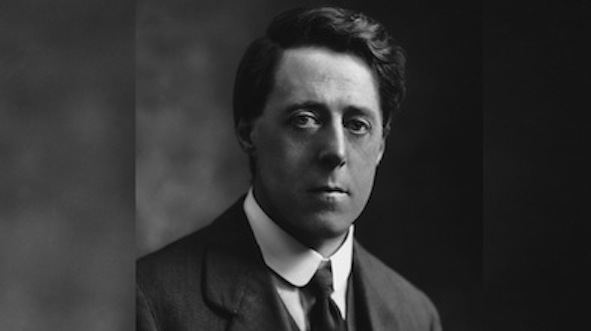
Binyon_via_BBC
(Laurence Binyon via BBC)

A great many people in the English-speaking world, even if unfamiliar with the name of Laurence Binyon, would probably recognise his words. These words anyway:

They shall grow not old, as we that are left grow old:
Age shall not weary them, nor the years condemn.
At the going down of the sun and in the morning
We will remember them.[1]

The fourth stanza of seven, used in all manner of places on Remembrance Day, formerly Armistice Day—of course, many people still call it that, though the date refers to only one armistice: the signatures on a document in a railway carriage in a clearing in the forest of Compiègne on 11 November 1918.

Binyon was born on 10 August 1869 (he died in 1943). For literary historians and, perhaps, some art historians, the authorship of those famous words might easily be forgotten or set aside as a mere detail in Binyon’s story, interesting in its own right but also connecting with a great many other stories.

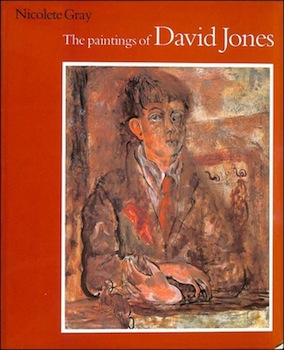
One example would be the Abstract & Concrete exhibition (February 1936), which was organised by Nicolete Gray. She was a friend of Myfanwy Evans, who edited a periodical called Axis, devoted to abstract art, from 1935 to 1937, and married John Piper in the latter year. Nicolete was an art scholar and calligrapher, later a friend of David Jones, publishing a book about his paintings  – and the youngest of Laurence Binyon’s daughters: she married Basil Gray, Binyon’s assistant at the British Museum.[2]

Gray-Jones

(The jacket illustration is Jones’s 1931 self-portrait entitled Human Being).

Another example would be an encounter in the Vienna – or Wiener – Café:

So it is to Mr Binyon that I owe, initially,
Mr Lewis, Mr P. Wyndham Lewis. His bull-dog, me,
as it were against old Sturge M’s bull-dog, Mr T. Sturge Moore’s
bull-dog[3]

The poet and playwright Thomas Sturge Moore was, in a way, Lewis’s mentor at that stage and, thirty years later, Lewis would write from his self-imposed wartime exile in Toronto: ‘How calm those days were before the epoch of wars and social revolution, when you used to sit on one side of your work-table and I on the other and we would talk’.[4] Thirty years before the Pisan Cantos, Pound wrote in Poetry magazine (June 1915) an appreciation of Sturge Moore in which he referred to the poet as ‘more master of cadence than any of his English contemporaries.’ In the same piece, he wrote a famous line that William Cookson would isolate many years later in his edition of Pound’s Selected Prose: ‘The essential thing in a poet is that he build us his world.’[5] And Pound said that these lines of Sturge Moore’s had stayed with him: ‘Aie, aie, aie!/ Laomedon![6]

At the time of that meeting in the Wiener Café, Binyon was Assistant Keeper at the British Museum. He became, in 1913, Keeper of the new Sub-Department of Oriental Prints and Drawings, with the orientalist Arthur Waley as his assistant. The exhibition Binyon organised of Chinese and Japanese paintings ran throughout 1910-12. His access to, and wide knowledge of, oriental art was hugely influential in the development of modernism. He published over forty books, including more than a dozen volumes of poetry and almost as many on British art and literature, another eight on oriental art, plus plays and biographies.

Binyon_Flight_Dragon

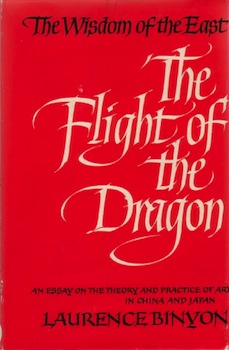
Pound often referred approvingly to Binyon’s 1911 book, The Flight of the Dragon, on Chinese and Japanese art (one factor in preparing Pound to respond as he did to the gift of Ernest Fenollosa’s notebooks from his widow, Mary, which resulted in Cathay); and he remembered too Binyon’s thirty-page poem Penthesilea (1905), about the queen of the Amazons, her involvement in the Trojan War and her eventual death at the hands of Achilles, whose spear penetrates her shield:

in her side it pierced
And bore her down; imperially she fell
Without a cry, sank on lost feet, nor heard
Achilles’ dread voice, ‘Art thou satisfied,
Penthesilea?’ but the heavy shield
Rang on her fallen, the helmet rolled in dust
From her proud head, and the long, loosened hair
Tossed one tress richly over throat and bosom
Shuddering strongly up from where the blood
Welled dark about the spear forced deep within;
And sudden as a torch plunged in a pool
Her face lay dead-pale with the eyes quite closed.[7]

Much later in life, Binyon produced a translation of Dante’s Divine Comedy in terza rima, which was the version used in the Portable Dante, published by Viking and available from Penguin Books for many years. Pound corresponded with him about his ten-year project and involved himself quite actively in it. In 1934, he published a long, complimentary review, in T. S. Eliot’s Criterion, of Binyon’s version of Inferno. In the course of that review, looking back to his pre-war acquaintance with Binyon at the British Museum, he recalled how he ‘perused, it now seems, in retrospect, for days the tales of . . . demme if I remember anything but a word, one name, Penthesilea, and that not from reading it, but from hearing it spoken by a precocious Binyonian offspring.’[8]

Pound wrote several detailed letters while Binyon was working on the Purgatorio and went through the proofs, commenting to his old teacher William Shepard that Binyon ‘sheds more light on Dante than any translation I have ever seen.’[9]

Ezra Pound 1939 by Wyndham Lewis 1882-1957
(Wyndham Lewis, Ezra Pound (1939): Tate Modern
© Wyndham Lewis and the estate of Mrs G A Wyndham Lewis
A major exhibition, Wyndham Lewis: Life, Art, War, is currently at IWM North (until 1 January 2018): The Quays, Trafford Wharf Road, Manchester, M17 1TZ)

His attitude to Binyon was often one of ‘baffled exasperation’, as Donald Davie phrases it in some fascinating pages on the relationship between them. Binyon, Davie says, ‘knew the unformulated rules of the society that he moved in, and played the game consistently as the amateur that that society required him to be. It is true to this day in England that, if one has learning, one must wear it so lightly that it is unnoticeable.’[10] (That was 1976. Forty years later—?)

before the world was given over to wars
Quand vous serez bien vieille
remember that I have remembered[11]

One other thing that Pound remembered was mentioned in a letter of 6 March 1934, when he asked Binyon: ‘I wonder if you are using (in lectures) a statement I remember your making in talk, but not so far as I recall, in print. “Slowness is beauty,” which struck me as very odd in 1908 (when I certainly did not believe it) and has stayed with me ever since’.[12]

It stayed with him for at least another twenty years, until ‘Canto LXXXVII’: ‘BinBin “is beauty”./ “Slowness is beauty.”‘


References

[1] Laurence Binyon, ‘For the Fallen’, first published in The Times, 21 September 1914. See Poetry of the First World War: An Anthology, edited by Tim Kendall (Oxford: Oxford University Press, 2013), 44.

[2] Frances Spalding, John Piper, Myfanwy Piper: Lives in Art (Oxford: Oxford University Press, 2009), 86-89.

[3] Ezra Pound, ‘Canto LXXX’, The Cantos of Ezra Pound, fourth collected edition (London: Faber and Faber, 1987), 507.

[4] Letters of Wyndham Lewis, edited by W. K. Rose (New York: New Directions, 1963), 293.

[5] Pound, ‘Hark to Sturge Moore’, Poetry, VI, 3 (June 1915), 139-145 (141, 140). The line was used as epigraph to ‘Part One’ of Ezra Pound, Selected Prose 1909-1965, edited by William Cookson (London: Faber and Faber, 1973), 19.

[6] Richard Sieburth points out that this is the opening to Sturge Moore’s 1903 work, The Rout of the Amazons: Ezra Pound, The Pisan Cantos, edited by Richard Sieburth (New York: New Directions, 2003), 148, note.

[7] Collected Poems of Laurence Binyon (London: Macmillan, 1931), 215. More Amazons! Why just then? The Suffragette group called The Bodyguard was dubbed ‘The Amazons’ by sections of the press, but this was a few years later.

[8] Pound, ‘Hell’, in Polite Essays (1937; Plainview, New York: Books for Libraries Press, 1966), 28-46 (29). Nicolete was born in 1911; Pound’s memory is probably of 1909 (he met Binyon in February of that year), and thus of one of the twins, Helen or Margaret (born in December 1904). See ‘Canto LXXX’, 506: ‘Mr Binyon’s young prodigies/ pronounced the word: Penthesilea’.

[9] Ezra Pound, Selected Letters, edited by D. D. Paige (New York: New Directions, 1971), 311. These letters to Binyon are concentrated in the period April–May, 1938.

[10] ‘Ezra Among the Edwardians’ (1976), collected in Studies in Ezra Pound: Chronicle and Polemic (Manchester: Carcanet Press, 1991), 227-231.

[11] Pound, ‘Canto LXXX’, The Cantos of Ezra Pound, 506.

[12] Pound, Selected Letters, 255.

[13] Pound, ‘Canto LXXXVII’, The Cantos of Ezra Pound, 572.