There not there


(Edmund Dulac, Frontispiece to Princess Badoura: A Tale from The Arabian Nights, by Laurence Housman)

‘The things you think of to link are not in your control. It’s just who you are, bumping into the world. But how you link them is what shows the nature of your mind. Individuality resides in the way links are made.’[1]

Bumping into the world, I noticed yesterday that I was reading A. S. Byatt on what would have been her 88th birthday. More, in the volume’s longest story, was the sentence: ‘And she waited for the sound of thunder, or worse, the silence of absence.’[2] I was struck (or bumped against) by that last phrase, having been thinking recently in similar terms. Sometimes the silence here is indeed the dictionary’s ‘absence of sound; complete quietness’ – but often something more. Silences have their own flavours, idiosyncrasies, tones, strengths and essences.

‘Throughout the house’, Patrick White wrote in  his story ‘The Night the Prowler’, ‘there were the sounds of furniture, and clocks, and silence.’[3] It has to be said that furniture was often on his mind, not least in populating Theodora Goodman’s world: ‘There is perhaps no more complete a reality than a chair and a table’ – though he adds there: ‘Still, there will always also be people, Theodora Goodman said, and she continued to wait with something of the superior acceptance of mahogany for fresh acts.’[4] When the painter Hurtle Duffield meets a man named Mothersole on the ferry, the printer asks what sort of things Duffield paints. ‘“Well! For some time now, tables and chairs.”’ Mothersole finds it a ’funny sort of subject’ and Duffield responds: ‘“Why? What could be more honest?”’[5]

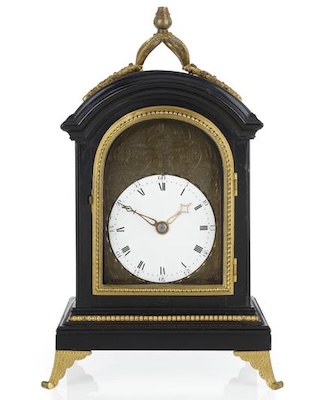
There must be vastly fewer ticking clocks in the world now, timepieces having been widely and inescapably recruited to the cause of at least electronic silence. Ticking is a disturbing anomaly in this grave, enslaved new world. My maternal grandfather once owned several fish and chip shops in Portsmouth but, by the time I was of an age to notice such things, he had become a jeweller and watchmaker. The clocks that had audibly populated so much fiction through several centuries still kept the faith in his shop. He even had, at one point and appropriately enough, a grandfather clock. Ticks, tocks and chimes galore.


(The Clockmakers’ Museum. Musical table clock by Thwaites for Barraud. L2015-3473 Science Museum Group Collection Online.)

Thinking of silence, then, we often think of absence too, perhaps of the old saying that ‘absence makes the heart grow fonder’ (or, as I once heard someone—probably of a poetic turn of mind—say, a few drinks in: ‘Absinthe takes the art au fond-er’). Old sayings, though. People sometimes ask: are they true? To which the answer is, can only be, it depends. For some yes, for others no.

Absence can be a source of amusement, an occasion for pleasure. Rudyard Kipling’s parents (John Lockwood Kipling and Alice Macdonald) were unable to attend a party given by Dante Gabriel Rossetti because the date of their sailing on the S. S. Ripon to Bombay had been brought forward by a day, to Wednesday 12 April, 1865. ‘In their absence, however, Ford Madox Brown proposed their health, in a speech throughout which, with his usual inability to remember names, he referred to the bridegroom as “John Gilpin”—to the delight of all present.’[6]

Annie Erneaux, though, recalled literally writing out her passion in Florence, being temporarily removed from an intense and wounding affair: ‘Those eight days on my own, without speaking, except to waiters in restaurants, haunted by the image of A. (to the extent that I was astonished to be accosted by men, could they not see him silhouetted inside my own body?) seemed to me an ordeal for the betterment of love. A sort of further investment, this time to imagination and craving through absence.’ And elsewhere she stated that:  ‘It is the absence of meaning in what one lives, at the moment one lives it, which multiplies the possibilities of writing.’[7]


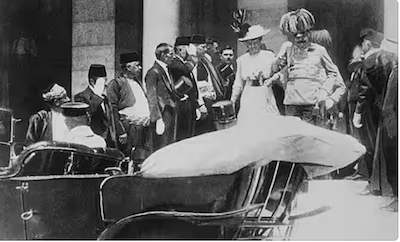
(Franz Ferdinand & Sophie. Photograph: Bettmann/Corbis via The Guardian)

When Stanley Weintraub wrote about the guns falling silent at the end of the First Word War, his book’s title, A Stillness Heard Round the World, looked back both to Ralph Waldo Emerson’s ‘Concord Hymn’, which included the phrase ‘the shot heard round the world’ and the fact that Emerson’s phrase has often been applied to the shot that began the war, fired at the Austrian Archduke Franz Ferdinand by Gavrilo Princip, who killed both the Archduke and his wife Sophie on 28 June 1914. The significance of that incident was not widely grasped and reports of it were often to be found on the inner pages of the following day’s newspapers – a squabble in the Balkans! – but since then a great deal of writing about it has certainly been found possible.

Marcel Proust observed that ‘the absence of a thing is not merely that, it is not simply a partial lack, it is a disruption of everything else, it is a new state which one cannot foresee in the old.’[8] We can, in fact, often foresee that absence, we grasp its inevitability, not least the inescapable end of every living thing but of course that single fact is not, cannot be, all there is. We distinguish between ‘surprise’ and ‘shock’ for a reason. Our awareness that something is coming, will inevitably happen, does not provide a thorough preparation for the event and its aftermath. Some effects are unscripted.

‘There is a time in life when you expect the world to be always full of new things’, Helen Macdonald wrote. ‘And then comes a day when you realise that is not how it will be at all. You see that life will become a thing made of holes. Absences. Losses. Things that were there and are no longer. And you realise, too, that you have to grow around and between the gaps, though you can put your hand out to where things were and feel that tense, shining dullness of the space where the memories are.’[9]


Yes. As Sarah Moss wrote, ‘One does not need to see ghosts, to know that people are haunted.’ And, a little further on: ‘It is not ghosts but absence that is harder to bear.’[10]


Notes

[1] Anne Carson, Paris Review interview (2004), quoted by Jennifer Krasinski in her review of Carson’s Wrong Norma in Bookforum, 30, 3 (Winter 2024), 13.

[2] A. S. Byatt, ‘The Djinn in the Nightingale’s Eye’, in Medusa’s Ankles: Selected Stories (London: Vintage, 2023), 256.

[3] Patrick White, ‘The Night the Prowler’, in The Cockatoos: Shorter Novels and Stories (London: Jonathan Cape, 1974), 149.

[4] White, The Aunt’s Story, (1948; Harmondsworth: Penguin Books, 1963), 141.

[5] White, The Vivisector (London: Jonathan Cape, 1970), 420.

[6] Roger Lancelyn Green, Kipling and the Children (London: Elek, 1965), 20, citing Georgiana Burne-Jones, Memorials of Edward Burne-Jones (1904), I, 290.

[7] Annie Erneaux, Simple Passion, translated by Tanya Leslie (London: Fitzcarraldo Editions, 2021), 33; A Girl’s Story, translated by Alison L. Strayer (London: Fitzcarraldo Editions, 2020), 143.

[8] Marcel Proust, In Search of Lost Time. 1: The Way By Swann’s, translated by Lydia Davis (London: Allen Lane, 2002), 308.

[9] Helen Macdonald, H is for Hawk (London: Jonathan Cape, 2014), 171.

[10] Sarah Moss, Signs for Lost Children (London: Granta Books, 2016), 64, 86.

Words made flesh, flash, at a trumpet crash


(‘The Ash Yggdrasil’ from Aasgard and the Gods, by Wilhelm Wägner)

‘I remember going on to think that Ragnarök seemed “truer” than the Resurrection’, the narrator of A. S. Byatt’s story, ‘Sugar’, writes, having known, as a child, the 1880 book Asgard and the Gods.[1]

There’s a peculiar fascination about those moments in a work of art when other practitioners are evoked, quoted or alluded to, especially when the source is altered. Often enough, this is because the writer is quoting from memory: while George Orwell usually announces that he’s about to do so, others engage in the same practice without any such explicit statement, not infrequently getting things almost—but not quite—right. In a letter to G. K. Chesterton (6 July 1928), T. S. Eliot wrote: ‘The last time that I ventured to quote from memory in print, a correspondent [ . . . ] pointed out that I had made twelve distinct mistakes in well-known passages of Shakespeare.’[2] Joseph Conrad used lines from Spenser’s Faerie Queene (I, ix, 359-360) as the epigraph to his novel The Rover (1923), and the same lines were  later incised on his gravestone at Canterbury: ‘Sleep after toyle, port after stormie seas,/ Ease after warre, death after life does greatly please’. When they reappeared at the close of the ‘English’ text of Ford Madox Ford’s No Enemy (there is an appendix with the original French version of an earlier chapter in English), there were a few differences. ‘Sleep’ becomes ‘rest’ (a resonant word in Ford’s writings), ‘ease after warre’ is excluded, even though Ford wrote much of the book in 1919, having just been gazetted out of the British army after serving both at home and in France and Flanders, ‘death after life’ goes too, since he is celebrating survival, if among a number of ghosts. This is far from simple ‘misquoting’ or ‘misremembering’.[3]


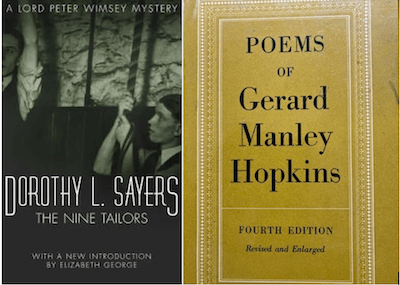
There’s a moment in Dorothy Sayers’ 1934 novel, The Nine Tailors—‘O my, what a lovely piece of work’, Guy Davenport commented, having just read Sayers’ book—when Lord Peter Wimsey, watching a coffin go off up the road, slips into reverie, or stream of consciousness, and suddenly comes up with a chunk of what was immediately familiar to me, though it took a minute or two to identify it as a poem by Gerard Manley Hopkins called ‘That Nature is a Heraclitean Fire’:

                            ‘In a flash, at a trumpet crash,
I am all at once what Christ is, | since he was what I am, and
This Jack, joke, poor potsherd, | patch, matchwood, immortal diamond,
                            Is immortal diamond.’[4]

These are characteristically arresting lines, but the poem’s full title is ‘That Nature is a Heraclitean Fire and of the Comfort of the Resurrection’, and there is a striking gap, an elision, in the passage that occurs in Wimsey’s thoughts: the line, ‘I am all at once what Christ is, | since he was what I am, and’, is missing.[5]

Hopkins wrote to his friend, the poet Robert Bridges, on 25 September 1888, that, while the sonnet he’d recently sent Bridges on the Heraclitean fire had distilled a lot of early Greek philosophical thought, perhaps ‘the liquor of the distillation did not taste very Greek’. He added: ‘The effect of studying masterpieces is to make me admire and do otherwise’—which seems eminently reasonable.[6]


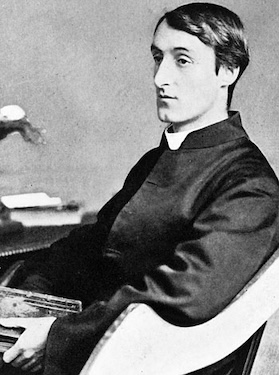
(Gerard Manley Hopkins)

Hopkins—Jesuit priest, classics professor—is, as W. H. Gardner wrote, ‘a religious, not merely a devotional, poet. Religion, for him, was the total reaction of the whole man to the whole of life’ (‘Introduction’ to Poems, xxxv). A good many of his poems are addressed directly and vividly to God, as in the first stanza of the first major poem, ‘The Wreck of the Deutschland’:

Thou mastering me
God! giver of breath and bread
World’s strand, sway of the sea;
Lord of living and dead
Thou has bound bones and veins in me, fastened me flesh,
And after it almost unmade, what with dread,
Thy doing: and dost thou touch me afresh?
Over again I feel thy finger and find thee.

‘The Windhover’ is dedicated ‘To Christ our Lord’, ‘Pied Beauty’ begins: ‘Glory be to God for dappled things’, ‘The Loss of the Eurydice’ is addressed ‘O Lord’ and a late sonnet begins: ‘Thou art indeed just, Lord, if I contend/ With thee’. The ‘terrible sonnets’, evidence of great stress, even ‘desolation’, also centrally concern his relationship with God:

I am gall, I am heartburn. God’s most deep decree
Bitter would have me taste: my taste was me;
Bones built in me, flesh filled, blood brimmed the curse.[7]


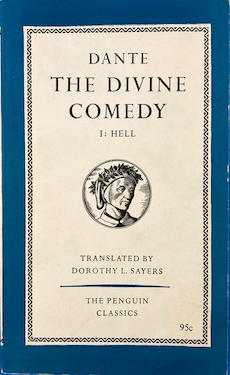
Religious themes featured early in Sayers’ writing life and became more central later, in her many plays and her translation of Dante’s Divine Comedy. This rector’s daughter may have had both father and rectory in mind when she wrote The Nine Tailors. Mr Venables is scholarly, very amiable and extremely absent-minded, and Lord Peter Wimsey comes to regard him with affection and respect. Could Sayers have felt that the line she omitted from Hopkins’ poem might have seemed blasphemous to some readers, an issue further complicated by its occurring in her hero’s thoughts? At one point, Wimsey is confronted by a visiting card on a wreath, purporting to be from him but actually supplied by his manservant Bunter (who had been Sergeant to Major Wimsey in the First World War). The card includes a biblical reference, Luke xii, 6. ‘“Very appropriate,” said his lordship, identifying the text after a little thought (for he had been carefully brought up)’ (The Nine Tailors, 133). It’s probably safe to assume that Sayers too had been ‘carefully brought up’ in that respect.


Notes

[1] A. S. Byatt, Medusa’s Ankles: Selected Stories (London: Vintage, 2023), 37. Her Ragnarok: The End of the Gods was published in 2011.

[2] Quoted in a note to the epigraph of ‘Gerontion’, in The Poems of T. S. Eliot. Volume I: Collected and Uncollected Poems, edited by Christopher Ricks and Jim McCue (London: Faber & Faber, 2015), 469.

[3] Paul Skinner, ‘Just Ford – an Appreciation of No Enemy: A Tale of Reconstruction’, Agenda, edited by Max Saunders, 27, 4/ 28, 1 (Winter 1989/ Spring 1990), 103-109 (105).

[4] Poems of Gerard Manley Hopkins, Fourth edition, revised and enlarged, edited by W. H. Gardner and N. H. Mackenzie (London: Oxford University Press, 1967), 105-106. These are the last lines of the poem.

[5] The Nine Tailors (1934; with an introduction by Elizabeth George, London: New English Library, 2003), 122. Davenport’s enthusiasm (he writes the title as The Nine Taylors) is expressed in a letter to Hugh Kenner, 10 April 1967: Questioning Minds: The Letters of Guy Davenport and Hugh Kenner, edited by Edward M. Burns, two volumes (Berkeley: Counterpoint Press, 2018), II, 888.

[6] The Letters of Gerard Manley Hopkins to Robert Bridges, edited by Claude Colleer Abbott (Oxford: Oxford University Press, 1955), 291.

[7] ‘I wake and feel the fell of dark’, Poems, 101.

Dusting the monument


Let not a monument give you or me hopes,
Since not a pinch of dust remains of Cheops.
(Byron, Don Juan, I, 219)

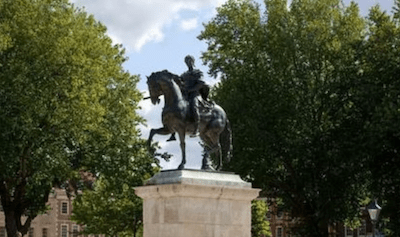
Walking to and from the Watershed, meeting my elder daughter, prior to her birthday, and her travels to Germany and France, we cross Queen Square. It’s a famous Bristol feature, dating in its present form from 1700 and named after the queen two years later. The statue of William III, ‘Dutch William’, by John Michael Rysbrack (originally Jan Michiel Rijsbrack), stands in the centre. The Bristol riots of October 1831, following the House of Lords blocking a Reform Bill, left nearly a hundred buildings in the square burned to the ground, their cellars looted, including the Mansion House. Four rioters were hanged and scores sent to prison. Estimates of those who actually died in the riots ranged up to 250. The rebuilding went on for decades.

Approaching the monument, I felt a flicker of uncertainty as to whether I would pass it on the left or the right. It really doesn’t matter to me but it certainly did to William Faulkner’s Benjy Compson, 33 years old but with the mind of a child and no sense of time. The closing pages portray, you might say, Benjy’s sound and his brother Jason’s fury. Luster, 14 year old son of the Compson family’s black servant Dilsey, in the driving seat, swings the horse, Queenie, to the left at the Confederate monument. ‘For an instant Ben sat in an utter hiatus. Then he bellowed. Bellow on bellow, his voice mounted, with scarce interval for breath. There was more than astonishment in it, it was horror; shock; agony eyeless, tongueless; just sound’ – provoking Jason to rush furiously across the square and on to the step. ‘With a backhanded blow he hurled Luster aside and caught the reins and sawed Queenie about and doubled the reins back and slashed her across the hips. He cut her again and again, into a plunging gallop,  while Ben’s hoarse agony roared about them, and swung her about to the right of the monument. Then he struck Luster over the head with his fist.
‘“Don’t you know any better than to take him to the left?” he said.’
When the horse moves again Ben hushes at once. ‘The broken flower drooped over Ben’s feet and his eyes were empty and blue and serene again as cornice and façade flowed smoothly once more from left to right; post and tree, window and doorway, and signboard, each in its ordered place.’[1]

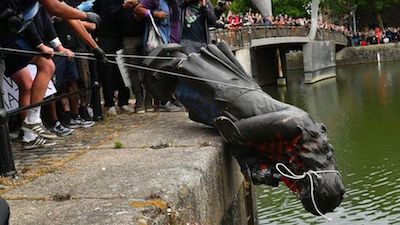
(The Colston statue taking a dip, Bristol, June 2020)

Monuments (not just Confederate ones) are a tricky business, of course. Rysbrack also produced a sculpture of Edward Colston, the Bristol slave trader and philanthropist, another statue of whom, created in 1895 by John Cassidy, was toppled into Bristol Harbour by protesters in June 2020. There have been many other contested monuments, Cecil Rhodes, Columbus and James Cook among them.

But other figures, perhaps in other ages, provoke quite different, and often more positive, emotions and reactions. Of the stone monument of Tsubo-no-ishibumi on the ancient site of the Taga castle in the village of Ichikawa (about six feet tall and three feet wide), Bashō wrote:

‘In this ever-changing world where mountains crumble, rivers change their courses, roads are deserted, rocks are buried, and old trees yield to young shoots, it was nothing short of a miracle that this monument alone had survived the battering of a thousand years to be the living memory of the ancients. I felt as if I were in the presence of the ancients themselves, and forgetting all the troubles I had suffered on the road, rejoiced in the utter happiness of this joyful moment, not without tears in my eyes.’[2]

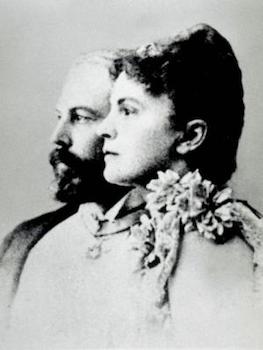
Also in Japan is the monument to Ernest Fenollosa, in Uyeno Park, Tokyo. He had suffered his final, fatal heart attack in September 1908, at his home in London, while his step-daughter Erwin Scott (‘Noshi’, aged sixteen), was reading Dante Gabriel Rossetti’s  ‘The Blessed Damozel’ to him. His ashes remained for a short while in Highgate cemetery but were then transported to Japan, to the hills overlooking Lake Biwa and the gardens of Miidera Temple, where they were reburied on the first anniversary of his death. The inscription, chosen by his students, read: ‘To the merit of our Sensei [teacher], high like the mountains and eternal like the water.’[3]


(Ernest and Mary Fenollosa)

It is not always a case of a specified and designated monument, but may be something that becomes so, such as the Esnoga synagogue that Steven Nadler wrote of: ‘Almost alone among the synagogues of Holland, this unmistakeable monument to Jewish achievement was left standing, undamaged, by the Nazis. Inside the hechal [ark of the Torah] is a Torah said to be the one brought to Amsterdam from Emden in 1602 by Moses Uri Halevi.’[4]

A monument might also serve as a complex representation of parallels and comparisons, whether discerned or imposed, as in Ezra Pound’s focus upon—or obsession with—the condottiere Sigismondo Malatesta’s monument to his wife Isotta. Pound was writing the Malatesta Cantos in the early 1920s and, Lawrence Rainey writes, ‘On the simplest level Pound seeks to suggest that the Tempio’s construction heralds a new cultural era, the dawn of the Renaissance and the spring of a neopagan revival.’ Of more urgent personal interest, though, he wished ‘to discern a parallel between himself and Sigismondo Malatesta’, and ‘between the magnum opus he wished to write and the unfinished monument of Rimini.’[5] That the Cantos (like the Tempio) ultimately remained unfinished was not then envisaged, and remains a curious historical irony.

‘Exegi monumentum aere perennius’, Horace wrote (Odes, Book III), and Pound translated it:

This monument will outlast metal and I made it
More durable than the king’s seat, higher than pyramids.
Gnaw of the wind and rain?
                                    Impotent
The flow of the years to break it, however many.[6]

One might argue of some of these names that it’s a bit soon to tell – but Horace (Quintus Horatius Flaccus) has lasted over 2030 years so far, and seems to be holding on quite well. . .


Notes

[1] William Faulkner, The Sound and the Fury (1929), in Novels 1926-1929, edited by Joseph Blotner and Noel Polk (New York: Library of America, 2006), 1123-1124. In ‘Appendix. Compson: 1699-1945’ (1141), Faulkner wrote of Luster that he was ‘a man, aged 14’, who was ‘not only capable of the complete care and security’ of Benjy, a man ‘twice his age and three times his size, but could keep him entertained.’

[2] Matsuo Bashō, The Narrow Road to the Deep North and other travel sketches, translated by Nobuyuki Yuasa (London: Penguin Books, 1966), 113.

[3] Lawrence W. Chisolm, Fenollosa: The Far East and American Culture (New Haven: Yale University Press, 1963), 211, 35.

[4] Steven Nadler, Rembrandt’s Jews (Chicago: University of Chicago Press, 2003), 162.

[5] Lawrence S. Rainey, Ezra Pound and the Monument of Culture: Text, History, and the Malatesta Cantos (Chicago: University of Chicago Press, 1991), 38, 43.

[6] Ezra Pound: Poems and Translations, edited by Richard Sieburth (New York: Library of America, 2003), 1146.

Burden of proofs


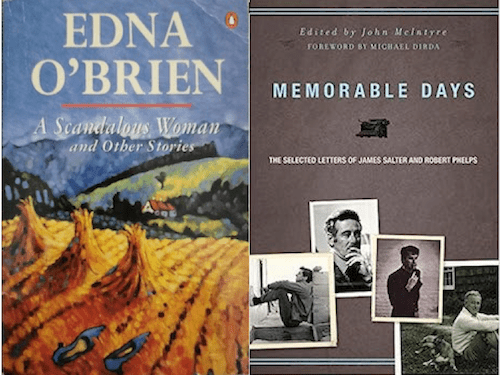
In the past couple of weeks, I’ve read a lot of tributes to, and memories of, Edna O’Brien, who died on 27 July. I know some of her books but clearly not enough of them. My favourite story about her is probably that in one of James Salter’s letters to Robert Phelps (a wonderful volume), dated 2 November 1972. Salter mentions at the top of the letter that Ezra Pound has died (it had happened the previous day) and reports on ‘Dinner last night with Edna O’Brien and her son.’ She was nervous about the play opening that night, A Pagan Place, from her novel of the same title. ‘She ate everything with her fingers’, Salter wrote, ‘lamb, clumps of spinach, they didn’t even have to wash her fork.’ O’Brien told him about a long story, ‘Over’, which the New Yorker was publishing. ‘She was marvelous, she could recite great passages, long pieces of her story, there was one sentence saying something like: I liked your voice and the way you poured things and your fingering.’ Her editor, ‘in the vastly inquisitorial galleys, wrote: “Mr Shawn [editor of the magazine, 1952-87] thinks this is a little too strong for us.” So Edna changed it to “and your fucking.”’[1]

Alas, ‘fingering’ seem to have made a comeback, certainly when the story was collected in A Scandalous Woman and other stories (1974): ‘Do you still use the same words exactly, and exactly the same caresses, the same touch, the same hesitation, the same fingering? Are you as shy with her as with me? If only you had had courage and a braver heart.’[2]

As for the change, was it made around that time, by reluctant but common consent, or later – perhaps at the proof stage? Proofs!

Looking for the umpteenth time at the draft of a Ford Madox Ford letter (its notes, rather), I wondered about an ‘enormous slap of cake’ and was dispirited by my glimpse of a poet named ‘William Worsworth’. In the first instance, I looked back to the original article and found—almost regretfully because I was warming to a ‘slap of cake’—that it was indeed ‘slab’. I didn’t need to check on the poet but simply inserted the missing letter. Any offended descendants of the poet Worsworth should write in.

Reporting on his struggle with the page proofs of The Pound Era (probably—but only probably—a longer book than this volume of letters will turn out to be), Hugh Kenner wrote to Guy Davenport: ‘It is demoralizing to find “viligance” for “vigilance” in a line one has already read 4 times.’[3] And any writer, editor or proofreader will be familiar with that feeling.


(Hugh Kenner via The National Post; photo by the scholar Walter Baumann)

Of an earlier book (on Samuel Beckett), Kenner had confided: ‘In accordance with my normal policy of imitating the specimen’s style, I rigorously trained myself to write dead-pan declarative sentences page after page, with here and there flickers of irony gleaming through the performance. I hope you like the effect.’ And proofs were not always an ordeal: fun was there for the taking, as he added to Davenport a week later: ‘I forget whether I told you that I have spliced bits of Happy Days into my Beckett proofs, so adroitly (I think) that no one will be able to tell they were not there all along.’[4]

In turn, Davenport mentioned, in his ‘Pergolesi’s Dog’—‘We are never so certain of our knowledge as when we’re dead wrong’—that ‘The New York Review of Books once referred to The Petrarch Papers of Dickens and a nodding proofreader for the TLS once let Margery Allingham create a detective named Albert Camus.’[5]

Sylvia Beach recalled the printer of Ulysses, Monsieur Dalantière, supplying as many sets of proofs as James Joyce wanted—‘he was insatiable’—and they were all ‘adorned with the Joycean rockets and myriads of stars guiding the printers to words and phrases all around the margins. Joyce told me that he had written a third of  Ulysses on the proofs.’ Right up to the last minute, ‘the long-suffering printers in Dijon were getting back these proofs, with new things to be inserted somehow, whole paragraphs, even, dislocating pages.’[6] My Viking Press edition of Finnegans Wake (New York: 4th printing, 1945) contains a list of corrections of misprints, made by Joyce: fifteen closely printed pages of double columns, in which such phrases as ‘insert comma’ and ‘delete stop’ abound.[7] The book was published in 1939, less than two years before Joyce’s death, after decades of eye trouble, cataracts, glaucoma and much else.


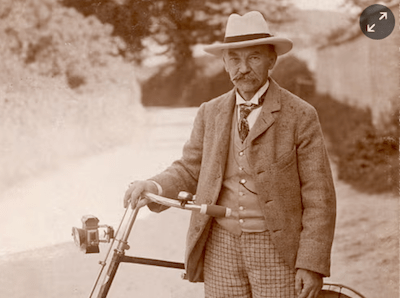
(Thomas Hardy, early 1920s via The Guardian)

For the professional writer, of course, proofs are a constant, whether burden or blessing. . ‘I am bringing out a stodgy novel this autumn’, E. M. Forster wrote to his friend Malcolm Darling (22 August 1910) ‘but I think I told you this. It’s called Howards End, and dealeth dully with many interesting matters. I am correcting proofs now.’[8] Sylvia Townsend Warner reported in her diary: ‘Proofs and ten thousand letters.’ She added the more specific news that: ‘Thomas Hardy has died. Dorset will mourn – a more rare and antique state of things than England mourning.’[9]

As yet, a very long way from reaching the proof stage, I am still inching through Word documents. As for the errors that other people have missed in the proofs of their texts, errors I come across almost daily in my reading, that would be altogether too long a tale to tell. . .


Notes

[1] Memorable Days: The Selected Letters of James Salter and Robert Phelps, edited by John McIntyre, foreword by Michael Dirda (Berkeley, California: Counterpoint, 2010), 95-96. Phelps, in his letter of 10 November, commented: ‘I’ll never forget Miss O’Brien’s way with spinach’ (97). ‘Over’ appeared in The New Yorker (24 November 1972).

[2] Penguin Books edition (Harmondsworth, 1976), 56.

[3] Letter of 21 June 1971: Questioning Minds: The Letters of Guy Davenport and Hugh Kenner, edited by Edward M. Burns, two volumes (Berkeley: Counterpoint Press, 2018), II, 1357.

[4] Letters of 27 September 1961 and 6 October 1961: Questioning Minds, I, 37, 39.

[5] Guy Davenport, Every Force Evolves a Form (San Francisco: North Point Press, 1987), 145. Allingham’s Albert Campion would probably have been amused.

[6] Sylvia Beach, Shakespeare and Company, new edition (Lincoln: University of Nebraska Press, 1991), 58.

[7] See, on Joyce ‘adding commas’, Richard Ellmann, James Joyce (new edition, Oxford: Oxford University Press, 1983), 731, 734.

[8] Selected Letters of E. M. Forster, Volume One: 1879-1920, edited by Mary Lago and P. N. Furbank (London: Collins, 1983), 114.

[9] The Diaries of Sylvia Townsend Warner, edited by Claire Harman (London: Virago Press, 1995), 11: entry for 12 January 1928. Hardy had died in Dorchester the previous day, at the age of 87.

Remembering, or forgetting, 4 August


(Selwyn Image, ‘Stained Glass Design’, 1887: © Victoria & Albert Museum)

Looking at the news this 4 August, it’s sobering to reflect that one of the candidates for the Tory leadership recently vowed to ‘turn the tide of Liberalism’, when it is painfully obvious that what is actually – and urgently – needed is to turn the tide of fascism and racist violence.

Today is the 110th anniversary of Britain’s declaration of war, which will be old news to anyone who reads or writes around the First World War, or simply has an average grasp of history, and it has tended rather to dwarf other, personal, events and anniversaries – though not, perhaps, for the individuals concerned.

Walter de la Mare (‘Jack’) and Elfrida Ingpen (‘Elfie’) were married privately in the parish church at Battersea on 4 August 1899. D. H. Lawrence’s sister Ada married William Edward Clarke on 4 August 1913.[1] Julian Barnes noted that his grandparents were married on 4 August 1914, the day itself,[2] which also marked the birth of Anthony, Rebecca West’s son by H. G. Wells. It was the birthday of Florence, Stanley Spencer’s sister: she married J. M. Image, Cambridge don and brother to Selwyn Image.[3] Ezra Pound, quite recently arrived in London, went in February 1909 to see Selwyn, ‘who does stained glass. & has writ a book of poems. & was one of the gang with Dowson – Jonson – Symons – Yeats etc. – talks of “when ‘old Verlaine’ came over etc.’[4]


(Plaque, Royal College Street, Camden, via The Guardian: photograph by Frank Baron)

‘Old Verlaine’ came over more than once, firstly in 1872, in the company of Arthur Rimbaud (whom he later shot and wounded, in Brussels, another story), settling for a while in rooms in Howland Street off the Tottenham Court Road and, on a second visit shortly afterwards, in Camden Town. They seem to have dropped in on one of the soirées at the Fitzroy Square home of Ford’s maternal grandfather, the painter Ford Madox Brown and his second wife Emma.[5] In October 1893, at the suggestion of William Rothenstein, Verlaine arrived to lecture and read his poetry, in London and in Oxford. Ernest Dowson recorded that, arriving in the small hours of the morning, Verlaine was greeted by the poet and critic Arthur Symons, ‘bearing a packet of biscuits and a bottle of gin’. He gave his first lecture at Barnard’s Inn on 21 November and two days later arrived in Oxford, to be met by Rothenstein and a man named York Powell, of Christ Church (Icelandic scholar, authority on Roman Law, boxing and Middle High Dutch. He also knew Hebrew and Old Irish). Verlaine lectured on contemporary French poetry ‘in the room behind Mr Blackwell’s shop’ and was so enamoured of the city—‘Ô toi, cité charmante et mémorable, Oxford!’— that prising him out of it necessitated both escorting him to the train and withholding his lecture fee until he was safely on the train for London.[6]

Famously (if not quite famously enough), 4 August is the date threaded through Ford Madox Ford’s The Good Soldier—seventeen occurrences in all—and also the birthdate (4 August 1841) of W. H. Hudson, one of Ford’s most consistently admired writers, to whose work he recurred over more than thirty years, sometimes singling out Nature in Downland but more generally stressing that Hudson’s writing had ‘a tranquillity, a clearness of epithet, and an utter absence of affectation or strain that renders his pages like balm for tired souls’, adding that, as with Turgenev, ‘it is all one whether these writers treat of birds or of South American revolutions, of peasants singing, or of Nihilists at their debates. It is simply that the pages of their books reveal a personality, restful soothing, and itself quite at ease.’[7]


(Edward Heron-Allen in 1927, via The Edward Heron-Allen Society)

On 4 August 1918, the polymath (writer, scientist, linguist, historian) Edward Heron-Allen—very much not a friend of Ford’s—wrote in his journal that: ‘One thing stands out and is certain, and that is, that mentally and physically we are changed, changed as we never dreamed a whole nation could be changed.’ He noted that he had ‘escaped the “Spanish Influenza” of which we hear so much, but it seems to be a real menace. We are told that the German Army is “decimated” by it, and that this accounts for the delay and failure’ of the recent offensive.[8]

A decade and a bit further on, the poet and artist David Jones was making his third visit to his friend Helen Sutherland at Rock Hall, Northumberland, 4 August 1931. At the start and end of each visit, Jones would be driven past the Duke of Northumberland’s castle. Helen told him that this was on the site of Lancelot’s castle, Joyous Guard – and the supposed place of his burial. ‘With this association in mind, Jones referred to the church at Rock as “the Chapel Perilous”, the place of terrifying enchantment that Lancelot enters –­ an episode in Malory that reminded him of his experience at night in Mametz Wood.’[9]

The Battle of Mametz Wood, during the First Battle of the Somme, involved British attacks on 7 and 10-12 July, centrally involving the 38th (Welsh) Division and resulting in huge losses: their casualties were one-fifth of their total strength. David Jones was wounded in the early hours of 11 July, and his great poem In Parenthesis, stops at that point.[10]


(David Jones via The Poetry Foundation)

Lie still under the oak
next to the Jerry
and Sergeant Jerry Coke.
   The feet of the reserves going up tread level with your fore-
head; and no word for you; they whisper one with another;
pass on, inward;
these latest succours:
green Kimmerii to bear up the war.[11]

Ford Madox Ford left Cardiff with the 3rd Battalion on 13 July; and departed for France from Waterloo on 17 July. When 4 August came around this time, he was in a Casualty Clearing Station at Corbie, having been blown into the air and severely concussed by a high explosive shell, ‘so that, as I have said, three weeks of my life are completely dead to me though I seem to have gone about my duties as usual. But, by the first of September I had managed to remember at least my own name…’[12]

Quite a few public figures (not least newspaper columnists) seem to have lost their memories lately – quite selectively and with markedly less excuse.


Notes

[1] Letters of D. H. Lawrence II, June 1913–October 1916, edited by George J. Zytaruk and James T. Boulton (Cambridge: Cambridge University Press, 1981), 38n.

[2] Julian Barnes, Nothing to be Frightened of (Cape 2008), 28.

[3] Kenneth Pople, Stanley Spencer: A Biography (London: Harper Collins, 1991), 55, 49.

[4] Ezra Pound to His Parents: Letters 1895–1929, edited by Mary de Rachewiltz, David Moody and Joanna Moody (Oxford: Oxford University Press, 2010), 160.

[5] Angela Thirlwell, Into the Frame: The Four Loves of Ford Madox Brown (London: Chatto & Windus, 2010), 100. On a later visit, Verlaine lodged at 10, London Street, Fitzroy Square, very close to Howland Street.

[6] Joanna Richardson, ‘’The English Connection: French Writers and England, 1800-1900’, in Richard Faber, editor, Essays by Divers Hands: being the transactions of the Royal Society of Literature. New Series: Volume XLV (Woodbridge: The Boydell Press, 1988), 33-35; Joanna Richardson, Verlaine (London: Weidenfeld and Nicholson, 1971), 317-320.

[7] Ford Madox Ford, ‘Literary Portraits: XXV. The Face of the Country’, Tribune (11 January 1908), 2.

[8] Edward Heron-Allen’s Journal of the Great War: From  Sussex Shore to Flanders Fields, edited by Brian W. Harvey and Carol Fitzgerald (Lewes: Sussex Record Society, 2002), 203. A footnote adds that there were approximately 70 million deaths worldwide in 1918-19, compared to the estimated total of 7.8 million killed in action in the war.

[9] Thomas Dilworth, David Jones: Engraver, Soldier, Painter, Poet (London: Jonathan Cape, 2017), 140-142.

[10] Anthony Hyne, David Jones: A Fusilier at the Front (Bridgend: Seren Books 1995), 37.

[11] David Jones, In Parenthesis (1937; London: Faber, 1963), 187.

[12] Ford Madox Ford, It Was the Nightingale (London: Heinemann, 1934), 175.

Oxford Days (a few)


(Tom Quad, Christ Church College)

‘Even when we protested the invasion of Iraq’, I said to the Librarian, recalling that day some twenty years earlier when we shuffled along London streets in company with over a million others, ‘I think we moved more quickly than this.’

‘This’ was our glacial progress up St Aldates in Oxford on a sunny afternoon, together with residents, tourists, American and other participants in the Oxford Experience, or those embarked upon the countless other summer courses and programmes, and many hundreds of—mainly Japanese—children dressed in the Gryffindor house colours of scarlet and gold, concerned to take in the Harry Potter vibrations from New College, the Bodleian Library and Christ Church College. Tour guides in their dozens hoisted small flags or halted in gateways with uplifted arms. Lanyards in their hundreds bobbed or swung. Some individuals, either on home turf or away, looked vague, a little stunned, reminding me of the passage in Rory Stewart’s memoir, where he described Steve Hilton, David Cameron’s director of strategy, moving into the corridor and another room. ‘He seemed to be searching for something – although I couldn’t tell whether it was a cat, an idea, or his shoes.’[1]

On High Street or Broad Street, Broad Walk, Christ Church Meadow, by rivers and canals, on bridges and benches, crowds ebbed and flowed – but mainly flowed. We are soon to be visible in a thousand physical or virtual photograph albums. I said, at one point, ‘Okay, if it’s a child of ten or younger having a photograph taken, we’ll pause. Otherwise, we plough straight on.’ The Librarian agreed but soon lowered the qualifying age to eight, then six. Minutes later, it was down to zero. Thereafter, we ploughed straight on.


(Alice Liddell’s dad, Henry George Liddell, dean of Christ Church from 1855)

Oxford! The literary references the word throws up are astonishing, even excluding the people that only studied there. Lewis Carroll, or rather, Charles Dodgson, haunts the place, but other names rampage through a distracted memory: Philip Pullman, Dorothy Sayers’ Gaudy Night, John Wain, P. D. James, Iris Murdoch, Hardy’s Jude and Colin Dexter’s Morse, C. S. Lewis and J. R. R. Tolkien. A random footnote fact I gathered since that visit was that Edward De Vere, seventeenth Earl of Oxford, was educated not at Oxford, as one might reasonably expect, but at Queen’s College, Cambridge. Attempts were later made to claim him as the ‘real’ author of Shakespeare’s plays, an idea launched by the splendidly named John Thomas Looney. De Vere was the nephew of Arthur Golding, translator of Ovid, his Metamorphoses ‘the most beautiful book in the language’, in Ezra Pound’s words.[2] A man skilled in ‘fourteeners’ (that many syllables in a line):

Then sprang up first the golden age, which of it selfe maintainde,
The truth and right of every thing unforst and unconstrainde.
There was no feare of punishment, there was no threatning lawe
In brazen tables nayled up, to keep the folke in awe.
There was no man would crouch or creepe to Judge with cap in hand,
They lived safe without a Judge, in everie Realme and lande.

Here Daphne flees from Apollo:

And as shee ran the meeting windes hir garments backewarde blue,
So that hir naked skinne apearde behinde hir as she flue,
Hir goodly yellowe golden haire that hanged loose and slacke,
With every puffe of ayre did wave and tosse behind hir backe.[3]

One name occurs on the ground as well as in the mind, the memorial plaque in Christ Church Cathedral (astonishing vaulted ceiling, stained glass by Burne-Jones and others, the St Frideswide Shrine). W. H. Auden came to the College to study biology, switched to English Literature in his second year and graduated (with a third class degree) in 1928. Nearly 30 years later, he became Oxford Professor of Poetry, and returned to Christ Church to live (part of the time) in 1972, the year before his death.


Wot, no Ford Madox Ford notes? Perhaps a sly one. In Some Do Not. . ., Christopher Tietjens, in a mood verging on ‘high good humour’, walks through a Kentish field with Valentine Wannop, a scene, a day, a walk which will recur in both their memories. Among those things that the best people must know are the local names (and the stories behind them) of the plants and flowers they pass. Tietjens—younger son, mathematician, member of the English public official class, who will also, in time, be lover, soldier and antique dealer—tells over to himself the words, the names, the language:

In the hedge: Our lady’s bedstraw: dead-nettle: bachelor’s button (but in Sussex they call it ragged robin, my dear: So interesting!) cowslip (paigle, you know, from the old French pasque, meaning Easter): burr, burdock (farmer that thy wife may thrive, let not burr and burdock wive!); violet leaves, the flowers of course over; black briony; wild clematis: later it’s old man’s beard; purple loose-strife. (That our young maids long purples call and liberal shepherds give a grosser name. So racy of the soil!) …[4]

In the wonderful Botanic Garden, the country’s oldest, one section is the Literary Garden, featuring plants that occur in literature, Alice in Wonderland, Agatha Christie (a great user of poisons) and others, including William Shakespeare:

Yes, those liberal shepherds grossly naming again. Modernists though Joyce, Eliot, Woolf, Wyndham Lewis and Ford were, they were not Futurists rejecting the past—a little more selective than that: ‘BLAST years 1837 to 1900’ and, indeed, ‘BLESS SHAKESPEARE for his bitter Northern Rhetoric of humour’—and they all had frequent recourse to that Elizabethan. . .


Notes

[1] Rory Stewart, Politics on the Edge: A Memoir from Within (London: Jonathan Cape, 2023), 100.

[2] Ezra Pound, The ABC of Reading (London: Faber and Faber, 1961), 127

[3] Extracts in The Oxford Book of Classical Verse, edited by Adrian Poole and Jeremy Maule (Oxford: Oxford University Press, 2000), 394; The Oxford Book of Verse in English Translation, Chosen and Edited by Charles Tomlinson (Oxford: Oxford University Press, 1980), 38.

[4] Ford Madox Ford, Some Do Not. . . (1924; edited by Max Saunders, Manchester: Carcanet Press, 2010), 132.

Taking liberties


(A. Webster, ‘An Oriental Harbour’, National Trust for Scotland, Castle Fraser, Garden & Estate)

Walking back from the long round of the Victorian cemetery, still early, the Librarian remarks that this would be ‘a good Harry day’. As it would: the sun already high, little or no cloud, barely a breath of wind, soon to be around 26 degrees or so – as high as 30 (that’s 86 degrees in American money). The back garden will be warm and calm, idyllically so for animals that worship sun and sleep.

Not much later, I am aboard the Al Raza, not a classic dhow, locally known as ‘a launch’, some sixty feet long, ‘decidedly stubby, and her single mast was more like a twig than a tree and carried no sails.’ The craft is ‘a working launch of 100 tons and looked it.’ A crew of eight, including the nakhoda, the ship’s master, all Baluchis except one Indian-born and one Iranian. When engine trouble forces them to drop anchor off the coast of Iran, Gavin Young, whose earlier reading on the trip has included Ford Madox Ford’s Memories and Impressions, and who repeatedly cites Joseph Conrad, turns to his copy of Helen MacInnes’s Decision at Delphi.[1]

Just then, a white rabbit passed me, plucking a pocket watch from his waistcoat and audibly murmuring that he mustn’t be late, before popping down a large rabbit-hole under the hedge. Naturally, having recently reread the Alice books for Fordian purposes, I followed.

Now, MacInnes. Surely Hammond? Scottish, 30-odd novels and other books. Had I not read one or two? The Wreck of the Mary Deare, perhaps? Levkas Man? The rabbit rolled its eyes. Of course – I was misremembering, actually thinking of Innes, Hammond Innes. Helen MacInnes (1907-1985), whom I then looked up, did an MA at Glasgow University in French and German and added a diploma in librarianship from University College, London. She married, translated from the German with her husband, travelled widely in 1930s Europe, taking copious notes along the way, and moved to the United States when her husband, a fellow of St John’s College, University of Oxford, was offered a chair at Columbia University, teaching Latin and Greek. She published more than 20 books, mainly espionage novels, and several were filmed. Decision at Delphi was her 11th published novel.


(Helen MacInnes in 1941)

Her husband was Gilbert Highet, classicist – and MI6 intelligence agent. That name rang a bell. Careful to avoid the white rabbit’s gaze, I leafed through various mental pages and turned up Ezra Pound and Sextus Propertius.

Pound’s Homage to Sextus Propertius appeared in part in Poetry (March 1919) and in volume form seven months later, though he’d written to his parents as early as 1910: ‘I’ve taken to Propertius’.[2] And, decades later, it was Highet who wrote, in Horizon (January 1961), that Pound’s Homage was ‘an insult both to poetry and to scholarship and to common sense.’[3]

It’s true that, beginning with Professor William Gardner Hale of Chicago, against whose emphatic protests Harriet Monroe reluctantly published four of twelve sections in Poetry, a good many classical scholars have clutched their pearls in outrage at this iconoclastic American taking such liberties with a canonical writer—one of theirs.

Annalists will continue to record Roman reputations,
Celebrities from the Trans-Caucasus will belaud Roman celebrities
And expound the distensions of Empire,
But for something to read in normal circumstances?
For a few pages brought down from the forked hill unsullied?
I ask a wreath which will not crush my head.
            And there is no hurry about it

The poet Charles Tomlinson headed his selection from the poem ‘A travesty of Propertius’ Latin’, but his grasp of what Pound was doing meant that there was no contradiction between that heading and his terming the poem a masterpiece.[4] In another Oxford anthology, Adrian Poole and Jeremy Maule quote Pound’s ‘rampant defence’ of his poem in a letter to A. R. Orage on the first page of their introduction: ‘My job was to bring a dead man to life, to present a living figure’ and begin their Part 7, ‘Propertius to Hadrian’, with Pound’s superb section VII.

Though you give all your kisses
                                    you give but few.

Nor can I shift my pains to other,
            Hers will I be dead,
If she confer such nights upon me,
                                    long is my life, long in years,
If she give me many,
                        God am I for the time.

As Poole and Maule rightly say, ‘Translators must take liberties. They are in any case bound to be accused of having done so.’[5] Indeed, the history of translation and its reception is littered with the husks of those who knew the classical texts but had no sense of living English. George Steiner writes in his introduction: ‘A first look at nearly any translation in this anthology is enough to show whether it comes before or after’ the Homage, adding: ‘But the “making new” of translation had already occurred in Personae (1909) and Provença (1910). After “The River Merchant’s Wife” (1915) the art of translation had entered its modern phase.’[6]


The critic F. R. Leavis, highly influential in his time, wrote appreciatively of Hugh Selwyn Mauberley but Hugh Kenner, in ‘The Making of the Modernist Canon’ (1984), remarks on how Henry James’s ‘habits of diction were refracted throughout a poem Leavis nowhere mentions, Pound’s Homage to Sextus Propertius. That was a central modernist discovery, that distinctions between “prose” and “verse” vanish before distinctions between firm writing and loose’.[7] Kenner also touches there on  Imaginary Letters (1917-18), a series in the Little Review, begun by Wyndham Lewis and continued by Pound when Lewis was transferred to France. One striking feature of Pound’s ‘Imaginary Letters’ is the extent to which their texts would not look out of place in the Homage. Much of this is to do with the varied registers of language, mixing contemporary diction, poeticisms, large-mouthed polysyllables and the careful use of plain often monosyllabic words for some of Propertius’ reflections on love, death or fate. To that extent, his poem’s real subject is language, the intimate relation between a country’s language and its cultural health, the differences between public and private pronouncements, the strategies of a ruling class entrenched behind fortifications of rhetoric and generality. The disorientation that a reading of the poem can produce results in part from the multiplicity of voices Pound employs: Propertius as conventionally heard and as Pound hears and presents him; Victorian or earlier translators; contemporary English poets (in that last year of the war). Perhaps unsurprisingly, not a few readers these days rate the Homage even above Mauberley. It was, and remains, an astonishing achievement, by turns provocative, moving and funny.

I have, of course, ordered a copy of MacInnes’s Decision at Delphi – and also a copy of Assignment in Brittany, her second book, which became, apparently, required reading for British agents joining forces with the French resistance.


Notes

[1] Gavin Young, Slow Boats to China (1981; London: Picador, 1995), 269, 278. His In Search of Conrad, published in 1991, won the Thomas Cook Travel Book Award.

[2] Ezra Pound to His Parents: Letters 1895–1929, edited by Mary de Rachewiltz, David Moody and Joanna Moody (Oxford: Oxford University Press, 2010), 239. His letter of 3 November 1918 has: ‘Also done a new oeuvre on Propertius’ (423).

[3] Quoted by J. P. Sullivan, Ezra Pound and Sextus Propertius: A Study in Creative Translation (London: Faber and Faber, 1965), ix.

[4] The Oxford Book of Verse in English Translation, Chosen and Edited by Charles Tomlinson (Oxford: Oxford University Press, 1980), 443; Tomlinson, Poetry and Metamorphosis (Cambridge: Cambridge University Press, 1983), 59. The book contains the four 1982 Clark Lectures, delivered at Trinity College, Cambridge.

[5] The Oxford Book of Classical Verse, edited by Adrian Poole and Jeremy Maule (Oxford: Oxford University Press, 2000), xxxv, 423.

[6] George Steiner, editor, The Penguin Book of Modern Verse Translation (Harmondsworth: Penguin Books, 1966), 33. In his introduction to The Translations of Ezra Pound (enlarged edition, London: Faber and Faber, 1970), Hugh Kenner remarks: ‘Pound calls the Propertius sequence a Homage, largely in a futile attempt to keep it from being mistaken for an attempt at translation’ (12-13). He does not include the poem in that volume.

[7] Reprinted in Hugh Kenner, Mazes (Athens: University of Georgia Press, 1995), 31. ‘Major snow job in western education is concealment of the hit & miss state of Graeco-Roman texts, all but a few’, Kenner wrote to Guy Davenport (8 June 1962).  ‘Ez rearranged Propertius fragments in the spirit of the scholarship that gave us the standard texts by—arranging fragments’: Questioning Minds: The Letters of Guy Davenport and Hugh Kenner, edited by Edward M. Burns, two volumes (Berkeley: Counterpoint Press, 2018), I, 137.

Changes for the worse


Strange days. Even to say so is to provoke suspicions of glimpses into the bleeding obvious. But strangeness there is, the compass broken and the maps all wrong.

Writing to Eudora Welty in July 1969, the novelist and editor William Maxwell told her of offering to let his elder daughter Kate, then fifteen, read a lot of the letters he’d received. He added: ‘And maybe I will, as a result, not be the mystery to her that my parents are to me, but more than likely it won’t change anything. It takes a great deal to change things. In a better way, I mean. To change things for the worse, all you need is somebody like Nixon, and there are plenty like him.’[1]

Watching a news programme earlier this month, I saw a clip of Nixon explaining to a bemused David Frost—unsurprisingly bemused since Nixon had no justification at all then for claiming this—that, whatever a president did, it couldn’t be illegal, by definition.

Rather more recently, of course, a stacked Supreme Court has thrust yet another blade into the guts of the republic.

 I began writing a post around the time of the British general election but was overtaken, as they say, by events. When the last results were coming in early on the Friday morning, it was clear that, after so many years of other countries viewing us with sympathy or disbelief or disdain, we had a distinct possibility of edging at least in the direction of honesty or sanity or some other unfashionable trait. The irony adhered in the fact that while we had pulled ourselves out of a ditch after a decade and half, some of those same countries seemed hellbent on hurling themselves into it. Thankfully, France has since pulled back to slightly firmer ground, though remaining unsettlingly close to the edge.

Watching the election, I flagged a little around 3 a.m. but rallied at the prospect of seeing some of the more appalling figures in the Tory ranks ditched. Some clung on but there were certainly highlights, particularly the member for North East Somerset being sent home to Nanny and seeing the shortest-serving British Prime Minister do to a 26,000 majority (2019) roughly what she’d done to the country. So, however brief or prolonged the respite it promises, that interesting Fourth of July turned out to be our Independence Day. It must have appeared a great deal less so in the United States,

Since then, a European football competition that grabbed wide attention, a botched assassination attempt on a former president of the United States, the usual murders, atrocities, coups, crises and catastrophes.


But for us, here, drowning out all that, the critical illness of an irreplaceable member of our household. Then the trips to the vet, the phone calls, the fraught conversations, the broken sleep, the agonised weighing of options. And now the weeks of ghost steps on the stairs, of puzzling shadows at the corners of your eyes, of strident silences and oddly empty spaces, because a light has gone out of our world.

Harry the Cat has left the building.


Notes

[1] Suzanne Marrs, editor, What There Is to Say, We Have Said: The Correspondence of Eudora Welty and William Maxwell (Boston and New York: Houghton Mifflin Harcourt, 2011), 259.

Fit to stroke a cat

‘If you are ready to leave father and mother, and brother and sister, and wife and child and friends, and never see them again’, Henry Thoreau wrote, ‘– if you have paid your debts, and made your will, and settled your affairs, and are a free man – then you are ready for a walk.’[1]

Without jettisoning all the relevant relations but also without a burdensome array of debt, I think I’m ready for a walk. A couple of mornings back, when someone all too few gardens away was learning to play ‘Johnny B. Goode’, I was a good deal readier but today, certainly at an early hour, there’s nothing louder than a blue tit close by and, further off, the occasional roar of propane burners firing as the two hot air balloons make sure that they’re well clear of the treetops in the park,

Hotter weather tends to make for weariness, certainly in those unaccustomed to it, like us in our northern temperate zone. It was hard to keep my eyes open on a recent trip down to Somerset by train, though driving probably wouldn’t have been much better (and a damned sight more hazardous). Judith Stinton once quoted Theodore Powys on motors and motoring: ‘A Journey in a motor car is the most tiring experience in the world . . . When I am tired all I feel fit to do is to stroke a cat’.[2] That I can do.

On that theme of tiredness: we have a General Election looming, its imminence evident from the increasingly desperate headlines in the right-wing press, as Jonn Elledge has noted:
https://www.newstatesman.com/politics/2024/06/the-tory-media-has-gone-into-meltdown


(William Hogarth, ‘An Election: 1. The Entertainment’: Sir John Soane’s Museums)

There’s a fairly general consensus that the present administration has failed utterly to honour the contract assumed to exist between government and governed, having trashed the public realm, lavished huge sums on the few at the expense of the many, and repeatedly attacked, dismantled or disparaged precisely those elements that distinguish a civilised society. Given the damage done and the importance of the contest, it seems a little strange that so much of the campaigning is so muffled – this is because neither of the two main parties can afford to be honest about the true state of the nation and what is needed even to begin to repair it. A while back, the – Tory – politician Rory Stewart, trying to define a picture of the country, came up with: ‘An economy 80 per cent based on elusive intangible services; buoyed by an improbable housing bubble, and entirely dependent for its health and care on immigrants, whom citizens seemed to wish to exclude.’[3] Not much has changed, unless for the worse. Yet with all that said, we are still in comparatively privileged conditions. It’s painfully obvious from the international news that a good many people, in several countries, some of them particularly surprising cases, have decided that fascism—which we thought a world war was largely fought to defeat—did not, after all, have a fair crack of the whip and deserves another go. Those people are doing their best, under various names and flags and guises, to give it that go now. And again, despite some disturbing recent domestic moves against democratic freedoms and the right to protest, we are still extremely unlikely in this country to be beaten, tortured or shot on account of being—or despite being—a medical professional, a journalist, a hospital patient, a poet, a photographer, a peace activist,  a woman, a child, or simply someone of the wrong racial character.

(‘After such knowledge, what forgiveness?’ T. S. Eliot asked in another context.[4] To which the most probable answer is: ‘none’.)

To avoid the danger of overdosing on the pleasures of current affairs, I’m taking refuge in the extremely relaxing early eighteenth century when ‘[s]tealing anything worth more than a shilling carried the death penalty’ but, on the other hand, ‘It took only four days to go from London to York or to Exeter by stagecoach.’[5] 

Those were the days. . .


Notes

[1] Henry Thoreau, ‘Walking’ (1862), in The Portable Thoreau, edited by Carl Bode (Harmondsworth: Penguin Books, 1979), 593. Emerson’s 1862 eulogy, ‘Thoreau’, included the observation that: ‘The length of his walks uniformly made the length of his writing. If shut up in the house he did not write at all.’ Ralph Waldo Emerson, Selected Essays, edited by Larzer Ziff (Harmondsworth: Penguin Books, 1982), 400.

[2] Judith Stinton, Chaldon Herring: Writers in a Dorset Landscape (Norwich: Black Dog Books, 2004), 41.

[3] Rory Stewart, Politics on the Edge: A Memoir from Within (London: Jonathan Cape, 2023), 360.

[4] T. S. Eliot, ‘Gerontion’.

[5] A ‘torrent of legislation’ after the Glorious Revolution of 1688 ‘raised the number of capital crimes from about fifty to over 200 by the turn of the nineteenth century.’ Lucy Moore, The Thieves’ Opera: The Remarkable Lives and Deaths of Jonathan Wild, Thief-Taker, and Jack Sheppard, House-Breaker (London: Penguin Books), 1998), ix, 188, 137.

Wording, birding


(Robert Wilson, Hadrian’s Villa, c.1765: Tate)

‘At night I trailed from one window recess to another’, the Emperor Hadrian recalls in Marguerite Yourcenar’s novel, ‘from balcony to balcony through the rooms of that palace where the walls were still cracked from the earthquake, here and there tracing my astrological calculations upon the stones, and questioning the trembling stars. But it is on earth that the signs of the future have to be sought.’[1]

So it is. ‘Ghosts await you in the future if they do not follow you from the past’, Sarah Moss wrote, and: ‘No one who knows what happens in the world, what humans do to humans, has any claim to contentment.’[2] Yes. I write pages and delete them, since they serve no real purpose except to relieve my feelings for a short while. The past is not always a foreign country and they do not always do things differently there. As Pankaj Mishra said in his recent ‘Winter Lecture’: ‘It hardly seems believable, but the evidence has become overwhelming: we are witnessing some kind of collapse in the free world.’[3]

Early summer creeps on, though fitfully. Watching rose petals fall from the bush in a light wind, I remembered Pound’s Canto XIII, the first in which Confucius appears, and which ends:

The blossoms of the apricot
            blow from the east to the west
And I have tried to keep them from falling.[4]


(Shen Zhou, ‘Apricot Blossom’, leaf from the album, Dreaming of Travelling While in Bed: Palace Museum, Beijing)

Ronald Bush observed that: ‘To keep the blossoms of the apricot from falling is to keep nature in a permanent vernal bounty.’[5] It also seems to me to signify cultural contact, the free exchange of ideas, without the limits of borders or nationalism. At that stage, Pound was using Guillaume Pauthier’s translation of Confucian texts in Confucius et Mencius: les quatre livres de philosophie morale et politique de la Chine and had written in ‘Exile’s Letter’:

Intelligent men came drifting in from the sea and from the west border,
And with them, and with you especially
There was nothing at cross purpose,
And they made nothing of sea-crossing or of mountain crossing,
If only they could be of that fellowship,
And we all spoke out our hearts and minds, and without regret.[6]

On the daily walks we speak our minds but, just lately, exchanges are punctuated by information from our newly downloaded Merlin app, available from Cornell University, which draws on a huge database of bird sounds, sightings and photographs to identify what you’re probably hearing in that nearby tree or passing overhead.


So we stroll along narrow paths thus:

Politics, dinner, politics. . .
‘Blue tit. Carrion crow. Wren.’
Politics, domestic details, politics, cat, literary chuntering. . .
‘Dunnock. Blackcap. Chiffchaff.’
Ash dieback, politics, university gossip, politics. . .
‘Blackbird. Herring gull. Great tit. Jay!’

Excuse me, sir, let me just ask about the birdsong: in a world both literally and metaphorically on fire, democracies hanging by a thread, war crimes, liars and knaves in public places – does it help?

Why, yes, a little – rather more than a little, in fact. . .


Notes

[1] Marguerite Yourcenar, The Memoirs of Hadrian, translated by Grace Frick, with Yourcenar (1951; Penguin Books, 2000), 82.

[2] Sarah Moss, Signs for Lost Children (London: Granta Books, 2016), 88-89, 97.

[3] Pankaj Mishra, ‘The Shoah after Gaza’ [Winter Lecture], London Review of Books 46, 5 (7 March 2024).

[4] The Cantos of Ezra Pound, fourth collected edition (London: Faber and Faber, 1987), 60.

[5] Ronald Bush, The Genesis of Ezra Pound’s Cantos (Princeton: Princeton University Press, 1989), 251.

[6] ‘Exile’s Letter’, Ezra Pound: Poems and Translations, edited by Richard Sieburth (New York: Library of America, 2003), 255.