Feeling sheepish

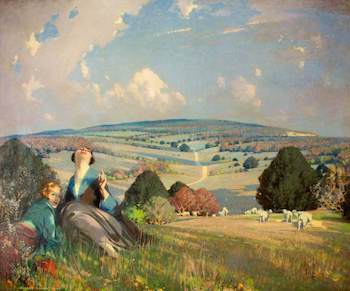
Lambs-gazing

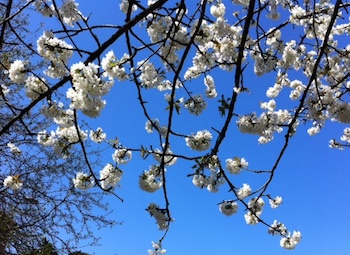
Outside the back door: the familiar plant pots; the collapsing shed; the teetering bird table that caters to blackbirds, magpies, blue tits. Working keenly enough at the thinning, clearing, preparations for the new season’s plants, the Librarian is, nevertheless, a little wistful: she is missing the sheep.

Close to the Black Mountains, we stayed in a cottage six hundred years old. People were smaller in those days, Robin of Locksley’s chum Little John notwithstanding. I think my skull had significant contact with wood six times in all: twice to remember to duck as I went in or out between kitchen and terrace; twice more to remember to stay ducked, since the total breadth of solid wood to be negotiated before straightening was more than twelve inches; and, say, twice accounted for by thinking of, or looking at, something else as I approached the doorway.

The noise of that world was its height when you could just make out the sound of the tractor in the field across the valley. Otherwise, you heard only sheep, birdsong—and bees interrogating the crevices in the slate wall which bordered the terrace below the orchard. At times, especially at day’s end, you heard nothing. The sound of silence.

‘As the truest society approaches always nearer to solitude, so the most excellent speech finally falls into silence.’[1] So wrote Henry Thoreau, who was not, perhaps, that crazy about society. Still, for our first three days in border country, we went nowhere and saw nobody—and loved it.

Holiday-reading

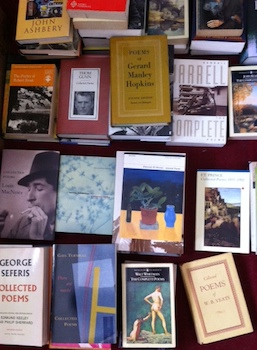
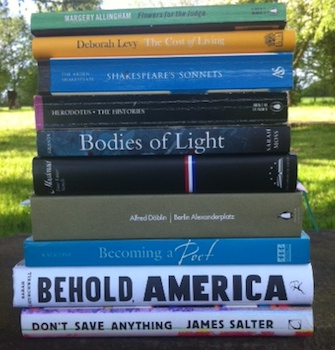
Did I take anything to read? I did. The Librarian’s gathering was a separate matter but didn’t consist of many fewer books.

As for sheep—literary sheep—I recalled the curious sentence in Ford Madox Ford’s memoir of Joseph Conrad: ‘In all our ten thousand conversations down the years we had only these two themes over which we quarrelled: as to the taste of saffron and as to whether one sheep is distinguishable from another.’ Hmm. The saffron affair came down to Conrad’s declaration that saffron had no flavour but was merely a matter of colouring, against Ford’s assertion that saffron was strongly flavoured. And one sheep distinguishable from another?

There was one more bone of contention mentioned later: the matter of official honours. ‘The reader should understand that this matter is one which divides forever—into sheep and goats—the world of the arts. There are some few artists who will accept Academic honours; to the majority of those who are really artists the idea is abhorrent, and those who accept such honours betray their brothers. To this majority Conrad had enthusiastically belonged. You had Flaubert who refused, you had Zola who all his life sought, academic distinction. For Conrad there had used to be no question as to which to follow. Now he had followed Zola.’[2]

As for the burning question of whether one sheep is distinguishable from another – on the basis of extensive research conducted over the last week, occasionally with a glass in my hand, I have an answer ready: yes.


References

[1] Henry David Thoreau, A Week on the Concord and Merrimack Rivers; Walden; The Maine Woods; Cape Cod (New York: Library of America, 1985), 318.

[2] Ford Madox Ford, Joseph Conrad: A Personal Remembrance (London: Duckworth, 1924), 29-30, 69.


Merry Jesting

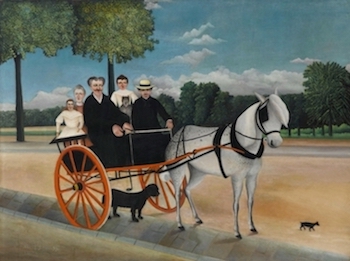
Rousseau_Carriole-Juniet

(Henri Rousseau, ‘La carriole du père Juniet’ (1908): Musée de l’Orangerie, Paris.)

Published in the Partisan Review in the summer of 1939, Elizabeth Bishop’s appreciation of Gregorio Valdes made no claims for him as a great painter—‘sometimes he was not even a good “primitive”’—and observed that the artist himself saw no difference between ‘what we think of as his good pictures and his poor pictures’, that success and failure seemed to be merely a matter of luck. Most were copied from photographs or reproductions, nevertheless, ‘when he copied, particularly from a photograph, and particularly from a photograph of something he knew and liked, such as palm trees, he managed to make just the right changes in perspective and coloring to give it a peculiar and captivating freshness, flatness, and remoteness.’

Bishop commissioned Valdes to paint a picture of the Key West house she was living in with Louise Crane, and asked the painter for extras: more flowers, ‘a monkey that lived next door, a parrot and a certain kind of palm tree, called the Traveller’s Palm.’ She began her memoir by describing the first Valdes painting that she saw, ‘a real View’: ‘In the middle of the road was the tiny figure of a man on a donkey, and far away on the right the white speck of a thatched Cuban cabin that seemed to have the same mysterious properties of perspective as the little dog in Rousseau’s The Cariole of M. Juniot.’[1] In letters of that period, she referred to Valdes as ‘our new Key West Rousseau’ and ‘our local Rousseau’.[2]

In 1949, Flannery O’Connor met Robert and Sally Fitzgerald, and subsequently moved into their house, Ridgefield, Connecticut, as a paying guest. In a letter to Janet McKane, 27 August 1963, O’Connor wrote: ‘Thanks so much for the museum bulletins with devilish dogs etc. The dog I like in painting is one in a painting of Rousseau. I don’t know the name of it but the family is in a wagon, all looking ahead and there is one dog in the wagon and one underneath, kind of prim diabolical dogs. It’s very funny. It used to hang in the Fitzgeralds’ kitchen (the people I lived with in Connecticut) but I have never seen it anywhere else.’[3]
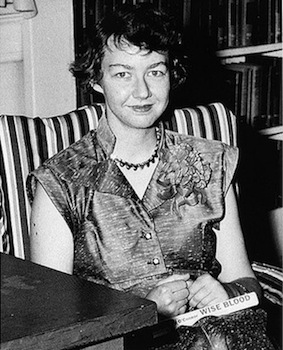
OConnor-InaDillardRussellLibrary

(Flannery O’Connor: Ina Dillard Russell Library via New Georgia Encyclopedia)

It is, of course, the same painting, ‘La carriole du père Juniet’ (‘Old Juniet’s Cart’), by Henri Rousseau, commonly called ‘Le Douanier’, although ‘he was never a douanier (customs inspector) but a gabelou (employee of the municipal toll service).’[4] Like most of the work of Valdes, Rousseau’s painting began with a photograph, ‘which shows how he selected and revised at will. The bleak snapshot is transformed into a study of red wheels and shafts penetrating masses of black. In the painting the people sit in a compact arrangement in the cart, with space around them, instead of standing formlessly on the kerb. They have become, recognizably, creatures of Rousseau’s vision.’[5] (And four of the people in the picture plus one dog are, pace O’Connor’s memory, not looking ahead but rather at us—only old Juniet and two of the dogs seem to be looking ahead.)

Rousseau has consistently been mocked or celebrated, and sometimes both simultaneously, as was the case with most of the guests attending the famous banquet, given in Rousseau’s honour by Pablo Picasso and Fernande Olivier at the Bateau Lavoir, probably on 21 November 1908. Those guests included Guillaume Apollinaire, Marie Laurencin, Gertrude Stein, Alice B. Toklas, André Salmon and Georges Braque. Many years later, Picasso commented that it was ‘vraiment une blague [really a joke]. Nobody believed in his talent, only Rousseau took it seriously. He wept with joy.’ And yet Picasso was ‘the only person present who genuinely admired Rousseau’s work.’[6]

André Derain commented on the work of Henri Rousseau that, ‘“It seems hardly worthwhile searching and using technical training, when a person so simple, so pure, such a dope, in fact, can succeed in giving such an impression; his work is the triumph of the dopes.”’[7] Nevertheless, his influence on several other painters, notably Robert Delaunay, is often remarked, and Guy Davenport suggests that Picasso’s career-long habit of ‘combining full face and profile’, which became ‘a stylistic trademark’, prompted Rousseau’s ‘perfectly accurate observation, “You and I, M. Picasso, are the two greatest living painters, I in the modern manner, you in the Egyptian,” the full-face eye in a face seen sideways being the rule in Egyptian drawing.’[8]

So too, the impact of the Rousseau retrospective at the 1911 Salon des Indépendants (the year following his death) was considerable. The younger artists ‘conspired to present a retrospective exhibition’ of forty-seven of Rousseau’s paintings. ‘Esteemed as a true “primitive” by Delaunay and Léger, Rousseau was considered a precursor by the salon cubists, on a par with Cézanne, another modernist primitive’.[9]
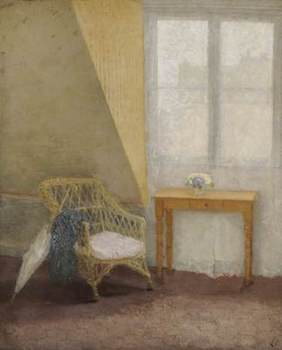
John, Gwen, 1876-1939; A Corner of the Artist's Room in Paris

(Gwen John, A Corner of the Artist’s Room in Paris: Museums Sheffield)

There were other, perhaps less predictable, appreciations. ‘In the Indépendants a man named Rousseau had a collection of pictures which you would be very interested in, I’m sure’, Gwen John wrote in a letter of 22 August 1911. ‘He has died lately. He was a douanier and at fifty year[s] old he felt he must paint and so he painted, not knowing at all how to paint. His pictures are very remarkable works, as you can imagine, but they are works of art. I hope you will be able to see them some day, but I don’t know where they are now. I suppose they have gone to his family. The other exhibitors in the Indépendants are just mad people.’[10]

Among recent critics, Robert Hughes wrote that Rousseau meant his visions to be absolutely real, the authenticity of the jungle scenes resting on a tissue of fibs about serving in the French army in Mexico in the 1860s. It was important, Hughes went on, that these spectacles ‘should seem witnessed, not invented’ – and they had, in fact, been witnessed twice, once in Rousseau’s imagination, once more in the Jardin des Plantes.[11] In fact, Roger Shattuck comments, much of the ‘lingering falsehood’ stems from Apollinaire’s articles, in which he stated that Rousseau ‘went to Mexico with troops sent by Napoleon III to support Maximilian, and that it is the memory of the “forbidden” tropical fruits in Central America that obsessed him in his jungle paintings.’ There’s no evidence of such a trip but, as Shattuck remarks, ‘Rousseau’s imagination was capable of its own voyages.’[12]

So it was. His paintings are unsettling but oddly compelling, with their huge children and tiny animals, moustachioed figures frozen in peculiar poses, startling vegetation, sly self-portraits, the sleeping gypsy (who is, in fact, awake, though pretending to be dead), the velvety exoticism of his snake-charmer.
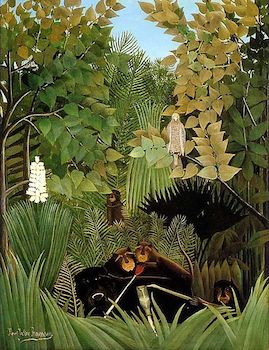
Rousseau_Merry_Jesters

(Henri Rousseau, Les joyeux farceurs: Louis and Walter Arensberg Collection, Philadelphia Museum of Art)

‘Until we are willing to enter Rousseau’s world’, Guy Davenport writes, ‘we are going to misread all his paintings.’ (He has just discussed five such misreadings, of Rousseau’s Les joyeux farceurs.) And, ‘What, psychologically, was most useful to Rousseau was not childishness but a quality wholly mature: the ability to fool himself.’ That is, he saw his paintings as he wished to see them. ‘In this he was a kind of Don Quixote; and, as with the Don, Rousseau wins us over to his way of seeing.’[13]

In a letter to Hugh Kenner (1 March 1963), accompanying his long poem, Flowers and Leaves, Davenport signed himself ‘The Douanier Rousseau of Poetry’ (Kenner’s letter of 1 May 1963 began ‘Dear Mr Rousseau’).[14] * And, as Davenport mentions in the essay just cited, Monsieur Rousseau is there, in that poem:

Henri Rousseau’s garden jungle
Is sincerity’s domain.

And:

Mr Rousseau, master in the modern manner,
Has depicted us in forests of flowers, inquisitive
As catfish, intelligent as Miss Gertrude Stein.[15]

* (Currently scheduled for October this year, and keenly awaited in some quarters, is Questioning Minds: The Letters of Guy Davenport and Hugh Kenner, edited by Edward Burns, published by Counterpoint Press: a total of 2016 – no, that’s not a date – pages: two volumes of a thousand pages each. Quoted price is $95.00 which, given that a lot of slim UK monographs come in at £70 or even £80 these days, seems a snip.)


References

[1] ‘Gregorio Valdes, 1879-1939’, in Elizabeth Bishop, Poems, Prose, and Letters, edited by Robert Giroux and Lloyd Schwartz (New York: Library of America, 2008), 326-332.

[2] Elizabeth Bishop, One Art: The Selected Letters, edited by Robert Giroux (London: Pimlico, 1996), 75; Bishop, Poems, Prose, and Letters, 746.

[3] Flannery O’Connor, Collected Works, edited by Sally Fitzgerald (New York: Library of America, 1988), 1190.

[4] Roger Shattuck, The Banquet Years: The Origins of the Avant-Garde in France, 1885 to World War I, revised edition (New York: Vintage, 1968), 46.

[5] Shattuck, The Banquet Years, 100.

[6] John Richardson, A Life of Picasso. Volume II, 1907-1917: The Painter of Modern Life (London: Pimlico, 1997), 110, 112.

[7] Derain, in Denys Sutton, André Derain (London: Phaidon, 1959), 27: quoted in Judi Freeman, The Fauve Landscape (London: Guild Publishing, 1990), 110.

[8] Guy Davenport, Objects on a Table: Harmonious Disarray in Art and Literature (Washington: Counterpoint, 1998), 68.

[9] Mark Antliff and Patricia Leighten, editors, A Cubism Reader: Documents and Criticism, 1906-1914 (Chicago: Chicago University Press, 2008), 120, 121.

[10] Gwen John to John Quinn, in Letters and Notebooks, edited by Ceridwen Lloyd-Morgan (London: Tate Publishing, 2004), 69.

[11] Robert Hughes, The Shock of the New, revised edition (London: Thames and Hudson, 1991), 229.

[12] Shattuck, The Banquet Years, 46.

[13] Guy Davenport, ‘What Are Those Monkeys Doing?’, in Every Force Evolves a Form (Berkeley: North Point Press, 1987), 14, 26.

[14] Edward M. Burns, ‘Questioning Minds: The Letters of Hugh Kenner and Guy Davenport’, The Hopkins Review, 8, 3 (Summer 2015), 338-371 (349).

[15] Guy Davenport, Flowers and Leaves (Flint, Michigan: Baumberger Books, 1991), 91, 110.
 

Larking about

Henry, George, 1858-1943; The Lark
(George Henry, The Lark: Newport Museum and Art Gallery)

After last week, when the rain drenched and draggled so doggedly that I was reminded of Louis MacNeice’s comment on ‘those April showers which in Ireland persist for twelve months’,[1] we are back to more settled unsettled weather, veering from sunshine to rain in the merest jiffy. We’re even promised a heat wave soon.

In a cool room, anyway, inching my eyes down the page, I encounter this:

Can vei la lauzeta mover
De joi sas alas contral ray,
Que s · oblida e · s layssa cazer
Per la doussor qu · al cor li vai
,
O my!’

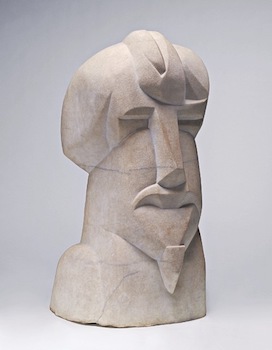
Hmm. Yet it seems faintly familiar. The next lines are: ‘Bird and she bird / Love and fall’.[2] I recalled Guy Davenport outlining his initial version of Ezra Pound, ‘first of all a man who had written a rich, barely comprehensible poem, a man whose portrait bust had been chiselled by Gaudier. My first response was to learn Italian and Provençal, and to paint in the quattrocento manner. All real education is such unconscious seduction.’[3]

henri gaudier-brzeska hieratic head of ezra pound 1914
(Henri Gaudier Brzeska, Hieratic Head of Ezra Pound, 1914: Tate)

I myself have signally failed to learn Provençal and must blunder along as best I can. Perhaps not Arnaut Daniel, and not Bertran de Born. I rummage in teetering piles. In Anthology of Troubadour Lyric Poetry, I find, ah yes, Bernard de Ventadour’s poem, translated there as prose: ‘When I see the lark beating with joy its wings against the ray of the sun until, oblivious, it swoons and drops for the sweetness which enters its heart’.[4] Ah, ‘Bird and she bird / Love and fall’ – so larks, like swifts, mate on the wing? Elsewhere, the poet W. D. Snodgrass offers rhymes:

‘Now when I see the skylark lift
His wings for joy in dawn’s first ray
Then let himself, oblivious, drift
For all his heart is glad and gay’.[5]

And, of course, the path snakes back to Pound: ‘When I see the lark a-moving / For joy his wings against the sunlight, / Who forgets himself and lets himself fall / For the sweetness which goes into his heart’.[6] That must be where I first saw it, thirty years back, probably more. So early in Pound’s career; but, very late in that career, in one of the last scraps of Cantos, the fragment ending ‘To be men not destroyers’, we find this:

“es laissa cader”
so high toward the sun and then falling,
“de joi sas alas”
to set here the roads of France.

In fact, the third line of Bernard’s verse has appeared in the first of the Pisan Cantos; the line about the roads of France, two cantos later.[7] And, apart from the sources of a Bible and an anthology of poetry, the Pisan Cantos are, of course, primarily memories—fragmentary, often imperfect, no doubt, adhering in odd patterns and permutations—mixed with observation of the day-to-day life of the camp. In retrospect, among Pound’s glimpses of paradise were life in pre-war London and his great ventures into Provence, in 1912, 1919 and 1924, but particularly the first. ‘Or, again, a man may walk the hill roads and river roads from Limoges and Charente to Dordogne and Narbonne and learn a little, or more than a little, of what the country meant to the wandering singers, he may learn, or think he learns, why so many canzos open with speech of the weather; or why such a man made war on such and such castles.’[8]

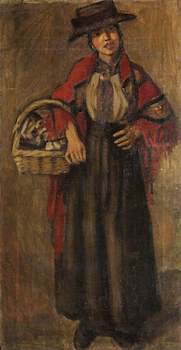
Layng, Mabel Frances, 1881-1937; The Gypsy
(Mabyl Frances Lang, The Gypsy: Bristol Museum and Art Gallery)

Or a man might write ‘The Gypsy’ or ‘Provincia Deserta’—or ‘Near Perigord’:

Take the whole man and ravel out the story.
He loved this lady in castle Montaignac?
The castle flanked him—he had need of it.
You read to-day, how long the overlords of Perigord,
The Talleyrands, have held the place, it was no transient fiction.
And Maent failed him? Or saw through the scheme?[9]

The lark is, I gather, ‘one of the most popular birds in post-classical Europeans poetry.’ I am directed to Shakespeare, Elizabeth Barrett Browning, Spenser, Wordsworth, Milton. Tennyson, Dante, Goethe, Shelley and Blake, among others.[10] It was George Meredith’s poem that gave Vaughan Williams the title of his ‘tone poem’, The Lark Ascending. It sometimes seems that this piece has been damned by its widespread popularity, though I don’t tire of it any more than I tire of, say, the several points on Somerset and Dorset roads where you breast a rise between trees and the world suddenly opens up, with great sweeps of country on either side and the clear sky fled endlessly away—or, in bookish vein, Conan Doyle’s Sherlock Holmes stories or yes (I’ve just confirmed) Hergé’s adventures of Tintin. A sweetness entering the heart – more or less.

References

[1] Louis MacNeice, The Strings are False: An Unfinished Autobiography, edited E. R. Dodds (London: Faber and Faber, 1996), 216.

[2] Guy Davenport, Flowers and Leaves (Flint, Michigan: Baumberger Books, 1991), 56.

[3] Guy Davenport, ‘Ezra Pound, 1885-1972’, in The Geography of the Imagination (Boston: David R. Godine, 1997), 174.

[4] Anthology of Troubadour Lyric Poetry, edited and translated by Alan R. Press (Edinburgh: Edinburgh Press, 1971), 77.

[5] W. D. Snodgrass, ‘The Skylark’, in Lark in the Morning: The Verses of the Troubadours, edited by Robert Kehew (Chicago: University of Chicago Press, 2005), 75.

[6] Ezra Pound, The Spirit of Romance (1910; New York: New Directions, 1968), 41.

[7] The Cantos of Ezra Pound, fourth collected edition (London: Faber and Faber, 1987), 802, 431, 455. In fact, Bernard’s poem crops up in Canto VI (22) as well.

[8] Ezra Pound, ‘Troubadours – Their Sorts and Conditions’ (1913), in Literary Essays of Ezra Pound, edited by T. S. Eliot (London: Faber and Faber, 1960), 95.

[9] Ezra Pound: Poems and Translations, edited by Richard Sieburth (New York: Library of America, 2003), 304.

[10] Michael Ferber, A Dictionary of Literary Symbols (Cambridge: Cambridge University Press, 1999), 104, 105.


The plural of referendum is – Herodotus?

Herodotus

(Herodotus asking ‘What??’)

In the latest issue of the London Review of Books, David Runciman’s ‘Too Few to Mention’, a review of Nick Clegg’s How to Stop Brexit (and Make Britain Great Again), assesses the arguments for and against a second referendum and concludes that ‘the likeliest way to overturn the referendum result is to wait until one party or other has taken clear ownership of its consequences. For that to happen, Brexit has to happen too.’ He adds: ‘It is possible that at some point a second referendum will be appropriate, once a new status quo has been established, to see whether people would prefer an alternative. Until then, however, conventional electoral politics will have to decide our collective fate.’

If you regard the whole Brexit business as a nose-to-tail blunder of epochal proportions (and arguably a very twenty-first century right-wing coup), this makes grim but convincing reading. Of course, the offhand incompetence displayed on an almost daily basis by those charged with seeing the whole sorry process through is itself extraordinary and I know that a great many people have been reduced to a state of rigid boredom as it drags on. Others still retain enough energy for outrage or forceful questioning – but this is generally of a rhetorical kind, with no real expectation of satisfactory answers. It’s not a new phenomenon, that of people reacting and indeed voting according to criteria that exclude facts, reason, logic and the rest: everyone does it to a greater or lesser extent, I suspect, the relevant question being the degree to which we’re conscious of doing so. What does seem to be a fairly recent phenomenon is the general realisation—by analysts of the reasonable, the rational, the logical—that this is actually the case. Why did so many people vote for Donald Trump, for Brexit, for political extremists in Hungary, Germany, Denmark? Hmmm. ‘How anyone can still be voting Tory,’ the Librarian remarks, as we listen to the results of the English local elections, ‘is baffling.’ I acknowledge and share that bafflement. But here we are.

Still, looking back at the EU referendum, I am strongly reminded of Herodotus writing about the Persians: ‘If an important decision is to be made, they discuss the question when they are drunk, and the following day the master of the house where the discussion was held submits their decision for reconsideration when they are sober. If they still approve it, it is adopted; if not, it is abandoned. Conversely, any decision they make when they are sober, is reconsidered afterwards when they are drunk.’[1]

Yes. I don’t think we advanced beyond the discussion-when-drunk stage. But I still don’t expect a second referendum.


Reference
[1] Herodotus, The Histories, translated by Aubrey de Sélincourt, revised by John Marincola (London: Penguin Books, 1996), 56. Cf. Tacitus, Germania, in Agricola and Germania, translated by S. A. Handford (London: Penguin Books, 2000), 120: ‘They debate when they are incapable of pretence but reserve their decision for a time when they cannot well make a mistake”


An Agreeable Rattle

Sassoon

(Siegfried Sassoon)

In the Spring of 1921, Siegfried Sassoon made an entry in his diary about Mary Marjorie, his oldest friend, and the effect she had on him, making him become ‘quite an agreeable rattle!’[1]

It’s an odd and striking phrase – and one to make a close reader of Ford Madox Ford sit up and rub her hands. In Some Do Not. . ., the first volume of Ford’s Parade’s End tetralogy, Mark Tietjens, Christopher’s elder brother, has been made to realise that a man called Ruggles, with whom he has shared ‘a floor of a large and rather gloomy building in Mayfair’ for some twenty years, has been spreading malicious and untrue gossip about Christopher. ‘Of Ruggles he thought little or nothing. He had once heard the phrase “agreeable rattle,” and he regarded Ruggles as an agreeable rattle, though he did not know what the phrase meant.’ Max Saunders’ footnote reads: ‘A person who talks incessantly in a lively or inane manner; a constant chatterer’: OED. The dictionary cites Rose Macaulay’s Orphan Island, also of 1924: ‘xiii. 143, I think he must have been a rather agreeable rattle’.[2]

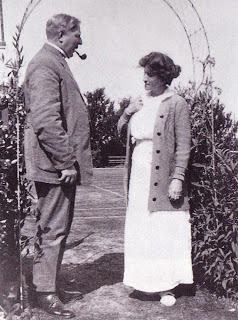
VH_FMF_Selsey

(Ford and Violet at Selsey)

A few more Fordian connections occur to me. Firstly, Violet Hunt, whose affair with Ford began in 1909, continued into the war years and foundered definitively when he encountered Stella Bowen. In Hunt’s novel, The Last Ditch, there is a markedly Fordian character named Audely: ‘“Call me an agreeable rattle at once!” he said.’[3]

Twenty years later, here is Caroline Gordon writing to Ford from Tennessee, assuring him that social intercourse would be available when he visited, given the proximity of the University of the South (Sewanee): ‘We have stayed out of this social spate, knowing it was too swift for us, and have permitted ourselves only one University friend, an agreeable rattle who comes once or twice a week and tells us tales that would curl our hair if we hadn’t already read it in Trollope or Cranford.’[4]

caroline-gordon

(Caroline Gordon)

Then a contemporary of Ford, though not, apparently, either friend or acquaintance, C. E. Montague, in whose story, ‘Ted’s Leave’, Ted ‘must have become the crowned wit of some little set of dull men, the sort of Agreeable Rattle to whom his world looks to keep the ball rolling in some second-rate bar.’[5]

One hundred and fifty years earlier, Act III of Oliver Goldsmith’s She Stoops to Conquer has Marlow explaining to Miss Hardcastle that, ‘At the Ladies’ Club in town I’m called their agreeable Rattle. Rattle, child, is not my real name, but one I’m known by.’ Just a few years before that, the young James Boswell had commented of Charles Crookshanks, Lord Eglinton’s steward in England: ‘He is a spirited fellow, has read a good deal, and is much of a gentleman, but has at the same time much of what is called a rattle.’ Boswell then added, ‘I must observe that we are not affected by the complaints of a genteel agreeable man against life.’ Boswell’s editor has earlier remarked of the Duke of York, heir presumptive to the throne when Boswell met him in 1760, that, ‘He was a violinist of some distinction, a rake, and what the eighteenth century called a “rattle.”’[6]

Woolf.2

(Virginia Woolf)

‘Rattle’—rattlers, rattletrap, rattling mumper—has an extensive history. But it strikes me now that ‘agreeable’ has almost vanished from common usage. Less than a hundred years ago, R. H. Mottram wrote of his character Skene’s ‘sure movements, straight glance, and agreeable carelessness’, and Virginia Woolf referred to becoming ‘part of that vast republican army of anonymous trampers, whose society is so agreeable after the solitude of one’s own room.’[7]

Just what is the problem with ‘agreeable’? Too bland, too unemphatic for these shouty times? Is it just too—Henry James? I recall now that his Portrait of a Lady begins, ‘Under certain circumstances there are few hours in life more agreeable than the hour dedicated to the ceremony known as afternoon tea.’ Pleasant, pleasing, my dictionary says. No, that really won’t do. Too restrained, too moderate, altogether too reasonable for these times. Good riddance, surely.

References

[1] Siegfried Sassoon, Diaries 1920-1922, edited by Rupert Hart-Davis (London: Faber and Faber, 1981), 64.

[2] Ford Madox Ford, Some Do Not. . . (1924; edited by Max Saunders, Manchester: Carcanet Press, 2010), 250 and fn.

[3] Violet Hunt, The Last Ditch (London: Stanley Paul, 1918), 305.

[4] Brita Lindbergh-Seyersted, editor, A Literary Friendship: Correspondence Between Caroline Gordon & Ford Madox Ford (Knoxville: The University of Tennessee Press, 1999), 97. The Editor’s note suggests that the ‘friend’ was ‘Probably Samuel Monk, a member of the English department.’

[5] C. E. Montague, Action (1928; Phoenix Library, 1936), 196.

[6] Boswell’s London Journal, 1762-1763, edited by Frederick A. Pottle (London: William Heinemann, 1950), 195-196; 53fn.

[7] R. H. Mottram, The Spanish Farm Trilogy (London: Chatto and Windus, 1927), 141;  Virginia Woolf, ‘Street Haunting: A London Adventure’, in Selected Essays, edited by David Bradshaw (Oxford: Oxford University Press, 2008), 177.


Mayday, or Mayday!

Hayman, Francis, 1708-1776; Mayday (The Milkmaids' Garland)

Mayday (‘The Milkmaids’ Garland’): Studio of Francis Hayman. English Heritage: Marble Hill House, Twickenham.

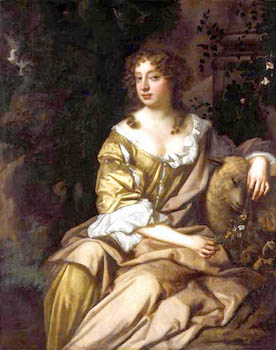
‘To Westminster, in the way meeting many milkmaids with their garlands upon their pails, dancing with a fiddler before them, and saw pretty Nelly standing at her lodgings door in Drury lane in her smock-sleeves and bodice, looking upon one – she seemed a mighty pretty creature.’ Samuel Pepys makes a Mayday note, 1667.

Nell_gwyn_peter_lely_c_1675

(Nell Gwynn by Sir Peter Lely)

May Day! Or, given the state we’re in: Mayday! Mayday! Mayday! Although—newsflash—the cavalry will not be coming. It’s up to us, which may be good news or bad, depending on your perspective.

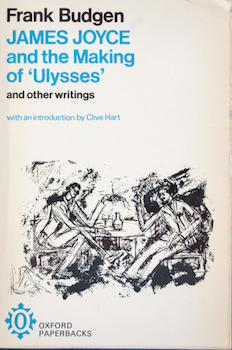
The cavalry often didn’t arrive in the past, or almost not. ‘And suppose the cavalry had not been able to ford that river? They almost did not, almost, almost. It is in the region of Almost that the blood sings.’[1] So Anthony Burgess, alluding, surely, to the conversation between his most admired author, James Joyce, and one of the best writers on that author, Frank Budgen, to whom Joyce is reading:

“After he woke me up last night same dream or was it? Wait. Open hallway. Street of harlots. Remember. Haroun al Raschid. I am almosting it. That man led me, spoke . . .”
“Almosting!” I said.
“Yes,” said Joyce. “That’s all in the Protean character of the thing. Everything changes: land, water, dog, time of day. Parts of speech change, too. Adverb becomes verb.”[2]

Budgen-Joyce

The settled conviction that the cavalry were, and would continue to be, the trump card in the British land army was slow to recede; and sceptics were regarded with wariness or hostility. Barbara Tuchman recorded that, ‘In the Russo-Japanese War an English observer, the future General Sir Ian Hamilton, reported that the only thing the cavalry could do in the face of entrenched machine guns was to cook rice for the infantry, causing the War Office to wonder if his months in the Orient had not affected his mind.’[3] In the event, of course, ‘The first and last British cavalry charge on the western front took place at Audreques on 24 August 1914.’[4]

By the Second World War, the cavalry had fled the scene but heroes were still in evidence, riding—or sailing—to the rescue: ‘There was high drama in May 1941 when a parachute mine went through the roof of the London Palladium, and hung entangled and unexploded in the flies. The Naval officer who successfully defused the mine (since these were sea-mines they were the responsibility of the Navy) was given free tickets to the Palladium for life.’

The envy of his colleagues, no doubt. Elsewhere on the cultural spectrum, ‘The Tate Gallery was hit in September, October and December, and again once a month from January to May 1941, but the only painting damaged was Richard Wilson’s Destruction of the Children of Niobe, which had been brought to London to be cleaned. The British Museum suffered damage to the Pediment Hall in November, and much more serious damage in May 1941, when 150,000 books in the Library were destroyed.’[5]

In fact, the cavalry occasionally call here, to take away a few boxes of books, sift them for items of personal interest, then pass the rest on to Good Causes. Against such occasional and partial thinning, logic demands that we set occasions like this last weekend, when the Librarian, glimpsing a few days off on the horizon, made a compelling argument for the whole of the 2018 Women’s Prize shortlist.

NewBks-290418

A few rogue titles have evidently slipped in here: there’s probably a reasonable explanation for that but I’m unable to access it just at the moment.

References

[1] Anthony Burgess, Napoleon Symphony (London, Jonathan Cape, 1974), 24.

[2] Frank Budgen, James Joyce and the Making of ‘Ulysses’ and other writings, enlarged edition (1934; London: Oxford University Press, 1972), 55. Joyce is reading from the third chapter of Ulysses, ‘Proteus’.

[3] Barbara Tuchman, in The Guns of August (1962; edited by Margaret MacMillan, New York: Library of America, 2012), 214.

[4] Mark Girouard, Life in the English Country House (London: Penguin Books, 1980), 289.

[5] Robert Hewison, Under Siege: Literary Life in London, 1939-45 (New York: Oxford University Press, 1977), 29.


Men of Kent, fruit, hops, women


Edward Gibbon (born 27 April, 1737, in Putney) wrote in his less famous work, the autobiography, ‘My family is originally derived from the country of Kent, whose inhabitants have maintained from the earliest antiquity a provincial character of civility, courage and freedom.’ In the southern district of the country, he added, ‘which borders on Sussex and the sea’, the Gibbons ‘were possessed of lands in the year one thousand three hundred and twenty-six; and the elder branch of the family, without much increase or diminution of property, still adheres to its native soil.’[1]

My own family derived mainly from Hampshire but I myself was born in Kent so I’ll take at face value this testimony from the author of damned, thick, square books. Peter Vansittart mentions that Edward the Confessor (termed in an early work by Ford Madox Ford ‘the wavering, prevaricating, and totally useless king’) was the patron saint of England until the Hundred Years’ War. ‘Then Edward III, in debt to Genoese bankers, replaced him with their patron, the more aggressive St George, who was not to escape the attention of the supreme English ironist, Gibbon: he dismissed George as a dishonest bacon contractor, loathed by Christian and pagan alike.’[2]

Kent seems not to figure largely in Gibbon’s later life, though. Oxford, Lausanne, yes, Paris and, of course, Italy, where it was, on the fifteenth of October 1764, ‘as I sat musing amidst the ruins of the Capitol, while the barefooted friars were singing vespers in the temple of Jupiter, that the idea of writing the decline and fall of the City first started to my mind.’[3]

Dyce, William, 1806-1864; Pegwell Bay, Kent - a Recollection of October 5th 1858

(William Dyce, Pegwell Bay, Kent – a Recollection of October 5th 1858: Tate)

Ford Madox Ford, Londoner, who lived in Kent and Sussex, would often quote what he claimed to have heard said of Sussex men by their Kentish detractors: ‘Oh, he comes from Sussex. He sucked in Sussex silliness with his mother’s milk, and has been silly ever since.’[4] He added that he didn’t know what those Sussex men had to say of the men of Kent.

In one of the most resonant scenes in the first volume of his Parade’s End tetralogy, place is specific and vital: ‘This, Tietjens thought, is England! A man and a maid walk through Kentish grass fields: the grass ripe for the scythe. The man honourable, clean, upright; the maid virtuous, clean, vigorous: he of good birth; she of birth quite as good; each filled with a too good breakfast that each could yet capably digest. Each come just from an admirably appointed establishment: a table surrounded by the best people: their promenade sanctioned, as it were, by the Church—two clergy—the State: two Government officials; by mothers, friends, old maids…. Each knew the names of birds that piped and grasses that bowed: chaffinch, greenfinch, yellow-ammer (not, my dear, hammer! ammer from the Middle High German for “finch”), garden warbler, Dartford warbler, pied-wagtail, known as “dishwasher.” (These charming local dialect names.) Marguerites over the grass, stretching in an infinite white blaze: grasses purple in a haze to the far distant hedgerow: cocksfoot, wild white clover, sainfoin, Italian rye grass (all technical names that the best people must know: the best grass mixture for permanent pasture on the Wealden loam).’[5] Another four or five more pages I must resist transcribing. . .

Though Ford himself was born in Merton (then a parish in Surrey), he may have inhaled a little Kentish enthusiasm from his beloved grandfather: ‘Although Madox Brown’s early years were spent mostly in France and Belgium, he retained affection, even an idealised loyalty for Kent, his mother’s and his wife’s English county of origin.’[6]

As Dickens’ Mr Jingle said, ‘Kent, sir—everybody knows Kent—apples, cherries, hops, and women.’[7] If those are not quite my abiding memories of the county, it may be because I left it at the age of two (my father was posted to Gibraltar), came back at five and left again at eight. Cocker spaniel, guinea pigs, cat, yes; but no fruit, no hops, no women, alas.

Men of Kent or Kentish men. This is traditionally decided by whether you come from east or west of the River Medway. I am, I have just confirmed, a man of Kent.

References

[1] Edward Gibbon, Memoirs of My Life (Harmondsworth: Penguin Books, 2006), 43.

[2] Peter Vansittart, In Memory of England: A Novelist’s View of History (London: John Murray, 1998), 42; Ford Madox Ford, The Cinque Ports (Edinburgh and London: William Blackwood and Sons, 1900), 249.

[3] Gibbon, Memoirs, 143.

[4] Examples are in Ford Madox Ford, Cinque Ports, 33 fn.1; ‘Literary Portraits XXVI—Miss Amber Reeves and A Lady and her Husband’, Outlook, XXXIII (7 March 1914), 310-311, reprinted in Critical Essays, edited by Max Saunders and Richard Stang (Manchester: Carcanet Press, 2002), 134; A Mirror to France (London: Duckworth, 1926), 43; No Enemy (1929; edited by Paul Skinner, Manchester: Carcanet Press, 2002), 19.

[5] Ford Madox Ford, Some Do Not. . . (1924; edited by Max Saunders, Manchester: Carcanet Press, 2010), 131-132.

[6] Angela Thirlwell, Into the Frame: The Four Loves of Ford Madox Brown (London: Chatto & Windus, 2010), 10.

[7] Charles Dickens, The Pickwick Papers (1836-37; edited by Mark Wormald, London: Penguin Books, 1999), 31.

Writing, healing and the First World War at The Authors’ Club

(Vivien Whelpton’s biography; Louisa Garrett Anderson:
https://www.londonremembers.com/subjects/dr-louisa-garrett-anderson )

Yesterday, pausing from doggedly extracting nails and staples from the newly exposed floorboards in the old kitchen, I took a crowded train to London, in the company of Lev Nikolayevich Tolstoy—always impressive but we’ll never be close friends.

I went to the Authors’ Club in London for an event entitled ‘Writing, Healing and the First World War’. There were three panellists: Sara Haslam, Chair of the Ford Madox Ford Society and author of—among other things—Fragmenting modernism: Ford Madox Ford, the novel and the Great War; Vivien Whelpton, who published a recent biography of poet, novelist, translator and biographer Richard Aldington; and Sunny Singh, novelist and lecturer in Creative Writing and English Literature.

Sara Haslam talked about her recent research: first, into the Endell Street Military Hospital started by Louisa Garrett Anderson and Flora Murray, doctors and suffragettes, run and staffed entirely by women and dealing almost exclusively with male patients, revolutionary facts in the context of that time; then into the War Library started by Helen Mary Gaskell to distribute free books to wounded servicemen, a scheme that produced a staggering number of volumes donated by the public, with one individual contribution of 35,000 titles and huge deliveries of new stock that often brought traffic to a standstill.

Vivien Whelpton talked very knowledgeably and engagingly about Aldington, particularly his poetry and his 1929 novel, Death of a Hero; also his marriage to H. D., and association with Ezra Pound, Ford Madox Ford, T. S. Eliot and others, damaged, as was so much else in Aldington’s life, by his experience of war. His 1955 book on T. E. Lawrence, then still idolised by many, effectively wrecked Aldington’s standing with the literary establishment in this country and his autobiography, Life for Life’s Sake, published in the United States in 1941, finally emerged here in 1968.

Sunny Singh discussed a tale by Chandradhar Sharma Guleri, later translated as ‘The Troth’—famous among a domestic audience though little known in this country—apparently the first short story in Hindi, published early in the war (1915) and highly suggestive in its handling of the complex issues around Imperial subjects fighting in a war which did not directly affect them, highlighting too the often degrading treatment suffered by the Indian troops. Perhaps as many as a million and a quarter Indian soldiers served on the Western Front and in Africa, a huge majority of those in combat roles, almost 75,000 of whom were killed.

A fascinating – and informative – evening.

Sara Haslam talking about Endell Street Military Hospital: A Suffragette story, in a short Open University film, is here:
https://www.youtube.com/watch?v=kEDRAv9NlY0

Her recent essay, ‘Reading, Trauma and Literary Caregiving 1914-1918: Helen Mary Gaskell and the War Library’, appeared in the Journal of Medical Humanities: http://oro.open.ac.uk/54285/


‘Feed the brutes’: Rupert Brooke

Brooke

In Jane Gardam’s A Long Way from Verona, Jessica Vye tells Florence Bonne about one of the books given to her by Miss Philemon: it includes ‘some poems by a heavenly-looking man (there’s a photo) called Rupert Brooke, but he only seems to write about fish.’[1] ‘Heaven’ is certainly concerned with fish, as is—unsurprisingly—‘The Fish’ but Jessica probably suffered from the oddities of an anthologist’s choices. That ‘heavenly-looking man’, though, was attested to by many, certainly more than the famously smitten, such as Henry James and Sir Edward Marsh. ‘It was in 1913, I think, and I sitting in the Café Royal feeling amazingly grand, when a young man came in who had a great air of beauty and walked like a panther—and the person I was with said, There’s Rupert Brooke. The only time I set eyes on him. [ . . . ] It was a year when everything was happening [ . . . ] but nothing ever got between me and my impression of the young man walking like a panther.’[2]

On this date in 1915 (a popular anniversary: Shakespeare! Wordsworth! Prokofiev! Lee Miller!) Rupert Brooke died of septicaemia aboard a hospital ship in the Aegean, at the age of twenty-seven, and was buried on Skyros. His legacy often seems to have dwindled to a selection of brooding photographs, a few quotations from besotted admirers, occasional ‘iconoclastic’ versions of the life, pointing out that he wasn’t always as nice as he should have been, and a handful of poems loved by a certain kind of reader and dismissed with a sniff by another kind of reader.

Three years ago, in the Times Literary Supplement (24 April, 2015, 13-15), William Wootten, wrote about Brooke’s afterlives, not least those envisaged by Brooke himself, though generally in terms of dust and scuffed earth rather than heavenly light or adoring readers. He traced a line connecting Brooke’s literary interests with those of T. S. Eliot a few years later. Brooke was deeply read in the work of John Webster (the subject of his dissertation) and other Jacobean dramatists, and recognised immediately the significance of Herbert Grierson’s landmark 1912 edition of Donne’s poems. ‘Had Brooke survived the war,’ Wootten commented, ‘he might well have made the gap between Georgian and Modernist seem far smaller than it has been made to appear.’ Of course, Brooke didn’t survive—but would, I suspect, not have made the case for such writers, often by practical demonstration in original poems, as Eliot did.

grantchester

https://dmdujour.wordpress.com/2016/06/02/rupert-brooke-the-old-vicarage-grantchester/

In November 1912, Brooke went to Berlin to stay with his Cambridge friend Dudley Ward. A few days later, T. E. Hulme arrived and Brooke met him at the station. They had several conversations about aesthetics, sitting outside the Café des Westens, though the ten days they spent often together didn’t lead to a friendship. In the following year, Hulme was one of the members of the jury that chose Brooke’s ‘The Old Vicarage, Grantchester’ as the best poem to have appeared in The Poetry Review that year, netting Hulme £30.[3] Edward Thomas, though friendly with Brooke and also on the jury, voted for Wilfrid Gibson.[4] The implied place and date of composition—or conception—of the poem, given in parentheses after the title, is ‘Café des Westens, Berlin, May 1912: this was the second of his four trips to Germany that year.

‘[Edward] Marsh gave me a book of English poems [Georgian Poetry]’, Stanley Spencer wrote to his friends, Jacques and Gwen Raverat. ‘I like Rupert Brooke because he knows what teatime is’.[5] ‘Stands the church clock at ten to three? / And is there honey still for tea?’ These are not only two of the best-known lines in British poetry; they are two of the most deceptive, in that they’re often quoted as if comprising almost the entire poem. But that poem contains one hundred and forty lines; and eleven questions precede these two. There is also a lot more humour in the poem than is sometimes allowed for, ‘poor Brooke—he was wittier than I thought’, as Elizabeth Bishop remarked.[6]

I only know that you may lie
Day-long and watch the Cambridge sky,
And, flower-lulled in sleepy grass,
Hear the cool lapse of hours pass,
Until the centuries blend and blur
In Grantchester, in Grantchester. . . .

Before the outbreak of war, Brooke would travel to North America and the Pacific (which produced some of his most interesting work). In 1913, he wrote to Edward Thomas to explain that he hadn’t been able to get down to Hampshire to visit because ‘London gripped me too firmly by the ankle.’ Might Thomas be in the capital the following week? If so, he could charge Brooke with some message for the United States. ‘And I could leave the muses of England in your keeping—I do that anyhow. Feed the brutes. If I don’t see you, farewell.’[7]

Self-Portrait 1914 by Sir Stanley Spencer 1891-1959

(Stanley Spencer, Self-Portrait, 1914, Tate © Estate of Stanley Spencer)

On the last day of July 1914, Brooke wrote to Stanley Spencer (‘Dear Cookham’), ‘But this damned war business. . . . If fighting starts, I shall have to enlist, or go as a correspondent. I don’t know. It will be Hell to be in it: and Hell to be out of it.’[8] Brooke was not really a war poet: his five sonnets are essentially the total of his ‘war poetry’. But he saw the effects of war closely enough, in Antwerp, writing to Leonard Bacon on11 November 1914, ‘That was like Hell, a Dantesque Hell, terrible. But there—and later—I saw what was a truer Hell. Hundreds of thousands of refugees, their goods on barrows and hand-carts and perambulators and waggons, moving with infinite slowness out into the night, two unending lines of them, the old men mostly weeping, the women with hard white drawn faces, the children playing or crying or sleeping.’ And, later in the same letter: ‘It’s a great life, fighting, while it lasts, The eyes grows clearer and the heart. But it’s a bloody thing, half the youth of Europe blown through pain to nothingness, in the incessant mechanical slaughter of these modern battles. I can only marvel at human endurance.’[9]

skyros-brooke-grave

Brooke’s poetic reputation has often struggled to stay alive among ‘serious’ readers, the established image of him and the symbolic burdens he’s been made to bear tending to obscure his writing and the few good poems to be found there. That figure of the naively patriotic, sentimental pastoralist of Edwardian England was not quite him. The narrator of Elizabeth Taylor’s novel writes of Hugo Macmillan, Vesey’s uncle: ‘He had gone on being Rupert Brooke all through the war – a tremendous achievement – and was only now, much later, finding his enthusiasms hardening into prejudices’.[10] The ironic thrust of this (‘all through the war’) is that Brooke’s death was indispensable to his dazzling afterlife, that celebrity in turn often obscuring what was authentic in his work.

References

[1] Jane Gardam, A Long Way from Verona (Penguin Books, 1973), 74,

[2] Sylvia Townsend Warner to Leonard Bacon, 23 August 1952, in Letters, edited by William Maxwell (London: Chatto & Windus, 1982), 136.

[3] Robert Ferguson, The Short Sharp Life of T. E. Hulme (London: Allen Lane, 2002), 134-136; Alun R. Jones, The Life and Opinions of T. E. Hulme (London: Gollancz, 1960), 99.

[4] Jean Moorcroft Wilson, Edward Thomas: From Adlestrop to Arras (London: Bloomsbury, 2015), 202.

[5] Kenneth Pople. Stanley Spencer: A Biography (London: Harper Collins, 1991), 52.

[6] Elizabeth Bishop to Robert Lowell, 30 July 1964, in Words in Air: The Complete Correspondence between Elizabeth Bishop and Robert Lowell, edited by Thomas Travisano with Saskia Hamilton (London: Faber and Faber, 2008), 548.

[7] The Letters of Rupert Brooke, edited by Sir Geoffrey Keynes (London: Faber and Faber, 1968), 459.

[8] Letters of Rupert Brooke, 601.

[9] Letters of Rupert Brooke, 632, 633.

[10] Elizabeth Taylor, A Game of Hide and Seek (1951; New York: New York Review of Books, 2012), 12.

All roses and shadow: Guy Davenport’s Sappho

Sappho

Reading Guy Davenport’s poems and translations, I paused on one of Sappho’s addresses to the goddess Aphrodite, liking the directness of its call, a sinewy compound of appeal and command:

Come out of Crete
And find me here,
Come to your grove,
Mellow apple trees
And holy altar
Where the sweet smoke
Of libanum is in
Your praise.

Where Leaf melody
In the apples
Is a crystal crash,
And the water is cold.

All roses and shadow,
This place, and sleep
Like dusk sifts down
From trembling leaves.

I paused even longer, I think, on this:

When death has laid you down among his own
And none remember you in all the years to be,
Know, grey among ghosts in that twilight world,
That, offered the roses of Pieria, you refused,
And wander forever in the dark lord Aida’s house
Reticent still, with the blind dead, unknown.[1]

GD-JW-1964

(Guy Davenport, ‘in a somewhat silent, Shakerish mood and garb’, by Jonathan Williams, 1964. Taken from Portrait Photographs , Coracle Press, London, 1979)

Yes. I was reminded of the physical responses to authentic poetry that A. E. Housman famously described in a 1933 lecture. He cites a figure named Eliphaz (in the Book of Job), to whom he ascribes the sentence, ‘A spirit passed before my face: the hair of my flesh stood up.’ He mentions bristling skin, a shiver down the spine; and mentions one of Keats’s letters, in which the poet writes of Fanny Brawne, ‘everything that reminds me of her goes through me like a spear’. Housman is making the point, at some length, that to him poetry seems ‘more physical than intellectual.’[2] Many readers would describe their reactions, rather, as ‘both’, though probably granting that each might apply at different times and in different states of mind or knowing.

Davenport’s translation wears the simple title ‘Vale’, ‘farewell’. The poem is also included in his Seven Greeks, where he gives a little more space to Sappho than to any other of his chosen writers. His note to this poem explains that ‘Aida’ here is Hades and adds: ‘Written, seemingly, to a standoffish girl. Thomas Hardy translates this in a poem called Achtung.’[3]

Achtung? Hardy’s version of Sappho quotes The Rubáiyát of Omar Khayyám and Shakespeare as epigraphs and runs:

Dead shalt thou lie; and nought
Be told of thee and thought,
For thou hast plucked not of the Muses’ tree:
And even in Hades’ halls
Amidst thy fellow-thralls
No friendly shade thy shade shall company![4]

thomas-hardy-portrait

(Thomas Hardy: Dorset County Museum)

There is no poem called ‘Achtung’ in the index to Hardy’s Collected Poems. The title here is ‘Sapphic Fragment’, which seems reasonable. Two anthologies, The Oxford Book of Classical Verse, edited by Adrian Poole and Jeremy Maule, and Charles Tomlinson’s Oxford Book of Verse in English Translation, point me to more versions of the poem, but they too sternly name Hardy’s translation ‘Sapphic Fragment’. Ah, but there’s one more anthology to check: Confucius to Cummings, edited by Ezra Pound and Marcella Spann. Here’s Sappho and here’s that poem, called here, yes, ‘Achtung’.[5] The Pound connection is often useful when reading Davenport.

The Loeb edition offers: ‘But when you die you will lie there, and afterwards there will never be any recollection of you or any longing for you since you have no share in the roses of Pieria; unseen in the house of Hades also, flown from our midst, you will go to and fro among the shadowy corpses.’ The notes cite Stobaeus and Plutarch to the effect that the poem was addressed to ‘an uneducated woman’, ‘a wealthy woman’ or ‘an uncultured, ignorant woman’.[6]

Still, ‘Written, seemingly, to a standoffish girl’, feels about right to me. ‘Her Aphrodite laughs’, Davenport writes of Sappho, adding, with characteristic sharpness, ‘Sexual frenzy was as respectable a passion to Sappho as rapacious selfishness to an American. Few societies have been as afraid of the body as ours, and in the West none has, within history, been as solicitous as the Greek of its beauty.’[7] And elsewhere, ‘Seems to me that Sappho was the poet of desire.’[8]

Desire, yes.

Percussion, salt and honey,
A quivering in the thighs;
He shakes me all over again,
Eros who cannot be thrown,
Who stalks on all fours like a beast.[9]

‘Vale’—or ‘Achtung’—sets the speaker, the poet who has accepted those Pierian roses, who has drunk deep of the Pierian spring, the fountain of the Muses in Thessaly, against that other, who has not embraced, either directly or through the person of the poet, intimate knowledge of the arts and sciences, who will pass into the shadows of Hades, unmourned and unremembered.

‘Pierian roses’ recalls that man Pound again: in Hugh Selwyn Mauberley, ‘The pianola “replaces” / Sappho’s barbitos’, while in Dr Johnson’s old haunts, Fleet Street has gone to the dogs; or, at least, to stallholders with socks to sell:

Beside this thoroughfare
The sale of half-hose has
Long since superseded the cultivation
Of Pierian roses.[10]

HD

(H. D.)

Sappho’s art, Davenport, comments, ‘belongs to cultural springtimes and renaissance’—hints here of the Persephone theme which increasingly appears to occupy an entire continent in the world of modern literature—and she spoke ‘with Euclidean terseness and authority of the encounters of the loving heart, the infatuated eye’s engagement with flowing hair, suave bodies, moonlight on flowers.’ Her imagery ‘is as stark and patterned as the vase painting of her time’ – ‘Never has poetry been this clear and bright.’ And he quotes, by way of comparison, one of H. D.’s— Hilda Doolittle’s—‘conscious imitations’:

delicate the weave,
fair the thread:

clear the colours,
apple-leaf green,
ox-heart blood-red:

rare the texture,
woven from wild ram,
sea-bred horned sheep:

the stallion and his mare,
unbridled, with arrow pattern,
are worked on
the blue cloth.[11]

This is from a late H. D. poem ‘Fair the Thread’ (topped and tailed), though H. D. did produce translations, or imitations, of several of Sappho’s poems – or, rather, fragments. Sappho’s corpus consists almost entirely of fragments, which are often fleshed out by translators with guesswork and conjecture. They are also used—by poets—as taking-off points for longer, connected poems. One example is Swinburne, whose version of the fragment that Davenport called ‘Vale’ is embedded in the 300-plus lines of ‘Anactoria’, beginning there ‘Thee too the years shall cover’.[12] H. D. herself is another example, though a complicated one: the editor of her Collected Poems cites three early poems which are ‘masked as expansions of fragments of Sappho’, while one of her later critics, referring to those poems explicitly based on Sappho’s ‘fragments’, suggests that H. D.’s ‘textual play’ with Sappho ‘goes far beyond these’.[13]

Sappho’s concision and precision seem peculiarly fitted to excite the minds of the early modernist poets, particularly the Imagists; but then the fragmented state of her work, its blanks and inscrutabilities, bafflements and painstaking decipherments are also very appropriate to the story of modern literature.

Flowers-Leaves-REM

(Jacket of Davenport’s long poem, Flowers and Leaves, published by Jonathan Williams in 1966: Ralph Eugene Meatyard, ‘Untitled’, 1959. © The Estate of Ralph Eugene Meatyard.)

One more Davenport-Sappho detail. Writing about his friend, the extraordinary photographer Ralph Eugene Meatyard, Davenport remembered that, ‘Greek nor Latin had he, though he once figured out with a modern Greek dictionary that a lyric of Sappho (which he had set out to read as his first excursion into the classics) had something to do with a truck crossing a bridge.’[14]

The art of the possible. Why not?

 
References

[1] Guy Davenport, Thasos and Ohio: Poems and Translations, 1950-1980 (San Francisco: North Point Press, 1986), 32, 33.

[2] A Shropshire Lad and Other Poems: The Collected Poems of A. E. Housman, edited by Archie Burnett, with an introduction by Nick Laird (London: Penguin Books, 2010), 254-255: the whole lecture, ‘The Name and Nature of Poetry’, is reprinted here (231-256). The letter he refers to is to Charles Brown, 1 November 1820: Letters of John Keats, edited by Robert Gittings (Oxford: Oxford University Press, 1979), 397.

[3] Guy Davenport, Seven Greeks (New York: New Directions, 1995), 234 n.6. For his introduction, see 4-14 on Sappho, and for translations of her work, 69-116.

[4] Thomas Hardy, The Complete Poems, edited by James Gibson (Basingstoke: Macmillan, 1976), 181.

[5] Confucius to Cummings: An Anthology of Poetry, edited by Ezra Pound and Marcella Spann (New York: New Directions, 1964), 18.

[6] Greek Lyric I: Sappho and Alcaeus, edited and translated by David A. Campbell (Cambridge, Massachusetts: Harvard University Press, 1990), 99.

[7] Davenport, Seven Greeks, 9.

[8] W. C. Bamberger, editor, Guy Davenport and James Laughlin: Selected Letters (New York: W. W. Norton & Co., 2007), 163.

[9] Davenport, Seven Greeks, 87.

[10] Ezra Pound: Poems and Translations, edited by Richard Sieburth (New York: Library of America, 2003), 550, 556.

[11] Davenport, Seven Greeks, 5.

[12] Algernon Charles Swinburne, Poems and Ballads & Atalanta in Calydon, edited by Kenneth Haynes (London: Penguin Books, 2000), 52.

[13] H. D., Collected Poems 1912-1944, edited by Louis L. Martz (Manchester: Carcanet Press, 1984), xiv; Eileen Gregory, H. D. and Hellenism: Classic Lines (Cambridge: Cambridge University Press, 1997), 148.

[14] Guy Davenport, ‘Ralph Eugene Meatyard’, The Geography of the Imagination (Boston: David R. Godine, 1997), 370.