Why it’s so difficult. . .

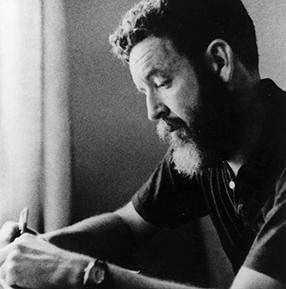
(James Salter and Robert Phelps, via Narrative magazine)

On 12 June (close enough) 1975, in a letter to Robert Phelps, James Salter wrote: ‘Why is it so difficult to assemble those things that really matter in life and to dwell among them only? I am referring to certain landscapes, persons, beasts, books, rooms, meteorological conditions, fruits. In fact, I insist on it.’[1]

Why is it so difficult? The temptation for a lot of readers would be simply to answer: ‘Money.’ But it’s rarely simply a question of money.

Towards the end of Ford Madox Ford’s The Good Soldier, the narrator, John Dowell, asks: ‘Why can’t people have what they want? The things were all there to content everybody; yet everybody has the wrong thing. Perhaps you can make head or tail of it; it is beyond me.’[2]

The four main characters in Ford’s novel are not short of cash and ‘everybody has the wrong thing’ gets a little closer to the real point. In what may—or certainly should—be a defining moment in the election campaign, the Prime Minister answered a nurse who had asked why her net pay had not increased in the past eight years by saying: ‘there isn’t a magic money tree that we can shake that suddenly provides for everything that people want.’ Apart from the sheer offensiveness of that response, the untruth was also very striking. As several commentators have pointed out in the past few days, if we’re talking about banks or controversial weapons systems, there certainly is a magic money tree, to the tune of tens—or hundreds—of billions of pounds. It is always a matter of choices, always a matter of priorities. (And these days, when a politician refers—with furrowed brow—to the need to make ‘difficult choices’, you know they mean ‘choosing to make life more difficult for you suckers’.)

https://www.theguardian.com/commentisfree/2017/jun/06/magic-money-tree-theresa-may-banks-nurses

We don’t pay nurses properly or seriously tackle the housing crisis or sufficiently fund education or social care or local councils not because there isn’t sufficient money to do so but because the government chooses not to.

Obviously, some voters believe or assume that the government’s current priorities are the right ones. Others think that the important things are the ones that identify a truly civilised society: education, health, housing, the environment, social care, a humane welfare system, public libraries, pavements that you can actually walk on, stuff like that.

Can it change? Of course it can. Will it change? We should have a better idea, come Friday morning.


References

[1] Memorable Days: The Selected Letters of James Salter and Robert Phelps, edited by John McIntyre, foreword by Michael Dirda (Berkeley: Counterpoint, 2010), 143-144.

[2] Ford, The Good Soldier: A Tale of Passion (1915; edited by Max Saunders, Oxford: Oxford University Press, 2012), 181.


Rainmaking

Chapman_Rainmaker

So the rain falls. Again. I don’t know that there’s a recognised function in history or myth entitled ‘Rainstopper’ or ‘Rainbreaker’; but there’s certainly plenty of scope for ‘Rainmaker’.

To people of a certain age and predilection, the word most likely conjures up the debut album of Michael Chapman, guitarist extraordinary, from Harvest Records, 1969. The (instrumental) title track followed the outstanding ‘It Didn’t Work Out’.

In a more literary frame of mind, the word—or rather, the idea—summons up the arresting opening of Allen Upward’s The Divine Mystery.

‘I was sitting like Abraham in my tent door in the heat of the day, outside a Pagan city of Africa, when the lord of the thunder appeared before me, going on his way into the town to call down thunder from heaven upon it.
‘He had on his wizard’s robe, hung round with magical shells that rattled as he moved; and there walked behind him a young man carrying a lute. I gave the magician a piece of silver, and he danced before me the dance that draws down the thunder. After which he went his way into the town; and the people were gathered together in the courtyard of the king’s house; and he danced before them all. Then it thundered for the first time for many days ; and the king gave the thunder-maker a black goat—the immemorial reward of the performing god.
‘So begins the history of the Divine Man, and such is his rude nativity. The secret of genius is sensitiveness. The Genius of the Thunder who revealed himself to me could not call the thunder, but he could be called by it. He was more quick than other men to feel the changes of the atmosphere; perhaps he had rendered his nervous system more sensitive still by fasting or mental abstraction; and he had learned to read his own symptoms as we read a barometer. So, when he felt the storm gathering round his head, he put on his symbolical vestment, and marched forth to be its Word, the archetype of all Heroes in all Mysteries.’[1]

divinemystery

Wonderful. Who wouldn’t feel curious enough to read on? This is also the passage with which Ezra Pound opened his review of Upward’s book, commenting then: ‘So begins the most fascinating book on folk-lore that I have ever opened. I can scarcely call it a book on “folk-lore”, it is a consummation. It is a history of the development of human intelligence.’[2]

Upward stresses the superior sensitivity of the seer, who ‘perceives as events in the future events which are already in existence as intentions or dispositions.’[3] He’d begun writing for The New Age in 1909, A. R. Orage, in Upward’s words, being ‘almost the only editor who has approached me of his own accord to ask for contributions, and he offered me an absolutely free hand’.[4] Upward outlined his philosophy of individual genius in a series of three articles entitled “The Order of the Seraphim”. In one of them, he writes: ‘Genius is the power of being sensitive to what is divine. The man of genius, the last delicate bud that sprouts from the tree of man, may be compared to the slender wire that rises from the receiving station to catch the unseen message that comes across the sea from an unseen continent. His duty, like the duty of the wire, is to record that message as he receives it.’[5]

That was written in 1910. Eight years earlier, Rudyard Kipling published ‘“Wireless”’, a mysterious story in which, while a chemist’s nephew is trying to pick up a signal on his wireless set, the chemist’s assistant takes medicine concocted by the narrator, who’s called in to see the ‘Marconi experiment’. The assistant, falling into a trance, starts to ‘compose’ fragments of poems by John Keats. In his diary for 1918, Kipling’s friend Rider Haggard quoted Kipling as saying: ‘We are only telephone wires.’[6]

Kipling-1905

(Rudyard Kipling in 1905: via BBC)

In his 1918 essay on Henry James, Pound wrote: ‘Artists are the antennae of the race’.[7] And Pound also had his rainmaking connections. He wrote in Canto 74:

‘I am noman, my name is noman’
but Wanjina is, shall we say, Ouan Jin
or the man with an education
and whose mouth was removed by his father
because he made too many things

‘Noman’ refers to the Greek ‘ou tis’ (no man or nobody), used by Odysseus to trick the Cyclops in Homer’s Odyssey. Ouan Jin—Chinese, ‘man of letters’—is rhymed with Wondjina, a rain god in Australian Aboriginal mythology. Later in the same Canto, Pound refers to the legend of Wagadu, the city destroyed four times, by vanity, falsehood, greed and dissension: reconstructed once more, it will live ‘now in the mind indestructible’.[8]

African_Genesis

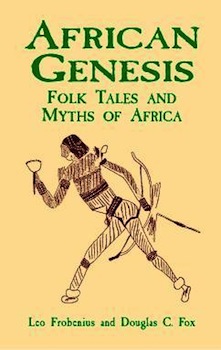
That story, ‘Gassire’s Lute’, was included in African Genesis:[9] Douglas Fox, who co-wrote it with by the German anthropologist and archaeologist Leo Frobenius, told Pound of an old man who explained to him that, had Wondjina’s father not removed his mouth, his people would have been burdened with ‘the glittering claptrap of the white man’s culture’, unable to devote themselves to ‘the important things of life: conversation, dancing, hunting and warfare.’[10]

But wait a moment – yes, the rain has stopped. Again. Ah, and started again. I shall put a notice in the window, next to the election poster: ‘No rainmaker required’.


References

[1] Upward, The Divine Mystery: A Reading of the History of Christianity Down to the Time of Christ (Garden City Press, 1913; Santa Barbara: Ross-Erikson, with an introduction by Robert Duncan, 1976).

[2] The New Freewoman, 15 November 1913; reprinted in Ezra Pound, Selected Prose 1909-1965, edited by William Cookson (London: Faber & Faber, 1973), 373; this volume also includes Pound’s 1914 essay ‘Allen Upward Serious’, 377-382.

[3] The Divine Mystery, 13.

[4] Upward quoted in Wallace Martin’s The New Age Under Orage: Chapters in English Cultural History (Manchester: Manchester University Press, 1967), 34.

[5] The Divine Mystery, 376.

[6] Collected in Traffics and Discoveries (1904; Harmondsworth: Penguin Books, 1987), edited by Hermione Lee, 181-199. See her notes on the story, 331-334, citing Haggard and including a wealth of other interesting material.

[7] Literary Essays of Ezra Pound, ed. T. S. Eliot (London: Faber and Faber, 1960), 297.

[8] The Cantos of Ezra Pound, fourth collected edition (London: Faber and Faber, 1987), 426-427, 430.

[9] Leo Frobenius and Douglas C. Fox, African Genesis (1937; New York: Dover, 1999), 97-110.

[10] See the notes to Richard Sieburth’s edition of The Pisan Cantos (New York: New Directions, 2003), 120-121.


Imagined past or possible future

Newspaper_reader

(Adolph von Menzel, via https://www.oldbookillustrations.com/)

Three days to the General Election. The true state of the parties is curiously opaque, though the current movement in the polls is reflected in the increasingly hysterical headlines in the Tory newspapers. (It’s been a marked feature of the past few weeks that the Conservatives have concentrated almost entirely on negative campaigning, using primarily personal attacks on Jeremy Corbyn.)

There are still, it seems, great numbers of voters undecided or switching from one side to the other. Such fickleness is baffling to those who’ve long ago made up their mind. There have been elections in the past where there seemed—not nothing to choose between the parties but certainly not enough—though it’s not true of this one. The futures envisaged on either side are radically different. A lot of it’s to do with the EU referendum, no doubt. Political allegiance in the United Kingdom may still be tribal but not in the old ways: the divisions are different, sharper, fiercer, more extreme.

The choice now seems quite clearly to be between a vote for an imagined past—or one for a possible positive future.


Turning to the Sunflowers

Sunflowers_4_small

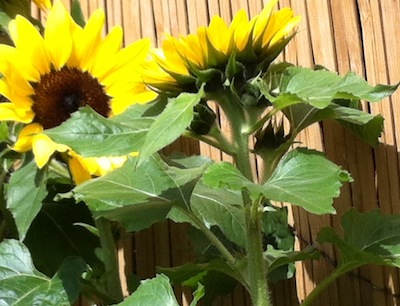
On a day disfigured by news of another mass murder, this time in London, I turn to our new dwarf sunflowers, as the sunflower itself is fabled to turn toward the sun. Helianthus annuus, ‘frequently appearing on rubbish-tips and in unexpected places in gardens, usually from birdseed’, Richard Mabey notes.[1]

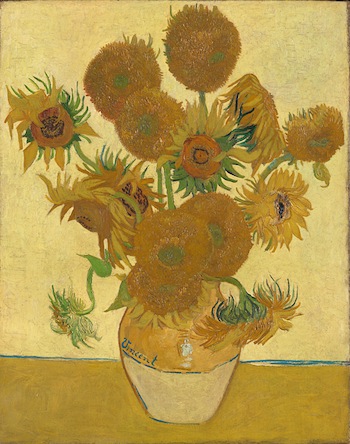
‘I am hard at it, painting with the enthusiasm of a Marseillais eating bouillabaisse, which won’t surprise you when you know that what I’m at is the painting of some big sunflowers,’ Vincent van Gogh wrote to his brother Theo.

Van_Gogh_Sunflowers

(Vincent van Gogh, ‘Sunflowers’: National Gallery)

‘I have three canvases going—1st, three huge flowers in a green vase, with a light background, a size 15 canvas; 2nd, three flowers, one gone to seed, having lost its petals, and one a bud against a royal-blue background, size 25 canvas; 3rd, twelve flowers and buds in a yellow vase (size 30 canvas). The last one is therefore light on light, and I hope it will be the best. Probably I shall not stop at that. Now that I hope to live with Gauguin in a studio of our own, I want to make decorations for the studio. Nothing but big flowers. Next door to your shop, in the restaurant, you know there is a lovely decoration of flowers; I always remember the big sunflowers in the window there.’[2]

Sunflowers.1

In ‘Morality and the Novel’, D. H. Lawrence writes of ‘the living moment’, of the ‘business’ of art being ‘to reveal the relation between man and his circumambient universe’ at that moment. His first example is this: ‘When van Gogh paints sunflowers, he reveals, or achieves, the vivid relation between himself, as man, and the sunflower, as sunflower, at that quick moment of time. His painting does not represent the sunflower itself. We shall never know what the sunflower itself is. And the camera will visualize the sunflower far more perfectly than van Gogh can.
‘The vision on the canvas is a third thing, utterly intangible and inexplicable, the offspring of the sunflower itself and van Gogh himself. The vision on the canvas is for ever incommensurable with the canvas, or the paint, or van Gogh as a human organism, or the sunflower as a botanical organism. You cannot weigh nor measure nor even describe the vision on the canvas. It exists, to tell the truth, only in the much-debated fourth dimension. In dimensional space it has no existence.
‘It is a revelation of the perfected relation, at a certain moment, between a man and a sunflower.’[3]

Allen Ginsberg’s ‘Sunflower Sutra’ remembers an occasion with Jack Kerouac but looks back to William Blake:

‘Look at the sunflower, he said, there was a dead gray shadow against the sky, big as a man, sitting dry on top of a pile of ancient sawdust—
—I rushed up enchanted—it was my first sunflower, memories of Blake—’[4]

ginsberg-flower

(Allen Ginsberg: https://bluerailroad.wordpress.com/allen-ginsberg-an-interview/)

Blake’s Songs of Experience included ‘Ah Sun-flower!’

Ah Sun-flower! weary of time,
Who countest the steps of the Sun:
Seeking after that sweet golden clime
Where the travellers journey is done.

Where the Youth pined away with desire,
And the pale Virgin shrouded in snow:
Arise from their graves and aspire,
Where my Sun-flower wishes to go.[5]

Hardly a cheerful poem, to be sure: ‘his terrible lyric on the sunflower’, the flower ‘which wistfully follows the sun across the sky all day, a perfect symbol of the “vegetable” life rooted in this world and longing to be free.’[6] It’s a flower, too, associated strongly with a painter—Vincent—who killed himself at the age of thirty-seven.

Not uncomplicatedly life-affirming, then, but clearly hugely attractive to a great many poets and painters. And forget those, anyway, for the moment, because what strikes me most often is people that say simply: ‘I love sunflowers’ or ‘Aren’t they beautiful?’ Quite basic, no doubt: the shape of a sun, the colour of sunlight. But an immediate, powerful, and genuine response or sense of connection.

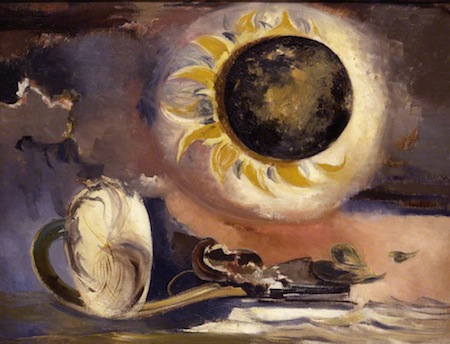
Paul Nash planned a series of four sunflower paintings but completed only Solstice of the Sunflower (1945), the year of his death, and 1944’s The Eclipse of the Sunflower.

Nash, Paul, 1889-1946; Eclipse of the Sunflower

(Photo credit: British Council Collection)

Last word to Conrad Aiken:

Each morning we devour the unknown.
Each day we find, and take, and spill, or spend, or lose, a sunflower splendor of which none knows the source.[7]

References

[1] Mabey, Flora Britannica (London: Sinclair-Stevenson, 1996), 379.

[2] The Complete Letters of Vincent van Gogh, second edition (London: Thames & Hudson, 1978), III, 18-19.

[3] D. H. Lawrence, Phoenix: The Posthumous Papers of D. H. Lawrence, edited and with an introduction by Edward D. McDonald (London: William Heinemann, 1936), 527.

[4] Ginsberg, Selected Poems 1947-1995 (London: Penguin Books, 2001), 60.

[5] The Complete Poetry & Prose of William Blake, newly revised edition, edited by David V. Erdman (New York: Anchor Books, 1988), 25. There is a short video of Ginsberg reading this poem: https://www.youtube.com/watch?v=jySDWBowDnY

[6] Northrop Frye, Fearful Symmetry: A Study of William Blake (1947; Princeton: Princeton University Press, 1969), 74.

[7] ‘A Letter from Li Po’: Conrad Aiken, Selected Poems (New York: Oxford University Press, 1961), 248.

Walking among graves (with just a touch of Whitman)

After my walk yesterday to the old haunts near the Tobacco Factory where, until the end of last year, we spent our civilized, productive days in an office on the ground floor—bonjour, Andrew, ça va bien?—I was tempted to rewrite it in the form of a political fable.

I had, as raw material, those motorists whose IQ plummets by forty points when they get behind the wheel; the cats sauntering across roads, taking appalling risks for no good reason; and . . . luckily, I resisted the temptation.

Path

Today, I walk via Baked (for a dark rye loaf) up the Wells Road to the extraordinary Arnos Vale cemetery, 45 acres, established in the year of Queen Victoria’s accession (its first burial two years later), the birdsong practically deafening on some of the innumerable leafy paths that lead off in all directions from the paved road that runs through it. You can spend quite some time here and will find yourself walking slowly, however briskly you set out. . .

https://arnosvale.org.uk/

Grass_Graves

Cemetery grass brings to mind—not every mind, I grant you—what is, I think, one of the finest images in Whitman’s Song of Myself: ‘And now it seems to me the beautiful uncut hair of graves.’[1]

Leaves of Grass. I consider, briefly, the oddness of that title. We speak of blades of grass, usually, not leaves. Still, the reader’s attention is constantly directed to the leaf as single sheet of paper, or thickness of paper, the page of a book; and precious metals beaten thin, gold leaf and silver leaf: these uses are often highlighted or implied. Perhaps the main force of the title, though, is to collapse those assumed barriers between poet and reader, the world inside and outside the book, either the actual barriers (print, physical distance) or metaphorical ones (conventional roles of reader and writer, of literature itself):

Come closer to me,
Push close my lovers and take the best I possess,
Yield closer and closer and give me the best you possess.

This is unfinished business with me. . . how is it with you?
I was chilled with the cold types and cylinder and wet paper between us.[2]

The repetitions, the lengthening lines, the insistent murmuring of sibilants in those lines mime a rising erotic excitement. This is not a genteel, decorous reading, turning the pages in the library. This is a physical embrace.

Sunshine_Corner

I sit at a table on the café terrace with an Americano and the sun is, briefly, so warm on my back as to be uncomfortable; but I sit long enough to read Richard Holmes’ wonderful account of the discovery of a trunk belonging to Scrope Davies, in the private deposit vault of what became Barclays Bank, left there by Davies in 1820, as he fled the country following his financial ruin. ‘Everything that Scrope valued, and much that he did not, was hurled into the trunk’ on the evening of its owner’s hurried departure. In addition to clothes, letters, a lock of hair, tailor’s bills and betting slips, there were found—when the trunk was finally opened in 1976—twenty previously unknown letters from Byron to Scrope; a notebook containing Byron’s fair copy of the third canto of Childe Harold’s Pilgrimage (which Davies should have delivered to Byron’s publisher but did not); and notebooks from the Shelley circle, containing a fair copy of Byron’s Prisoner of Chillon as well as four of Shelley’s own poems, including two unknown sonnets.[3]

One of my favourite sentences in the whole piece, in the course of Holmes’ charting the history of Number 1, Pall Mall East and the name changes of the banks that occupied it: ‘Time passed, as it does in England.’ Which word would you care to stress here?

Sidetracks

Admittedly an unrelated photograph now, since this visiting cat is glancing not at Sidetracks but at the last few pages of William Boyd’s Sweet Caress, under the mistaken impression that its previous four hundred pages can be skipped.

Cat_Reading

No reading stamina. Wrong diet, probably.


References

[1] Walt Whitman: The Complete Poems, edited by Francis Murphy (Harmondsworth: Penguin Books, 1986), 68.

[2] These are the opening lines of the poem—untitled, as were all the poems in the 1855 edition of Leaves of Grass—which was later called ‘A Song for Occupations’, though these lines were dropped: see Whitman: Complete Poetry and Collected Prose, edited by Justin Kaplan (New York: Library of America, 1982), 89.

[3] Richard Holmes, ‘Scrope’s Last Throw’, Sidetracks: Explorations of a Romantic Biographer (London: Harper Collins, 2000), 271-282.

‘Camerado! this is no book’

walt-whitman

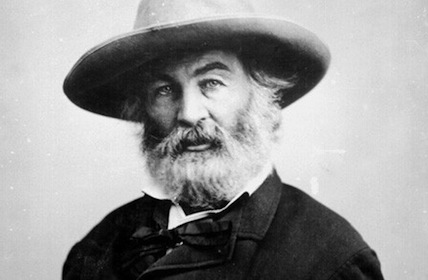
Walt Whitman—‘an American, one of the roughs, a kosmos’[1]
https://www.poetryfoundation.org/poems-and-poets/poets/detail/walt-whitman

‘Camerado, this is no book,
Who touches this touches a man’—Walt Whitman, ‘So Long!’[2]

In the summer of 1945, a prisoner in the Disciplinary Training Center in Pisa, Ezra Pound, at the end of his tether (‘au bout de mes forces’), came across a copy of The Pocket Book of Verse, edited by Morris Speare and first published in 1940:

That from the gates of death
that from the gates of death: Whitman or Lovelace
found on the jo-house seat at that
in a cheap edition! [and thanks to Professor Speare]
hast’ou swum in a sea of air strip
through an aeon of nothingness,
when the raft broke and the waters went over me[3]

In April 1913, Pound had published ‘A Pact’.

I make a pact with you, Walt Whitman—
I have detested you long enough.
I come to you as a grown child
Who has had a pig-headed father;
I am old enough now to make friends.
It was you that broke the new wood,
Now is a time for carving
We have one sap and one root—
Let there be commerce between us.[4]

Not exactly a ringing endorsement for a poet who will throw you a lifeline thirty years later. One can see why Pound was included in the list of those ‘arbiters of current taste’ that, in John Berryman’s words, ‘have generally now declared themselves in favour of Whitman; but always reluctantly and with a certain resentment or even contempt. I am not,’ Berryman goes on, ‘able to feel these reservations myself’, and then: ‘I like or love Whitman unreservedly’.[5]

Randall Jarrell (never better than when he is enthusing about someone or something) wrote that: ‘To show Whitman for what he is one does not need to praise or explain or argue, one needs simply to quote.’ Jarrell does, at length and with great effect. And again, ‘Not many poets have written better, in queerer and more convincing and more individual language, about the world’s gliding wonders’. And again, ‘In modern times, what controlling, organising, selecting poet has created a world with as much in it as Whitman’s, a world that so plainly is the world?’ Perhaps just one more: ‘The thereness and suchness of the world are incarnate in Whitman as they are in few other writers.’[6]
claude-cahun-sylvia-beach

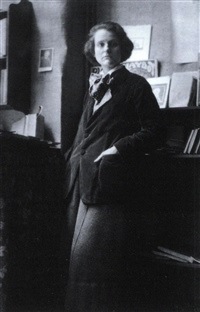
(Sylvia Beach 1919 by Claude Cahun, via http://www.artnet.fr/)

Sylvia Beach (proprietor of Shakespeare & Co., first publisher of Joyce’s Ulysses), wrote of her Aunt Agnes visiting Whitman in Camden, where manuscripts were strewn all over the floor. Her aunt was with a friend, Alys Smith, who later married Bertrand Russell. Earlier visitors had included Henry Thoreau who, on 10 November 1849, went to Brooklyn with Bronson Alcott to meet Whitman, while, according to one of Whitman’s biographers, Bram Stoker also paid a visit and later ‘used Whitman as the model for the murderous count in Dracula’.[7]

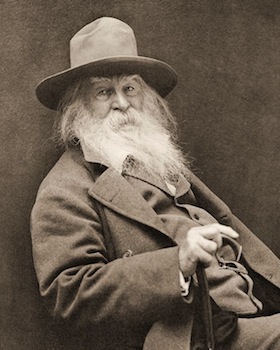
It’s just short of 200 years since Walt Whitman was born, 31 May, at West Hills, Long Island; 162 since his copyright was registered (15 May 1855) and 795 copies of Leaves of Grass printed, 200 of them with embossed green cover and gilded lettering, while the remainder were bound more cheaply.[8]

Walt-Whitman-2

(Walt Whitman: via The Guardian)

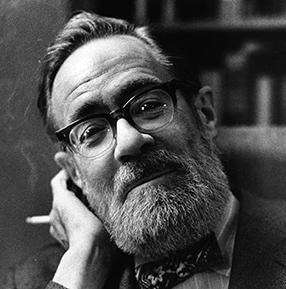
He was prolific, sometimes heroic, sometimes verbose, sometimes ridiculous, often magnificent. I tend towards Berryman’s sentiment here: unreservedly, why not? Jarrell is not uncritical—‘only a man with the most extraordinary feel for language, or none whatsoever, could have cooked up Whitman’s worst messes’—but he grasps what is perhaps the salient point about Whitman: while we are too often steered towards ‘gems’, the glittering phrases, the quotable lines, some poets need to be approached and seen and held more largely. Quoting section 36 of Song of Myself, Jarrell comments: ‘There are faults in this passage, and they do not matter’.[9] Yes. (It occurs to me at this juncture that, setting these three—Whitman, Berryman, Jarrell—together, I achieve not only an assembly of fine poets but a trio, a triumvirate, a trinity of profusely bearded Americans.)

JohnBerryman_TomBerthiaume  RandallJarrell_poets.org

(John Berryman; Randall Jarrell; both via Academy of American Poets (https://www.poets.org/): John Berryman photo credit: Tom Berthiaume)

Apart from the pulling and hauling stands what I am,
Stands amused, complacent, compassionating, idle, unitary,
Looks down, is erect, or bends an arm on an impalpable certain rest,
Looking with side-curved head curious what will come next,
Both in and out of the game and watching and wondering at it.[10]

‘If you want me again look for me under your boot-soles’, Whitman wrote towards the end of ‘Song of Myself’. And again: ‘Failing to fetch me at first keep encouraged, / Missing me one place search another, / I stop somewhere waiting for you.’[11]

Do I contradict myself?
Very well then I contradict myself,
(I am large, I contain multitudes.)[12]

And he does. As we do, which is really the point.

There is a wonderful resource, the Walt Whitman Archive, at: http://www.whitmanarchive.org/
Co-directed by Ed Folsom and Kenneth M. Price and published by the Center for Digital Research in the Humanities, at the University of Nebraska-Lincoln, it offers published works, letters, manuscripts, biography, criticism, pictures, Civil War notebooks and journalism, and much else. They have also digitized—good grief—the whole nine volumes of Horace Traubel’s With Walt Whitman in Camden.


References

[1] Song of Myself (1855 edition), printed as Appendix 4 of Walt Whitman: The Complete Poems, edited by Francis Murphy (Harmondsworth: Penguin Books, 1986), 698.

[2] Walt Whitman: The Complete Poems, 513.

[3] The Cantos of Ezra Pound, fourth collected edition (London: Faber and Faber, 1987), 512-513. The last lines refer to the sequence in The Odyssey (Book V) where Odysseus, having left Calypso’s island on a raft, is shipwrecked through the malice of the god Poseidon and saved through the intervention of the goddess Leucothea.

[4] Ezra Pound: Poems and Translations (New York: Library of America, 2003), 269.

[5] Berryman, ‘“Song of Myself”: Intention and Substance’, in The Freedom of the Poet (New York: Farrar. Straus & Giroux, 1976), 227.

[6] Jarrell, Poetry and the Age ([1955] London: Faber & Faber, 1973), 107, 110, 119, 122.

[7] Sylvia Beach, Shakespeare and Company, new edition (Lincoln: University of Nebraska Press, 1991), 20; Jerome Loving, Walt Whitman: The Song of Himself (Berkeley: University of California Press, 1999), 422-426, 445.

[8] Paul Zweig, Walt Whitman: The Making of the Poet (Harmondsworth: Penguin 1986), 231.

[9] Jarrell, Poetry and the Age, 110, 116.

[10] Whitman, Song of Myself, Section 4. This is the 1891-1892 ‘deathbed’ edition, in Walt Whitman: The Complete Poems, 66-67.

[11] Song of Myself, Section 52; and the last lines: The Complete Poems, 124.

[12] Song of Myself, Section 51: The Complete Poems, 123.


‘Decent provision for the poor’

foodbank

http://www.independent.co.uk/news/uk/home-news/food-banks-hidden-uk-poverty-hundreds-independent-food-aid-network-trussel-trust-a7762576.html

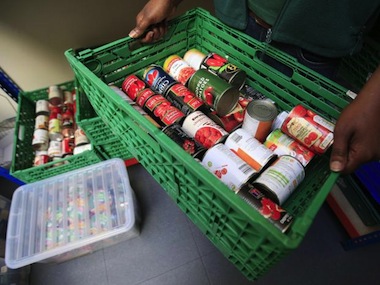
Between 1st April 2016 and 31st March 2017, The Trussell Trust’s Foodbank Network provided 1,182,954 three day emergency food supplies to people in crisis compared to 1,109,309 in 2015-16. Of this number, 436,938 went to children.

https://www.trusselltrust.org/2017/04/25/uk-foodbank-use-continues-rise/

‘Where a great proportion of the people (said he,) are suffered to languish in helpless misery, that country must be ill policed, and wretchedly governed: a decent provision for the poor is the true test of civilization’ (1770)—James Boswell, Life of Johnson

Oh, Doctor Johnson, you . . .  Tory!


Poppies by the million

Poppy.2

We bought a poppy plant at the garden centre yesterday and it had bloomed already this morning, even under such a glowering sky.

Apart from its fiery beauty, the poppy is blessed or cursed with an extraordinary array of literary, artistic, historical, mythological and medicinal associations, but is most widely recognised in the context of Armistice Day in the United Kingdom and the Commonwealth countries.

As for the paintings: leafing through art books once to settle on the one half-remembered picture after passing a school where a flowerbed had been thickly planted with poppies, I realised just how many there were to choose from. John Constable and Mary Fedden, Angelica Garnett and Vincent Van Gogh, Vanessa Bell and Georgia O’Keeffe, Christopher Wood and Ivon Hitchens, real one and paper ones by William Nicholson (in the early years, people wore real poppies on Armistice Day). But I finally decided that I must have been thinking either of Claude Monet:

Poppy_Field_Near_Argenteuil

(Claude Monet, Poppy Field Near Argentuil)

or, yes, of Stanley Spencer, whose irises and poppies stick in the mind just as surely as his resurrections, figures on beds, swans, soldiers and shipbuilding.

Spencer, Stanley, 1891-1959; Poppies

(Stanley Spencer, Poppies, 1938. Newark Town Hall Museum and Art Gallery:
© the estate of Stanley Spencer; all rights reserved 2014, Bridgeman Images)

And literary associations? The poppy’s connection with the First World War often takes off from the Canadian John McCrae’s poem, first published anonymously in Punch in December 1915:

In Flanders fields the poppies blow
Between the crosses, row on row,
That mark our place; and in the sky
The larks, still bravely singing, fly

Scarce heard amid the guns below.

ending:

We shall not sleep, though poppies grow
In Flanders fields.[1]

Edmund Blunden wrote, in ‘Vlamertinghe: Passing the Chateau, July, 1917’:

Bold great daisies’ golden lights,
Bubbling roses’ pinks and whites—
Such a gay carpet! poppies by the million;
Such damask! such vermilion!
But if you ask me, mate, the choice of colour
Is scarcely right; this red should have been duller.[2]

Rosenberg, Isaac, 1890-1918; Isaac Rosenberg

(Isaac Rosenberg, Self-Portrait, 1914: National Portrait Gallery, London)

The one that most stays with me, though, is probably Isaac Rosenberg’s ‘Break of Day in the Trenches’, which ends:

Poppies whose roots are in man’s veins
Drop, and are ever dropping;
But mine in my ear is safe—
Just a little white with the dust.[3]

But then I think of a holiday in Greece more than fifteen years ago now, a vivid memory of Mycenae, with everywhere the bright clusters of blood-red poppies.

The poppy’s literary associations begin in classical texts, usually there the ‘sleep-bearing’ or garden poppy, the source of opium. Alethea Hayter notes that, ‘In an Egyptian medical treatise of the sixteenth century B. C., Theban physicians were advised to prescribe opium for crying children just as, three and a half millennia later, Victorian babies were dosed with the opiate Godfrey’s Cordial by their nurses to keep them quiet.’[4]

The ancient Greeks and Romans grew poppies in their gardens and ate the seeds, often mixed with honey.[5] The link between the poppy and sleep is implicit in the last lines of McCrae’s poem. Hypnos, the god of sleep, holds a poppy in the representations of him in Roman and Hellenistic sculpture. He worked in partnership with his brother Thanatos, god of death, to remove fallen warriors from the battlefield.[6]

The most notable association, though, is probably with Demeter who, frantic from the loss of her daughter Persephone, who had been carried off by the god of the underworld, ‘soothed her grief with the narcotic juice of the poppy’. The plant ‘has the reputation of giving life, hence the association of the poppy with Demeter, the earth goddess who bestowed fertility on fields.’[7] Alethea Hayter mentions the legend that tells of Demeter, in her search for Persephone, reaching Sicyon, ‘once called Mecone, the city of poppies’, and gathering their flowers. Slitting the seed-cases, she tasted the juice and ‘forgot her sorrows’. She was sometimes portrayed, then, holding a poppy instead of the more established sheaf of corn: the flower ‘adorned her altars and its drug was perhaps used in her rites at Eleusis, to bring forgetfulness of the sorrow of the dying year and to share, by a short winter sleep of the emotions, in the death and re-birth of the plants’.[8]

In his poem ‘In the Trenches’, Richard Aldington wrote:

But that each rush and crash
Of mortar and shell,
Each cruel bitter shriek of bullet
That tears the wind like a blade,
Each wound on the breast of earth,
Of Demeter, our Mother,
Wound us also[9]

In Homer’s Iliad, Teukros, aiming an arrow straight at Hector, misses him and strikes instead Gorgythion:

He bent drooping his head to one side, as a garden poppy
bends beneath the weight of its yield and the rains of springtime;
so his head bent slack to one side beneath the helm’s weight.[10]

This is how Alice Oswald renders that passage:

And now the arrow flies through GIORGYTHION
Somebody’s darling son

As if it was June
A poppy being hammered by the rain
Sinks its head down
It’s exactly like that
When a man’s neck gives in
And the bronze calyx of his helmet
Sinks his head down[11]

Death as slackening, bending, as sinking into sleep, all consciousness and memory gone. Hypnos and Thanatos, sleep and death, lived in Hades, near Lethe, the river of forgetfulness.

Allen Ginsberg, in ‘A Supermarket in California’, addressed to Walt Whitman, ends:

‘Ah, dear father, graybeard, lonely old courage-teacher, what America did you have when Charon quit poling his ferry and you got out on a smoking bank and stood watching the boat disappear on the black waters of Lethe?’[12]

Also.Poppy

One more Poppy. . . .


References

[1] Robert Giddings, The War Poets (1988; London: Bloomsbury, 2000), 55-57.

[2] Blunden, Undertones of War (1928; London: Penguin Books, 1982), 256.

[3] Isaac Rosenberg (21st-Century Authors), edited by Vivien Noakes (Oxford: Oxford University Press, 2008), 106.

[4] Alethea Hayter, Opium and the Romantic Imagination (London: Faber and Faber, 1971), 19. Godfrey’s Cordial was a mixture of opium, treacle, water and spices. See also Hayter’s introduction to Thomas de Quincey, Confessions of an English Opium Eater (Harmondsworth: Penguin Books, 1971), 14-15.

[5] See Michael Ferber, A Dictionary of Literary Symbols (Cambridge: Cambridge University Press, 1999), 160-161. See also: http://classicalanthology.theclassicslibrary.com/2015/02/17/poppies-in-classical-poetry-homer-catullus-virgil-dante-contributed-by-jane-mason-and-david-bevan/

[6] I. Aghion, C. Barbillon, F. Lissarragne, Gods and Heroes of Classical Antiquity (Paris: Flammarion, 1996), 162-163.

[7] Hellmut Baumann, Greek Wild Flowers and plant lore in ancient Greece, translated and augmented by William T. Stearn and Eldwyth Ruth Stearn (London: The Herbert Press, 1993), 69.

[8] Hayter, Opium and the Romantic Imagination, 20.

[9]The Complete Poems of Richard Aldington (London: Allen Wingate, 1948), 62.

[10] Homer, The Iliad of Homer, translated by Richard Lattimore (Chicago: University of Chicago Press, 1961), 190, Bk.V., ll.306-308.

[11] Alice Oswald, Memorial (London: Faber and Faber, 2011), 32.

[12] Ginsberg, Selected Poems 1947-1995 (London: Penguin Books, 2001), 59.

Furious fancies: defence in Bedlam

Hogarth_Scene-in-Bedlam
(‘Scene in Bedlam’: Plate VIII of Hogarth’s A Rake’s Progress.)

Hearing politicians declaim about ‘defence’ these days often puts me in mind of the anonymous poem, ‘Tom a Bedlam’ or ‘Tom o’Bedlam’s Song’, probably dating from the early seventeenth century if not before. Its last two verses are:

With an host of furious fancies,
Whereof I am commander.
With a burning spear
And a horse of Air,
To the wilderness I wander.

By a knight of ghosts and shadows,
I summoned am to tourney
Ten leagues beyond
The wild world’s end-
Methinks it is no journey.[1]

Phantasmal armies; equally phantasmal foes. Knowing the reality of what actually threatens us now, who are these enemies that can be defeated or discouraged by a massively expensive and inevitably anachronistic nuclear weapons system?

Following Jeremy Corbyn’s speech in the wake of the mass murder in Manchester, Theresa May, other Tories and the right-wing tabloids launched a predictable attack.

https://www.theguardian.com/politics/2017/may/26/may-puts-manchester-bombing-at-heart-of-election-with-attack-on-corbyn

http://www.telegraph.co.uk/news/2017/05/26/jeremy-corbyn-making-excuses-terror-attacks-theresa-may-says/

It’s only too possible that Michael Fallon didn’t wholly grasp what Mr Corbyn actually said. Certainly, on Channel 4 News, he dismissed a statement simply because he believed it to be by Jeremy Corbyn when in fact it was a quote from Boris Johnson. Theresa May would have understood what Jeremy Corbyn was saying but chose to wilfully misrepresent him, safe in the knowledge that most people would not have seen the text of his speech, and that a great many voters’ grasp of defence policy is hardly nuanced or anything much more than a drowsy assumption that Trident is something to do with an intelligent ‘defence policy’—rather than expressing a determination of the ‘size matters’ lobby to stay at the big table of the Security Council of the United Nations.

Trident-via

http://www.greenpeace.org.uk/peace/trident-the-uks-nuclear-weapons-system

The primary misrepresentation was to pretend that Mr Corbyn had claimed that the Manchester atrocity and other terrorist acts were solely due to British foreign policy (though that pretence also entailed an apparent unfamiliarity with the English language’s distinction between ‘excuse’ and ‘explanation’). Neither he nor anyone else worth attending to would claim that this country’s foreign policy was the only factor but it would be naïve, misinformed or, frankly, deliberately misleading to claim that there is no connection whatsoever.[2]

Jeremy Corbyn actually said (in what was a perfectly reasonable and rational response): ‘We will also change what we do abroad. Many experts, including professionals in our intelligence and security services have pointed to the connections between wars our government has supported or fought in other countries, such as Libya, and terrorism here at home.
‘That assessment in no way reduces the guilt of those who attack our children. Those terrorists will forever be reviled and implacably held to account for their actions.
‘But an informed understanding of the causes of terrorism is an essential part of an effective response that will protect the security of our people, that fights rather than fuels terrorism.
‘Protecting this country requires us to be both strong against terrorism and strong against the causes of terrorism. The blame is with the terrorists, but if we are to protect our people we must be honest about what threatens our security.
‘Those causes certainly cannot be reduced to foreign policy decisions alone.’
‘And no rationale based on the actions of any government can remotely excuse, or even adequately explain, outrages like this week’s massacre. But we must be brave enough to admit the war on terror is simply not working. We need a smarter way to reduce the threat from countries that nurture terrorists and generate terrorism.’
‘So, let the quality of our debate, over the next fortnight, be worthy of the country we are proud to defend. Let’s have our arguments without impugning anyone’s patriotism and without diluting the unity with which we stand against terror.’

But it seems that we can’t do that in this country. We have to impugn, we have to dilute, we have to posture.

I am always busily resisting the temptation to align myself—mutatis mutandis—with the Major in J. G. Farrell’s novel Troubles, set during the Irish War of Independence:

‘The Major only glanced at the newspaper these days, tired of trying to comprehend a situation which defied comprehension, a war without battles or trenches. Why should one bother with the details: the raids for arms, the shootings of policemen, the intimidations? What could one learn from the details of chaos? Every now and then, however, he would become aware with a feeling of shock that, for all its lack of pattern, the situation was different, and always a little worse.’[3]

References

[1] Famously, this poem inspired Kenneth Patchen’s extraordinary 1941 novel, The Journal of Albion Moonlight.
[2] Shiraz Maher, ‘In the minds of the murderers’, New Statesman, 26 May—1 June 2017, 24.
[3] J. G. Farrell, Troubles (1970; London: Flamingo Books, 1984), 169.


Dawn chorus and aubades

Woken by the bird chorus at 04:15, I note that it’s a new record for this month, having previously been woken at 05:15 and 04:45. They’ll be waking me the previous evening before too long. Since we are still, so to speak, between cats, we have—with curious logic—set up a bird table in our small back garden. The regular visitors are blackbirds, blue tits, and beautiful—if omnivorous and scavenging—magpies, plus the occasional sparrow. Perhaps this dawn choir is an expression of avian gratitude.

Magpie_rspb.org

(Magpie via https://www.rspb.org.uk/ )

There was a distinct dawn-related genre in Provençal troubadour literature: the aube or aubade, poems or songs announcing, or in praise of, the dawn—though the Troubadour poets sometimes lamented the dawn’s arrival since it meant the parting of the lovers.

The appeal of first light (or, sometimes, darkness) has endured. Philip Larkin’s ‘Aubade’ begins: ‘I work all day, and get half-drunk at night./ Waking at four to soundless dark, I stare.’[1]

The first stanza of William Empson’s fine ‘Aubade’ runs:

Hours before dawn we were woken by the quake.
My house was on a cliff. The thing could take
Bookloads off shelves, break bottles in a row.
Then the long pause and then the bigger shake.
It seemed the best thing to be up and go.[2]

(Nine more stanzas with just a bare handful of run-on lines; also a quite intricate pattern of repetition.)

Empson_via_New_Directions

(William Empson via New Directions Publishing)

Ezra Pound’s second book, A Quinzaine for this Yule, was dedicated to ‘The Aube of the West Dawn’; he wrote and translated several aubades.

In No More Parades (the second of the volumes of Ford Madox Ford’s Parade’s End), Sylvia Tietjens has turned up at the Rouen base camp where her husband Christopher is charged with moving troops up the line.

He added: “I shall have to be up in camp before four-thirty to-morrow morning. . . . ”
Sylvia could not resist saying:
“Isn’t there a poem . . . Ah me, the dawn, the dawn, it comes too soon! . . . said of course by lovers in bed? . . . Who was the poet?”
[ . . . ]
[Tietjens] then said in his leisurely way:
“There were a great many poems with that refrain in the Middle Ages…. You are probably thinking of an albade by Arnaut Daniel, which someone translated lately. . . . An albade was a song to be sung at dawn when, presumably, no one but lovers would be likely to sing. . . . ”
“Will there,” Sylvia asked, “be anyone but you singing up in your camp to-morrow at four?”[3]

The lines that Sylvia quotes are most likely from Pound’s ‘Alba Innominata’, a translation based on the anonymous Provençal poem, ‘En un vergier sotz fue’. Its five verses and ‘Envoi’ all end (apart from one slight variation) with the line ‘Ah God! Ah God! That dawn should come so soon!’[4]

Lark_in_Morning_

Ford and Pound had met in April 1909, through the novelist May Sinclair, and Pound’s third volume, Personae, appeared in that same month. His first important periodical publication in this country was in the pages of the English Review, edited by Ford: ‘Sestina: Altaforte’, in the issue of June 1909. ‘Alba Innominata’ was included in Pound’s next volume, Exultations, published in October 1909.

At the end of 1920, Pound and his wife Dorothy moved to Paris and, in late 1922, Ford and Stella Bowen also moved to France, first to St-Jean-Cap-Ferrat, then Paris. In early 1925, they took a cottage in the village of Guermantes, about an hour’s train travel from Paris. No More Parades was begin in October 1924 and, in that same month, Pound and his wife Dorothy moved permanently to Rapallo, in Italy

Six years after his novel was published, Ford would recall Pound’s early years in London when the poet, ‘looking down his nose would chuckle like Mephistopheles and read you a translation from Arnaut Daniel. The only part of that albade that you would understand would be the refrain: “Ah me, the darn, the darn it comes toe sune!”’[5]


References

[1] Larkin, Collected Poems, edited by Anthony Thwaite (East St Kilda: The Marvell Press and London: Faber, 2003), 190.

[2] Empson’s poem is taken from Contemporary Verse, edited by Kenneth Allott (Harmondsworth: Penguin Books, 1950), 157.

[3] Ford, No More Parades (1925; edited by Joseph Wiesenfarth, Manchester: Carcanet Press, 2011), 134-135.

[4] Ezra Pound: Poems and Translations (New York: Library of America, 2003), 120; and see Richard Sieburth’s note, 1262.

[5] Ford, Return to Yesterday: Reminiscences 1894-1914 (London: Victor Gollancz, 1931), 388.